
Globalization is the spread of businesses technologies or
Globalization is the spread of businesses, technologies, or philosophies throughout the world. The global economy is characterized by a totally interconnected marketplace, unhampered by time zones or national boundaries.
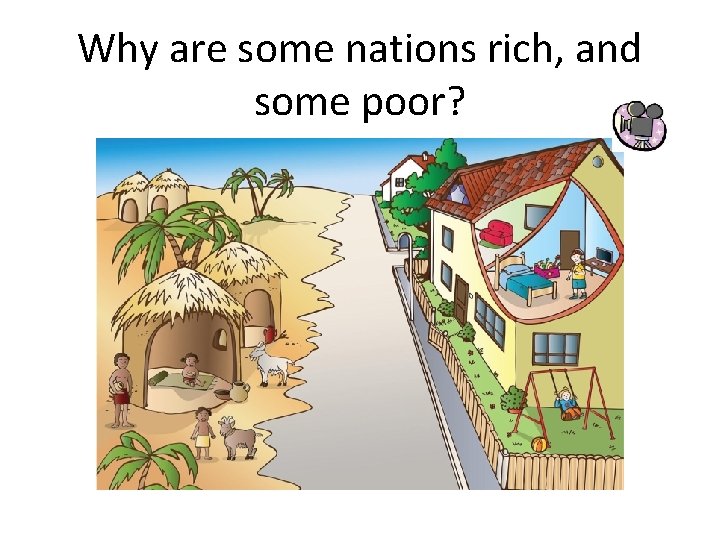
Developed and Developing There are over 200 nations in the world today at different stages of economic development. The industrialized nations of the world are classified as developed nations and have high levels of industrial and technical expertise. Developing nations are characterized by low Gross Domestic Product (GDP), limited resources, agricultural focus and rapid population growth. Developed United States Canada Japan Most of Europe Developing Many South American Nations Many African Nations India Many South Asian Nations
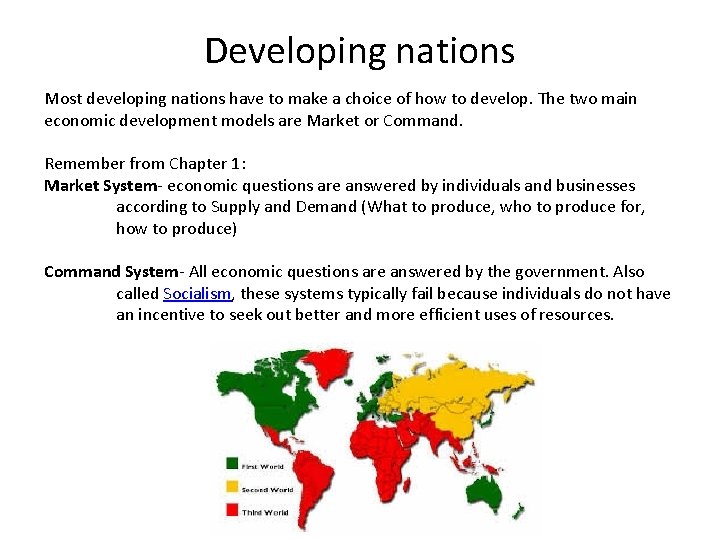
Developing nations Most developing nations have to make a choice of how to develop. The two main economic development models are Market or Command. Remember from Chapter 1: Market System- economic questions are answered by individuals and businesses according to Supply and Demand (What to produce, who to produce for, how to produce) Command System- All economic questions are answered by the government. Also called Socialism, these systems typically fail because individuals do not have an incentive to seek out better and more efficient uses of resources.
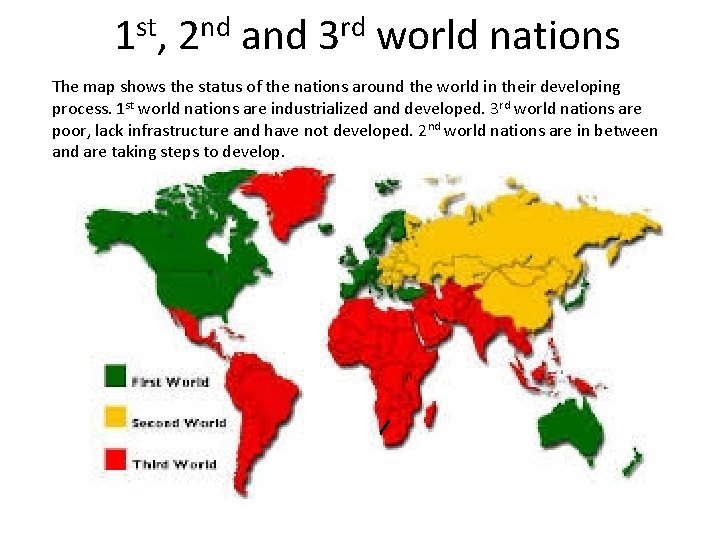
st 1 , nd 2 and rd 3 world nations The map shows the status of the nations around the world in their developing process. 1 st world nations are industrialized and developed. 3 rd world nations are poor, lack infrastructure and have not developed. 2 nd world nations are in between and are taking steps to develop.
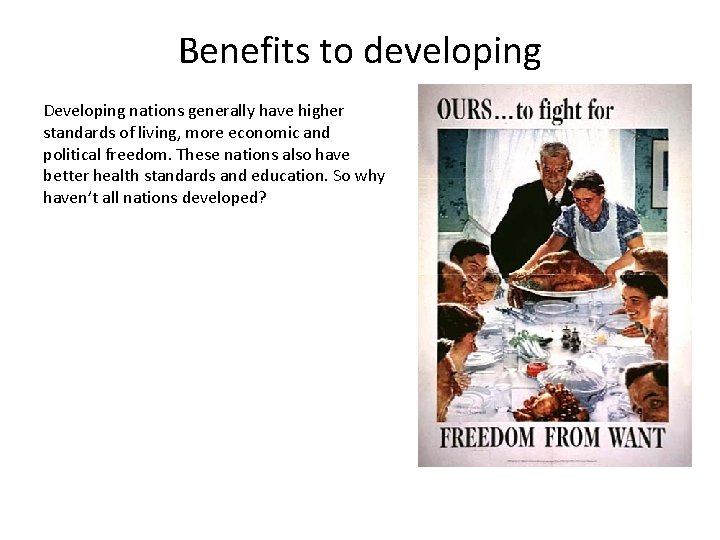
Benefits to developing Developing nations generally have higher standards of living, more economic and political freedom. These nations also have better health standards and education. So why haven’t all nations developed?
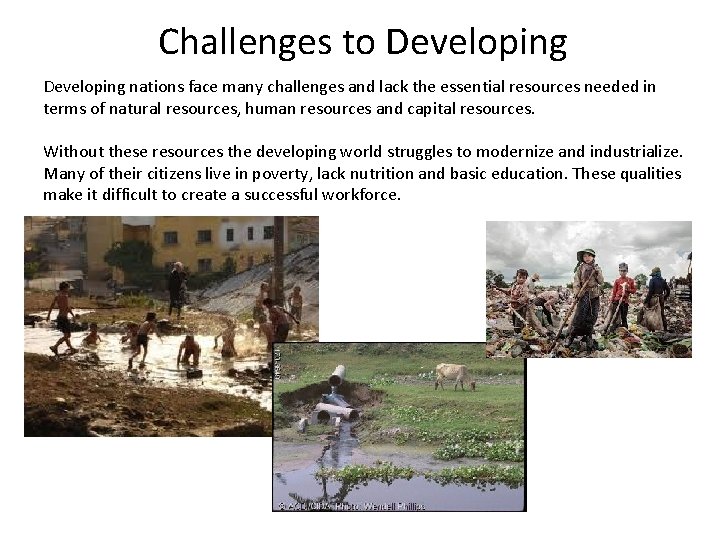
Challenges to Developing nations face many challenges and lack the essential resources needed in terms of natural resources, human resources and capital resources. Without these resources the developing world struggles to modernize and industrialize. Many of their citizens live in poverty, lack nutrition and basic education. These qualities make it difficult to create a successful workforce.
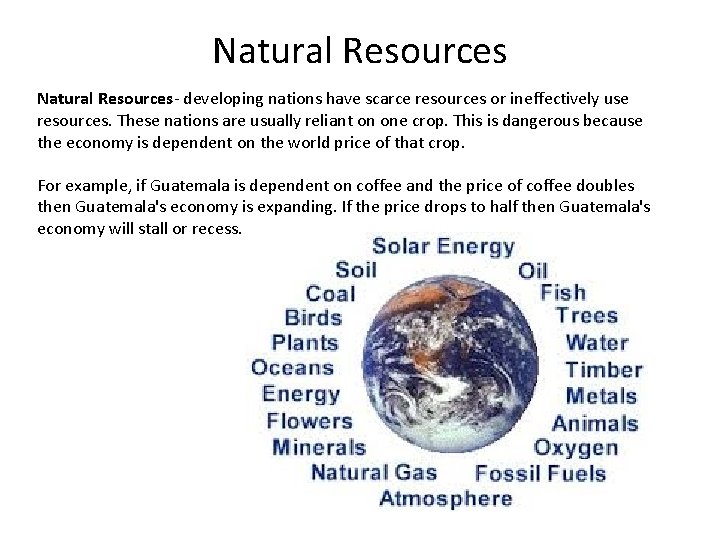
Natural Resources- developing nations have scarce resources or ineffectively use resources. These nations are usually reliant on one crop. This is dangerous because the economy is dependent on the world price of that crop. For example, if Guatemala is dependent on coffee and the price of coffee doubles then Guatemala's economy is expanding. If the price drops to half then Guatemala's economy will stall or recess.
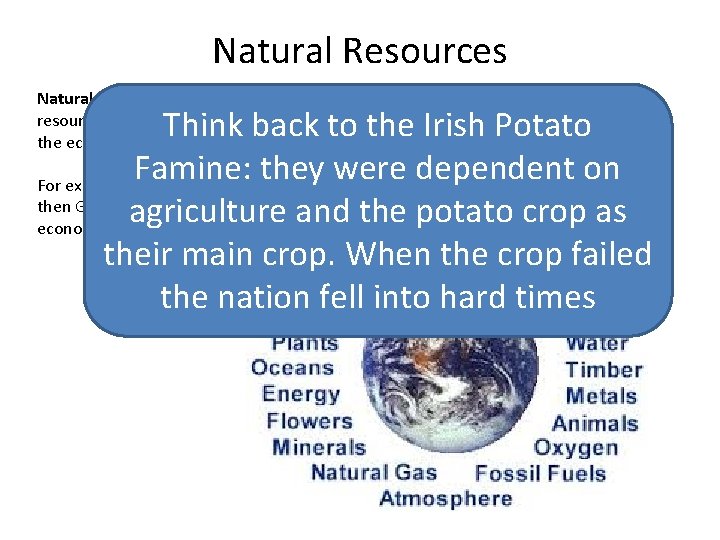
Natural Resources- developing nations have scarce resources or ineffectively use resources. These nations are usually reliant on one crop. This is dangerous because the economy is dependent on the world price of that crop. Think back to the Irish Potato Famine: they were dependent on For example, if Guatemala is dependent on coffee and the price of coffee doubles then Guatemala's economy is expanding. If the price drops to half then Guatemala's agriculture and the potato crop as economy will stall or recess. their main crop. When the crop failed the nation fell into hard times
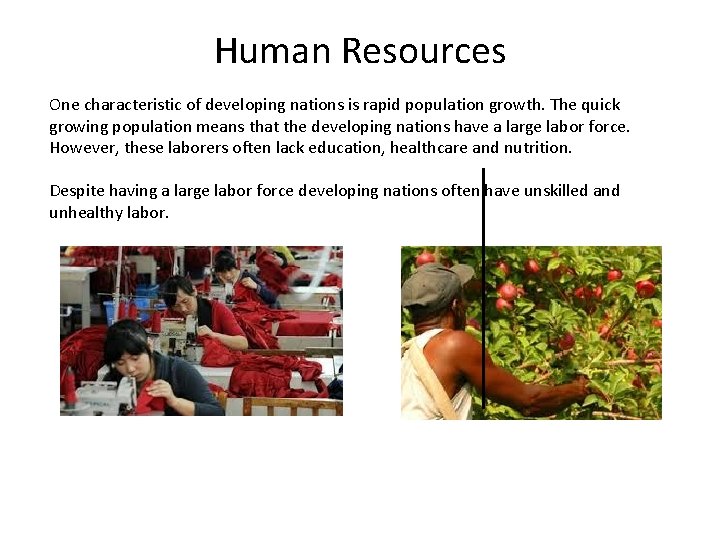
Human Resources One characteristic of developing nations is rapid population growth. The quick growing population means that the developing nations have a large labor force. However, these laborers often lack education, healthcare and nutrition. Despite having a large labor force developing nations often have unskilled and unhealthy labor.
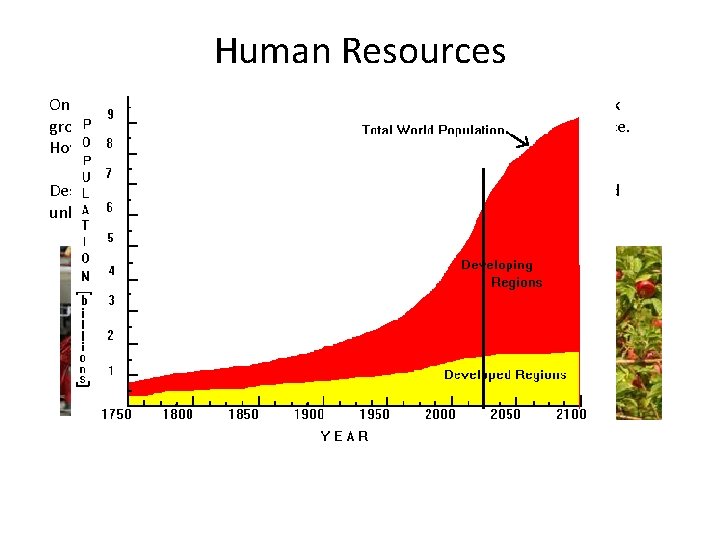
Human Resources One characteristic of developing nations is rapid population growth. The quick growing population means that the developing nations have a large labor force. However, these laborers often lack education, healthcare and nutrition. Despite having a large labor force developing nations often have unskilled and unhealthy labor.
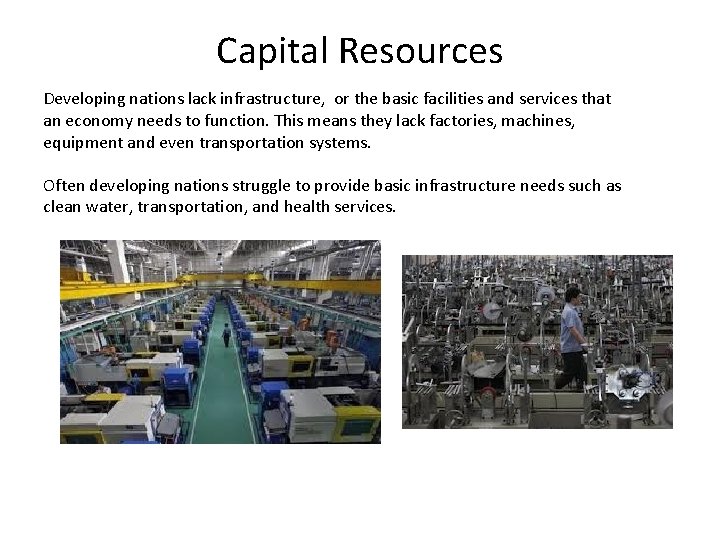
Capital Resources Developing nations lack infrastructure, or the basic facilities and services that an economy needs to function. This means they lack factories, machines, equipment and even transportation systems. Often developing nations struggle to provide basic infrastructure needs such as clean water, transportation, and health services.
Helping Developing Nations Many developed nations want to help these developing nations so they can create new trade partners and markets. There are several ways the international community helps developing nations with Foreign Aid, loans and investment leading the way. International organizations like the International Monetary Fund (IMF) and World Bank allow developing nations to take loans at low interest rates to help them create needed infrastructure. Humanitarian efforts also donate millions of dollars every year to help nations develop education and medical services.
Helping Developing Nations Many international developed nations want to help these developing nations so they can create new trade partners and markets. There are several ways the international community helps developing nations with Foreign Aid, loans and investment leading the way. Why does it benefit the US, England, st world nations to France and other 1 International organizations like the International Monetary Fund (IMF) and World Bank allow developing take loans at low interest rates to help them create assistnations thetounderdeveloped nations? needed infrastructure. Humanitarian efforts also donate millions of dollars every year to help nations develop education and medical services.
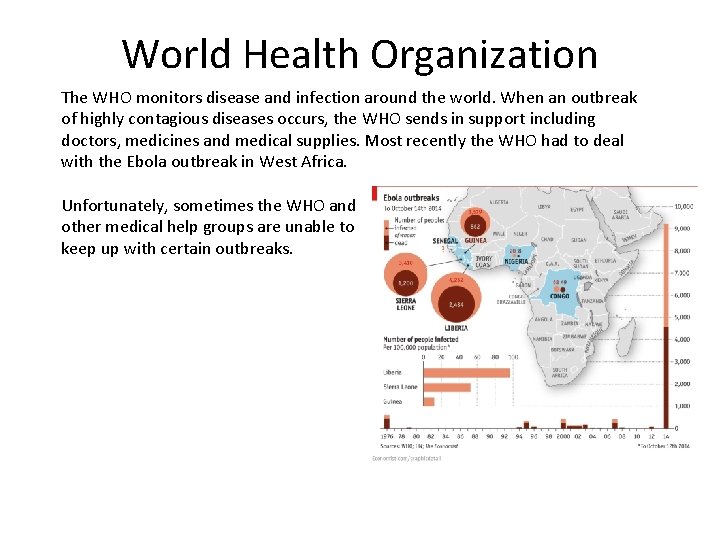
World Health Organization The WHO monitors disease and infection around the world. When an outbreak of highly contagious diseases occurs, the WHO sends in support including doctors, medicines and medical supplies. Most recently the WHO had to deal with the Ebola outbreak in West Africa. Unfortunately, sometimes the WHO and other medical help groups are unable to keep up with certain outbreaks.
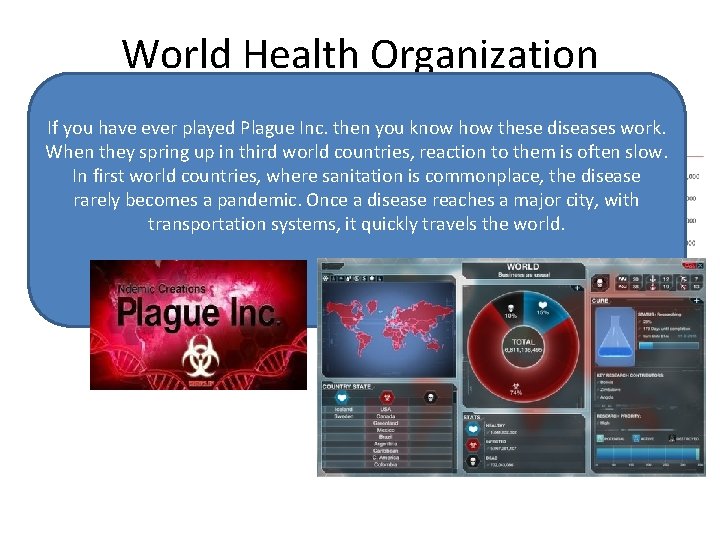
World Health Organization The WHO monitors disease and infection around the world. When an outbreak of highly contagious diseases occurs, the WHO sends in support including If you have ever played Plague Inc. then you know how these diseases work. doctors, medicines and medical supplies. Most recently the WHO had to deal When they. Ebola spring up in third world countries, reaction to them is often slow. with the outbreak in West Africa. In first world countries, where sanitation is commonplace, the disease rarely becomes a pandemic. Once Unfortunately, sometimes the WHO anda disease reaches a major city, with transportation systems, other medical help groups are unable toit quickly travels the world. keep up with certain outbreaks.
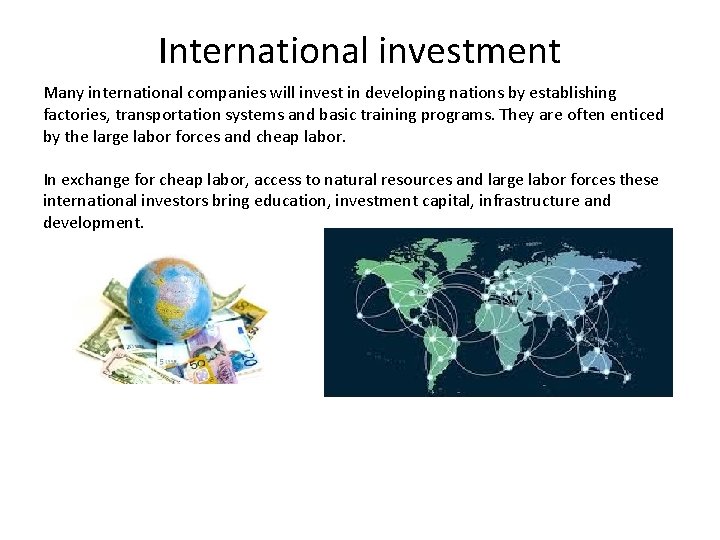
International investment Many international companies will invest in developing nations by establishing factories, transportation systems and basic training programs. They are often enticed by the large labor forces and cheap labor. In exchange for cheap labor, access to natural resources and large labor forces these international investors bring education, investment capital, infrastructure and development.
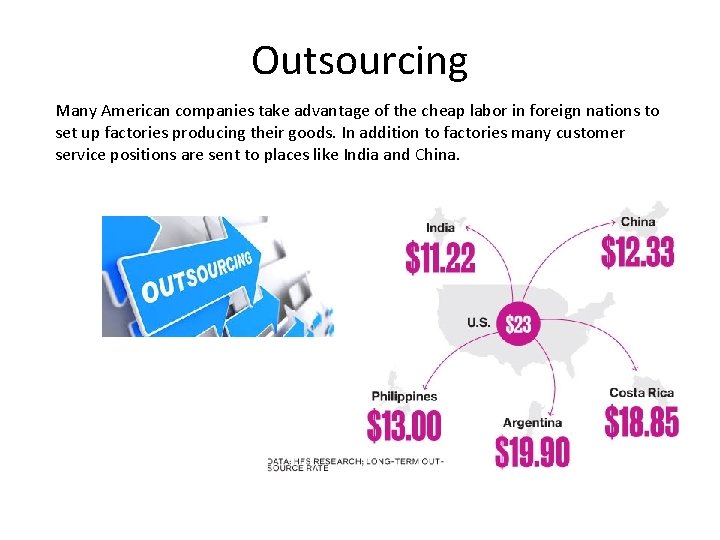
Outsourcing Many American companies take advantage of the cheap labor in foreign nations to set up factories producing their goods. In addition to factories many customer service positions are sent to places like India and China.
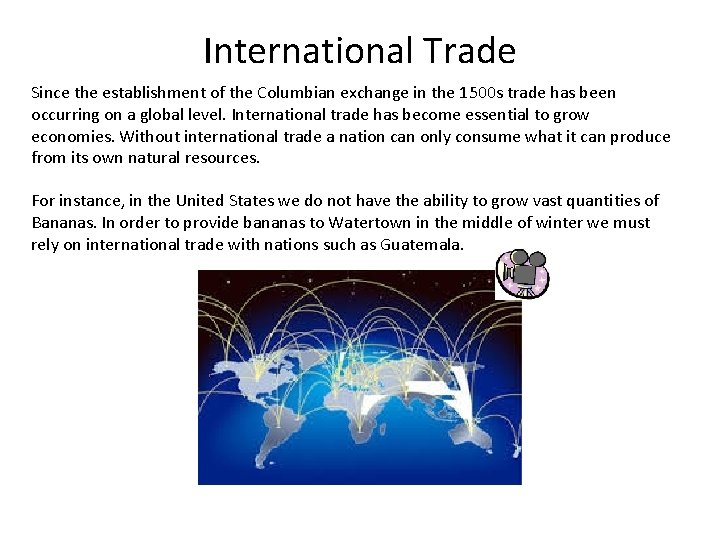
International Trade Since the establishment of the Columbian exchange in the 1500 s trade has been occurring on a global level. International trade has become essential to grow economies. Without international trade a nation can only consume what it can produce from its own natural resources. For instance, in the United States we do not have the ability to grow vast quantities of Bananas. In order to provide bananas to Watertown in the middle of winter we must rely on international trade with nations such as Guatemala.
Specialization Many nations specialize in certain goods and services. This is known as Specialization, or focusing on a small variety of products. Guatemala focuses on growing bananas and coffee in order to sell on the international market. In return Guatemala buys products like Chocolate from Sweden. Both nations benefit from this specialized trade. Therefore, specialization offers each nation the opportunity to become efficient in certain production of goods and services to trade them for goods and services they cannot produce.
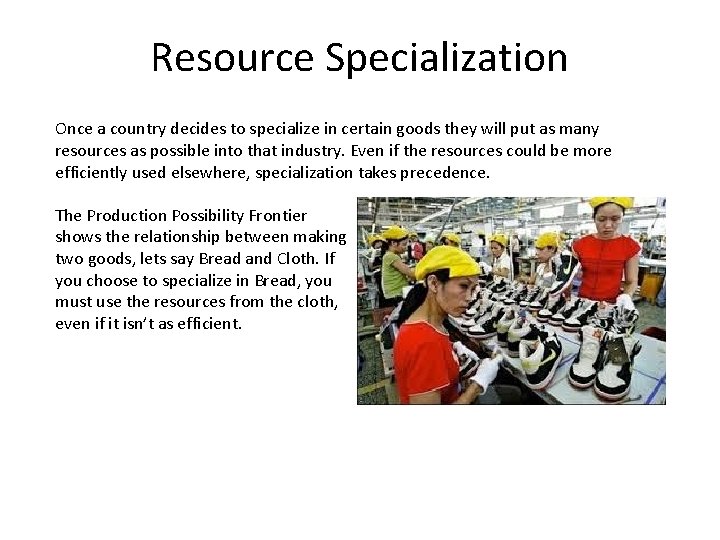
Resource Specialization Once a country decides to specialize in certain goods they will put as many resources as possible into that industry. Even if the resources could be more efficiently used elsewhere, specialization takes precedence. The Production Possibility Frontier shows the relationship between making two goods, lets say Bread and Cloth. If you choose to specialize in Bread, you must use the resources from the cloth, even if it isn’t as efficient.
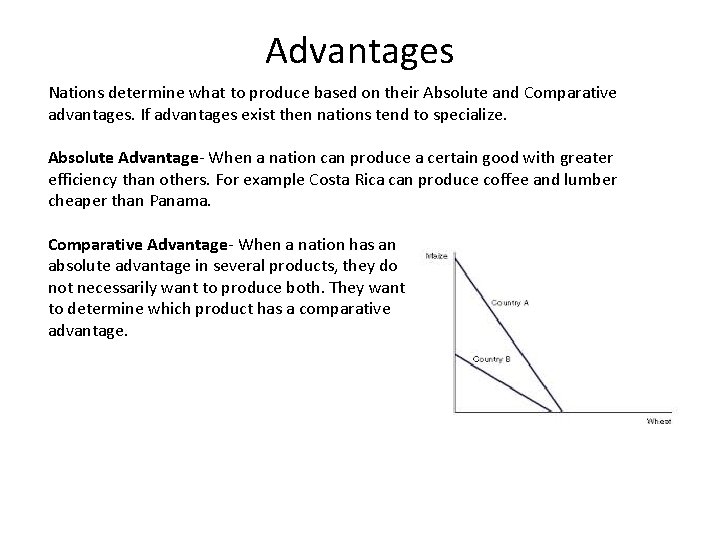
Advantages Nations determine what to produce based on their Absolute and Comparative advantages. If advantages exist then nations tend to specialize. Absolute Advantage- When a nation can produce a certain good with greater efficiency than others. For example Costa Rica can produce coffee and lumber cheaper than Panama. Comparative Advantage- When a nation has an absolute advantage in several products, they do not necessarily want to produce both. They want to determine which product has a comparative advantage.
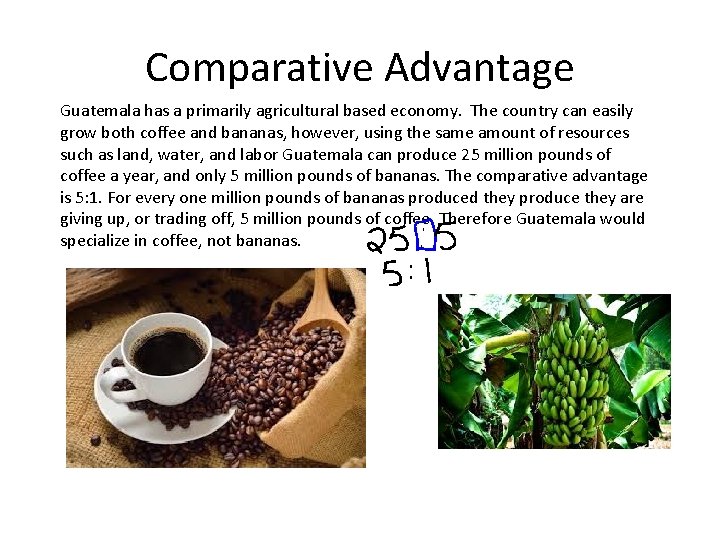
Comparative Advantage Guatemala has a primarily agricultural based economy. The country can easily grow both coffee and bananas, however, using the same amount of resources such as land, water, and labor Guatemala can produce 25 million pounds of coffee a year, and only 5 million pounds of bananas. The comparative advantage is 5: 1. For every one million pounds of bananas produced they produce they are giving up, or trading off, 5 million pounds of coffee. Therefore Guatemala would specialize in coffee, not bananas.
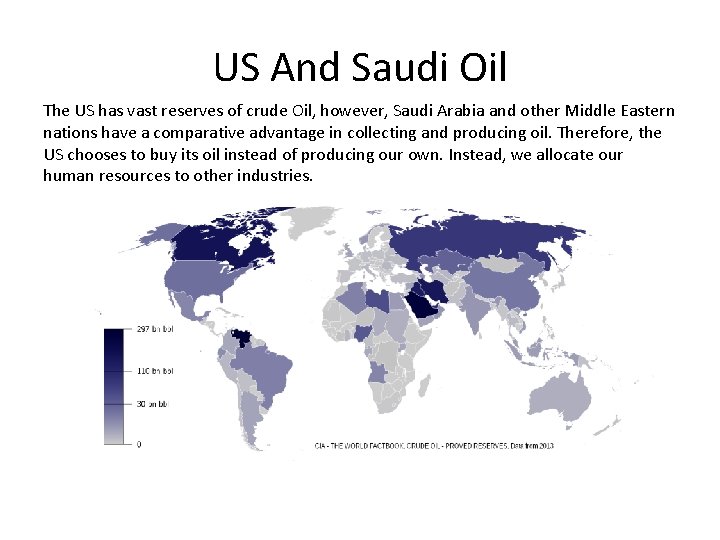
US And Saudi Oil The US has vast reserves of crude Oil, however, Saudi Arabia and other Middle Eastern nations have a comparative advantage in collecting and producing oil. Therefore, the US chooses to buy its oil instead of producing our own. Instead, we allocate our human resources to other industries.
US And Saudi Oil The US has vast reserves of crude Oil, however, Saudi Arabia and other Middle Eastern nations have a comparative advantage in collecting and producing oil. Therefore, the US chooses to buy its oil instead of producing our own. Instead, we allocate our The United States and Saudi Arabia both produce Oil and human resources to other industries. Think about it: Milk. Using all of their resources, The United States produces 10 million barrels of oil per day at an average cost of $36 per barrel. Saudi Arabia produces 12. 5 million barrels of oil per day at an average cost of $12 per barrel. The US produces 14. 6% of the world’s milk with 3. 4% of the world’s cows while Saudi Arabia has to import most of its feed and water to produce milk. If both the US and Saudi Arabia wish to engage in trade, who should produce oil and why?
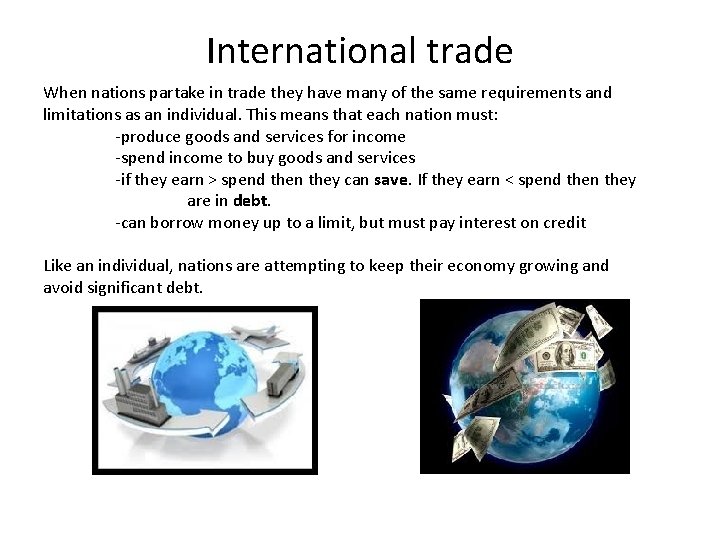
International trade When nations partake in trade they have many of the same requirements and limitations as an individual. This means that each nation must: -produce goods and services for income -spend income to buy goods and services -if they earn > spend then they can save. If they earn < spend then they are in debt. -can borrow money up to a limit, but must pay interest on credit Like an individual, nations are attempting to keep their economy growing and avoid significant debt.
International trade When nations partake in trade they have many of the same requirements and limitations as an individual. This means that each nation must: -produce goods and services for income -spend income to buy goods and services -if they earn > spend then they can save. If they earn < spend then they are in debt. -can borrow money up to a limit, but must pay interest on credit Nations trade with other nations because they benefit in some way! Like an individual, nations are attempting to keep their economy growing and avoid significant debt.
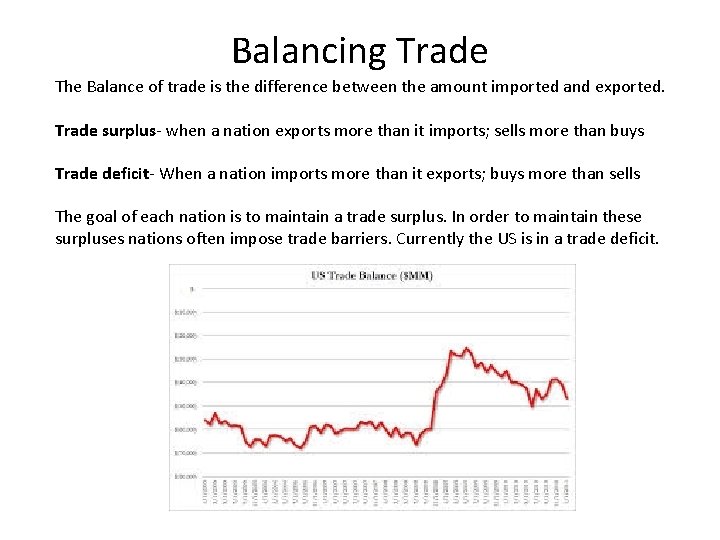
Balancing Trade The Balance of trade is the difference between the amount imported and exported. Trade surplus- when a nation exports more than it imports; sells more than buys Trade deficit- When a nation imports more than it exports; buys more than sells The goal of each nation is to maintain a trade surplus. In order to maintain these surpluses nations often impose trade barriers. Currently the US is in a trade deficit.
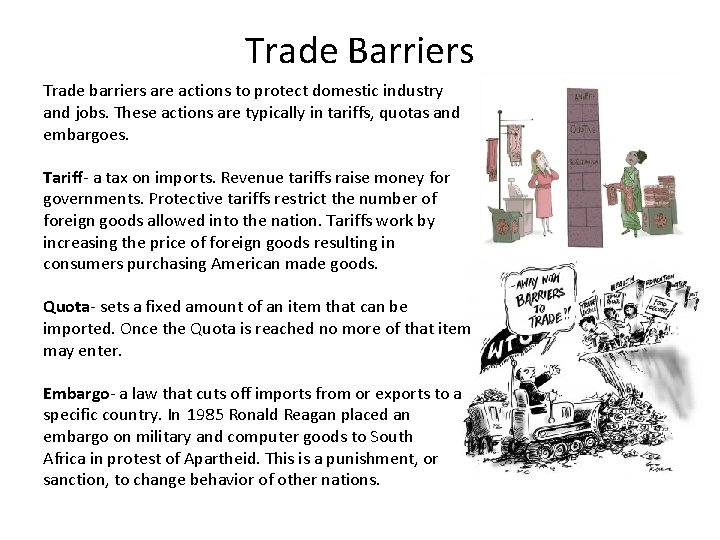
Trade Barriers Trade barriers are actions to protect domestic industry and jobs. These actions are typically in tariffs, quotas and embargoes. Tariff- a tax on imports. Revenue tariffs raise money for governments. Protective tariffs restrict the number of foreign goods allowed into the nation. Tariffs work by increasing the price of foreign goods resulting in consumers purchasing American made goods. Quota- sets a fixed amount of an item that can be imported. Once the Quota is reached no more of that item may enter. Embargo- a law that cuts off imports from or exports to a specific country. In 1985 Ronald Reagan placed an embargo on military and computer goods to South Africa in protest of Apartheid. This is a punishment, or sanction, to change behavior of other nations.
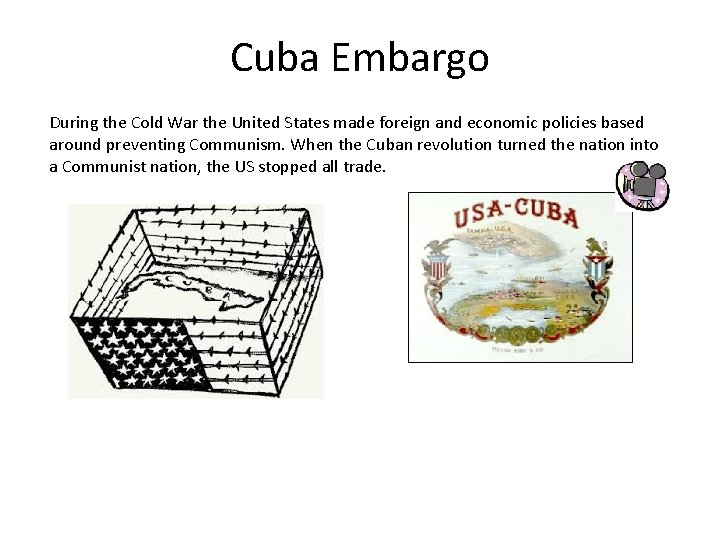
Cuba Embargo During the Cold War the United States made foreign and economic policies based around preventing Communism. When the Cuban revolution turned the nation into a Communist nation, the US stopped all trade.
Cuba Embargo Cubathewas starting open toforeign and economic policies based During Coldjust War the United to States made trade, but they began struggling around preventing Communism. When the Cuban revolution turned the nation into a Communist nation, the US all trade. under the influx ofstopped Americans. This is because they are underdeveloped… However, President Trump strengthened the embargo, forbidding travel once again. And those classic cars? ! Those are the only option after a 50+ year embargo!
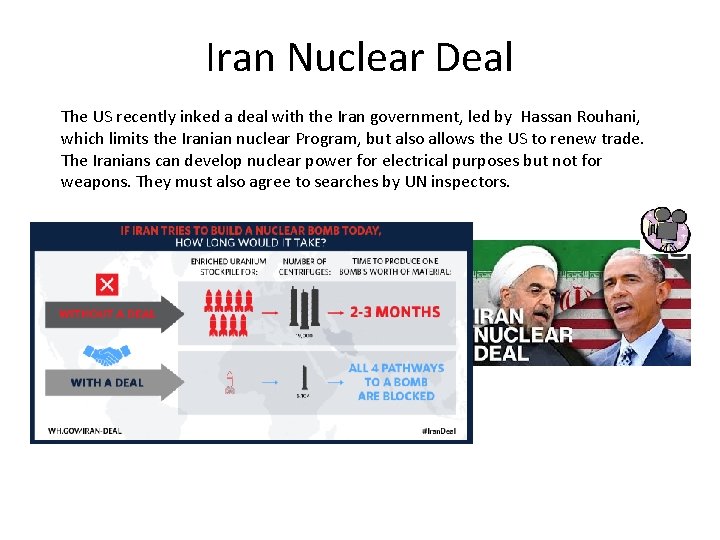
Iran Nuclear Deal The US recently inked a deal with the Iran government, led by Hassan Rouhani, which limits the Iranian nuclear Program, but also allows the US to renew trade. The Iranians can develop nuclear power for electrical purposes but not for weapons. They must also agree to searches by UN inspectors.
Iran Nuclear Deal The US recently inked a deal with the Iran government, led by Hassan Rouhani, which limits the Iranian nuclear Program, but also allows the US to renew trade. th The Iranians can develop nuclear power for electrical purposes but not for weapons. They must also agree to searches by UN inspectors. May 8 , 2018 President Trump announced the US would re-impose sanctions on Iran, effectively withdrawing from the Iran Nuclear Deal. This has been heavily criticized around the world and seen as a mistake by most Americans. https: //www. youtube. com/watch? v=U-mw. Foev 3 OQ (January 03, 2020 President Trump authorized a closed door attack on Iranian General Qassem Suleimani, whom was killed)
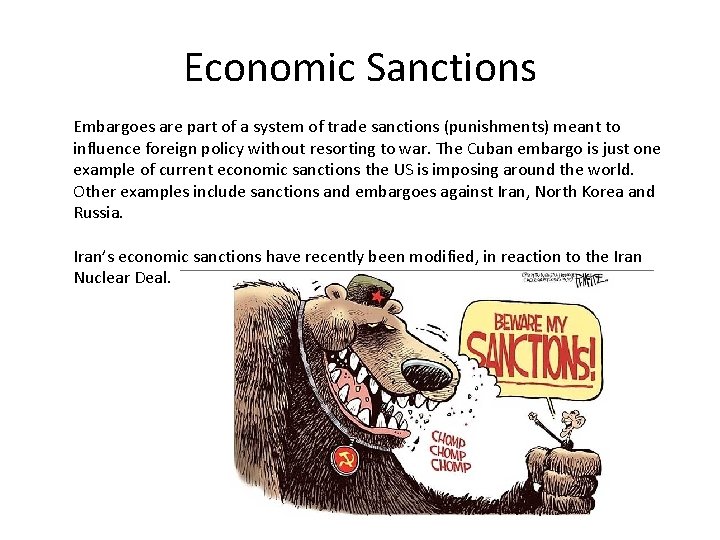
Economic Sanctions Embargoes are part of a system of trade sanctions (punishments) meant to influence foreign policy without resorting to war. The Cuban embargo is just one example of current economic sanctions the US is imposing around the world. Other examples include sanctions and embargoes against Iran, North Korea and Russia. Iran’s economic sanctions have recently been modified, in reaction to the Iran Nuclear Deal.
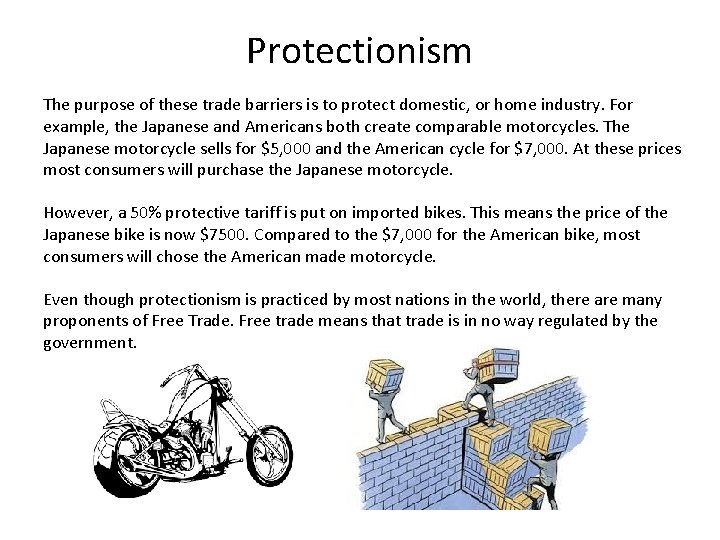
Protectionism The purpose of these trade barriers is to protect domestic, or home industry. For example, the Japanese and Americans both create comparable motorcycles. The Japanese motorcycle sells for $5, 000 and the American cycle for $7, 000. At these prices most consumers will purchase the Japanese motorcycle. However, a 50% protective tariff is put on imported bikes. This means the price of the Japanese bike is now $7500. Compared to the $7, 000 for the American bike, most consumers will chose the American made motorcycle. Even though protectionism is practiced by most nations in the world, there are many proponents of Free Trade. Free trade means that trade is in no way regulated by the government.
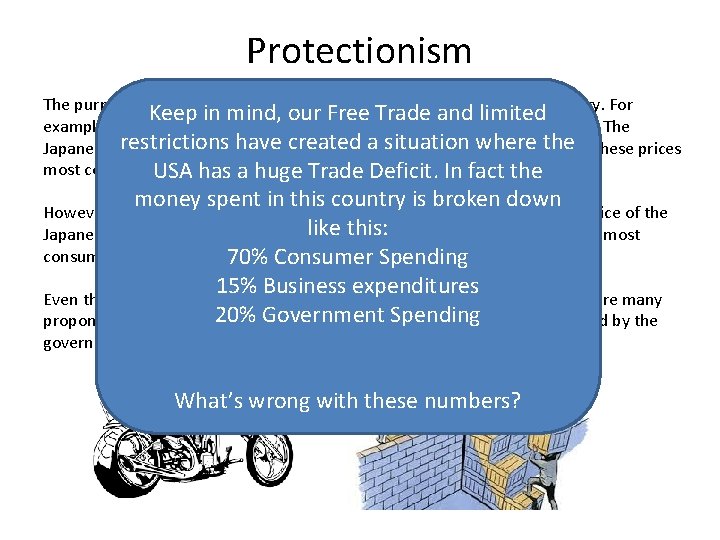
Protectionism The purpose of these trade barriers is to protect domestic, or home industry. For Keep in mind, our Free Trade and limited example, the Japanese and Americans both create comparable motorcycles. The restrictions created situation where the. At these prices Japanese motorcycle sells have for $5, 000 and thea. American cycle for $7, 000. most consumers will purchase the Japanese USA has a huge Trade motorcycle. Deficit. In fact the money spent in this country is broken down However, a 50% protective tariff is put on imported bikes. This means the price of the liketothis: Japanese bike is now $7500. Compared the $7, 000 for the American bike, most consumers will chose the 70% American made motorcycle. Consumer Spending 15% Business expenditures Even though protectionism is practiced by most nations in the world, there are many 20% Spending proponents of Free Trade. Free. Government trade means that trade is in no way regulated by the government. What’s wrong with these numbers?
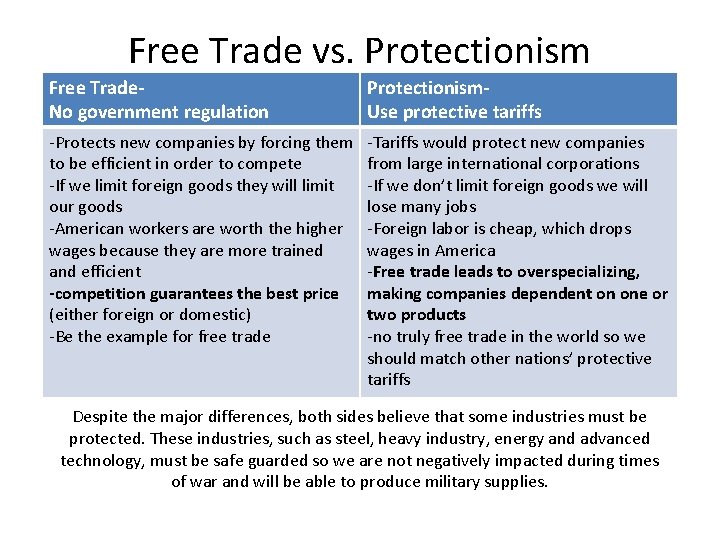
Free Trade vs. Protectionism Free Trade. No government regulation Protectionism. Use protective tariffs -Protects new companies by forcing them to be efficient in order to compete -If we limit foreign goods they will limit our goods -American workers are worth the higher wages because they are more trained and efficient -competition guarantees the best price (either foreign or domestic) -Be the example for free trade -Tariffs would protect new companies from large international corporations -If we don’t limit foreign goods we will lose many jobs -Foreign labor is cheap, which drops wages in America -Free trade leads to overspecializing, making companies dependent on one or two products -no truly free trade in the world so we should match other nations’ protective tariffs Despite the major differences, both sides believe that some industries must be protected. These industries, such as steel, heavy industry, energy and advanced technology, must be safe guarded so we are not negatively impacted during times of war and will be able to produce military supplies.
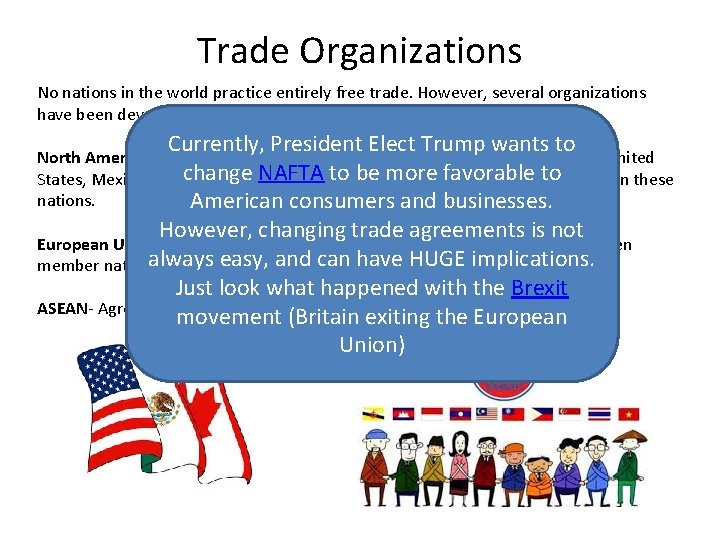
Trade Organizations No nations in the world practice entirely free trade. However, several organizations have been developed to help reduce trade barriers. Currently, President Elect Trump wants to North American Free Trade Agreement (NAFTA)- an agreement between the United change NAFTAandtoeventually be more favorable to between these States, Mexico and Canada to reduce eliminate all tariffs nations. American consumers and businesses. However, changing trade agreements is not European Union- Creates a common currency and limited trade barriers between always easy, and can have HUGE implications. member nations Just look what happened with the Brexit ASEAN- Agreement between many ASEAN nations to limit trade barriers movement (Britain exiting the European Union)
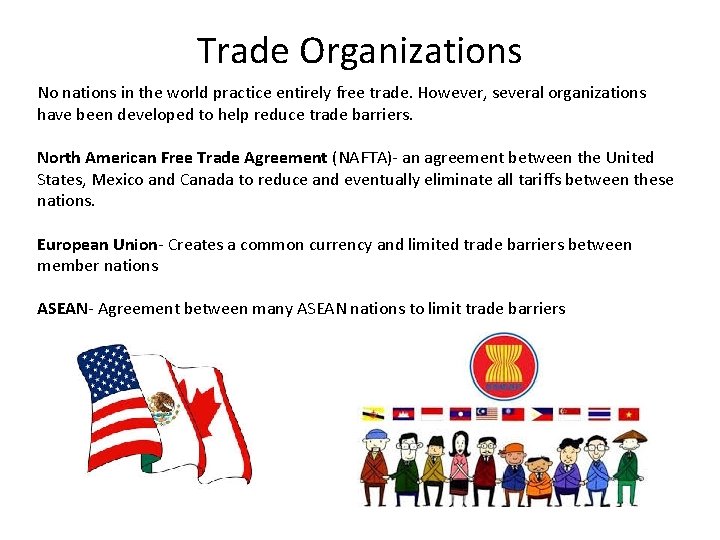
Trade Organizations No nations in the world practice entirely free trade. However, several organizations have been developed to help reduce trade barriers. North American Free Trade Agreement (NAFTA)- an agreement between the United States, Mexico and Canada to reduce and eventually eliminate all tariffs between these nations. European Union- Creates a common currency and limited trade barriers between member nations ASEAN- Agreement between many ASEAN nations to limit trade barriers
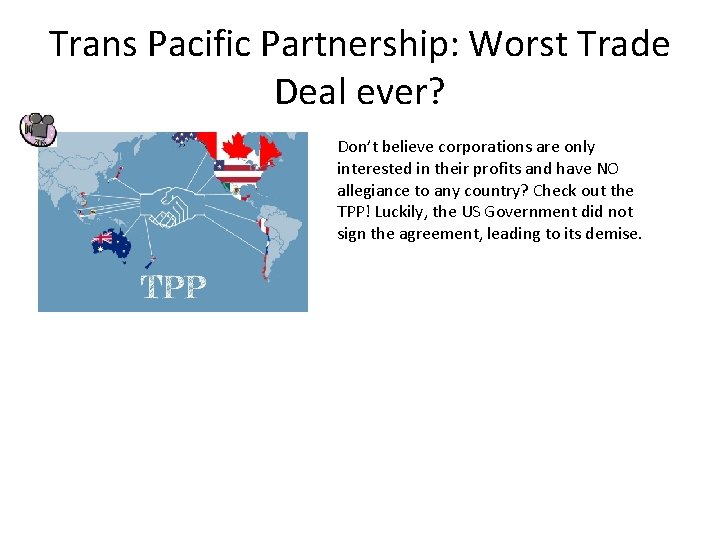
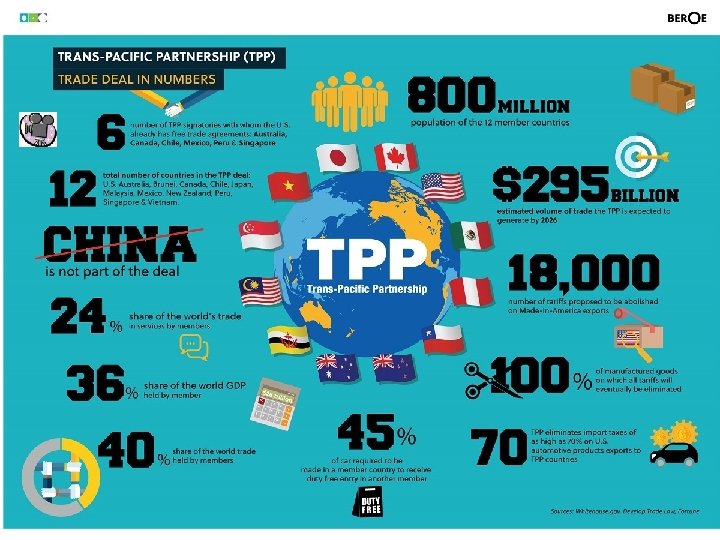
Trans Pacific Partnership: Worst Trade Deal ever? Don’t believe corporations are only interested in their profits and have NO allegiance to any country? Check out the TPP! Luckily, the US Government did not sign the agreement, leading to its demise.
Trans Pacific Partnership: Worst Trade Deal ever? Don’t believe corporations are only interested in their profits and have NO allegiance to any country? Check out the TPP! Luckily, the US Government did not sign the agreement, leading to its demise.
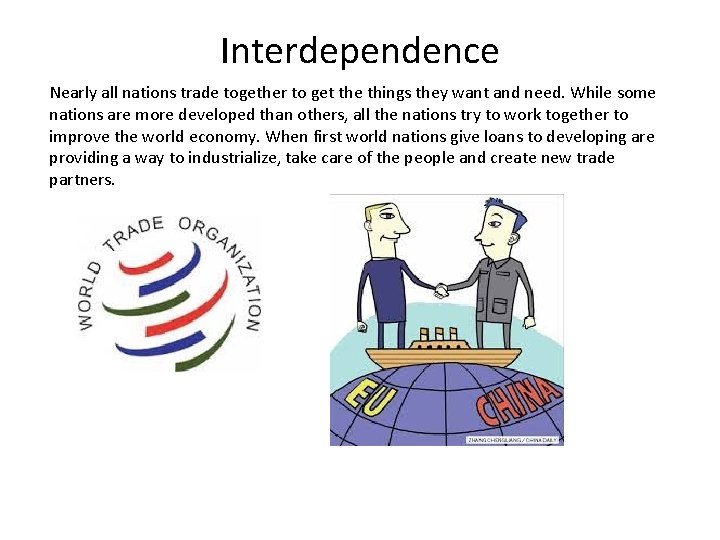
Interdependence Nearly all nations trade together to get the things they want and need. While some nations are more developed than others, all the nations try to work together to improve the world economy. When first world nations give loans to developing are providing a way to industrialize, take care of the people and create new trade partners.
Interdependence Nearly all nations trade together to get the things they want and need. While some nations are more developed than others, all theagainst nationsforeign try to work together to as When the US Dollar becomes weaker currency such improve world economy. When first world. Irrigation nations give loans to(which developing the Euro, what is the impact on Jain Company is anare providing a way to industrialize, take care of the people and create new trade Indian company) here in Watertown? They make specialized irrigation partners. systems that are used all over the world. 1. Less manufacturing will occur in the US 2. More manufacturing will occur in Europe 3. More manufacturing will occur in the US 4. There will be no change
Why are some nations rich, and some poor?
TASK 1) Explain the difference between developed and developing nations. 2) What are some obstacles for developing nations? 3) Why do international economies try to help developing nations? 4) What is the Comparative Advantage for each of the following 1) Costa Rica 15 million pounds of Coffee and 5 million pounds of bananas 2) Sweden 22 million pounds of Chocolate and 4 million pounds of gum 3) China 50 million computers and 100 million IPods 5) In your opinion should the United States focus on Protectionism or Free Trade for our international trade? Provide your opinion and justify it in 4 -5 sentences. 6) The US and other nations often use embargoes as a way to sanction, or punish, foreign nations. For instance, America currently has economic sanctions in place against North Korea and Iran to stop their Nuke development. How do sanctions like these work to promote change? 7) Why do some American companies prefer to manufacture their goods in far away nations?
- Slides: 44