
Globalization as a historical process Is globalization a
Globalization as a historical process
• Is globalization a modern phenomenon? • What does a proper chronology and historical periodization of globalization look like?
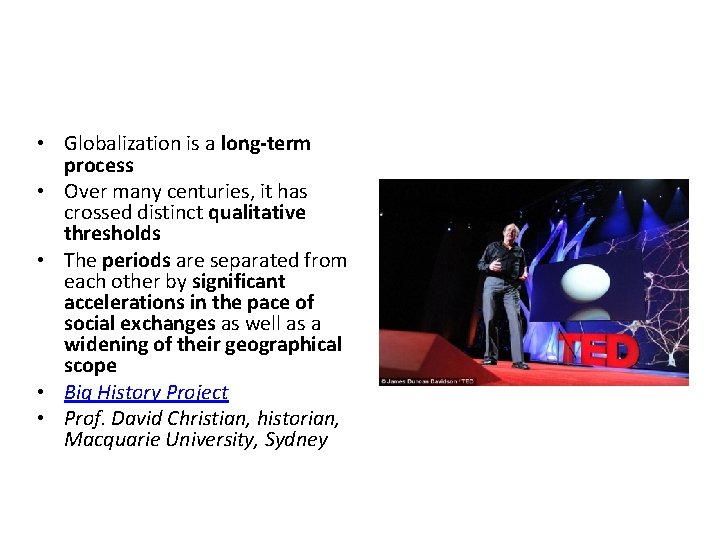
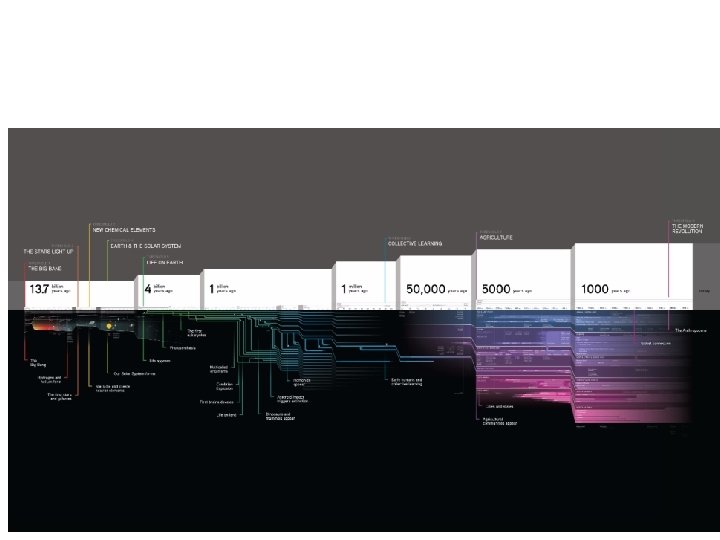
• Globalization is a long-term process • Over many centuries, it has crossed distinct qualitative thresholds • The periods are separated from each other by significant accelerations in the pace of social exchanges as well as a widening of their geographical scope • Big History Project • Prof. David Christian, historian, Macquarie University, Sydney
The prehistoric period (10000 BCE 3500 BCE) • The truly global dispersion of our species was achieved; Africa →→→ South America <Human migration> <Video 01 02: 30 -3: 15> • Hunters and gatherers: Contact was geographically limited and mostly coincidental • (8000 BCE) Farmers and herders, i. e. agriculture <Video 02 0: 45 -1: 30> Population increases, the establishment of permanent villages, the construction of fortified towns. • Nomads → settled tribes, chiefdoms, powerful states based on agricultural food production • Decentralized, egalitarian nature of groups → centralized and highly stratified patriarchal social structures headed by chiefs and priests + additional social classes: full-time craft specialists (invention of new technologies) and professional bureaucrats and soldiers • However, globalization in the prehistoric period was still severely limited
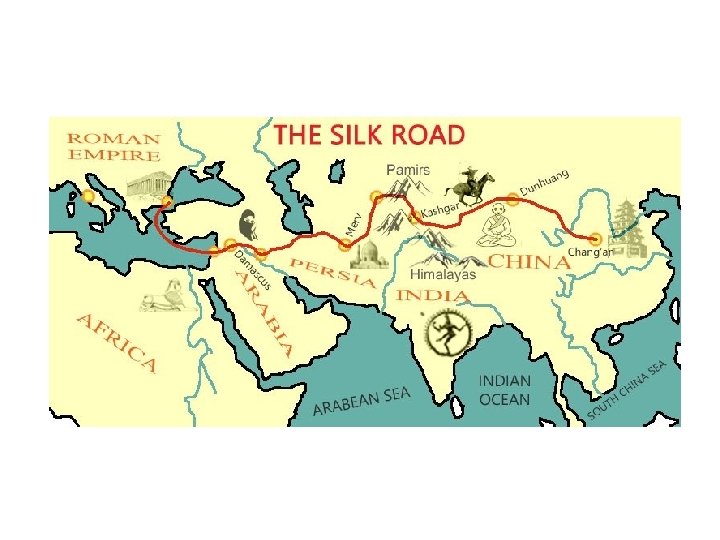
The premodern period (3500 BCE-1500 BCE) • The invention of writing (spread of ideas, coordination of complex social activities or large state formations), of the wheel (transportation) + their diffusion in Eurasia • The age of empires <Video 03 00: 40 -02: 05> • Fostered the multiplication and extension of long-distance communication and the exchange of culture (e. g. religions), technology, commodities, and diseases • E. g. the Silk Road connected the Chinese and the Roman Empires • First China or East Asia, then Europe emerge as the primary historical agents behind the intensification of globalization <Video 04 03: 00 -05: 30>
The early modern period (1500 -1750) • <Video 05 00: 40 -01: 45> • The role of Europe (the influence of Islamic and Chinese cultures) – Expansion westward: Searching for a new, profitable sea route to India • Substantial support from their respective governments (e. g. national joint stock companies like the Dutch and British East India companies): Economic, social, and cultural influence later enabled direct political rule (colonies) × the Atlantic slave trade and forced population transfers within the Americas • Another qualitative leap that greatly intensified demographic, cultural, ecological, and economic flows between Europe, Africa, and the Americas – Between the Enlightenment and the Renaissance • Inventions, innovations + the Reformation (the power of the Catholic Church reduced, helped spread related ‘liberal’ ideas of individualism and limited government) – The rise of European metropolitan centers and their affiliated merchant classes (economic entrepreneurs) laid the foundation of the ‘capitalist world system’ – Religious warfare within Europe →→→ the Westphalian states system → Interdependencies among nation-states
The modern period (1750 -1970) • The era of colonialism – Europeans confronted with stories of the ‘distant’ and images of countless ‘others’, assumed the role of the world’s guardians of universal law and morality, civilizational leaders – Racist practices and inequality, the West and the ‘rest’ • The capitalist system: Philosophy of individualism and rational self-interest, the free market and its ‘invisible hand’ • The system fed by a steady stream of materials and resources from the ‘rest’ - new industrial regimes required new resources × environmental damage, conflicts • Another qualitative shift in social relations <Video 06 08: 0510: 50>
The modern period (continued) • The volume of world trade increased dramatically; peaked before WW 1 • Expansion of transportation: railways, mechanized shipping, intercontinental air transport enabled the establishment of a genuine global infrastructure, while lowering transportation costs • Communication technologies: The telegraph, the telephone and wireless radio communication (AT&T: a world ‘inextricably bound together’), mass circulation newspapers and magazines, film, and television • An unprecedented population explosion; enormous waves of migration → boost in productivity AND bureaucratic control and surveillance techniques • Mass migration, urbanization, colonial competition, and the excessive liberalization of world trade → intensified interstate rivalries – extreme nationalism and two devastating world wars • Changing global imaginary: People convinced of the linked fate of geographically and politically separated ‘nations’ – why: The atomic bomb, the Cold-War ‘MAD’ strategies, decolonization, interdependence, the UN, global (democratic governance), the three ‘Worlds’, superpower confrontations, and global conflict

The contemporary period (from 1970) • Another quantum leap in the history of globalization: the dramatic creation, expansion, and acceleration of worldwide interdependencies and global exchanges • The collapse of Soviet-style communism and attempts to create a single global market • NOW <Video 07 00: 10 -05: 03> • Future <Video 08 02: 20>
Various aspects of globalization
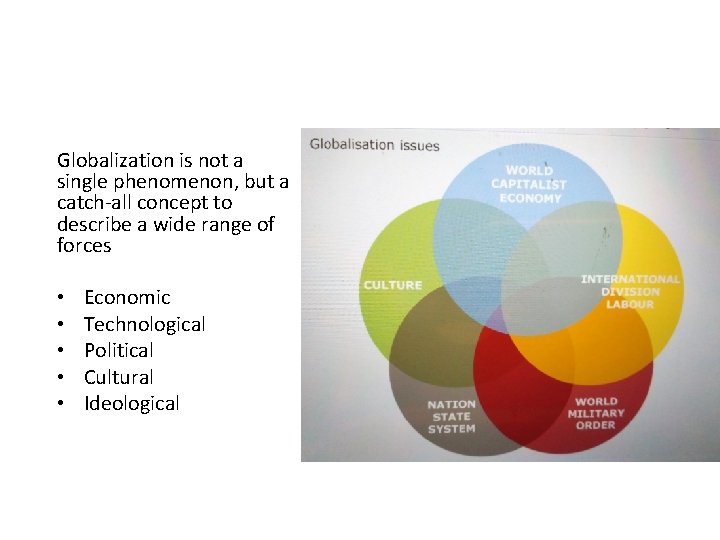
Globalization is not a single phenomenon, but a catch-all concept to describe a wide range of forces • • • Economic Technological Political Cultural Ideological
Opportunities • access to new technologies, as in the area of trade, the globalization of markets offers developing countries opportunity to integrate themselves more fully into the world economy • growth of international trade and the strengthening of multilateral rules and dispute settlement mechanisms within the framework of the World Trade Organization (WTO) • explosive pace of global financial development has created opportunities for financing • the spread of global values, the struggle for the right to be different and the establishment of international mechanisms to defend the exercise of citizenship - respect for human rights, democracy, gender equality and ethnic diversity
Main problems and risks • • contrast between the rapid development of markets and the slow development of global governance (problems caused by the asymmetry existing between the strength of market forces and the weakness of the institutional frameworks that regulate them) the lack of effective international instruments for guaranteeing the achievement of the development goals that have been reiterated so often, i. e. in the UN Millennium Declaration the asymmetries faced by developing countries in the global order in the areas of production, technology, finance and macroeconomics as a result of the contrast between the high international mobility of capital and the tight restrictions imposed on the mobility of labour the developing countries also face the challenge of adapting their policies to the institutional mechanisms required by WTO the educational and knowledge requirements imposed by global technologies and markets, which threaten to marginalize those who are not fully prepared global environmental processes affect all countries, but small tropical countries, particularly island states, are especially vulnerable to global environmental changes, as is demonstrated by the increasing frequency and intensity of natural disasters the globalization of the communications media and their concentration in the hands of a few pose new problems tensions between homogeneity and cultural diversity
Global Problems
Global problems • First World Problems – https: //www. youtube. com/watch? v=v. N 2 Wz. Qzxuo. A – https: //www. youtube. com/watch? v=0 Cl 7 TY 92 rd 4 • Top 10 First World Problems – https: //www. youtube. com/watch? v=Oe. Mjg. Eqg. Gss • Global world problems – https: //www. youtube. com/watch? v=YY 9 nx. G 2 ZQ 7 w
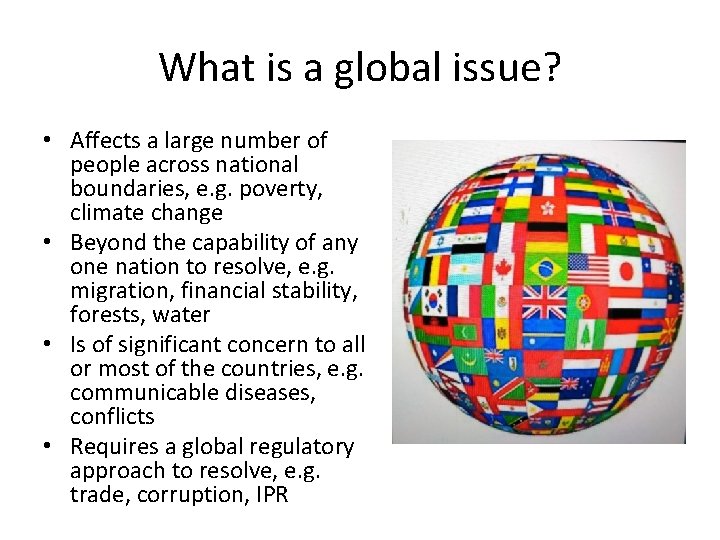
What is a global issue? • Affects a large number of people across national boundaries, e. g. poverty, climate change • Beyond the capability of any one nation to resolve, e. g. migration, financial stability, forests, water • Is of significant concern to all or most of the countries, e. g. communicable diseases, conflicts • Requires a global regulatory approach to resolve, e. g. trade, corruption, IPR
Key Global Issues • Global Economy: – Poverty – Trade – Inequality – Migration – Financial stability – Debt – Aid
• Global Environment and natural resources: – Water – Forests – Energy – Fisheries – Climate change
• Global human development: – Education – Health – Nutrition – Infectious diseases
• Global governance and security: – Corruption – UN system – International Financial Institutions – Conflicts – Terrorist threats – Proliferation of weapons of mass destruction
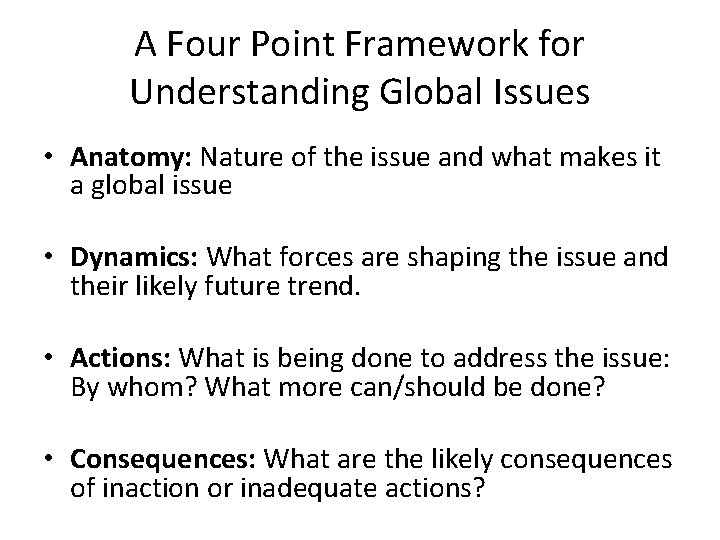
A Four Point Framework for Understanding Global Issues • Anatomy: Nature of the issue and what makes it a global issue • Dynamics: What forces are shaping the issue and their likely future trend. • Actions: What is being done to address the issue: By whom? What more can/should be done? • Consequences: What are the likely consequences of inaction or inadequate actions?
Forces underlying global issues Demographic transition Global income growth and social justice Scientific and technological innovation Increasing interconnectedness and interdependence • Global governance and influence of civil society • Security and social cohesion • •
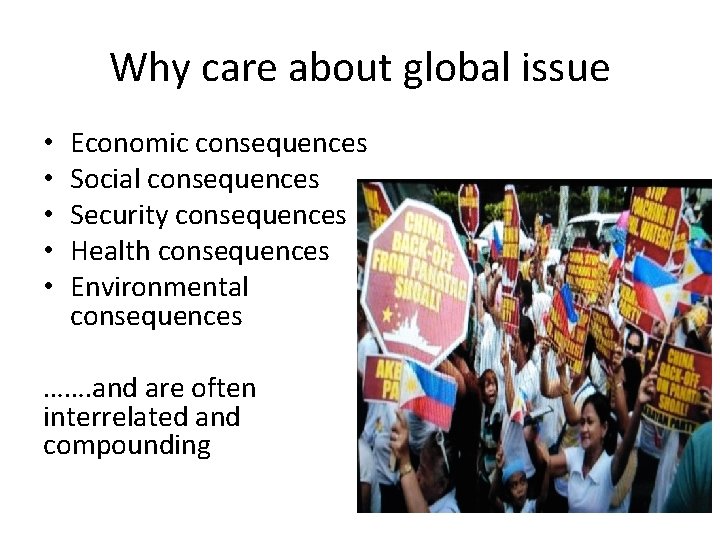
Why care about global issue • • • Economic consequences Social consequences Security consequences Health consequences Environmental consequences ……. and are often interrelated and compounding
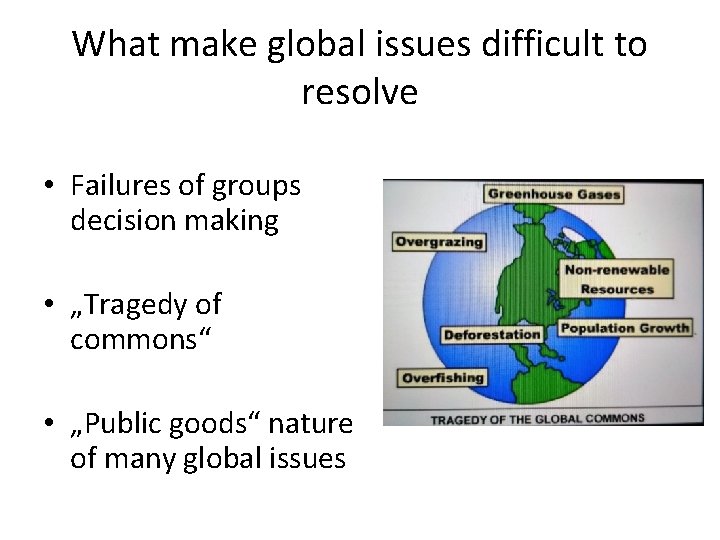
What make global issues difficult to resolve • Failures of groups decision making • „Tragedy of commons“ • „Public goods“ nature of many global issues
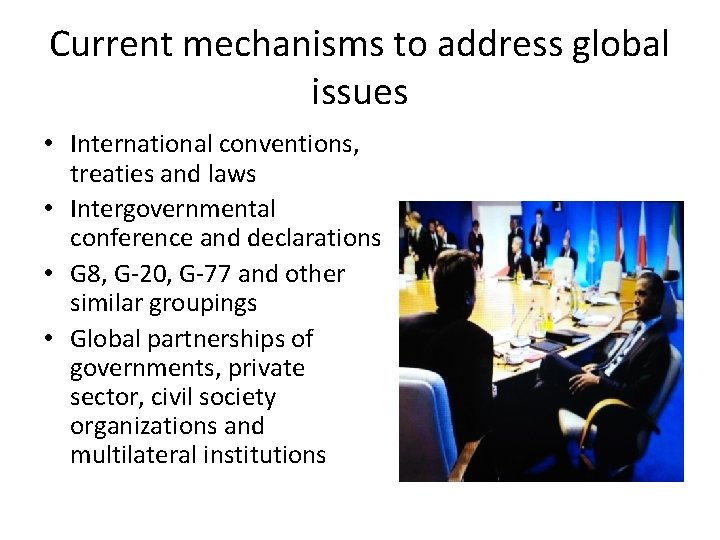
Current mechanisms to address global issues • International conventions, treaties and laws • Intergovernmental conference and declarations • G 8, G-20, G-77 and other similar groupings • Global partnerships of governments, private sector, civil society organizations and multilateral institutions
Who are the key players involved in global issues? • Countries • UN system • International Financial Institutions • International NGOs • Transnational corporations • Foundations • You i. e. global citizens

MDGs?
MDGs • Established after the Millennium Summit of the United Nations in 2000 – => United Nations Millennium Declaration • Criticism: lack of analysis and justification, lack of measurements for some goals and uneven progress, local change through external innovations and financing, no participants from developing countries => lack of legitimacy
MDGs 1. To eradicate extreme poverty and hunger 2. To achieve universal primary education 3. To promote gender equality and empower women 4. To reduce child mortality 5. To improve maternal health 6. To combat HIV/AIDS, malaria, and other diseases 7. To ensure environmental sustainability 8. To develop a global partnership for development
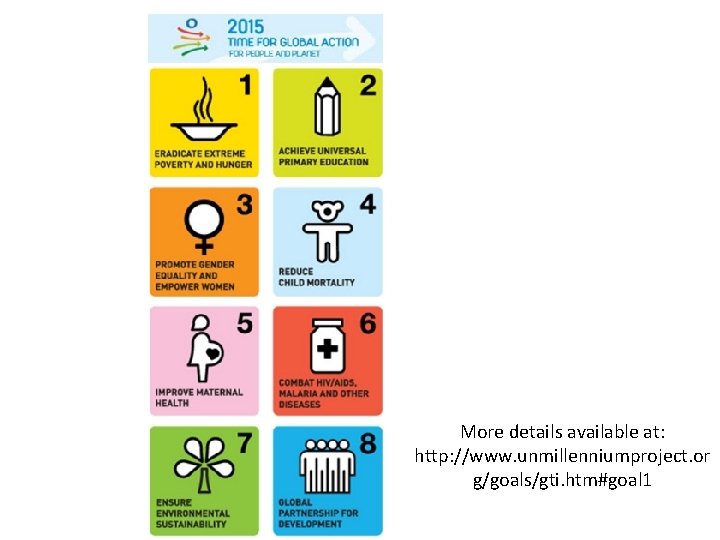
More details available at: http: //www. unmillenniumproject. or g/goals/gti. htm#goal 1
MDGs • Failed to consider root causes of poverty • Overlooked gender inequality and universal need for development that works for all people • No mention of human rights • X economic development • In theory applied to all countries, in reality targets for poor countries to achieve, with finance from developed states • BUT: all countries expected to work towards achieving MDGs
MDGs - videos • Millennium Development Goals – https: //www. youtube. com/watch? v=4 h. A 81 oa. CNXk • 8 Millennium Development Goals: What We Met And Missed – https: //www. youtube. com/watch? v=A 5 gi. OGjj 5 X 8 • Transitioning from the MDGs to the SDGs – https: //www. youtube. com/watch? v=5_h. Lu. Eui 6 ww • Sustainable Development Goals (SDGs) explained – https: //www. youtube. com/watch? v=Nk. Av 9 L 1_r 1 M • Infographics – http: //www. un. org/millenniumgoals/multimedia. sht ml#pretty. Photo
SDGs • Accepted at the United Nations Conference on Sustainable Development (Rio+20) in 2012 • Adopted on 25 September 2015 (2030 Agenda for Sustainable Development) • All three dimensions of sustainable development (environmental, social, and economic) included • It applies to all countries, promotes peaceful and inclusive societies, creates better jobs and tackles the environmental challenges — particularly climate change – http: //www. undp. org/content/undp/en/home/sdgoverview. ht ml • Criticism: too many, messy, misconceived, no local context…
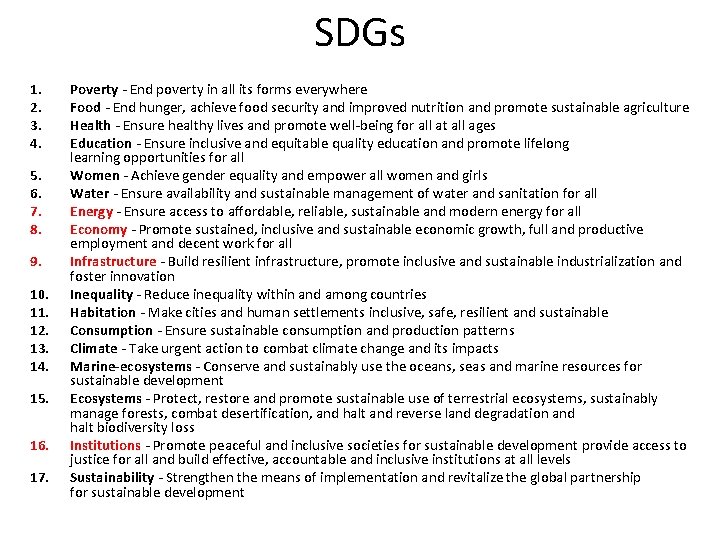
SDGs 1. 2. 3. 4. 5. 6. 7. 8. 9. 10. 11. 12. 13. 14. 15. 16. 17. Poverty - End poverty in all its forms everywhere Food - End hunger, achieve food security and improved nutrition and promote sustainable agriculture Health - Ensure healthy lives and promote well-being for all at all ages Education - Ensure inclusive and equitable quality education and promote lifelong learning opportunities for all Women - Achieve gender equality and empower all women and girls Water - Ensure availability and sustainable management of water and sanitation for all Energy - Ensure access to affordable, reliable, sustainable and modern energy for all Economy - Promote sustained, inclusive and sustainable economic growth, full and productive employment and decent work for all Infrastructure - Build resilient infrastructure, promote inclusive and sustainable industrialization and foster innovation Inequality - Reduce inequality within and among countries Habitation - Make cities and human settlements inclusive, safe, resilient and sustainable Consumption - Ensure sustainable consumption and production patterns Climate - Take urgent action to combat climate change and its impacts Marine-ecosystems - Conserve and sustainably use the oceans, seas and marine resources for sustainable development Ecosystems - Protect, restore and promote sustainable use of terrestrial ecosystems, sustainably manage forests, combat desertification, and halt and reverse land degradation and halt biodiversity loss Institutions - Promote peaceful and inclusive societies for sustainable development provide access to justice for all and build effective, accountable and inclusive institutions at all levels Sustainability - Strengthen the means of implementation and revitalize the global partnership for sustainable development
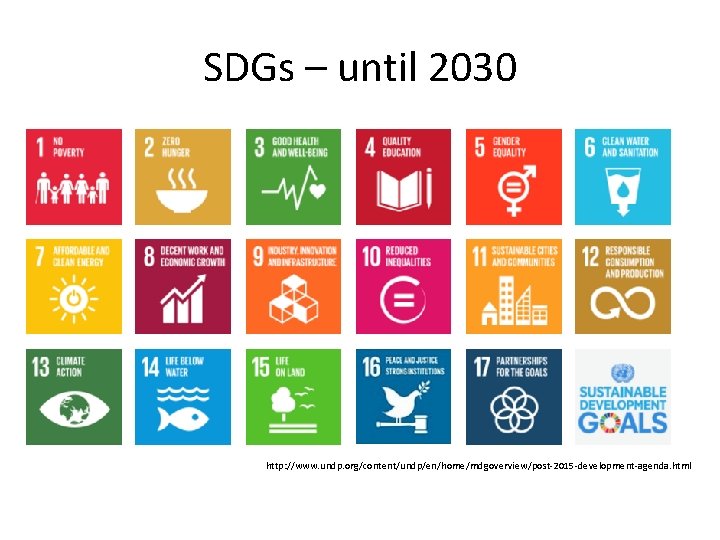
SDGs – until 2030 http: //www. undp. org/content/undp/en/home/mdgoverview/post-2015 -development-agenda. html
Discussion: • What global problems do you consider to be the most urgent ones? • Choose the most urgent one and think about: – How to approach / solve it? – What actors should participate?
B. Lomborg • TED talk: https: //www. ted. com/talks/bjorn_lomborg_sets _global_priorities? language=cs • • What does BL think about global problems? Which problems should be solved first and why? On what does he base his recommendation? What do you think about his approach?
- Slides: 39