
Globalization and Political Economy Overview Political economy globalization
Globalization and Political Economy: Overview • Political economy, globalization and commodity chains • Informal economies • Neoliberal economic reforms and local livelihoods • Case study: the illicit global drug trade ▫ ▫ Producers and consumers Case study of Bolivia (coca/cocaine production) Agency and structural violence Alternatives
What is political economy? • Interdisciplinary approach that examines how global and local power structures in societies affect people’s differential access to and consumption of resources • Political economy of globalization • Commodity chain – path through which goods are produced, distributed and consumed • Looks at the disconnection between people and products in industrialized capitalist economies
Political economy in daily life • Think about what you’re wearing right now. Do you know offhand where any of your clothing, shoes or accessories were produced? • How many people (producers, middlemen, retailers) were involved in the production and sale of these goods? • How many miles did these items travel before you purchased them (how much fuel was consumed in transport)?
Informal economies • Economic activities unregulated by the state; often undertaken by low-income and unemployed populations • Illegal goods (underground/black market) – e. g. , drugs, weapons, stolen/smuggled goods, human/organ trafficking • Scale: ▫ ▫ ▫ 9. 4% of US economy ($650 billion) 27% Italy 40% Brazil 45% Russia 45 -85% nonagricultural GDP in Asia over 80% nonagricultural GDP in Africa (Schlosser 2003: 5 -6; Carr and Chen 2001)

Globalization and neoliberal reforms • Examples of neoliberal economic reforms (structural adjustment programs / austerity measures) imposed by World Bank/IMF since 1980 s: ▫ ▫ ▫ Elimination of trade barriers Currency devaluation Privatization of state industries Cutbacks in social spending Creation of free trade agreements (e. g. , NAFTA) and free trade zones (Mexico, Central America, Caribbean, Asia, etc. ) Nike production factory in China
Effects of neoliberal reforms on local livelihoods • Generally: ▫ Increased cost of utilities ▫ Decreased value of local currencies ▫ Competition with foreign, imported agricultural cash crops that may cost less than locally produced goods ▫ Declining quality of health care, education and social services ▫ Increased rural-urban migration for wage labor in free trade zones • Case of Bolivia: ▫ Reliance on cash crops to compete in markets increase in coca production ▫ Increases in rural-urban migration for wage labor ▫ Protests against privatization of water in Cochabamba
Political economy of the drug trade • Major part of global economy for over 300 yrs. ▫ Tobacco – originated in Americas; first observed by Europeans and brought to Europe post-1492 • 20 th c. growth of drug trade: opium, cannabis and coca made illegal in US in 1914 became pillars of informal economy • Today – global drug trade = 0. 9% of world’s GDP ($320 billion) (UNODC 2006: 17)
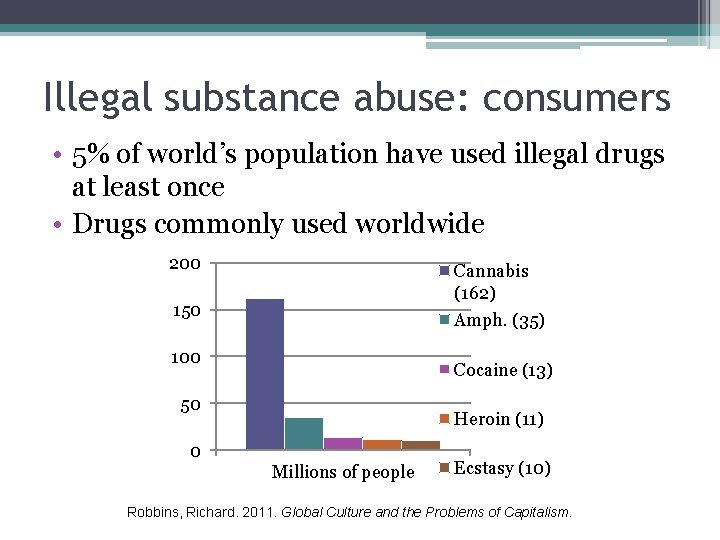
Illegal substance abuse: consumers • 5% of world’s population have used illegal drugs at least once • Drugs commonly used worldwide 200 Cannabis (162) 150 Amph. (35) 100 Cocaine (13) 50 Heroin (11) 0 Millions of people Ecstasy (10) Robbins, Richard. 2011. Global Culture and the Problems of Capitalism.
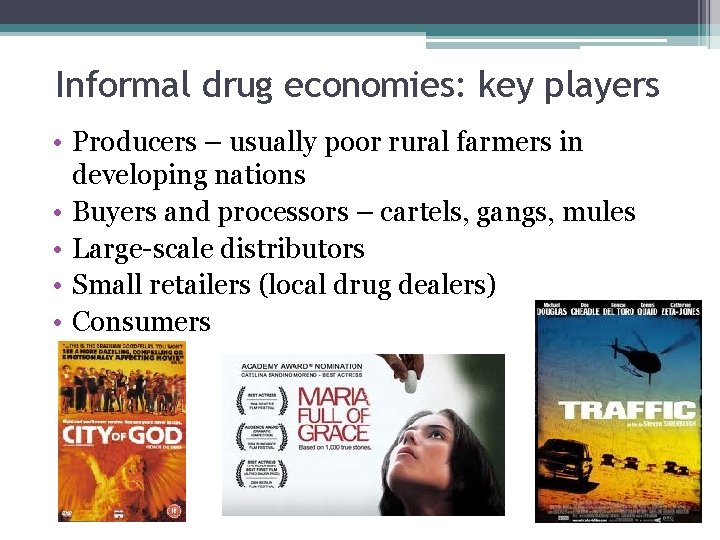
Informal drug economies: key players • Producers – usually poor rural farmers in developing nations • Buyers and processors – cartels, gangs, mules • Large-scale distributors • Small retailers (local drug dealers) • Consumers
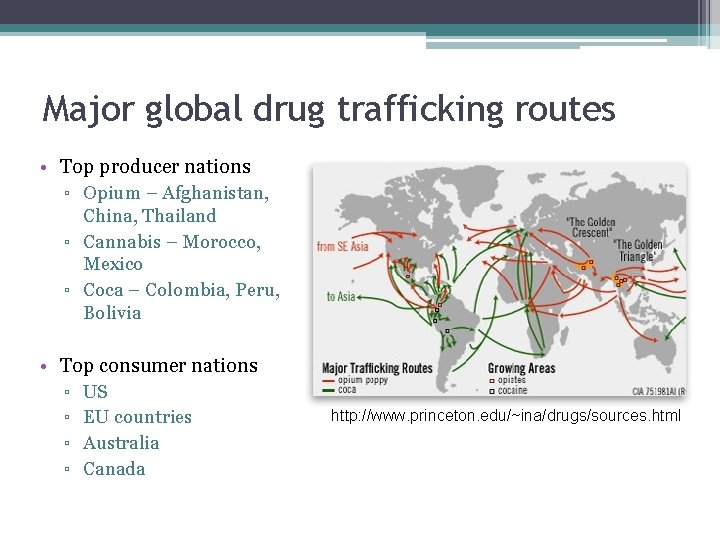
Major global drug trafficking routes • Top producer nations ▫ Opium – Afghanistan, China, Thailand ▫ Cannabis – Morocco, Mexico ▫ Coca – Colombia, Peru, Bolivia • Top consumer nations ▫ US ▫ EU countries ▫ Australia ▫ Canada http: //www. princeton. edu/~ina/drugs/sources. html
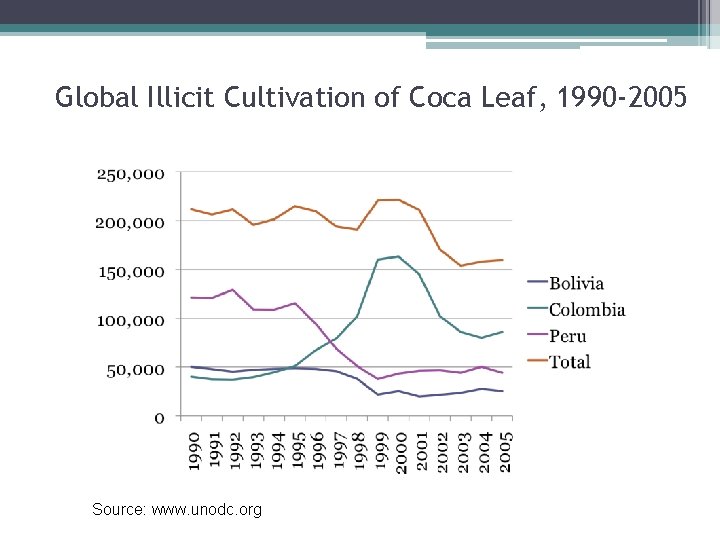
Global Illicit Cultivation of Coca Leaf, 1990 -2005 Source: www. unodc. org
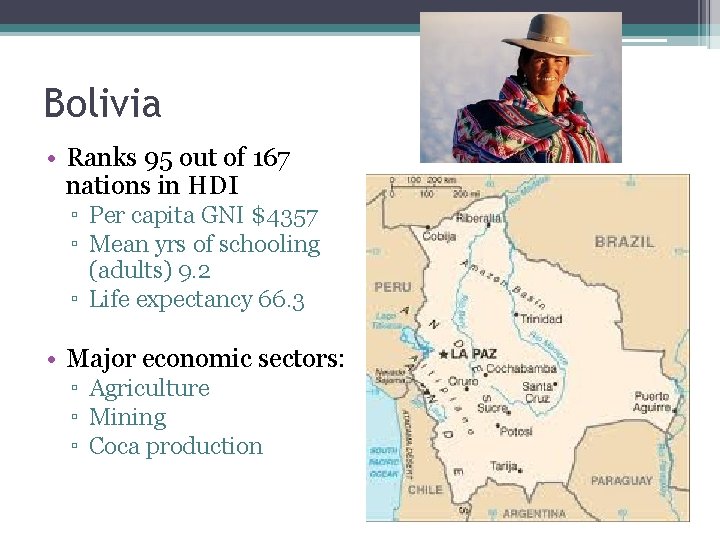
Bolivia • Ranks 95 out of 167 nations in HDI ▫ Per capita GNI $4357 ▫ Mean yrs of schooling (adults) 9. 2 ▫ Life expectancy 66. 3 • Major economic sectors: ▫ Agriculture ▫ Mining ▫ Coca production
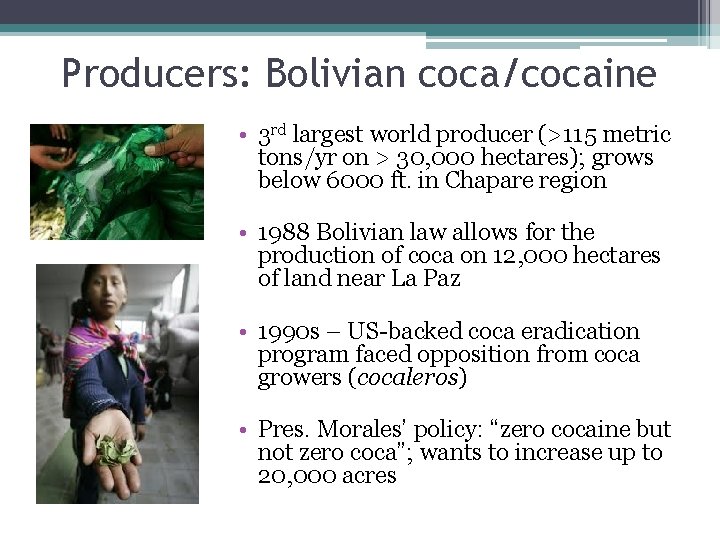
Producers: Bolivian coca/cocaine • 3 rd largest world producer (>115 metric tons/yr on > 30, 000 hectares); grows below 6000 ft. in Chapare region • 1988 Bolivian law allows for the production of coca on 12, 000 hectares of land near La Paz • 1990 s – US-backed coca eradication program faced opposition from coca growers (cocaleros) • Pres. Morales’ policy: “zero cocaine but not zero coca”; wants to increase up to 20, 000 acres
Producers: Bolivian coca/cocaine • Process ▫ Leaf harvested pisacocas make pasta (300 -500 kg of leaves = 1 gram) sold to middleman refined smuggled resold consumed • Effects ▫ ▫ ▫ ▫ Environmental damage Physical damage to workers Prostitution – young girls in Chapare Increase in STIs (estimated at 50% in Chapare region) Loss of productive labor force in rural areas Increased food insecurity Disintegration of communities Weatherford, Jack. 2009 [1986]. Cocaine and the economic deterioration of Bolivia. In J. Spradley and D. Mc. Curdy, eds. Conformity and Conflict. NJ: Pearson.
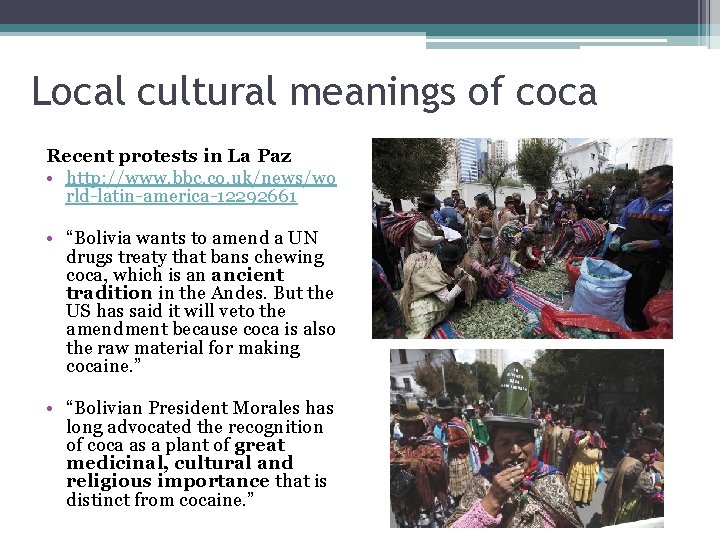
Local cultural meanings of coca Recent protests in La Paz • http: //www. bbc. co. uk/news/wo rld-latin-america-12292661 • “Bolivia wants to amend a UN drugs treaty that bans chewing coca, which is an ancient tradition in the Andes. But the US has said it will veto the amendment because coca is also the raw material for making cocaine. ” • “Bolivian President Morales has long advocated the recognition of coca as a plant of great medicinal, cultural and religious importance that is distinct from cocaine. ”
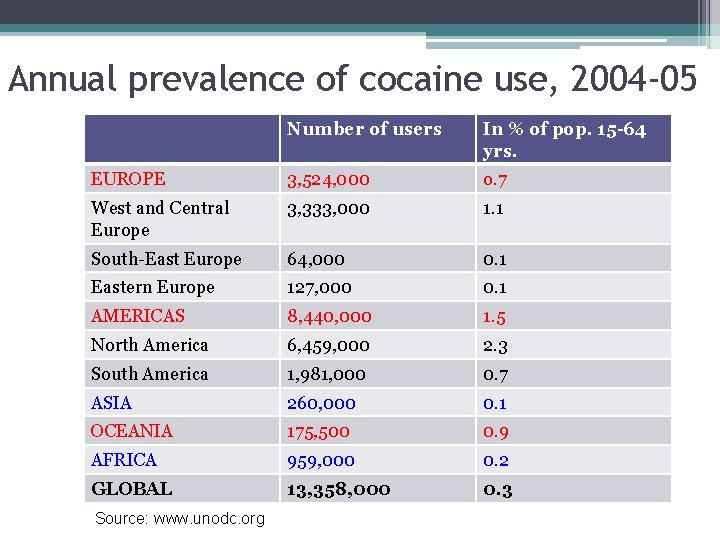
Annual prevalence of cocaine use, 2004 -05 Number of users In % of pop. 15 -64 yrs. EUROPE 3, 524, 000 o. 7 West and Central Europe 3, 333, 000 1. 1 South-East Europe 64, 000 0. 1 Eastern Europe 127, 000 0. 1 AMERICAS 8, 440, 000 1. 5 North America 6, 459, 000 2. 3 South America 1, 981, 000 0. 7 ASIA 260, 000 0. 1 OCEANIA 175, 500 0. 9 AFRICA 959, 000 0. 2 GLOBAL 13, 358, 000 0. 3 Source: www. unodc. org
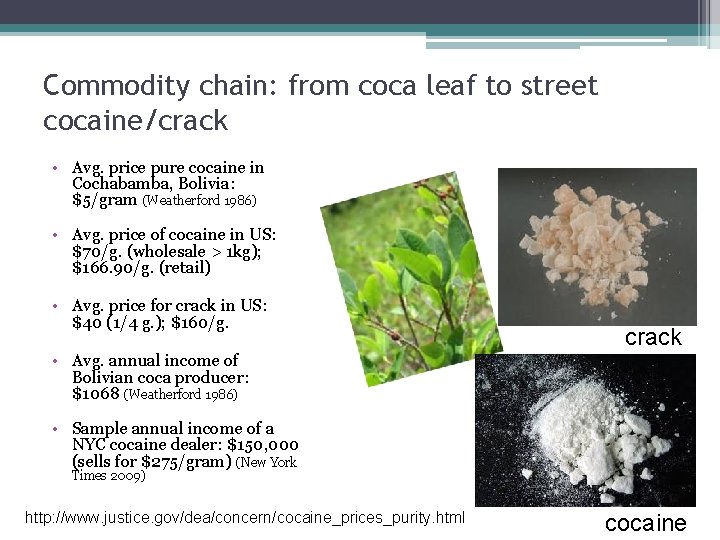
Commodity chain: from coca leaf to street cocaine/crack • Avg. price pure cocaine in Cochabamba, Bolivia: $5/gram (Weatherford 1986) • Avg. price of cocaine in US: $70/g. (wholesale > 1 kg); $166. 90/g. (retail) • Avg. price for crack in US: $40 (1/4 g. ); $160/g. crack • Avg. annual income of Bolivian coca producer: $1068 (Weatherford 1986) • Sample annual income of a NYC cocaine dealer: $150, 000 (sells for $275/gram) (New York Times 2009) http: //www. justice. gov/dea/concern/cocaine_prices_purity. html cocaine
‘War on drugs’– policy level • What is the state’s role? • Survival strategy in absence of state assistance? • Criminalization of marginalized populations seizure of farms in Bolivia; high rates of incarceration in US
Structural violence and agency • Structural violence – physical and psychological harm that results from exploitive and unjust social, political and economic systems (refs: Paul Farmer, Nancy Scheper-Hughes) • Agency – the individual’s capacity to act in the world; contingent on socioecon. and political realities ▫ What are the structural constraints to personal agency for producers and consumers? • How does globalization affect people’s ability to make economic choices?
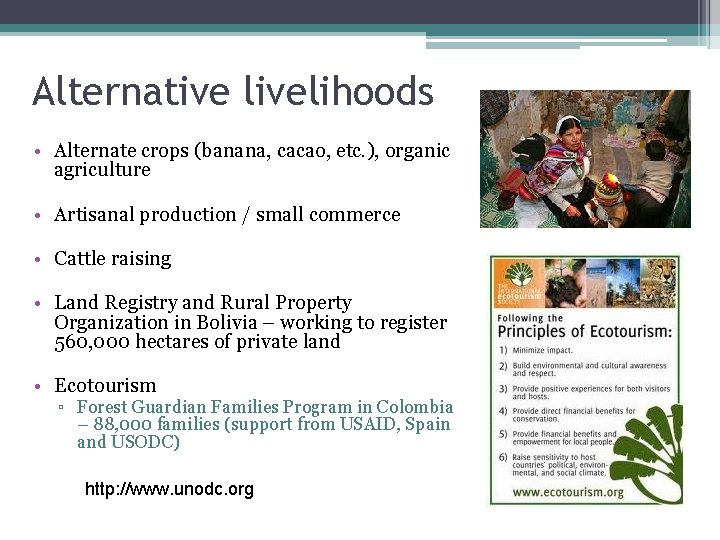
Alternative livelihoods • Alternate crops (banana, cacao, etc. ), organic agriculture • Artisanal production / small commerce • Cattle raising • Land Registry and Rural Property Organization in Bolivia – working to register 560, 000 hectares of private land • Ecotourism ▫ Forest Guardian Families Program in Colombia – 88, 000 families (support from USAID, Spain and USODC) http: //www. unodc. org
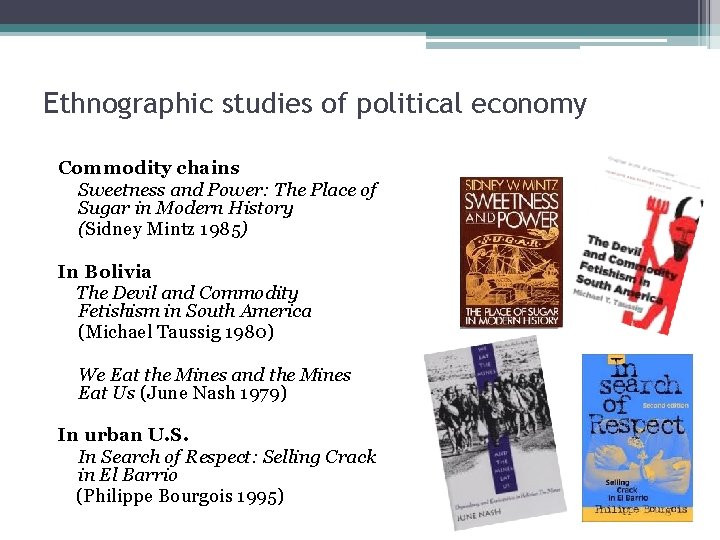
Ethnographic studies of political economy Commodity chains Sweetness and Power: The Place of Sugar in Modern History (Sidney Mintz 1985) In Bolivia The Devil and Commodity Fetishism in South America (Michael Taussig 1980) We Eat the Mines and the Mines Eat Us (June Nash 1979) In urban U. S. In Search of Respect: Selling Crack in El Barrio (Philippe Bourgois 1995)
- Slides: 21