
Globalization and News Translation and Mass Media Communication
Globalization and News Translation and Mass Media Communication © Cristina Marinetti 2012
Globalization and Translation • New economy as informational and global, • • interconnectedness, increase need for translation (Cronin, 2003) Theories of globalization also foreground: the compression of space (Cyberspace; instant communication) (Bielsa & Bassnett 2009: 19) Compression of space brings negative consequences: – A sense of fragmentation (modernist, post-modernist art and fiction) – Distancing of social relationships – New sense of time – instantaneous time (Lash and Urry qt. in Bassnett and Bielsa, 2009)
Instantaneous time ‘the instantaneous character of contemporary time facilitates its use by powerful organizations which often results in a flattening and disembedding of social relations. But the use of instantaneous time can also be enabling for ordinary subjects. They can view and evaluate different cultures at the flick of a switch. This enables the rapid and estensive juxtaposition of, and comparison between, different cultures and places. (Lash and Urry qt. in Bassnett & Bielsa, 2009: 24) What the consequences of this view of globalization on translation?
Invisible Agents • Globalization theories have highlighted the • • interconnectedness of different languages and cultures which often coexist in the same context/field, In these contexts translation is integrated in the working practices of the professionals. No translated texts or translators? Translation agency or agents of translation While the notion of agency in sociology is generally used in contrast with ‘structure’, in translation studies it is often used to broaden the discussion from the work of individual translator, to the work of other professionals who become ‘agents’ of translation (Inghilleri, 2005).
News agencies as large translation organizations • News agencies are conceived as international spaces • • • (Agence France Press; Reuters) Their role is: Ø to facilitate communication flows between different linguistic communities Ø to reach global publics with maximum speed and efficiency Translation is of the utmost importance in news agencies It’s inseparable from other journalistic practices that intervene in the production of news
Rewriting news • Global news agencies gather, process and sell news not • • • to the public but to: News organizations (newspapers, TV stations etc) around the world News agencies produce raw information but also ready-to-print news (news reports, analyses and comments) News organizations can reproduce that material fully or in part, introducing any alteration, change (REWRITING) they see fit without even acknowledging the source.
Translation ‘agents’ in global news • News agencies do not employ translators as such but • • foreign correspondents & local journalists Foreign correspondents: Ø highly mobile, stay in post for no longer than 5 years Ø Maintain close links with home Ø Write news reports in the main language of the agency (e. g. English; French) Local Journalists: Ø Employed in the agency’s local offices/bureaus Ø Not directly linked to headquarters, they function independently Ø Write news reports in their own language and translate news reports from other wires for the local market
Translation as rewriting • Translation is not seen as separate from other • • journalistic tasks (selecting, writing up, editing) News editors work as part of a ‘desk’ where reports are edited and translated (often called trans-editing) Transediting involves the tasks of: selection, correction, verification, completion, development or reduction Like literary rewritings, journalistic rewritings are the form in which news is made available to readers worldwide But this aspect is often hidden or taken for granted
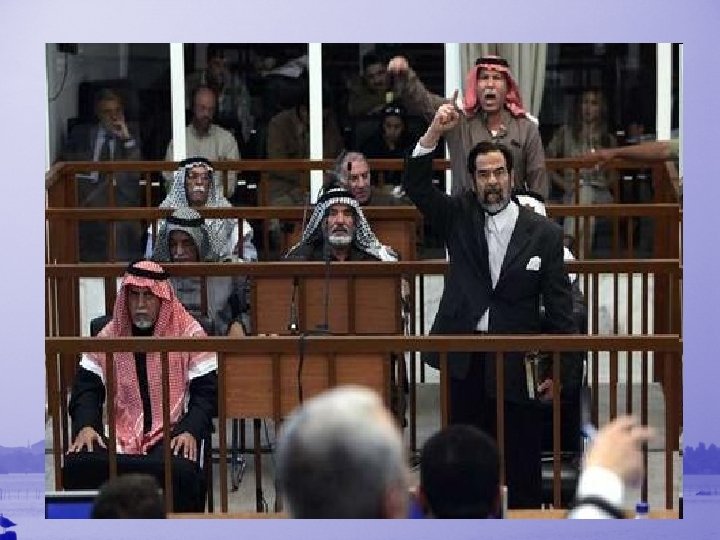
Example 2: Saddam’s trial • Both versions are ‘transedited’ versions of the Saddam trial which occurred in the original Arabic • Do the two reports give the same picture of the trial? • If not, what differences in the language used contribute to give a different picture?
- Slides: 10