
Globalization and Multicultural Management Susan Vonsild Interlink Crosscultural
Globalization and Multicultural Management Susan Vonsild Interlink
Cross-cultural management studies the behavior of people in organizations around the world and trains people to work in organizations with employee and client populations. It describes organizational behavior within countries and cultures; Compares organizational behavior across cultures and countries: and perhaps, most importantly, seeks to understand improve the interaction of co-workers, clients, suppliers, and alliance partners from different countries and cultures. Cross-cultural management thus expands the scope of domestic management to encompass the international and multicultural spheres. Adler: “International Dimensions of Organizational Behavior” (1991)
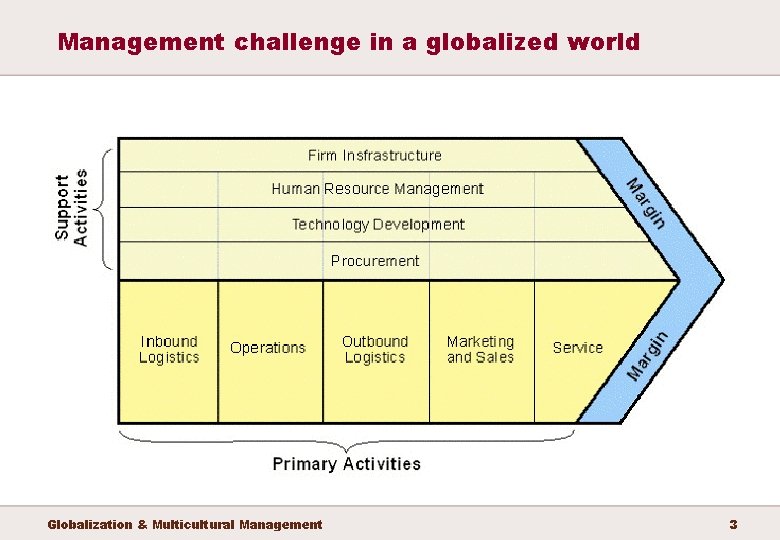
Management challenge in a globalized world Globalization & Multicultural Management 3
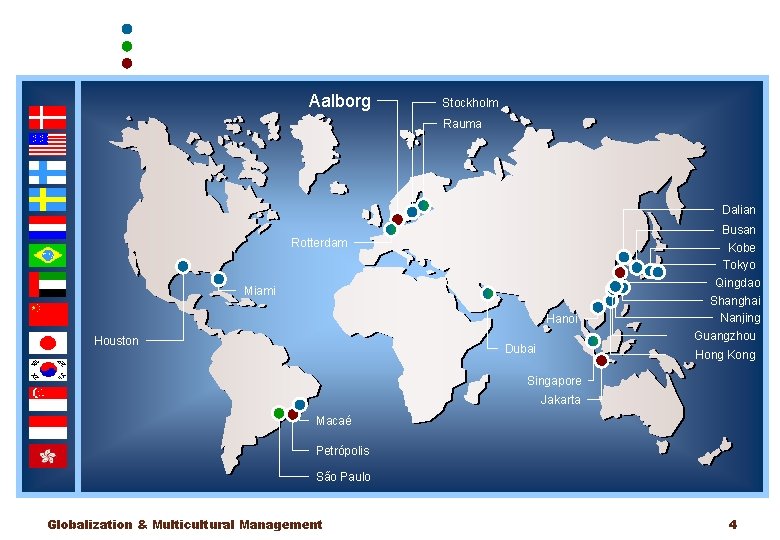
Aalborg Industries Selskaber Marine aktiviteter Industri aktiviteter Fabrikker Aalborg Stockholm Rauma Dalian Rotterdam Miami Hanoi Houston Busan Kobe Tokyo Qingdao Shanghai Nanjing Guangzhou Dubai Hong Kong Singapore Jakarta Macaé Petrópolis São Paulo Globalization & Multicultural Management 4
Business forms new & old: • • • HQ-Subsidiaries Projects Joint ventures M&A Strategic alliances, partnerships Outsourcing/Offshoring >> Mgt of operations which are located in different organisations in different parts of the world with personnel of diverse backgrounds.
Changing structures & management capabilities From traditional hierarchical structures emphasizing either-or choices (centralization vs decentralization, product vs geographcial divisions) >> Transnational, integrated networks of assets and resources with multidimensional mgt perspectives and capabilities, and flexible coordinative processes. Managers must be able to sense and intepret complex and dynamic environmental changes; able to develop & integrate multiple strategic capabilities; able to build & manage the new organisations required to link these sensing and response capabilities; and deliver coordinated action on a world-wide basis. Bartlett & Ghoshal, ”Building Transnational Capabilties: The Management Challenge” (2000) Globalization & Multicultural Management 6
Changing management capabilities Global business management: worldwide business strategist architect of assets and resources configuration cross-border coordinator Worldwide functional management: worldwide intelligence scanner cross-polinator of ”best practices” champion of transnational innovation Geographic subsidiary management: bicultural interpreter national defender & advocate frontline Implementer of Corporate stategy Top level corporate managemnnt providing direction & purpose leveraing corporate performance ensuring continual renewal Globalization & Multicultural Management Bartlett & Ghoshal, ”Building Transnational Capabilties: The Management Challenge” (2000 7
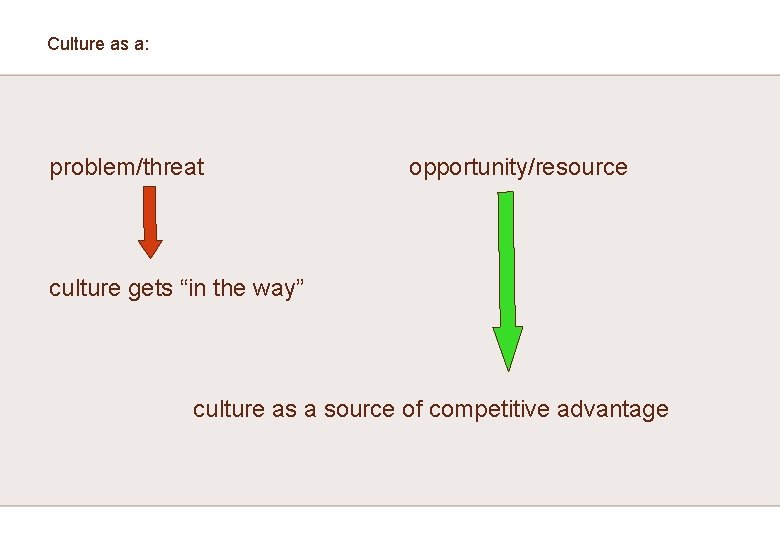
Culture as a: problem/threat opportunity/resource culture gets “in the way” culture as a source of competitive advantage
How to get that competitive advantage? “importance of releasing cultural synergies at the interfaces where knowledge, values and experience are exchanged” Søderberg & Holden “Rethinking Cross Cultural Management in a Globalizing Business World” (2002) Example: Indian Global Sales Manager for a Danish company from his office in Shanghai.
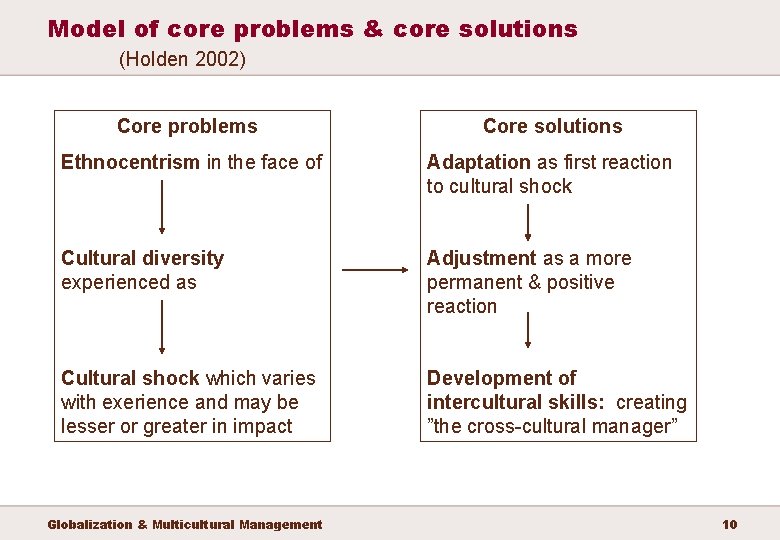
Model of core problems & core solutions (Holden 2002) Core problems Core solutions Ethnocentrism in the face of Adaptation as first reaction to cultural shock Cultural diversity experienced as Adjustment as a more permanent & positive reaction Cultural shock which varies with exerience and may be lesser or greater in impact Development of intercultural skills: creating ”the cross-cultural manager” Globalization & Multicultural Management 10
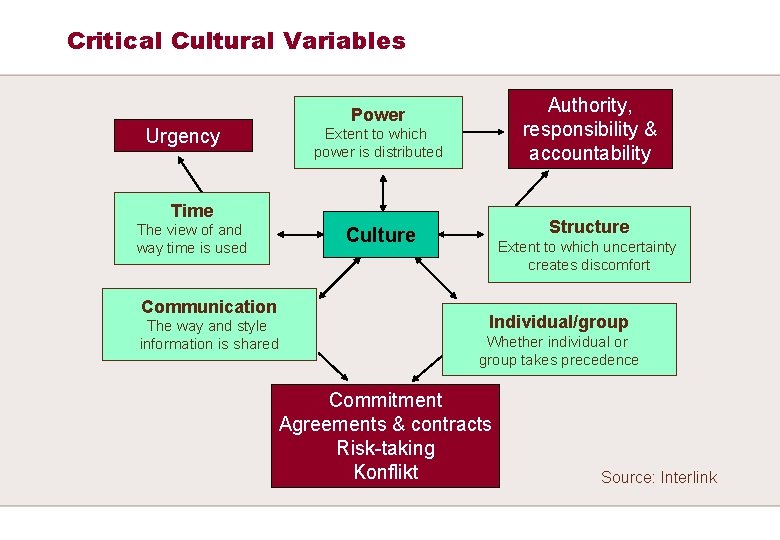
Critical Cultural Variables Authority, responsibility & accountability Power Urgency Extent to which power is distributed Time The view of and way time is used Communication The way and style information is shared Structure Culture Extent to which uncertainty creates discomfort Individual/group Whether individual or group takes precedence Commitment Agreements & contracts Risk-taking Konflikt Source: Interlink
Multi-cultural teams “The central operating mode for a global enterprises is the creation, organization and management of multi-cultural teams – groups that represent diversity in functional capability, experience levels and cultural backgrounds. Rheinsmith, “The Manager’s Guide to Globalization” (1993) Globalization & Multicultural Management 12
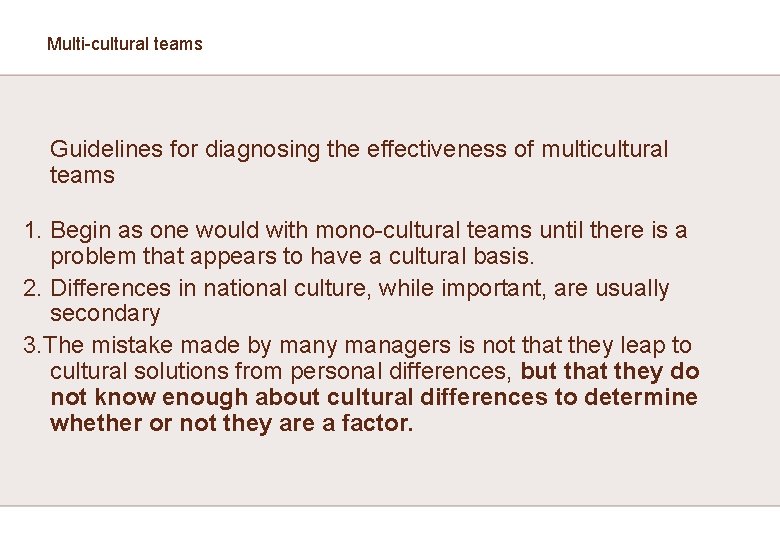
Multi-cultural teams Guidelines for diagnosing the effectiveness of multicultural teams 1. Begin as one would with mono-cultural teams until there is a problem that appears to have a cultural basis. 2. Differences in national culture, while important, are usually secondary 3. The mistake made by managers is not that they leap to cultural solutions from personal differences, but that they do not know enough about cultural differences to determine whether or not they are a factor.
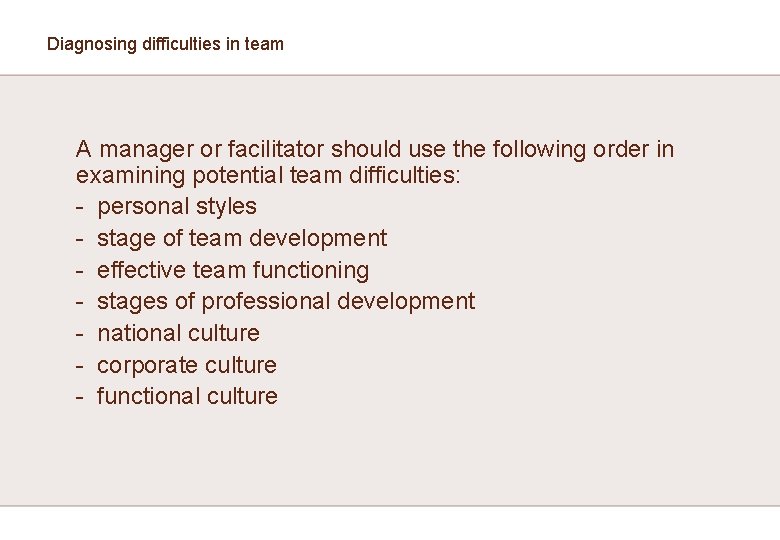
Diagnosing difficulties in team A manager or facilitator should use the following order in examining potential team difficulties: - personal styles - stage of team development - effective team functioning - stages of professional development - national culture - corporate culture - functional culture
Group task • What are the evidences of paradigm shift in the Vicks case? Globalization & Multicultural Management 15
- Slides: 15