
Globalization and FDI International Trade Issues in Comparative

Globalization and FDI International Trade Issues in Comparative Perspective

Globalization and FDI 1. Globalization and movements of products and factors
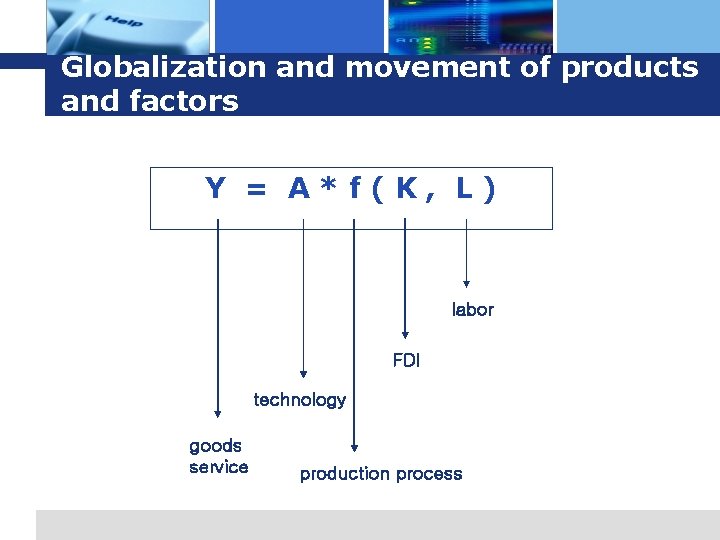
Globalization and movement of products and factors Y = A*f(K, L) labor FDI technology goods service production process
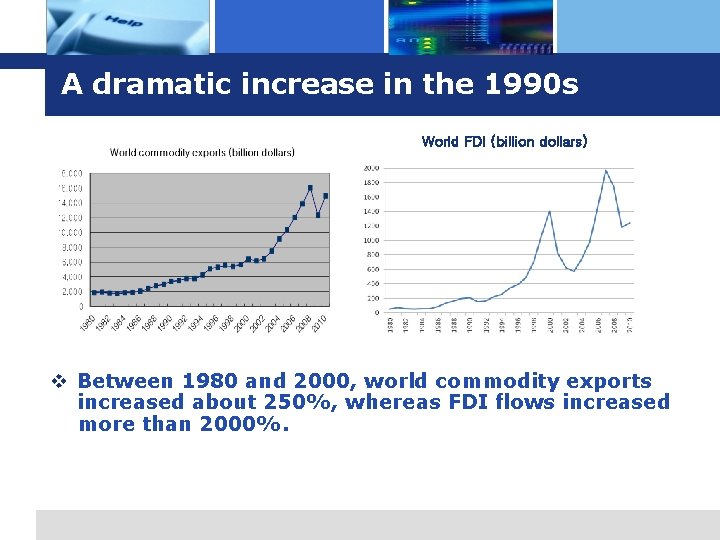
A dramatic increase in the 1990 s World FDI (billion dollars) v Between 1980 and 2000, world commodity exports increased about 250%, whereas FDI flows increased more than 2000%.
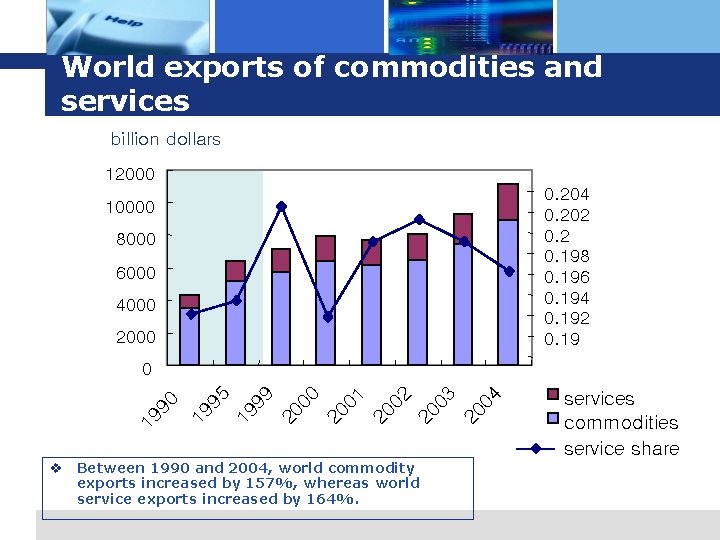
World exports of commodities and services billion dollars 12000 0. 204 0. 202 0. 198 0. 196 0. 194 0. 192 0. 19 10000 8000 6000 4000 2000 v Between 1990 and 2004, world commodity exports increased by 157%, whereas world service exports increased by 164%. 04 20 03 20 02 20 01 20 00 20 99 19 95 19 19 90 0 services commodities service share
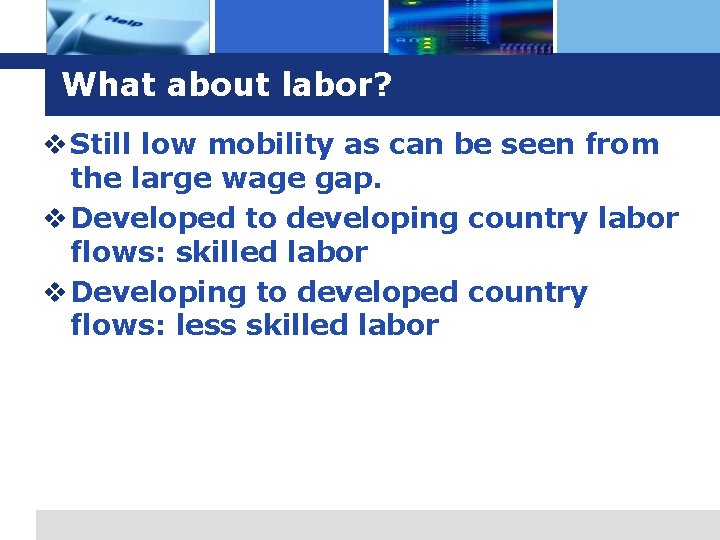
What about labor? v Still low mobility as can be seen from the large wage gap. v Developed to developing country labor flows: skilled labor v Developing to developed country flows: less skilled labor
What about technology? v embedded in capital & labor v loyalties and licenses: very small (less than 6% of total service exports, growth rate lower than the average) v R&D

Globalization and FDI 2. Recent trends
Recent trends v Increasing participation of developing countries v Dominant share of service FDI v Recent increase in primary sector FDI v A new wave of cross-border M&A v Internationalization of R&D v National policy changes v International investment arrangements
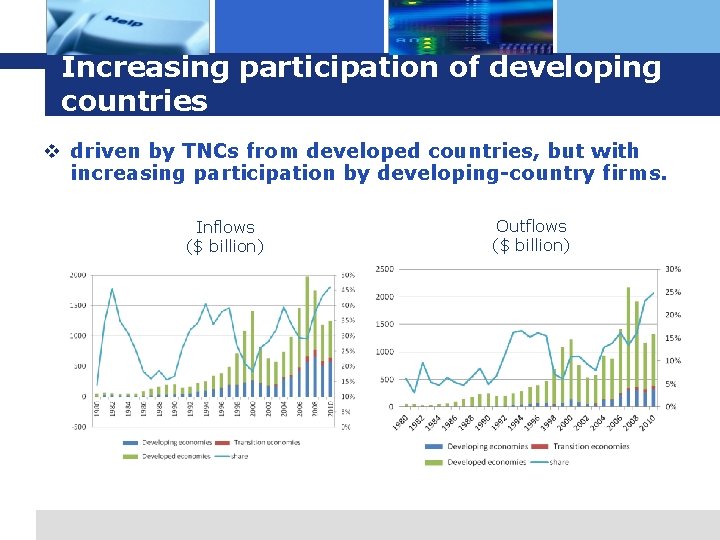
Increasing participation of developing countries v driven by TNCs from developed countries, but with increasing participation by developing-country firms. Inflows ($ billion) Outflows ($ billion)
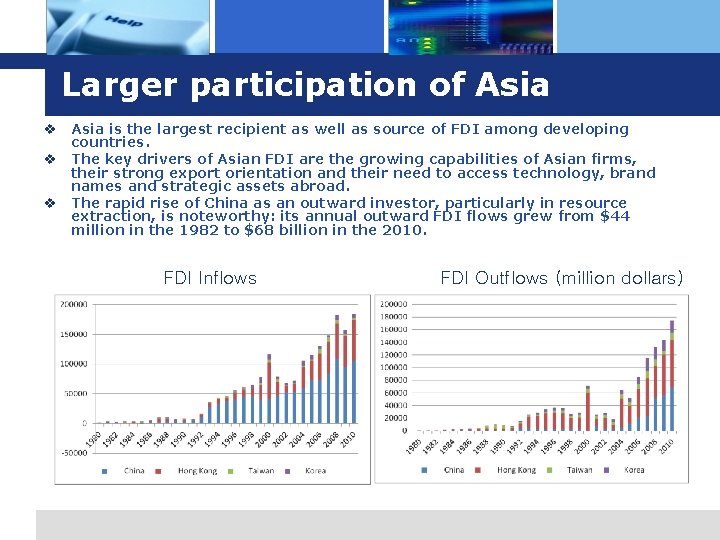
Larger participation of Asia v Asia is the largest recipient as well as source of FDI among developing countries. v The key drivers of Asian FDI are the growing capabilities of Asian firms, their strong export orientation and their need to access technology, brand names and strategic assets abroad. v The rapid rise of China as an outward investor, particularly in resource extraction, is noteworthy: its annual outward FDI flows grew from $44 million in the 1982 to $68 billion in the 2010. FDI Inflows FDI Outflows (million dollars)
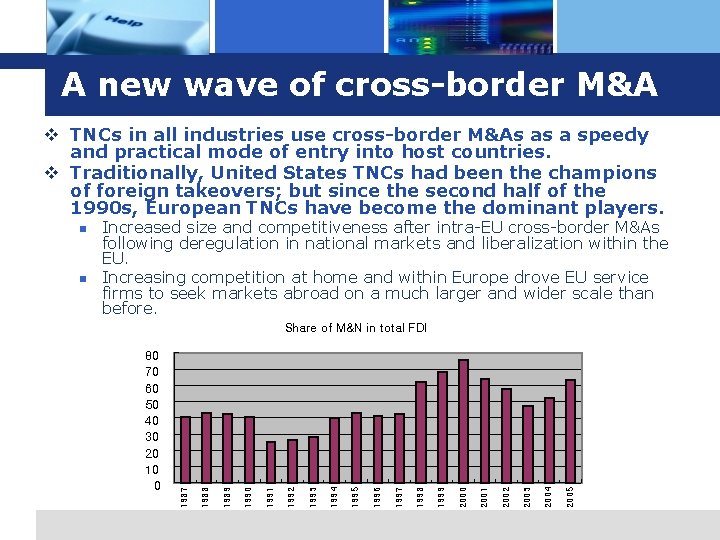
A new wave of cross-border M&A v TNCs in all industries use cross-border M&As as a speedy and practical mode of entry into host countries. v Traditionally, United States TNCs had been the champions of foreign takeovers; but since the second half of the 1990 s, European TNCs have become the dominant players. 2005 2004 2003 2002 2001 2000 1999 1998 1997 1996 1995 1994 1993 1992 1991 1990 80 70 60 50 40 30 20 10 0 1989 Share of M&N in total FDI 1988 n Increased size and competitiveness after intra-EU cross-border M&As following deregulation in national markets and liberalization within the EU. Increasing competition at home and within Europe drove EU service firms to seek markets abroad on a much larger and wider scale than before. 1987 n
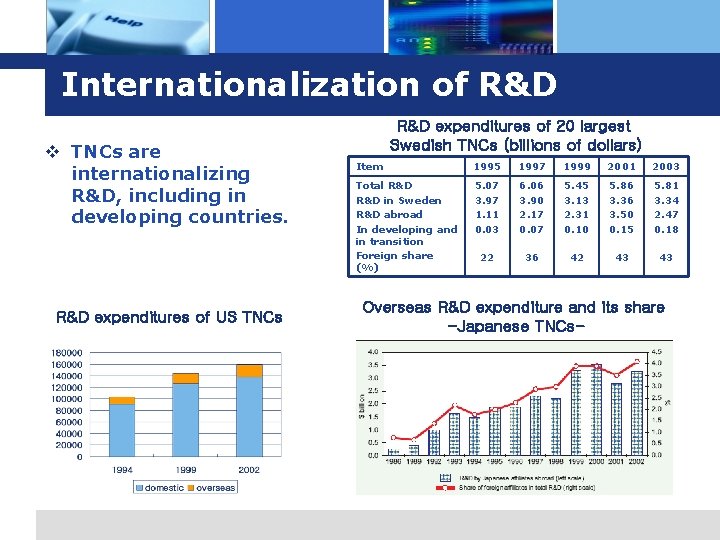
Internationalization of R&D v TNCs are internationalizing R&D, including in developing countries. R&D expenditures of US TNCs R&D expenditures of 20 largest Swedish TNCs (billions of dollars) Item 1995 1997 1999 2001 2003 Total R&D in Sweden R&D abroad In developing and in transition Foreign share (%) 5. 07 3. 97 1. 11 0. 03 6. 06 3. 90 2. 17 0. 07 5. 45 3. 13 2. 31 0. 10 5. 86 3. 36 3. 50 0. 15 5. 81 3. 34 2. 47 0. 18 22 36 42 43 43 Overseas R&D expenditure and its share -Japanese TNCs-

Globalization and FDI 3. Economic Effects
Determinants and Effects of FDI ?
Economic effects v Positive spillovers n n Interaction by nationals with technicians and engineers of the foreign firms can bring about positive knowledge spillovers. Potential for development of new inputs or improvement in the quality of existing ones. Multinationals that export their goods to foreign markets may induce domestic firms to follow suit, thus acting as catalysts for domestic exporters. Condition: the host country has to have capacity to absorb the technology. 16
Economic effects v Negative spillovers n n Domestic firms may be displaced by foreign ones. Domestic firms may find that the cost of factors of production increases as a result of the presence of foreign firms. 17
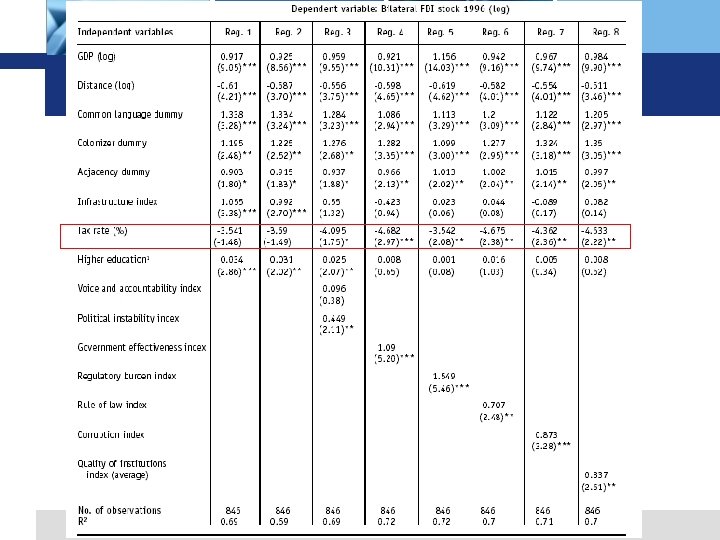
Welfare effect to the host country v Depends on the manner in which the investment is attracted into the country. v If countries compete aggressively by offering subsidies to potential investors, net benefits generated by FDI projects might be competed away and ultimately accrue only to the foreign investors. v A more positive approach is for countries to make themselves more attractive to foreign investors by improving the quality of their institutions, labor force and infrastructure. 19
What determines where FDI goes? v Taxes on foreign corporations n Competing for FDI by lowering taxes or offering subsidies can lead to “race to the bottom”. v Quality of labor force and infrastructure n Countries can make themselves more attractive by educating their labor force or improving the quality of their infrastructure or institutions. v Quality of institutions 20
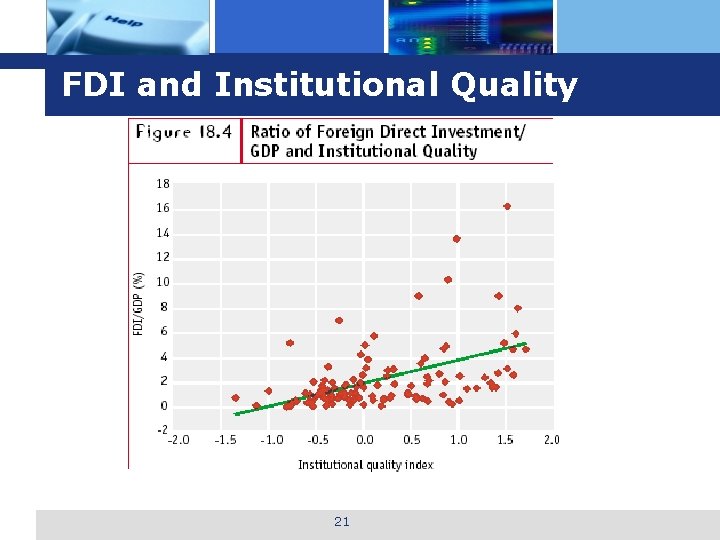
FDI and Institutional Quality 21
22
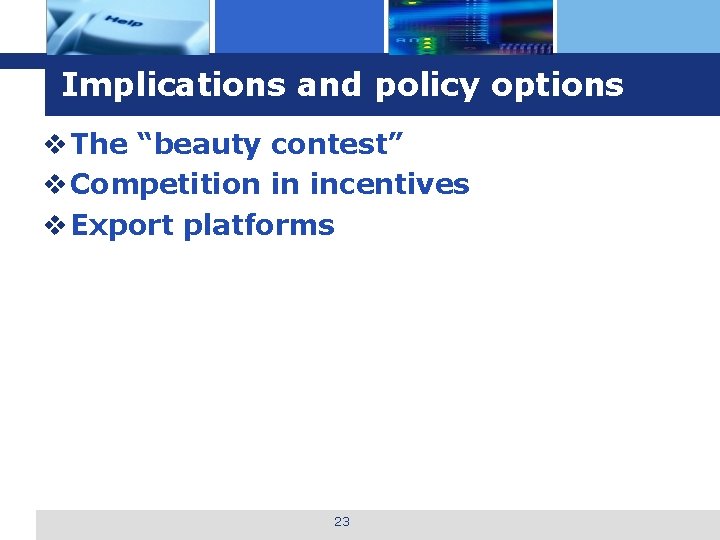
Implications and policy options v The “beauty contest” v Competition in incentives v Export platforms 23
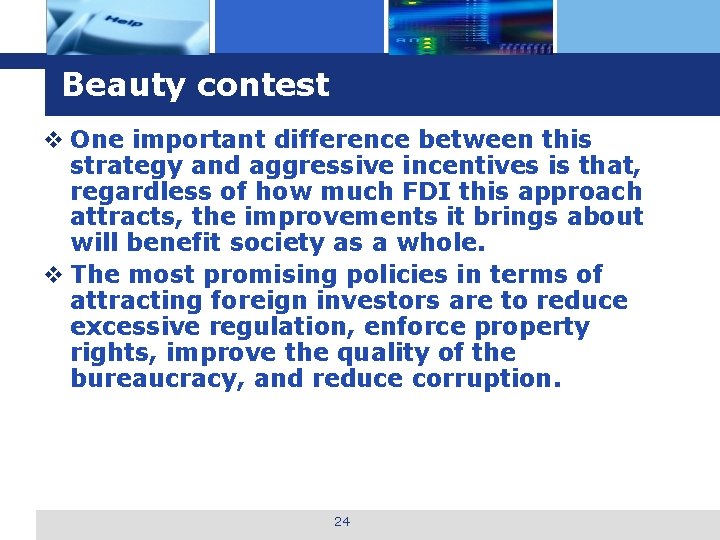
Beauty contest v One important difference between this strategy and aggressive incentives is that, regardless of how much FDI this approach attracts, the improvements it brings about will benefit society as a whole. v The most promising policies in terms of attracting foreign investors are to reduce excessive regulation, enforce property rights, improve the quality of the bureaucracy, and reduce corruption. 24
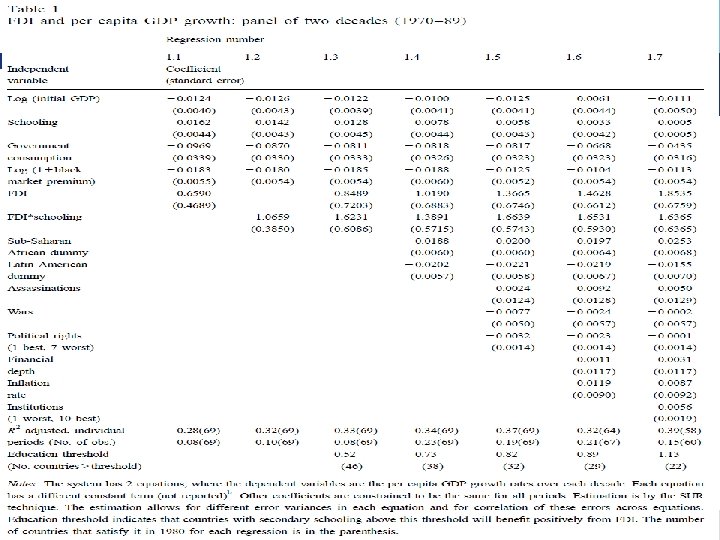
Education of labor force v Education of labor force may have important effects on the benefits from FDI through two channels n n Educating the labor force may affect the type of FDI a host country receives. n Availability of educated labor tends to attract more advanced industries. For a given type of investment, host countries may be better able to derive benefits from FDI if the labor force is educated. n FDI has a positive effect on growth, provided that the host country has sufficient high levels of human capital (Borensztein et al, 1998) 25
Positive feedback v A large foreign investor for which education (infrastructure) is an important consideration will demand that the government improve the educational level of the labor force (quality of infrastructure). v A foreign investor attracted to a country because of its cheap labor will likely demand that the government ensure the continuous availability of cheap labor. 26
Competition in incentives v If there is heated competition between countries to provide incentives for FDI, the main beneficiaries of the investments will be the foreign investors themselves. v The intensity of competition for FDI increased in recent years. Why? n n With the increase in FDI, the stakes in the quest to attract FDI are now much higher. Number of players in the game has increased. n China, subnational governments of US and Brazil 27
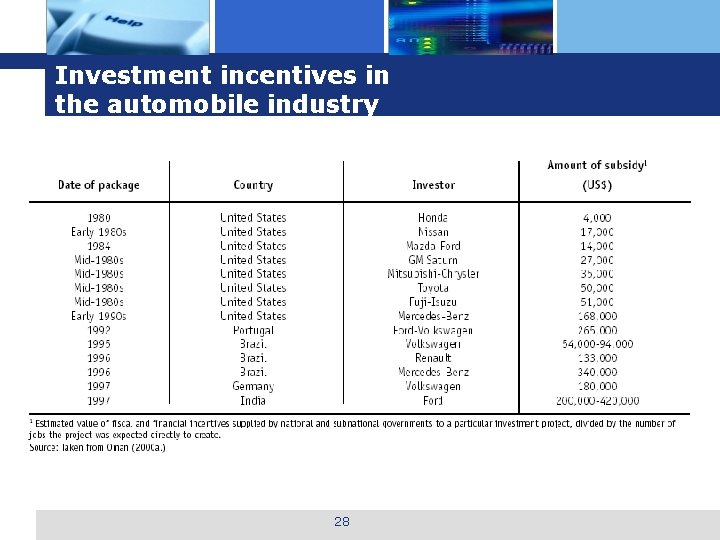
Investment incentives in the automobile industry 28
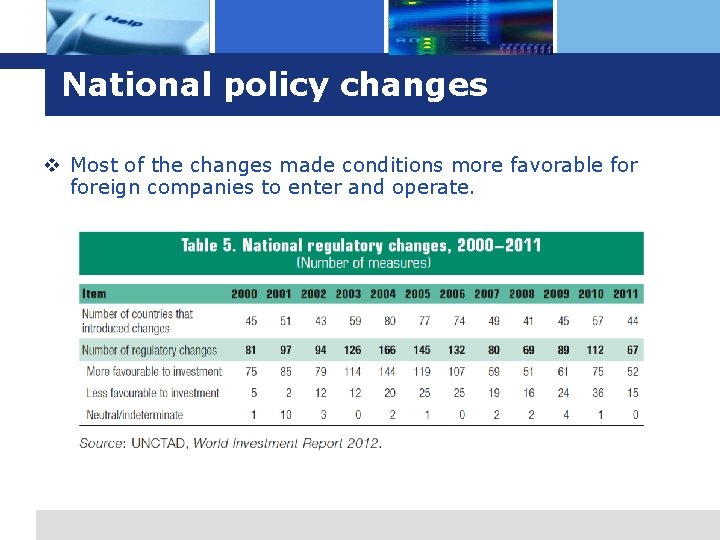
National policy changes v Most of the changes made conditions more favorable foreign companies to enter and operate.
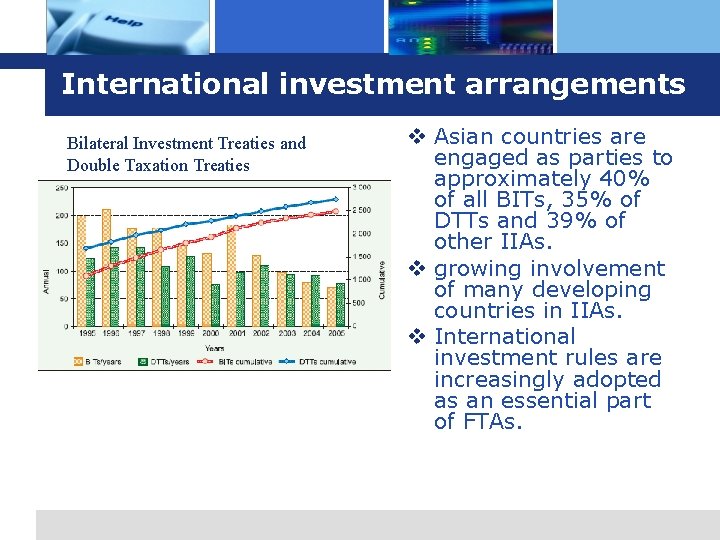
International investment arrangements Bilateral Investment Treaties and Double Taxation Treaties v Asian countries are engaged as parties to approximately 40% of all BITs, 35% of DTTs and 39% of other IIAs. v growing involvement of many developing countries in IIAs. v International investment rules are increasingly adopted as an essential part of FTAs.

Globalization and FDI 4. Regional Integration and FDI
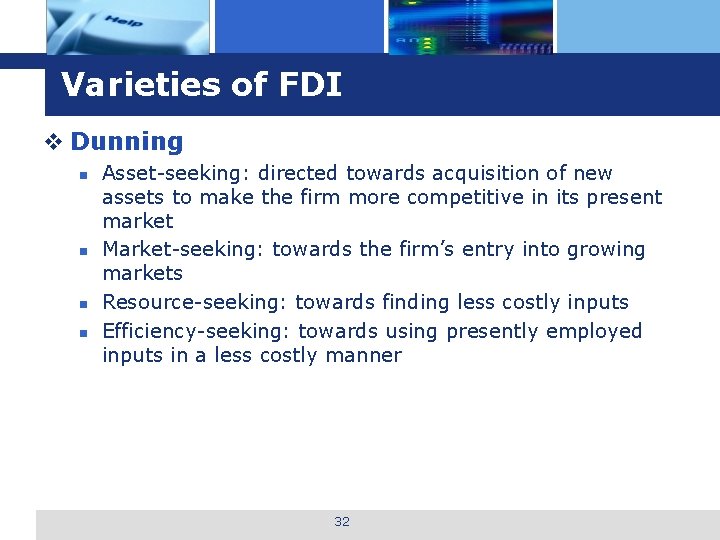
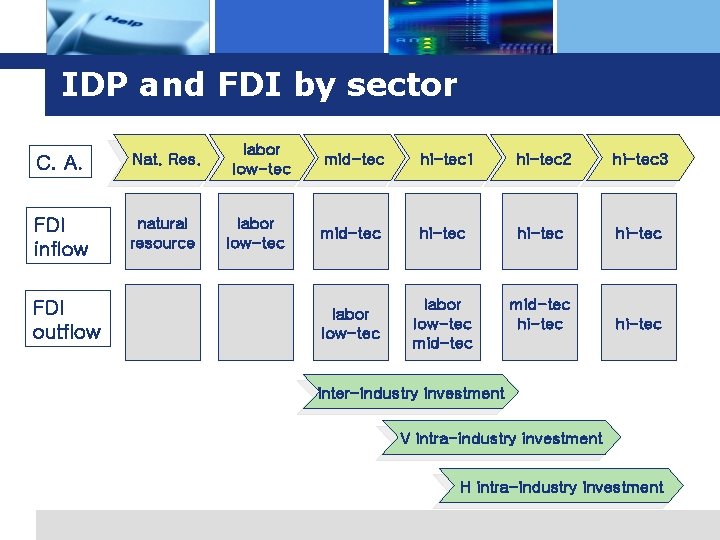
Varieties of FDI v Dunning n n Asset-seeking: directed towards acquisition of new assets to make the firm more competitive in its present market Market-seeking: towards the firm’s entry into growing markets Resource-seeking: towards finding less costly inputs Efficiency-seeking: towards using presently employed inputs in a less costly manner 32
RIAs and Dunning’s FDI v Different categories may be affected differently by integration n n RIAs could generate more resource seeking FDI by facilitating cross-border trade in inputs RIAs could diminish market-seeking FDI if the market in question no longer justifies domestic production of certain goods. 33
Vertical FDI v Vertical FDI: When a corporate facility(management, R&D) can be separated from production facility, firms localize each ‘stage’ of production to take advantage of international differences in factor prices. n n n resource-seeking, efficiency-seeking and, in some instances, the asset-seeking categories of FDI. No FDI between countries with similar factor endowments. Vertical FDI complementary with trade 34
Horizontal FDI v Horizontal FDI: firms invest in other countries and produce a homogeneous good in multiple production facilities, each facility supplying its domestic market. n n n Market-seeking and, in some instances, the assetseeking categories. The volume of horizontal FDI depends on the interplay between firm-level fixed costs, plant-level fixed costs, and trade costs. FDI will arise when trade costs are large (tariff-jumping) Horizontal FDI is a substitute for trade Horizontal FDI is less likely to be found among countries with very different factor proportions. 35
Implications v FDI from North to South are more likely to be vertical, while N-N and S-S flows are more likely to be horizontal. However, n n n The general absence of high trade barriers among developed countries weakens the likelihood that N-N FDI will be horizontal. Horizontal FDI can arise between N-S, even when their factor endowments are very different, as long as trade barriers are high enough. It may be that much of FDI does not fall neatly into either of the two categories. Differentiated goods 36
RIAs and FDI v N-N: Dunning finds that since Europe’s 1985 launch of its Internal Market Program, both intra-EC and outside-EC FDI have been stimulated, particularly the latter; FDI has grown the most in knowledgeintensive activities; and the growth of FDI has been complementary to the growth of trade. v S-S: Chudnovsky and Lopez find that FDI in Mercosur has been largely from nonregional sources; has taken the form primarily of M&As; has displaced domestic investment; and has been directed towards supplying the internal market. v N-S: Waldkirch finds that NAFTA has substantially increased FDI in Mexico, mostly from intra-regional partners Canada and the United States. He infers that the agreement’s impetus to vertical integration is the likely explanation. 37
Case study methodology v Advantage: one can take into account the institutional detail of the countries under study. v Disadvantage: difficult to draw conclusions about the importance of RIAs for FDI when so many other variables complicate the cases. n n In Mercosur, it is difficult to disentangle the effect of the RIA from that of macroeconomic stabilization. In Mexico, the effect of NAFTA is hard to distinguish from that of other changes in policies toward FDI. 38
Gravity Model v Data: International direct investment statistics (OECD) v 20 source OECD countries, 60 host countries v Dependent variable: bilateral outward FDI stocks from 1982 through 1998 39
Effects of RIAs on FDI v Vertical integration: Lower tariffs lower transaction costs for firms to integrate vertically within the RIA FDI creation v Tariff-jumping: Lower tariffs lower costs of serving markets through trade Should reduce FDI from RIA partners. v FDI diversion: If a RIA makes the partner countries relatively more attractive, non-members likely to get less FDI. v FDI dilution: If a RIA expands, locational advantages of original members are diluted. Example: Mexico in FTAA. v Extended market effect: generates new investment in activities with economies of scale. Larger markets make it more worthwhile for outside FDI to “jump” external tariff. v Redistributive effects: The regional effect is not evenly distributed: New and existing FDI may be relocated to more attractive countries winners and losers. 40
Regional integration variables v Same RIA dummy = 1 when source and host country belong to the same free trade area. Source: Frankel (1997) v Extended market effect: host extended market: log of the joint GDP of all the countries that are RIA partners of the host country, including host country itself v Diversion / dilution effects: source extended market: log of the joint GDP of all the countries that are RIA partners of the source country, including source country itself v extended market variables capture the of size of the market to which a firm in the country has access with zero tariff 41
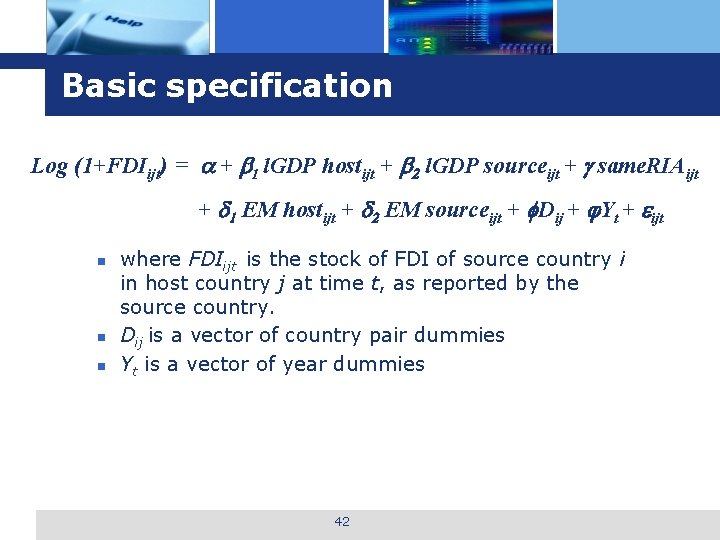
Basic specification Log (1+FDIijt) = a + b 1 l. GDP hostijt + b 2 l. GDP sourceijt + g same. RIAijt + d 1 EM hostijt + d 2 EM sourceijt + f. Dij + j. Yt + eijt n n n where FDIijt is the stock of FDI of source country i in host country j at time t, as reported by the source country. Dij is a vector of country pair dummies Yt is a vector of year dummies 42
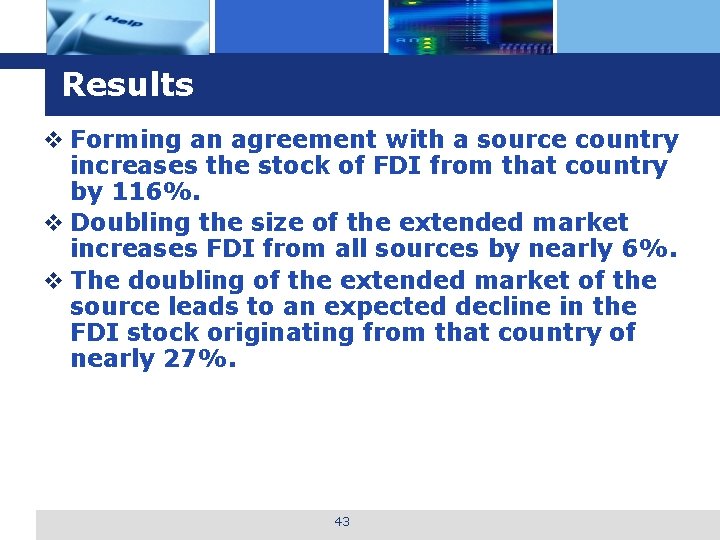
Results v Forming an agreement with a source country increases the stock of FDI from that country by 116%. v Doubling the size of the extended market increases FDI from all sources by nearly 6%. v The doubling of the extended market of the source leads to an expected decline in the FDI stock originating from that country of nearly 27%. 43
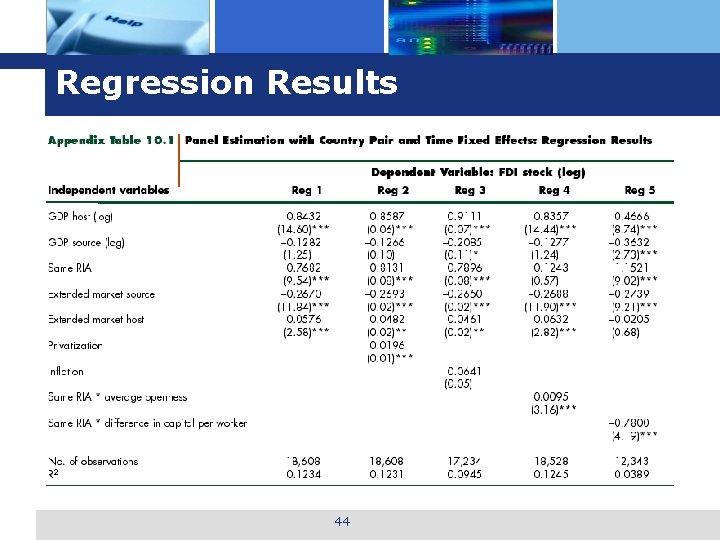
Regression Results 44
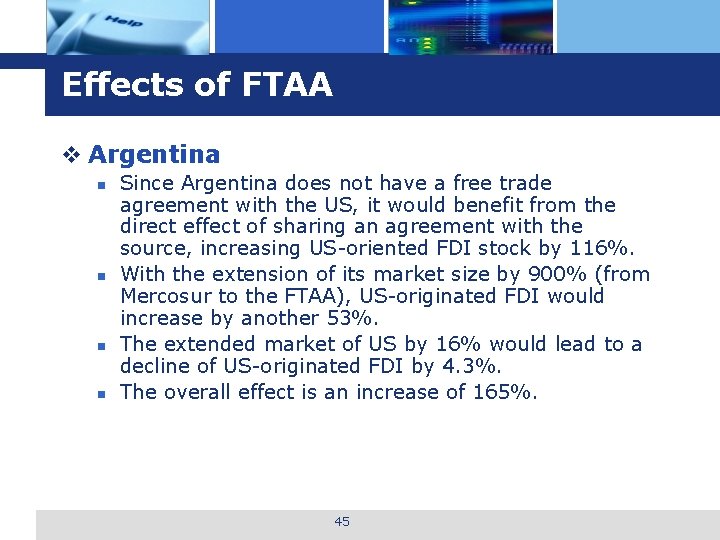
Effects of FTAA v Argentina n n Since Argentina does not have a free trade agreement with the US, it would benefit from the direct effect of sharing an agreement with the source, increasing US-oriented FDI stock by 116%. With the extension of its market size by 900% (from Mercosur to the FTAA), US-originated FDI would increase by another 53%. The extended market of US by 16% would lead to a decline of US-originated FDI by 4. 3%. The overall effect is an increase of 165%. 45
Effects of FTAA v Mexico n n n As Mexico is member of NAFTA, the FTAA would have no direct effect on US-originated FDI. The extension of Mexico’s market from existing FTAs to FTAA would be 13%, leading to an increase of USoriginated FDI of 0. 75%. Netting the source extended market effect (-4. 3%), the overall effect is a decline of 3. 5%. 46

Globalization and FDI 5. Increasing FDI from Developing Countries
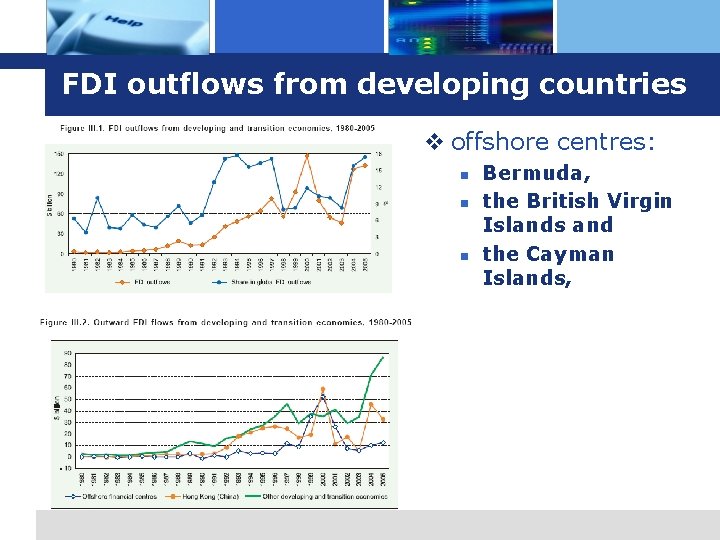
FDI outflows from developing countries v offshore centres: n n n Bermuda, the British Virgin Islands and the Cayman Islands,
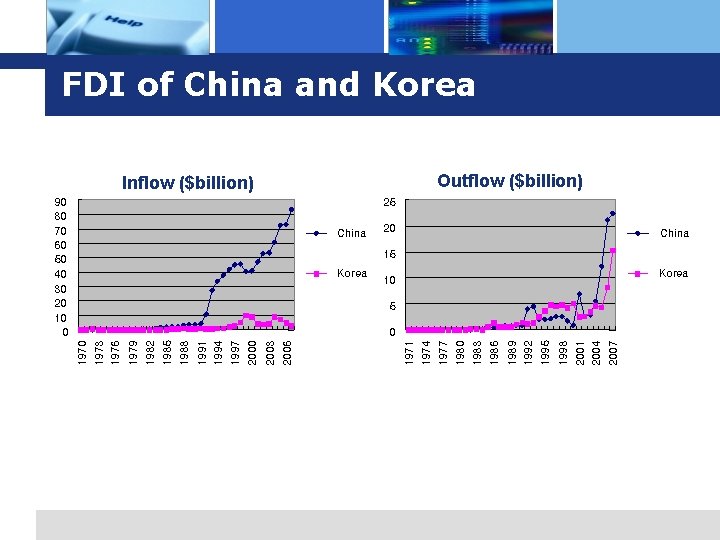
FDI of China and Korea Outflow ($billion) Inflow ($billion) 90 80 70 60 50 40 30 20 10 0 25 China 20 China 15 Korea 10 5 2007 2001 2004 1998 1995 1989 1992 1986 1983 1980 1977 1974 1971 2006 2003 2000 1997 1991 1994 1988 1985 1982 1979 1976 1973 1970 0
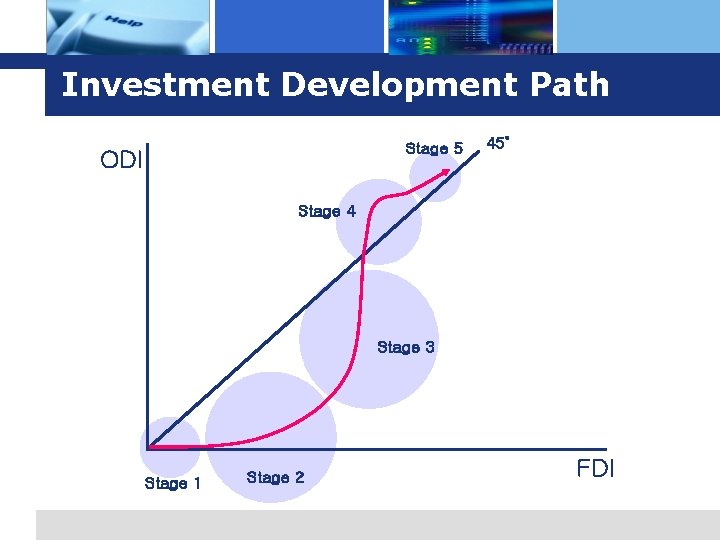
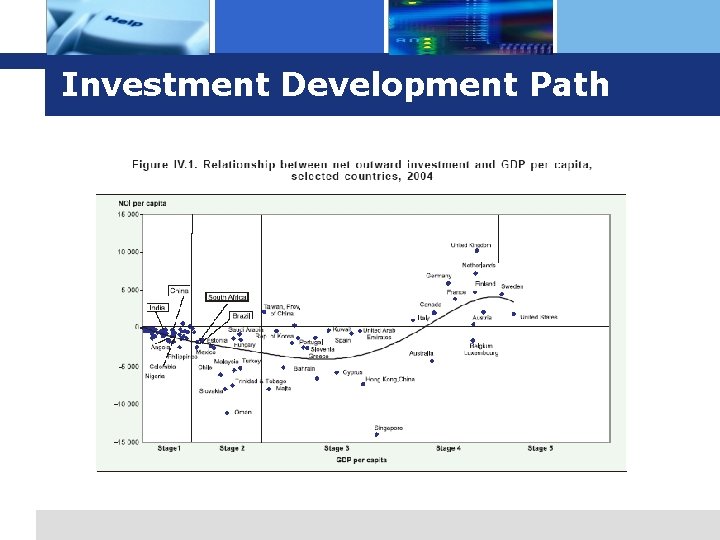
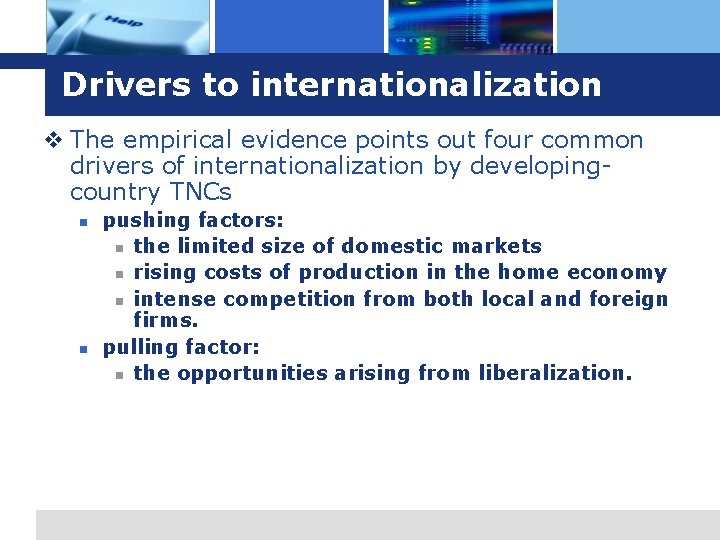
Investment Development Path v The IDP theory argues that as countries become more industrialized or developed their firms are likely to build up firm-specific advantages, and so are able to compete more effectively at the international level. v As developing economies become more open to international competition, their firms are increasingly forced to compete with TNCs from other countries in their home and foreign markets, and one of the means at their disposal is through FDI.
Investment Development Path Stage 5 ODI 45˚ Stage 4 Stage 3 Stage 1 Stage 2 FDI
Investment Development Path
IDP and FDI by sector C. A. Nat. Res. FDI inflow natural resource FDI outflow labor low-tec mid-tec hi-tec 1 hi-tec 2 hi-tec 3 mid-tec hi-tec labor low-tec mid-tec hi-tec inter-industry investment V intra-industry investment H intra-industry investment
Drivers to internationalization v The empirical evidence points out four common drivers of internationalization by developingcountry TNCs n n pushing factors: n the limited size of domestic markets n rising costs of production in the home economy n intense competition from both local and foreign firms. pulling factor: n the opportunities arising from liberalization.

Globalization and FDI 5. FDI and FDI in Service
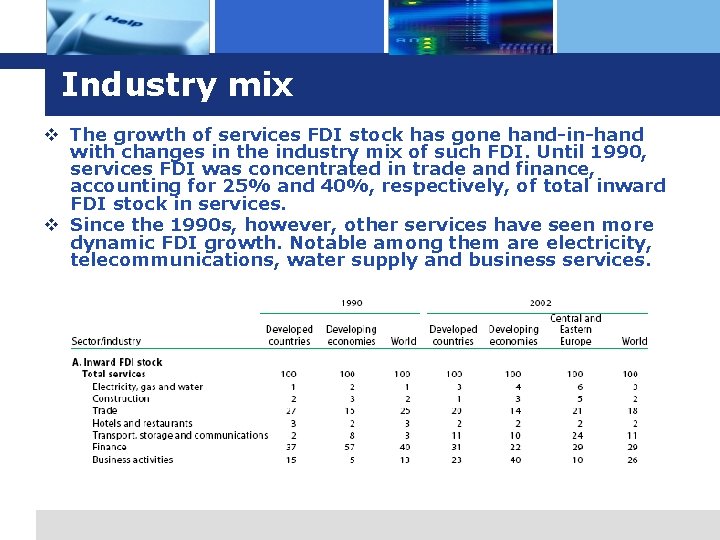
Industry mix v The growth of services FDI stock has gone hand-in-hand with changes in the industry mix of such FDI. Until 1990, services FDI was concentrated in trade and finance, accounting for 25% and 40%, respectively, of total inward FDI stock in services. v Since the 1990 s, however, other services have seen more dynamic FDI growth. Notable among them are electricity, telecommunications, water supply and business services.
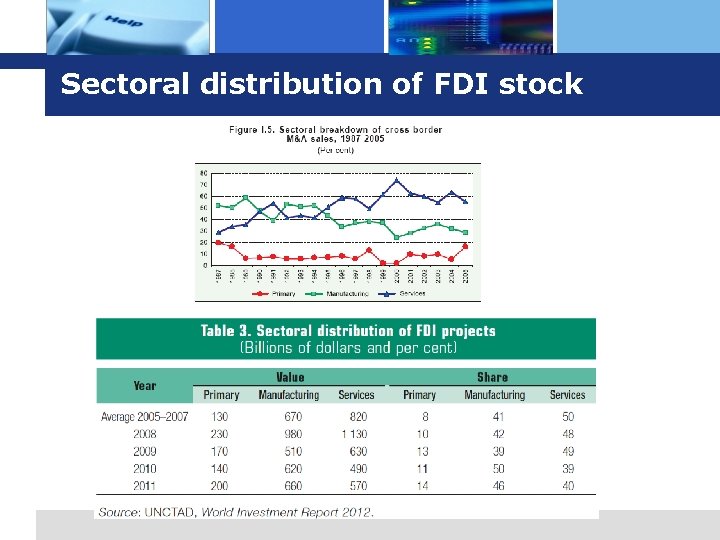
Sectoral distribution of FDI stock
Industry mix v OECD n n Transportation, telecommunications, real estate and hotels and restaurants are, on average, the service industries in which inward FDI plays the smallest role. Business services, and computer and related services, are at the other end of the spectrum, while financial and trading services fall in between. v Developing countries n FDI/GDP is high in finance, electricity and, to a lesser extent, transport, storage and communications, and low in construction and hotels and restaurants
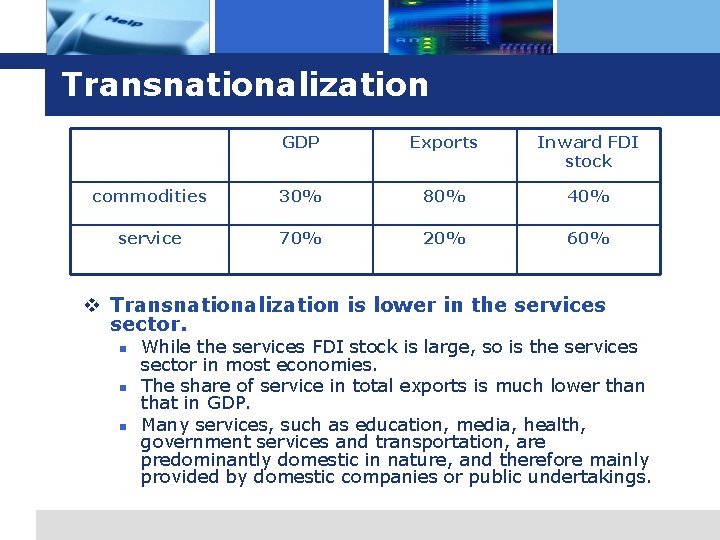
Transnationalization GDP Exports Inward FDI stock commodities 30% 80% 40% service 70% 20% 60% v Transnationalization is lower in the services sector. n n n While the services FDI stock is large, so is the services sector in most economies. The share of service in total exports is much lower than that in GDP. Many services, such as education, media, health, government services and transportation, are predominantly domestic in nature, and therefore mainly provided by domestic companies or public undertakings.
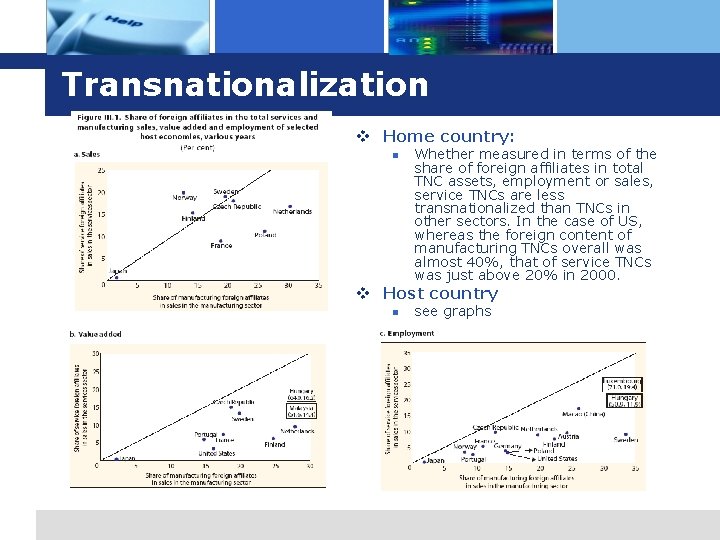
Transnationalization v Home country: n Whether measured in terms of the share of foreign affiliates in total TNC assets, employment or sales, service TNCs are less transnationalized than TNCs in other sectors. In the case of US, whereas the foreign content of manufacturing TNCs overall was almost 40%, that of service TNCs was just above 20% in 2000. v Host country n see graphs
Non-equity forms of investment v Difference between TNCs in goods and services: Non-equity forms of investment n franchising, management contracts, concessions, partnerships, turnkey, build-operate-and-transfer (BOT) and build-transfer-and-operate (BTO) projects. v Different capital flows but similar impacts as FDI v They are important in hotels, fast-food outlets, restaurants, car rentals, retailing, and various professional services. n n A survey of 34 large international hotel chains in the 1990 s showed that fully- or partially-owned foreign affiliates in 1990 s accounted for only 36% of their overseas properties. The rest took the form of non-equity arrangements as management contracts (37%) and franchising agreements (28%).
Reasons of Non-equity forms of investment v The competitive advantages of service firms consist of knowledge-based, intangible assets, rather than tangible ones that are more important in manufacturing firms. n n Intangible assets, such as organizational and managerial expertise, can be separated from tangible and capital-intensive ones. ex. hotel industry v In some service industries, host countries’ policies are decisive in determining the mode of entry and the forms of cross-border inter-firm cooperation. n ex. air transportation : deregulation but restricted foreign ownership → cross-border alliance rather than FDI v Privatization: Concession of state owned assets n Ex. Ports, electricity company
Players of service FDI v Goods TNCs n n A large – but declining – proportion of outward FDI in services is controlled by goods rather than service TNCs: at least 41% in the case of the United States in 1999 and 10% in Germany in 2000. marketing, financial, R&D affiliates v Service TNCs n n United States TNCs still have a strong presence in many services, but they are less dominant than 20 years ago, and in some industries they no longer occupy leading positions. The role of Japanese trading TNCs and banks has decreased. Most importantly, a large group of new TNCs has emerged in service industries that are new for FDI – notably telecommunications, electricity, water and postal services – somewhat sidelining long-standing TNCs in traditional FDI industries such as banking or trading. Another big change is the rise of service TNCs from developing economies.
Drivers of service FDI v The rise in the share of services in economic activity v the externalization of services to independent providers v the growing service intensity of the production of goods v the deregulation of service markets and the liberalization of FDI policies v greater competitive pressures in service markets v OLI advantages
Eclectic Theory (Dunning) v Three preconditions for firms to engage in international production 1. 2. 3. Ownership-specific advantage: The firm possesses net ownership advantages (largely of intangible assets) visà-vis firms of other nationalities in serving particular markets. Internalization advantage: It must be more beneficial to the enterprise possessing these advantages to use them itself rather than to sell or lease them to foreign firms, that is, for it to internalize its advantages through an extension of its own activities rather than externalize them through licensing. Location advantage: It must be profitable for the enterprise to utilize these advantages in conjunction with at least some factor inputs outside its home country.
OLI and service FDI v O: At the beginning, the objective of service FDIs is to support overseas manufacturing or trade. But increasingly on their own. n n what are the advantages of banking, hotel, consulting, etc? Have these increased? v L: access to a good information and communication infrastructure, well-developed institutions and trained human resources, privatization, protection of IPR v I: safeguard proprietary knowledge, ensure product quality, minimize transaction costs associated with opportunism, protect property rights, avoid search and negotiation costs, tap synergies from geographical diversification, obtain inputs or develop new markets n Many of the improvements in firms’ ownership-specific advantages are based on proprietary knowledge on which profits might be maximized though internalization.
Types of FDI by motives v Dunning n n Asset-seeking: directed towards acquisition of new assets to make the firm more competitive in its present market Market-seeking: towards the firm’s entry into growing markets Resource-seeking: towards finding less costly inputs Efficiency-seeking: towards using presently employed inputs in a less costly manner
Seeking for market or efficiency? v Mostly market seeking: non-tradability of service n In 2001, 84% of worldwide sales of services in host countries by foreign affiliates of United States TNCs were local sales, while the corresponding share for goods was 61%. v Towards efficiency seeking n n Services production is evolving in the direction of integrated international production networks. TNCs locate one or more functional activities along the value chain of services in affiliates abroad, and integrate them with activities elsewhere within their production systems. simple integration: parent firms ↔ affiliates complex integration: + affiliates ↔ affiliates v In goods, there has been a long-term shift towards complex integration. v Integrated international production in services remains largely simple integration

Globalization and FDI 6. FDI and Production Sharing
Production sharing v fragmentation, internationalization, integration, division of labor v The possibility of breaking up the production process depends on the techniques of production of industries. v phenomenon mostly observed in manufacture
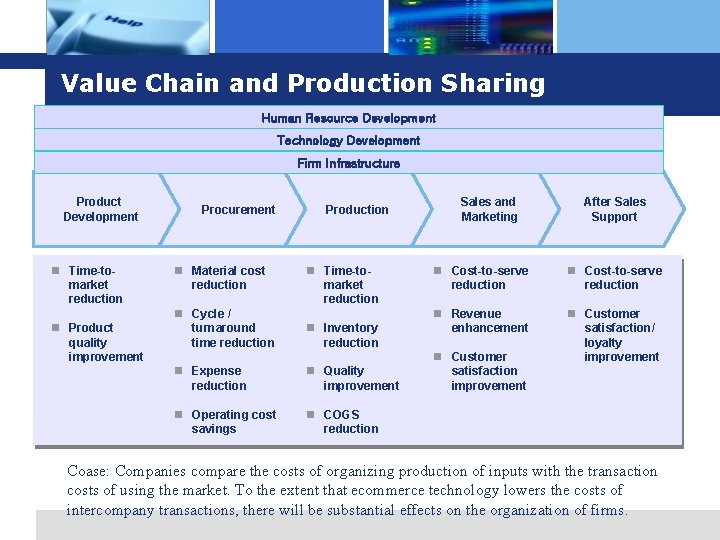
Value Chain and Production Sharing Human Resource Development Technology Development Firm Infrastructure Product Development n Time-tomarket reduction n Product quality improvement Procurement n Material cost reduction Production n Time-tomarket reduction n Cycle / turnaround time reduction n Inventory reduction n Expense reduction n Quality improvement n Operating cost savings n COGS reduction Sales and Marketing After Sales Support n Cost-to-serve reduction n Revenue enhancement n Customer satisfaction/ loyalty improvement n Customer satisfaction improvement Coase: Companies compare the costs of organizing production of inputs with the transaction costs of using the market. To the extent that ecommerce technology lowers the costs of intercompany transactions, there will be substantial effects on the organization of firms.
Drivers v Liberalization of trade and FDI v development of ICT and telecommunication v Transportation cost v Multinational firm strategies v trade policy: tariff structure, effective protection v Regional integration: FTA, CU, etc
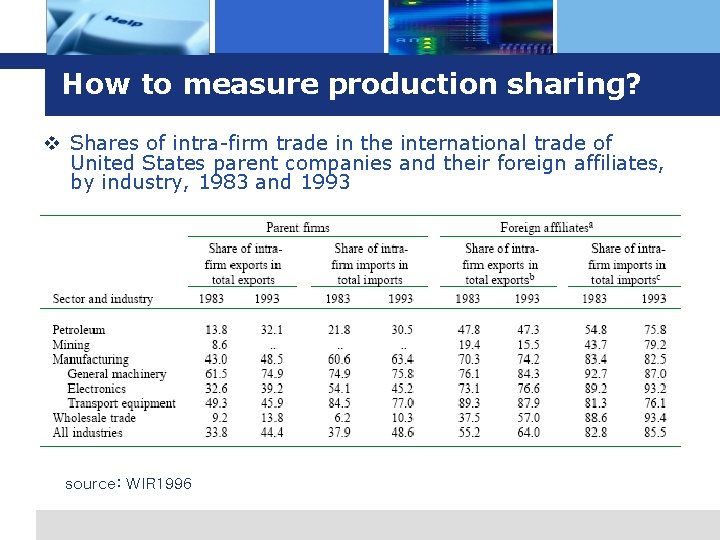
How to measure production sharing? v Shares of intra-firm trade in the international trade of United States parent companies and their foreign affiliates, by industry, 1983 and 1993 source: WIR 1996
How to measure production sharing? v OECD countries’ exports of parts and components (as a share of SITC 7)
Production sharing and backward linkage v Benefits of backward linkage to host countries n n n linkages raise output and employment channels for diffusing knowledge and skills linkages can promote production efficiency, productivity growth, technological and managerial capabilities and market diversification in supplier firms. promote exports by linked enterprises and, under the right conditions, domestic firms may develop to become global suppliers and/or TNCs in their own right. Spillovers effects through demonstration effects, mobility of trained labor, enterprise spin-offs and competition effects v Benefits of TNCs n Local procurement can lower production costs in host economies with lower costs and allow greater specialization and flexibility, with better adaptation of technologies and products to local conditions.
Production sharing in East Asia v Heterogeneous countries with different endowments v Transportations cost v ICT v Intra-regional FDI: efficiency seeking

Globalization and FDI 7. Internationalization of R&D
Internationalization of R&D v Traditionally, R&D was reserved for the home countries of the TNCs. v Recently, TNCs are setting up R&D facilities outside developed countries that go beyond adaptation for local markets. n in some developing and South-East European and CIS countries, TNCs’ R&D is targeting global markets and is integrated into the core innovation efforts of TNCs.
Internationalization of R&D v R&D is a form of service activity and like other services, it is “fragmenting”, with certain segments being located where they can be performed most efficiently. v unexpected. why? n n R&D is a service activity with very demanding skill, knowledge and support needs, traditionally met only in developed countries with strong national innovation systems. R&D is taken to be the least “fragmentable” of economic activities because it involves knowledge that is strategic to firms, and because it often requires dense knowledge exchange between users and producers within localized clusters.
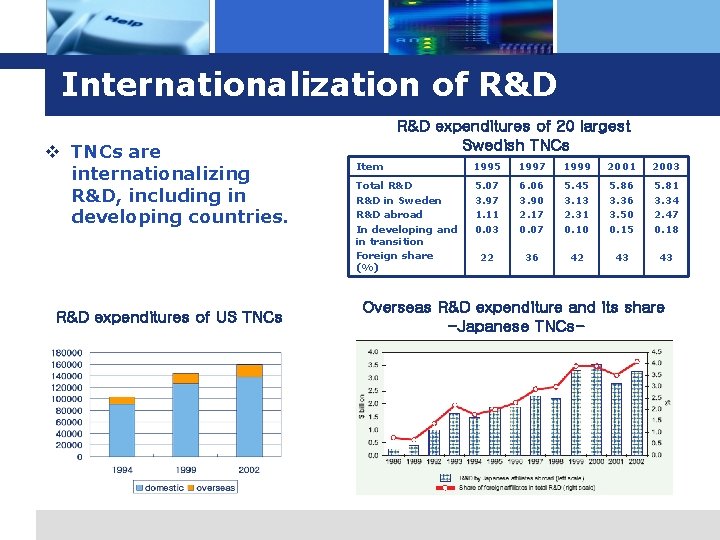
Internationalization of R&D v TNCs are internationalizing R&D, including in developing countries. R&D expenditures of US TNCs R&D expenditures of 20 largest Swedish TNCs Item 1995 1997 1999 2001 2003 Total R&D in Sweden R&D abroad In developing and in transition Foreign share (%) 5. 07 3. 97 1. 11 0. 03 6. 06 3. 90 2. 17 0. 07 5. 45 3. 13 2. 31 0. 10 5. 86 3. 36 3. 50 0. 15 5. 81 3. 34 2. 47 0. 18 22 36 42 43 43 Overseas R&D expenditure and its share -Japanese TNCs-
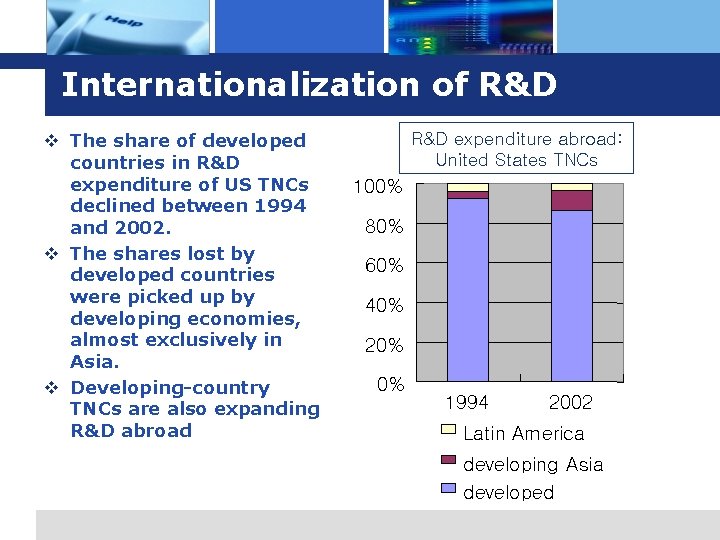
Internationalization of R&D v The share of developed countries in R&D expenditure of US TNCs declined between 1994 and 2002. v The shares lost by developed countries were picked up by developing economies, almost exclusively in Asia. v Developing-country TNCs are also expanding R&D abroad R&D expenditure abroad: United States TNCs 100% 80% 60% 40% 20% 0% 1994 2002 Latin America developing Asia developed
Reasons for Internationalizing of R&D v to adapt foreign technologies to local markets, v to access skilled research personnel, v to learn from foreign lead markets and customers, v to take advantage of technologies developed by foreign companies, v to keep abreast of foreign technologies, v to support local production, v to comply with local market access regulations and pressures, v to take advantage of public R&D programs in host countries, v to evade an inappropriate R&D environment at home
Push and Pull factors v push factors n n intensifying competition, rising costs of R&D in developed countries the scarcity of engineering and scientific manpower the increasing complexity of R&D v pull factors n n n the growing availability of scientific and engineering skills and manpower at competitive costs, the ongoing globalization of manufacturing processes, substantial and fast-growing markets in some developing countries
- Slides: 83