
Globalisering og motstand II Kontekstuelle case Kristian Stokke
Globalisering og motstand II Kontekstuelle case Kristian Stokke kristian. stokke@sgeo. uio. no
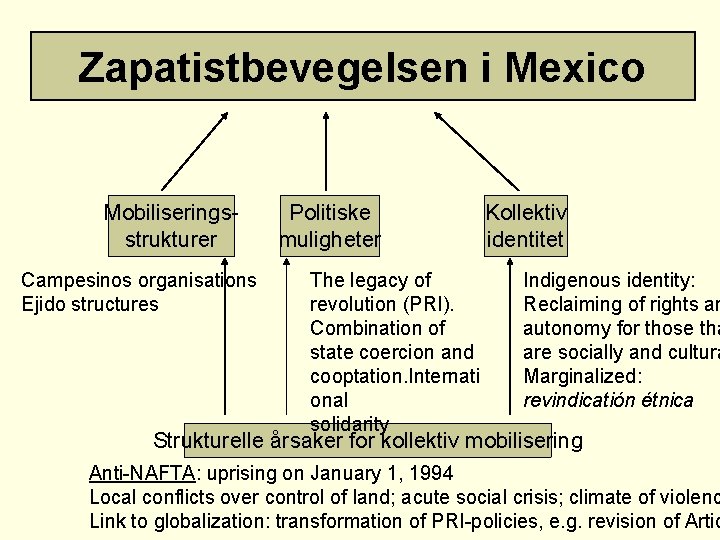
Zapatistbevegelsen i Mexico Mobiliseringsstrukturer Campesinos organisations Ejido structures Politiske muligheter The legacy of revolution (PRI). Combination of state coercion and cooptation. Internati onal solidarity Kollektiv identitet Indigenous identity: Reclaiming of rights an autonomy for those tha are socially and cultura Marginalized: revindicatión étnica Strukturelle årsaker for kollektiv mobilisering Anti-NAFTA: uprising on January 1, 1994 Local conflicts over control of land; acute social crisis; climate of violenc Link to globalization: transformation of PRI-policies, e. g. revision of Artic
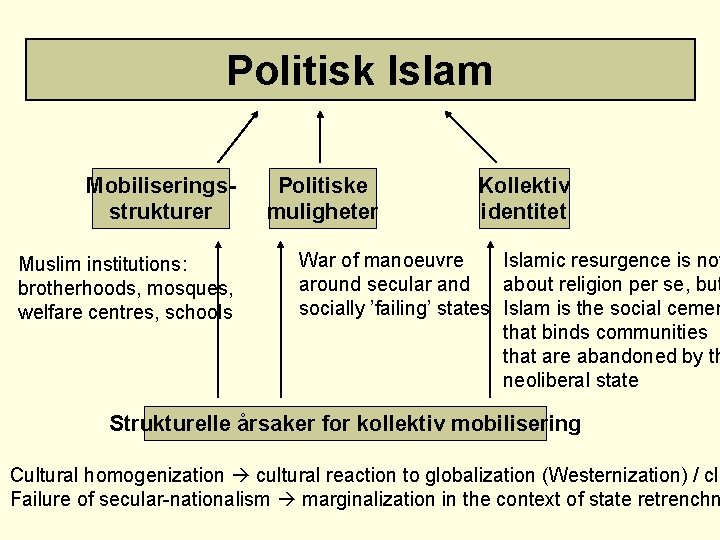
Politisk Islam Mobiliseringsstrukturer Muslim institutions: brotherhoods, mosques, welfare centres, schools Politiske muligheter Kollektiv identitet War of manoeuvre Islamic resurgence is not around secular and about religion per se, but socially ’failing’ states Islam is the social cemen that binds communities that are abandoned by th neoliberal state Strukturelle årsaker for kollektiv mobilisering Cultural homogenization cultural reaction to globalization (Westernization) / cla Failure of secular-nationalism marginalization in the context of state retrenchm
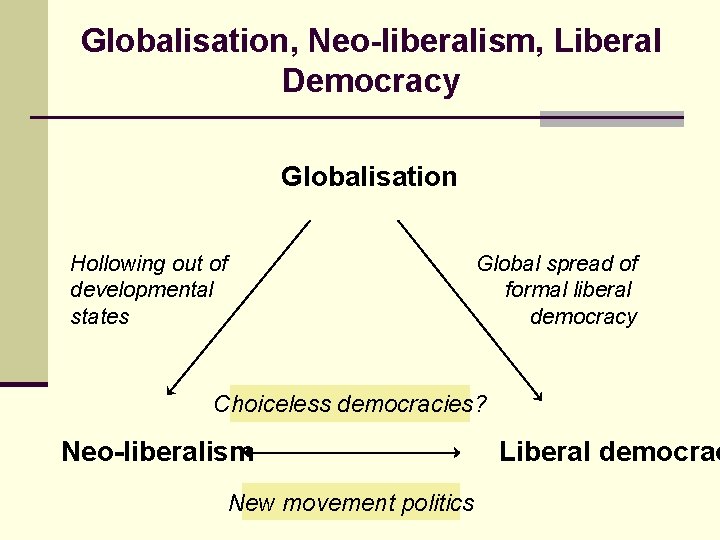
Globalisation, Neo-liberalism, Liberal Democracy Globalisation Hollowing out of developmental states Global spread of formal liberal democracy Choiceless democracies? Neo-liberalism New movement politics Liberal democrac
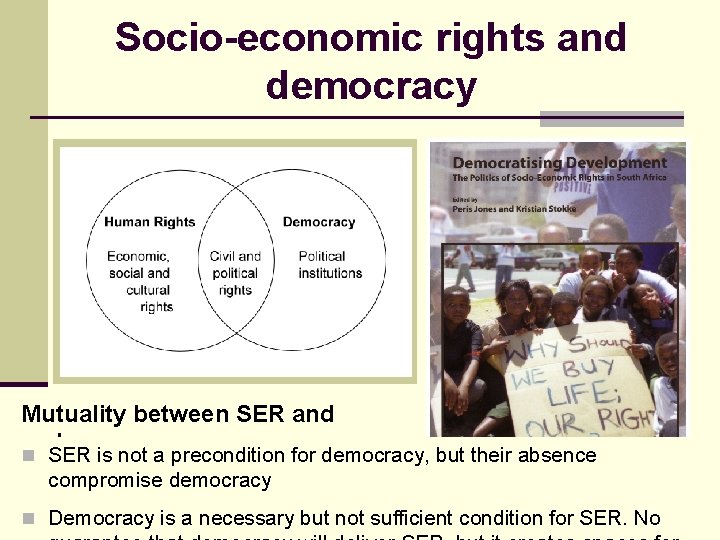
Socio-economic rights and democracy Mutuality between SER and democracy n SER is not a precondition for democracy, but their absence compromise democracy n Democracy is a necessary but not sufficient condition for SER. No
Assessing South Africa’s democracy n Judicial enforcement of socio-economic rights n Progressive Constitution and Bill of Rights whereby socioeconomic rights are justiciable n Constitutional Court has upheld state obligations to socio-economic rights, but questions of implementation of court rulings n Critical questions about reasonable-ness of state policies and regarding access

Assessing South Africa’s democracy n Politics of economic and social policy-making n Important achievements in social delivery, but also a remarkably conservative turn in policy-making n Explained with reference to balance of power: Erosion of vertical accountability, lack of substantive uncertainty n Political importance of labour and social movements politics of socio-economic rights in the context of ANC hegemony
The role of post-apartheid movements Polarised political polemics n ‘Radical’ critics represent South African politics as an oppositional polarization between the neo-liberal state and popular interests and movements in civil society n ‘Liberal’ thinkers emphasize governance arrangements through which civil society is assumed to work with the state n “Need to transcend the false divide that has emerged between opposition and
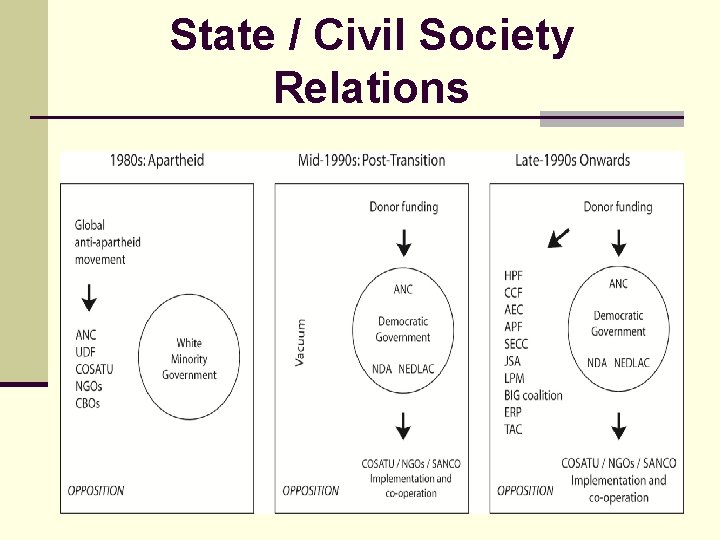
State / Civil Society Relations
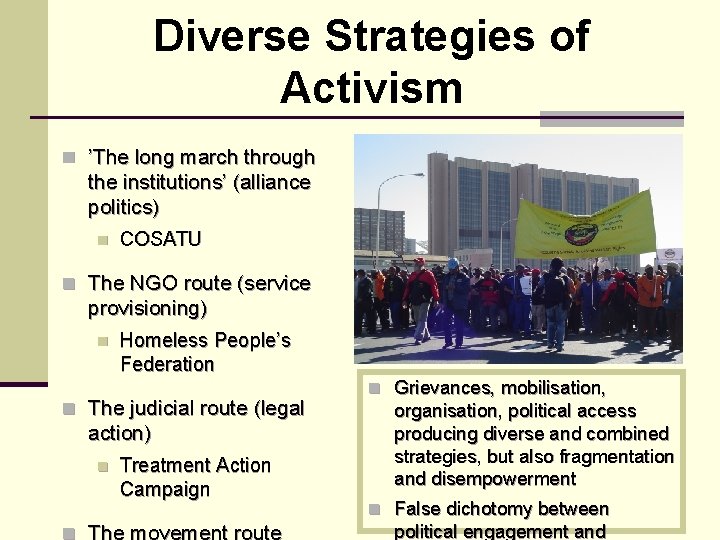
Diverse Strategies of Activism n ’The long march through the institutions’ (alliance politics) n COSATU n The NGO route (service provisioning) n Homeless People’s Federation n The judicial route (legal action) n Treatment Action Campaign n Grievances, mobilisation, organisation, political access producing diverse and combined strategies, but also fragmentation and disempowerment n False dichotomy between political engagement and
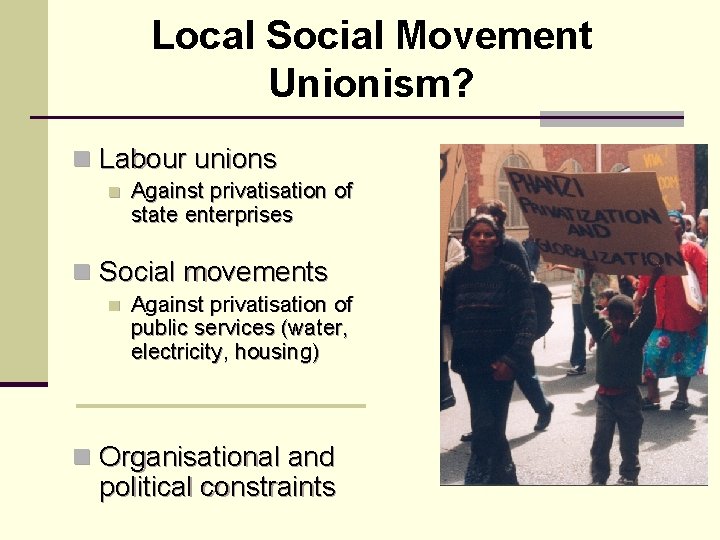
Local Social Movement Unionism? n Labour unions n Against privatisation of state enterprises n Social movements n Against privatisation of public services (water, electricity, housing) n Organisational and political constraints
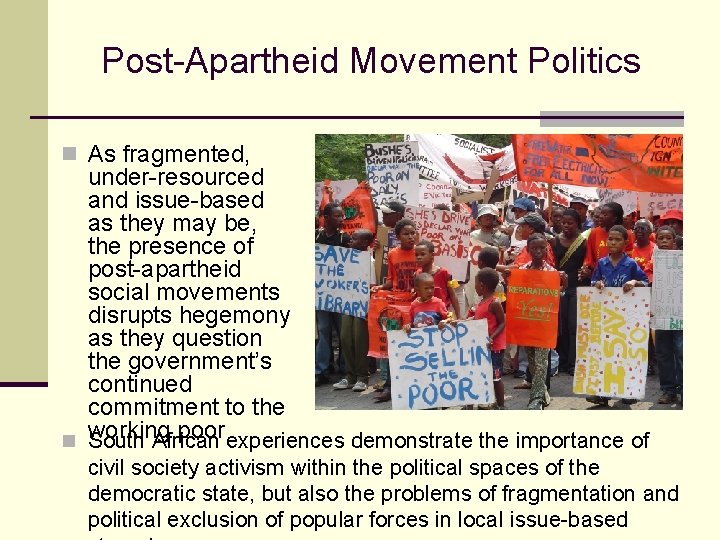
Post-Apartheid Movement Politics n As fragmented, under-resourced and issue-based as they may be, the presence of post-apartheid social movements disrupts hegemony as they question the government’s continued commitment to the poorexperiences demonstrate the importance of n working South African civil society activism within the political spaces of the democratic state, but also the problems of fragmentation and political exclusion of popular forces in local issue-based
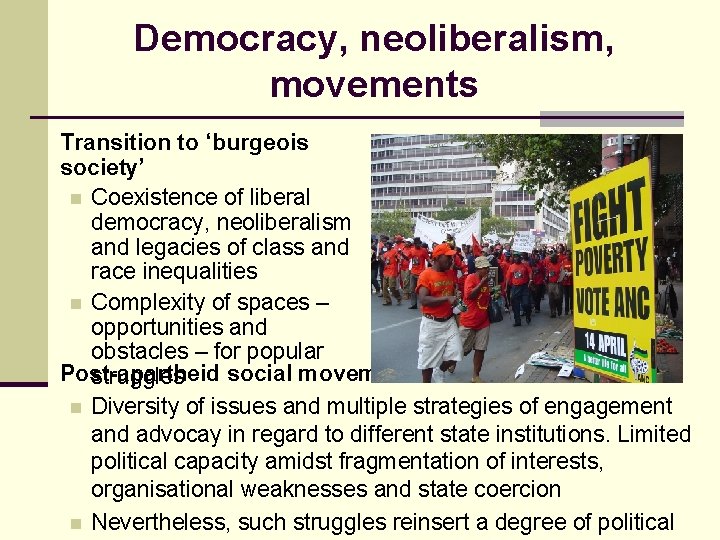
Democracy, neoliberalism, movements Transition to ‘burgeois society’ n Coexistence of liberal democracy, neoliberalism and legacies of class and race inequalities n Complexity of spaces – opportunities and obstacles – for popular Post-apartheid social movements struggles n Diversity of issues and multiple strategies of engagement and advocay in regard to different state institutions. Limited political capacity amidst fragmentation of interests, organisational weaknesses and state coercion n Nevertheless, such struggles reinsert a degree of political
- Slides: 13