
Global Warming Climate Change Outline of Lectures Earths
Global Warming (Climate Change)
Outline of Lectures • Earth’s Energy Balance – incident solar energy – outgoing longwave radiation – detailed energy balance • Greenhouse Gases – the greenhouse effect, and GHGs – increasing GHGs – biogeochemical cycles; the carbon cycle • Radiative Forcing: the Enhanced Greenhouse Effect – explanation of the concept of radiative forcing – current values of radiative forcings • Climate Change: Trends and Predictions – – past global average temperature trends feedback effects. Factors driving climate change. computer models predictions: global warming and other changes in climate
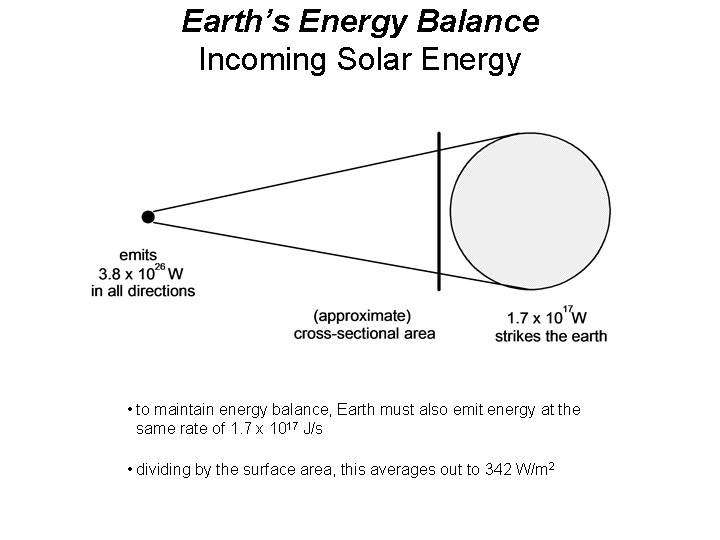
Earth’s Energy Balance Incoming Solar Energy • to maintain energy balance, Earth must also emit energy at the same rate of 1. 7 x 10¹⁷ J/s • dividing by the surface area, this averages out to 342 W/m 2
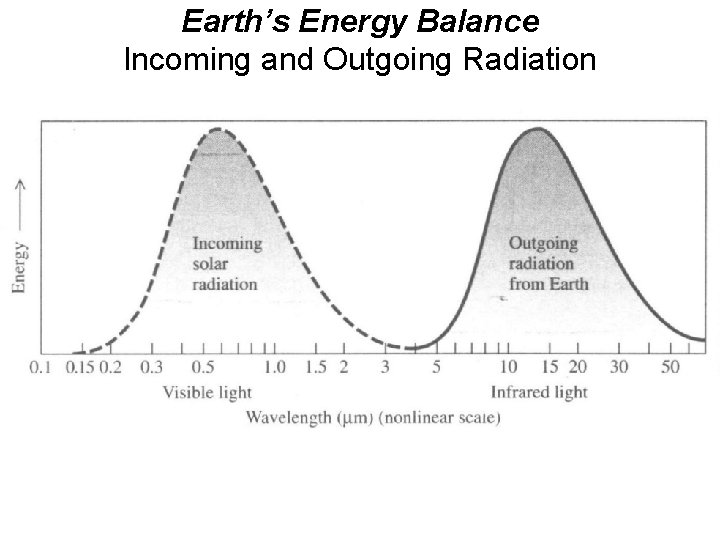
Earth’s Energy Balance Incoming and Outgoing Radiation
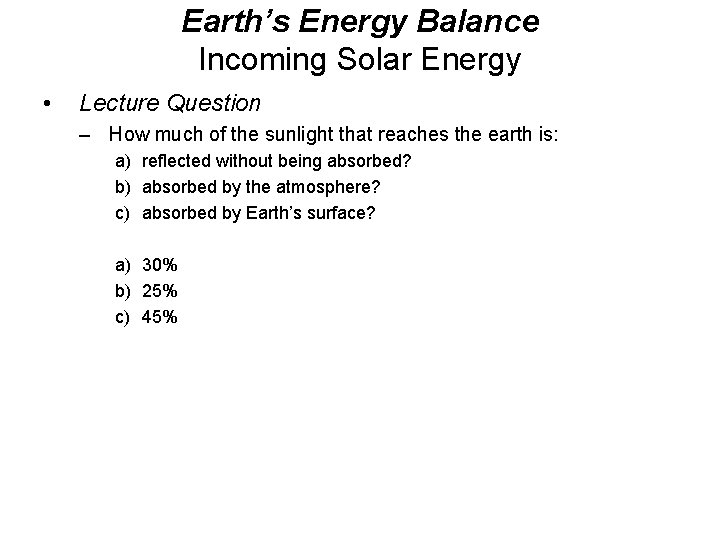
Earth’s Energy Balance Incoming Solar Energy • Lecture Question – How much of the sunlight that reaches the earth is: a) reflected without being absorbed? b) absorbed by the atmosphere? c) absorbed by Earth’s surface? a) 30% b) 25% c) 45%

Earth’s Energy Balance Incoming Solar Energy • about 30% of incoming sunlight is reflected back to space (clouds, oceans, snow/ice) • this is Earth’s albedo • the amount available to heat the earth is 235 W/m 2 • about 25% is absorbed by the atmosphere (see figure on left) • the rest (about 45%) is absorbed by the surface land water
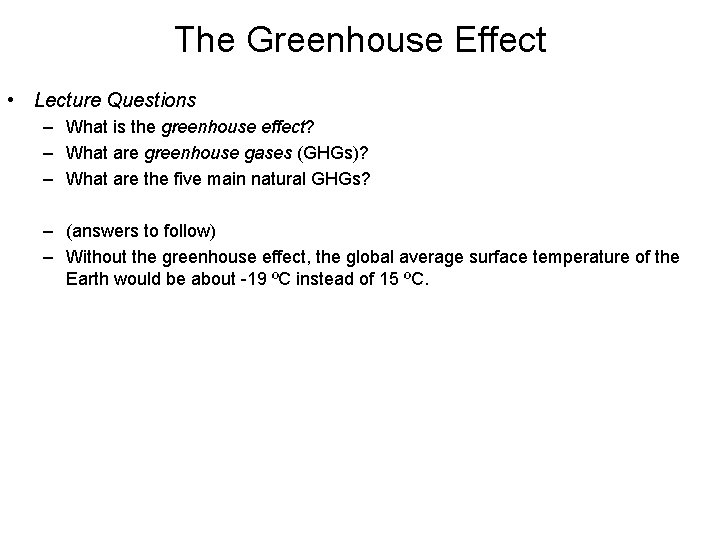
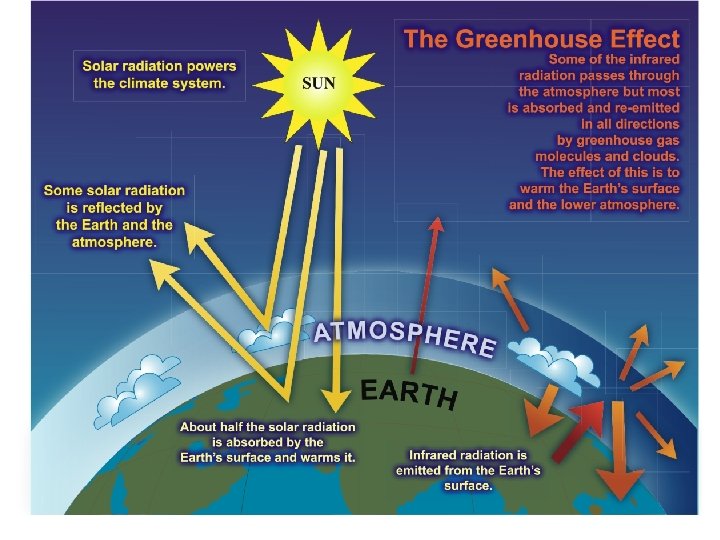
The Greenhouse Effect • Lecture Questions – What is the greenhouse effect? – What are greenhouse gases (GHGs)? – What are the five main natural GHGs? – (answers to follow) – Without the greenhouse effect, the global average surface temperature of the Earth would be about -19 ºC instead of 15 ºC.
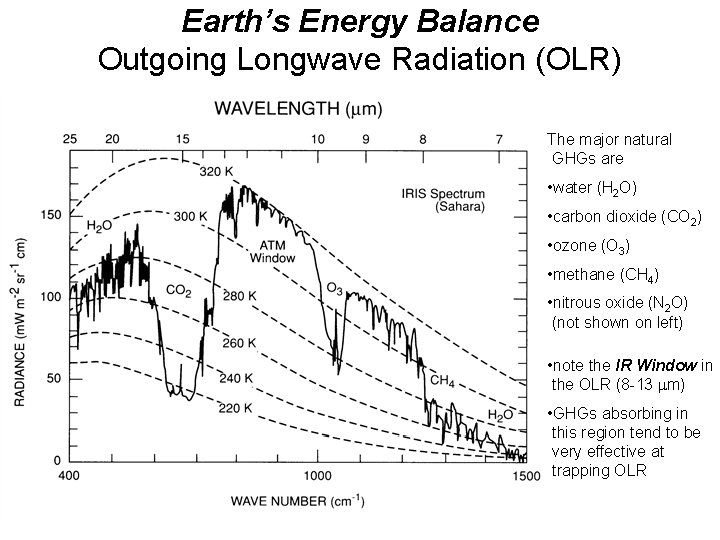
Earth’s Energy Balance Outgoing Longwave Radiation (OLR) The major natural GHGs are • water (H 2 O) • carbon dioxide (CO 2) • ozone (O 3) • methane (CH 4) • nitrous oxide (N 2 O) (not shown on left) • note the IR Window in the OLR (8 -13 mm) • GHGs absorbing in this region tend to be very effective at trapping OLR

Earth’s Energy Balance: Detailed Balance
The Enhanced Greenhouse Effect • Lecture Question – What is the enhanced greenhouse effect? – The enhanced greenhouse effect is an increase in the amount of energy trapped by the atmosphere, largely due to increased concentrations of greenhouse gases. – What GHGs have been increased in the atmosphere due to human activities? – CO 2, CH 4, N 2 O, tropospheric O 3 (smog), and halocarbons (CFCs, HFCs, halons, and other cpds)
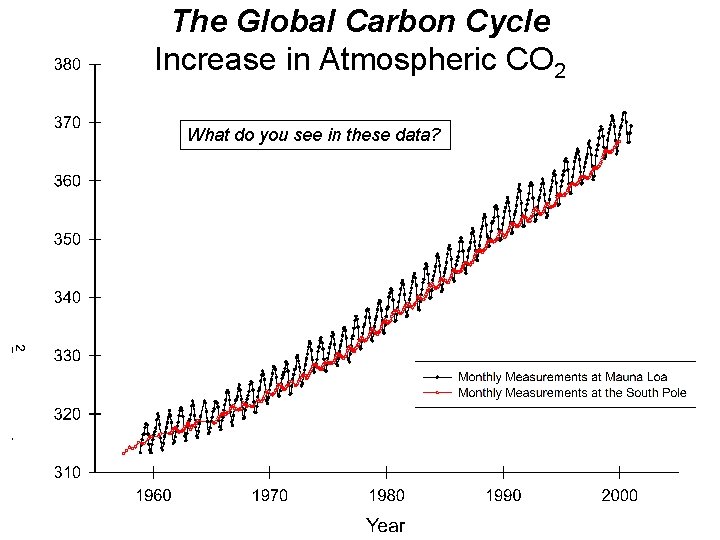
The Global Carbon Cycle Increase in Atmospheric CO 2 What do you see in these data?
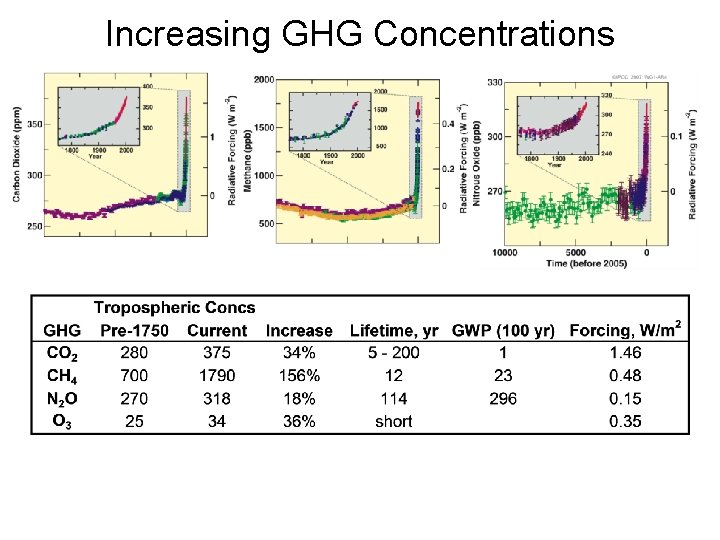
Increasing GHG Concentrations
The Global Carbon Cycle • Lecture Question – What is the carbon cycle? – What are the main processes that contribute to the carbon cycle? – Global Biogeochemical Cycles • Most important cycles: carbon (usually taken to be carbon dioxide), nitrogen, sulfur, phosphorus, water • Earth is divided up into a number of distinct reservoirs (“boxes”) such as: atmosphere, water, land, etc. – Divisions can be finer than this. For example, the atmosphere can be further subdivided into troposphere and stratosphere; the hydrosphere can be divided into oceans and freshwater (and these can be further subdivided), etc. – The amount of the element in each reservoir is esimtated in some manner. • The processes that allow exchange of the element between the reservoirs are described and their rates are quantified – For the carbon cycle, the most important processes are: photosynthesis, respiration/decay, combustion, dissolution/outgassing, Ca. CO 3 (calcite) formation and dissolution
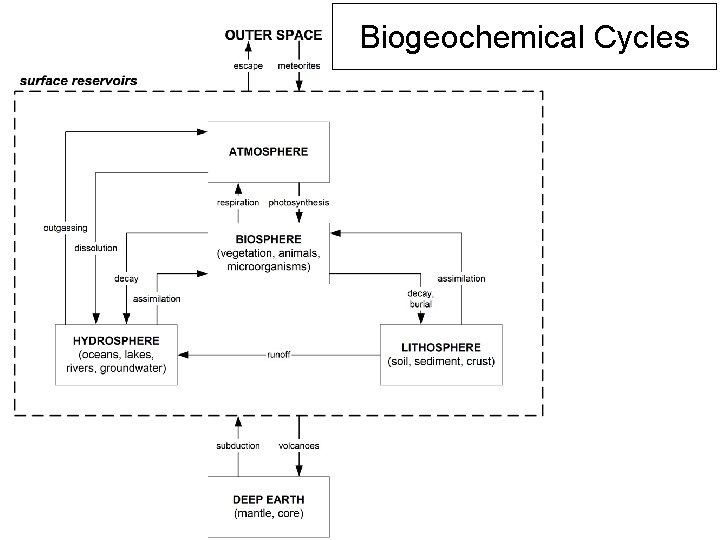
Biogeochemical Cycles

Main Components of the Natural Carbon Cycle Source: IPCC Units: 1015 g C or 1015 g C/yr
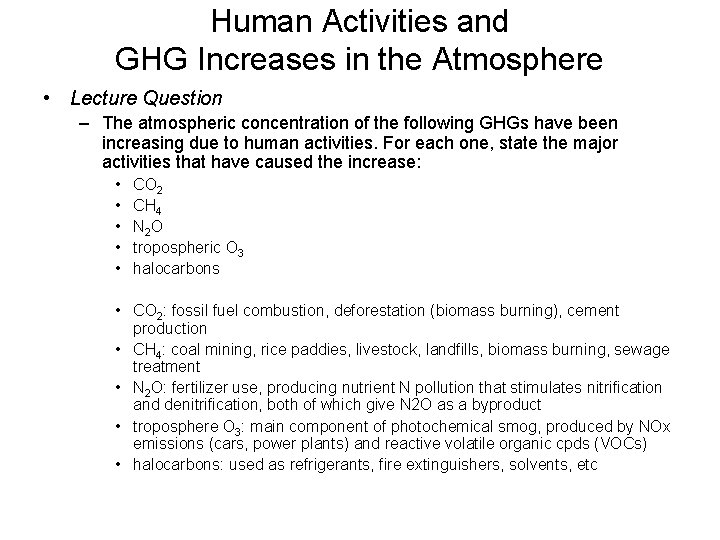
Human Activities and GHG Increases in the Atmosphere • Lecture Question – The atmospheric concentration of the following GHGs have been increasing due to human activities. For each one, state the major activities that have caused the increase: • • • CO 2 CH 4 N 2 O tropospheric O 3 halocarbons • CO 2: fossil fuel combustion, deforestation (biomass burning), cement production • CH 4: coal mining, rice paddies, livestock, landfills, biomass burning, sewage treatment • N 2 O: fertilizer use, producing nutrient N pollution that stimulates nitrification and denitrification, both of which give N 2 O as a byproduct • troposphere O 3: main component of photochemical smog, produced by NOx emissions (cars, power plants) and reactive volatile organic cpds (VOCs) • halocarbons: used as refrigerants, fire extinguishers, solvents, etc
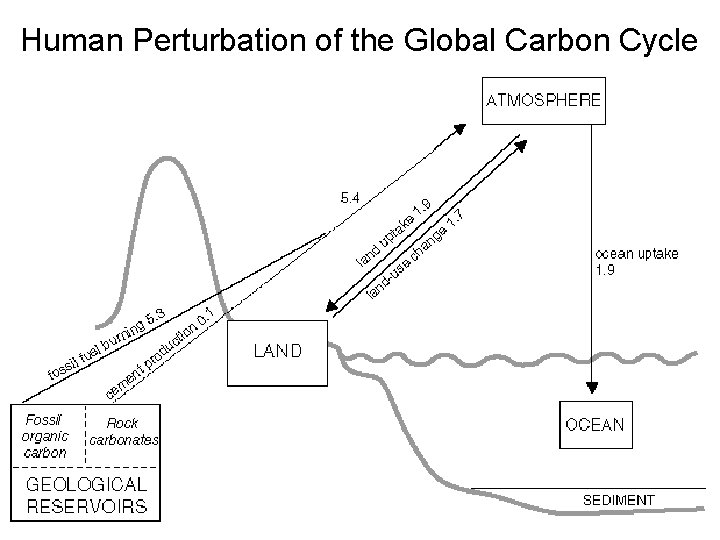
Human Perturbation of the Global Carbon Cycle
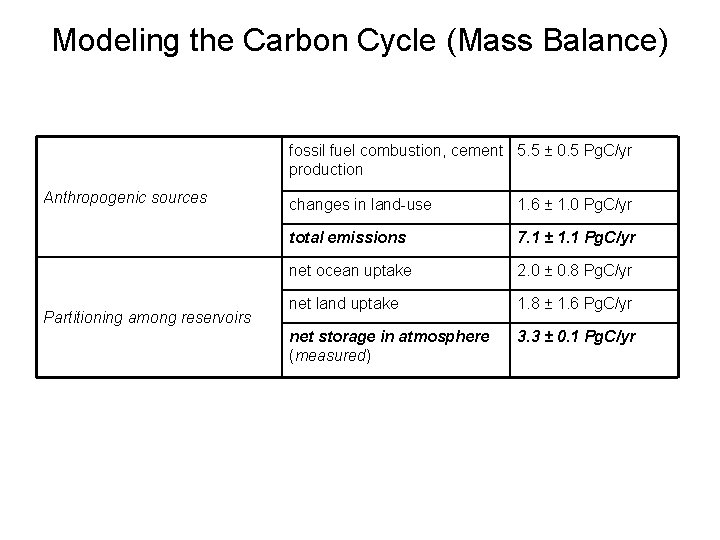
Modeling the Carbon Cycle (Mass Balance) fossil fuel combustion, cement 5. 5 ± 0. 5 Pg. C/yr production Anthropogenic sources Partitioning among reservoirs changes in land-use 1. 6 ± 1. 0 Pg. C/yr total emissions 7. 1 ± 1. 1 Pg. C/yr net ocean uptake 2. 0 ± 0. 8 Pg. C/yr net land uptake 1. 8 ± 1. 6 Pg. C/yr net storage in atmosphere (measured) 3. 3 ± 0. 1 Pg. C/yr

The Methane Cycle

Radiative Forcing • Lecture Question – What is radiative forcing? – Radiative forcing is a quantitative measure of the imbalance between incoming (solar) and outgoing (reflected plus infrared) radiation. – A positive radiative forcing indicates an increase in the amount of radiation trapped by the atmosphere (an enhanced greenhouse effect), eventually leading to global warming. A negative forcing eventually leads to global cooling.
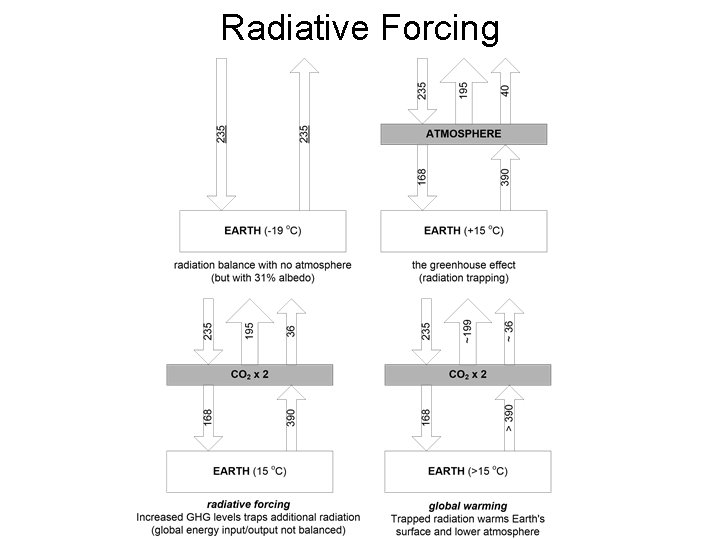
Radiative Forcing

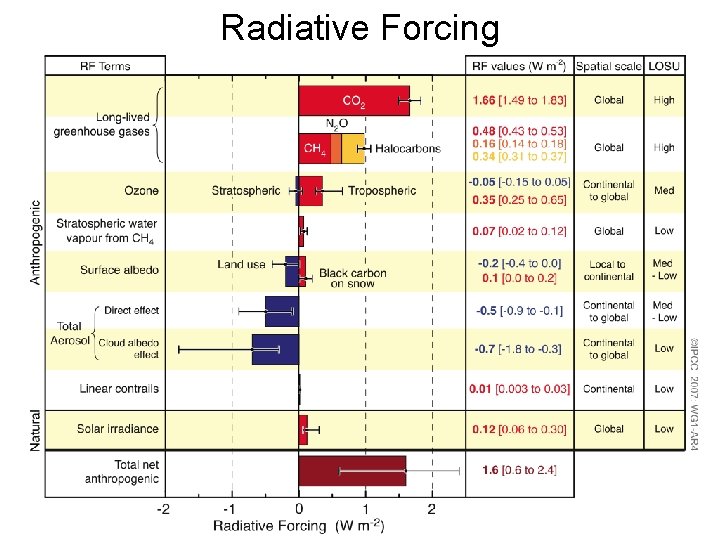
Radiative Forcing • Lecture Questions – What have been the major (direct) factors that have caused a positive forcing in the past century? • increases in concentrations of CO 2, CH 4, halocarbons, tropospheric O 3, and N 2 O • increase in elemental carbon PM (ie, soot) • increase in solar output – What factors have caused a negative forcing? • stratospheric ozone depletion, increases in most PM (esp sulfate), changes in cloud formation process, increased albedo due to landuse changes
Radiative Forcing

Radiative Forcing
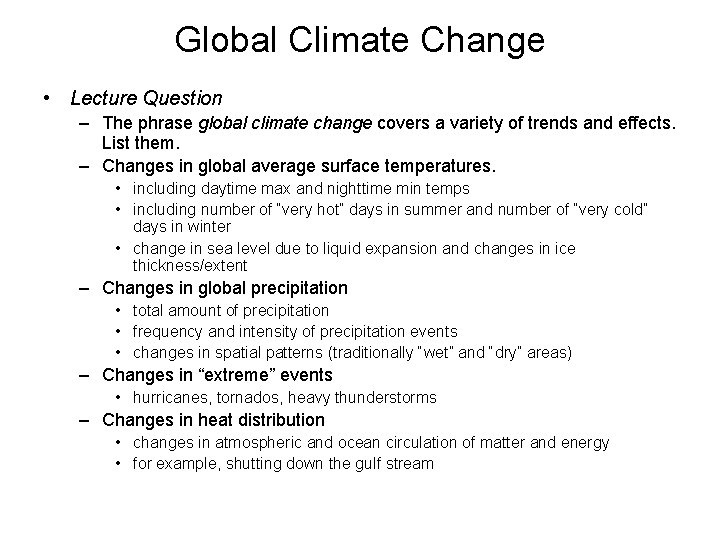
Global Climate Change • Lecture Question – The phrase global climate change covers a variety of trends and effects. List them. – Changes in global average surface temperatures. • including daytime max and nighttime min temps • including number of “very hot” days in summer and number of “very cold” days in winter • change in sea level due to liquid expansion and changes in ice thickness/extent – Changes in global precipitation • total amount of precipitation • frequency and intensity of precipitation events • changes in spatial patterns (traditionally “wet” and “dry” areas) – Changes in “extreme” events • hurricanes, tornados, heavy thunderstorms – Changes in heat distribution • changes in atmospheric and ocean circulation of matter and energy • for example, shutting down the gulf stream
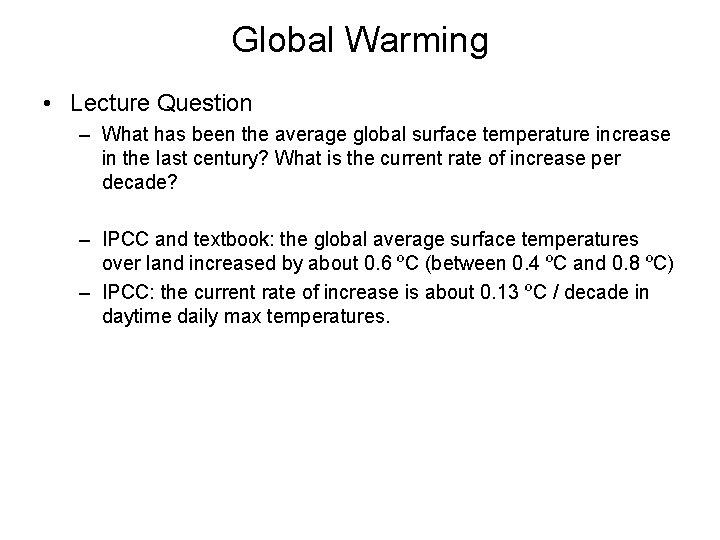
Global Warming • Lecture Question – What has been the average global surface temperature increase in the last century? What is the current rate of increase per decade? – IPCC and textbook: the global average surface temperatures over land increased by about 0. 6 ºC (between 0. 4 ºC and 0. 8 ºC) – IPCC: the current rate of increase is about 0. 13 ºC / decade in daytime daily max temperatures.
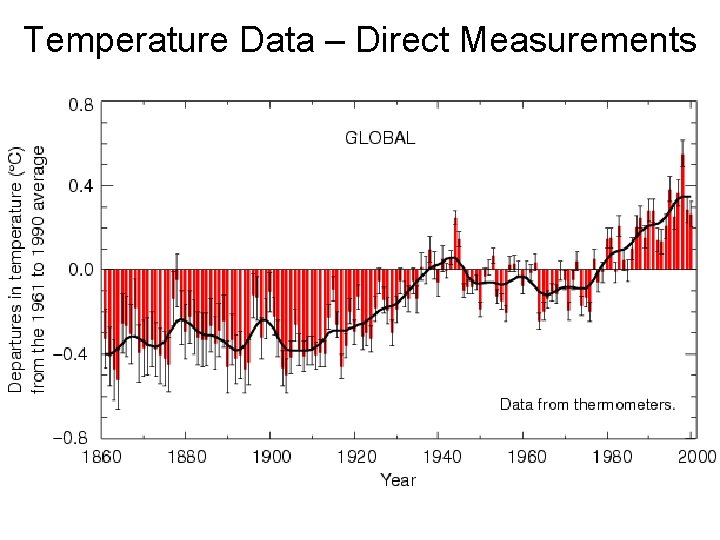
Temperature Data – Direct Measurements
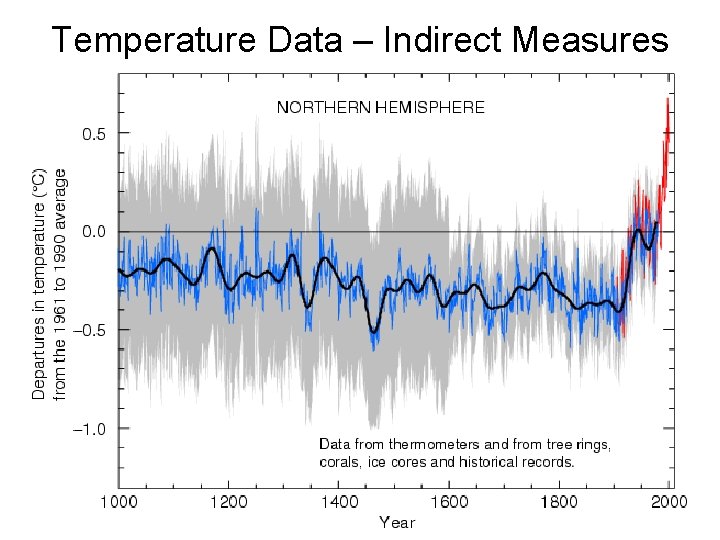
Temperature Data – Indirect Measures
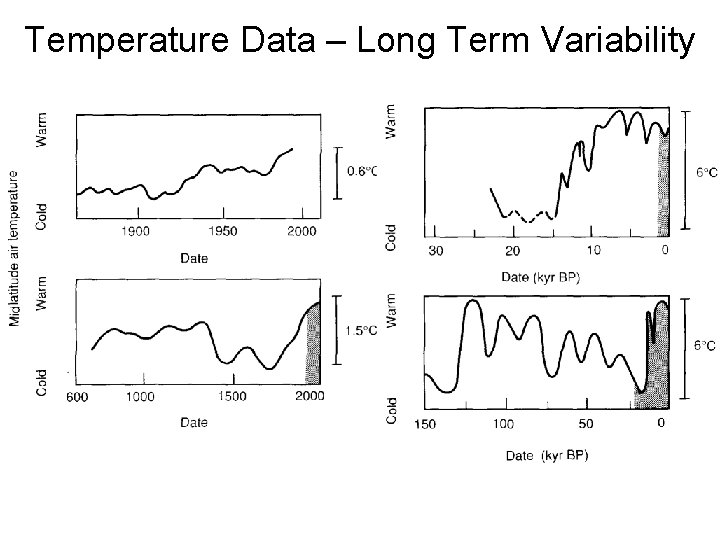
Temperature Data – Long Term Variability
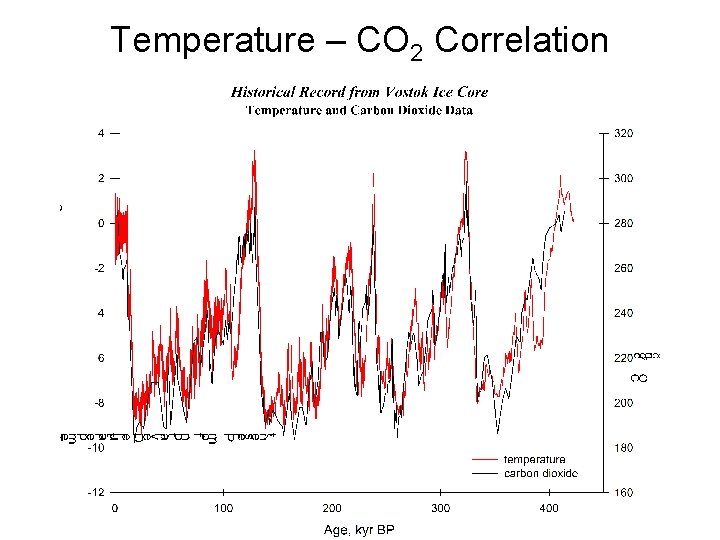
Temperature – CO 2 Correlation
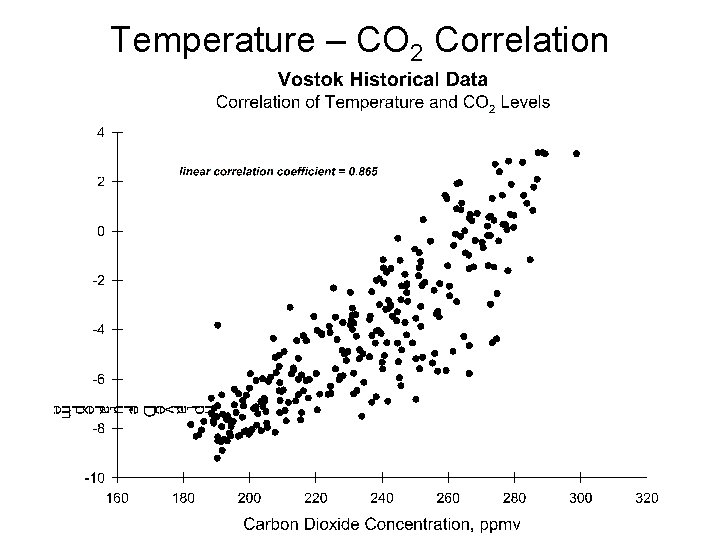
Temperature – CO 2 Correlation
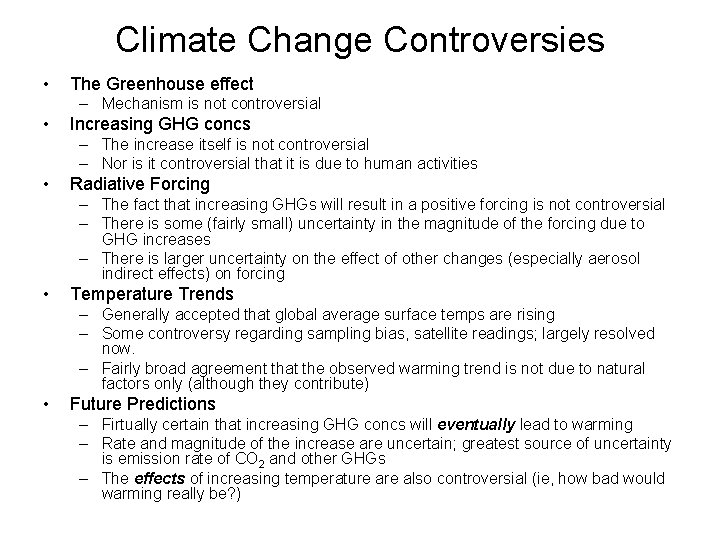
Climate Change Controversies • The Greenhouse effect – Mechanism is not controversial • Increasing GHG concs – The increase itself is not controversial – Nor is it controversial that it is due to human activities • Radiative Forcing – The fact that increasing GHGs will result in a positive forcing is not controversial – There is some (fairly small) uncertainty in the magnitude of the forcing due to GHG increases – There is larger uncertainty on the effect of other changes (especially aerosol indirect effects) on forcing • Temperature Trends – Generally accepted that global average surface temps are rising – Some controversy regarding sampling bias, satellite readings; largely resolved now. – Fairly broad agreement that the observed warming trend is not due to natural factors only (although they contribute) • Future Predictions – Firtually certain that increasing GHG concs will eventually lead to warming – Rate and magnitude of the increase are uncertain; greatest source of uncertainty is emission rate of CO 2 and other GHGs – The effects of increasing temperature also controversial (ie, how bad would warming really be? )
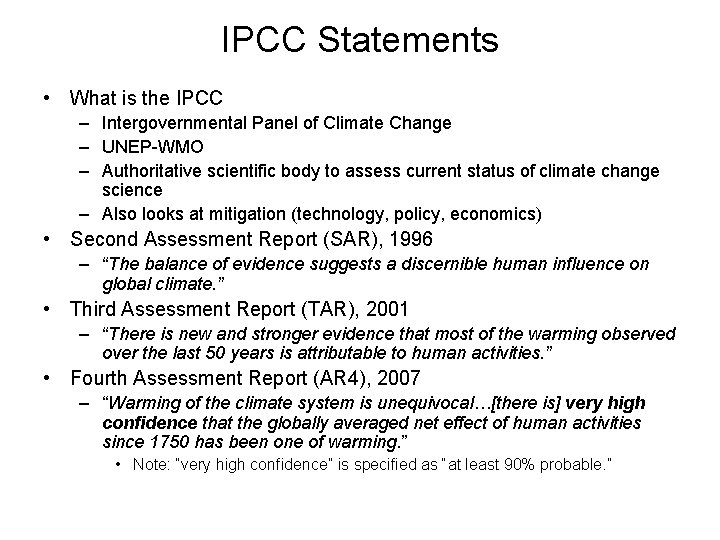
IPCC Statements • What is the IPCC – Intergovernmental Panel of Climate Change – UNEP-WMO – Authoritative scientific body to assess current status of climate change science – Also looks at mitigation (technology, policy, economics) • Second Assessment Report (SAR), 1996 – “The balance of evidence suggests a discernible human influence on global climate. ” • Third Assessment Report (TAR), 2001 – “There is new and stronger evidence that most of the warming observed over the last 50 years is attributable to human activities. ” • Fourth Assessment Report (AR 4), 2007 – “Warming of the climate system is unequivocal…[there is] very high confidence that the globally averaged net effect of human activities since 1750 has been one of warming. ” • Note: “very high confidence” is specified as “at least 90% probable. ”
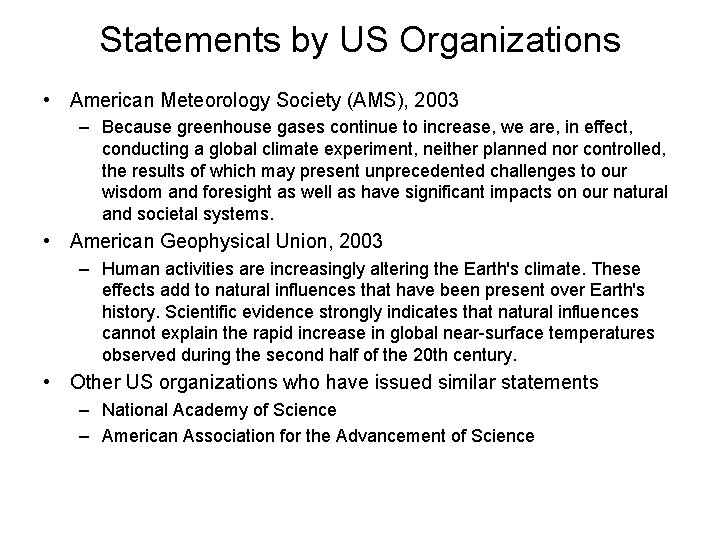
Statements by US Organizations • American Meteorology Society (AMS), 2003 – Because greenhouse gases continue to increase, we are, in effect, conducting a global climate experiment, neither planned nor controlled, the results of which may present unprecedented challenges to our wisdom and foresight as well as have significant impacts on our natural and societal systems. • American Geophysical Union, 2003 – Human activities are increasingly altering the Earth's climate. These effects add to natural influences that have been present over Earth's history. Scientific evidence strongly indicates that natural influences cannot explain the rapid increase in global near-surface temperatures observed during the second half of the 20 th century. • Other US organizations who have issued similar statements – National Academy of Science – American Association for the Advancement of Science
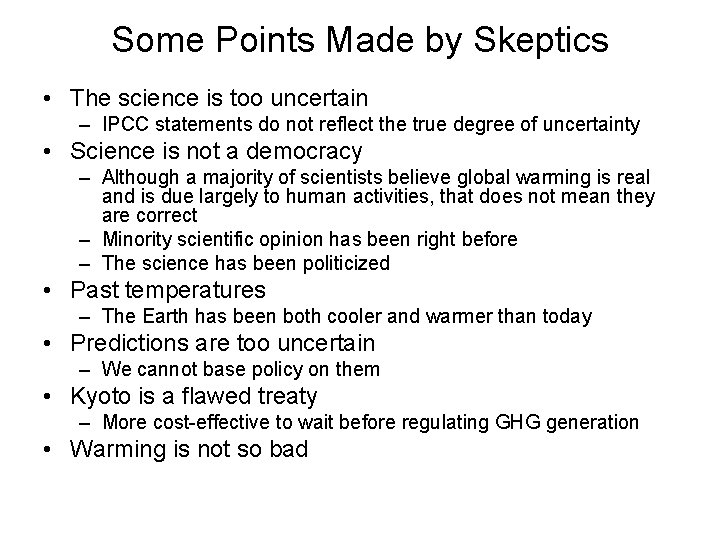
Some Points Made by Skeptics • The science is too uncertain – IPCC statements do not reflect the true degree of uncertainty • Science is not a democracy – Although a majority of scientists believe global warming is real and is due largely to human activities, that does not mean they are correct – Minority scientific opinion has been right before – The science has been politicized • Past temperatures – The Earth has been both cooler and warmer than today • Predictions are too uncertain – We cannot base policy on them • Kyoto is a flawed treaty – More cost-effective to wait before regulating GHG generation • Warming is not so bad
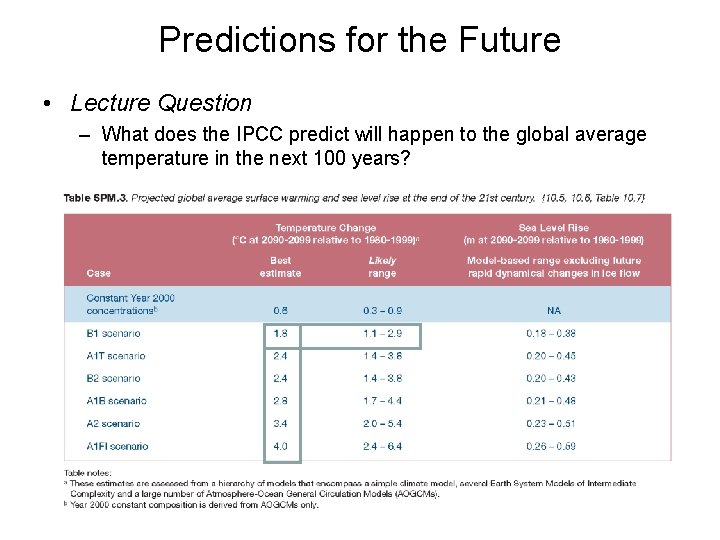
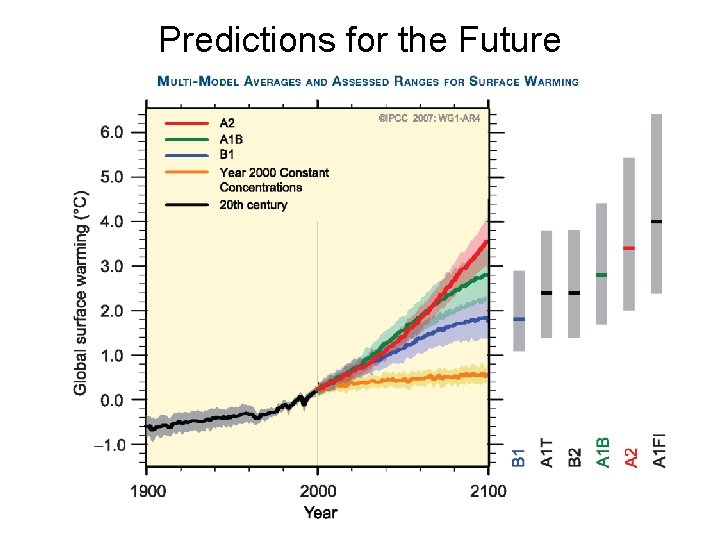
Predictions for the Future • Lecture Question – What does the IPCC predict will happen to the global average temperature in the next 100 years?
Predictions for the Future
Predictions for the Future
Predictions for the Future • Questions – How are future temperatures predicted? • Sophisticated General Circulation Models (GCMs) are used. – Commonly called “Global Climate Models” – Computer-based integration of the exchange of energy and matter in a 3 -dimensional spatial grid. They are run forward in time, and future trends in climate (temperature, precipitation, etc) are predicted for each element of the grid. – Very many processes must be considered (see next slide) – Nonlinear feedback effects must also be considered. – How are predictions verified? • Model predictions can be made for past climates and compared to the actual measurements that were collected.

Factors Driving Climate bold arrows represent aspects that may change
Feedback Effects • What are feedback effects? – A negative feedback is one that tends to dampen changes – A positive feedback is one that tends to reinforce changes • Examples (not inclusive): effects of increasing temperature on – The carbon cycle • decreases solubility of CO 2 in water, decreasing the ocean uptake rate • possibly increases the rate of photosynthesis and plant growth • increases the rate of decomposition – The hydrologic cycle • increases water vapor pressure, increasing conc of water in the atmosphere – Earth’s albedo • increases cloud cover • decreases snow cover – Energy circulation • atmospheric circulation • oceanic (thermohaline) circulation
Predictions: GCMs • What are GCMs? – Global Climate Models or General Circulation Models – A GCM “aims to describe geophysical flow by integrating a variety of fluid-dynamical, chemical, or even biological equations that are either derived directly from physical laws (e. g. Newton's law) or constructed by more empirical means. ” (Wikipedia) – There are GCMs for ocean and atmospheric components; coupled atmospheric-oceanic GCMs (AOGCMs) can be used to make climate predictions – Most sophisticated GCMs are 3 -dimensional “grids” to model fluid motion – Ideally provide both regional and global predictions of climate – The models are imperfect • True of any model, but: • Critics of global warming theory content that the imperfections are significant
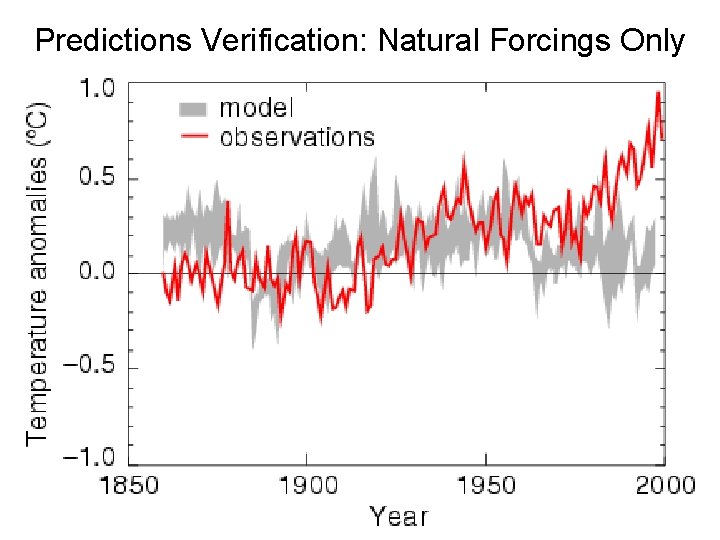
Predictions Verification: Natural Forcings Only
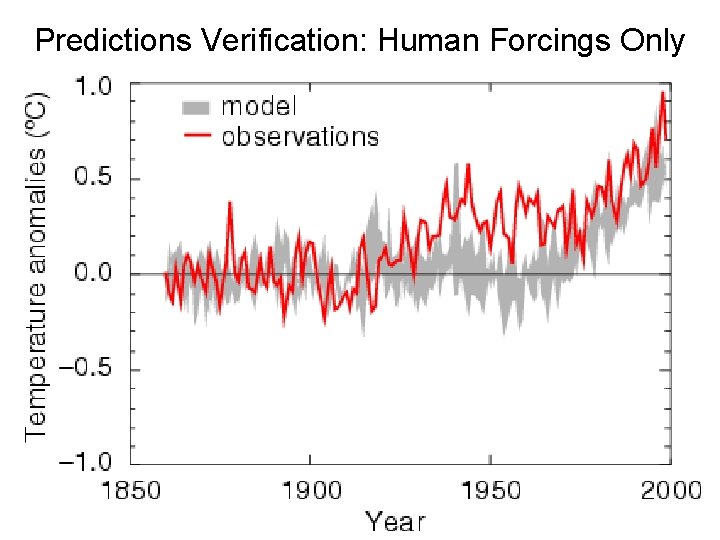
Predictions Verification: Human Forcings Only
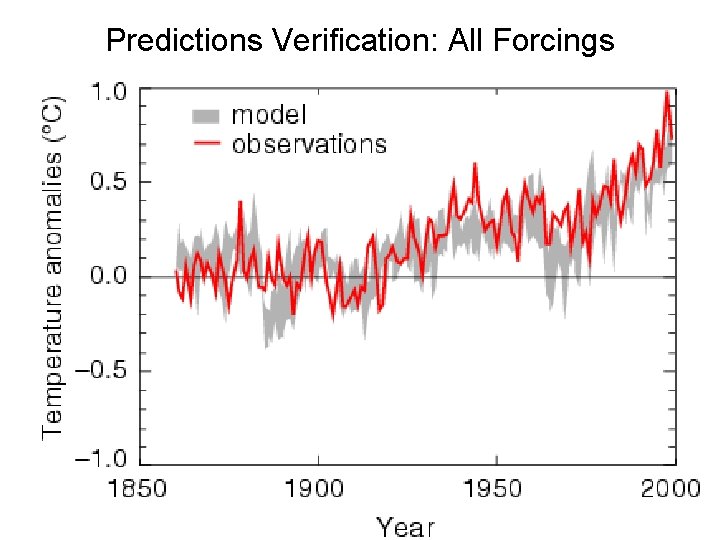
Predictions Verification: All Forcings
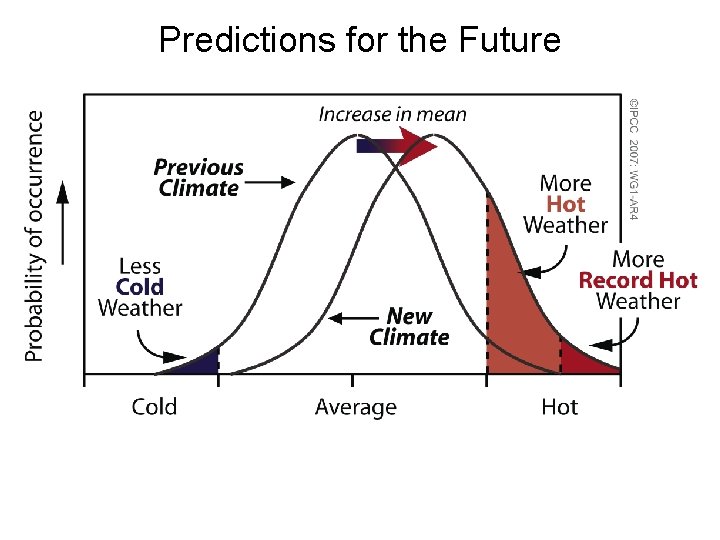
Other Effects on Global Climate • Lecture Question – Other than warming, what other changes are predicted in global climate in the next century? – Sea level will rise • 0. 18 m – 0. 59 m (AR 4) by 2100 by thermal expansion, which will continue for centuries • Potentially much larger increases due to loss/shifts of landlocked ice sheets such as in Greenland (complete elimination would lead to 7 m rise) and Antarctica – Precipitation will increase in some areas, decrease in others • Possible increase in high latitudes and decrease in subtropical regions – Increase in frequency and intensity of “extreme” climate events • Heat waves, heavy precipitation events, tornados, hurricanes, stronger El Nino events, monsoons, etc – Effects on ecosystems uncertain • ranges of various organisms will change • increased spread of infectious disease (esp insect-borne) possible • decrease in biodiversity feared – Circulation in the Atlantic Ocean (MOC) will slow
- Slides: 47