
Global value chains and JapanBrazil FTA for XVIII
Global value chains and Japan-Brazil FTA for XVIII JBECC August 31, 2015 Michitaka Nakatomi President Nippon Amazon Aluminium Co. , Ltd. 1
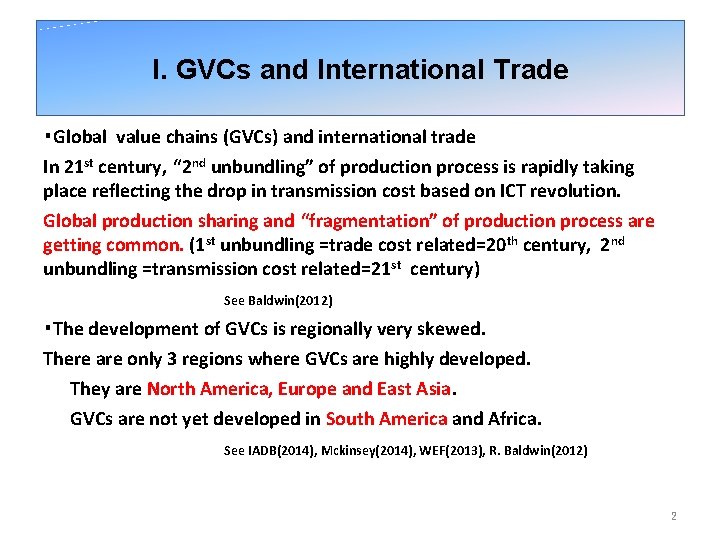
I. GVCs and International Trade ・Global value chains (GVCs) and international trade In 21 st century, “ 2 nd unbundling” of production process is rapidly taking place reflecting the drop in transmission cost based on ICT revolution. Global production sharing and “fragmentation” of production process are getting common. (1 st unbundling =trade cost related=20 th century, 2 nd unbundling =transmission cost related=21 st century) See Baldwin(2012) ・The development of GVCs is regionally very skewed. There are only 3 regions where GVCs are highly developed. They are North America, Europe and East Asia. GVCs are not yet developed in South America and Africa. See IADB(2014), Mckinsey(2014), WEF(2013), R. Baldwin(2012) 2
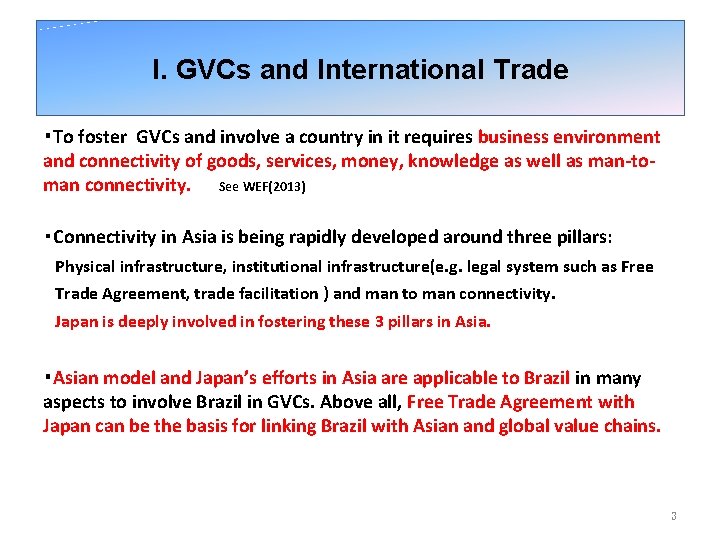
I. GVCs and International Trade ・To foster GVCs and involve a country in it requires business environment and connectivity of goods, services, money, knowledge as well as man-toman connectivity. See WEF(2013) ・Connectivity in Asia is being rapidly developed around three pillars: Physical infrastructure, institutional infrastructure(e. g. legal system such as Free Trade Agreement, trade facilitation ) and man to man connectivity. Japan is deeply involved in fostering these 3 pillars in Asia. ・Asian model and Japan’s efforts in Asia are applicable to Brazil in many aspects to involve Brazil in GVCs. Above all, Free Trade Agreement with Japan can be the basis for linking Brazil with Asian and global value chains. 3
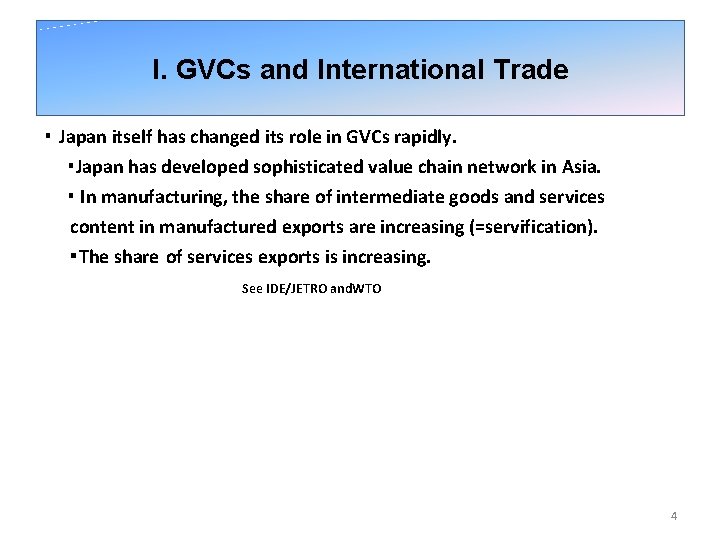
I. GVCs and International Trade ・ Japan itself has changed its role in GVCs rapidly. ・Japan has developed sophisticated value chain network in Asia. ・ In manufacturing, the share of intermediate goods and services content in manufactured exports are increasing (=servification). ・The share of services exports is increasing. See IDE/JETRO and. WTO 4
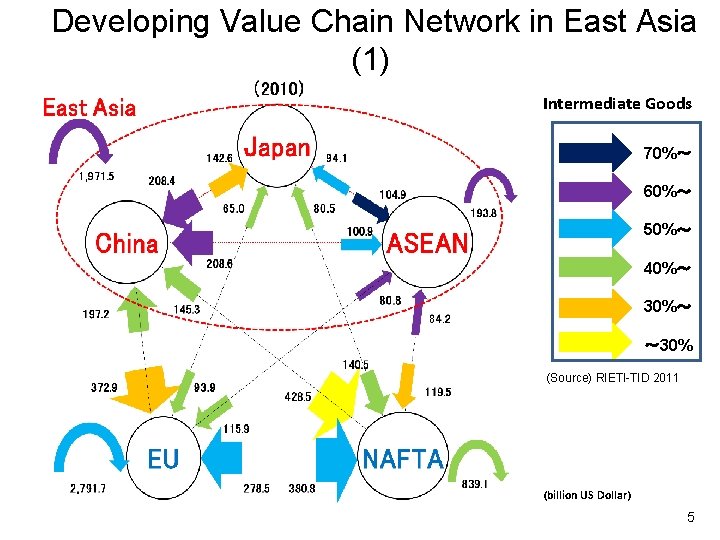
Developing Value Chain Network in East Asia (1) Intermediate Goods 70%~ 60%~ 50%~ 40%~ 30%~ ~ 30% (Source) RIETI-TID 2011 (billion US Dollar) 5
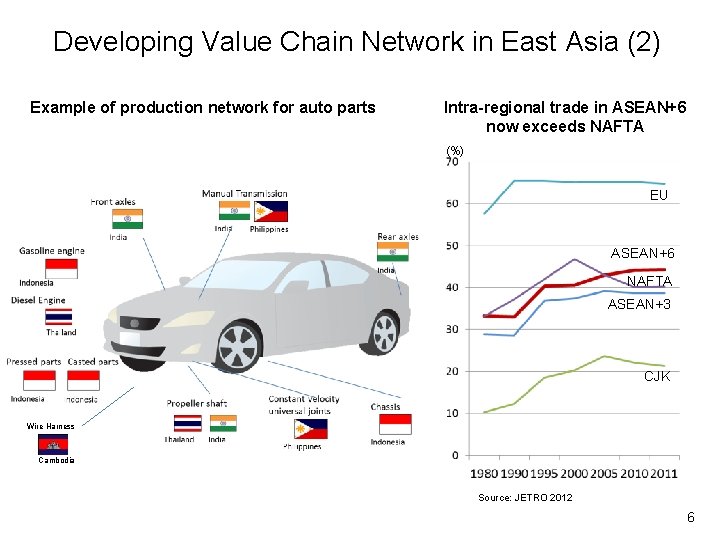
Developing Value Chain Network in East Asia (2) Example of production network for auto parts Intra-regional trade in ASEAN+6 now exceeds NAFTA (%) EU ASEAN+6 NAFTA ASEAN+3 CJK Wire Harness Cambodia Source: JETRO 2012 6

Development of Japan’s EPA/FTA Network In force/Signed ( 12 countries and 1 region ) In force/Signed Under Negotiation Joint Study Singapore Asia Malaysia Thailand Asia Japan-EU EPA India Mexico Latin America Indonesia Brunei China-Japan-Korea FTA Vietnam Chile Peru ASEAN Europe Switzerland Philippines TPP Under Negotiation ( Trans-Pacific Partnership ) ( 5 countries and 5 regions ) RCEP ( Regional Comprehensive Economic Partnership ) ( ASEAN, Japan, China, Korea, India, NZ and Aus ) Asia/ Pacific Mongolia Pacific Australia C-J-K Europe EU RCEP North America Canada Republic of Korea (Negotiation suspended ) Latin America Colombia TPP Middle East GCC* Joint Study ( 1 country ) Middle East Turkey * GCC: Gulf Cooperation Council (UAE, Bahrain, Kuwait, Oman, Qatar, Saudi Arabia) 7

Development of Regional FTA/EPAs in East Asia l After completion of ASEAN+1 s and proposals of +3 (EAFTA) and +6 (CEPEA), negotiation of RCEP (Regional Comprehensive Economic Partnership) began. Japan-China-Korea FTA is also developing simultaneously. l TPP negotiation has been strongly affecting. Some ASEAN member countries participate in TPP ASEAN CEPT under AFTA (1993) 2006 2009 ATIGA (ASEAN Trade In Goods Agreement) (2008) ASEAN China FTA (goods) (2005) ASEAN Korea FTA (goods) (2007) AJCEP (goods) (2008) Track 2 study ASEAN India FTA (goods) (2010) 2011 Tariff Elimination of all ASEAN members by 2015 EAFTA ASEAN+3 China proposed ASEAN+3 (2003) ASEAN Australia. New Zealand FTA (2010) Completion of ASEAN+1 FTAs with 6 partners Outside ASEAN++ ASEAN+1 CEPEA ASEAN+6 Discussion on Japan proposed ASEAN+6 (2006) FTAAP (2006~) Track 2 study Agreed to launch governmental discussion with CEPEA and EAFTA in parallel (2009 EAS) Japan and China jointly proposed WG for liberalization (2011) TPP negotiation (2010~) ASEAN proposed RCEP (2011. 12) Announced to launch RCEP negotiation in early 2013 (2012 EAS) Launch of RCEP negotiation (2013) Japan China Korea agreed to prepare for FTA (2011. 5) Japan-China. Korea FTA announce(201 2) launch (2013) 8
2. GVCs and Japan-Brazil relationship ・Global value chains (GVCs) and trade rules GVCs require multifaceted rules covering not only border measures but behind-the-border measures/non tariff issues. Holistic coverage of trade rules is essential. ・FTA and GVCs WTO headed by DG R. Azevedo is ideally the best forum to develop global rules related to GVCs but the Doha Round logjam is serious. Deep FTA is, for the time being, the most promising option to realize liberalization and rulemaking to meet the needs of GVCs. 9
2. GVCs and Japan-Brazil relationship ・Japan-Brazil FTA Developing FTA between Japan and Brazil matching the needs of business societies and GVCs is a realistic choice. ・JBECC recommendation for the comprehensive Japan-Brazil FTA is thus most relevant. 10
2. GVCs and Japan-Brazil relationship ・Basic points for consideration on Japan Brazil FTA from GVC perspectives ・Think always Supply Chain implicationーAccomodating the interests of businesses and realities of GVCs See WEF(2013) ・Think Globally—Necessity of vision on future global trade system To form the basis of future WTO rules, not just regional rules. Avoiding emergence of “Spaghetti bowls in rules” is essntial. See WEF(2013), Keidanren(2013) (Concept of “Unified Axis”), Nakatomi(2013), Baldwin and Nakatomi (2015) ・Think “Holistic” approach 11
2. GVCs and Japan-Brazil relationship ・Avoid hegemonic fights Japan as a non hegemon (currently trying to bridge Asia, Europe and Americas by the network of FTAs) is the perfect partner for Brazil to begin developing mega FTA. ・Speed and flexibilityーsince the shape of GVCs is changing all the time Quick launch and conclusion of the negotiation and flexible adaptation/adjustment machanism after implementation is required. 12
References Baldwin, Richard (2012), “WTO 2. 0: Global Governance of Supply-Chain Trade, ” CEPR Policy Insight 64. Baldwin, Richard and Michitaka Nakatomi (2015). ”A world without the WTO: what’s at stake? , ” CEPR Policy Insight No 84(July 2015), Centre for Economic Policy Research IADB (2014), “Synchronized Factories Latin America and the Caribbean in the Era of Global Value Chains” IDE/JETRO and WTO (2011), “Trade Patterns and Global Value Chains in East Asia: From Trade in Goods to Trade in Tasks” Keidanren (2013), “Proposals for Redefining of Trade Strategy: Towards a proactive new trade strategy that takes the initiative to establish global rules, ” April 16, 2013. Mc. Kinsey Global Institute (2014), “Connecting Brazil to the world: A path to inclusive growth” Nakatomi, M. (2013), “Global Value Chain Governance in the Era of Mega FTAs and a Proposal of an International Supply-chain Agreement, ” Vox. EU Column, August 15, 2013. World Economic Forum(2013), “Enabling Trade: Valuing Growth Opportunities” 13
- Slides: 13