
Global Value Chain in East Asia Michitaka Nakatomi
“Global Value Chain” in East Asia Michitaka Nakatomi President Japan External Trade Organization(JETRO) 1
Implications of WTO/IDE study �Issues of "global value chains" and "vertical specialization" highlighted ◦ Diversity and complementarities of production networks cause "fragmented value chains" ◦ The concept of "country of origin" is becoming increasingly difficult to apply �Importance of lowering trade barriers �A new trade regime is needed, as firms go beyond national boundaries 2
The regime should include: �Wider regional coverage �Universality �Elimination of trade barriers ◦ Freer movement of goods, services, capital, people and technologies �Contribution to global business activities 3
Importance of WTO �WTO as a universal regime ◦ WTO as a regime for ensuring companies' productions and activities globally ◦ Swift conclusion of Doha Round necessary �A regime that provides solutions to business challenges is needed ◦ Not only tariffs, but also anti-dumping rules, trade facilitation, trade and investment, competition policy and intellectual property rights, etc. cf. Chapter IV of the study: necessity to deal with NTMs �Speed : Business requires a regime which responds quickly to its needs. 4
Complementary regimes for WTO �FTAs ◦ Bilateral ◦ Regional �Plurilateral Agreements (such as ITA) �Other bilateral or regional cooperation ⇒ Consistency with WTO rules is required 5
Japan's action and global value chains in East Asia �Supply chains in East Asia ◦ Deepening of intra-regional trade ◦ The widespread system of supply chains �Japan's support for WTO regime ◦ Only 17% of Japan's trade is with FTA partners ◦ A multilateral-based trade rule is the best solution 6
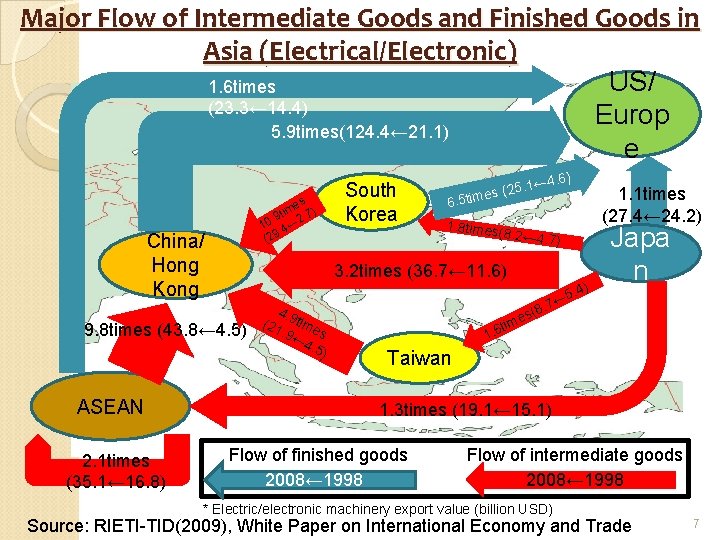
Major Flow of Intermediate Goods and Finished Goods in Asia (Electrical/Electronic) US/ 1. 6 times (23. 3← 14. 4) Europ 5. 9 times(124. 4← 21. 1) e s me. 7) i t. 9 10. 4← 2 (29 China/ Hong Kong 2. 1 times (35. 1← 16. 8) 4. (21 9 time. 9← s 4. 5 ) 1. 1 times (27. 4← 24. 2) 6. 5 t 1. 8 times (8. 2← 4. 7 ) 3. 2 times (36. 7← 11. 6) 9. 8 times (43. 8← 4. 5) ASEAN South Korea 4. 6) 25. 1← imes ( 8. 7 s( ime . 4 ← 5 ) Japa n t 1. 6 Taiwan 1. 3 times (19. 1← 15. 1) Flow of finished goods 2008← 1998 Flow of intermediate goods 2008← 1998 * Electric/electronic machinery export value (billion USD) Source: RIETI-TID(2009), White Paper on International Economy and Trade 7
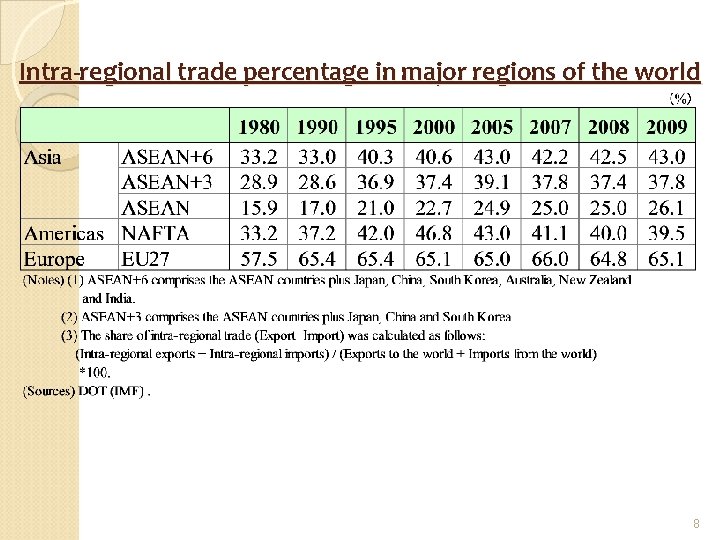
Intra-regional trade percentage in major regions of the world 8
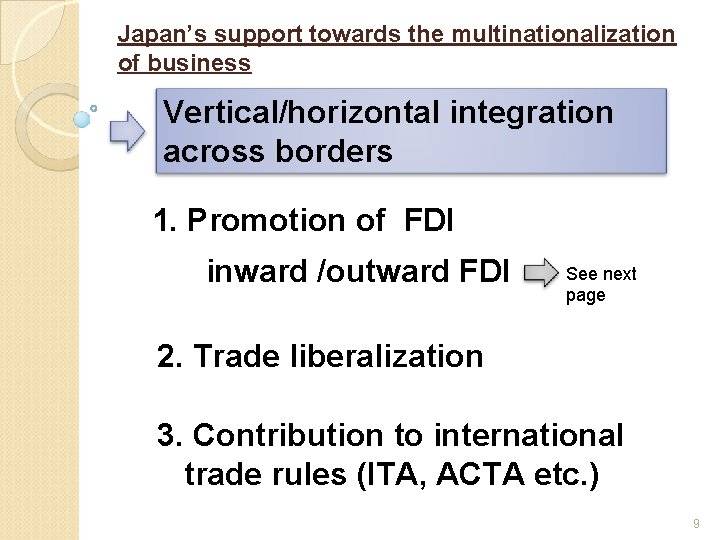
Japan’s support towards the multinationalization of business Vertical/horizontal integration across borders 1. Promotion of FDI inward /outward FDI See next page 2. Trade liberalization 3. Contribution to international trade rules (ITA, ACTA etc. ) 9
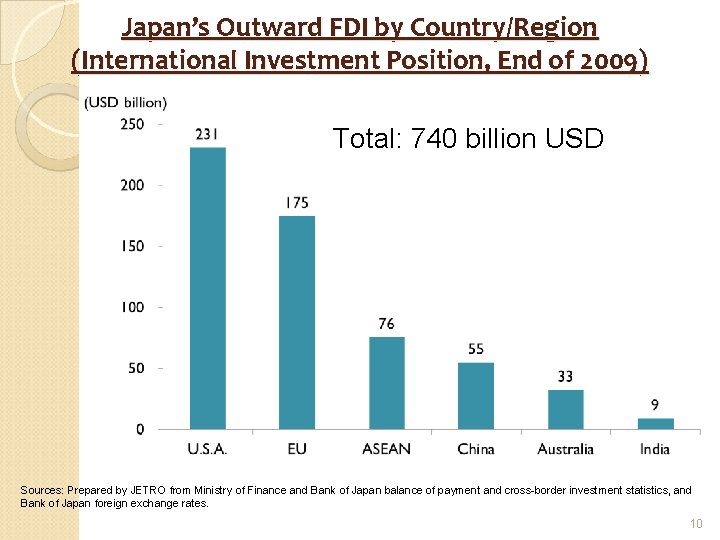
Japan’s Outward FDI by Country/Region (International Investment Position, End of 2009) Total: 740 billion USD Sources: Prepared by JETRO from Ministry of Finance and Bank of Japan balance of payment and cross-border investment statistics, and Bank of Japan foreign exchange rates. 10
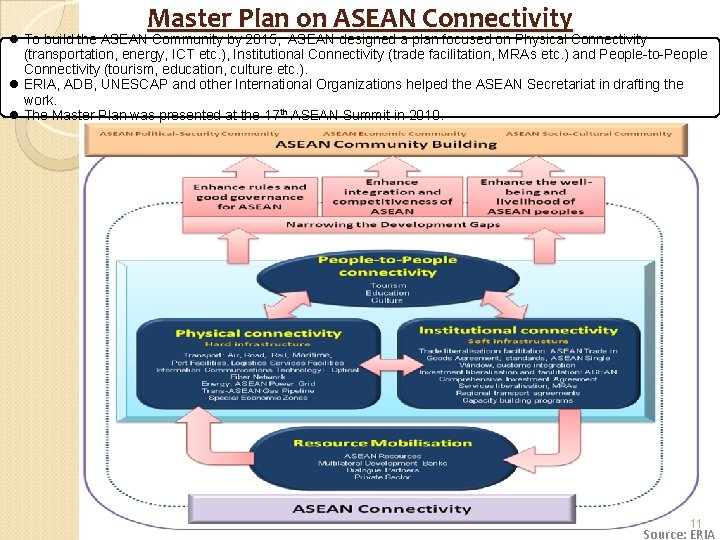
Master Plan on ASEAN Connectivity l To build the ASEAN Community by 2015, ASEAN designed a plan focused on Physical Connectivity (transportation, energy, ICT etc. ), Institutional Connectivity (trade facilitation, MRAs etc. ) and People-to-People Connectivity (tourism, education, culture etc. ). l ERIA, ADB, UNESCAP and other International Organizations helped the ASEAN Secretariat in drafting the work. l The Master Plan was presented at the 17 th ASEAN Summit in 2010. 11 Source: ERIA
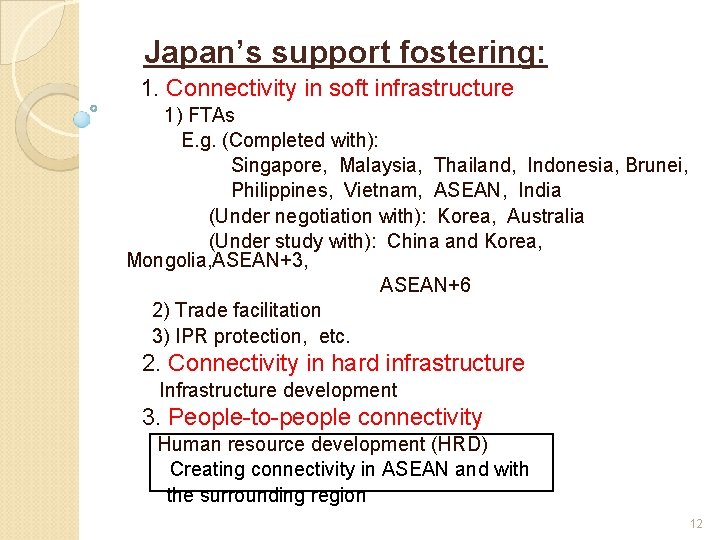
Japan’s support fostering: 1. Connectivity in soft infrastructure 1) FTAs E. g. (Completed with): Singapore, Malaysia, Thailand, Indonesia, Brunei, Philippines, Vietnam, ASEAN, India (Under negotiation with): Korea, Australia (Under study with): China and Korea, Mongolia, ASEAN+3, ASEAN+6 2) Trade facilitation 3) IPR protection, etc. 2. Connectivity in hard infrastructure Infrastructure development 3. People-to-people connectivity Human resource development (HRD) Creating connectivity in ASEAN and with the surrounding region 12
- Slides: 12