
Global Trends in RIA drs Kees R Jonkheer
Global Trends in RIA drs. Kees R. Jonkheer 13 May, 2019
Good Afternoon, my name is: Kees Roeland Jonkheer q MSc in Economic Geography § specialized in European Trade Law q Economic Researcher for first 10 years of career § at the largest economic research institute of The Netherlands, EIM, that developed the first fully operational regulatory impact assessment tool q Ministry of Finance – Advisory Board on Regulatory Burden § World Bank Review 2007: World Leader Regulatory Impact Assessment q Last 11 years: international Regulatory Impact Assessment consultant 2
Agenda The Agenda of this Global Trends in RIA Session on Regulatory Impact Assessment: q Relevance of Regulation Why do we engage in Regulatory Impact Assessment? q RIA in international context q Specific Reasons for RIA in African nations q Five RIA trends in RIA practise q RIA practise Africa: examples 3
Regulation: role and relevance Regulations are big decisions that affect ‘us’, or ‘other people’ 4
Regulation: role and relevance q Regulation is aimed at bringing guiding order in societies, with direct repercussions of compliance for large groups of people, over a substantial geographical area, usually for a long period of time. q Regulations address problems and provide conditions to solve these. q Regulations are essential references, will always be referred to, and may intrinsically provoke new (re)actions, will constantly be challenged and will be suffering from abuse where possible, in cases where people see (economic) benefit. q Regulation is at the heart of the fabric of a system that allows for checks and balances. Without the unequivocal reference points of regulation, checks and balances would not be possible. q Regulation exists within a regulatory framework. New regulation is bound to fit, correspond and be consistent with an existing regulatory framework. 5

2017 OECD Forum 1. The role of regulation is increasingly crucial in "Unlocking investment" for fostering the right Investment Climate. 2. Regulatory Reform and Non-Tarriff Barriers are increasingly key to Trade Development (see f. e. EAC, COMESA, SADC, Tripartite Free Trade Area). 3. All the challenges of implementation that better regulators are familiar with, are key to integrated policies such as Sustainable Development Goals (see f. e. Uganda Agenda 2030, Uganda Vision 2040). 6
Why do we engage in Regulatory Impact Assessment? Technically, regulation is the most drastic, thorough and far-reaching intervention governments can take: q Regulation usually addresses systemic issues, such as elimination of market failure, preventing economic swings, maintaining quality standards, improve market infrastructure & discipline, increase economic growth, etc. q The regulatory process is lengthy and time-consuming. q Regulation is costly for the administrator, to conceptualize, draft, implement, and enforce. q Regulation is costly for society, markets, and specifically for the regulatory target group, in terms of compliance costs. 7
Why do we engage in Regulatory Impact Assessment? cont’d q Regulation has legal and judicial consequences, and requires to be coherent with an overall legal framework and constitution. q Once in place, regulation becomes the prevailing, structural, reference. q Because of its ‘radicalism’, thoroughness and far-reach, impact of regulations are often hard to predict, and are often unintended and unforeseen. Regulation should be an intervention option governments would only resort to in the ultimate instance when other options do not suffice. “We don’t regulate, unless” 8
Regulatory Impact Assessment q A principle decision has been reached to regulate. Ideally, it is a process and a document created before a new government regulation is introduced. q Regulation is the motive for a RIA. As such, it is part of the Legislative Process. q RIA is a decision tool applied to regulation that identifies the optimal form of a piece of Regulation, and possible alternative Policy Options. q Ultimately, the RIA assesses the intended regulation by ‘the four basic RIA questions’. RIA is applied when there is a regulatory intent. “We regulate, unless” 9
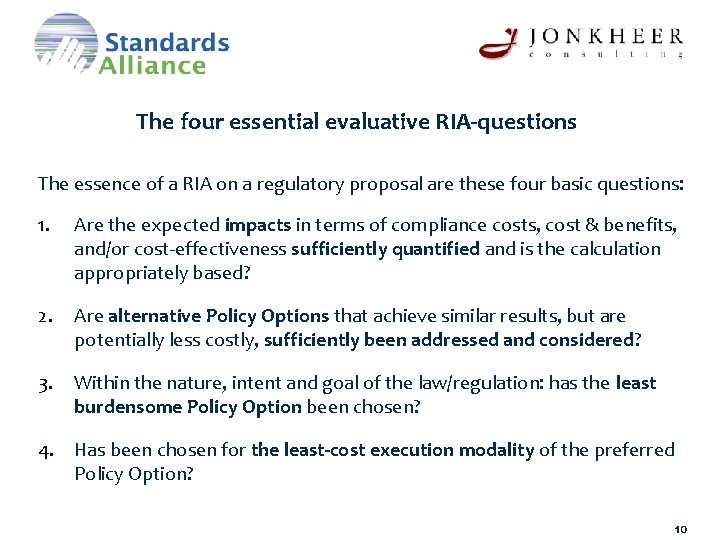
The four essential evaluative RIA-questions The essence of a RIA on a regulatory proposal are these four basic questions: 1. Are the expected impacts in terms of compliance costs, cost & benefits, and/or cost-effectiveness sufficiently quantified and is the calculation appropriately based? 2. Are alternative Policy Options that achieve similar results, but are potentially less costly, sufficiently been addressed and considered? 3. Within the nature, intent and goal of the law/regulation: has the least burdensome Policy Option been chosen? 4. Has been chosen for the least-cost execution modality of the preferred Policy Option? 10
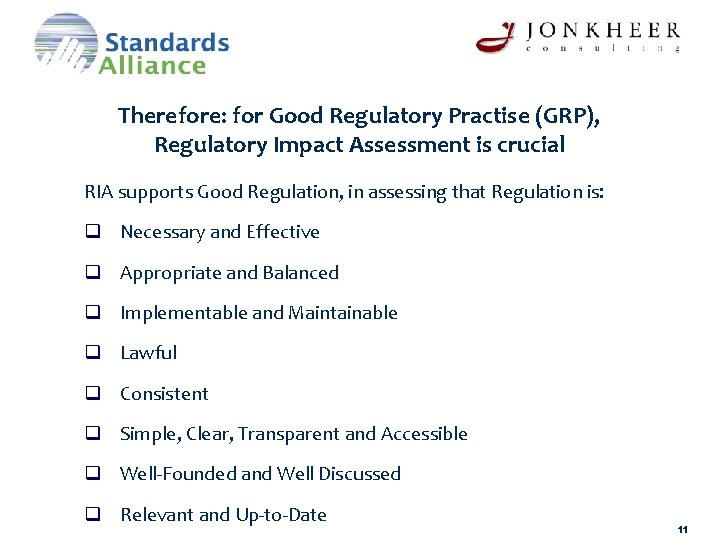
Therefore: for Good Regulatory Practise (GRP), Regulatory Impact Assessment is crucial RIA supports Good Regulation, in assessing that Regulation is: q Necessary and Effective q Appropriate and Balanced q Implementable and Maintainable q Lawful q Consistent q Simple, Clear, Transparent and Accessible q Well-Founded and Well Discussed q Relevant and Up-to-Date 11
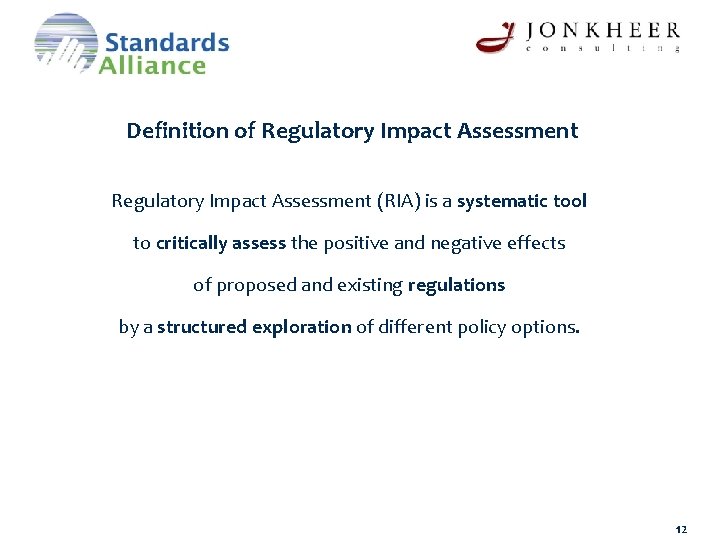
Definition of Regulatory Impact Assessment (RIA) is a systematic tool to critically assess the positive and negative effects of proposed and existing regulations by a structured exploration of different policy options. 12
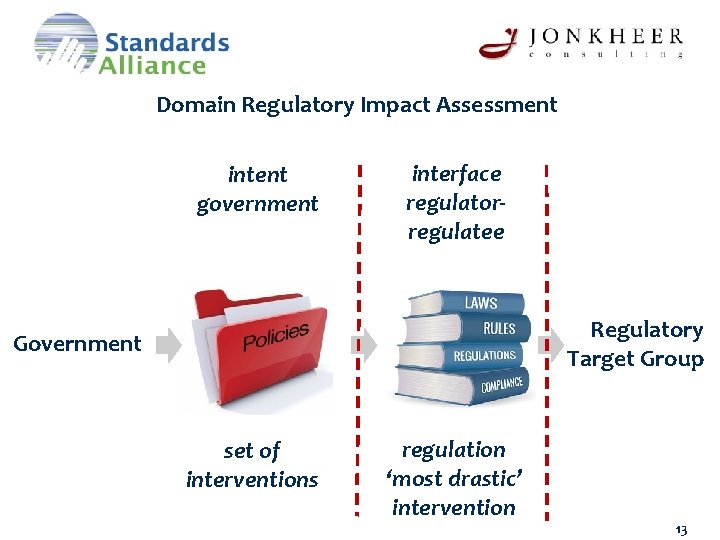
Domain Regulatory Impact Assessment intent government interface regulatorregulatee Regulatory Target Group Government set of interventions regulation ‘most drastic’ intervention 13
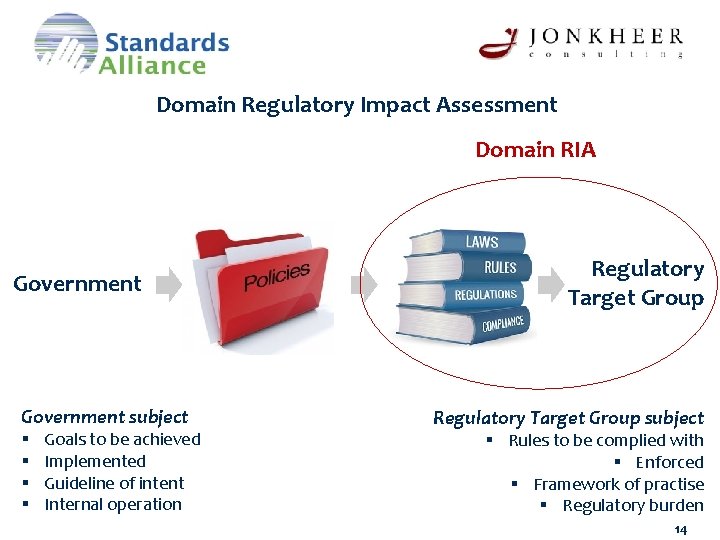
Domain Regulatory Impact Assessment Domain RIA Government subject § § Goals to be achieved Implemented Guideline of intent Internal operation Regulatory Target Group subject § Rules to be complied with § Enforced § Framework of practise § Regulatory burden 14
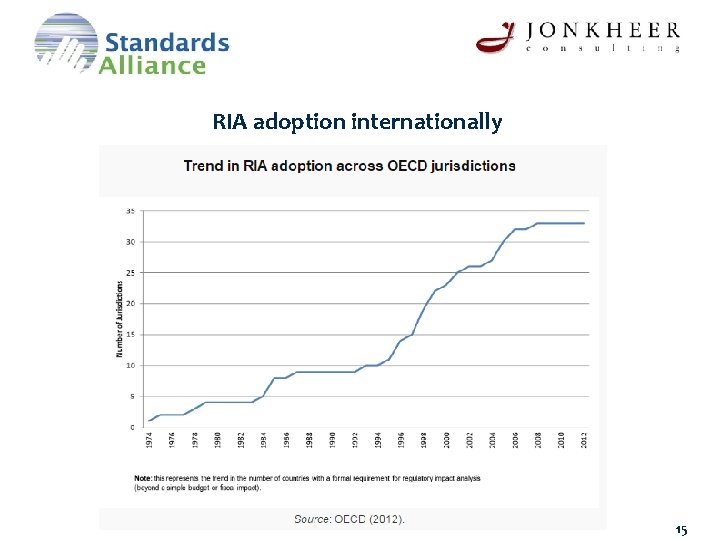
RIA adoption internationally 15
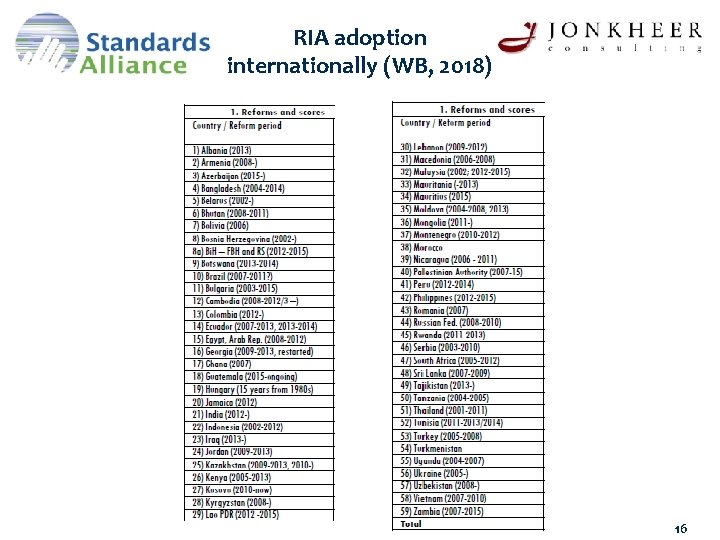
RIA adoption internationally (WB, 2018) 16
Specific Reasons for RIA in African nations (1) 1. Many African countries, including Tanzania and Mozambique, and indeed Uganda, are still emerging from a history of heavy-handed socialist regulation. 2. This means they are hampered by the legacy of a heavily regulated economy and a command control approach to administration and enforcement. As such, their regulatory systems are not well developed to support a flourishing market economy that will create growth and jobs. 3. RIA can help ensure economic growth and a better business environment by encouraging policy makers to focus on the needs of the market, especially small firms. 17
Specific Reasons for RIA in African nations (2) 1. MSMEs constitute the majority of businesses in most countries, and account for the bigger share of total employment and gross domestic product. 2. Complicated regulatory burden is one of the reasons why many of the MSMEs operate in the informal sector. MSMEs are more vulnerable to regulatory burdens than larger firms, as they are not able to take advantage of economies of scale in reducing the relative impact of regulatory burdens. Around 85 percent of the small and medium enterprises in Uganda are thought to be informal. 3. RIA-induced clear and simple laws may offer opportunity to leave informality, thus creating certainty for businesses, and offering relief of being subject to arbitrariness and unfair treatment that are characteristic to informal economic relations. 18
Specific Reasons for RIA in African nations (3) 1. Corruption is more pervasive in many developing countries than in the OECD countries. Uganda is placed 142 nd out of 175 countries in Transparency International’s 2014 Corruption Perceptions Index. 2. At present, in many countries, the proportionately greatest burden of corruption is borne by those small businesses that succeed, thereby creating a disincentive for entrepreneurs to invest and grow their businesses. 3. RIA facilitated administrative simplification can bring greater transparency that help contain levels of rent-seeking behaviour and contribute to economic efficiency. 19
Specific Reasons for RIA in African nations (4) 1. In Africa generally, often multi-ethnic societies can be less homogenous than in other parts of the world. 2. National unity is not always served well when one group is seen unjustifiably to benefit at the cost of other groups. RIA helps to identify the impact of regulation also in this respect. 3. RIA brings focus to the distribution of impacts, enlightening and encouraging policymakers to identify whether one ethnic or religious group loses disproportionately from regulatory change compared with other groups. 20
Specific Reasons for RIA in African nations (5) Fifth, there are vulnerable groups in developing countries whose needs are especially relevant. RIA can provide a framework for ensuring that these vulnerable groups’ special needs are taken into account. For example, in assessing the impact of new regulations on small businesses, RIA should encourage to take into account that: 1. Regulation should improve access to government service, not make it harder. 2. Adjustment to regulations may be expensive for small businesses. Support measures, transition periods, a phased approach, and perhaps sometimes exemptions might be appropriate. 3. Small businesses are more vulnerable to changes in prices, which can significantly diminish or increase real incomes. 4. Social ties are very important, as they constitute a line of defence against risk. Regulations should not damage the social capital. Security offered by informal mechanisms may suffer if these become subject to regulation. 21
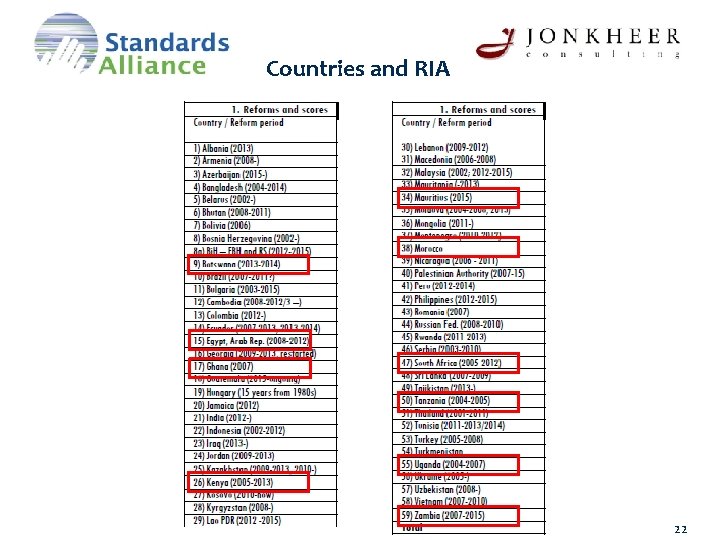
Countries and RIA 22
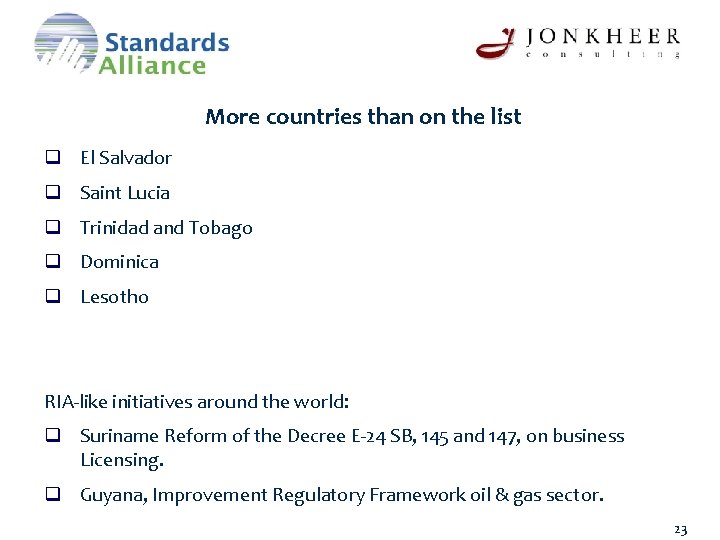
More countries than on the list q El Salvador q Saint Lucia q Trinidad and Tobago q Dominica q Lesotho RIA-like initiatives around the world: q Suriname Reform of the Decree E-24 SB, 145 and 147, on business Licensing. q Guyana, Improvement Regulatory Framework oil & gas sector. 23
Trend 1: Regulatory Impact Assessment Legally Institutionalized? It is often stated that a legal basis for a RIA system is a good indicator by which may be understood how well the RIA system is being implemented. Legal basis: law, presidential order, prime ministerial decree, cabinet or policy directive, etc. ? The main 3 basic questions concerning RIA in international comparison: 1. Is RIA legally institutionalized? 2. Is a Regulatory Oversight Body legally institutionalized? 3. Are MDAs legally bound to conduct RIA? 24
Trend 2: RIA part of Policy Development or Legislative Process? q The place of RIA in government institutional framework? q When do you start RIA? q Who are the actors? Conclusion: it depends, and it may differ from country to country 25
Trend 3: RIA Practise in order to align with International Regulatory Framework, to promote trade q q q RIA in relation to standards (SLBS, BOBS, etc. ) WTO-TBT SDGs EPA Regional harmonization (SADC-TRF) 26
Trend 4: However RIA Practise often still donor-driven, momentum changes q Experience from countries like Tanzania shows that RIA as an external, donor-driven programme shows little sustainability. Source: Towards Water Resources Regulation in South Africa, 3 rd report (2011) q Uganda in 2018 reinforced RIA Practise from President’s Office. 27
Trend 5: RIA Methodology Poorly Applied q Incoherent Business Case: Problem Definition, Objectives, and Policy Options not fully aligned. q Poor Data Availability and/or Collection. q Poor Application and Justification of chosen Method of Measurement. q Impact Assessment still often about what Impact is endured by Government as opposed to impact on the Regulatory Target Group. 28
RIA in African countries: MENA 1. In Tunisia, Circular No. 14 of the Prime Ministry (2011), followed by a Decree in 2012 requires that for new laws or regulations an assessment is made of the regulatory impacts. 2. In Morrocco the Government Programme 2012 -2016 foresees a “whole-ofgovernment reform” of the regulatory system. To this end, Morrocco has launched a pilot project at the Ministry for Plubic Sector Modernisation to simplify 100 administrative procedures. 29
RIA in Egypt 1. Mega projects and FDI are a good push for Egypt’s economy. However: Egypt has to create 700, 000 new jobs yearly, to keep up with the birth rate. 2. SMEs employ 83% of the population, jobs will be created by growing and stimulating Egyptian companies. 3. This requires an “opening up” of the private sector’s base by removing bureaucracy, red tape and over-regulation. 4. By simplifying regulation, opening access to foreign currency and contracts, government will help Egyptian SMEs as well as encourage foreign investors. 5. Regulatory Impact Assessment is a process tool to support better regulation and create a better business environment. 6. Regulatory Oversight Body ERRADA plays a key role in conducting and advocating RIA in Egypt. The initiative was officially launched in 2008 by Ministerial Decree No. 1089/2008, and is chaired by the Minister of Finance. 30
RIA in Sub-Saharan countries 1. Tanzania. RIA introduced in 2004. RIA was introduced and embedded in the ‘Business Environment Strengthening for Tanzania’ (BEST) programme. The Office of the Cabinet Secretariat is the focal point for RIA compliance. 2. South Africa. Cabinet of South Africa approved RIA in 2007. The Central RIA Unit is located in the Presidencies’ Cabinet Office to provide oversight function and support government departments in implementing RIA. The National Treasury provides technical assistance to departments. From 1 October 2015 Cabinet Memoranda seeking approval for draft policies, Bills or regulations must include an impact assessment that has been signed off by the SEIAS Unit. April 2016, Red Tape Impact Assessment Bill. 31
RIA in Kenya 1. The Constitution of Kenya, 2010, demands that all legislation is prepared on the basis of transparent, comprehensive and balanced evidence. “RIA is aimed at ensuring rigorous analysis of regulatory proposals, effective and appropriate consultation and transparency of process". 2. National Handbook Policy Making (2012). 3. The Statutory Instruments Act, 2013, requires regulatory authorities to prepare a regulatory impact statement for every statutory instrument (rule, order, regulation, form, by-law, resolution, etc. ). The statement shall include an analysis of the impact on the private sector. The Act requires public consultation of all the statutory instruments. 4. Kenya Law Reform Commission (the Commission), established by the Kenya Law Reform Commission Act, 2013 (No. 19 of 2013), keeps under review all the laws, has a mandate to ensure that all the laws in the Statute Book are reviewed, provide technical assistance to and capacity building. 5. A Guide to the Legislative Process in Kenya, 2015. 32
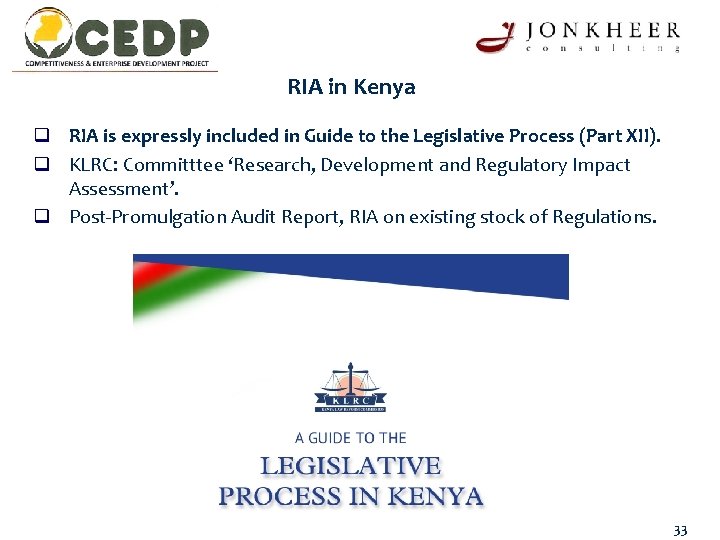
RIA in Kenya q RIA is expressly included in Guide to the Legislative Process (Part XII). q KLRC: Committtee ‘Research, Development and Regulatory Impact Assessment’. q Post-Promulgation Audit Report, RIA on existing stock of Regulations. 33
RIA in Botswana q Review of the Standards (Import Inspection) Regulations (SIIR) and the Carrying Out of the RIA on the Proposed Revised SIIR. q To review the SIIR with the view of; i. Aligning it to the WTO TBT Agreement. ii. Strengthening of the sanctions to ensure that the SIIR achieves its objectives. q Conduct Regulatory Impact Assessment (RIA) on the proposed revised Technical Regulation with the view of; i. Improving coordination among government departments and regulatory bodies. ii. Ensuring transparency in the decision process as well as help to eliminate any Non -Tariff Barriers. iii. Conducting an assessment on the impact of the regulatory requirements on regulated products (2018). q Coordinated by the Botswana Bureau of Standards (BOBS) 34
RIA in Lesotho q Regulatory Impact Assessment framework to design RIA framework for electricity and water, and to undertake detailed RIA assessment for the two regulated industries in the country (2018). q Develop a Legaal and Regulatory Framework for Standards and Quality, Supporting s. Sale of Bottled Water, a Regulatory Impact Assessment of the regulation of bottled water (2018). 35
RIA in Mauritius q Trade Regulatory Impact Assessment. TBT programme promotes “Studies, reviews and regulatory impact assessments (RIA) to assess the adequacy of the national/regional/continental Quality Infrastructure and regulatory capacity in order to allow elimination of TBT to intra-REC (Art 31. 1 Abuja Treaty), intra-continental and intra-ACP trade, to assess needs, to define strategies and action plans, to evaluate the impact of harmonized TR and standards (2017). q OECD-funded project regarding capacity building for RIA practise at the Economic Development Board of Mauritius (2019). q RIA-project, Mauritius EPA Support Project for Improving the Business and Investment Climate financed under European Development Fund (pending). 36
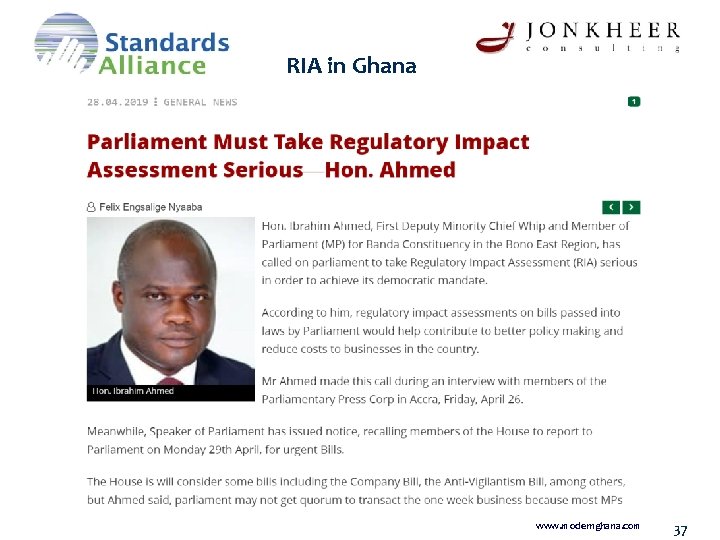
RIA in Ghana www. modernghana. com 37
RIA in Zambia q The Business Regulatory Act N 0. 3 of 2014. q Business Regulatory Review Agency (before BLRC, from 2008 onwards). q Successful implementation of business registration and licensing reforms in Zambia (best practise). q Two main documents: the Regulatory Impact Assessment (RIA). standards and guidelines and the BRRA RIA Handbook for public bodies in Zambia. q Any Public body that intends to introduce any policy or proposed law for regulating business activities should perform a Regulatory Impact Assessment (RIA). q Many RIAs on proposed regulation. 38
RIA-like initiatives in Sub-Saharan countries In some countries projects are conducted that are not labelled RIA, but bear the characteristics: 1. Mauretania is not yet using RIA systematically, however for high impact regulations ministries are requested to provide a summary on the social, economic, health, political and environmental effects of the regulation. 2. Nigeria Public-Private Dialogue projects because of its consultative nature may bear ample resemblances to RIAs, review Decree No. 21 of 1998, Taxes and Levies (Approved List for Collection) Decree. Economic Impact Assessments, yes. 39
Case: Regulatory Impact Assessment in Uganda (1) 1. In Uganda Better Regulation – and, RIA being part of this - is seen as a key tool to achieve its economic growth targets. 2. In Uganda, most of the government reform programmes/policies are set up separately within each ministry, to support efforts in building a regulatory management system to review and streamline business-related regulations. 3. RIA is not found to be legally binding in Uganda. Despite RIA being included in a large-scale program of regulatory reform and publications of Guide of Good Regulations and Regulatory Impact Assesment, approval for the legal requirement to include RIA in policy/legislation submissions to Cabinet is still to be obtained. 4. The institutional framework of the initiative is currently oversighted by the Cabinet Secretariat of the President’s Office. 5. RIA are frequently done on policies. World Bank 2017 Global RIA Award (Honorable mention) for RIA on National Fertilizer Policy: “Influential RIA”. 40
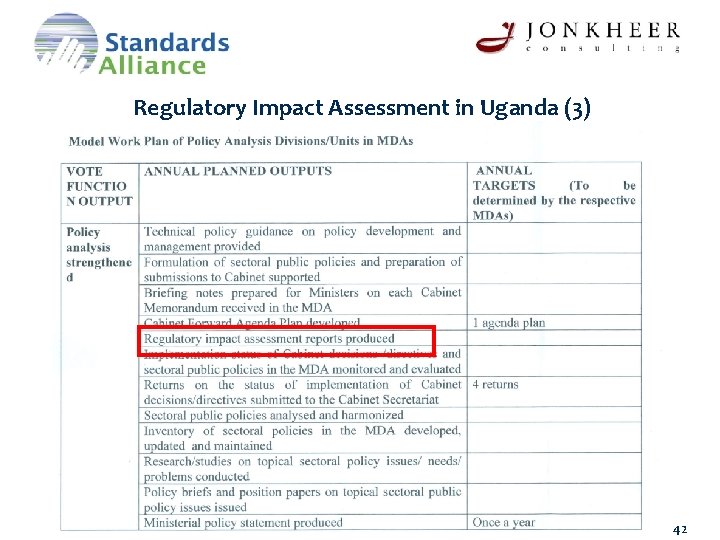
Regulatory Impact Assessment in Uganda (2) Uganda: q Guide of Good Regulations and Regulatory Impact Assessment. q Law providing for the certificate of financial implications of regulations. It was amended in 2015. Currently therefore, Section 76 of the Public Finance Management Act, 2015, requires that every Bill introduced in Parliament is accompanied by a certificate of financial implications. q Implementation of RIA is overseen by the Cabinet Secretariat. q Business Licensing Reform and calculation of effects on compliance. q Recently, Model Work Plan for Policy Analysis Divisions/Units in MDAs (March 2018), and a Simplified RIA Outline (April 2018), have been issued. 41
Regulatory Impact Assessment in Uganda (3) 42
Regulatory Impact Assessment in Uganda (4) Uganda: q Despite a Guide of Good Regulation and a Guide of Regulatory Impact Assessment, RIA practice is NOT legally institutionalized in Uganda. q A Regulatory Oversight Body is NOT legally institutionalized in Uganda. q MDAs are NOT legally bound to conduct a RIA in Uganda, however RIA practise reinforced in 2018. 43
Regulatory Impact Assessment in Uganda (5) q The current Framework has been designed without an enforcement mechanism. q The capacity of the Cabinet Secretariat to assess the quality of RIAs and audit RIAs remains low. q The monitoring and evaluation framework of RIA has not been provided. The lack of dedicated institution for the monitoring and evaluation of RIA remains a major weakness. By nature, this institution should have an audit mandate and should not be involved in the implementation process to avoid conflict of interest. q Lack of Cabinet Forward Policy Agenda (planning agenda). 44
- Slides: 44