
GLOBAL SYSTEM FOR MOBILE COMMUNICATION GSM ARCHITECTURE Vivek
GLOBAL SYSTEM FOR MOBILE COMMUNICATION (GSM) ARCHITECTURE Vivek E. B
History & Evolution of Mobile Radio 1 G Systems 2 G Systems 3 G Systems 4 G Systems 22 -Jan-22 Mobile communication 2
1 G Systems -Limitations Analog technology Limited capacity Poor security against fraud Little to offer in terms of advanced services. 22 -Jan-22 Mobile communication 3
Second Generation Systems 2 G Use of digital technology Advantages Increased Greater More 22 -Jan-22 capacity security against fraud advanced services Mobile communication 4
Second Generation Systems -2 G Limitation They are not well suited to data communications 22 -Jan-22 Mobile communication 5
2. 5 /2. 75 Generation Systems GPRS EDGE CDMA 2000 1 x 22 -Jan-22 Mobile communication 6
GSM SPECIFICATIONS 1. Standard - ETSI. 2. Access Method - FDMA-TDMA. 3. Voice channels -8 chnls/carrier. 4. RF channel spacing(Channel BW) – 200 KHz. 5. Voice Coding Algorithm – RPE-LTP. 6. Voice Coding Rate – 13 Kbps. 7. Channel bitrate – 270. 833 Kbps. 8. Modulation Method- GMSK.
GSM SPECIFICATIONS Therefore the frequencies for the uplink and the downlink are different ( Frequency Division Duplex - FDD) and the bandwidth of the GSM System is 25 Mhz. . Number of Channels – 124 channels pairs ( 25 Mhz/200 Khz )are available spaced at 200 KHz intervals Due to interference to other systems, the very first carrier is not used.
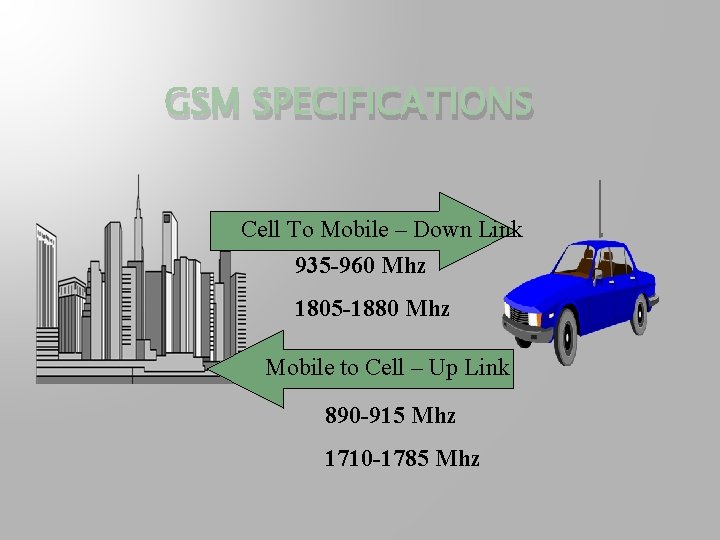
GSM SPECIFICATIONS Cell To Mobile – Down Link 935 -960 Mhz 1805 -1880 Mhz Mobile to Cell – Up Link 890 -915 Mhz 1710 -1785 Mhz
FDMA/TDMA Each channel pair serves eight ( Full Rate ) channels successively in a Timed Cycle. In FDMA system each channel requires a transmitter and receiver 8 Voice channels, staggered in Time are transmitted via one carrier frequency Each of the 124 FDMA linked carrier frequency is used to transmit 8 TDMA voice channels Discontinuous nature of TDMA makes the entire 200 Khz bandwidth available to all 8 Voice channels.
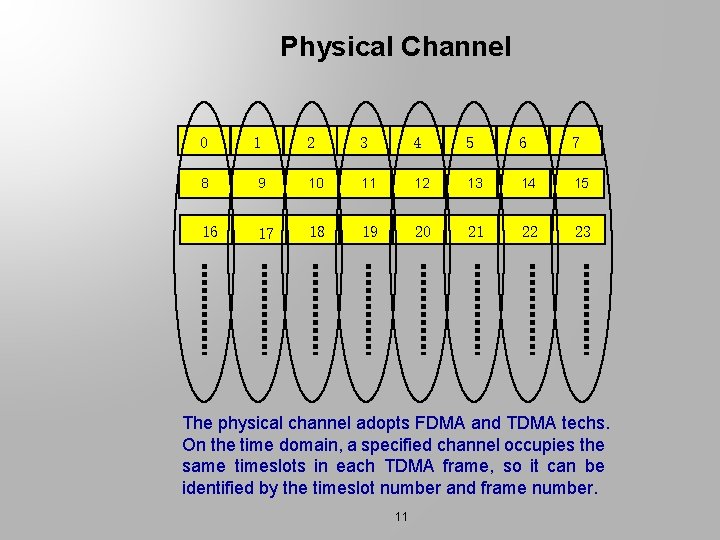
Physical Channel 0 1 2 3 4 5 6 7 8 9 10 11 12 13 14 15 16 17 18 19 20 21 22 23 The physical channel adopts FDMA and TDMA techs. On the time domain, a specified channel occupies the same timeslots in each TDMA frame, so it can be identified by the timeslot number and frame number. 11

GSM Various subsystems Mobile Station Radio Subsystem (Base Station Subsystem - BSS) includes the equipments and functions related to the management of the connections on the radio path. Network & Switching Subsystem -NSS includes the equipments and functions related to end-to-end call. Operations & Support subsystem- OSS includes the operation and maintenance of GSM equipment for the radio and network interface. 12
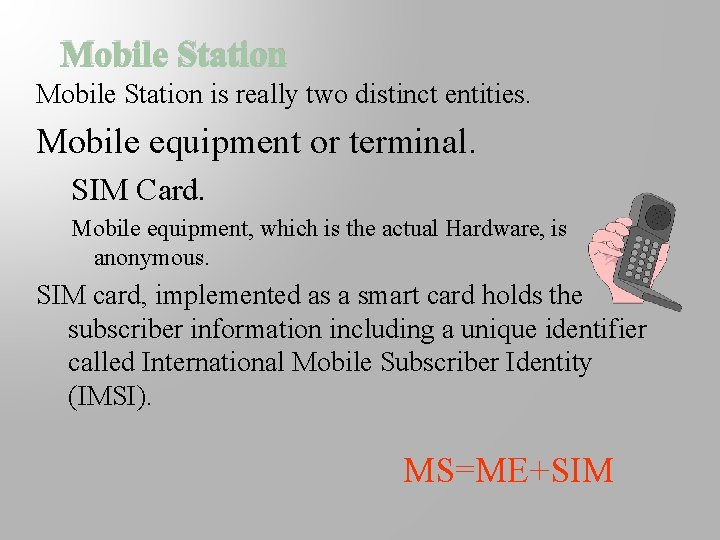
Mobile Station is really two distinct entities. Mobile equipment or terminal. SIM Card. Mobile equipment, which is the actual Hardware, is anonymous. SIM card, implemented as a smart card holds the subscriber information including a unique identifier called International Mobile Subscriber Identity (IMSI). MS=ME+SIM
Functions of Mobile Station Voice and data transmission Frequency and time synchronization Monitoring of power and signal quality of the surrounding cells Provision of location updates even during inactive state Equalization of multi path distortions
IMSI (International Mobile Subscriber Identity) An unique identity which is used internationally. Used within the N/W to identify a mobile subscriber. The IMSI is fused in SIM by SIM manufacturer on the basis of information provided by the PLMN operator. Stored within subscriber identity module(SIM), HLR, VLR, AC database. The total number of digit in IMSI shall not be more than 15 digit.
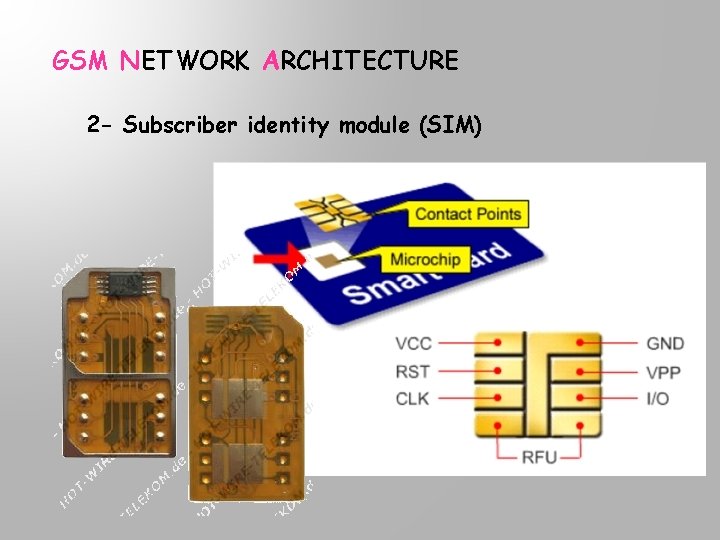
GSM NETWORK ARCHITECTURE 2 - Subscriber identity module (SIM)
SIM CARD A Smart Card That Identifies the Terminal SIM provides personal mobility SIM makes the terminal operational User can have access to all subscribed services irrespective of both location of the terminal and the use of a specific terminal SIM card may be protected against unauthorized use by a PIN (a Password) Identified with IMSI
FUNCTIONS OF SIM CARD Acces control Customisation Service personalisation Network branding and advertising Value addition in operator services Roaming
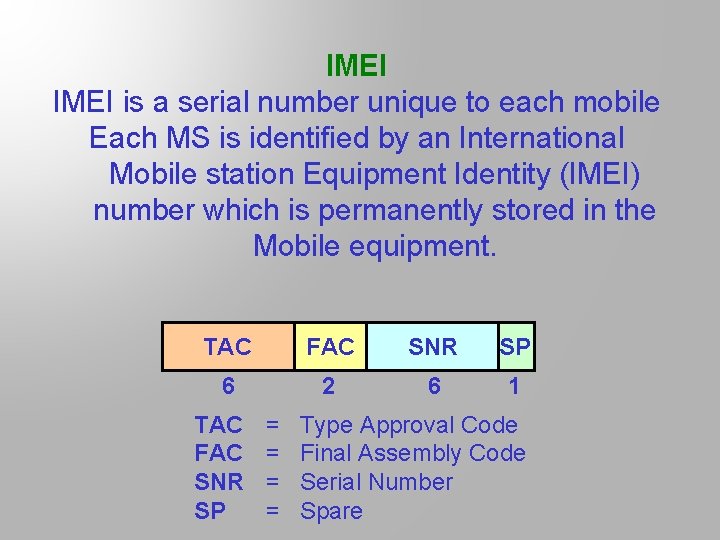
IMEI is a serial number unique to each mobile Each MS is identified by an International Mobile station Equipment Identity (IMEI) number which is permanently stored in the Mobile equipment. TAC FAC SNR SP 6 2 6 1 TAC FAC SNR SP = = Type Approval Code Final Assembly Code Serial Number Spare
Base transceiver station The base transceiver station, or BTS, contains the equipment for transmitting and receiving radio signals (transceivers), antennas, and equipment for encrypting and decrypting communications with the base station controller (BSC). Typically a BTS for anything other than apicocell will have several transceivers (TRXs) which allow it to serve several different frequencies and different sectors of the cell (in the case of sectorised base stations).
Base Transceiver station - BTS FUNCTIONS Ø Ø Ø Encodes, encrypts, multiplexes, modulates and feeds the RF signals to the antenna Transcoding and rate adaption Functionality Time and frequency synchronisation signals transmission. Frequency hopping Uplink radio channel measurements Random access detection
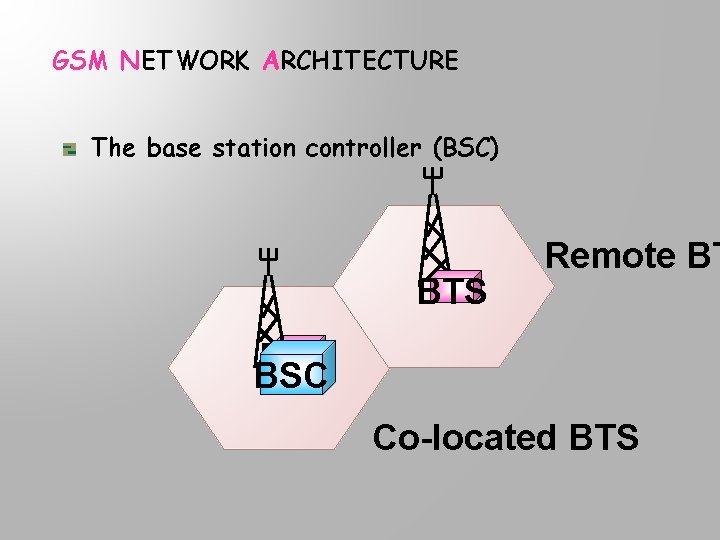
GSM NETWORK ARCHITECTURE The base station controller (BSC) BTS Remote BT BTS BSC Co-located BTS
BSC The databases for all the sites, including information such as carrier frequencies, frequency hopping lists, power reduction levels, receiving levels for cell border calculation, are stored in the BSC
FUNCTION OF BSC Ø Ø Ø Ø It is connected to BTS and offloads MSC Radio resource management Inter-cell handover Reallocation of frequencies Power control Performs traffic concentration to reduce the number of lines from BSC to MSC. BSC performs call processing.
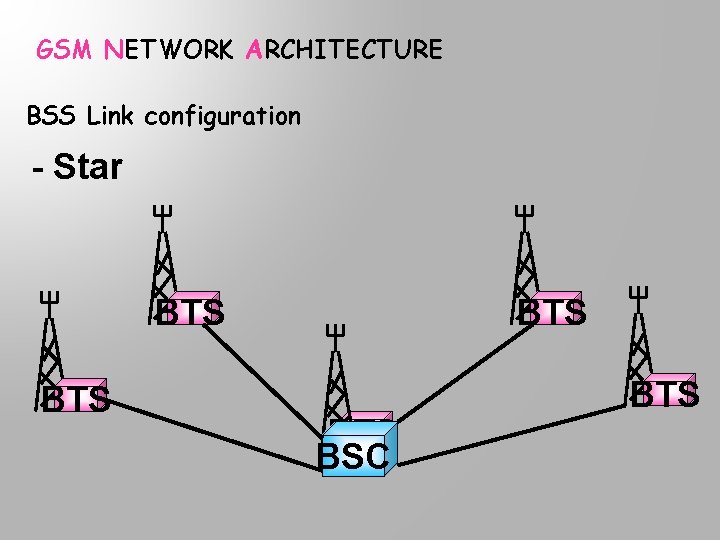
GSM NETWORK ARCHITECTURE BSS Link configuration - Star BTS BTS BSC BTS
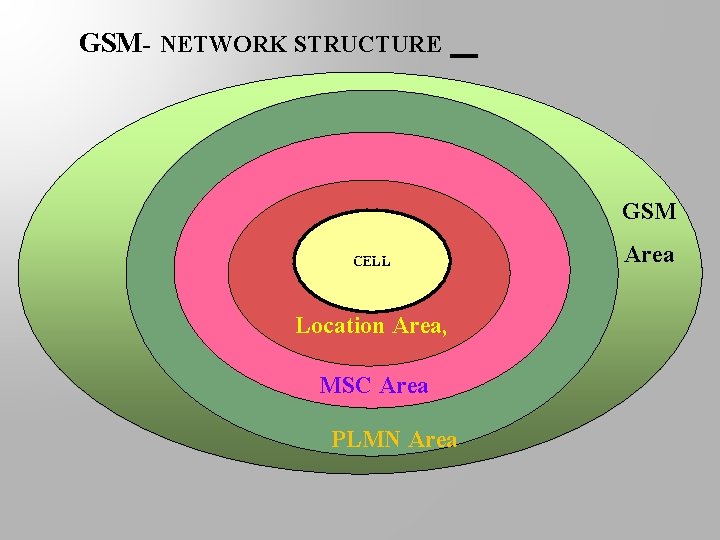
GSM- NETWORK STRUCTURE GSM pppp CELL Location Area, MSC Area PLMN Area
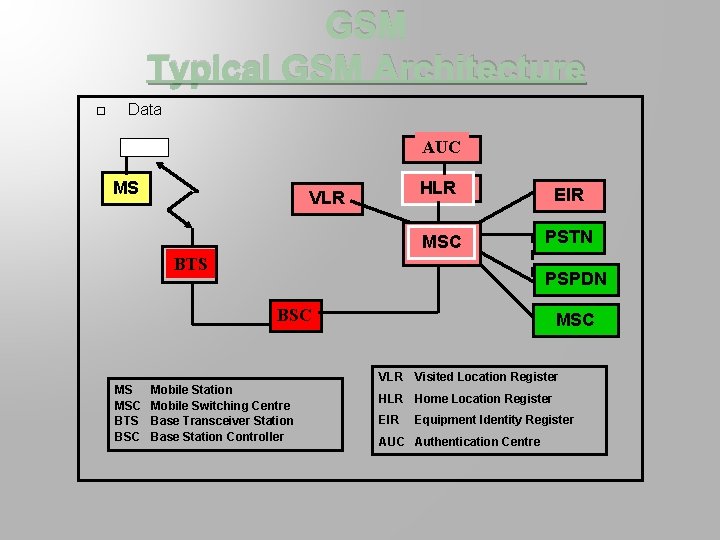
GSM Typical GSM Architecture Data AUC MS VLR HLR EIR MSC PSTN BTS PSPDN BSC MS MSC BTS BSC Mobile Station Mobile Switching Centre Base Transceiver Station Base Station Controller MSC VLR Visited Location Register HLR Home Location Register EIR Equipment Identity Register AUC Authentication Centre
Network & Switching Subsystem Manages the communication between the mobile users and other users. Provides all the functionality needed to handle a mobile subscriber such as: Registration Authentication Location updating Handovers and Routing to roaming subscribers.
Network & Switching Subsystem Mobile Switching Center (MSC) provides the services in conjunction with four intelligent databases. Home Location Register (HLR) Visitor Location Register (VLR) Equipment Identity Register (EIR) Authentication Centre (Au. C). .
GSM MOBILE SWITCHING CENTER Major functions: Call setup, supervision and release Digit collection and translation Call routing Billing information and collection Mobility management(registration, location updating, handoff) Paging and alerting Management of radio resources during a call Interrogation of appropriate registers(vlr/hlr) Echo cancellation and manage connections to BSS, MSCs, PSTN
GSM Home Location Register… Contains all administrative information of each subscriber registered in an GSM network. Logically there is one HLR per GSM. Can be implemented as a distributed database. .
GSM Visitor Location Register…. VLR Contains selected administrative information from HLR needed for call control and provision of subscribed services for each mobile located in the geographical area controlled by it. .
GSM Authentication Centre… The authentication center (Au. C) stores the keys required for checking whether a mobile subscriber is authorized to access the PLMN. -Used for security purposes. -A protected database -Subscriber authentication data ie. Authentication Keys Ki -Encryption data. -Used in association with random number, ciphering algorithms etc. .
GSM Equipment Identity Register… A database that contains a list of all valid mobile equipment of the network. Valid List, Suspect List & Fraudulent list through the use of International Mobile Equipment Identity (IMEI). Forbid calls from unauthorised terminals (non-standard terminals). .
Call Process !MSC receives a dialing command from a calling subscriber. !MSC analyses the called number, send a command to the HLR of the called subscriber. !HLR query the database, and get the route information from the VLR that the called subscriber is existing in, namely MSRN. !MSC build a connection with the MSC that the called subscriber is existing in according to the MSRN. 35
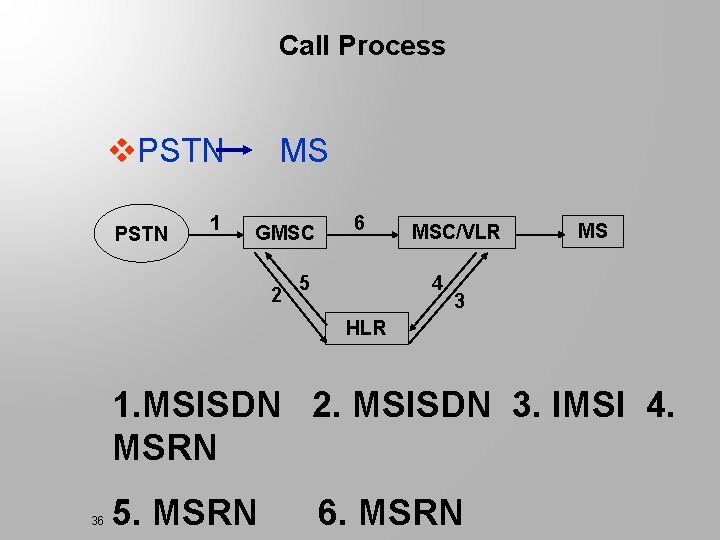
Call Process v. PSTN 1 MS GMSC 2 6 5 MSC/VLR 4 MS 3 HLR 1. MSISDN 2. MSISDN 3. IMSI 4. MSRN 36 5. MSRN 6. MSRN
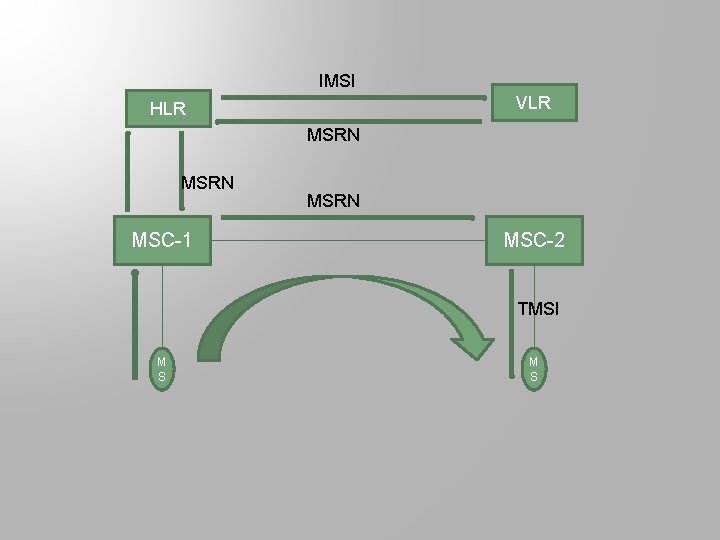
IMSI VLR HLR MSRN MSC-1 MSRN MSC-2 TMSI M S
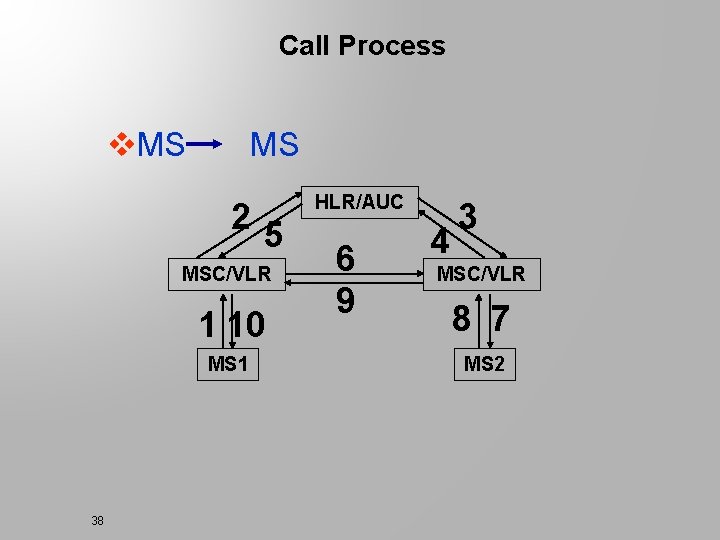
Call Process v. MS MS 25 MSC/VLR 1 10 MS 1 38 HLR/AUC 6 9 4 3 MSC/VLR 8 7 MS 2
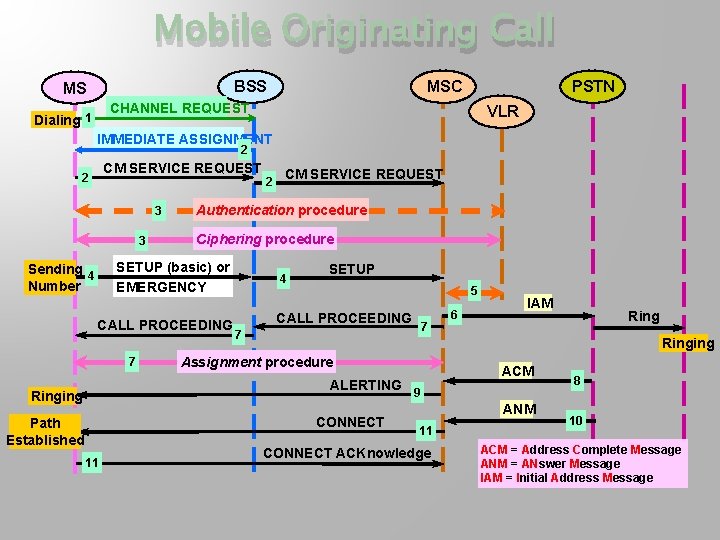
Mobile Originating Call BSS MS PSTN MSC CHANNEL REQUEST Dialing 1 VLR IMMEDIATE ASSIGNMENT 2 CM SERVICE REQUEST 2 3 3 Ciphering procedure CALL PROCEEDING 7 CM SERVICE REQUEST Authentication procedure SETUP (basic) or EMERGENCY Sending 4 Number 2 4 SETUP 5 CALL PROCEEDING 7 7 Assignment procedure CONNECT Path Established 11 IAM Ringing ALERTING 9 Ringing 6 ACM ANM 11 CONNECT ACKnowledge 8 10 ACM = Address Complete Message ANM = ANswer Message IAM = Initial Address Message

Thank You 22 -Jan-22 CET 40
- Slides: 40