
GLOBAL SUPPLY CHAINS AND EXPORT PROCESSING ZONES CONCEPTS
GLOBAL SUPPLY CHAINS AND EXPORT PROCESSING ZONES: CONCEPTS, ORIGINS AND EVOLVING ISSUES Program for Workers’ Education International Training Centre of ILO
Outline of Presentation q Definition of concepts q Origins of EPZs and Statistical overview q Incentives offered in EPZs q Why governments create EPZs? q Factors influencing the choice of an enterprise for a production platform q Evolving issues in GSCs q The challenge of Decent Work in GSCs
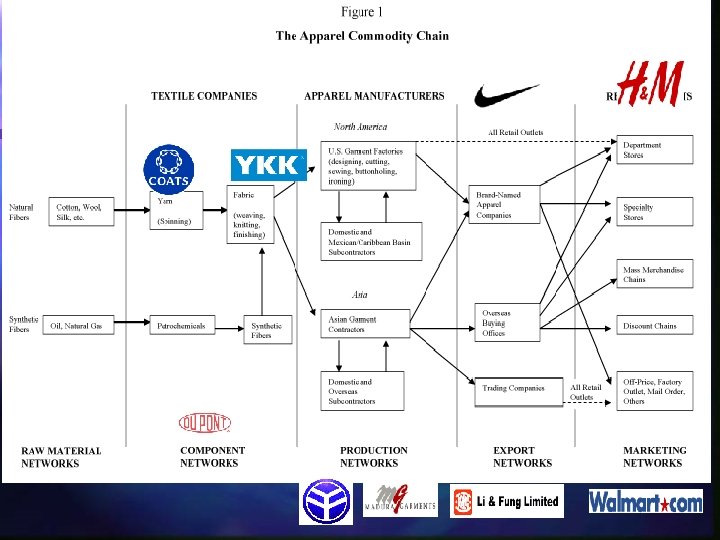
Definition of Concepts Global Supply Chain n Internationally joined-up production arrangements – Full range of activities that firms and workers perform to bring a product from its conception to end use and beyond. n Activities include design, production, marketing, distribution and support to the final consumer. n The supply chain: – Is the network created amongst different companies producing, handling and/or distributing a specific product; and encompasses the steps it takes to get a good or service from the supplier to the customer
Definition of Concepts n n Trade liberalization, advances in ICT and the dynamics of international investment benefited the rise of the “Supply Chain Model. ” It has allowed businesses to internationalized their operations across multiple locations in order to increase efficiency, lower costs and speed up production
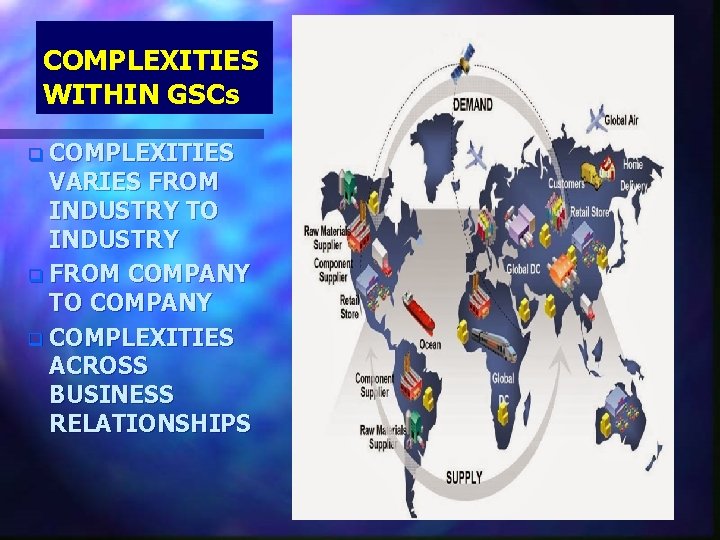
COMPLEXITIES WITHIN GSCs q COMPLEXITIES VARIES FROM INDUSTRY TO INDUSTRY q FROM COMPANY TO COMPANY q COMPLEXITIES ACROSS BUSINESS RELATIONSHIPS
Definition of Concepts Key Sectors: n n n n Manufacturing Agriculture Fishery Textile (Apparel) Footwear Electronics Tourism Services, etc.
Definition of Concepts Export Processing Zones n An EPZ is an area of a country where some normal trade barriers such as tariffs and quotas are relaxed and/or eliminated and bureaucratic requirements are lowered in favour of attracting Foreign Direct Investment (FDI) n EPZs are often labour intensive production centers that rely on the import of raw materials or components and the export of their finish product n Many of the economic activities of GSCs are outsourced and carried out in EPZs

Definition of Concepts Export Processing Zones q. Industrial zones with special incentives q. Relatively small, geographically separated areas within a country, usually near an international sea port or airport q. The purpose of EPZs is to attract export-oriented industries by offering free trade conditions and a liberal regulatory environment q. The entire production of such zones is generally exported
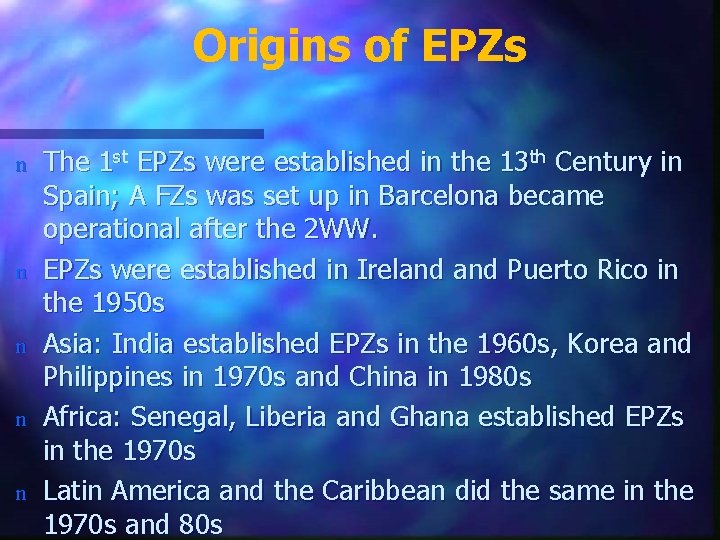
Origins of EPZs n n n The 1 st EPZs were established in the 13 th Century in Spain; A FZs was set up in Barcelona became operational after the 2 WW. EPZs were established in Ireland Puerto Rico in the 1950 s Asia: India established EPZs in the 1960 s, Korea and Philippines in 1970 s and China in 1980 s Africa: Senegal, Liberia and Ghana established EPZs in the 1970 s Latin America and the Caribbean did the same in the 1970 s and 80 s
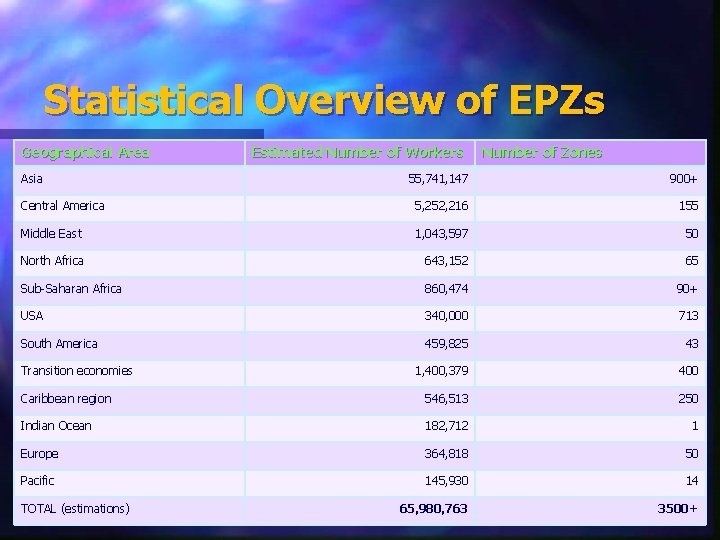
Statistical Overview of EPZs Geographical Area Asia Estimated Number of Workers Number of Zones 55, 741, 147 900+ Central America 5, 252, 216 155 Middle East 1, 043, 597 50 North Africa 643, 152 65 Sub-Saharan Africa 860, 474 90+ USA 340, 000 713 South America 459, 825 43 1, 400, 379 400 Caribbean region 546, 513 250 Indian Ocean 182, 712 1 Europe 364, 818 50 Pacific 145, 930 14 65, 980, 763 3500+ Transition economies TOTAL (estimations)
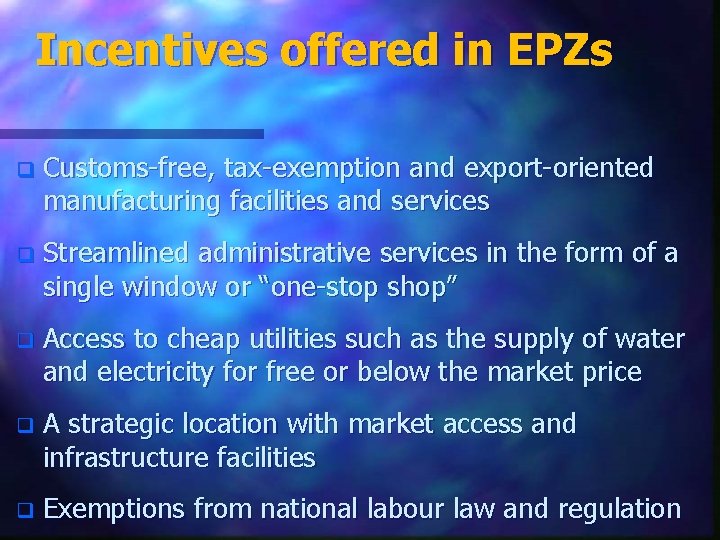
Incentives offered in EPZs q Customs-free, tax-exemption and export-oriented manufacturing facilities and services q Streamlined administrative services in the form of a single window or “one-stop shop” q Access to cheap utilities such as the supply of water and electricity for free or below the market price q A strategic location with market access and infrastructure facilities q Exemptions from national labour law and regulation
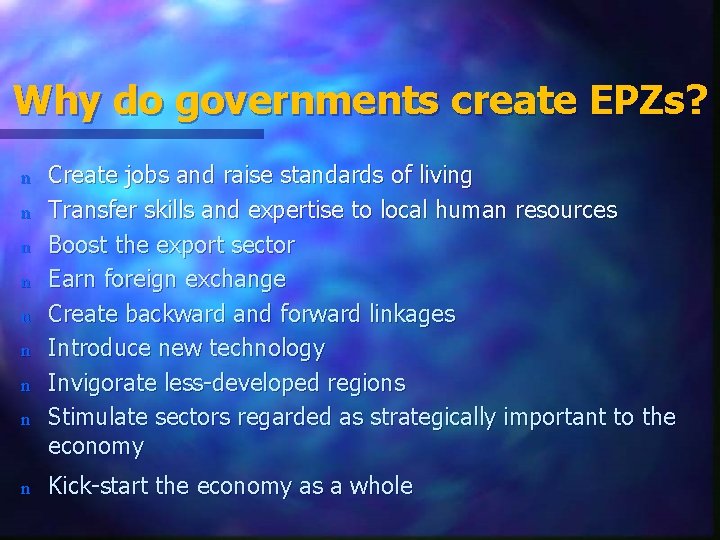
Why do governments create EPZs? n n n n n Create jobs and raise standards of living Transfer skills and expertise to local human resources Boost the export sector Earn foreign exchange Create backward and forward linkages Introduce new technology Invigorate less-developed regions Stimulate sectors regarded as strategically important to the economy Kick-start the economy as a whole
Factors Influencing the Choice of an Enterprise for a Production Platform n n n n n Generosity of the incentives on offer Relatively low labour cost Political and social stability Availability of appropriate and competent human resources Strategic location close to the markets or partner firms Quality of the infrastructure Supply of raw materials Existing trade agreements Undervalued currency that renders costs lower and raises export competitiveness
Evolving Issues n n n MNE-controlled GSCs undercut the power of labour to bargain over wages and working conditions. Growing importance: One in five jobs can be linked to supply chains (ILO 2015) A plethora of voluntary forms of regulation has emerged in the 1980 s: – Codes of conduct – Human Rights Policies (Company level) – Global Compact of the UN – Certification schemes – ISO-26. 000 by the International Organization for Standardization – “CSR Industry”
Evolving Issues n The challenge: Labour relations are largely missing in these initiatives n ILO is now exploring key topics such as: labour regulation in GSCs, workforce development, productivity issues, greening of value chains, gender
![Workers’ Concerns n Race to the bottom [low wages and precarious contracts] amid little](http://slidetodoc.com/presentation_image_h2/4500d10a0c51262bf245c53e303636fc/image-17.jpg "Workers’ Concerns n Race to the bottom [low wages and precarious contracts] amid little")
Workers’ Concerns n Race to the bottom [low wages and precarious contracts] amid little or no trade union presence and/or participation in the GSCs – Jeopardise rights at work, in particular FOA and CB n n n Employment: often insecure and under deplorable as well as unsafe conditions Surge in disguised employment relationships Widespread violation of workers’ rights [no maternity protection, sexual harassment, denial of FOA + CB] n n Weak or non-existence of labour inspection Generation of costs for society and perpetuation of poverty and inequalities [tax evasion and avoidance]
Workers’ Concerns n The rights challenge relates to: – The difficulty of organization and representation of workers in GSCs – Workers’ weak collective power to negotiate with employers – Insufficient or no social protection coverage for workers – Workers not in a position to access or secure other rights e. g. maternity protection guarantees n n Rights challenge is huge for migrant, seasonal and contract workers Gender discrimination, forced labour and child labour are rife in GSCs and EPZs
What Can Be Done? n n n Develop a Decent Work Framework for assessing gaps in GSC Assess ILS in GSC. Enabling rights established in GSC; including in EPZ Negotiate for improved working conditions including wages, working time and OSH through CB and labour inspection Advocate for fair distribution of benefits generated by GSC Demand an all-inclusive dialogue process in the development of labour relations Governance: constituents should drive this process and device policies at different levels
What Can Be Done? Organize workers in GSCs and EPZs into trade unions n Mobilize workers to defend and promote their rights n Use the ILO supervisory mechanism, OECD guidelines to expose and report violation of workers’ rights n Provide legal services and assistant to victims of abuse and exploitation Note: Organizing in GSCs and EPZs is difficult but it is possible n

THE END QUESTIONS THANK YOU!
- Slides: 21