
Global Supply Chain Management Chapter 8 Materials Handling

Global Supply Chain Management

Chapter #8 Materials Handling and Packaging
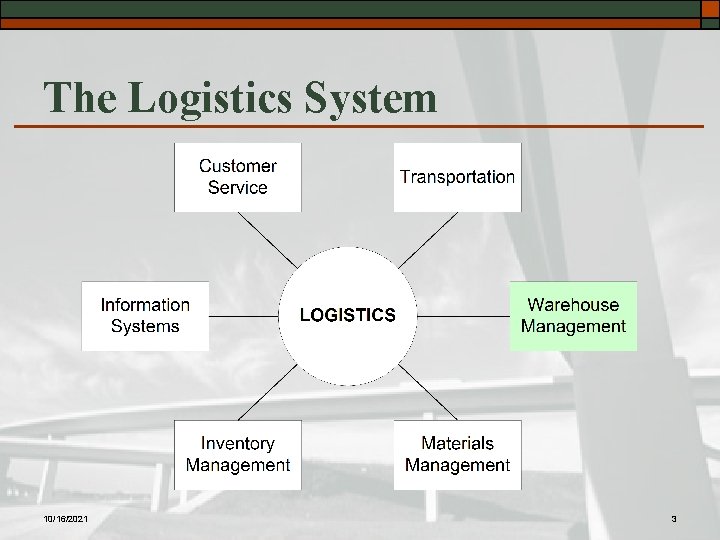
The Logistics System 10/16/2021 3
Overview o o o We will quickly review basic warehouse design considerations We will examine in some depth the trade-offs between manual and automated warehousing and material handling We will look at the functions of packaging and examine how packaging influences material handling considerations 10/16/2021 4
Introduction o Space utilization within a warehouse is crucial and has implications for a number of logistics activities n o Poor design slows movement of goods, raises costs and impacts customer service Handling of goods and placement of goods are both affected by warehouse design and the design is affected by our decisions on placement and handling 10/16/2021 5
Introduction o Packaging serves a number of functions including compensating for material handling issues n Total cost impact of packaging decisions are often difficult to quantify o o o 10/16/2021 Numerous stakeholders Marketing Logistics Manufacturing Legal, etc. 6
Warehouse Design Guidelines o Several general principles guide the layout of any warehouse n n n o One-story if possible Straight line flows, receiving to storage to shipping (Chapter 7) Efficient material handling resources/operations Effective storage plan and use of space Minimize aisle space, maximize use of building height Guidelines only …obviously we are often constrained by other factors 10/16/2021 7
Manual Materials Handling o o Manual systems obviously require labor to implement Manual systems impose several constraints on warehouse design and operations n n 10/16/2021 Generally must rely on simple systems of racks and bins for storage Require wider aisles Limit the use of conveyors and other automated handling and sorting equipment Limit the usable storage height 8
Manual Materials Handling o Rely on labor extensively to pick and place inventory units using: n Pallet jacks n Carts n Man-on fork lifts n Short conveyor runs, etc. 10/16/2021 9

Manual Materials Handling o Tend to work best for either very high or very low demand goods o Disadvantages include: n Cost of labor n Damage rates n Incorrect placement of goods, frustrating storage and/or picking to order 10/16/2021 10
Automated Material Handling o Automated systems replace direct labor with mechanization wherever feasible n Automation has a number of advantages: o o o o 10/16/2021 Automation improves productivity by mechanizing labor intensive handling activities Generally lower operating costs Greater efficiency of space utilization Less damage Fewer errors in put-up or pick Better integration with IS insures good stock rotation Can work 24/7 regardless of location 11
Automated Material Handling n Automation is not without disadvantages: o Initial cost is much greater n n o o 10/16/2021 Equipment Computer systems Design considerations, e. g. flat-floors Personnel training, etc. Reliability and maintainability Integration with the organization’s existing IS Retention of the people displaced by automation is a big concern in some countries Fixed nature of the solution reduces flexibility and increases time/cost to change 12
Manual vs. Automated Handling o Generally, benefits of automation outweigh the costs n o In countries where labor is plentiful, this may not be the case In some markets, maintenance and reliability issues may outweigh the potential cost savings and efficiency gains as a function of distance from equipment providers and lack of skilled service personnel n 10/16/2021 When the system is down…nothing moves! 13
Future Trends in Material Handling o o While you can buy automation off-the-shelf today, most integrated systems are essentially one of a kind In the future, such systems will not provide the cost effective solutions required by industry n n n 10/16/2021 They will still exist Special applications Special situations…Nike 14
Future Trends in Material Handling o Reliability will require the right mix of robust equipment, fault tolerance and redundancy n Move from buying based on lowest bidder to buying the best equipment for the job/environment o Integration with existing systems will become more important as we move toward total supply chain integration n 10/16/2021 Our systems and those of our vendors and customers! 15

Future Trends in Material Handling o o Upgradeability will be required in new automation design and implementation to handle changes in mission and technology Automated ID systems based on radio frequency identification (RFID) systems will replace barcode and OCR identification systems n 10/16/2021 Wal-Mart is requiring their top 150 suppliers to use RFID by January 2006 16
Future Trends in Material Handling o Automated ID systems based on radio frequency identification (RFID) systems will replace barcode and OCR identification systems (continued) n n n 10/16/2021 The Do. D has announced the requirement for RFID tagging beginning with contracts written in 2005 RFID tags/chips provide increased visibility of inventory items and improve Tracking, condition monitoring, etc. 17
Future Trends in Material Handling o Ease of use will increase as automated systems become part of the broader systems n n o Self monitoring Voice recognition, etc. Maintainability needs will increase because of: n n 10/16/2021 Cost considerations 24/7 operation 18
Future Trends in Material Handling o Manual systems will still exist, but management will have to closely analyze the costs and benefits of alternatives to implement the system that best meets customer and logistics needs 10/16/2021 19
Product Packaging o o Packaging is receiving increasing attention as we expand into global markets Packaging decisions have numerous impacts on our costs and are a concern to a number of internal stakeholders: n n n 10/16/2021 Logistics Marketing Legal Production Finance 20
Types of Packaging o Two basic kinds of packaging n Consumer package is the product packaging that the consumer sees o n Industrial package is the packaging that protects the goods and facilitates their handling through the logistics system o 10/16/2021 Also called interior or marketing package Also called exterior package 21

Types of Packaging o o Obviously, different parts of the organization are focused on consumer and industrial packaging Considered independently, we can end up with a very costly system to implement, i. e. Gillette Razors 10/16/2021 22

Packaging Considerations o Marketing is interested in the package’s role in capturing and retaining customers n n n 10/16/2021 Sufficient information Attractive Etc. 23
Packaging Considerations o Legal is concerned about product safety and legal information requirements n n 10/16/2021 How to properly dispose of the product when done Point of origin Materials/ingredients Etc. 24
Packaging Considerations o Production is primarily concerned with how packaging impacts production n n 10/16/2021 How to make/source the packaging How to get the individual units packaged How to package for storage and shipping Etc. 25
Role of packaging o Logistics is concerned with how the packaging affects customer service, quality, shipping and handling n n 10/16/2021 How the product packaging will affect the product’s journey through the supply chain We like to work with cubes Getting marketing packages into exterior packs (a concern shared equally with production) Protection from damage, weather, contamination, tampering, etc. 26
Role of packaging o Logistics is concerned with how the packaging affects customer service, quality, shipping and handling (continued) n n n 10/16/2021 Security issues Ease of handling Storage and space utilization Cost of shipping Environmental issues Import/export and other legal issues, etc. 27
Packaging Materials o Traditionally, we have used lots of wood and metal in packaging n o Excellent physical protection o Both weigh a lot o Can be expensive to produce/procure o Disposal remains an issue in many markets Today cardboard is still the primary material for exterior packaging 10/16/2021 28
Packaging Materials o Interior packaging is increasingly plastics and other synthetics n n n o Lots of environmental issues with synthetics New laws in many countries with respect to disposal of packaging But packages are light, easy and inexpensive to produce in a customized format, etc. For exterior packaging, reusable systems are on the rise. n 10/16/2021 Automated ID technologies can play a big role 29
Packaging for Global Markets o Certainly some unique problems n Packaging might have to be designed to endure the worst possible conditions o Over packaged for handling protection o Packaging for one region might not be sufficient for another 10/16/2021 30
Packaging for Global Markets o Legal requirements vary by product and market o Environmental requirements vary by product and market o Identification, language, marking, instructions, etc. all vary by region/country and often by product 10/16/2021 31
Bar Coding o Bar codes have been the standard of identification for the past two decades n n n 10/16/2021 New multi-dimensional barcodes contain and convey more than simple product information Bar codes have enabled much of our material handling automation Barcode technology took >20 years to become ubiquitous in the marketplace 32
Bar Coding o RFID is on the verge of replacing bar coding as the standard method of identification n n o Capable of carrying huge amounts of information Much less expensive to use…after the cost of the tags themselves ($. 25 today headed to $. 05) Capable of integrating with quality monitoring systems Likely to become the standard in <10 years But. . . few have yet been able to make a compelling business case for adoption 10/16/2021 33
Trade-offs with packaging Management must do the analysis to evaluate the trade-offs between packaging costs and n n o Transportation Handling Storage Etc. Once again, we are looking for the best overall system of costs vs. benefits with customer service always at the top of our list 10/16/2021 34
- Slides: 34