
Global Supply Chain Management Chapter 12 Logistics Strategies
Global Supply Chain Management
Chapter #12 Logistics Strategies
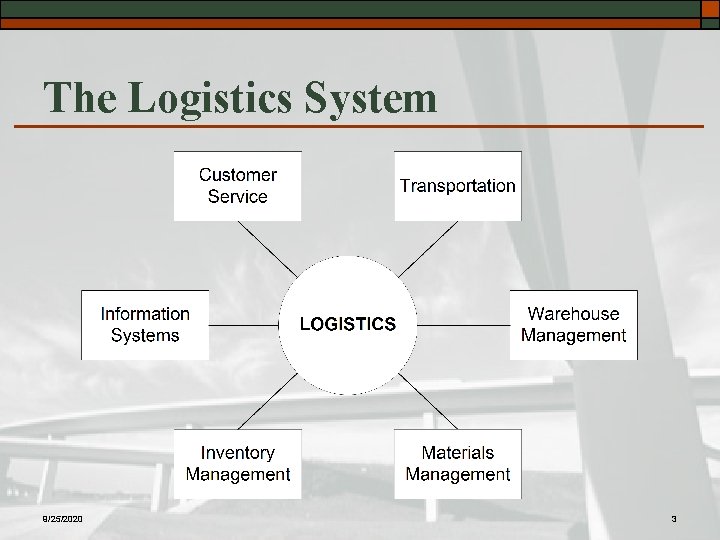
The Logistics System 9/25/2020 3
Overview o o o We will review organizational planning with attention to strategic planning We will place logistics strategic planning in the context of the firm’s overall planning process We will review the critical elements considered in developing a logistics strategy 9/25/2020 4
Overview o o o We will review the integration of the logistics channel …the supply chain We will discuss implementation of strategies We will briefly look at the issues that will affect logistics in the future…and must be accounted for in planning 9/25/2020 5
Organizational Planning o Development of strategy is a two part process n n o Critical elements Planning Critical elements include the areas of business for which options are evaluated and decisions are made n n n 9/25/2020 Selecting lines of business Market areas Stakeholder commitments Growth strategies Which core competencies to exploit, etc. 6
Organizational Planning o o Decisions made with respect to these elements set the constraints for the organization strategically, tactically and operationally Strategic planning starts with a vision and a set of objectives identified by management to satisfy its various stakeholders n Stakeholders must be defined liberally o o o 9/25/2020 Customers Vendors Employees Shareholders The public in general and maybe specific subgroups The government, etc. 7
Organizational Planning o Steps in Strategic Planning n n n n 9/25/2020 Vision/Mission Statement/Goals Environmental Scan Strength, Weakness, Opportunity and Threat (SWOT) analysis Development of Stakeholder analysis Modify Vision/Mission/Goals as required based on last three analyses Develop several alternative strategies to attain our delineated goals Select the strategy that best fits within our constraints 8
Organizational Planning o o The distinction between Environmental Scanning and SOWT is different for different people Environmental Scanning includes the activities that access your organization, competitors, society, customers, governments, economies, technology at a macro level looking for indicators that could affect your business/plans 9/25/2020 9
Organizational Planning o o SOWT looks internally at resources and competencies and at a more focused level externally for opportunities and threats From the strategic plan, developed typically by top management, other parts of the organization formulate the n n 9/25/2020 Tactical plans (one – two+ years out) Operational plans (action plans for day-to-day activity) 10
Organizational Planning o Logistics managers must be attuned to the organizations strategies when developing the logistics strategy n 9/25/2020 As, of course, must every other functional group with the organization 11
Logistics Strategy o Formulated within the context of organizational strategy with an eye on: n n Organizational level goals Functional area plans o o o 9/25/2020 Manufacturing Finance Marketing, etc. 12
Logistics Strategy o o Growing visibility of logistics in part due to its interaction across the functional groups of the organization Challenge for logistics managers is to develop a flexible plan under, often, significant uncertainty 9/25/2020 13
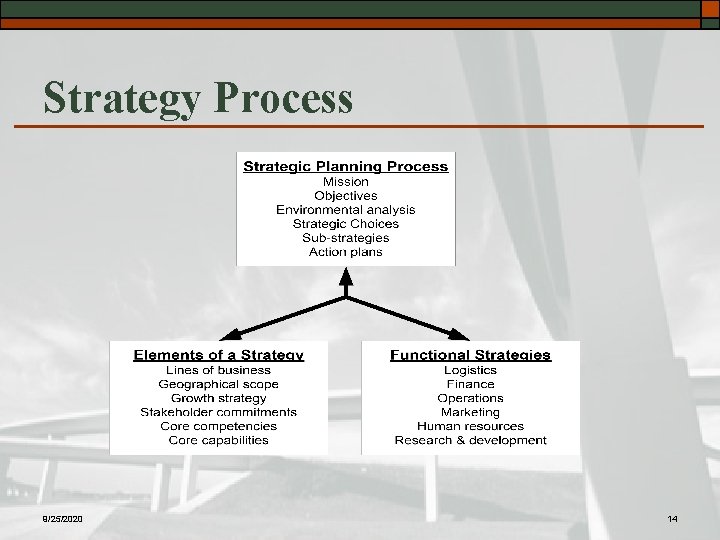
Strategy Process 9/25/2020 14
Logistics Strategy o o The emerging answer to this dilemma is through supply chain integration By Supply Chain we mean the channel of organizations involved from raw materials suppliers through manufacturing and distribution who are required to deliver the product/service to the final customer – the extended system 9/25/2020 15
Logistics Strategy o Integrated supply chain management will result in superior performance o Integration requires sharing of information especially demand capacity planning 9/25/2020 16
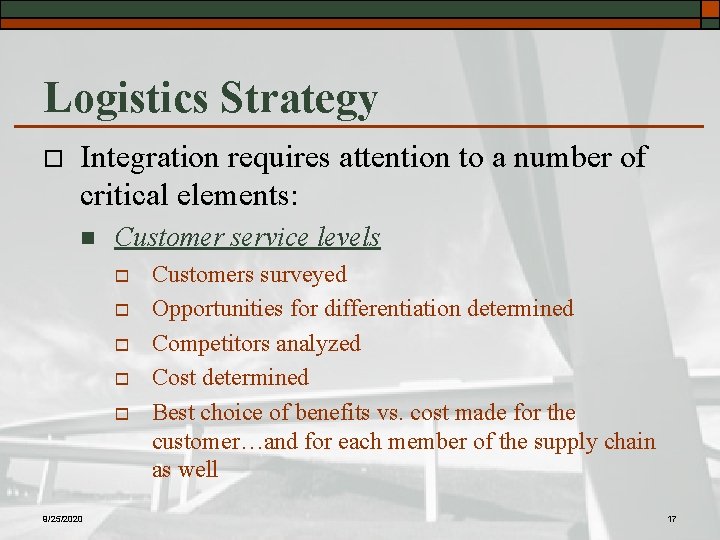
Logistics Strategy o Integration requires attention to a number of critical elements: n Customer service levels o o o 9/25/2020 Customers surveyed Opportunities for differentiation determined Competitors analyzed Cost determined Best choice of benefits vs. cost made for the customer…and for each member of the supply chain as well 17
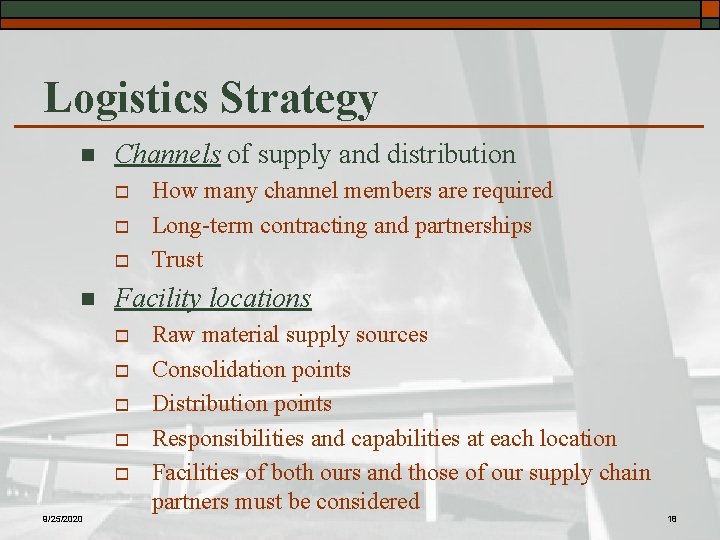
Logistics Strategy n Channels of supply and distribution o o o n Facility locations o o o 9/25/2020 How many channel members are required Long-term contracting and partnerships Trust Raw material supply sources Consolidation points Distribution points Responsibilities and capabilities at each location Facilities of both ours and those of our supply chain partners must be considered 18
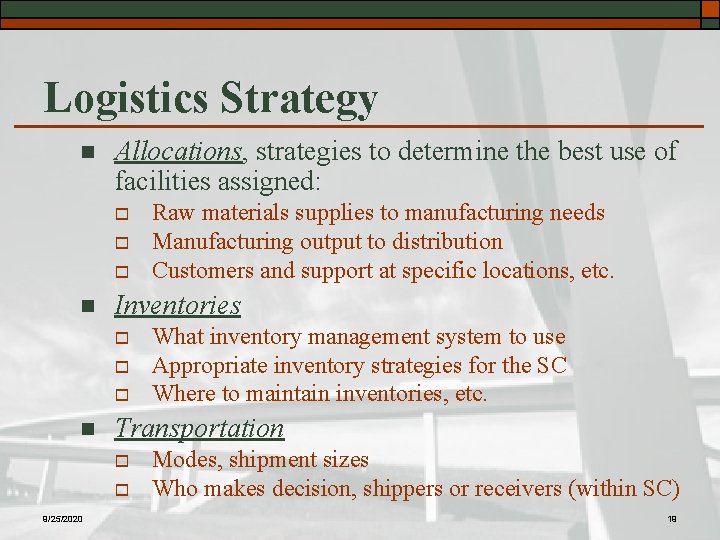
Logistics Strategy n Allocations, strategies to determine the best use of facilities assigned: o o o n Inventories o o o n What inventory management system to use Appropriate inventory strategies for the SC Where to maintain inventories, etc. Transportation o o 9/25/2020 Raw materials supplies to manufacturing needs Manufacturing output to distribution Customers and support at specific locations, etc. Modes, shipment sizes Who makes decision, shippers or receivers (within SC) 19
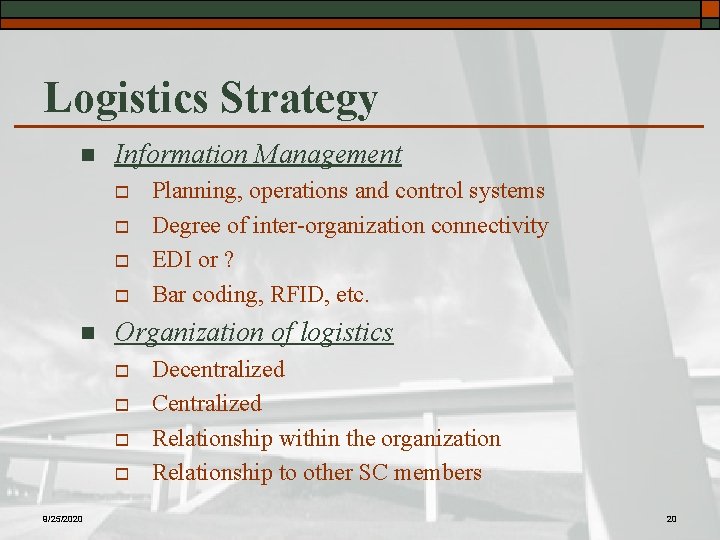
Logistics Strategy n Information Management o o n Organization of logistics o o 9/25/2020 Planning, operations and control systems Degree of inter-organization connectivity EDI or ? Bar coding, RFID, etc. Decentralized Centralized Relationship within the organization Relationship to other SC members 20
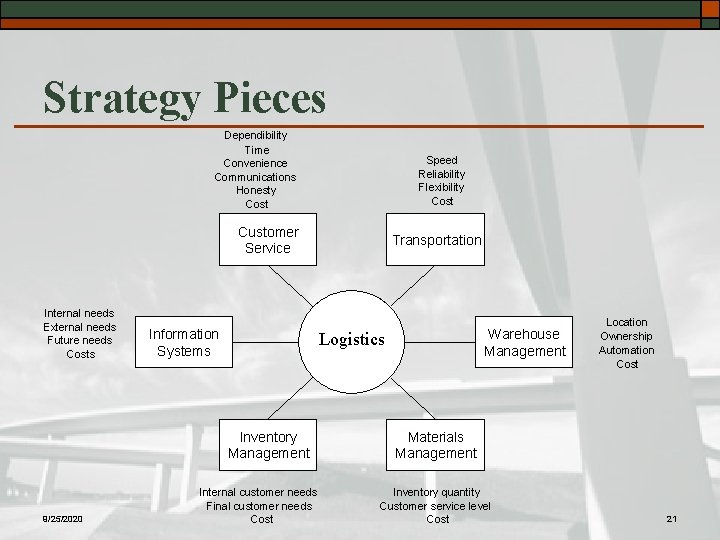
Strategy Pieces Dependibility Time Convenience Communications Honesty Cost Speed Reliability Flexibility Cost Customer Service Internal needs External needs Future needs Costs Information Systems Warehouse Management Logistics Inventory Management 9/25/2020 Transportation Internal customer needs Final customer needs Cost Location Ownership Automation Cost Materials Management Inventory quantity Customer service level Cost 21
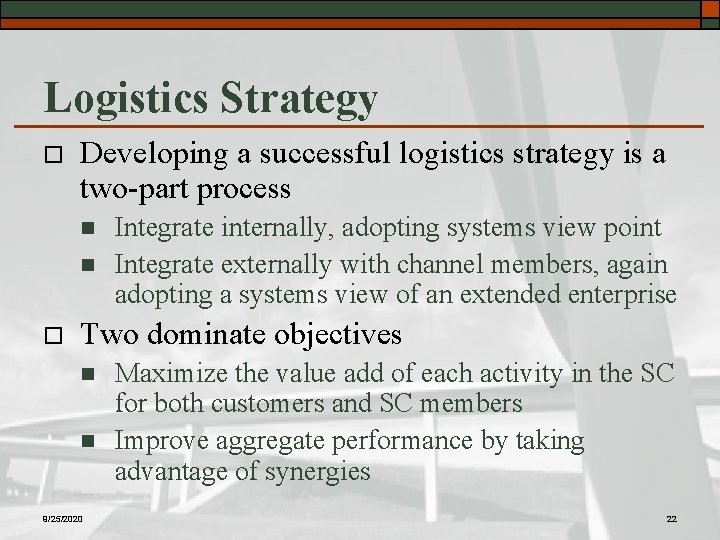
Logistics Strategy o Developing a successful logistics strategy is a two-part process n n o Integrate internally, adopting systems view point Integrate externally with channel members, again adopting a systems view of an extended enterprise Two dominate objectives n n 9/25/2020 Maximize the value add of each activity in the SC for both customers and SC members Improve aggregate performance by taking advantage of synergies 22
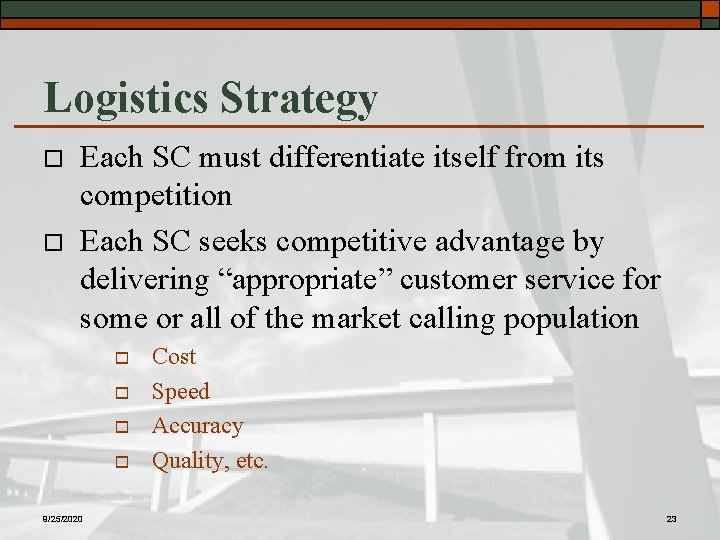
Logistics Strategy o o Each SC must differentiate itself from its competition Each SC seeks competitive advantage by delivering “appropriate” customer service for some or all of the market calling population o o 9/25/2020 Cost Speed Accuracy Quality, etc. 23
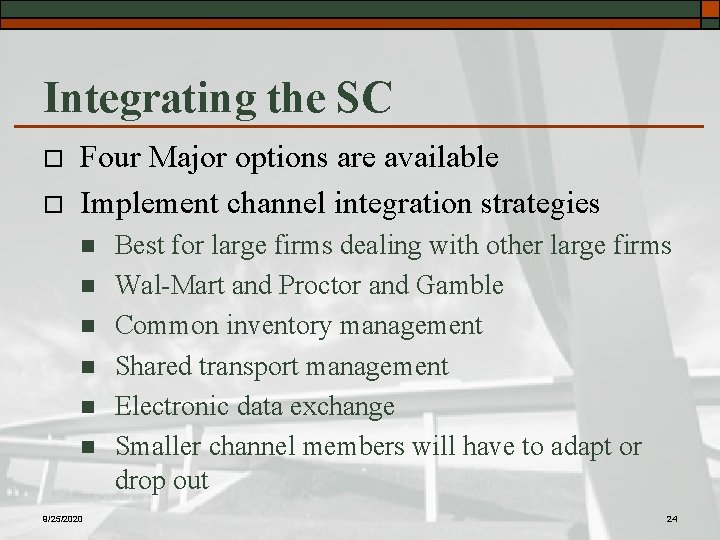
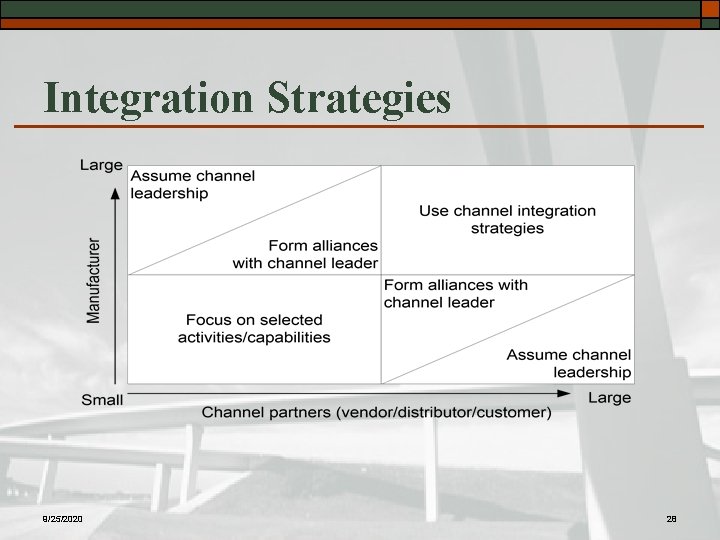
Integrating the SC o o Four Major options are available Implement channel integration strategies n n n 9/25/2020 Best for large firms dealing with other large firms Wal-Mart and Proctor and Gamble Common inventory management Shared transport management Electronic data exchange Smaller channel members will have to adapt or drop out 24
Integrating the SC o Assume the leadership of the channel n n n 9/25/2020 Appropriate when a single large member deals with many smaller channel members Channel leader develops strategies that are good for all channel members Devise ways to share information Provide value added services Implement productivity improvements 25
Integrating the SC o Form alliances with the channel leader n n n 9/25/2020 Appropriate for a smaller firm dealing with a large, dominant channel leader Identify the channel leader’s goals Participate in identifying alternative methods for achieving the goals Identify methods of modifying our process to improve the channel leader’s and overall SC performance Take advantage of the strength of the channel leader to improve the firms own process and procedures 26
Integrating the SC o Focus on very selective activities n n n o Appropriate when the channel is basically made up of many small firms competing with similar channels or channels comprised of larger firms Identify the functions that can be performed best, that is adding the most value at the least cost, by each of the channel members Focus on competing within a differentiated portion of the overall market on specific points of value While most of the focus has been on channel integration to form supply chains for large companies, smaller ones can benefit as well 9/25/2020 27
Integration Strategies 9/25/2020 28
Implementing Logistics Strategies o o Several issues must be considered after choosing an appropriate strategy Centralization vs. Decentralization…once more n Centralization o o o 9/25/2020 Improved efficiency with reduced resources High level of control Cost effectiveness 29
Implementing Logistics Strategies o Centralization vs. Decentralization…once more (continued) n Decentralization o o o n 9/25/2020 Better coordination on a local or regional basis Better customer service Less control Most often, of course, we need some mix of both 30
Implementing Logistics Strategies o Third Party providers n n 9/25/2020 Can do everything in-house Traditionally have used some third parties, e. g. freight forwarders Move toward outsourcing more activities, even the entire logistics process Management still must dictate strategy and manage the activity to ensure customer value 31
Implementing Logistics Strategies o Third Party providers (continued) n Most common concerns include o o o n 9/25/2020 Uncertainty of service levels True cost of service is often difficult to determine initially Job security, information security, questionable expertise are all questions that must be addressed in making the decision Implementation is often troublesome 32
Implementing Logistics Strategies o Third Party providers (continued) n Implementation is often troublesome o o o 9/25/2020 Knowledge transfer Training Cultural (as in corporate) differences Integration of LIS systems Lack of clear performance criteria Slow response to changing customer needs 33
Implementing Logistics Strategies o Third Party providers (continued) n n The final decision must be made on the basis of what is best for the customer Some decisions may lock us in for a very long term o n 9/25/2020 Facilities, people, management expertise, etc. Customer satisfaction must be monitored continuously to ensure performance 34
Implementing Logistics Strategies o Improved corporate performance n n n 9/25/2020 Logistics managers must be cognizant of how strategy impacts overall performance of the organization Total logistics savings can be significant 40 -50% has been reported No such thing as a one-fits-all strategy in terms of markets any longer 35
Future Issues Affecting Logistics o o Primary purpose of planning is to enable managers to react proactively to changes in their environments Challenges will do nothing but increase n 9/25/2020 Sound planning and planning practices are the only way to deal with them 36
Future Issues Affecting Logistics o Challenges include: n Continued expansion of global business o o o n Environmental and ecological issues o o o 9/25/2020 Continuing increase in rate of change New products, technologies, governments, etc Increasing risks Increasing need for environmentally sound practices New laws and regulations Challenge is to minimize effects while continuing to reduce cost and improve services 37
Future Issues Affecting Logistics o Challenges (continued) n n Transport infrastructure condition and capacity will continue to decrease with use and age Transportation deregulation will continue to provide new opportunities and challenges o 9/25/2020 Onus on management to understand every part of their global network 38
Future Issues Affecting Logistics n Government regulations will continue to change o o o n Consumerism o o 9/25/2020 Laws and regulations, e. g. environmental Customs laws and processes A moving target that must be constantly managed As we have said before, developing markets will result in customers with increasing expectations Must continually monitor this evolution to determine appropriate levels of customer service 39
Future Issues Affecting Logistics n Technology advances o o o Increasing data availability Demands evolution of decision support systems New transport opportunities, speed, quality and environmental friendliness Better material handling systems Better packaging materials, etc All these challenges require better planning and adoption of a system view on the part of logistics and corporate management 9/25/2020 40
Implementations for Managers o o Impacts magnified for companies serving global markets Must adopt a systems approach to best serve the customer base Creative responses required to ensure customer service expectations are met at the lowest possible level Bottom line is change …change is constant and must be constantly managed 9/25/2020 41
- Slides: 41