
Global Stratification Patterns of social inequality in the
Global Stratification Patterns of social inequality in the world as a whole
Changing Terminology v Old terminology – First world–Industrial rich countries – Second world–Less industrial socialist countries – Third world–Non-industrial poor countries v Problems with old terminology – After the Cold War, the second world no longer existed. – Third World is too economically diverse to be meaningful.
Changing Terminology New terminology v. High-income–Nations with the highest standard of living v. Middle-income–Somewhat poorer nations with economic development typical for the world as a whole v. Low-income–Nations with lowest productivity and extensive poverty The extent of global inequality is much greater than these comparisons suggest. Well-off people in rich countries live “worlds apart” from the poorest people in low-income countries.
High-Income Countries v. First to develop during industrial revolution two centuries ago. v. Enjoy 80% of the world’s income. v. More income means control of world’s financial markets. v. Control of financial markets means control of other countries. Examples: United States, Western Europe, Japan, Australia, Canada, etc.
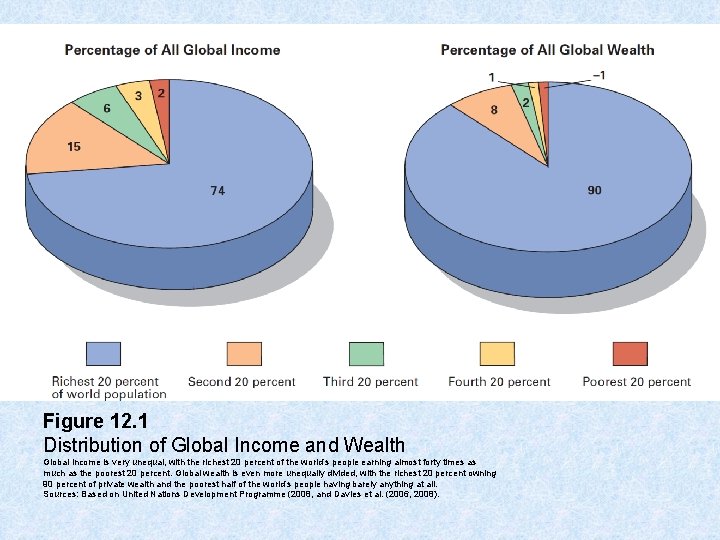
Figure 12. 1 Distribution of Global Income and Wealth Global income is very unequal, with the richest 20 percent of the world’s people earning almost forty times as much as the poorest 20 percent. Global wealth is even more unequally divided, with the richest 20 percent owning 90 percent of private wealth and the poorest half of the world’s people having barely anything at all. Sources: Based on United Nations Development Programme (2008, and Davies et al. (2006, 2008).
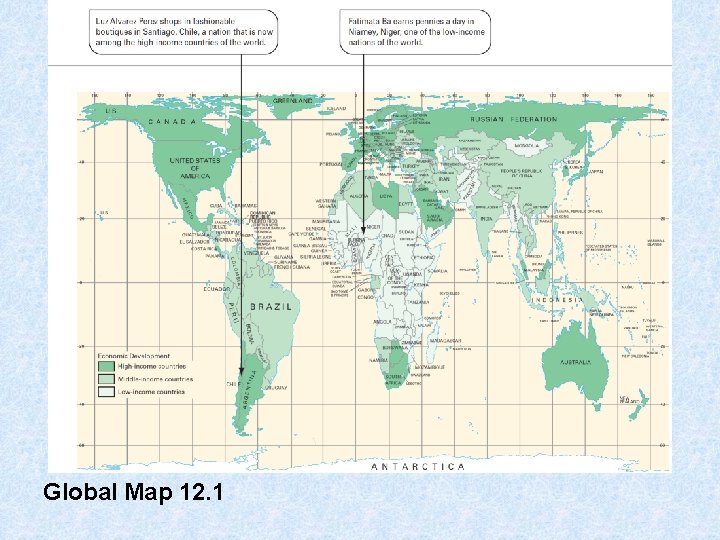
Global Map 12. 1
Middle-Income Countries v About 55% of the population lives in or near urban areas and have industrial jobs v About 45% live in rural areas and engage in agricultural activities -- a general lack of access to schools, medical care, and safe water Examples: some Eastern European countries, Latin America, and some African countries
Low-Income Countries v Mostly poor, rural economies v Agrarian, with some industry v Life expectancy is very short. v Hunger, disease, and unsafe housing shape the lives of the world’s poorest people Examples: Africa, and much of Asia
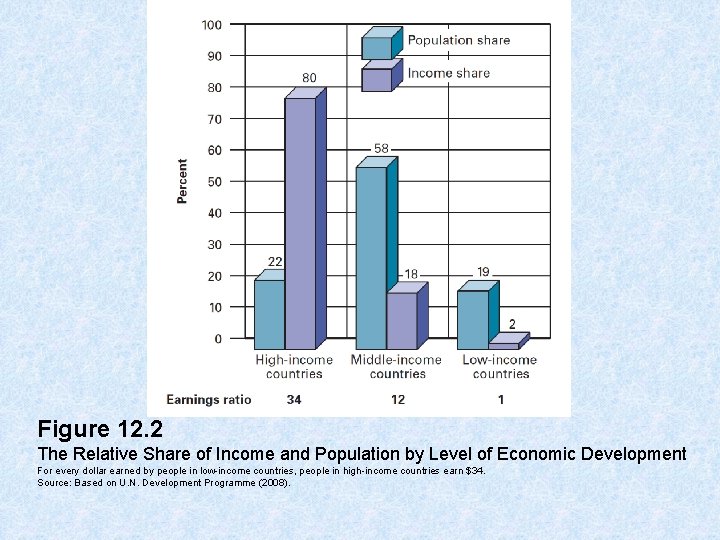
Figure 12. 2 The Relative Share of Income and Population by Level of Economic Development For every dollar earned by people in low-income countries, people in high-income countries earn $34. Source: Based on U. N. Development Programme (2008).
The Severity of Poverty v. Poverty in poor countries is more severe than it is in rich countries. v. The United Nations found that: – Norway had the highest “quality of life” rating, followed by Australia and Canada; the United States ranked 6 th – Niger had the lowest
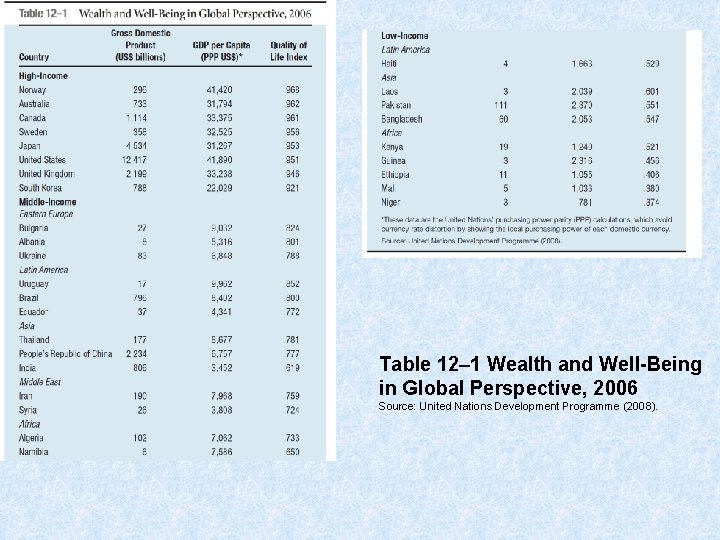
Table 12– 1 Wealth and Well-Being in Global Perspective, 2006 Source: United Nations Development Programme (2008).
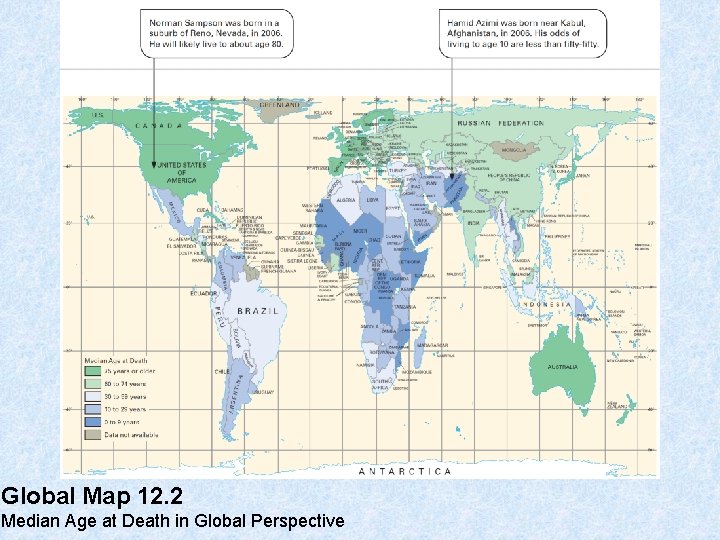
Global Map 12. 2 Median Age at Death in Global Perspective
The Severity of Poverty v Relative poverty – People lack resources that others take for granted. – This sort of poverty exists in every society, rich or poor. v Absolute poverty – A life-threatening lack of resources – One-third or more of the people in low-income countries experience poverty at this level.
Extent of Poverty v. Is poverty life-threatening? In some African and Asian countries, half of annual deaths are children under the age of 10. v. Every 10 minutes, 100 people around the world die of hunger, about 25, 000 people a day. v 1. 4 billion people suffer from chronic hunger in the world.
Poverty and Children v 100 million children in poor countries are forced to work the streets (e. g. , beg, steal, sell sex). v 100 million children are orphaned or have left their families and live on the streets. v. Many girls, with little or no access to medical assistance, become pregnant. v 50 million street children are found in Latin American cities. v. In Darfur (Sudan), impoverished children are forced to join armed groups, provide physical labor without pay, and work as sex slaves.
Women, Slavery, and Poverty v Women 1. In all societies, a woman’s work is unrecognized, undervalued, and underpaid. 2. Sweatshop workers are mostly women. 3. 70% of the world’s 1. 4 billion people living near absolute poverty are women. v Slavery 1. 2. 3. 4. Chattel slavery–One person owns another. Child slavery–A more common form of bondage Debt bondage–Employers hold workers to pay debts. Servile forms of marriage–Women married against their will or forced into prostitution. 5. Human Trafficking – third largest source of profit to organized crime.
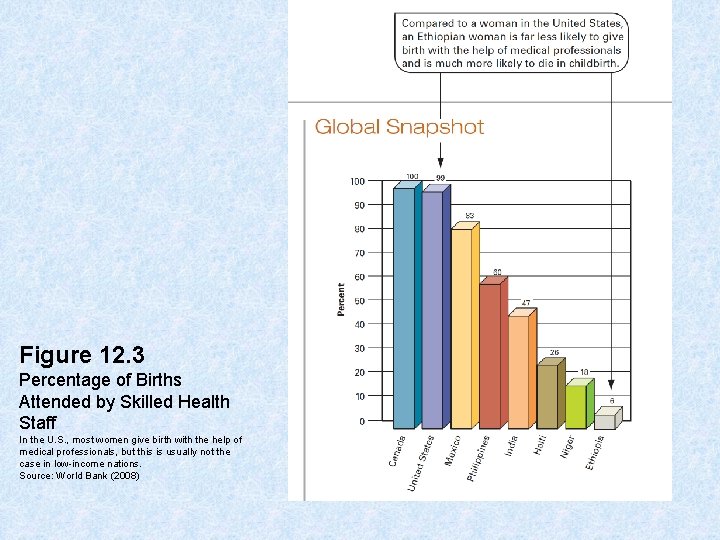
Figure 12. 3 Percentage of Births Attended by Skilled Health Staff In the U. S. , most women give birth with the help of medical professionals, but this is usually not the case in low-income nations. Source: World Bank (2008)
Human Trafficking v The movement of men, women, and children from one place to another for the purpose of performing forced labor v People are lured to a new country with the promise of a job, then forced to become prostitutes or farm laborers. Or people adopt foreign children and force them to work in sweatshops.
Explanations of Global Poverty v Technology – One-quarter of the people in low-income countries use human or animal power to farm land. v Population growth – Population for poor countries in Africa doubles every 25 years. v Cultural patterns – People resist innovations; accept slavery as a way of life. v Social stratification – Low-income countries distribute wealth very unequally.
Correlates of Global Poverty v Gender inequality – Raising living standards means improving women’s standing. v Global power relationships – Colonialism–The process by which some nations enrich themselves through political and economic control of other nations – Neocolonialism–A “new” form of global power relationships that involves not direct political control but economic exploitation by multinational corporations – Multinational corporation–A huge business that operates in many countries
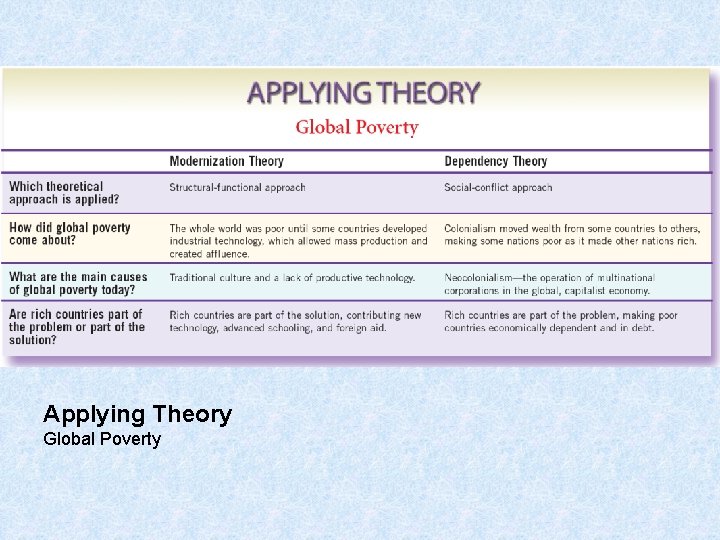
Applying Theory Global Poverty
Modernization Theory Model of economic development that explains global inequality in terms of technological and cultural differences between societies v Historical perspective – Centuries ago, the entire world was poor. – Exploration, trade, and the industrial revolution transformed Western Europe then North America. v Cultural perspective – Weber: Protestant Reformation reshaped traditional Catholicism. – Individualism replaced the traditional emphasis on family and community.
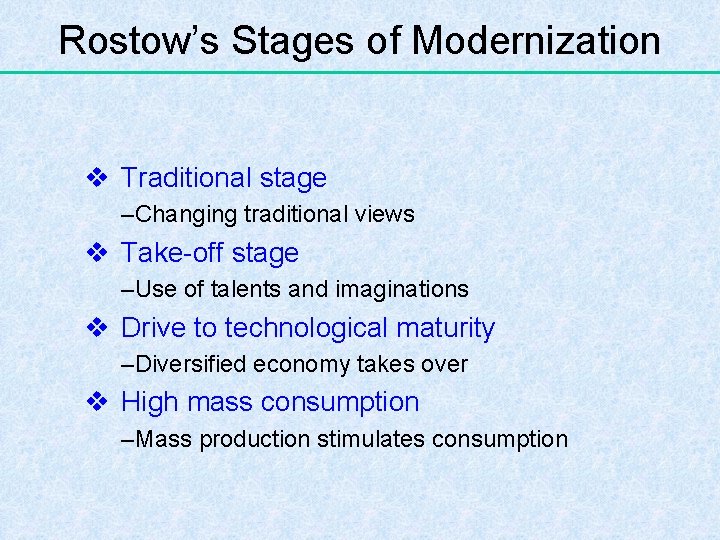
Rostow’s Stages of Modernization v Traditional stage –Changing traditional views v Take-off stage –Use of talents and imaginations v Drive to technological maturity –Diversified economy takes over v High mass consumption –Mass production stimulates consumption
The Role of Rich Nations v Controlling population – Exporting birth control and educating people on its importance v Increasing food production – The use of new hybrid seeds, modern irrigation methods, the use of chemicals and pesticides v Introducing industrial technology – Machinery and information must be shared if shifts in economies are to happen. v Providing foreign aid – Money can be used for equipment necessary for change.
Critical Evaluation v Modernization simply hasn’t happened in many nations. v Fails to recognize how rich nations benefit from the status quo of poor nations v Fails to see that international relations affect all nations v Ethnocentric: It holds up the richest nations as the standard to judge other societies v Blames global poverty on the poor societies
Dependency Theory A model of economic and social development that explains global inequality in terms of the historical exploitation of poor nations by rich ones. v Historical perspective – People living in poor countries were better off in the past than they are now. Economic position of rich & poor are linked. v Importance of colonialism – Europeans colonized much of the west, south & east. – African slave trade is the most brutal form of human exploitation. – Neocolonialism is the “essence” of the modern capitalistic world economy.
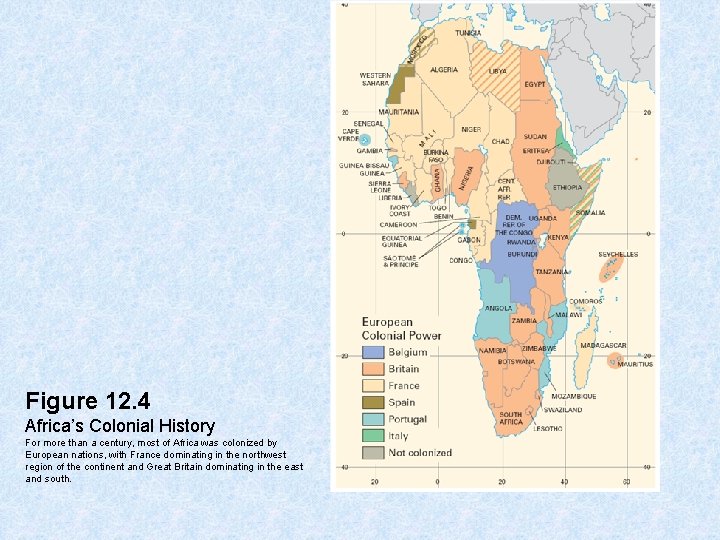
Figure 12. 4 Africa’s Colonial History For more than a century, most of Africa was colonized by European nations, with France dominating in the northwest region of the continent and Great Britain dominating in the east and south.
Wallerstein’s Capitalist World Economy Today’s world economy is rooted in the colonization that began 500 years ago. v. Rich countries form the core of the world economy being enriched by raw materials from around the world. v. Low-income countries are the periphery, providing inexpensive labor and a market for industrial products. v. Middle-income countries form the semiperiphery, having a closer tie to the core.
Wallerstein’s Ideas The world economy benefits rich nations by generating profits and harms the rest of the world by perpetuating poverty; thus the world economy makes poor nations dependent on rich ones. Three factors: 1. Narrow, export-oriented economies: Poor countries produce only a few crops for export to rich countries. 2. Lack of industrial capacity: Poor countries must sell raw materials to rich countries, then buy finished products at high prices. 3. Foreign debt: Poor countries owe the rich countries $1 trillion dollars, including hundreds of billions to the United States.
Critical Evaluation v Wrongly treats wealth as a zero-sum game v Wrong to blame rich nations for global poverty v Too simplistic citing capitalism as the single factor – Repressive corrupt regimes, stifling cultural tradition v More protest than policy – Thinly disguised call for world socialism
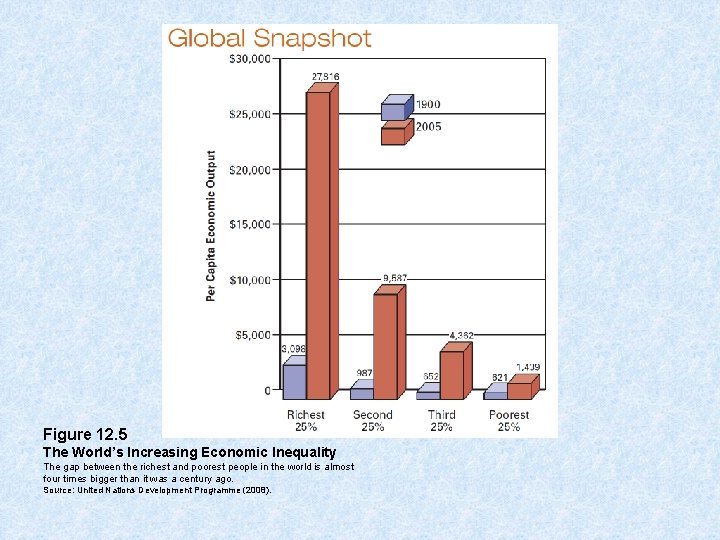
Figure 12. 5 The World’s Increasing Economic Inequality The gap between the richest and poorest people in the world is almost four times bigger than it was a century ago. Source: United Nations Development Programme (2008).
- Slides: 31