
GLOBAL SOURCING AND PROCUREMENT Chapter Sixteen Mc GrawHillIrwin
GLOBAL SOURCING AND PROCUREMENT Chapter Sixteen Mc. Graw-Hill/Irwin Copyright © 2014 by The Mc. Graw-Hill Companies, Inc. All rights reserved.
Learning Objectives LO 16– 1: Explain what strategic sourcing is. LO 16– 2: Explain why companies outsource processes. LO 16– 3: Analyze the total cost of ownership. LO 16– 4: Evaluate sourcing performance. 16 -2
Strategic Sourcing Strategic sourcing: the development and management of supplier relationships to acquire goods and services in a way that aids in achieving the immediate needs of the business In the past, sourcing was another name for purchasing. As a result of globalization, sourcing implies a more complex process suitable for products that are strategically important. 16 -3
Strategic Sourcing (continued) Specificity: refers to how common the item is and, in a relative sense, how many substitutes might be available Commonly available products can be purchased using a relatively simple process. Request for proposal (RFP): used for purchasing items that are more complex or expensive and where there may be a number of potential vendors Vendor-managed inventory: when a customer actually allows the supplier to manage an item or group of items for them 16 -4
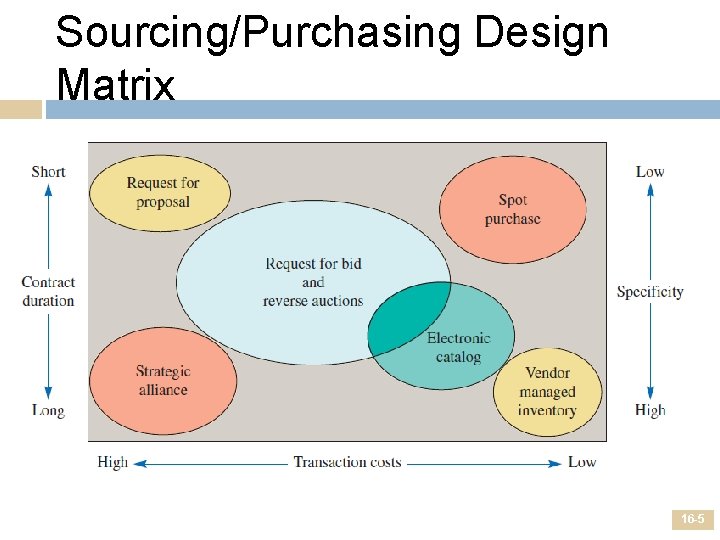
Sourcing/Purchasing Design Matrix 16 -5
The Bullwhip Effect Bullwhip effect: phenomenon of variability magnification as we move from the customer to the producer in the supply chain A slight change in consumer sales ripples backward as magnified oscillations upstream, like the result of a flick of a bullwhip handle. Continuous replenishment: inventory is replaced frequently, as part of an ongoing process 16 -6
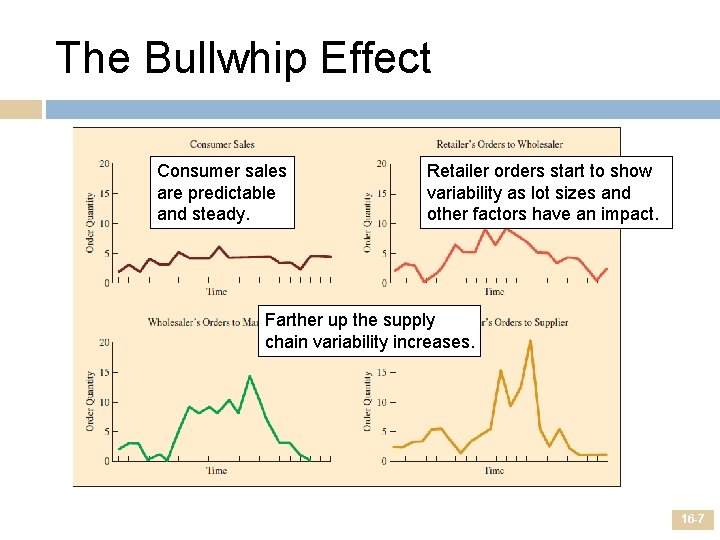
The Bullwhip Effect Consumer sales are predictable and steady. Retailer orders start to show variability as lot sizes and other factors have an impact. Farther up the supply chain variability increases. 16 -7
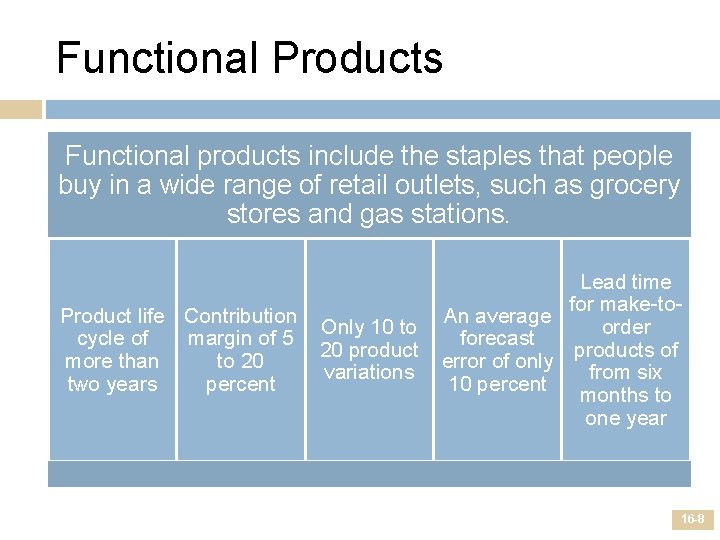
Functional Products Functional products include the staples that people buy in a wide range of retail outlets, such as grocery stores and gas stations. Product life Contribution cycle of margin of 5 more than to 20 two years percent Only 10 to 20 product variations Lead time for make-to. An average order forecast products of error of only from six 10 percent months to one year 16 -8
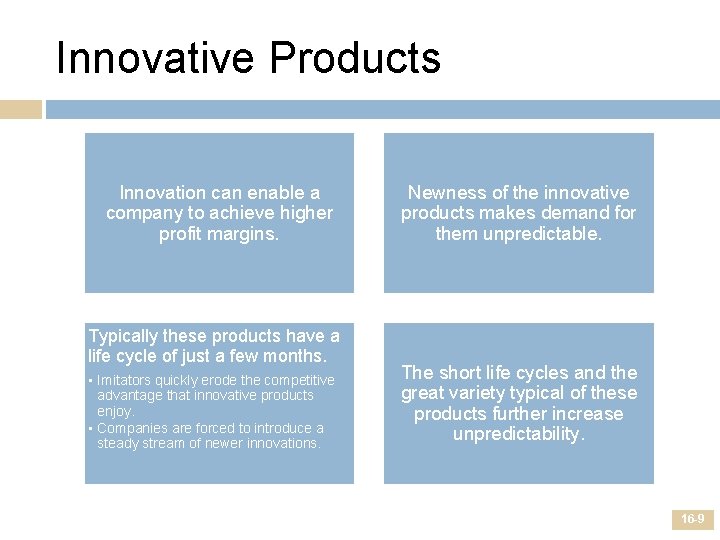
Innovative Products Innovation can enable a company to achieve higher profit margins. Typically these products have a life cycle of just a few months. • Imitators quickly erode the competitive advantage that innovative products enjoy. • Companies are forced to introduce a steady stream of newer innovations. Newness of the innovative products makes demand for them unpredictable. The short life cycles and the great variety typical of these products further increase unpredictability. 16 -9
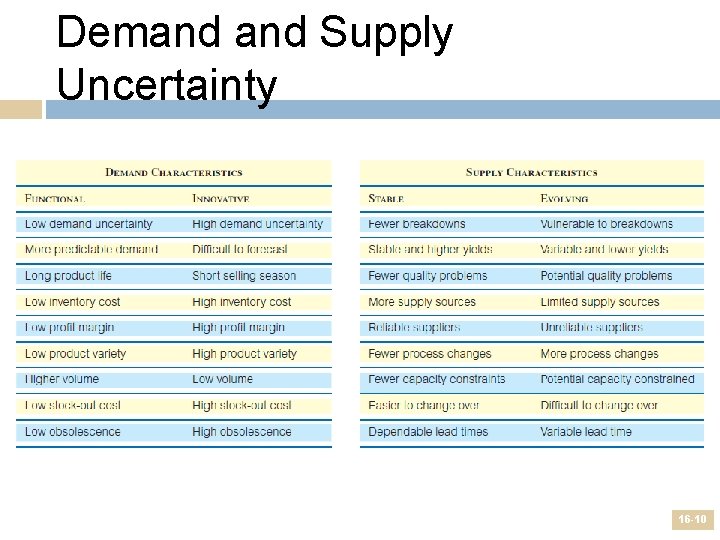
Demand Supply Uncertainty 16 -10
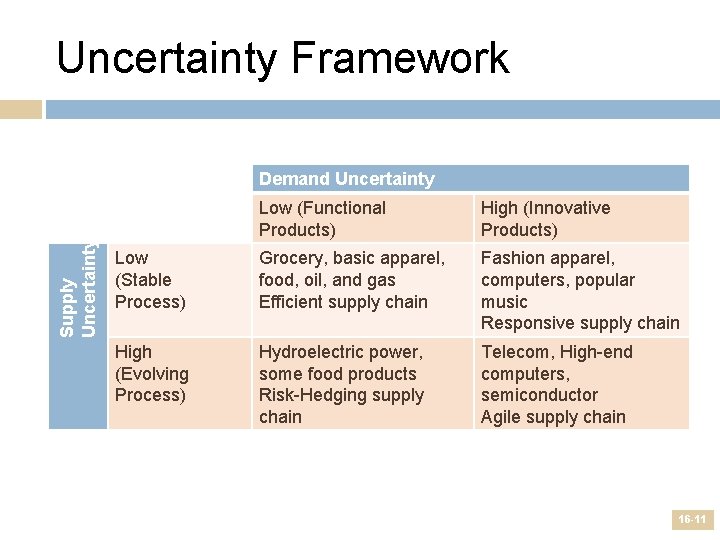
Uncertainty Framework Supply Uncertainty Demand Uncertainty Low (Functional Products) High (Innovative Products) Low (Stable Process) Grocery, basic apparel, food, oil, and gas Efficient supply chain Fashion apparel, computers, popular music Responsive supply chain High (Evolving Process) Hydroelectric power, some food products Risk-Hedging supply chain Telecom, High-end computers, semiconductor Agile supply chain 16 -11
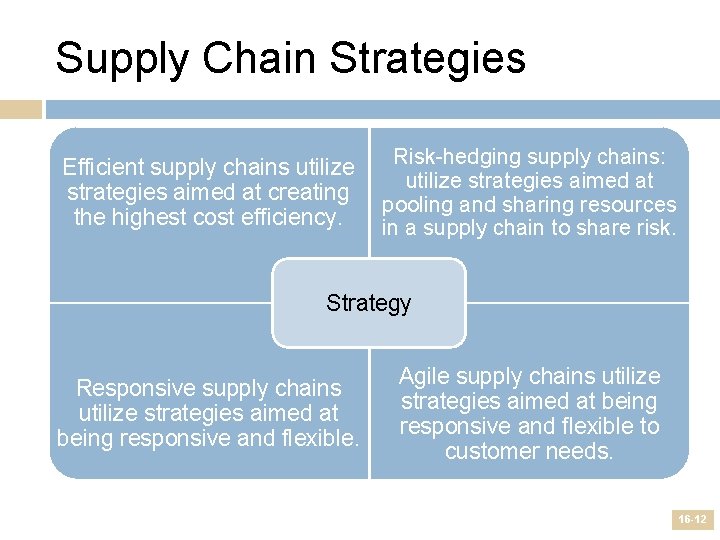
Supply Chain Strategies Efficient supply chains utilize strategies aimed at creating the highest cost efficiency. Risk-hedging supply chains: utilize strategies aimed at pooling and sharing resources in a supply chain to share risk. Strategy Responsive supply chains utilize strategies aimed at being responsive and flexible. Agile supply chains utilize strategies aimed at being responsive and flexible to customer needs. 16 -12
Outsourcing Outsourcing: moving some of a firm’s internal activities and decision responsibility to outside providers Allows a company to create a competitive advantage while reducing cost. An entire function may be outsourced, or some elements of an activity may be outsourced, with the rest kept in-house. 16 -13
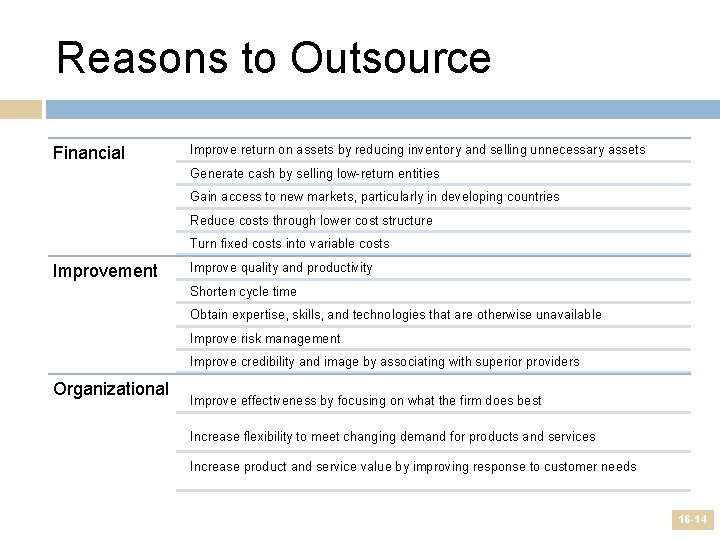
Reasons to Outsource Financial Improve return on assets by reducing inventory and selling unnecessary assets Generate cash by selling low-return entities Gain access to new markets, particularly in developing countries Reduce costs through lower cost structure Turn fixed costs into variable costs Improvement Improve quality and productivity Shorten cycle time Obtain expertise, skills, and technologies that are otherwise unavailable Improve risk management Improve credibility and image by associating with superior providers Organizational Improve effectiveness by focusing on what the firm does best Increase flexibility to meet changing demand for products and services Increase product and service value by improving response to customer needs 16 -14
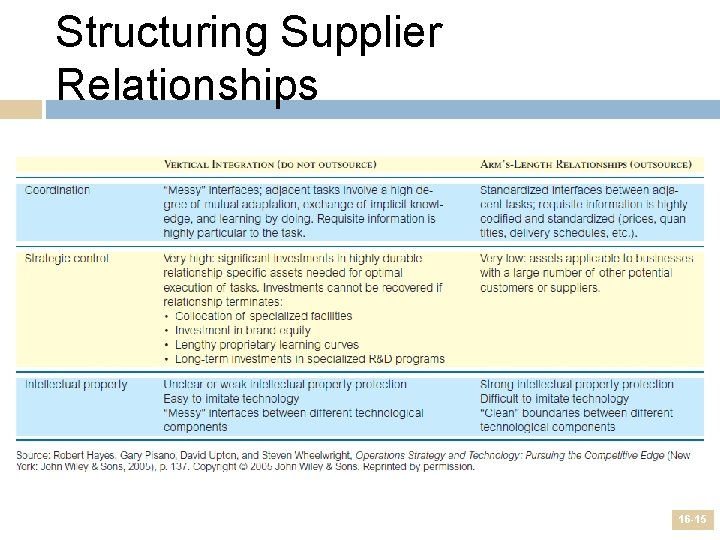
Structuring Supplier Relationships 16 -15
Green Sourcing Being environmentally responsible has become a business imperative. Many firms are looking to their supply chains to deliver “green” results. Financial results can often be improved through going green. A comprehensive green sourcing effort should assess how a company uses items that are purchased internally. It is also important to reduce waste. 16 -16
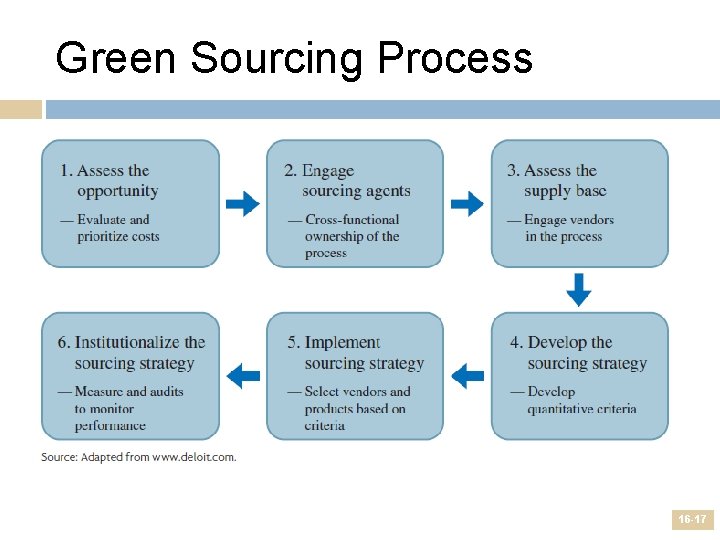
Green Sourcing Process 16 -17
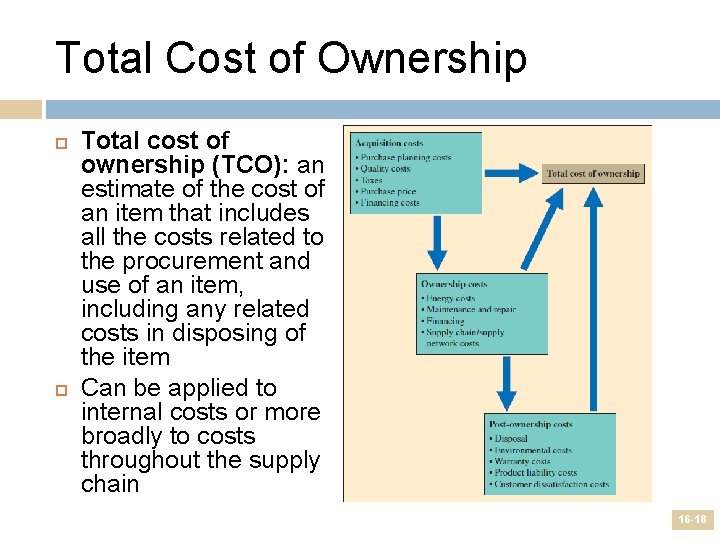
Total Cost of Ownership Total cost of ownership (TCO): an estimate of the cost of an item that includes all the costs related to the procurement and use of an item, including any related costs in disposing of the item Can be applied to internal costs or more broadly to costs throughout the supply chain 16 -18
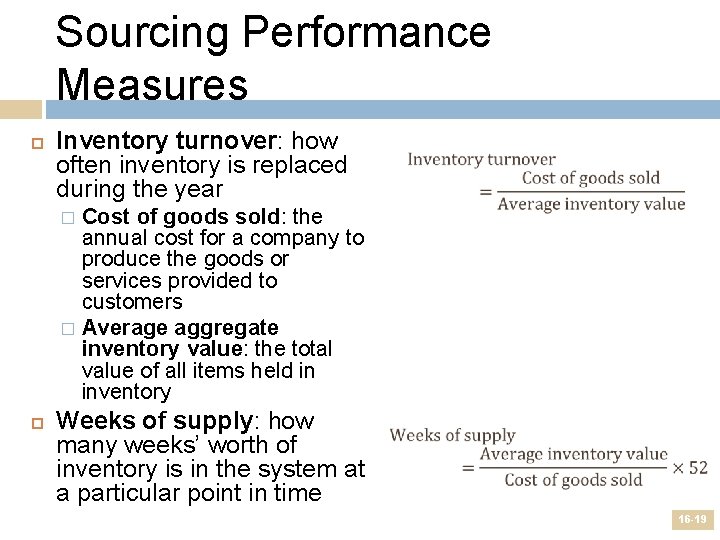
Sourcing Performance Measures Inventory turnover: how often inventory is replaced during the year Cost of goods sold: the annual cost for a company to produce the goods or services provided to customers � Average aggregate inventory value: the total value of all items held in inventory � Weeks of supply: how many weeks’ worth of inventory is in the system at a particular point in time 16 -19
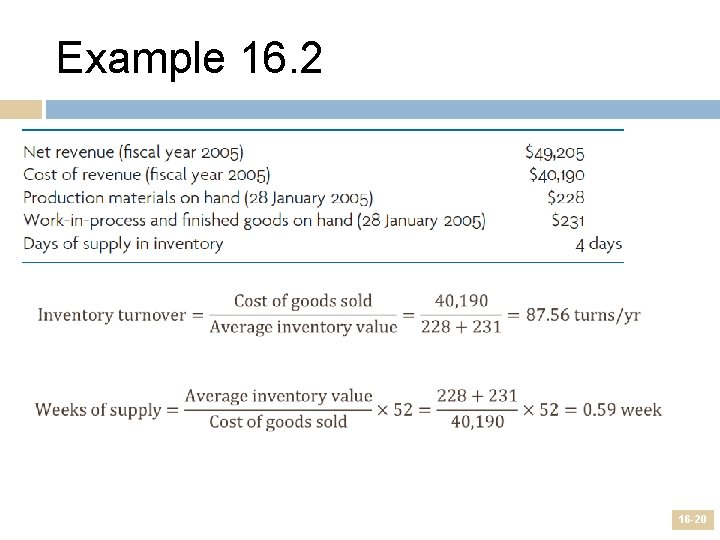
Example 16. 2 16 -20
- Slides: 20