
GLOBAL SHELTER CLUSTER linkages with Logistics Cluster Presentation
GLOBAL SHELTER CLUSTER linkages with Logistics Cluster Presentation at Logistics Cluster workshop Nairobi, 8 -9 November 2010
GLOBAL SHELTER CLUSTER IASC members & standing invitees GSC active participants Co-leads/conveners UNHCR, IFRC Partners Archi-Urgent, Care, CHF, CRS, DFID, Habitat for Humanity, IOM, Medair, NRC, OFDA, Oxfam, Pro. Act, Pro. Vention, Red. R, Relief International, RICS, Save The Children, Shelter Centre, SKAT, UN Habitat, UN OCHA, UNRWA, World Vision

Global level Cluster coordination Standards and policy-setting • Inputs to IASC and other policy documents • Evaluations (participate or provide inputs) • Inter-Clusters Missions Building response capacity • Training and system development at all levels • Surge capacity and standby rosters • Material stockpile Operational Support • Emergency Preparedness • Advocacy & Resource Mobilization • Skilled staff roster for immediate deployment Logistics Cluster workshop: Global Shelter Cluster Presentation Nairobi, 8 -9 November 2010
Country level Cluster coordination UNHCR - Global Cluster Lead for Conflict Emergencies: 1. Coordinator from UNHCR or other agency as agreed at country level 2. Support from UNHCR or standby agreement agencies IFRC - Global Cluster Convener for Natural Disaster Emergencies: Leads standardised Shelter Coordination Team (SCT) comprises of: Coordinator, Information Manager, Technical Coordinator, Shelter Recovery Advisor, plus possibility of Environmental Advisors, Mapping Advisors, Assistant Coordinators as required. Provides needed operational support and guidance to the field Logistics Cluster workshop: Global Shelter Cluster Presentation Nairobi, 8 -9 November 2010
GSC Reference Groups UNHCR and IFRC co-chair: • Information Management Reference Group • Training Reference Group • Transition Phase Reference Group Chaired by partners: • Technical Reference Group (Care, UN-HABITAT) • Environment Reference Group (Pro. Act, WWF) • Contingency Planning & Preparedness Reference Group (CHR, Medair, World Vision) • Built Environment Reference Group (RICS) Logistics Cluster workshop: Global Shelter Cluster Presentation Nairobi, 8 -9 November 2010
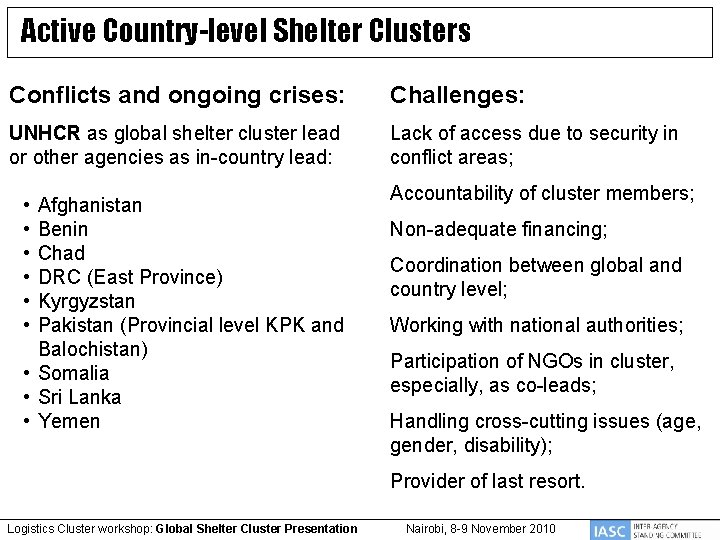
Active Country-level Shelter Clusters Conflicts and ongoing crises: Challenges: UNHCR as global shelter cluster lead or other agencies as in-country lead: Lack of access due to security in conflict areas; • • • Afghanistan Benin Chad DRC (East Province) Kyrgyzstan Pakistan (Provincial level KPK and Balochistan) • Somalia • Sri Lanka • Yemen Accountability of cluster members; Non-adequate financing; Coordination between global and country level; Working with national authorities; Participation of NGOs in cluster, especially, as co-leads; Handling cross-cutting issues (age, gender, disability); Provider of last resort. Logistics Cluster workshop: Global Shelter Cluster Presentation Nairobi, 8 -9 November 2010
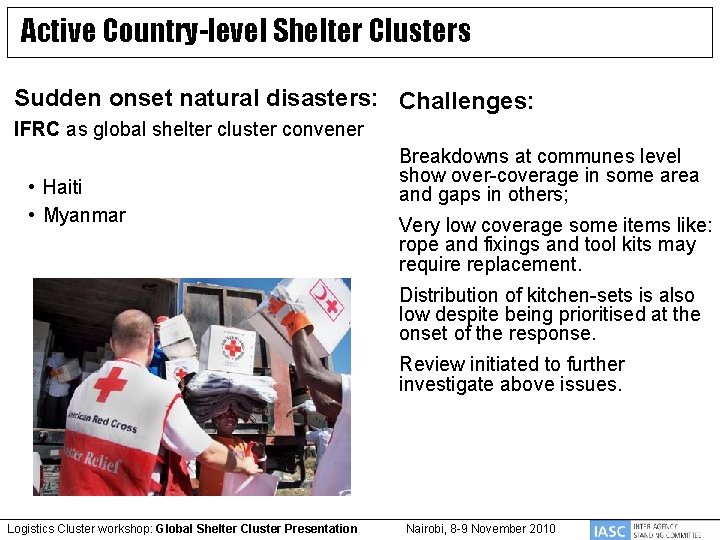
Active Country-level Shelter Clusters Sudden onset natural disasters: Challenges: IFRC as global shelter cluster convener • Haiti • Myanmar Breakdowns at communes level show over-coverage in some area and gaps in others; Very low coverage some items like: rope and fixings and tool kits may require replacement. Distribution of kitchen-sets is also low despite being prioritised at the onset of the response. Review initiated to further investigate above issues. Logistics Cluster workshop: Global Shelter Cluster Presentation Nairobi, 8 -9 November 2010
Active Country-level Shelter Clusters Shelter and NFI Cluster leading partners in other emergencies: Challenges: • IOM - Pakistan (Country level) • OCHA - Sudan • UN-HABITAT – Iraq • UNICEF - DRC (Remainder of country) Scale of disaster Logistics Cluster workshop: Global Shelter Cluster Presentation Access Security Government participation Nairobi, 8 -9 November 2010
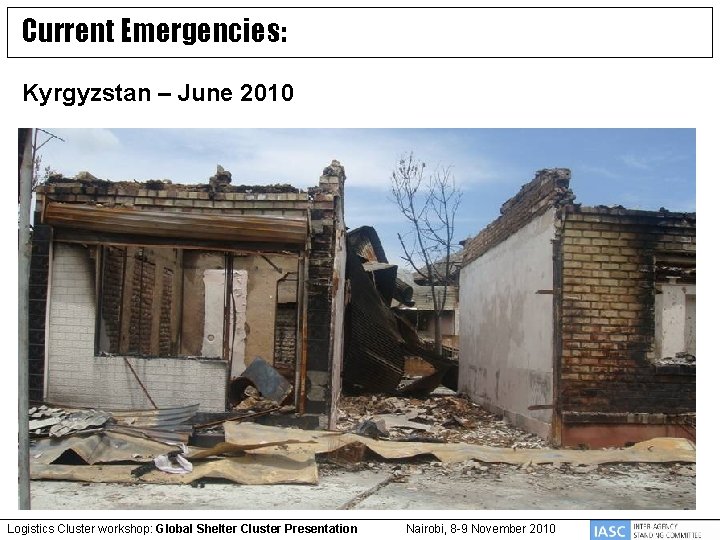
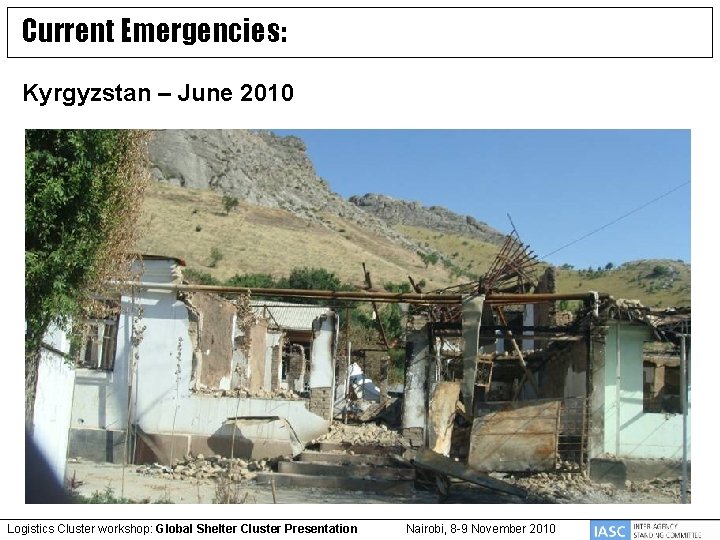
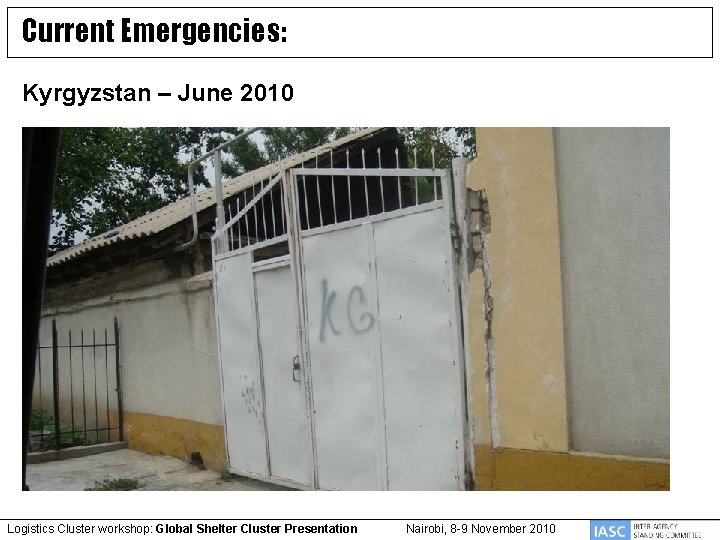
Example - A Current Emergency: Kyrgyzstan – June 2010 Emergency background • Ethnic violence & conflict on the 10 – 11 June 2010 • Uzbeks targeted in the cities of Osh and Jalalabad • Almost 300, 000 were displaced, with up to 75, 000 crossing the border into Uzbekstan, returning to their homes within a few days Logistics Cluster workshop: Global Shelter Cluster Presentation Nairobi, 8 -9 November 2010
Current Emergencies: Kyrgyzstan – June 2010 Logistics Cluster workshop: Global Shelter Cluster Presentation Nairobi, 8 -9 November 2010
Current Emergencies: Kyrgyzstan – June 2010 Logistics Cluster workshop: Global Shelter Cluster Presentation Nairobi, 8 -9 November 2010
Current Emergencies: Kyrgyzstan – June 2010 Logistics Cluster workshop: Global Shelter Cluster Presentation Nairobi, 8 -9 November 2010
Current Emergencies: Kyrgyzstan – June 2010 Response UNHCR established the Shelter Cluster team in the immediate response to the conflict emergency in by deploying staff, including the lead coordinator. The ESC undertook joint assessment to determine the scale of damage. Houses were catagorised according to damage level 1 -4. Total number of houses damaged catagories 1 – 4 = 1, 741 Total number of houses category 3 & 4 (total reconstruction) = 1, 642 Strategy - ESC provided emergency shelters and coordinated the construction of 1, 642 emergency transitional shelters, and thousands of winter relief items for affected families before the winter. Logistics Cluster workshop: Global Shelter Cluster Presentation Nairobi, 8 -9 November 2010
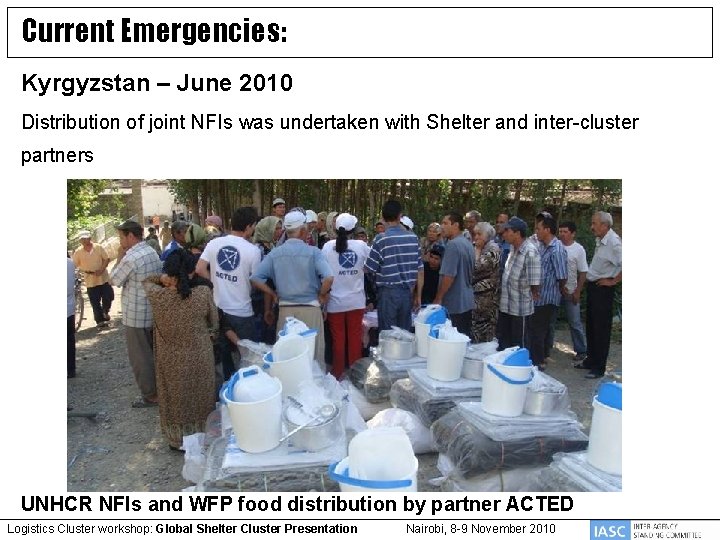
Current Emergencies: Kyrgyzstan – June 2010 Distribution of joint NFIs was undertaken with Shelter and inter-cluster partners UNHCR NFIs and WFP food distribution by partner ACTED Logistics Cluster workshop: Global Shelter Cluster Presentation Nairobi, 8 -9 November 2010
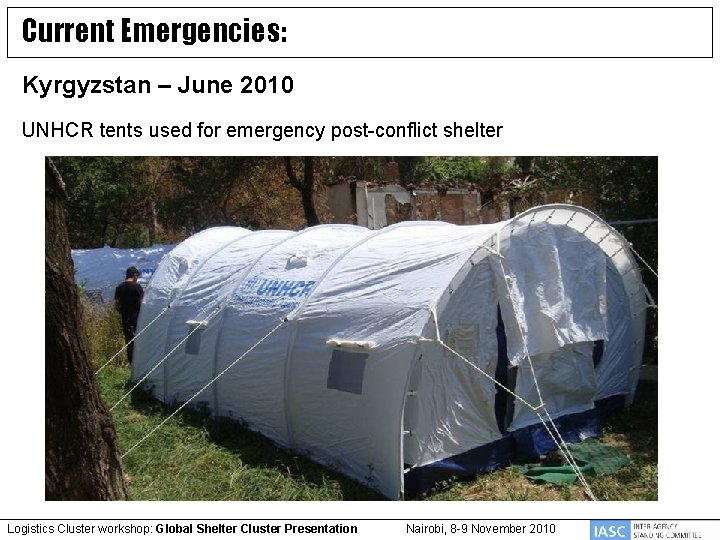
Current Emergencies: Kyrgyzstan – June 2010 UNHCR tents used for emergency post-conflict shelter Logistics Cluster workshop: Global Shelter Cluster Presentation Nairobi, 8 -9 November 2010
Shelter and Logistics For all emergencies, the GSC relies on inter-cluster relations to get equipment, staff and resources to the affected population Logistics Cluster workshop: Global Shelter Cluster Presentation Nairobi, 8 -9 November 2010
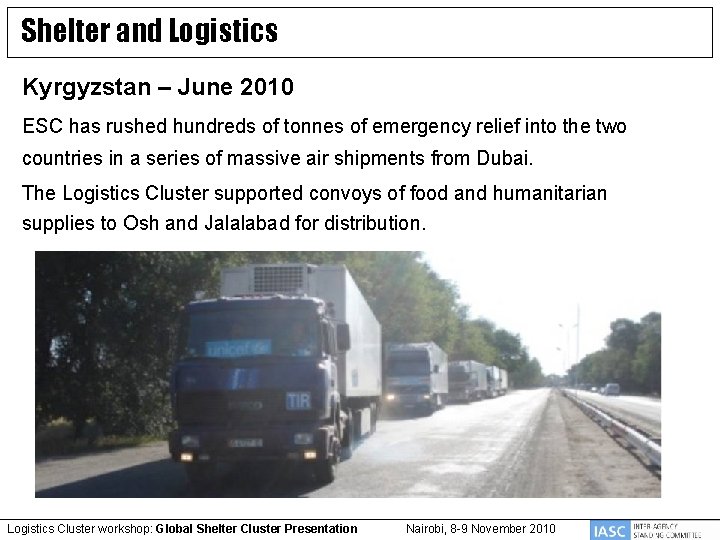
Shelter and Logistics Kyrgyzstan – June 2010 ESC has rushed hundreds of tonnes of emergency relief into the two countries in a series of massive air shipments from Dubai. The Logistics Cluster supported convoys of food and humanitarian supplies to Osh and Jalalabad for distribution. Logistics Cluster workshop: Global Shelter Cluster Presentation Nairobi, 8 -9 November 2010
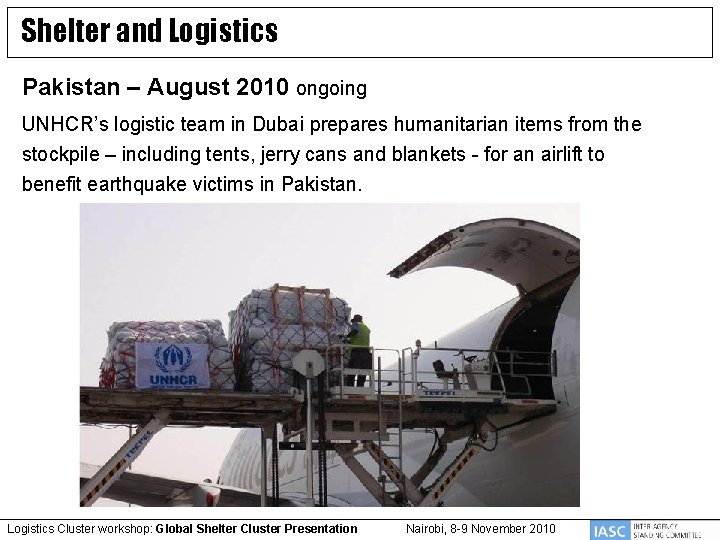
Shelter and Logistics Pakistan – August 2010 ongoing UNHCR’s logistic team in Dubai prepares humanitarian items from the stockpile – including tents, jerry cans and blankets - for an airlift to benefit earthquake victims in Pakistan. Logistics Cluster workshop: Global Shelter Cluster Presentation Nairobi, 8 -9 November 2010
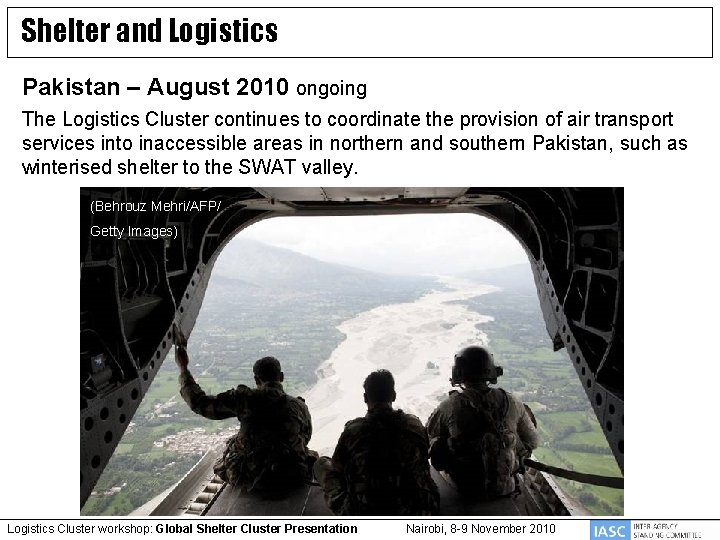
Shelter and Logistics Pakistan – August 2010 ongoing The Logistics Cluster continues to coordinate the provision of air transport services into inaccessible areas in northern and southern Pakistan, such as winterised shelter to the SWAT valley. (Behrouz Mehri/AFP/ Getty Images) Logistics Cluster workshop: Global Shelter Cluster Presentation Nairobi, 8 -9 November 2010
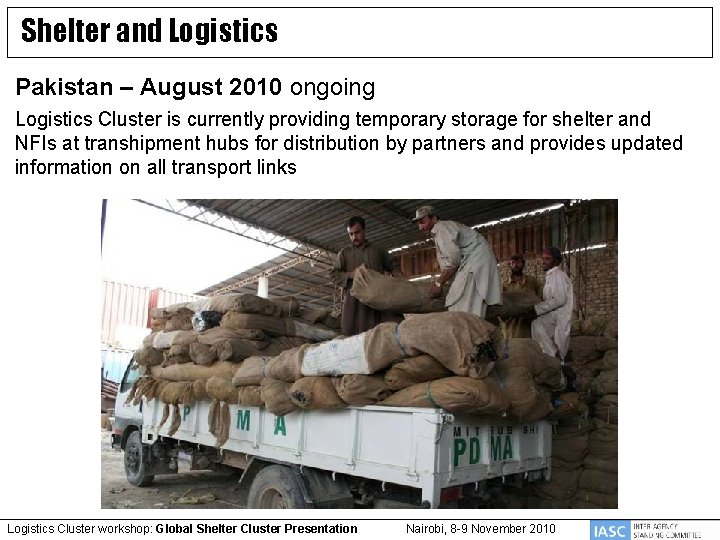
Shelter and Logistics Pakistan – August 2010 ongoing Logistics Cluster is currently providing temporary storage for shelter and NFIs at transhipment hubs for distribution by partners and provides updated information on all transport links Logistics Cluster workshop: Global Shelter Cluster Presentation Nairobi, 8 -9 November 2010
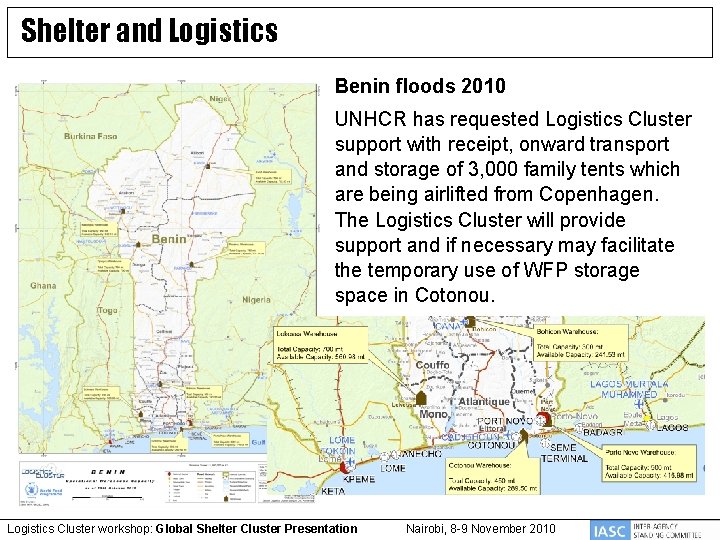
Shelter and Logistics Benin floods 2010 UNHCR has requested Logistics Cluster support with receipt, onward transport and storage of 3, 000 family tents which are being airlifted from Copenhagen. The Logistics Cluster will provide support and if necessary may facilitate the temporary use of WFP storage space in Cotonou. Logistics Cluster workshop: Global Shelter Cluster Presentation Nairobi, 8 -9 November 2010
Summary of Global Shelter Cluster activities • Participation open to all humanitarian agency representatives • Bi-annual working meetings to review key issues arising from country level that could/should inform Global Shelter Cluster capacity building and preparedness activities • Ad hoc meetings as required to support specific in-country clusters during a response • Activities arising from the reference groups, including trainings, piloting of tools, reviews of country level clusters etc. Logistics Cluster workshop: Global Shelter Cluster Presentation Nairobi, 8 -9 November 2010
UNHCR GSC activities planned for 2011 Cluster objectives and activities will be based on two main Shelter pillars: • enhance response capacity both at global and country levels • extend support to coordination and implementation of cluster related activities at country level. Logistics Cluster workshop: Global Shelter Cluster Presentation Nairobi, 8 -9 November 2010
UNHCR GSC activities planned for 2011 Actions: 1. Support field operations in emergency shelter activities • Improved response capacity • Preparedness for immediate deployment • Stockpiles of tents and NFIs in the Central Emergency Stockpile (CES) 2. Improve the capacity of lead and cluster partners at both at global as well as country levels through training activities 3. Coordinate with cluster partners at both global level and field levels to ensure that responses are consistent and resources are used effectively. Including supporting and enhancing inter-cluster collaboration and coordination Logistics Cluster workshop: Global Shelter Cluster Presentation Nairobi, 8 -9 November 2010
GLOBAL SHELTER CLUSTER Global Shelter Cluster contacts and information www. humanitarianreform. org www. oneresponse. org www. sheltercluster. org IFRC – Graham Saunders (Coordinator) graham. saunders@ifrc. org UNHCR – Sajjad Malik (Coordinator) malik@unhcr. org IFRC – Miguel Urquia, Focal Point miguel. urquia@ifrc. org UNHCR – Surendra Panday, Focal Point pandays@unhcr. org UNHCR – Elizabeth Palmer, palmere@unhcr. org Logistics Cluster workshop: Global Shelter Cluster Presentation Nairobi, 8 -9 November 2010
- Slides: 25