
Global Remote Sensing of Aerosol using MODIS Algorithm
Global Remote Sensing of Aerosol using MODIS: Algorithm and Validation Quantifying the Ambient (Undisturbed) Conditions Yoram Kaufman, Lorraine Remer, Robert Levy* and the MODIS Aerosol Team at NASA/GSFC Code 613. 2 Brent Holben and the AERONET Team at NASA/GSFC Code 614. 4 Rachel Pinker and the Fall 2003 METO 624 Remote Sensing class at UMDCollege Park
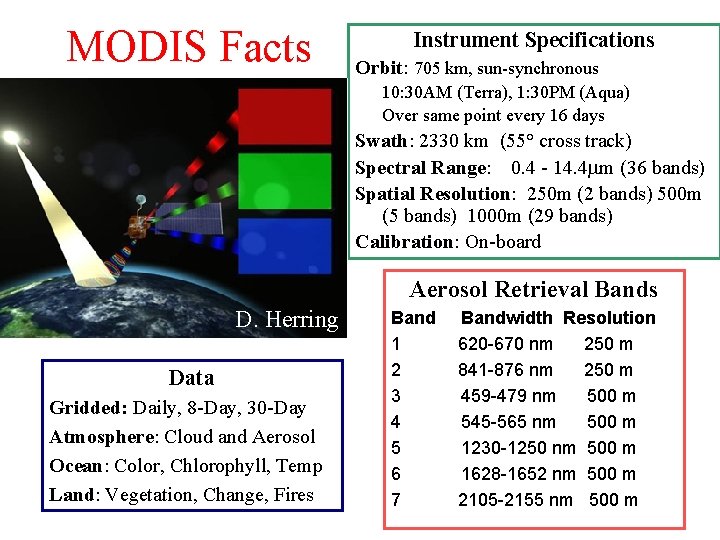
MODIS Facts Instrument Specifications Orbit: 705 km, sun-synchronous 10: 30 AM (Terra), 1: 30 PM (Aqua) Over same point every 16 days Swath: 2330 km (55° cross track) Spectral Range: 0. 4 - 14. 4 mm (36 bands) Spatial Resolution: 250 m (2 bands) 500 m (5 bands) 1000 m (29 bands) Calibration: On-board Aerosol Retrieval Bands D. Herring Data Gridded: Daily, 8 -Day, 30 -Day Atmosphere: Cloud and Aerosol Ocean: Color, Chlorophyll, Temp Land: Vegetation, Change, Fires Band 1 2 3 4 5 6 7 Bandwidth Resolution 620 -670 nm 250 m 841 -876 nm 250 m 459 -479 nm 500 m 545 -565 nm 500 m 1230 -1250 nm 500 m 1628 -1652 nm 500 m 2105 -2155 nm 500 m

“Visible Image” April 19, 2000 (composite of Red, Green and Blue wavelengths) Mark Gray
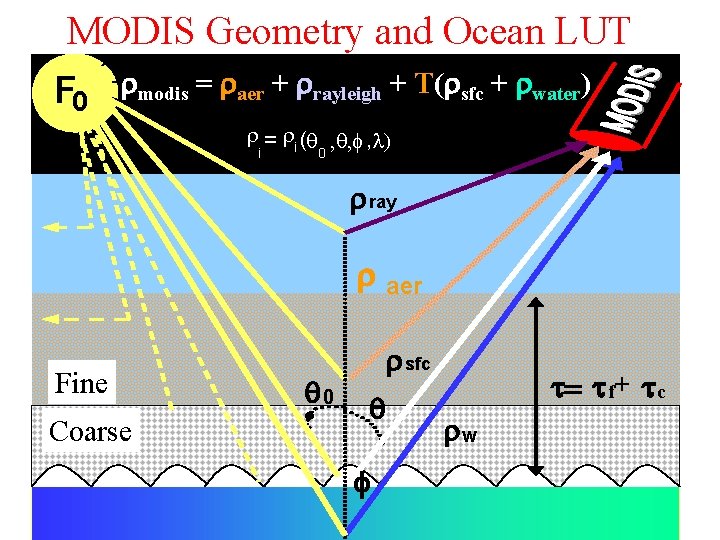
MODIS Geometry and Ocean LUT F 0 rmodis = raer + rrayleigh + T(rsfc + rwater) r = ri (q , q, f, l) i 0 r ray r Fine aer r sfc q 0 q Coarse f = f + c rr w w
MODIS Ocean Aerosol Retrieval
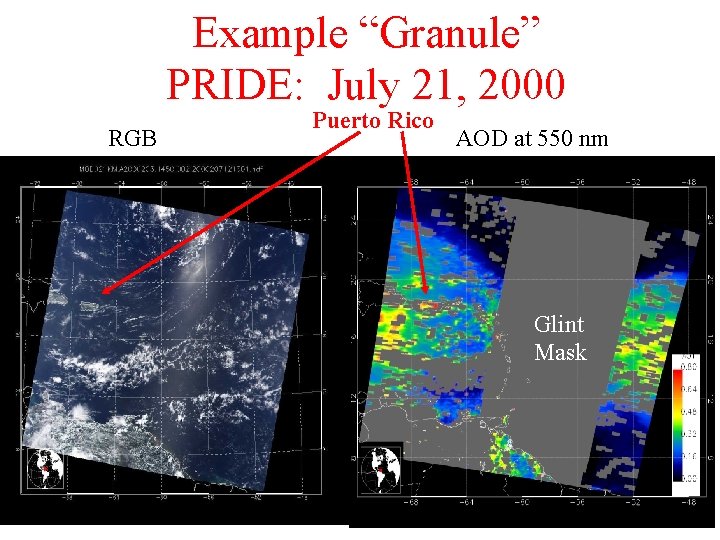
Example “Granule” PRIDE: July 21, 2000 RGB Puerto Rico AOD at 550 nm Glint Mask
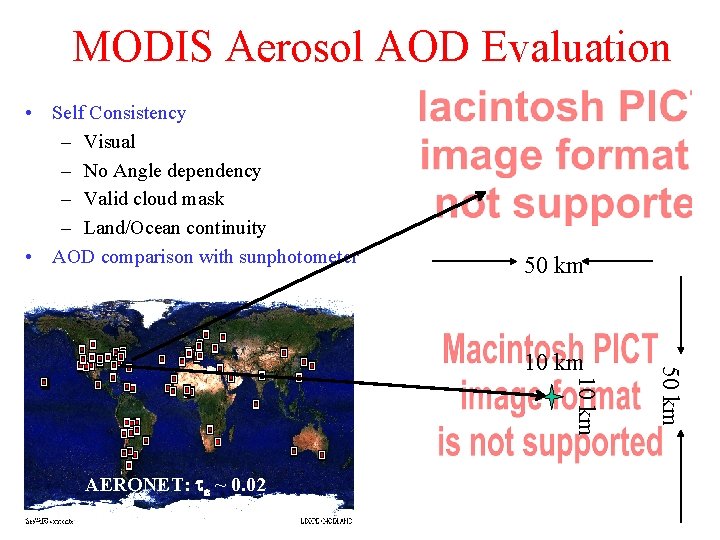
MODIS Aerosol AOD Evaluation • Self Consistency – Visual – No Angle dependency – Valid cloud mask – Land/Ocean continuity • AOD comparison with sunphotometer 50 km 10 km AERONET: ~ 0. 02 50 km 10 km
- Slides: 7