
Global Regulatory Trends in Mutual Funds Cafemutual Conference
Global Regulatory Trends in Mutual Funds Cafemutual Conference - 2016 Mumbai June 7, 2016 Siddharth Shah Khaitan & Co
History of Mutual Funds § The first modern mutual, or open-end, fund was the Massachusetts Investors Trust which was introduced in Boston in March 1924. The fund introduced important innovations to the investment company concept by establishing a simplified capital structure, continuous offering of shares, the ability to redeem shares rather than hold them until dissolution of the fund, and a set of clear investment restrictions and policies § The stock market crash of 1929 and the Great Depression that followed hampered the growth of pooled investments until a succession of landmark securities laws, beginning with the Securities Act of 1933 and concluding with the Investment Company Act of 1940, reinvigorated investor confidence in USA § However, globally mutual funds became really popular only in the 1980 s and 1990 s when mutual fund investment hit record highs and investors saw incredible returns § The global growth of mutual funds was fuelled by the increasing globalization of finance and expanding presence of large multinational financial groups in a large number of countries and by the strong performance of equity and bond markets * https: //www. ific. ca/en/articles/who-we-are-history-of-mutual-funds/ Copyright © Khaitan & Co 2016 | 1
Mutual Funds in India § The mutual fund industry in India started in 1963 with the formation of Unit Trust of India under a special act of Parliament § SBI Mutual Fund was the first non-UTI Mutual Fund which was established in June 1987 § The erstwhile Kothari Pioneer (now merged with Franklin Templeton) was the first private sector mutual fund registered in July 1993 § With the entry of private sector funds in 1993, a new era started in the Indian mutual fund industry, giving the Indian investors a wider choice of fund families § The SEBI (Mutual Fund) Regulations, 1996 set uniform standards for all funds § The mutual fund industry has grown exponentially in size since and has even attracted significant number of international players § Total AUM for domestic Mutual Funds as on Dec 2015 was Rs. 1, 339, 484 Cr (approx. US$ 206 bn) Copyright © Khaitan & Co 2016 | 2
Recent Trends in Mutual Funds Globally
General Global Trends § Household investors are moving from asset accumulation to investing to meet their long-term personal financial objectives, such as preparing for retirement, child education etc. § As compared to pure equity or debt funds, hybrid funds are finding more buyers as they are perceived as providing better balance between risks and reward § Changing demographics and investors’ reactions to U. S. and worldwide economic and financial conditions (oil prices, interest rate, commodities prices etc) play important roles in determining how demand for specific types of mutual funds—and for mutual funds in general—evolves § Constant innovation around newer structures and products to meet investors’ changing needs and improved level of sophistication leading to increased deployment of alternative strategies § In the past decade, demand for ETFs has increased as institutional investors have found ETFs to be a convenient vehicle for participating in, or hedging against, broad movements in the stock market. § Increased focus on alternative distribution channels with a focus to improve geographic reach and reduce costs for distribution Copyright © Khaitan & Co 2016 | 4
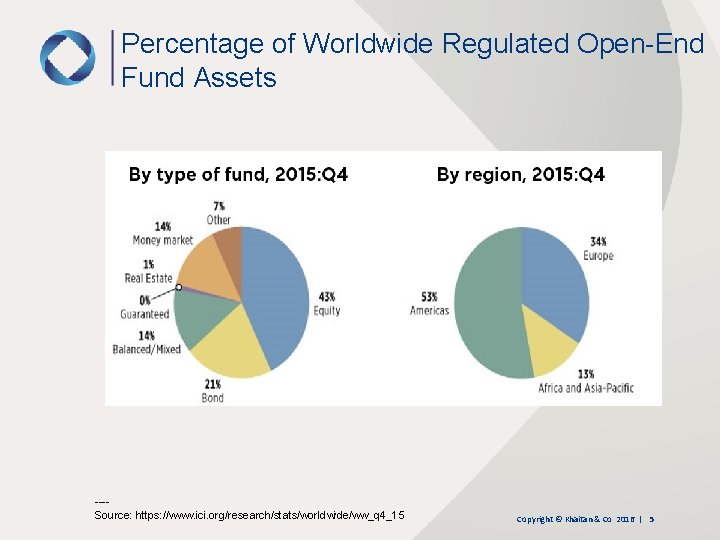
Percentage of Worldwide Regulated Open-End Fund Assets ---Source: https: //www. ici. org/research/stats/worldwide/ww_q 4_15 Copyright © Khaitan & Co 2016 | 5
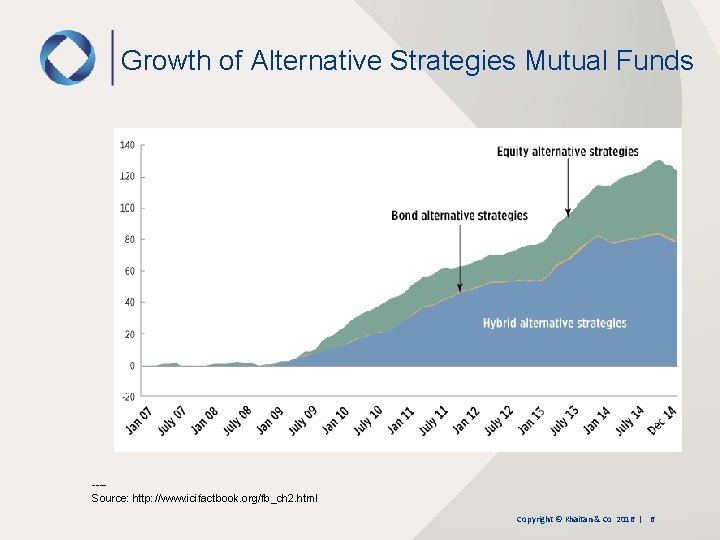
Growth of Alternative Strategies Mutual Funds ---Source: http: //www. icifactbook. org/fb_ch 2. html Copyright © Khaitan & Co 2016 | 6
Mutual Funds in United States of America § There has been a rise in preference for securities and assets held through funds as compared to equities and bonds held directly § Since individual investors comprise the largest group of investors, the majority of the assets in the recent past have been in long-term funds wherein equity funds comprised more than half of such funds § Businesses and institutional investors, on the other hand, rely on money market funds to manage their cash and short-term assets § In 2015, there was a substantial movement of money out of the US equity market and into international equities and this trend has continued into Q 1 2016* § In 2015, investors moved over $207 billion into international equity funds, while pulling $66 billion out of U. S. equity funds. As of Feb. 29, 2016, investors have pulled another $19 billion out of US based equity funds year to date, and added another $14 billion to international funds* § Funds relating to precious metals and index funds also saw a rise in inflows over 2015 and the trend has continued well into 2016* § Since long-term interest rates in the US have decreased, there has been an increase in investments in bond funds § The U. S. ETF market—with 1, 594 funds and $2. 1 trillion in assets under management — remained the largest in the world, accounting for 72 percent of the $2. 9 trillion in ETF assets worldwide ---* http: //www. investopedia. com/articles/investing/040716/5 -trends-mutual-fund-market-date-2016 -tfcvx. asp Copyright © Khaitan & Co 2016 | 7
UCITS in European Union § UCITS provides a single European regulatory framework for an investment vehicle which allows the manager to market the vehicle across the EU irrespective of the country it is domiciled in § The European alternative UCITS industry has been growing since the UCITS III directive came into effect more than a decade ago and made way for alternative investment funds to be formed under the European regulated structure § Investors consider UCITS-compliant funds more attractive for better regulatory supervision, transparency, liquidity and tax effectiveness § UCITS funds are designed basically to protect the investments during the periods of economic uncertainties and when market is volatile and falling § Following the financial crisis, the market of alternative UCITS funds saw a tremendous growth, both in assets and number of funds § The assets under management by the alternative UCITS climbed from 34 billion euros in 2008 to 305 billion euros in 2014* § There has been an annualised growth at the rate of 30% in the alternative UCITS assets since the 2008 financial crisis* § After a bumpy start to the year 2016, the European fund industry saw an increase in net inflows into long-term mutual funds towards the end of Q 1 2016. Equity funds were the asset type with the highest net outflows while, bond funds were the best selling asset type followed by alternative UCITS, commodity products, and mixed-asset funds as well as real estate products** ---* http: //www. hedgethink. com/resources/the-latest-trends-of-the-european-alternative-ucits-industry/ ** http: //lipperalpha. financial. thomsonreuters. com/reports/2016/05/monday-morning-memo-european-fund-flow-trends-april 2016/ Copyright © Khaitan & Co 2016 | 8
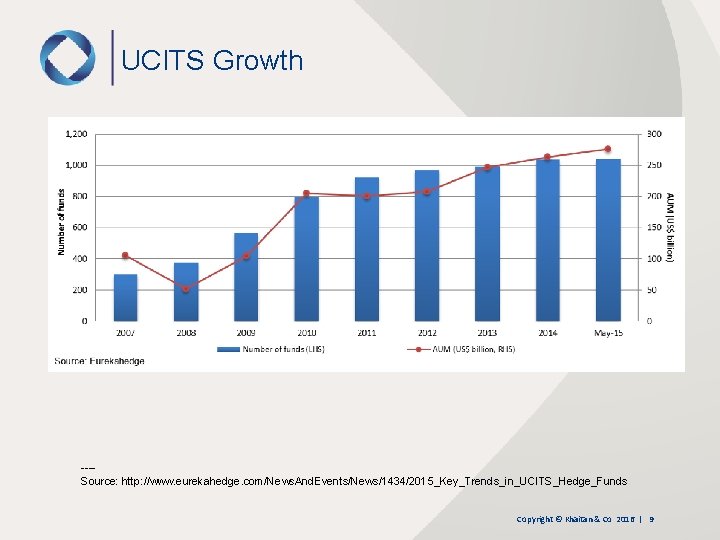
UCITS Growth ---Source: http: //www. eurekahedge. com/News. And. Events/News/1434/2015_Key_Trends_in_UCITS_Hedge_Funds Copyright © Khaitan & Co 2016 | 9
Mutual Funds in Japan § Amongst Asia-Pacific markets Japan shares an investment culture similar to India § Mutual funds in Japan are primarily governed by the Financial Instruments and Exchange Act § Mutual funds are typically structured as unit trusts § Japanese equity funds attracted investment of $2 billion in early January but have since been increasingly hit with redemptions since the start of 2016 despite several measures taken to provide economic stimulus and strengthen the yen* § This has largely been attributed to domestic economic stagnation and a low-rate environment § However, several Japan-focused ETFs have managed to attract investment dollars in 2016** § Eight of the top 15 mutual funds with the largest asset outflows in April 2016 were bond funds*** § Several of the Japanese mutual funds do invest in foreign securities and have been investors in some of the offshore funds organised by Indian AMCs ---* http: //www. ft. com/intl/cms/s/0/27198 f 7 e-0 d 94 -11 e 6 -b 41 f-0 beb 7 e 589515. html#axzz 4 Ao 3 Jp. M 8 H ** http: //www. investopedia. com/articles/etfs-mutual-funds/042616/etf-flows-japan-etfs-winning-assets-fjp-hewj. asp *** http: //www. asiaasset. com/news/JMF_CH 0106_FS_DM. aspx Copyright © Khaitan & Co 2016 | 10
Regulatory Regimes for Mutual Funds
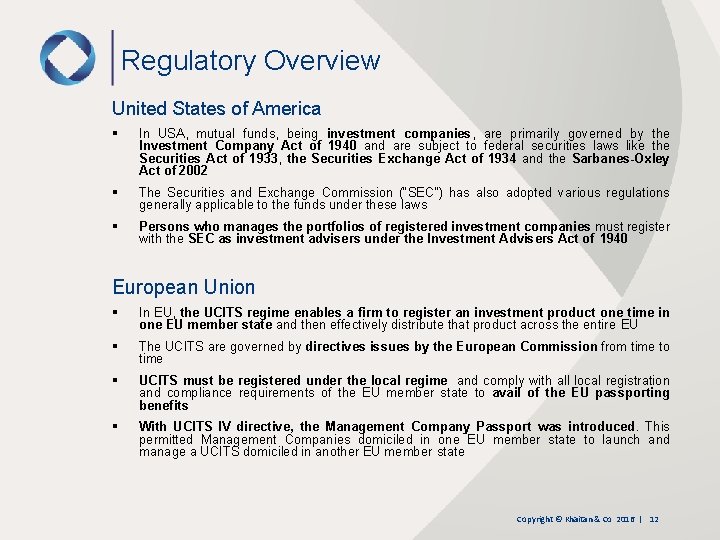
Regulatory Overview United States of America § In USA, mutual funds, being investment companies, are primarily governed by the Investment Company Act of 1940 and are subject to federal securities laws like the Securities Act of 1933, the Securities Exchange Act of 1934 and the Sarbanes-Oxley Act of 2002 § The Securities and Exchange Commission (“SEC”) has also adopted various regulations generally applicable to the funds under these laws § Persons who manages the portfolios of registered investment companies must register with the SEC as investment advisers under the Investment Advisers Act of 1940 European Union § In EU, the UCITS regime enables a firm to register an investment product one time in one EU member state and then effectively distribute that product across the entire EU § The UCITS are governed by directives issues by the European Commission from time to time § UCITS must be registered under the local regime and comply with all local registration and compliance requirements of the EU member state to avail of the EU passporting benefits § With UCITS IV directive, the Management Company Passport was introduced. This permitted Management Companies domiciled in one EU member state to launch and manage a UCITS domiciled in another EU member state Copyright © Khaitan & Co 2016 | 12
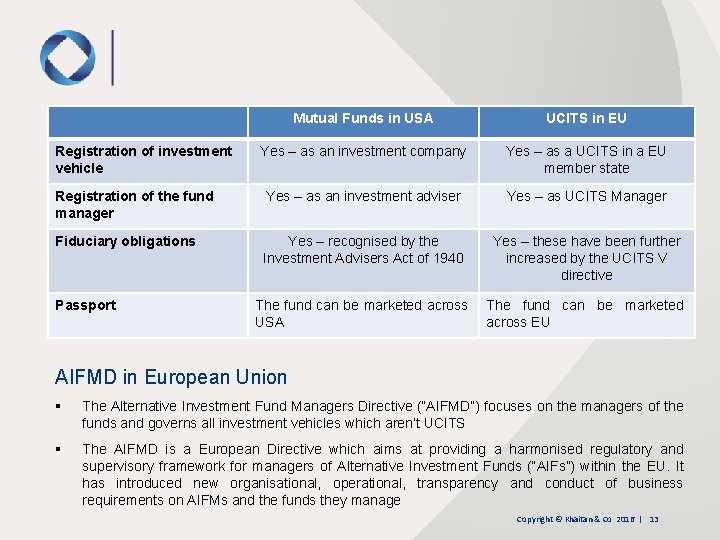
Mutual Funds in USA UCITS in EU Yes – as an investment company Yes – as a UCITS in a EU member state Registration of the fund manager Yes – as an investment adviser Yes – as UCITS Manager Fiduciary obligations Yes – recognised by the Investment Advisers Act of 1940 Yes – these have been further increased by the UCITS V directive The fund can be marketed across USA The fund can be marketed across EU Registration of investment vehicle Passport AIFMD in European Union § The Alternative Investment Fund Managers Directive (“AIFMD”) focuses on the managers of the funds and governs all investment vehicles which aren’t UCITS § The AIFMD is a European Directive which aims at providing a harmonised regulatory and supervisory framework for managers of Alternative Investment Funds (“AIFs”) within the EU. It has introduced new organisational, operational, transparency and conduct of business requirements on AIFMs and the funds they manage Copyright © Khaitan & Co 2016 | 13
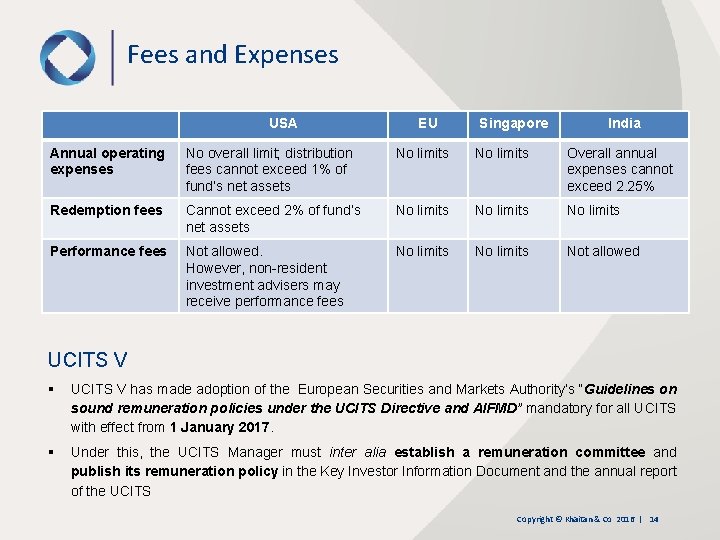
Fees and Expenses USA EU Singapore India Annual operating expenses No overall limit; distribution fees cannot exceed 1% of fund’s net assets No limits Overall annual expenses cannot exceed 2. 25% Redemption fees Cannot exceed 2% of fund’s net assets No limits Performance fees Not allowed. However, non-resident investment advisers may receive performance fees No limits Not allowed UCITS V § UCITS V has made adoption of the European Securities and Markets Authority’s “Guidelines on sound remuneration policies under the UCITS Directive and AIFMD” mandatory for all UCITS with effect from 1 January 2017. § Under this, the UCITS Manager must inter alia establish a remuneration committee and publish its remuneration policy in the Key Investor Information Document and the annual report of the UCITS Copyright © Khaitan & Co 2016 | 14
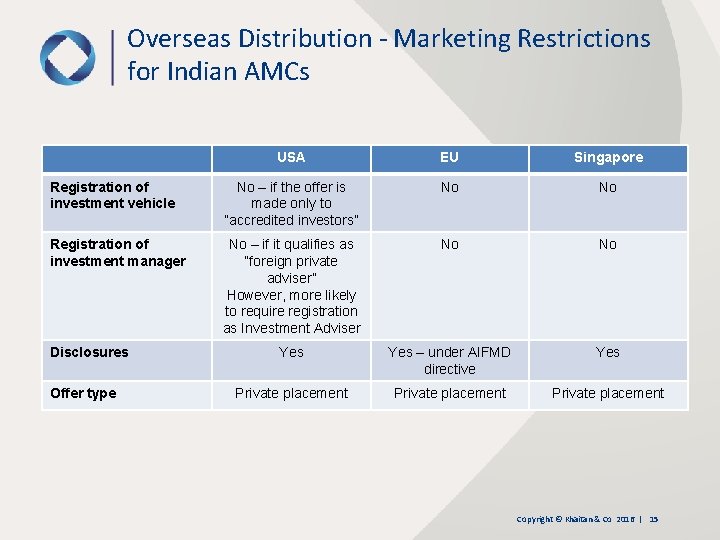
Overseas Distribution - Marketing Restrictions for Indian AMCs USA EU Singapore Registration of investment vehicle No – if the offer is made only to “accredited investors” No No Registration of investment manager No – if it qualifies as “foreign private adviser” However, more likely to require registration as Investment Adviser No No Yes – under AIFMD directive Yes Private placement Disclosures Offer type Copyright © Khaitan & Co 2016 | 15
Marketing Offshore Funds in India Key Considerations § Growing interest from offshore funds in raising capital from India § FEMA restrictions and exchange control limitations on individual investors (subject to limits prescribed under the liberalised remittance scheme) § Limits on Indian mutual funds on investing in offshore funds (monetary as well as types of funds) § No specific guidelines governing distribution of offshore products in India at the moment § Largely governed by provisions of the Companies Act, 2013 § Marketing of interest strictly on a private placement basis § Advisable to use regulated/registered intermediaries for distribution of such products in India. Copyright © Khaitan & Co 2016 | 16
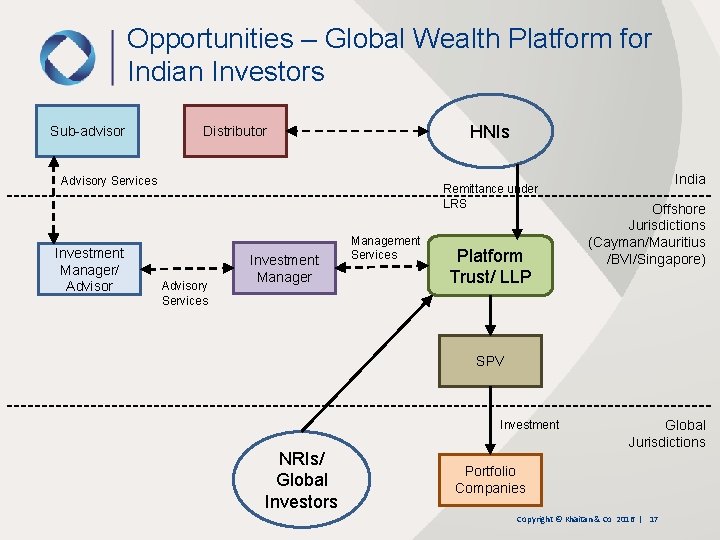
Opportunities – Global Wealth Platform for Indian Investors Sub-advisor HNIs Distributor Advisory Services Investment Manager/ Advisor Remittance under LRS Advisory Services Investment Manager Management Services Platform Trust/ LLP India Offshore Jurisdictions (Cayman/Mauritius /BVI/Singapore) SPV Investment NRIs/ Global Investors Global Jurisdictions Portfolio Companies Copyright © Khaitan & Co 2016 | 17

www. khaitanco. com Khaitan & Co asserts its copyright as the author of this presentation. The contents of this presentation are for informational purposes only. Khaitan & Co disclaims all liability to any person for any loss or damage caused by reliance on any part of this presentation.
- Slides: 19