
Global perspectives on integrating unique identification numbers in
Global perspectives on integrating unique identification numbers in civil registration and in achieving universal health coverage Pacific Regional Workshop on Legal Identity and Identity Security July 10, 2019 Carol Dayo Obure Sam Mills
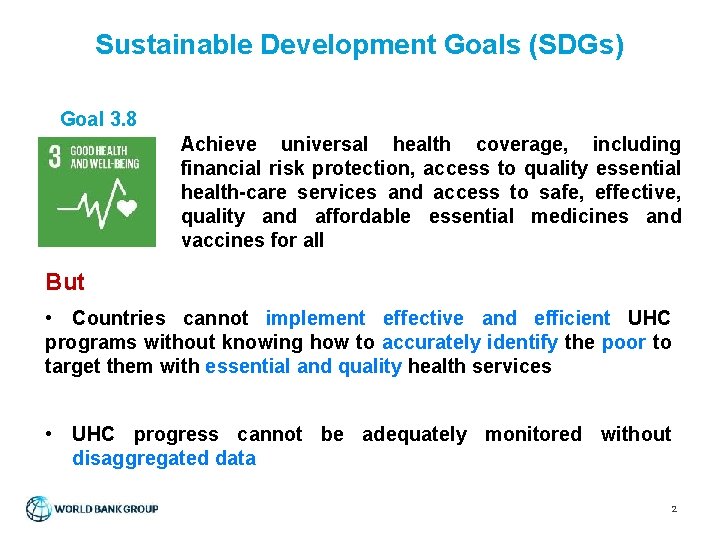
Sustainable Development Goals (SDGs) Goal 3. 8 Achieve universal health coverage, including financial risk protection, access to quality essential health-care services and access to safe, effective, quality and affordable essential medicines and vaccines for all But • Countries cannot implement effective and efficient UHC programs without knowing how to accurately identify the poor to target them with essential and quality health services • UHC progress cannot be adequately monitored without disaggregated data 2
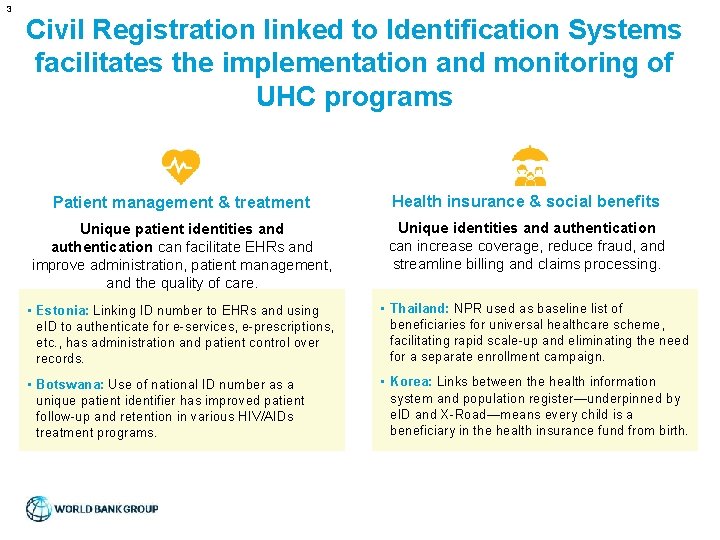
3 Civil Registration linked to Identification Systems facilitates the implementation and monitoring of UHC programs Patient management & treatment Health insurance & social benefits Unique patient identities and authentication can facilitate EHRs and improve administration, patient management, and the quality of care. Unique identities and authentication can increase coverage, reduce fraud, and streamline billing and claims processing. • Estonia: Linking ID number to EHRs and using e. ID to authenticate for e-services, e-prescriptions, etc. , has administration and patient control over records. • Thailand: NPR used as baseline list of beneficiaries for universal healthcare scheme, facilitating rapid scale-up and eliminating the need for a separate enrollment campaign. • Botswana: Use of national ID number as a unique patient identifier has improved patient follow-up and retention in various HIV/AIDs treatment programs. • Korea: Links between the health information system and population register—underpinned by e. ID and X-Road—means every child is a beneficiary in the health insurance fund from birth.
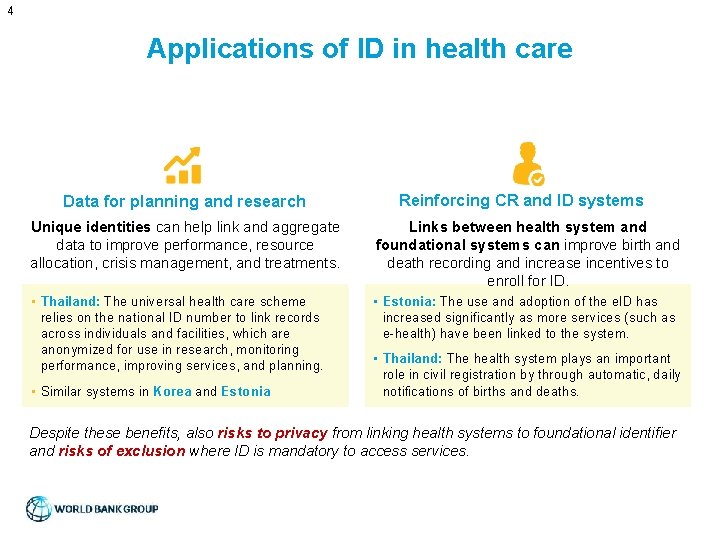
4 Applications of ID in health care Data for planning and research Reinforcing CR and ID systems Unique identities can help link and aggregate data to improve performance, resource allocation, crisis management, and treatments. Links between health system and foundational systems can improve birth and death recording and increase incentives to enroll for ID. • Thailand: The universal health care scheme relies on the national ID number to link records across individuals and facilities, which are anonymized for use in research, monitoring performance, improving services, and planning. • Estonia: The use and adoption of the e. ID has increased significantly as more services (such as e-health) have been linked to the system. • Similar systems in Korea and Estonia • Thailand: The health system plays an important role in civil registration by through automatic, daily notifications of births and deaths. Despite these benefits, also risks to privacy from linking health systems to foundational identifier and risks of exclusion where ID is mandatory to access services.
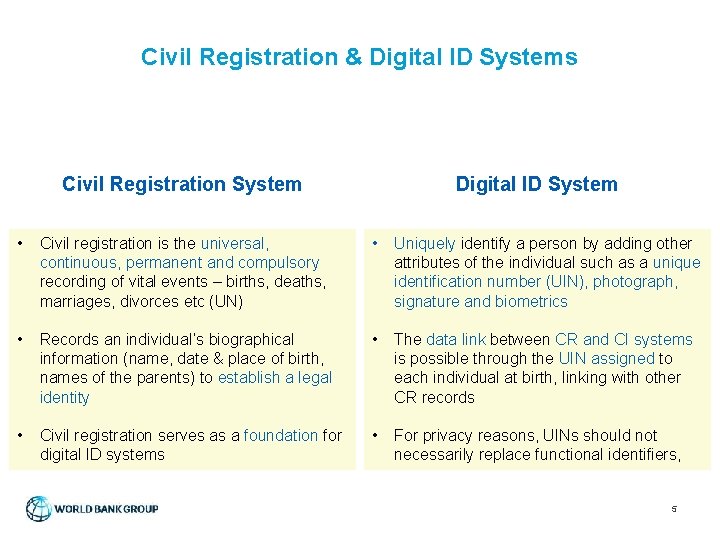
Civil Registration & Digital ID Systems Civil Registration System Digital ID System • Civil registration is the universal, continuous, permanent and compulsory recording of vital events – births, deaths, marriages, divorces etc (UN) • Uniquely identify a person by adding other attributes of the individual such as a unique identification number (UIN), photograph, signature and biometrics • Records an individual’s biographical information (name, date & place of birth, names of the parents) to establish a legal identity • The data link between CR and CI systems is possible through the UIN assigned to each individual at birth, linking with other CR records • Civil registration serves as a foundation for digital ID systems • For privacy reasons, UINs should not necessarily replace functional identifiers, 5
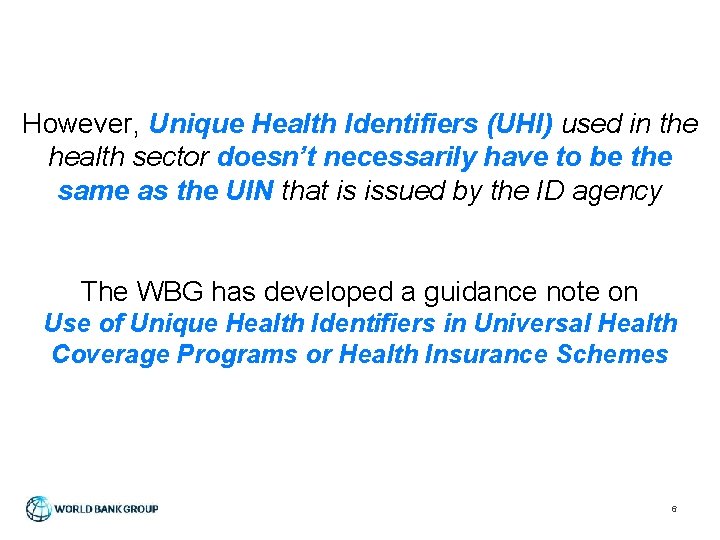
However, Unique Health Identifiers (UHI) used in the health sector doesn’t necessarily have to be the same as the UIN that is issued by the ID agency The WBG has developed a guidance note on Use of Unique Health Identifiers in Universal Health Coverage Programs or Health Insurance Schemes 6
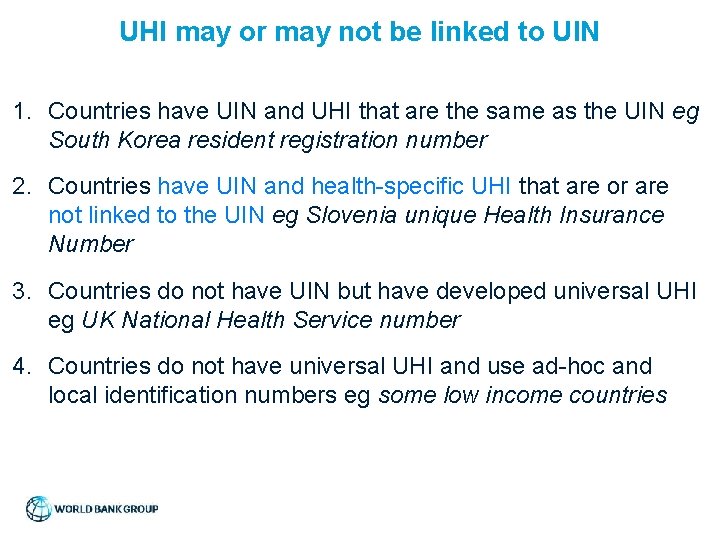
UHI may or may not be linked to UIN 1. Countries have UIN and UHI that are the same as the UIN eg South Korea resident registration number 2. Countries have UIN and health-specific UHI that are or are not linked to the UIN eg Slovenia unique Health Insurance Number 3. Countries do not have UIN but have developed universal UHI eg UK National Health Service number 4. Countries do not have universal UHI and use ad-hoc and local identification numbers eg some low income countries
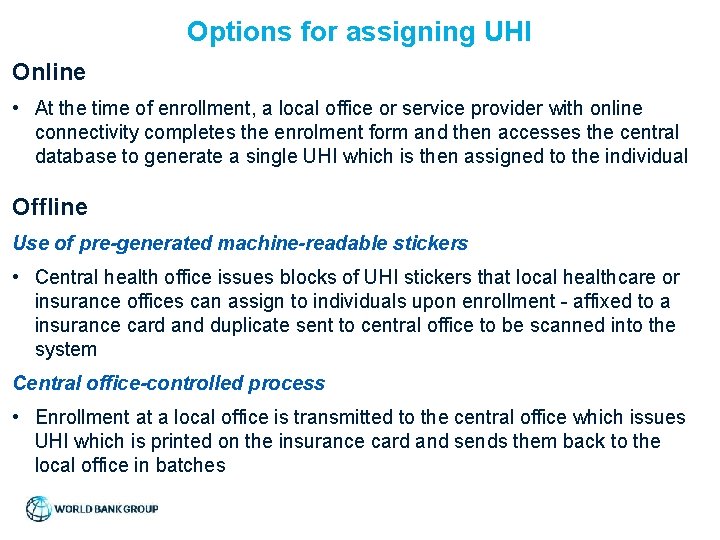
Options for assigning UHI Online • At the time of enrollment, a local office or service provider with online connectivity completes the enrolment form and then accesses the central database to generate a single UHI which is then assigned to the individual Offline Use of pre-generated machine-readable stickers • Central health office issues blocks of UHI stickers that local healthcare or insurance offices can assign to individuals upon enrollment - affixed to a insurance card and duplicate sent to central office to be scanned into the system Central office-controlled process • Enrollment at a local office is transmitted to the central office which issues UHI which is printed on the insurance card and sends them back to the local office in batches
Country Examples a. Slovenia b. South Korea c. Thailand WBG - CRVS/ID/UHC Studies Forthcoming publications
Slovenia • Electronic birth registration with UIN assigned a birth • Subsequently separate unique health insurance number is generated • UIN allows the linkage of various registers and databases including healthcare • Link to the civil register allows deceased to be identified and provision of health care and other services and payments to be discontinued
Slovenia Benefits • e. Prescription - doctors prescribe medications and transmit electronically to pharmacy o Improves patient safety and eliminates errors due to bad handwriting and o Information on the patient’s prescriptions are available for subsequent visits • e. Referral and e. Appointment – allows patient referral and appointment from primary to secondary & tertiary healthcare levels • e. Health record - allows comprehensive and continuous treatment of patients • Online portal for patients to securely access their records and make appointments • Electronic claims/bills processing and financial managements system improves efficiency
Slovenia Benefits • Preventive care e. g. colorectal cancer screening – information in database is used to identify those due for colonoscopy screening • Analysis of the electronic data provides information for the monitoring and the provision of health services, detection and prevention of fraud • Example of fraud that are prevented: o Use of false documents for insurance registration o Prescriptions of medications to persons without medical indications or larger than expected doses, abnormal combination of drugs etc o Suspicious billing (repeated for similar services in a short period, services not appropriate for age or sex, services that are illogical in relation to the gender or age of the person, etc
South Korea • Resident registration (RR) number is issued at birth • RR number provides access to benefits through national health insurance system • No separate health insurance card but the RR card is required at the point of care • Large hospitals generate patient number but the RR number is entered in the electronic health record for the health insurance claim
South Korea Benefits • RR numbers are used for enrollment and management of disease prevention and health promotion programs o All vaccination records are integrated and managed using the RR number • Unvaccinated children are easily identified • Prevents double vaccination • Recipients can check and manage their own vaccination history o RR numbers are used to select undernourished children for meal aid programs o RR numbers are used for the Nutri Plus Program - a nutritional support management program for infants and pregnant women
South Korea Benefits • Service providers use RR numbers for: o Enrollment & treatment of patients o Enrollment & management of infectious and chronic diseases o Enrollment & management of the poor for the Medical Care Assistance program • Patients can use RR numbers to access the medical record sharing portal • The 2017 Enforcement Decree of the Medical Act required standardization of the electronic health records to facilitate referral and sharing of information across hospitals • Electronic claims reimbursement processing
Thailand o Unique personal identification numbers are issued along with birth certificates o UIN is used to identify and verify legal identity, citizenship & enrollment into insurance schemes o Each hospital’s healthcare information system creates its own patient identification number
Thailand Benefits • Healthcare providers and insurers use encrypted UINs to: o Identify and enroll individuals for healthcare service provision o Track delivery of services o Claims reimbursement and detect claims duplication o Enable electronic healthcare services data exchange between payers and providers & among providers for continuity of care
Key Messages • Health sector contributes to and benefits from CRVS o Facilitate birth & death notification and registration o Medical certification of cause of death o Disaggregated data from CRVS is useful for planning and monitoring of health programs at national and district levels o Unique identifier contributes to effective and efficient UHC programs • ID is crucial for the efficient delivery of health services and is therefore instrumental for the achievement of SDG 3.
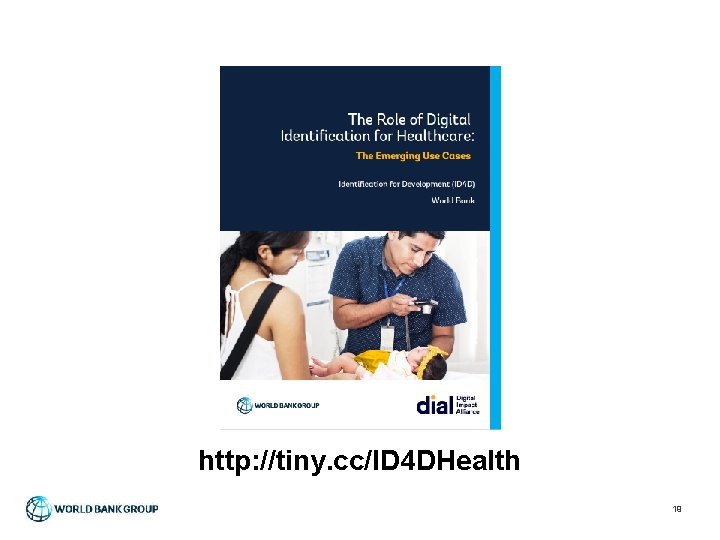
http: //tiny. cc/ID 4 DHealth 19
Thank you
- Slides: 20