
Global PAN AIDC ICD AIDC Implementation Seminar 28
(Global) PAN AIDC ICD AIDC Implementation Seminar 28 th – 31 st October 2014 Adam Watkin Airservices Australia
History § In 1971, Canada and the United Kingdom agreed to exchange data between Gander and Shanwick Oceanic Area Control Centres (OACs) using On-Line Data-Interchange (OLDI) § Subsequently, a similar arrangement was agreed to between Reykjavik and the Shanwick OAC/ACCs Ø Improved efficiency between the Air Traffic Services (ATS) units concerned Ø However, they were not standard (or even compatible) Ø To gain full benefits regional standardisation was required
History § At NAT SPG/25 (Paris, September 1988), a Task Force was established to develop a future ATS system concept for the whole of the NAT Region (NAT SPG/25, Conclusion 25/11 refers) § The Task Force identified that a common interface Control Document (ICD) that would describe OLDI exchanges between ATS units within and adjacent to the NAT Region was required
History § At NAT SPG/26 (Paris, May 1990) it was agreed that a working group should be established to oversee the development and co-ordinated implementation of a common ICD for the NAT Region (NAT SPG/26, Conclusion 26/17 refers) § At NAT SPG/27 (Paris, June 1991), it was noted that the draft ICD was sufficiently mature to be used for planning purposes and therefore agreed that States should endeavour to replace agreements that existed at the time with the common ICD by the end of 1991
History § On the basis of the work conducted by NAT SPG, APANPIRG/5 (Bangkok, 1994) undertook the task of developing a document describing the interfacility message exchanges required to support automation in the Asia Pacific region § As a result of this undertaking, Asia Pacific AIDC ICD V 1 was issued in May 1995 § The content of the original document was based mainly on North Atlantic AIDC ICD Ø Few differences Ø Divergence over the years as both documents have evolved

History
History Decision 20/14 – Support for Global ICD for AFTN AIDC “That, recognizing the benefits to be gained from globally harmonized interface arrangements for AIDC, APANPIRG supports the work being undertaken by the United States to coordinate a global Interface Control Document (ICD) for AFTN AIDC and invites the Asia/Pacific Regional Office to act as the regional point of contact for this work”
Establishing IRAIDCTF § Inter-regional AIDC task force (IRAIDCTF) established in January 2013 § This Task Force was established in accordance with: Ø NAT SPG Conclusion 48/28; and Ø APANPIRG Conclusion 23/20
Establishing IRAIDCTF Meetings held: § IRAIDCTF/1: Paris 16 -18 January 2013 § IRAIDCTF/2: Bangkok 22 to 26 July 2013 § IRAIDCTF/3: Montreal 24 -28 March 2014 Webexes: § Web/1: 27 February 2013 § Web/2: 10 April 2013 § Web/3: 11 June 2014 § Web/4: 9 July 2014 § Web/5: 6 Aug 2014
Developing PAN AIDC ICD § Work initially focussed on merging the North Atlantic & Asia Pacific ICDs Ø Common functionalities were sometimes worded differently Ø Best text chosen, or new text developed Ø Differences identified, and an acceptable way forward discussed and implemented Ø There were not an insurmountable number of significant differences!
Developing PAN AIDC ICD § Several messages were retained in the PAN AIDC ICD even though technically not AIDC messages Ø NAT (NAT Organized Track Structure Message) Ø TDM (Track Definition Message) § Moved to an Appendix Ø Retained because message format does not appear to be defined anywhere else
Developing PAN AIDC ICD § Once the structure and overall content of the document was agreed to Ø Overhaul of text Ø Lessons learnt incorporated Ø Area where ambiguities have occurred improved
Developing PAN AIDC ICD § Current version is V 0. 92 (Coordination draft) Ø Similar layout to parent documents Ø Awaiting resolution to several comments emanating from NAT SPG § Presented to OPLINK Panel meeting – Oct 2014 Ø Intention is to develop into an ICAO Document, with references in Annexes and PANS-ATM
PAN AIDC ICD § The following slides outline the significant differences between the current Asia Pacific AIDC ICD, and the draft PAN AIDC ICD
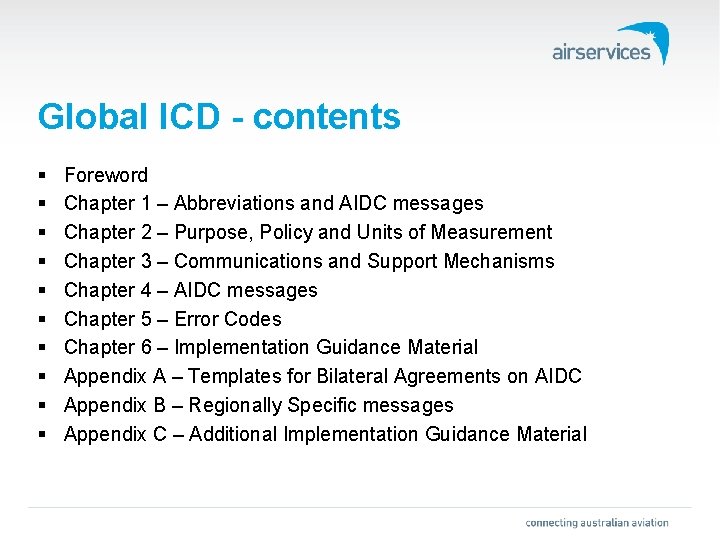
Global ICD - contents § § § § § Foreword Chapter 1 – Abbreviations and AIDC messages Chapter 2 – Purpose, Policy and Units of Measurement Chapter 3 – Communications and Support Mechanisms Chapter 4 – AIDC messages Chapter 5 – Error Codes Chapter 6 – Implementation Guidance Material Appendix A – Templates for Bilateral Agreements on AIDC Appendix B – Regionally Specific messages Appendix C – Additional Implementation Guidance Material
Chapter 2 § Cruise climb format § Examples on Field 14 formats moved to Chapter 4 § “Restriction” section significantly updated
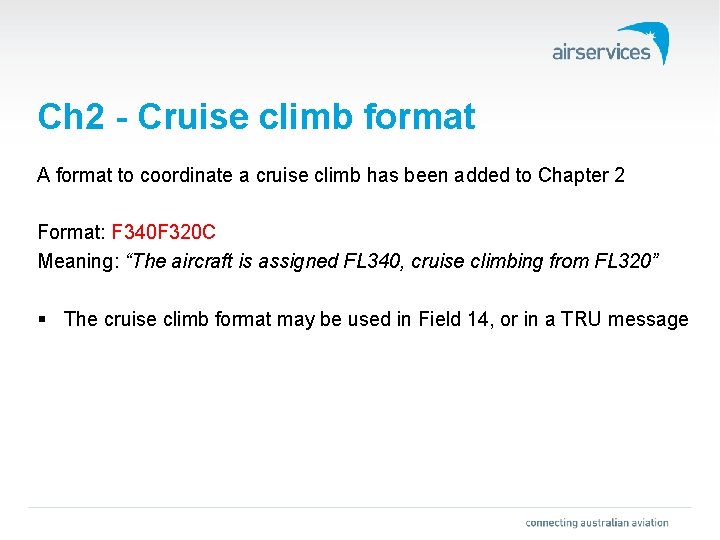
Ch 2 - Cruise climb format A format to coordinate a cruise climb has been added to Chapter 2 Format: F 340 F 320 C Meaning: “The aircraft is assigned FL 340, cruise climbing from FL 320” § The cruise climb format may be used in Field 14, or in a TRU message
Ch 2 – Field 14 examples § All the examples of Field 14 formats have been moved to Chapter 4 Ø Provides consistency, because Ch 4 contains examples of other flight plan fields
Ch 2 - Restriction formats § The section describing Restriction format has been considerably updated. It now accommodates: Ø Change of speed and/or level to commence at a future time or place Ø Change of level to be completed by a future time or place § The descriptions in existing documents were a little confusing and contradictory Ø Formats are now standardised Ø Addition of numerous examples
Chapter 3 § Specified the CRC to be used § Interpreting the AIDC Header § Measuring AIDC performance
Ch 3 - CRC § Historically there have been problems with the CRC, due to a number of versions of CRC-CCITT being available Ø Defined which specific CRC to use (“XModem”) Ø Provided examples of AIDC messages, along with their associated CRC for testing purposes
Ch 3 – AIDC Message Header § Provides information concerning the AIDC message Header Ø Description of the contents a description of the contents Ø Example showing the linking of AIDC messages using message header information
Ch 3 - AIDC performance § Provides information on AIDC performance: Ø Description and examples using time stamp information
Chapter 4 – AIDC messages § Expanded description of allowable flight plan fields (with examples) § Rewrite of the description of AIDC messages § New AIDC messages added § Allowable contents of TRU message updated § Moved TDM and NAT messages
Ch 4 - Flight Plan fields § New section added describing flight plan fields Ø Description of allowable contents Ø Inclusion of examples (including Field 14 examples, moved from Ch 2)
Ch 4 – Description of AIDC messages § The description of the AIDC messages has been rewritten Ø Ø Standardised format and content Examples improved, and updated to 2012 FPL format Removed the ability to amend destination in ABI Updated table showing allowable content of messages
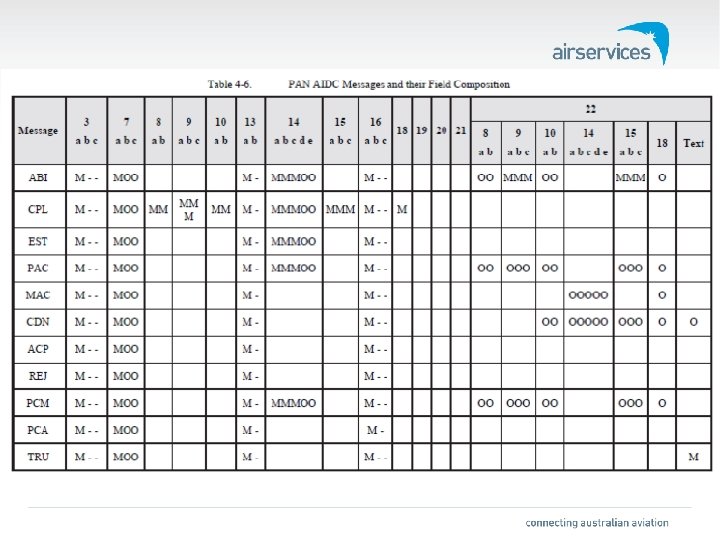
Ch 4 – Description of AIDC messages § The description of the AIDC messages has been rewritten Ø Ø Standardised format and content Examples improved, and updated to 2012 FPL format Removed the ability to amend destination in ABI Updated table showing allowable content of messages
Ch 4 - New AIDC messages – PCM, PCA PCM (Profile Confirmation Message) § Used to detect and recover from coordination errors, such as: Ø No coordination conducted at all Ø Coordination completed, but amendments have not been coordinated § Intended to be sent as the aircraft approaches the FIR boundary (e. g. 5 minute prior to FIR boundary)
Ch 4 - New AIDC messages – PCM, PCA PCM – Contents (Mandatory) § Aircraft identification § Departure aerodrome § Estimate data § Destination aerodrome (Optional) § Flight rules and type of flight § Number, type of aircraft, and wake turbulence category § Equipment § Route § Other information
Ch 4 - New AIDC messages – PCM, PCA (Profile Confirmation Acceptance) § Sent in response to a PCM Ø Confirms coordination information previously transmitted is correct; or Ø Acts as a last minute “Safety net” PCA – Contents (Mandatory) § Aircraft identification § Departure aerodrome § Destination aerodrome
Ch 4 – Allowable contents of TRU message § Allowable contents of TRU message updated Ø Added ability to coordinate “Present level”, and “Requested Flight level”
Ch 4 – TDM and NAT messages § These messages are not strictly AIDC messages “(TDM TRK A 940413124001 9404131900 9404140800 LILIA 27 N 170 W 29 N 180 E 31 N 170 E 32 N 160 E MASON RTS/ PHNL KEOLA 2 LILIA MASON OTR 15 SMOLT OTR 16 SUNNS OTR 20 LIBRA RJAA RMK/0)”
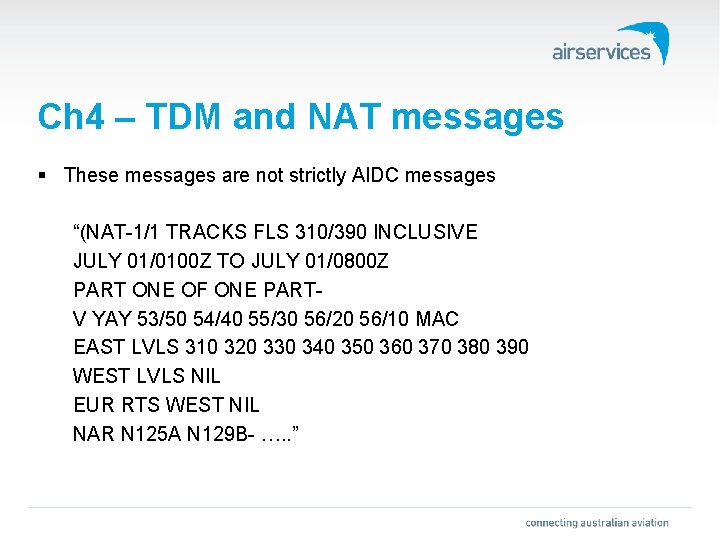
Ch 4 – TDM and NAT messages § These messages are not strictly AIDC messages “(NAT-1/1 TRACKS FLS 310/390 INCLUSIVE JULY 01/0100 Z TO JULY 01/0800 Z PART ONE OF ONE PARTV YAY 53/50 54/40 55/30 56/20 56/10 MAC EAST LVLS 310 320 330 340 350 360 370 380 390 WEST LVLS NIL EUR RTS WEST NIL NAR N 125 A N 129 B- …. . ”
Ch 4 – TDM and NAT messages § These messages are not strictly AIDC messages Ø However, format does not appear to be defined elsewhere Ø Messages retained, but moved to Appendix
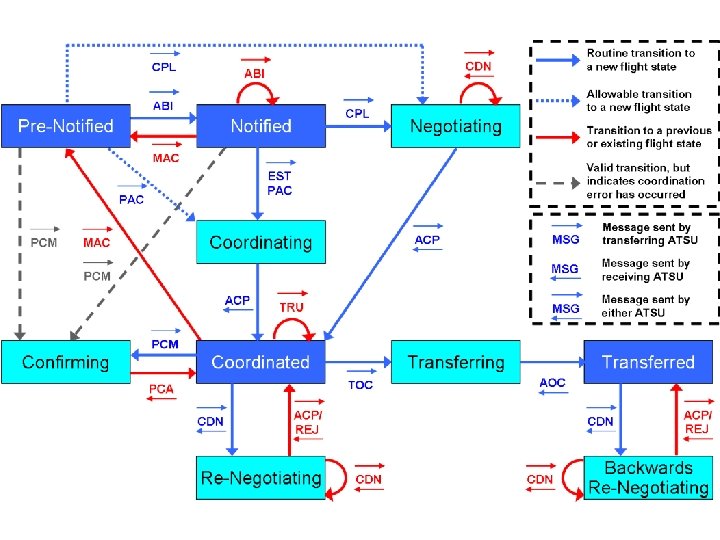
Chapter 6 - Implementation Guidance Material § Substantial re-write Ø Reorganised, additional guidance added Ø Improved examples § Description of Area of Common Interest § Updated Flight State Transition Diagram
Ch 6 - Implementation Guidance Material § This chapter was significantly expanded Ø 15 pages in Asia Pacific ICD expanded to 41 pages in PAN AIDC ICD § Sections moved around to match the order that AIDC messages are listed in elsewhere in the document § Additional guidance provided for all AIDC message types
Ch 6 - Description of ACI § A description of the Area of Common Interest (ACI) has been added Ø Includes diagrams § References to ACI have been updated throughout the document
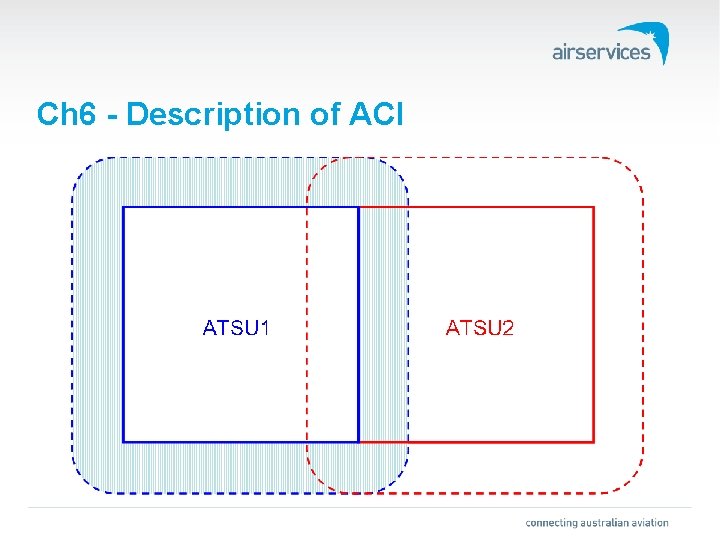
Ch 6 - Description of ACI
Ch 6 – Flight State Transition diagram § The flight state transition diagram was updated Ø Corrected previous limitations Ø Included new AIDC messages Ø Improved legend To be discussed in greater detail later in the seminar
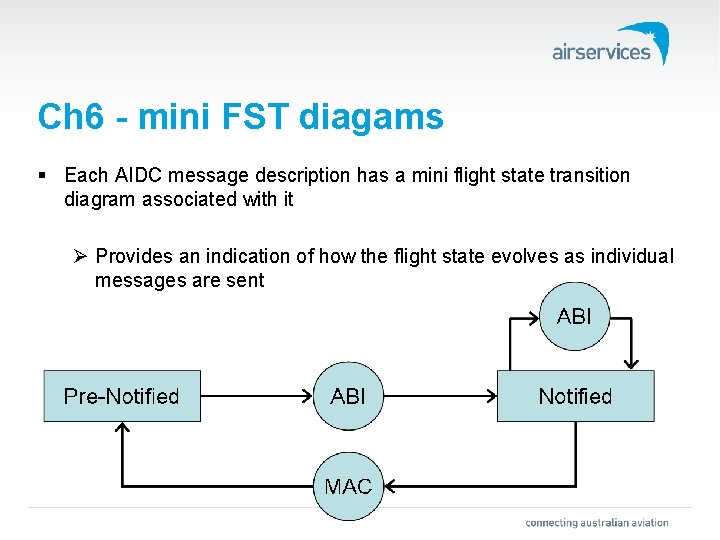
Ch 6 - mini FST diagams § Each AIDC message description has a mini flight state transition diagram associated with it Ø Provides an indication of how the flight state evolves as individual messages are sent
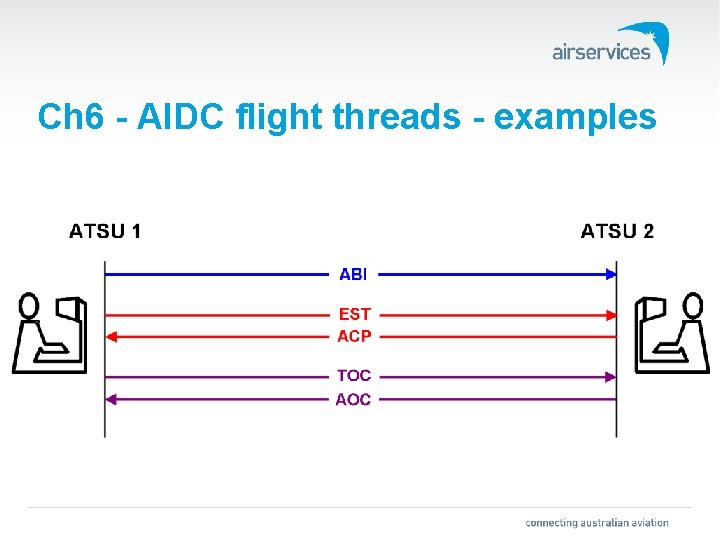
Ch 6 - AIDC flight threads - examples § Examples have all been updated and expanded upon Ø Now 14 examples Ø Cross section of all message types & formats Each example contains: § Text describing the scenario; § A graphical flight thread that illustrates the sequence of messages Ø flight threads are colour coded Ø message ‘dialogues’ displayed in the same colour § A table containing the associated AIDC messages
Ch 6 - AIDC flight threads - examples Example 1 – Coordination using abbreviated initial coordination dialogue ATSU 1 transmits a notification message (ABI) to ATSU 2. The ABI contains Estimate data of RUNOD at 1209, operating in a block clearance between FL 350 and FL 370. By agreement, ATSU 1 includes flight planned speed/level changes in Field 15 of AIDC messages. Subsequently the estimate for RUNOD changes to 1213, but ATSU 1 has an agreement with ATSU 2 not to sent revised Notification messages for revisions of less than 5 minutes. ATSU 1 transmits an abbreviated coordination message (EST) to ATSU 2. The proposed coordination contains Estimate data of RUNOD at 1213 operating in a block clearance between FL 350 and FL 370. ATSU 2 accepts the proposed coordination conditions by responding with an ACP. ATSU 1 proposes a transfer of control responsibility by transmitting a TOC to ATSU 2 accepts control responsibility by responding with an AOC
Ch 6 - AIDC flight threads - examples
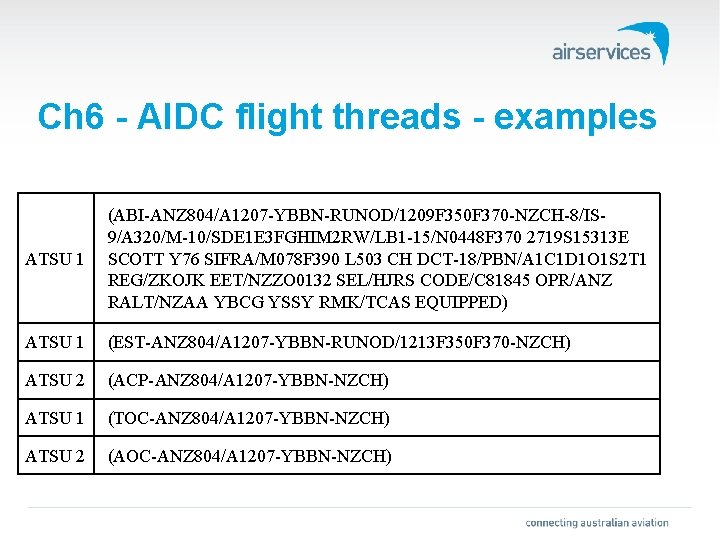
Ch 6 - AIDC flight threads - examples ATSU 1 (ABI-ANZ 804/A 1207 -YBBN-RUNOD/1209 F 350 F 370 -NZCH-8/IS 9/A 320/M-10/SDE 1 E 3 FGHIM 2 RW/LB 1 -15/N 0448 F 370 2719 S 15313 E SCOTT Y 76 SIFRA/M 078 F 390 L 503 CH DCT-18/PBN/A 1 C 1 D 1 O 1 S 2 T 1 REG/ZKOJK EET/NZZO 0132 SEL/HJRS CODE/C 81845 OPR/ANZ RALT/NZAA YBCG YSSY RMK/TCAS EQUIPPED) ATSU 1 (EST-ANZ 804/A 1207 -YBBN-RUNOD/1213 F 350 F 370 -NZCH) ATSU 2 (ACP-ANZ 804/A 1207 -YBBN-NZCH) ATSU 1 (TOC-ANZ 804/A 1207 -YBBN-NZCH) ATSU 2 (AOC-ANZ 804/A 1207 -YBBN-NZCH)
PAN AIDC ICD - future § PAN AIDC ICD presented at OPLINKP/2 (WP/11 refers) § Proposed to be developed as an ICAO Manual Doc XXXX § Include European OLDI Ø Wont be merged with OLDI – too many differences Ø OLDI probably included as a separate section § Update Annexes, Doc 4444 appropriately
More information Adam Watkin Air Traffic Controller Brisbane Centre adam. watkin@airservicesaustralia. com
- Slides: 48