
Global Optimization Lecture 16 Prof Bodik CS 164
Global Optimization Lecture 16 Prof. Bodik CS 164 Lecture 16, Fall 2004 1
Lecture Outline • Global flow analysis • Global constant propagation • Liveness analysis Prof. Bodik CS 164 Lecture 16, Fall 2004 2
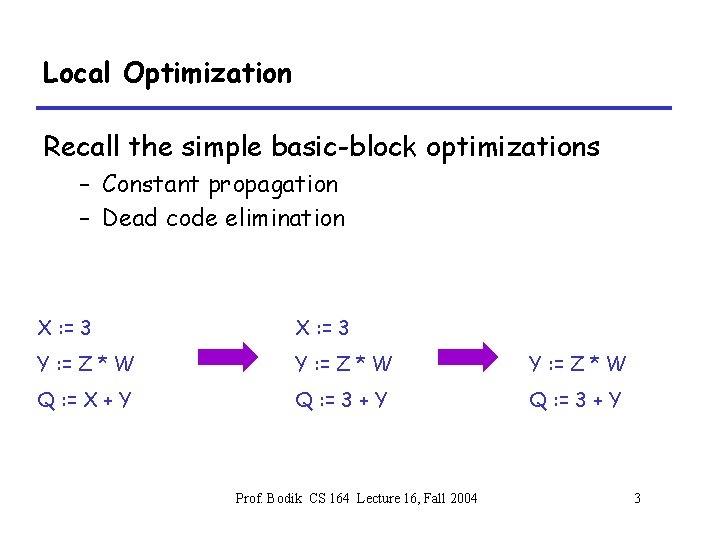
Local Optimization Recall the simple basic-block optimizations – Constant propagation – Dead code elimination X : = 3 Y : = Z * W Q : = X + Y Q : = 3 + Y Prof. Bodik CS 164 Lecture 16, Fall 2004 3
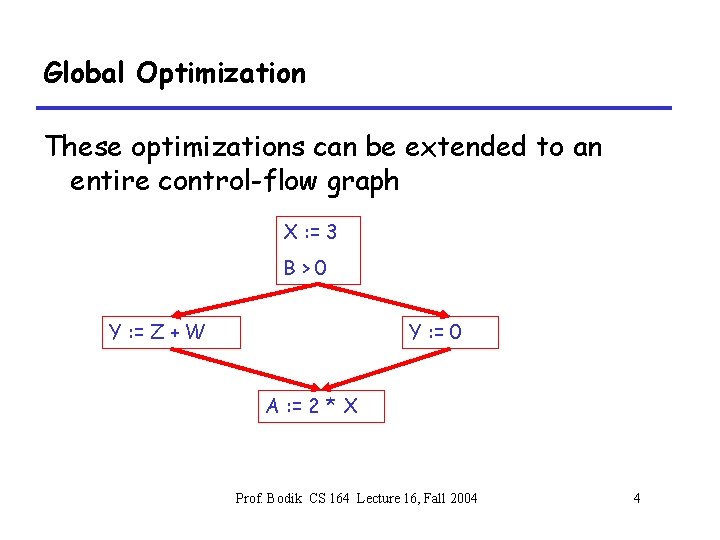
Global Optimization These optimizations can be extended to an entire control-flow graph X : = 3 B>0 Y : = Z + W Y : = 0 A : = 2 * X Prof. Bodik CS 164 Lecture 16, Fall 2004 4
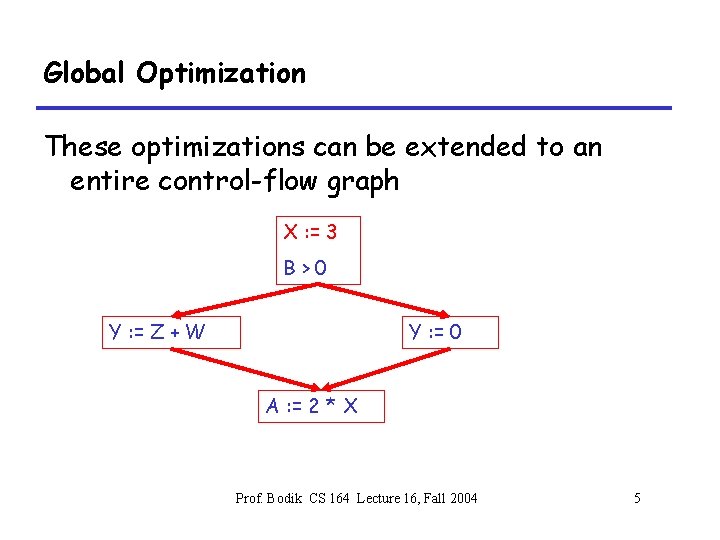
Global Optimization These optimizations can be extended to an entire control-flow graph X : = 3 B>0 Y : = Z + W Y : = 0 A : = 2 * X Prof. Bodik CS 164 Lecture 16, Fall 2004 5
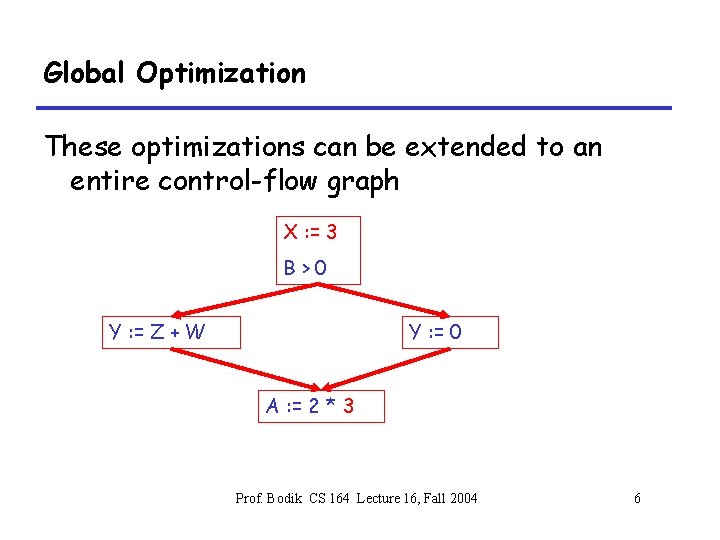
Global Optimization These optimizations can be extended to an entire control-flow graph X : = 3 B>0 Y : = Z + W Y : = 0 A : = 2 * 3 Prof. Bodik CS 164 Lecture 16, Fall 2004 6
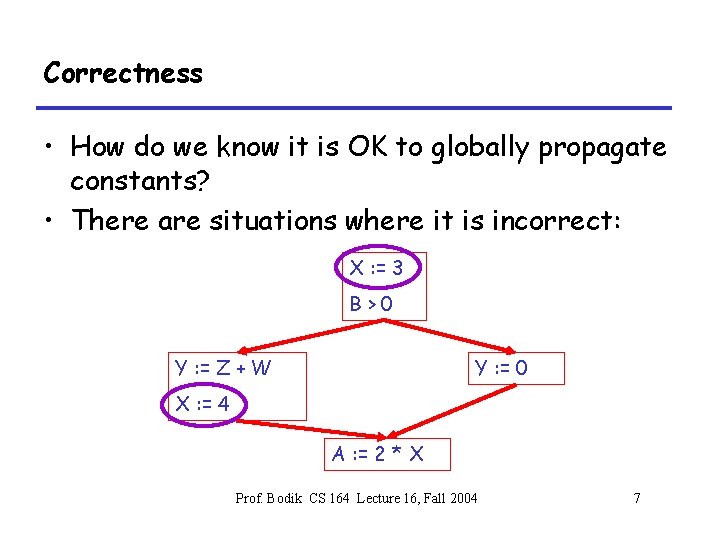
Correctness • How do we know it is OK to globally propagate constants? • There are situations where it is incorrect: X : = 3 B>0 Y : = Z + W Y : = 0 X : = 4 A : = 2 * X Prof. Bodik CS 164 Lecture 16, Fall 2004 7
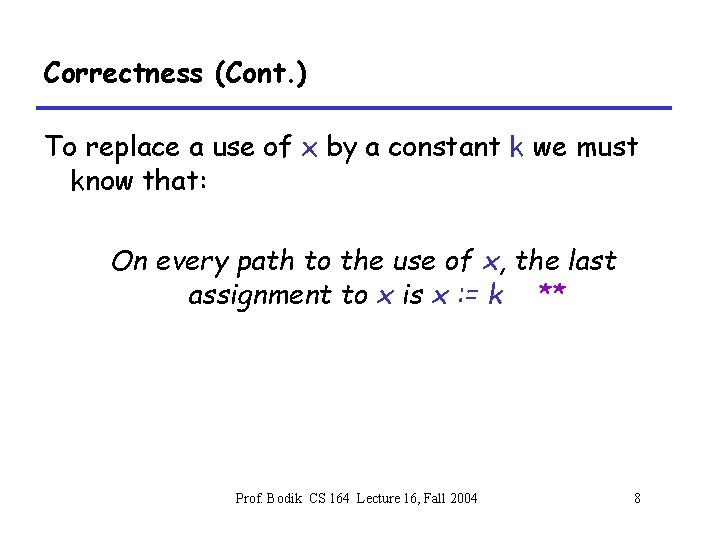
Correctness (Cont. ) To replace a use of x by a constant k we must know that: On every path to the use of x, the last assignment to x is x : = k ** Prof. Bodik CS 164 Lecture 16, Fall 2004 8
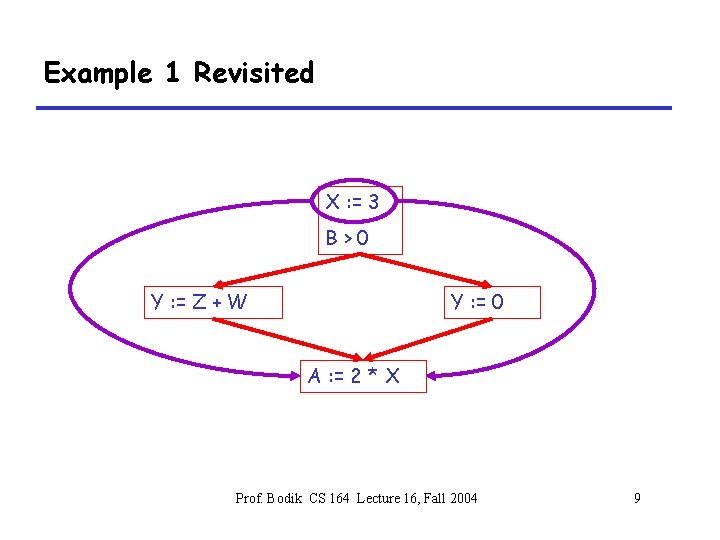
Example 1 Revisited X : = 3 B>0 Y : = Z + W Y : = 0 A : = 2 * X Prof. Bodik CS 164 Lecture 16, Fall 2004 9
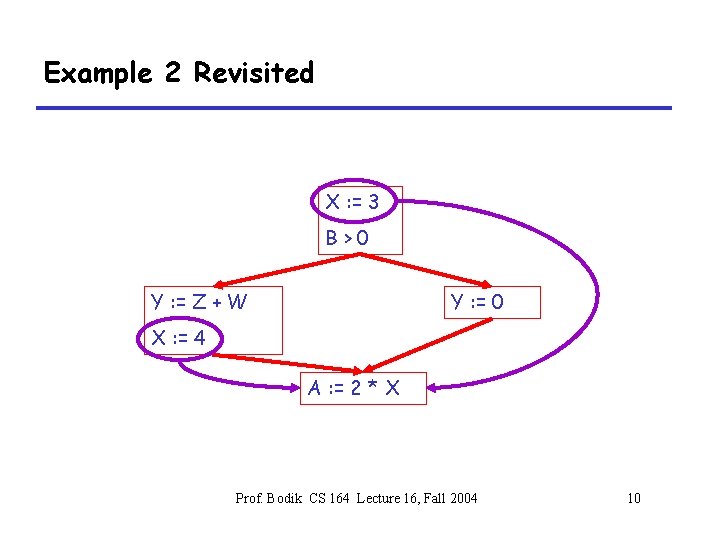
Example 2 Revisited X : = 3 B>0 Y : = Z + W Y : = 0 X : = 4 A : = 2 * X Prof. Bodik CS 164 Lecture 16, Fall 2004 10
Discussion • The correctness condition is not trivial to check • “All paths” includes paths around loops and through branches of conditionals • Checking the condition requires global analysis – An analysis of the entire control-flow graph for one method body Prof. Bodik CS 164 Lecture 16, Fall 2004 11
Global Analysis Global optimization tasks share several traits: – The optimization depends on knowing a property X at a particular point in program execution – Proving X at any point requires knowledge of the entire method body – It is OK to be conservative. If the optimization requires X to be true, then want to know either • X is definitely true • Don’t know if X is true – It is always safe to say “don’t know” Prof. Bodik CS 164 Lecture 16, Fall 2004 12

Global Analysis (Cont. ) • Global dataflow analysis is a standard technique for solving problems with these characteristics • Global constant propagation is one example of an optimization that requires global dataflow analysis Prof. Bodik CS 164 Lecture 16, Fall 2004 13
Global Constant Propagation • Global constant propagation can be performed at any point where ** holds • Consider the case of computing ** for a single variable X at all program points Prof. Bodik CS 164 Lecture 16, Fall 2004 14
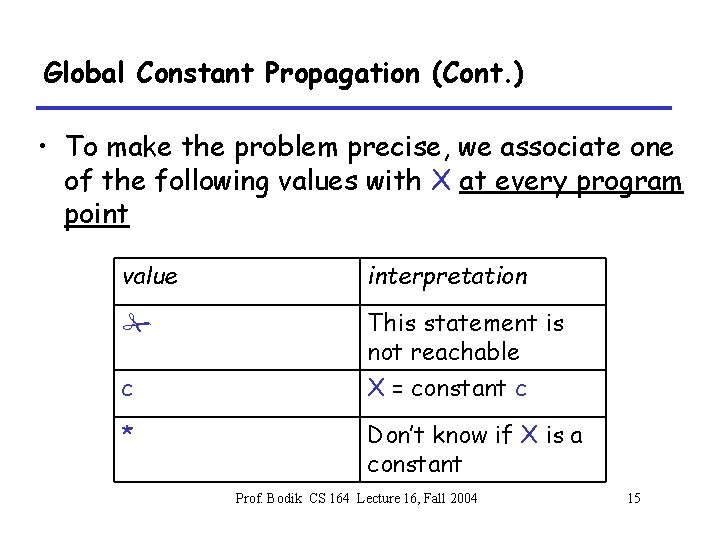
Global Constant Propagation (Cont. ) • To make the problem precise, we associate one of the following values with X at every program point value interpretation # This statement is not reachable c X = constant c * Don’t know if X is a constant Prof. Bodik CS 164 Lecture 16, Fall 2004 15
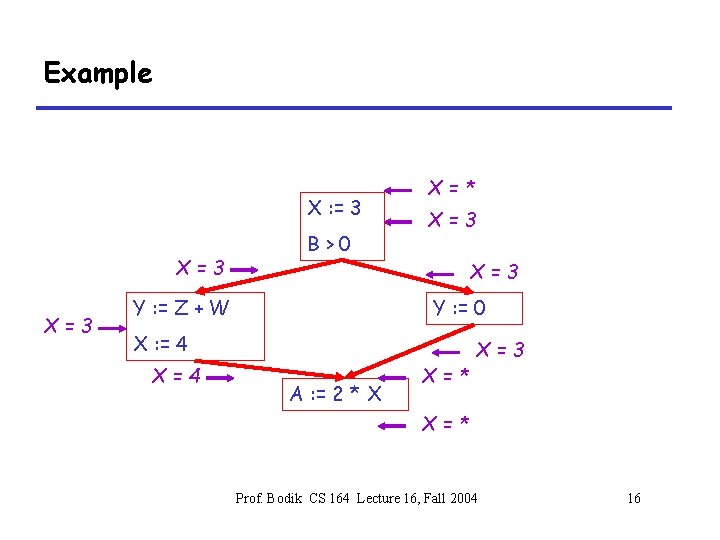
Example X : = 3 X=3 B>0 X=* X=3 Y : = Z + W Y : = 0 X : = 4 X=4 A : = 2 * X X=* X=3 X=* Prof. Bodik CS 164 Lecture 16, Fall 2004 16
Using the Information • Given global constant information, it is easy to perform the optimization – Simply inspect the x = ? associated with a statement using x – If x is constant at that point replace that use of x by the constant • But how do we compute the properties x = ? Prof. Bodik CS 164 Lecture 16, Fall 2004 17
The Idea The analysis of a complicated program can be expressed as a combination of simple rules relating the change in information between adjacent statements Prof. Bodik CS 164 Lecture 16, Fall 2004 18
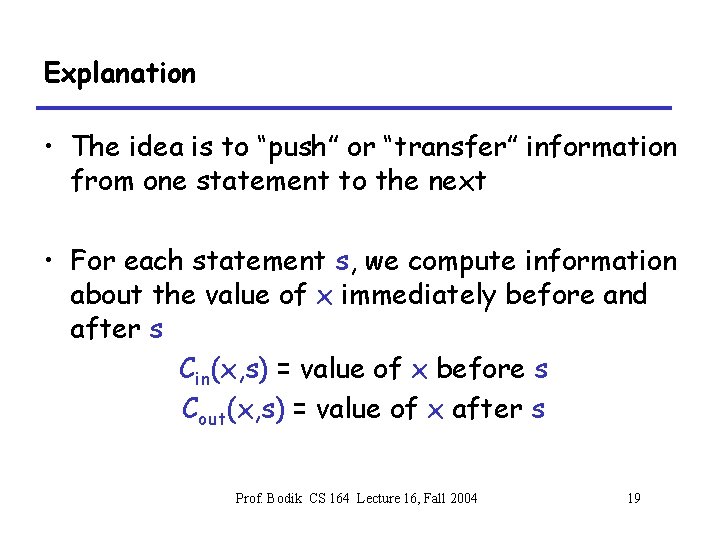
Explanation • The idea is to “push” or “transfer” information from one statement to the next • For each statement s, we compute information about the value of x immediately before and after s Cin(x, s) = value of x before s Cout(x, s) = value of x after s Prof. Bodik CS 164 Lecture 16, Fall 2004 19
Transfer Functions • Define a transfer function that transfers information from one statement to another • In the following rules, let statement s have immediate predecessor statements p 1, …, pn Prof. Bodik CS 164 Lecture 16, Fall 2004 20
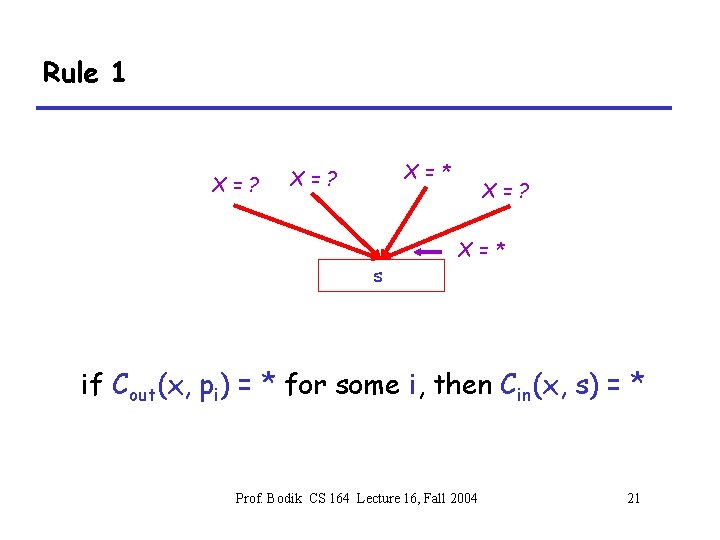
Rule 1 X=? X=* X=? s X=? X=* if Cout(x, pi) = * for some i, then Cin(x, s) = * Prof. Bodik CS 164 Lecture 16, Fall 2004 21
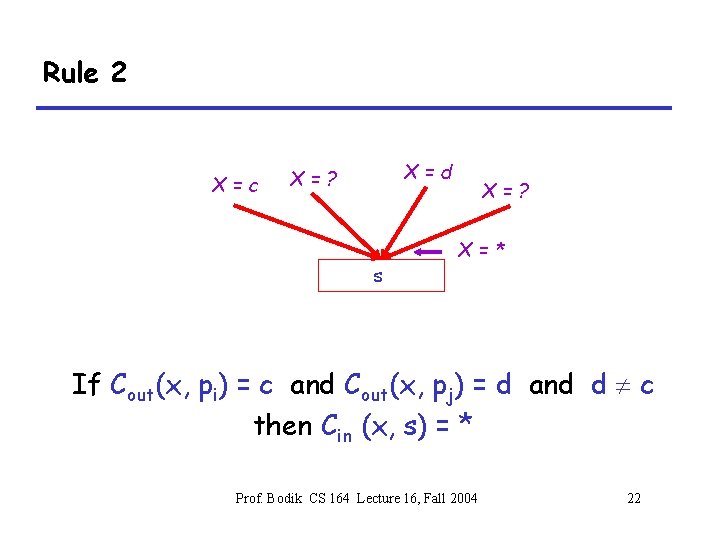
Rule 2 X=c X=d X=? s X=? X=* If Cout(x, pi) = c and Cout(x, pj) = d and d c then Cin (x, s) = * Prof. Bodik CS 164 Lecture 16, Fall 2004 22
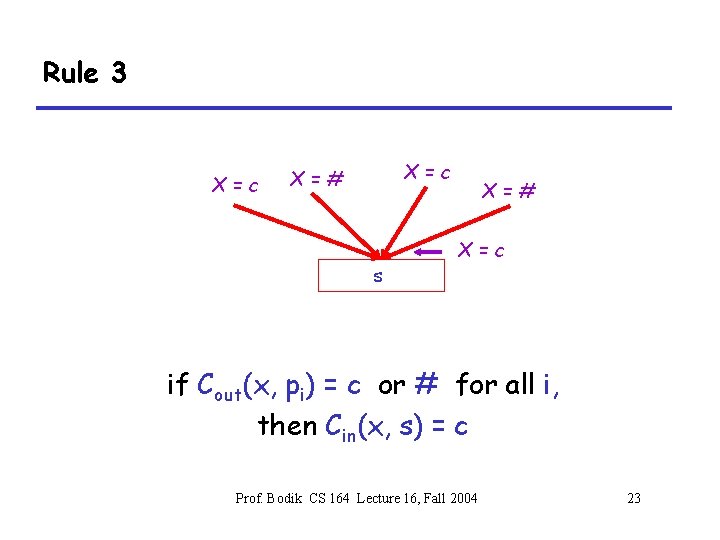
Rule 3 X=c X=# s X=# X=c if Cout(x, pi) = c or # for all i, then Cin(x, s) = c Prof. Bodik CS 164 Lecture 16, Fall 2004 23
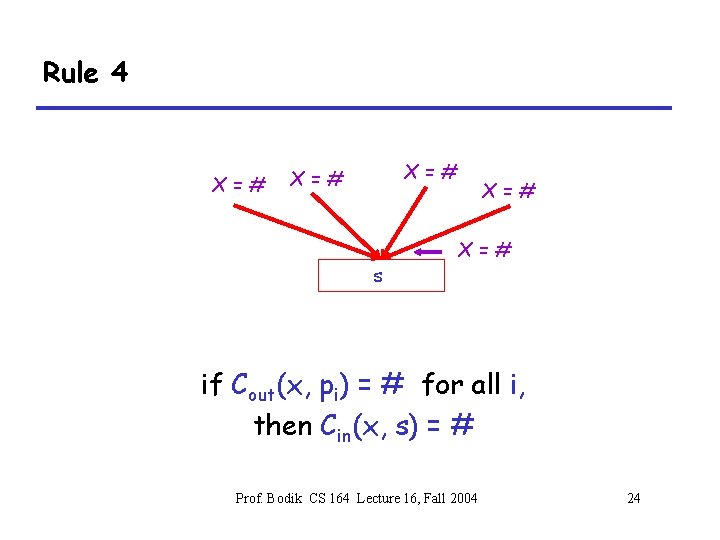
Rule 4 X=# X=# s X=# if Cout(x, pi) = # for all i, then Cin(x, s) = # Prof. Bodik CS 164 Lecture 16, Fall 2004 24
The Other Half • Rules 1 -4 relate the out of one statement to the in of the successor statement – they propagate information forward across CFG edges • Now we need rules relating the in of a statement to the out of the same statement – to propagate information across statements Prof. Bodik CS 164 Lecture 16, Fall 2004 25
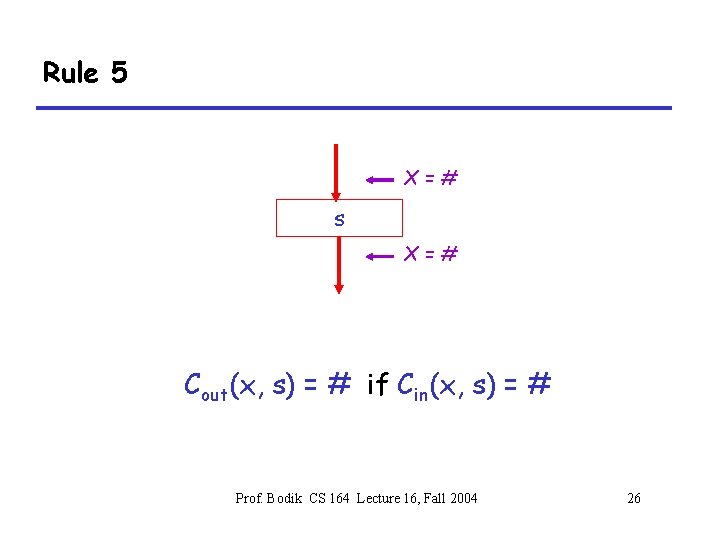
Rule 5 X=# s X=# Cout(x, s) = # if Cin(x, s) = # Prof. Bodik CS 164 Lecture 16, Fall 2004 26
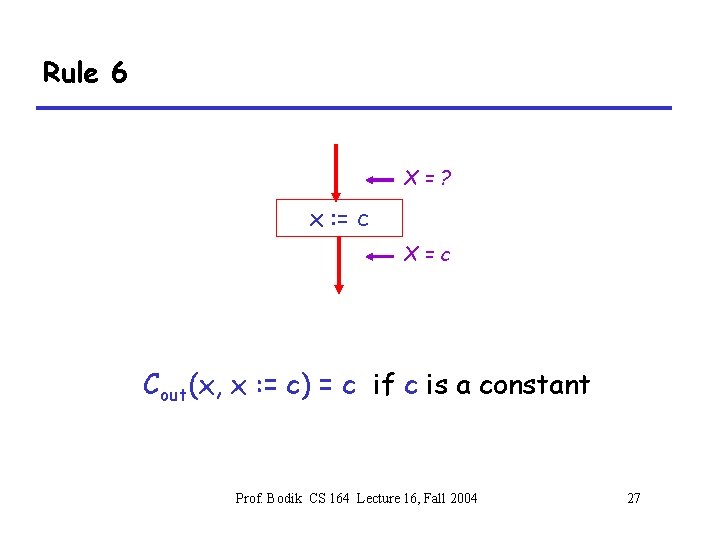
Rule 6 X=? x : = c X=c Cout(x, x : = c) = c if c is a constant Prof. Bodik CS 164 Lecture 16, Fall 2004 27
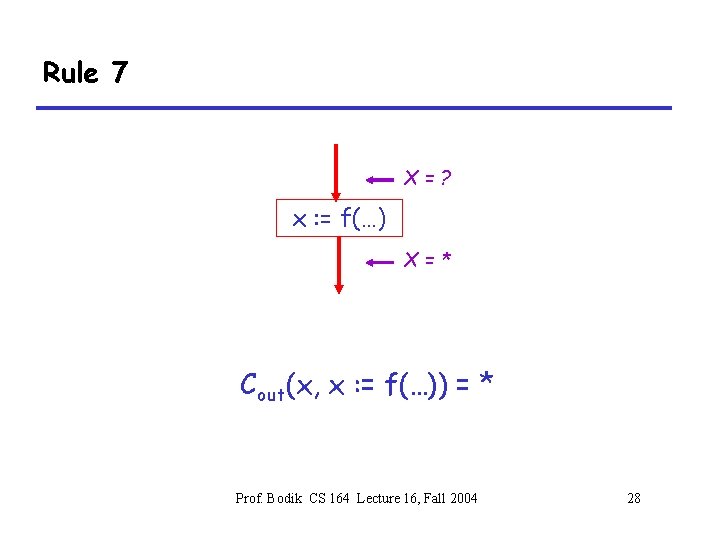
Rule 7 X=? x : = f(…) X=* Cout(x, x : = f(…)) = * Prof. Bodik CS 164 Lecture 16, Fall 2004 28
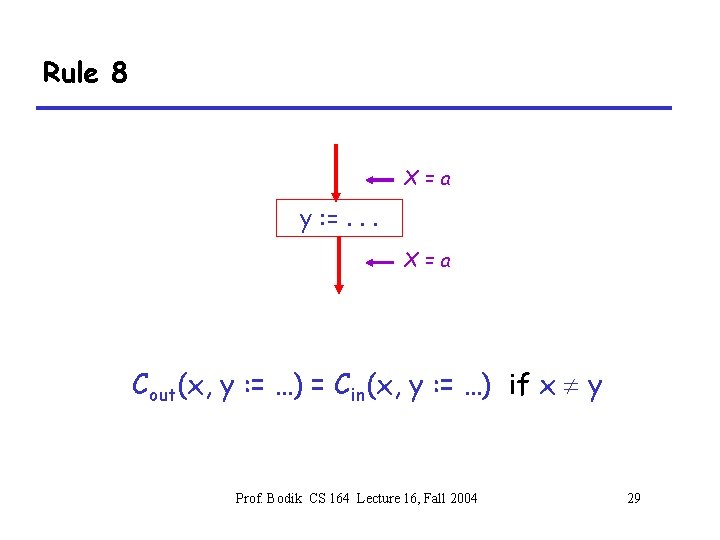
Rule 8 X=a y : =. . . X=a Cout(x, y : = …) = Cin(x, y : = …) if x y Prof. Bodik CS 164 Lecture 16, Fall 2004 29
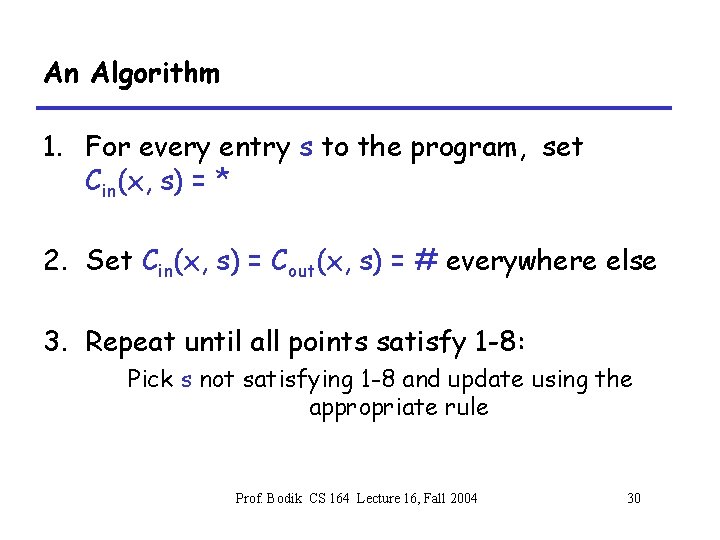
An Algorithm 1. For every entry s to the program, set Cin(x, s) = * 2. Set Cin(x, s) = Cout(x, s) = # everywhere else 3. Repeat until all points satisfy 1 -8: Pick s not satisfying 1 -8 and update using the appropriate rule Prof. Bodik CS 164 Lecture 16, Fall 2004 30
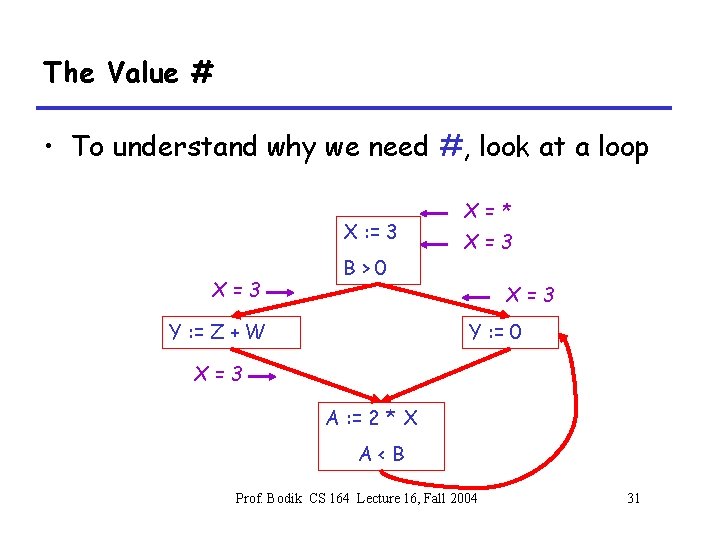
The Value # • To understand why we need #, look at a loop X : = 3 X=3 B>0 Y : = Z + W X=* X=3 Y : = 0 X=3 A : = 2 * X A<B Prof. Bodik CS 164 Lecture 16, Fall 2004 31
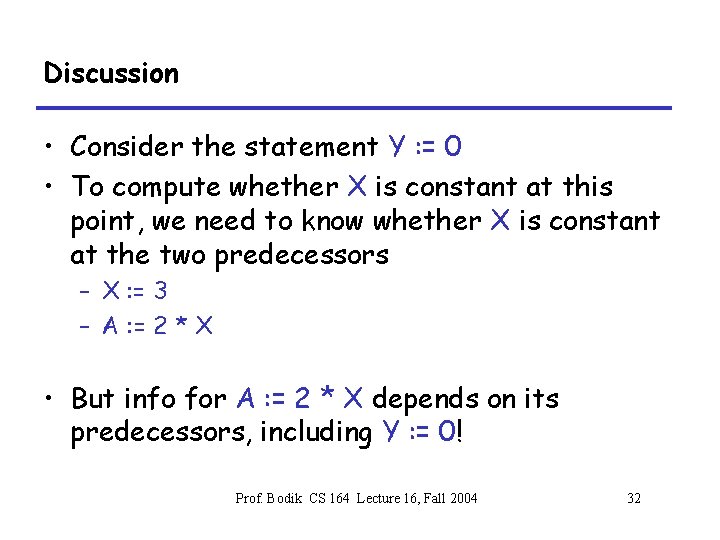
Discussion • Consider the statement Y : = 0 • To compute whether X is constant at this point, we need to know whether X is constant at the two predecessors – X : = 3 – A : = 2 * X • But info for A : = 2 * X depends on its predecessors, including Y : = 0! Prof. Bodik CS 164 Lecture 16, Fall 2004 32
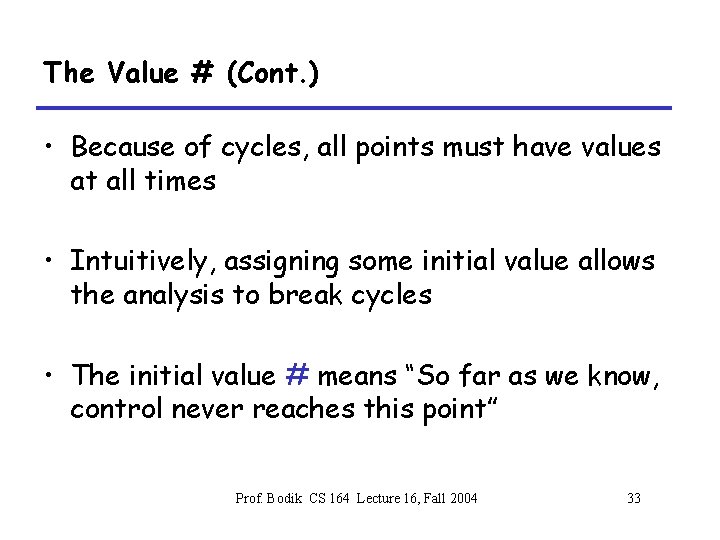
The Value # (Cont. ) • Because of cycles, all points must have values at all times • Intuitively, assigning some initial value allows the analysis to break cycles • The initial value # means “So far as we know, control never reaches this point” Prof. Bodik CS 164 Lecture 16, Fall 2004 33
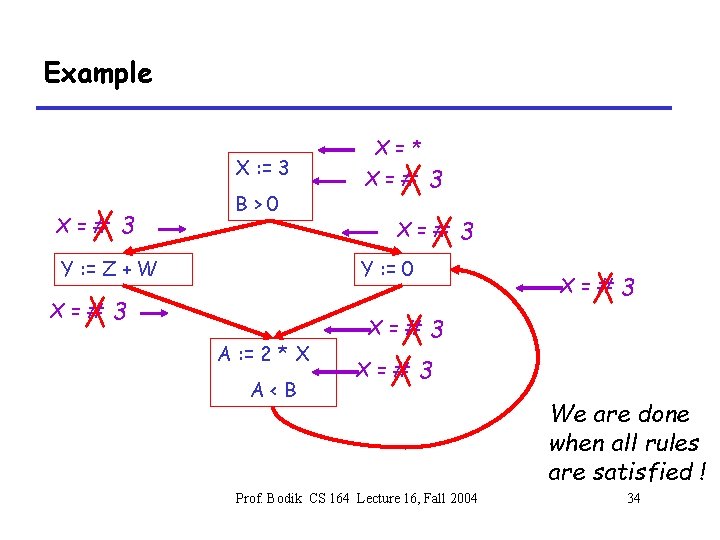
Example X : = 3 X=# 3 B>0 Y : = Z + W X=# X=* 3 X=# 3 Y : = 0 3 A : = 2 * X A<B X=# X=# 3 3 3 Prof. Bodik CS 164 Lecture 16, Fall 2004 We are done when all rules are satisfied ! 34
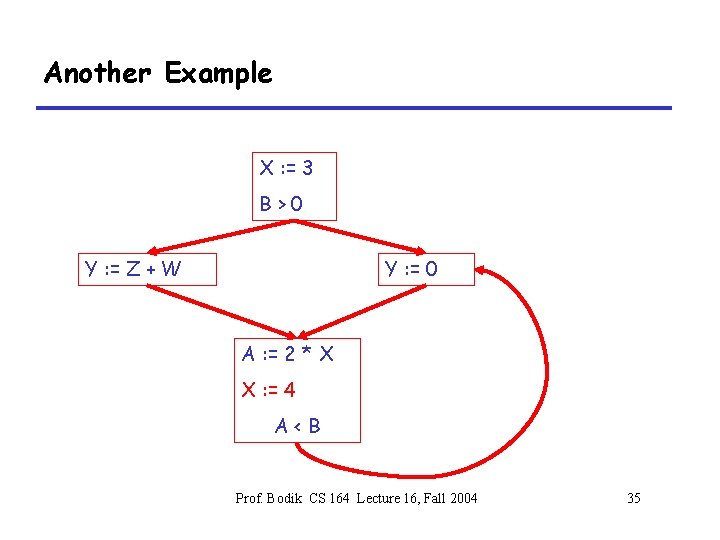
Another Example X : = 3 B>0 Y : = Z + W Y : = 0 A : = 2 * X X : = 4 A<B Prof. Bodik CS 164 Lecture 16, Fall 2004 35
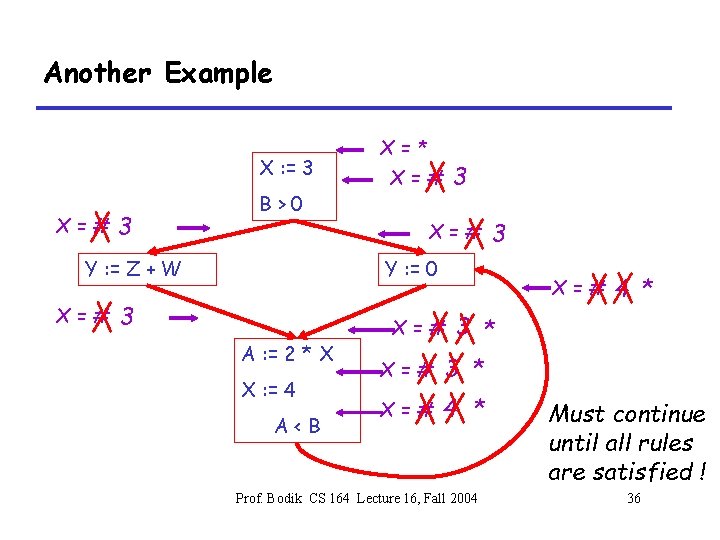
Another Example X : = 3 X=# 3 B>0 Y : = Z + W X=# X=* X=# 3 Y : = 0 3 A : = 2 * X X : = 4 A<B X=# 4 * 3 * X=# 4 * Prof. Bodik CS 164 Lecture 16, Fall 2004 Must continue until all rules are satisfied ! 36
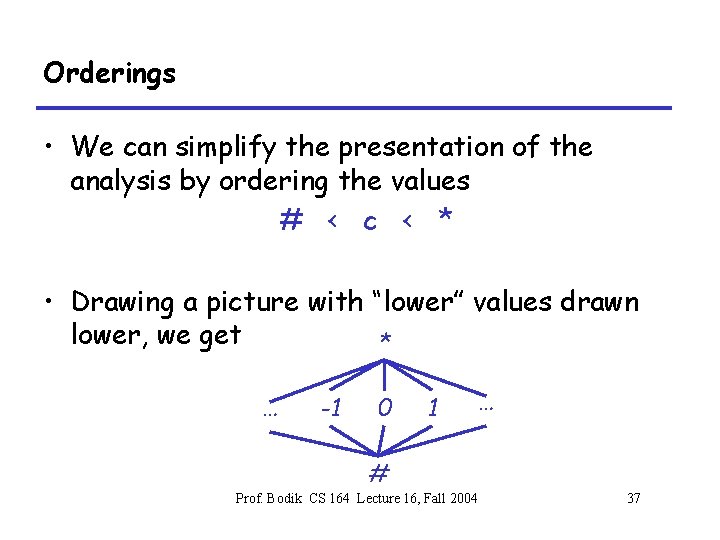
Orderings • We can simplify the presentation of the analysis by ordering the values # < c < * • Drawing a picture with “lower” values drawn lower, we get * … -1 0 1 … # Prof. Bodik CS 164 Lecture 16, Fall 2004 37
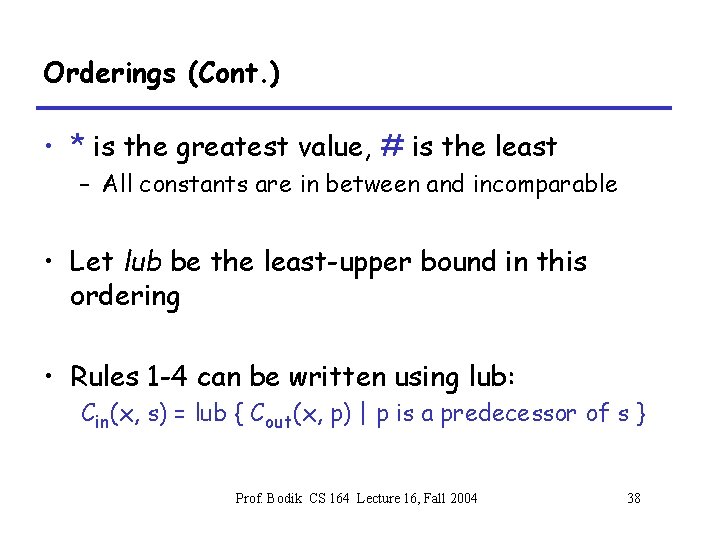
Orderings (Cont. ) • * is the greatest value, # is the least – All constants are in between and incomparable • Let lub be the least-upper bound in this ordering • Rules 1 -4 can be written using lub: Cin(x, s) = lub { Cout(x, p) | p is a predecessor of s } Prof. Bodik CS 164 Lecture 16, Fall 2004 38
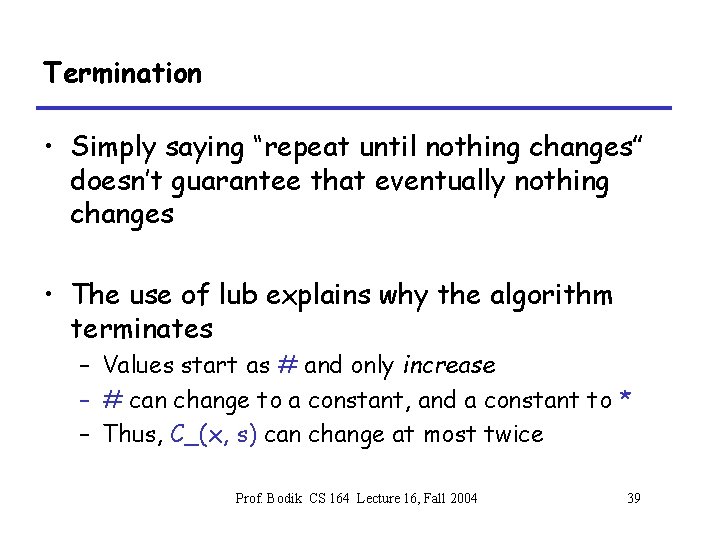
Termination • Simply saying “repeat until nothing changes” doesn’t guarantee that eventually nothing changes • The use of lub explains why the algorithm terminates – Values start as # and only increase – # can change to a constant, and a constant to * – Thus, C_(x, s) can change at most twice Prof. Bodik CS 164 Lecture 16, Fall 2004 39
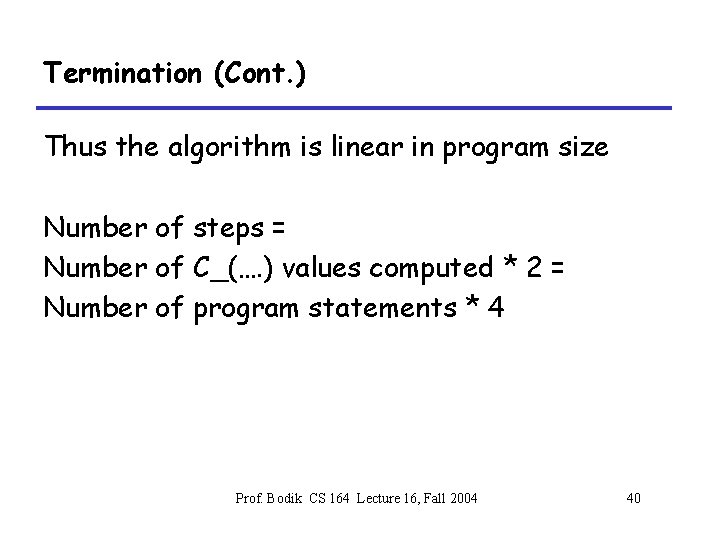
Termination (Cont. ) Thus the algorithm is linear in program size Number of steps = Number of C_(…. ) values computed * 2 = Number of program statements * 4 Prof. Bodik CS 164 Lecture 16, Fall 2004 40
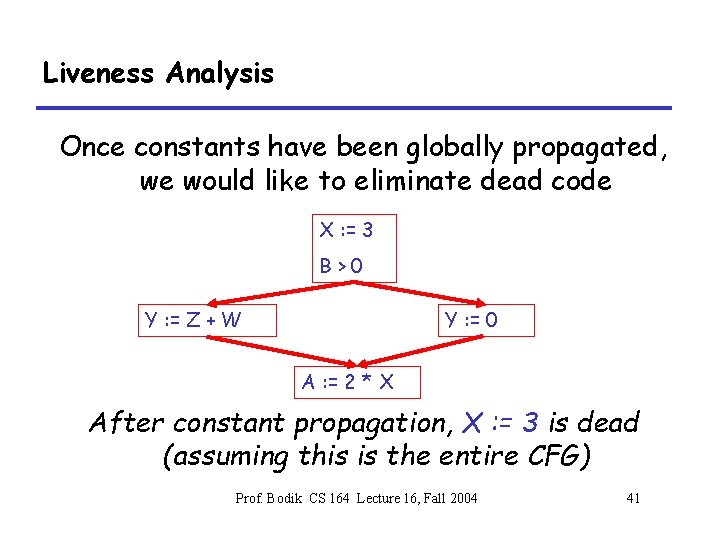
Liveness Analysis Once constants have been globally propagated, we would like to eliminate dead code X : = 3 B>0 Y : = Z + W Y : = 0 A : = 2 * X After constant propagation, X : = 3 is dead (assuming this is the entire CFG) Prof. Bodik CS 164 Lecture 16, Fall 2004 41
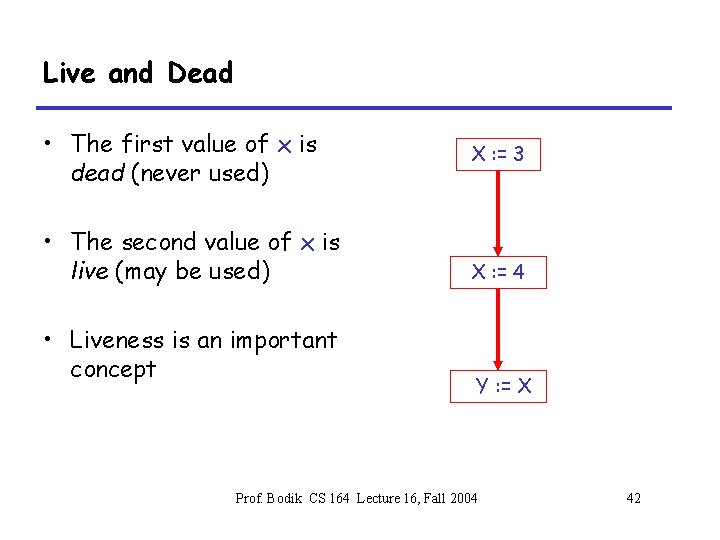
Live and Dead • The first value of x is dead (never used) • The second value of x is live (may be used) • Liveness is an important concept X : = 3 X : = 4 Y : = X Prof. Bodik CS 164 Lecture 16, Fall 2004 42
Liveness A variable x is live at statement s if – There exists a statement s’ that uses x – There is a path from s to s’ – That path has no intervening assignment to x Prof. Bodik CS 164 Lecture 16, Fall 2004 43
Global Dead Code Elimination • A statement x : = … is dead code if x is dead after the assignment • Dead statements can be deleted from the program • But we need liveness information first. . . Prof. Bodik CS 164 Lecture 16, Fall 2004 44
Computing Liveness • We can express liveness in terms of information transferred between adjacent statements, just as in copy propagation • Liveness is simpler than constant propagation, since it is a boolean property (true or false) Prof. Bodik CS 164 Lecture 16, Fall 2004 45

Liveness Rule 1 p X=? X = true X=? Lout(x, p) = Ú { Lin(x, s) | s a successor of p } Prof. Bodik CS 164 Lecture 16, Fall 2004 46
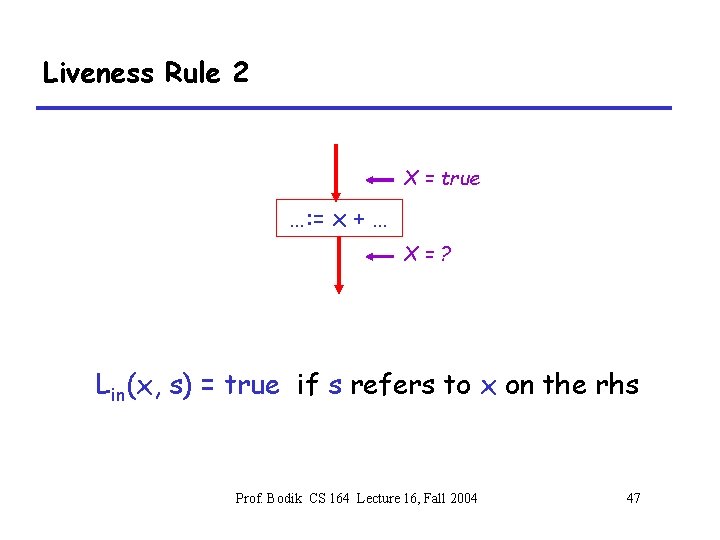
Liveness Rule 2 X = true …: = x + … X=? Lin(x, s) = true if s refers to x on the rhs Prof. Bodik CS 164 Lecture 16, Fall 2004 47
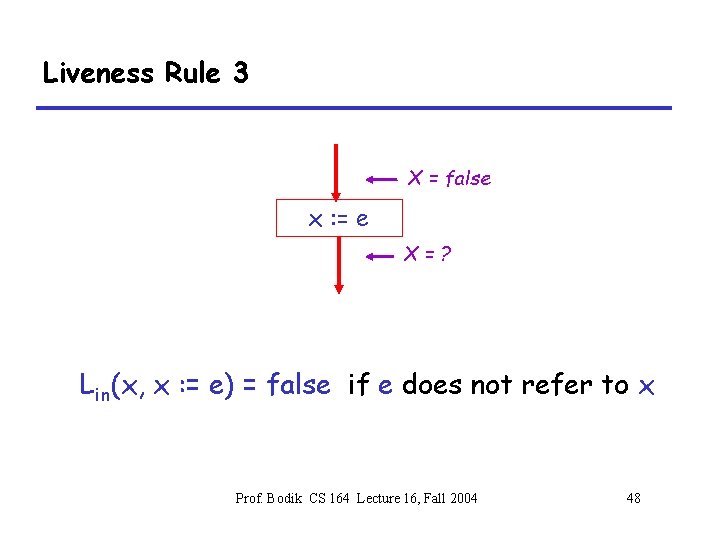
Liveness Rule 3 X = false x : = e X=? Lin(x, x : = e) = false if e does not refer to x Prof. Bodik CS 164 Lecture 16, Fall 2004 48
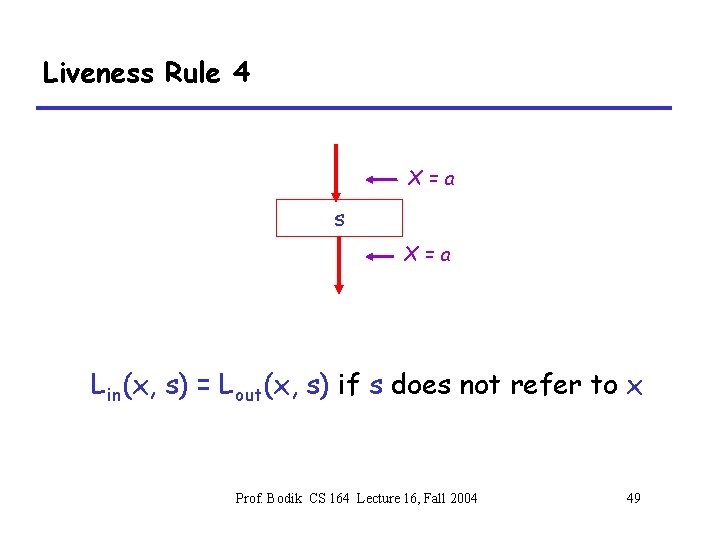
Liveness Rule 4 X=a s X=a Lin(x, s) = Lout(x, s) if s does not refer to x Prof. Bodik CS 164 Lecture 16, Fall 2004 49
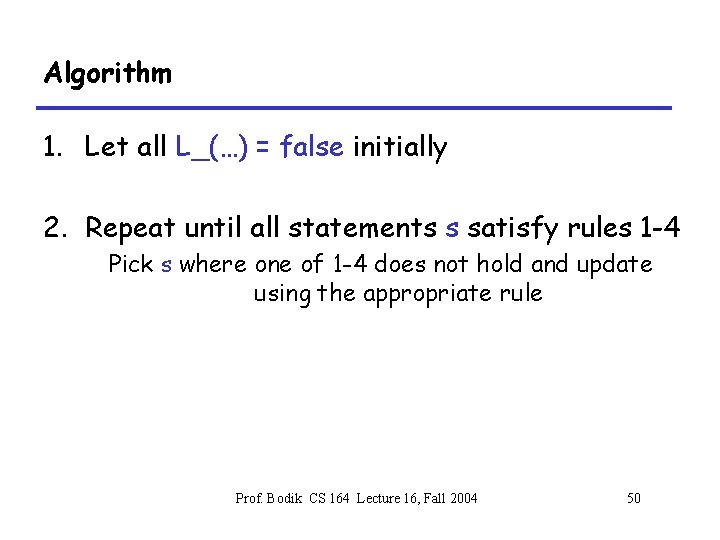
Algorithm 1. Let all L_(…) = false initially 2. Repeat until all statements s satisfy rules 1 -4 Pick s where one of 1 -4 does not hold and update using the appropriate rule Prof. Bodik CS 164 Lecture 16, Fall 2004 50
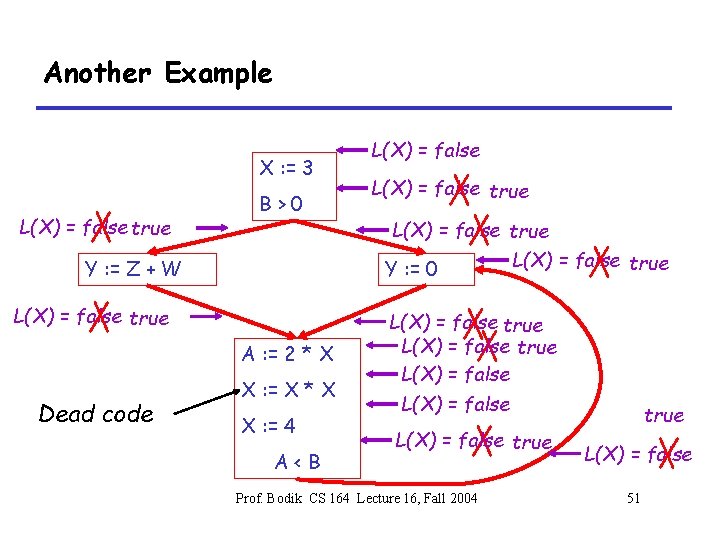
Another Example X : = 3 L(X) = false true B>0 Y : = Z + W L(X) = false true A : = 2 * X Dead code X : = X * X X : = 4 A<B L(X) = false true Y : = 0 L(X) = false true L(X) = false true Prof. Bodik CS 164 Lecture 16, Fall 2004 true L(X) = false 51
Termination • A value can change from false to true, but not the other way around • Each value can change only once, so termination is guaranteed • Once the analysis is computed, it is simple to eliminate dead code Prof. Bodik CS 164 Lecture 16, Fall 2004 52
Forward vs. Backward Analysis We’ve seen two kinds of analysis: Constant propagation is a forwards analysis: information is pushed from inputs to outputs Liveness is a backwards analysis: information is pushed from outputs back towards inputs Prof. Bodik CS 164 Lecture 16, Fall 2004 53
Analysis • There are many other global flow analyses • Most can be classified as either forward or backward • Most also follow the methodology of local rules relating information between adjacent program points Prof. Bodik CS 164 Lecture 16, Fall 2004 54
- Slides: 54