
Global Ocean Monitoring Recent Evolution Current Status and
Global Ocean Monitoring: Recent Evolution, Current Status, and Predictions Prepared by Climate Prediction Center, NCEP/NOAA October 5, 2012 http: //www. cpc. ncep. noaa. gov/products/GODAS/ This project to deliver real-time ocean monitoring products is implemented by CPC in cooperation with NOAA's Climate Observation Division (COD) 1
Outline • Overview • Recent highlights – Pacific/Arctic Ocean – Indian Ocean – Atlantic Ocean • Global SST Predictions 2
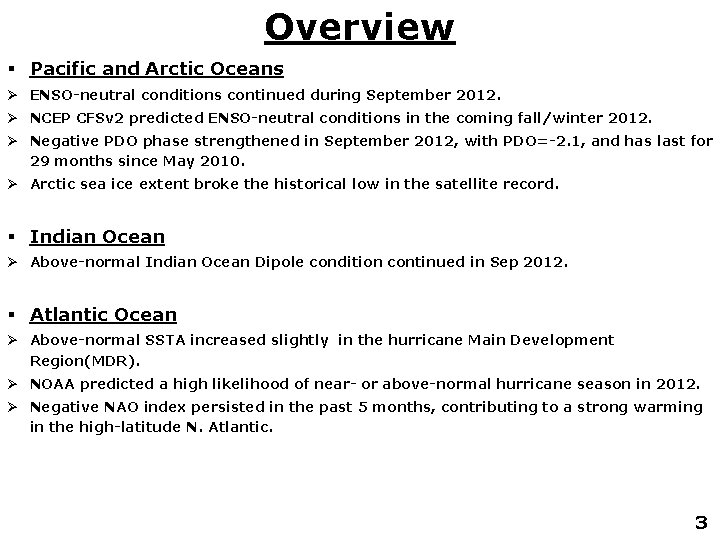
Overview § Pacific and Arctic Oceans Ø ENSO-neutral conditions continued during September 2012. Ø NCEP CFSv 2 predicted ENSO-neutral conditions in the coming fall/winter 2012. Ø Negative PDO phase strengthened in September 2012, with PDO=-2. 1, and has last for 29 months since May 2010. Ø Arctic sea ice extent broke the historical low in the satellite record. § Indian Ocean Ø Above-normal Indian Ocean Dipole condition continued in Sep 2012. § Atlantic Ocean Ø Above-normal SSTA increased slightly in the hurricane Main Development Region(MDR). Ø NOAA predicted a high likelihood of near- or above-normal hurricane season in 2012. Ø Negative NAO index persisted in the past 5 months, contributing to a strong warming in the high-latitude N. Atlantic. 3
Global Oceans 4
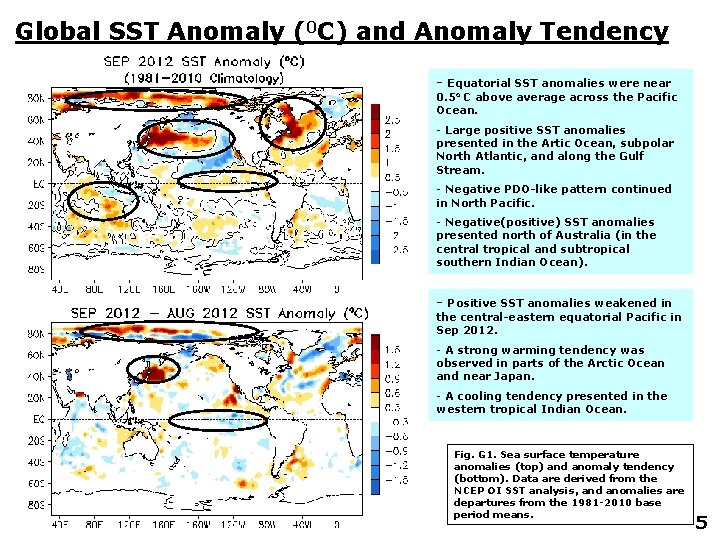
Global SST Anomaly (0 C) and Anomaly Tendency - Equatorial SST anomalies were near 0. 5 o C above average across the Pacific Ocean. - Large positive SST anomalies presented in the Artic Ocean, subpolar North Atlantic, and along the Gulf Stream. - Negative PDO-like pattern continued in North Pacific. - Negative(positive) SST anomalies presented north of Australia (in the central tropical and subtropical southern Indian Ocean). - Positive SST anomalies weakened in the central-eastern equatorial Pacific in Sep 2012. - A strong warming tendency was observed in parts of the Arctic Ocean and near Japan. - A cooling tendency presented in the western tropical Indian Ocean. Fig. G 1. Sea surface temperature anomalies (top) and anomaly tendency (bottom). Data are derived from the NCEP OI SST analysis, and anomalies are departures from the 1981 -2010 base period means. 5
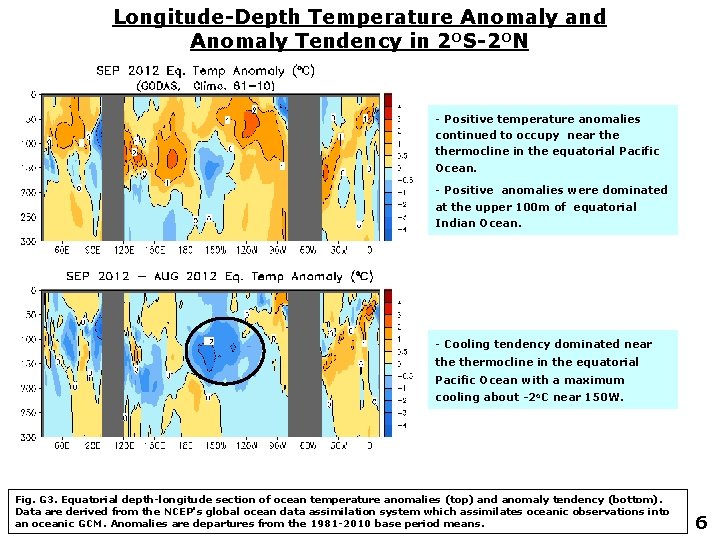
Longitude-Depth Temperature Anomaly and Anomaly Tendency in 2 OS-2 ON - Positive temperature anomalies continued to occupy near thermocline in the equatorial Pacific Ocean. - Positive anomalies were dominated at the upper 100 m of equatorial Indian Ocean. - Cooling tendency dominated near thermocline in the equatorial Pacific Ocean with a maximum cooling about -2 o. C near 150 W. Fig. G 3. Equatorial depth-longitude section of ocean temperature anomalies (top) and anomaly tendency (bottom). Data are derived from the NCEP's global ocean data assimilation system which assimilates oceanic observations into an oceanic GCM. Anomalies are departures from the 1981 -2010 base period means. 6
Tropical Pacific Ocean and ENSO Conditions 7
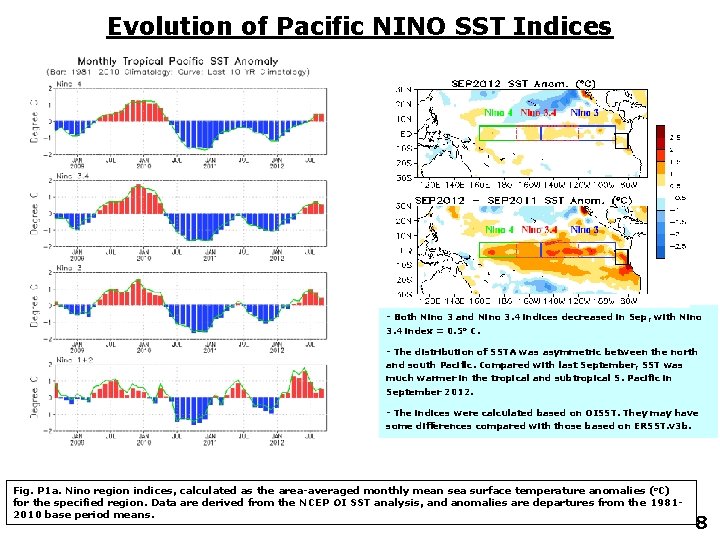
Evolution of Pacific NINO SST Indices - Both Nino 3 and Nino 3. 4 indices decreased in Sep, with Nino 3. 4 index = 0. 5 o C. - The distribution of SSTA was asymmetric between the north and south Pacific. Compared with last September, SST was much warmer in the tropical and subtropical S. Pacific in September 2012. - The indices were calculated based on OISST. They may have some differences compared with those based on ERSST. v 3 b. Fig. P 1 a. Nino region indices, calculated as the area-averaged monthly mean sea surface temperature anomalies (o. C) for the specified region. Data are derived from the NCEP OI SST analysis, and anomalies are departures from the 19812010 base period means. 8
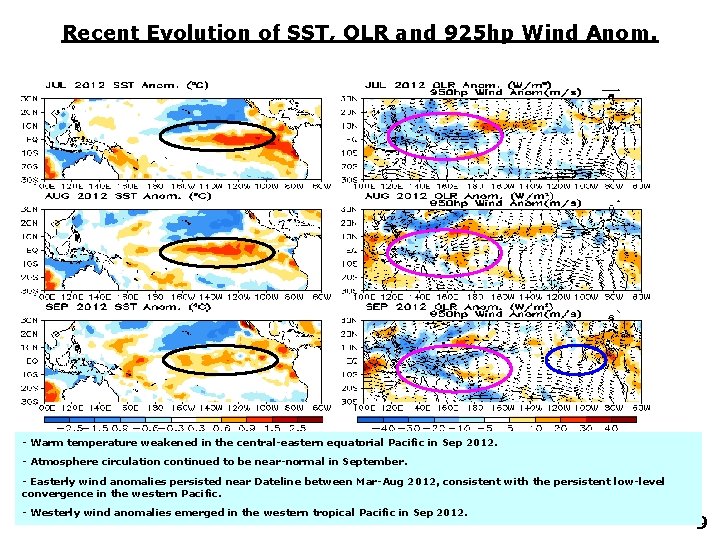
Recent Evolution of SST, OLR and 925 hp Wind Anom. - Warm temperature weakened in the central-eastern equatorial Pacific in Sep 2012. - Atmosphere circulation continued to be near-normal in September. - Easterly wind anomalies persisted near Dateline between Mar-Aug 2012, consistent with the persistent low-level convergence in the western Pacific. - Westerly wind anomalies emerged in the western tropical Pacific in Sep 2012. 9
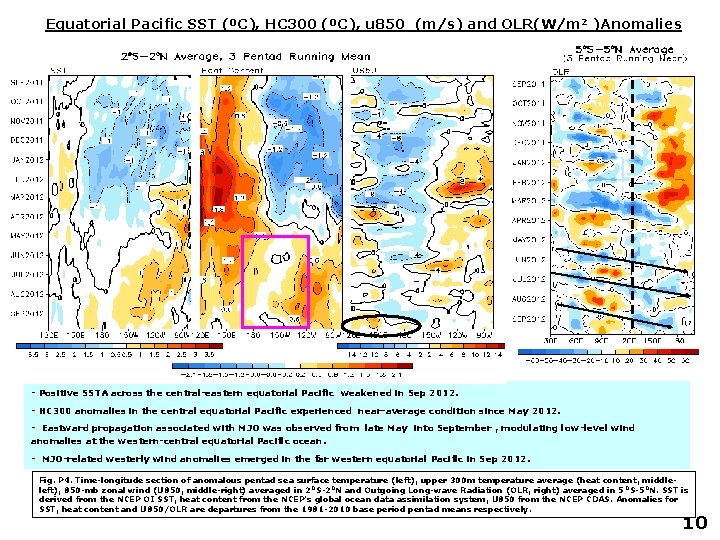
Equatorial Pacific SST (ºC), HC 300 (ºC), u 850 (m/s) and OLR(W/m 2 )Anomalies - Positive SSTA across the central-eastern equatorial Pacific weakened in Sep 2012. - HC 300 anomalies in the central equatorial Pacific experienced near-average condition since May 2012. - Eastward propagation associated with MJO was observed from late May into September , modulating low-level wind anomalies at the western-central equatorial Pacific ocean. - MJO-related westerly wind anomalies emerged in the far western equatorial Pacific in Sep 2012. Fig. P 4. Time-longitude section of anomalous pentad sea surface temperature (left), upper 300 m temperature average (heat content, middleleft), 850 -mb zonal wind (U 850, middle-right) averaged in 2 OS-2 ON and Outgoing Long-wave Radiation (OLR, right) averaged in 5 OS-5 ON. SST is derived from the NCEP OI SST, heat content from the NCEP's global ocean data assimilation system, U 850 from the NCEP CDAS. Anomalies for SST, heat content and U 850/OLR are departures from the 1981 -2010 base period pentad means respectively. 10

Evolution of Equatorial Pacific Surface Zonal Current Anomaly (cm/s) Positive zonal current anomalies in the central-eastern equatorial Pacific switched to negative in early Sep 2012. - 11
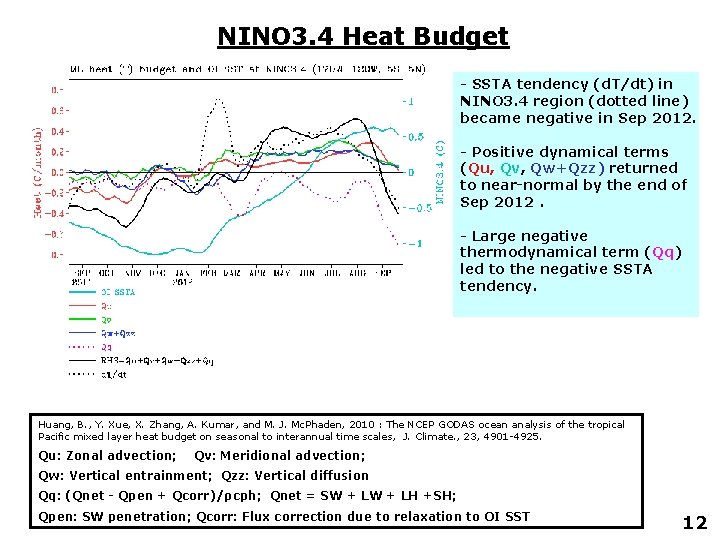
NINO 3. 4 Heat Budget - SSTA tendency (d. T/dt) in NINO 3. 4 region (dotted line) became negative in Sep 2012. - Positive dynamical terms (Qu, Qv, Qw+Qzz) returned to near-normal by the end of Sep 2012. - Large negative thermodynamical term (Qq) led to the negative SSTA tendency. Huang, B. , Y. Xue, X. Zhang, A. Kumar, and M. J. Mc. Phaden, 2010 : The NCEP GODAS ocean analysis of the tropical Pacific mixed layer heat budget on seasonal to interannual time scales, J. Climate. , 23, 4901 -4925. Qu: Zonal advection; Qv: Meridional advection; Qw: Vertical entrainment; Qzz: Vertical diffusion Qq: (Qnet - Qpen + Qcorr)/ρcph; Qnet = SW + LH +SH; Qpen: SW penetration; Qcorr: Flux correction due to relaxation to OI SST 12
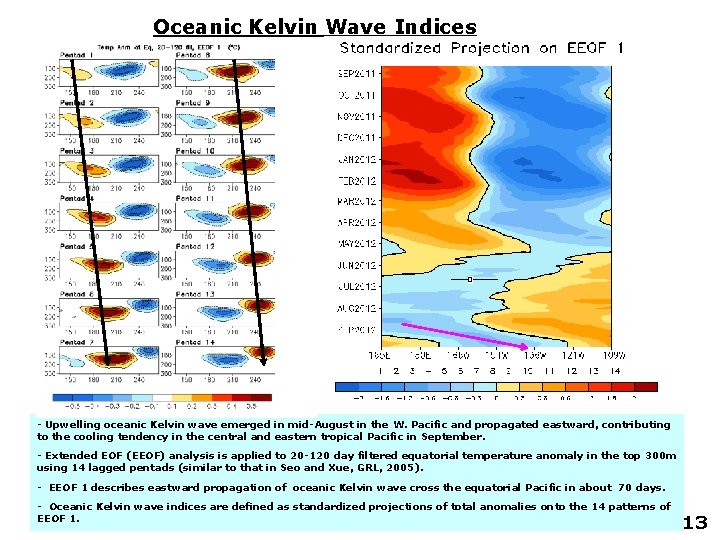
Oceanic Kelvin Wave Indices - Upwelling oceanic Kelvin wave emerged in mid-August in the W. Pacific and propagated eastward, contributing to the cooling tendency in the central and eastern tropical Pacific in September. - Extended EOF (EEOF) analysis is applied to 20 -120 day filtered equatorial temperature anomaly in the top 300 m using 14 lagged pentads (similar to that in Seo and Xue, GRL, 2005). - EEOF 1 describes eastward propagation of oceanic Kelvin wave cross the equatorial Pacific in about 70 days. - Oceanic Kelvin wave indices are defined as standardized projections of total anomalies onto the 14 patterns of EEOF 1. 13
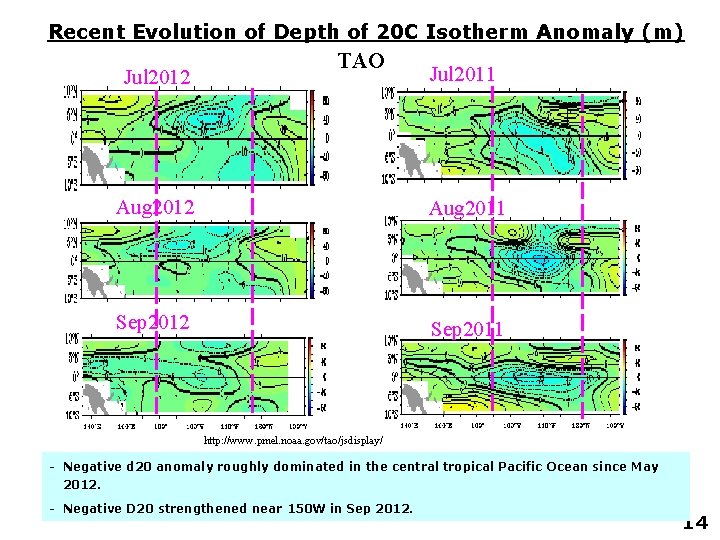
Recent Evolution of Depth of 20 C Isotherm Anomaly (m) Jul 2012 TAO Jul 2011 Aug 2012 Aug 2011 Sep 2012 Sep 2011 http: //www. pmel. noaa. gov/tao/jsdisplay/ - Negative d 20 anomaly roughly dominated in the central tropical Pacific Ocean since May 2012. - Negative D 20 strengthened near 150 W in Sep 2012. 14
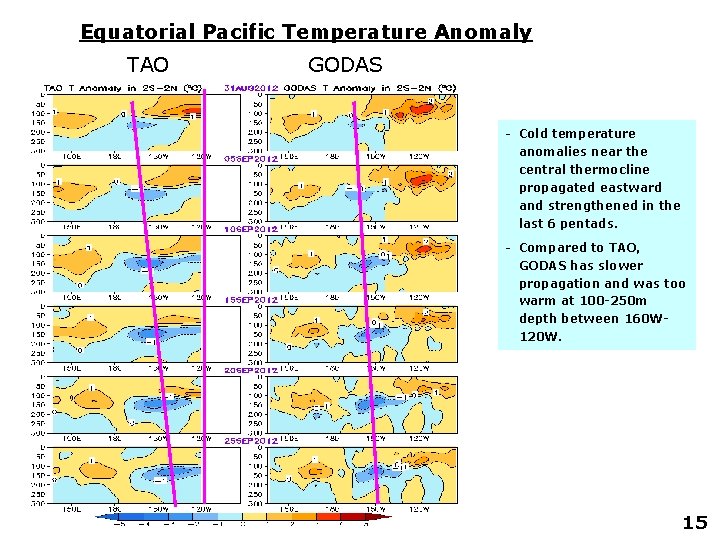
Equatorial Pacific Temperature Anomaly TAO GODAS - Cold temperature anomalies near the central thermocline propagated eastward and strengthened in the last 6 pentads. - Compared to TAO, GODAS has slower propagation and was too warm at 100 -250 m depth between 160 W 120 W. 15
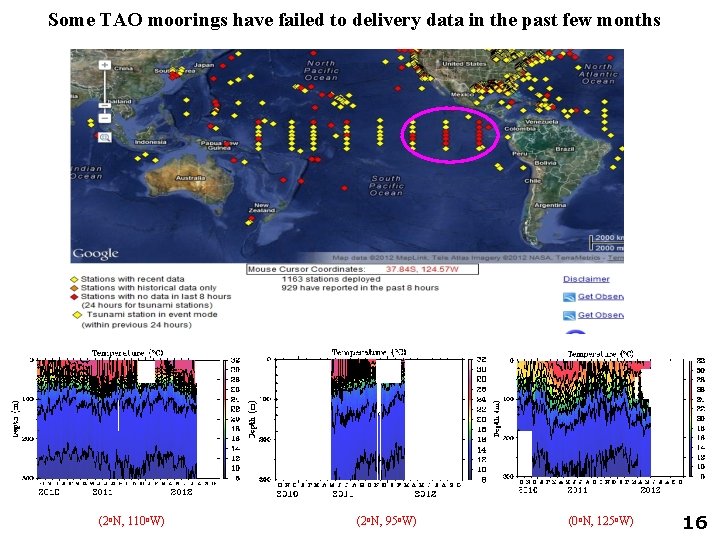
Some TAO moorings have failed to delivery data in the past few months (2 o. N, 110 o. W) (2 o. N, 95 o. W) (0 o. N, 125 o. W) 16
North Pacific & Arctic Oceans 17
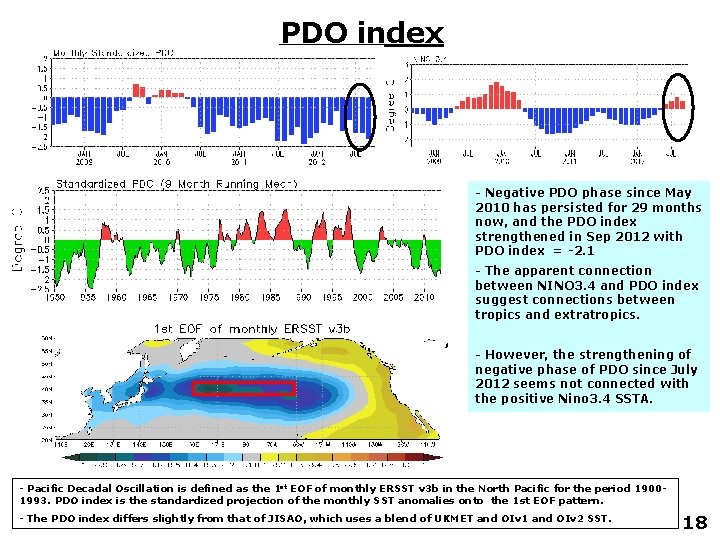
PDO index - Negative PDO phase since May 2010 has persisted for 29 months now, and the PDO index strengthened in Sep 2012 with PDO index = -2. 1 - The apparent connection between NINO 3. 4 and PDO index suggest connections between tropics and extratropics. - However, the strengthening of negative phase of PDO since July 2012 seems not connected with the positive Nino 3. 4 SSTA. - Pacific Decadal Oscillation is defined as the 1 st EOF of monthly ERSST v 3 b in the North Pacific for the period 19001993. PDO index is the standardized projection of the monthly SST anomalies onto the 1 st EOF pattern. - The PDO index differs slightly from that of JISAO, which uses a blend of UKMET and OIv 1 and OIv 2 SST. 18
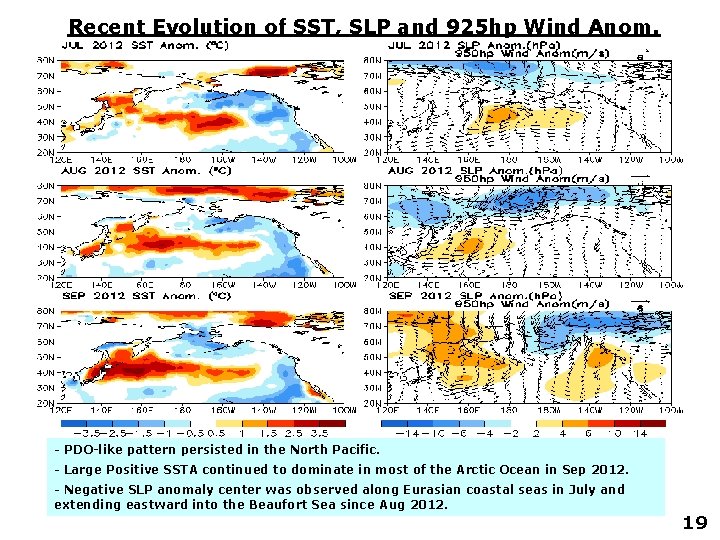
Recent Evolution of SST, SLP and 925 hp Wind Anom. - PDO-like pattern persisted in the North Pacific. - Large Positive SSTA continued to dominate in most of the Arctic Ocean in Sep 2012. - Negative SLP anomaly center was observed along Eurasian coastal seas in July and extending eastward into the Beaufort Sea since Aug 2012. 19
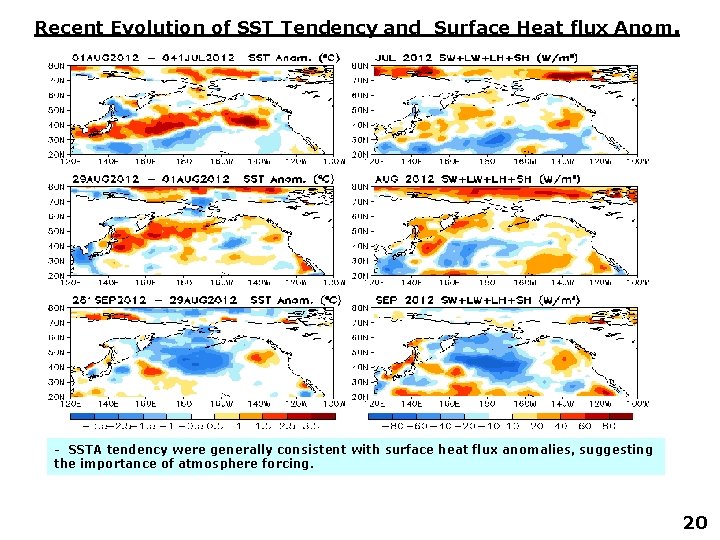
Recent Evolution of SST Tendency and Surface Heat flux Anom. - SSTA tendency were generally consistent with surface heat flux anomalies, suggesting the importance of atmosphere forcing. 20
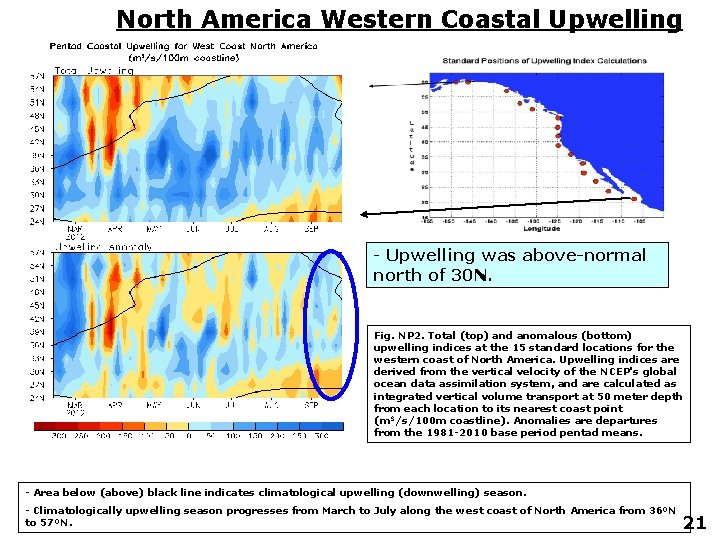
North America Western Coastal Upwelling - Upwelling was above-normal north of 30 N. Fig. NP 2. Total (top) and anomalous (bottom) upwelling indices at the 15 standard locations for the western coast of North America. Upwelling indices are derived from the vertical velocity of the NCEP's global ocean data assimilation system, and are calculated as integrated vertical volume transport at 50 meter depth from each location to its nearest coast point (m 3/s/100 m coastline). Anomalies are departures from the 1981 -2010 base period pentad means. - Area below (above) black line indicates climatological upwelling (downwelling) season. - Climatologically upwelling season progresses from March to July along the west coast of North America from 36ºN to 57ºN. 21
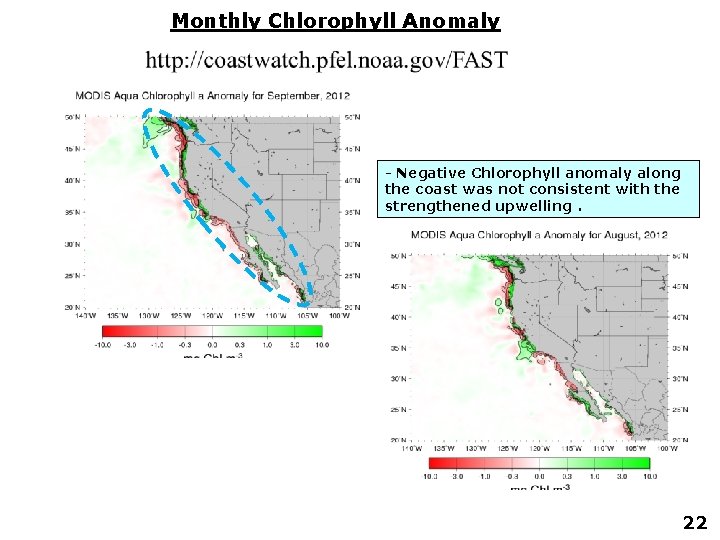
Monthly Chlorophyll Anomaly - Negative Chlorophyll anomaly along the coast was not consistent with the strengthened upwelling. 22
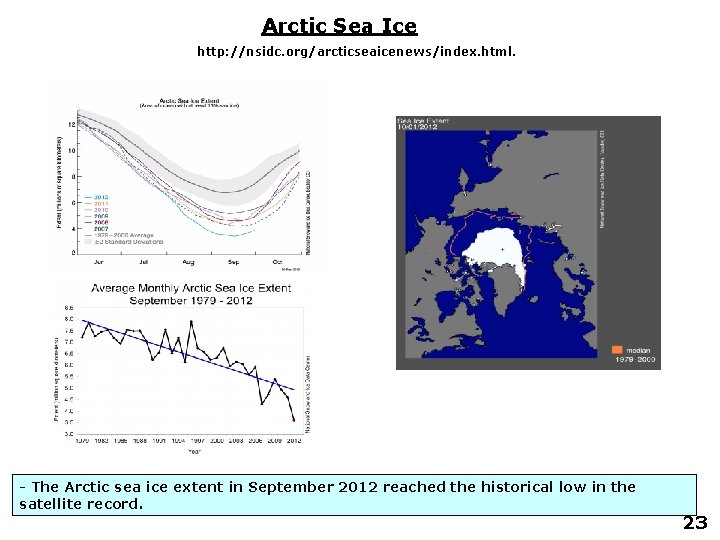
Arctic Sea Ice http: //nsidc. org/arcticseaicenews/index. html. - The Arctic sea ice extent in September 2012 reached the historical low in the satellite record. 23
Indian Ocean 24
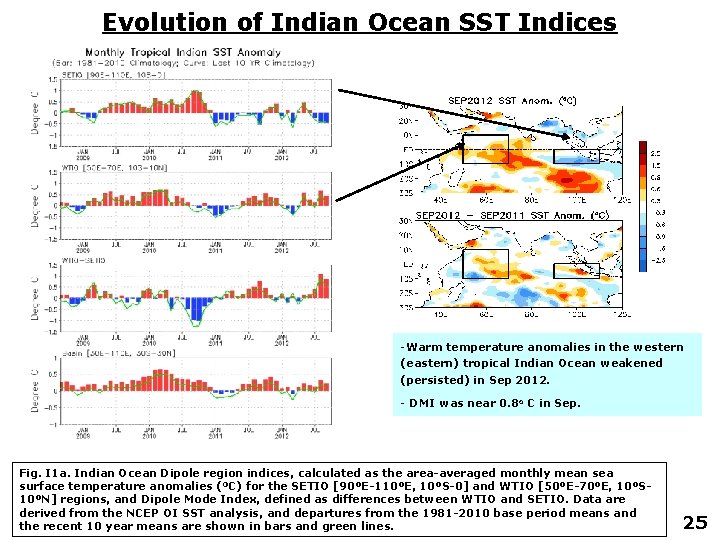
Evolution of Indian Ocean SST Indices -Warm temperature anomalies in the western (eastern) tropical Indian Ocean weakened (persisted) in Sep 2012. - DMI was near 0. 8 o C in Sep. Fig. I 1 a. Indian Ocean Dipole region indices, calculated as the area-averaged monthly mean sea surface temperature anomalies (OC) for the SETIO [90ºE-110ºE, 10ºS-0] and WTIO [50ºE-70ºE, 10ºS 10ºN] regions, and Dipole Mode Index, defined as differences between WTIO and SETIO. Data are derived from the NCEP OI SST analysis, and departures from the 1981 -2010 base period means and the recent 10 year means are shown in bars and green lines. 25
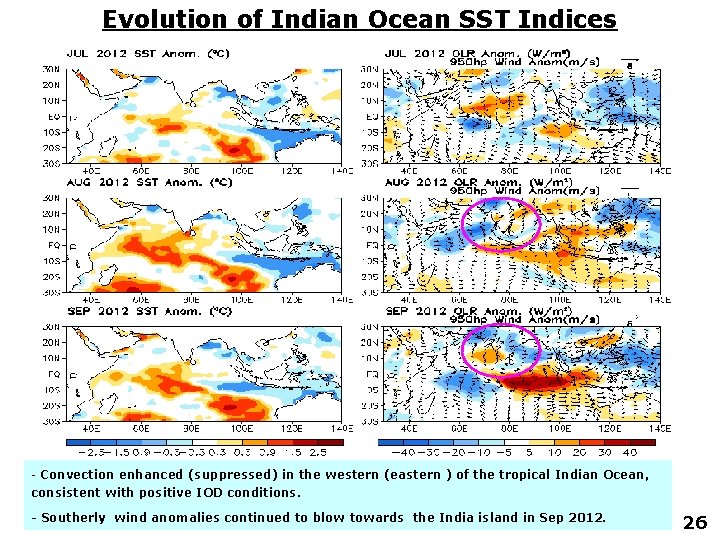
Evolution of Indian Ocean SST Indices - Convection enhanced (suppressed) in the western (eastern ) of the tropical Indian Ocean, consistent with positive IOD conditions. - Southerly wind anomalies continued to blow towards the India island in Sep 2012. 26
Tropical and North Atlantic Ocean 27
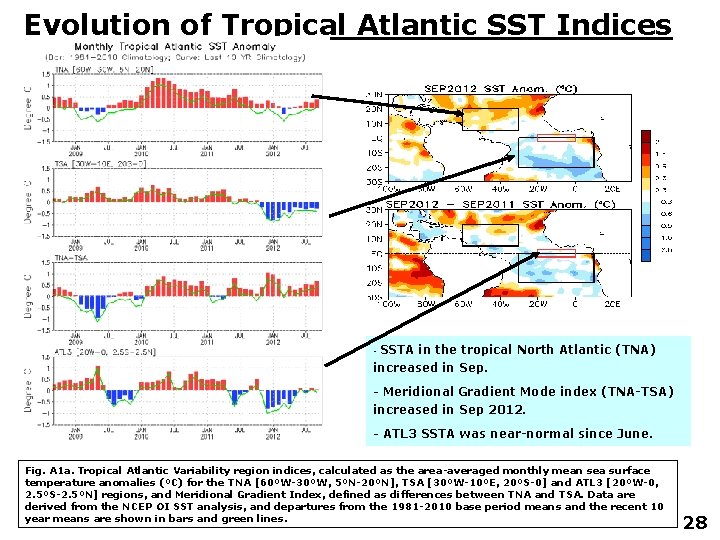
Evolution of Tropical Atlantic SST Indices SSTA in the tropical North Atlantic (TNA) increased in Sep. - - Meridional Gradient Mode index (TNA-TSA) increased in Sep 2012. - ATL 3 SSTA was near-normal since June. Fig. A 1 a. Tropical Atlantic Variability region indices, calculated as the area-averaged monthly mean sea surface temperature anomalies (ºC) for the TNA [60ºW-30ºW, 5ºN-20ºN], TSA [30ºW-10ºE, 20ºS-0] and ATL 3 [20ºW-0, 2. 5ºS-2. 5ºN] regions, and Meridional Gradient Index, defined as differences between TNA and TSA. Data are derived from the NCEP OI SST analysis, and departures from the 1981 -2010 base period means and the recent 10 year means are shown in bars and green lines. 28
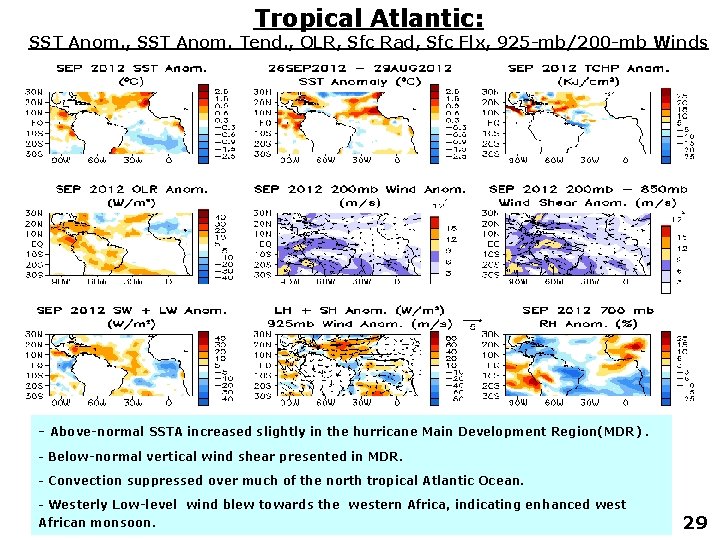
Tropical Atlantic: SST Anom. , SST Anom. Tend. , OLR, Sfc Rad, Sfc Flx, 925 -mb/200 -mb Winds - Above-normal SSTA increased slightly in the hurricane Main Development Region(MDR). - Below-normal vertical wind shear presented in MDR. - Convection suppressed over much of the north tropical Atlantic Ocean. - Westerly Low-level wind blew towards the western Africa, indicating enhanced west African monsoon. 29
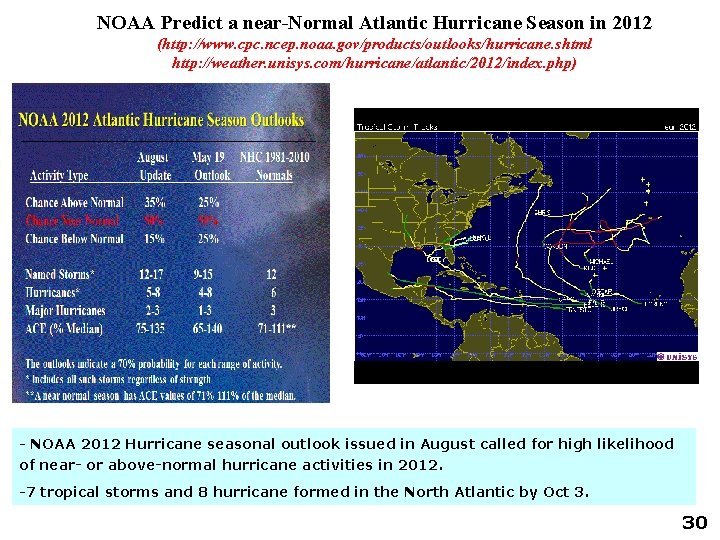
NOAA Predict a near-Normal Atlantic Hurricane Season in 2012 (http: //www. cpc. ncep. noaa. gov/products/outlooks/hurricane. shtml http: //weather. unisys. com/hurricane/atlantic/2012/index. php) - NOAA 2012 Hurricane seasonal outlook issued in August called for high likelihood of near- or above-normal hurricane activities in 2012. -7 tropical storms and 8 hurricane formed in the North Atlantic by Oct 3. 30
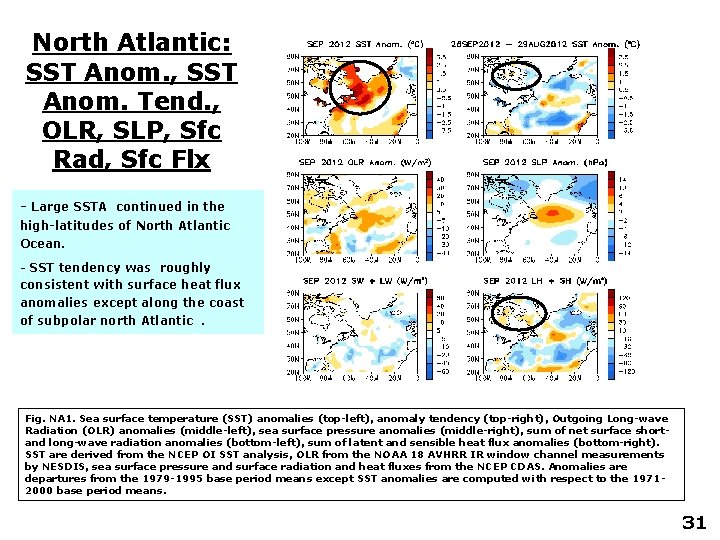
North Atlantic: SST Anom. , SST Anom. Tend. , OLR, SLP, Sfc Rad, Sfc Flx - Large SSTA continued in the high-latitudes of North Atlantic Ocean. - SST tendency was roughly consistent with surface heat flux anomalies except along the coast of subpolar north Atlantic. Fig. NA 1. Sea surface temperature (SST) anomalies (top-left), anomaly tendency (top-right), Outgoing Long-wave Radiation (OLR) anomalies (middle-left), sea surface pressure anomalies (middle-right), sum of net surface shortand long-wave radiation anomalies (bottom-left), sum of latent and sensible heat flux anomalies (bottom-right). SST are derived from the NCEP OI SST analysis, OLR from the NOAA 18 AVHRR IR window channel measurements by NESDIS, sea surface pressure and surface radiation and heat fluxes from the NCEP CDAS. Anomalies are departures from the 1979 -1995 base period means except SST anomalies are computed with respect to the 19712000 base period means. 31
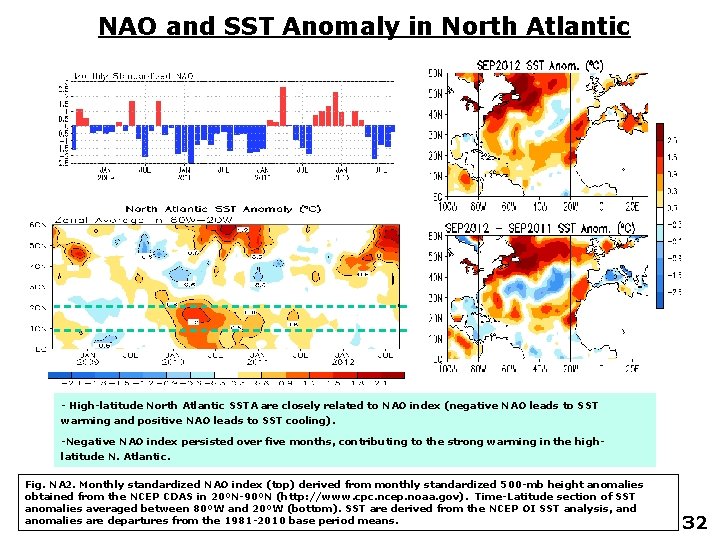
NAO and SST Anomaly in North Atlantic - High-latitude North Atlantic SSTA are closely related to NAO index (negative NAO leads to SST warming and positive NAO leads to SST cooling). -Negative NAO index persisted over five months, contributing to the strong warming in the highlatitude N. Atlantic. Fig. NA 2. Monthly standardized NAO index (top) derived from monthly standardized 500 -mb height anomalies obtained from the NCEP CDAS in 20ºN-90ºN (http: //www. cpc. ncep. noaa. gov). Time-Latitude section of SST anomalies averaged between 80ºW and 20ºW (bottom). SST are derived from the NCEP OI SST analysis, and anomalies are departures from the 1981 -2010 base period means. 32
Global SST Predictions 33
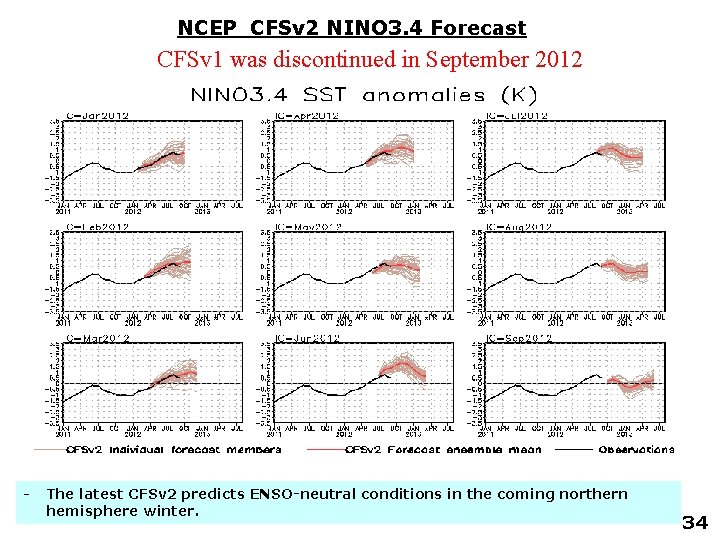
NCEP CFSv 2 NINO 3. 4 Forecast CFSv 1 was discontinued in September 2012 - The latest CFSv 2 predicts ENSO-neutral conditions in the coming northern hemisphere winter. 34
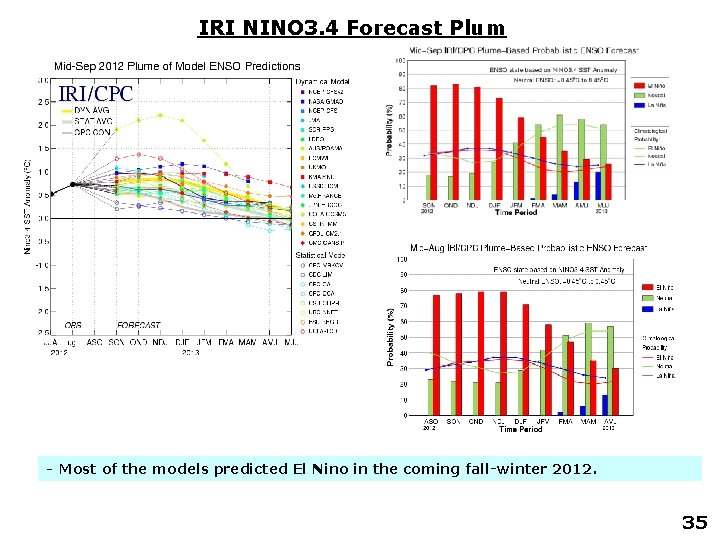
IRI NINO 3. 4 Forecast Plum - Most of the models predicted El Nino in the coming fall-winter 2012. 35
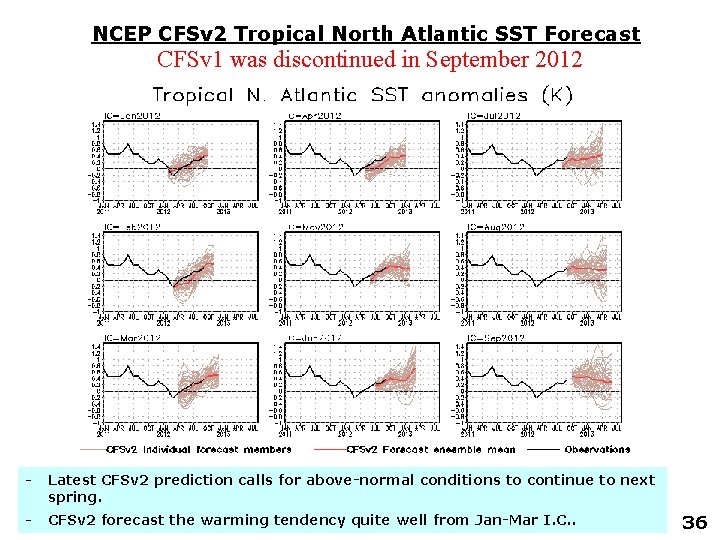
NCEP CFSv 2 Tropical North Atlantic SST Forecast CFSv 1 was discontinued in September 2012 denfield@earthlink. net - Latest CFSv 2 prediction calls for above-normal conditions to continue to next spring. - CFSv 2 forecast the warming tendency quite well from Jan-Mar I. C. . 36
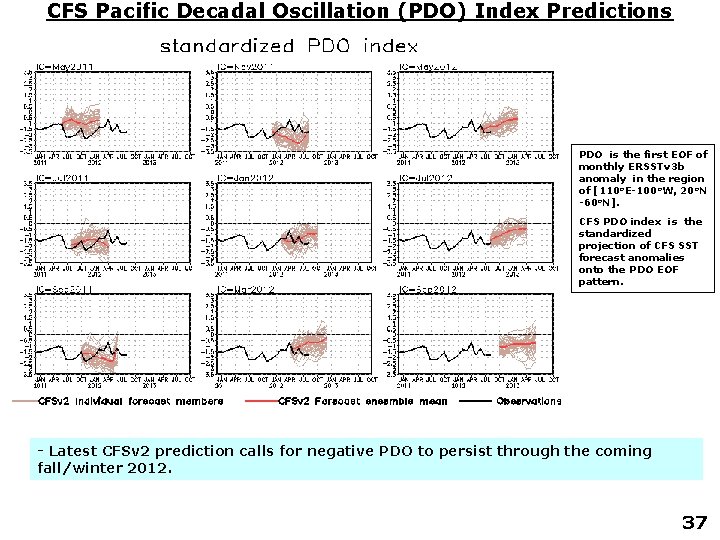
CFS Pacific Decadal Oscillation (PDO) Index Predictions from Different Initial Months PDO is the first EOF of monthly ERSSTv 3 b anomaly in the region of [110 o. E-100 o. W, 20 o. N -60 o. N]. CFS PDO index is the standardized projection of CFS SST forecast anomalies onto the PDO EOF pattern. - Latest CFSv 2 prediction calls for negative PDO to persist through the coming fall/winter 2012. 37
Overview § Pacific and Arctic Oceans Ø ENSO-neutral conditions continued during September 2012. Ø NCEP CFSv 2 predicted ENSO-neutral conditions in the coming fall/winter 2012. Ø Negative PDO phase strengthened in September 2012, with PDO=-2. 1, and has last for 29 months since May 2010. Ø Arctic sea ice extent broke the historical low in the satellite record. § Indian Ocean Ø Above-normal Indian Ocean Dipole condition continued in Sep 2012. § Atlantic Ocean Ø Above-normal SSTA increased slightly in the hurricane Main Development Region(MDR). Ø NOAA predicted a high likelihood of near- or above-normal hurricane season in 2012. Ø Negative NAO index persisted in the past ? ? months, contributing to a strong warming in the high-latitude N. Atlantic. 38

Backup Slides 39
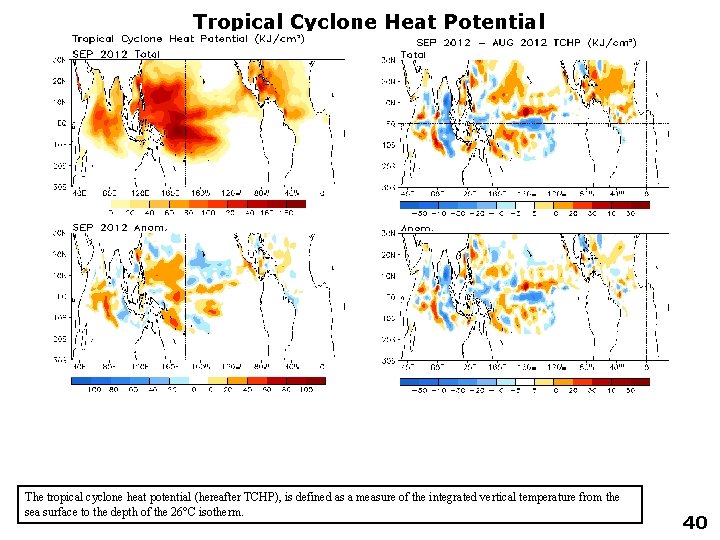
Tropical Cyclone Heat Potential The tropical cyclone heat potential (hereafter TCHP), is defined as a measure of the integrated vertical temperature from the sea surface to the depth of the 26°C isotherm. 40
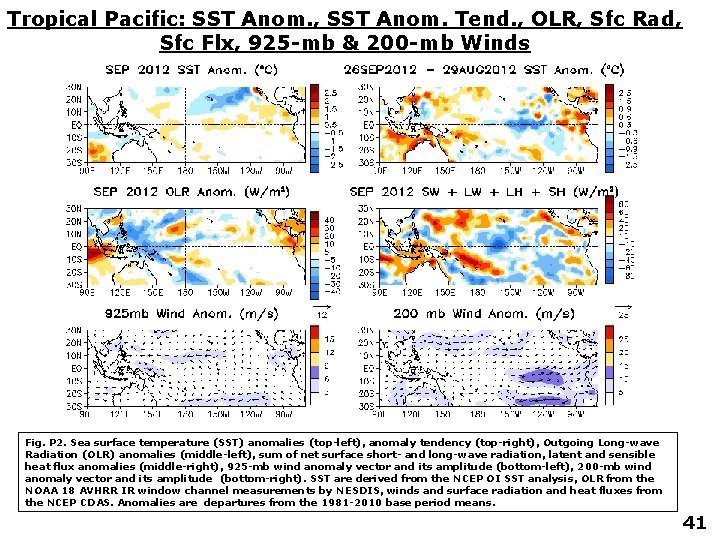
Tropical Pacific: SST Anom. , SST Anom. Tend. , OLR, Sfc Rad, Sfc Flx, 925 -mb & 200 -mb Winds Fig. P 2. Sea surface temperature (SST) anomalies (top-left), anomaly tendency (top-right), Outgoing Long-wave Radiation (OLR) anomalies (middle-left), sum of net surface short- and long-wave radiation, latent and sensible heat flux anomalies (middle-right), 925 -mb wind anomaly vector and its amplitude (bottom-left), 200 -mb wind anomaly vector and its amplitude (bottom-right). SST are derived from the NCEP OI SST analysis, OLR from the NOAA 18 AVHRR IR window channel measurements by NESDIS, winds and surface radiation and heat fluxes from the NCEP CDAS. Anomalies are departures from the 1981 -2010 base period means. 41
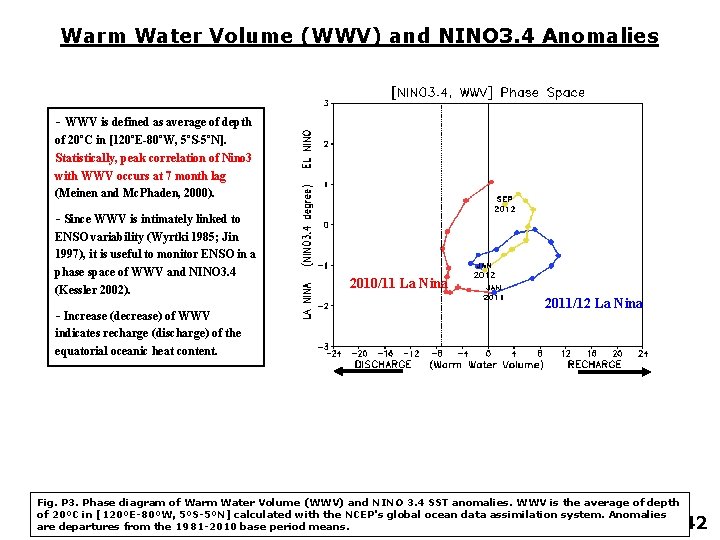
Warm Water Volume (WWV) and NINO 3. 4 Anomalies - WWV is defined as average of depth of 20ºC in [120ºE-80ºW, 5ºS-5ºN]. Statistically, peak correlation of Nino 3 with WWV occurs at 7 month lag (Meinen and Mc. Phaden, 2000). - Since WWV is intimately linked to ENSO variability (Wyrtki 1985; Jin 1997), it is useful to monitor ENSO in a phase space of WWV and NINO 3. 4 (Kessler 2002). - Increase (decrease) of WWV indicates recharge (discharge) of the equatorial oceanic heat content. 2010/11 La Nina 2011/12 La Nina Fig. P 3. Phase diagram of Warm Water Volume (WWV) and NINO 3. 4 SST anomalies. WWV is the average of depth of 20ºC in [120ºE-80ºW, 5ºS-5ºN] calculated with the NCEP's global ocean data assimilation system. Anomalies are departures from the 1981 -2010 base period means. 42
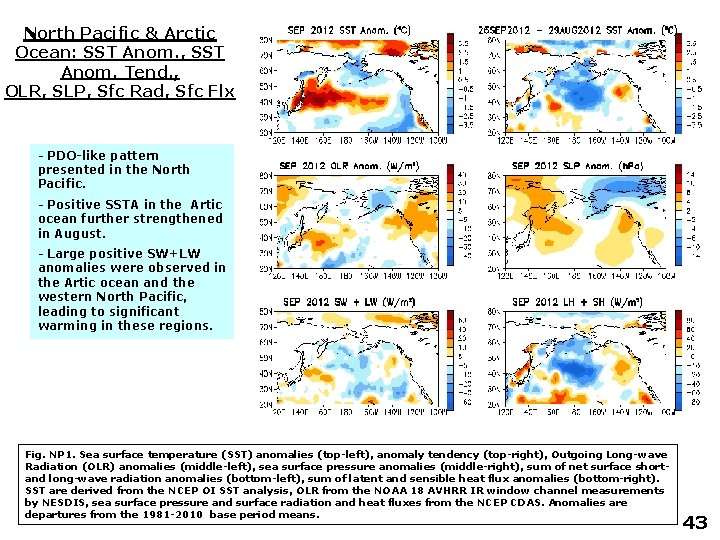
North Pacific & Arctic Ocean: SST Anom. , SST Anom. Tend. , OLR, SLP, Sfc Rad, Sfc Flx - PDO-like pattern presented in the North Pacific. - Positive SSTA in the Artic ocean further strengthened in August. - Large positive SW+LW anomalies were observed in the Artic ocean and the western North Pacific, leading to significant warming in these regions. Fig. NP 1. Sea surface temperature (SST) anomalies (top-left), anomaly tendency (top-right), Outgoing Long-wave Radiation (OLR) anomalies (middle-left), sea surface pressure anomalies (middle-right), sum of net surface shortand long-wave radiation anomalies (bottom-left), sum of latent and sensible heat flux anomalies (bottom-right). SST are derived from the NCEP OI SST analysis, OLR from the NOAA 18 AVHRR IR window channel measurements by NESDIS, sea surface pressure and surface radiation and heat fluxes from the NCEP CDAS. Anomalies are departures from the 1981 -2010 base period means. 43
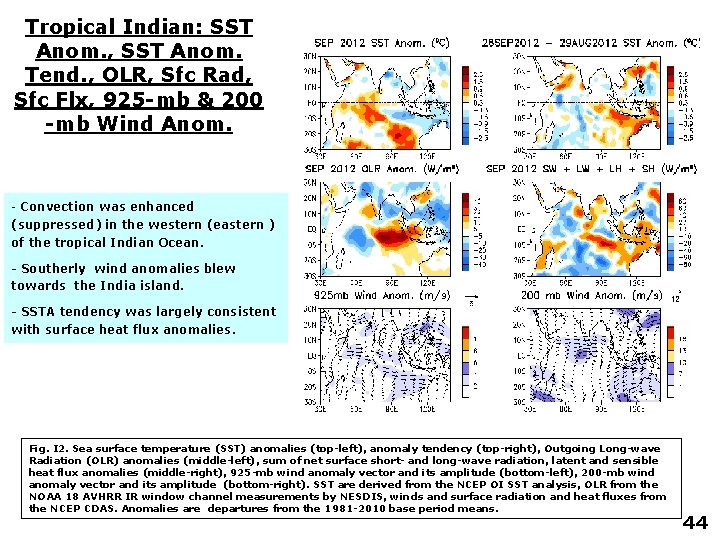
Tropical Indian: SST Anom. , SST Anom. Tend. , OLR, Sfc Rad, Sfc Flx, 925 -mb & 200 -mb Wind Anom. - Convection was enhanced (suppressed) in the western (eastern ) of the tropical Indian Ocean. - Southerly wind anomalies blew towards the India island. - SSTA tendency was largely consistent with surface heat flux anomalies. Fig. I 2. Sea surface temperature (SST) anomalies (top-left), anomaly tendency (top-right), Outgoing Long-wave Radiation (OLR) anomalies (middle-left), sum of net surface short- and long-wave radiation, latent and sensible heat flux anomalies (middle-right), 925 -mb wind anomaly vector and its amplitude (bottom-left), 200 -mb wind anomaly vector and its amplitude (bottom-right). SST are derived from the NCEP OI SST analysis, OLR from the NOAA 18 AVHRR IR window channel measurements by NESDIS, winds and surface radiation and heat fluxes from the NCEP CDAS. Anomalies are departures from the 1981 -2010 base period means. 44
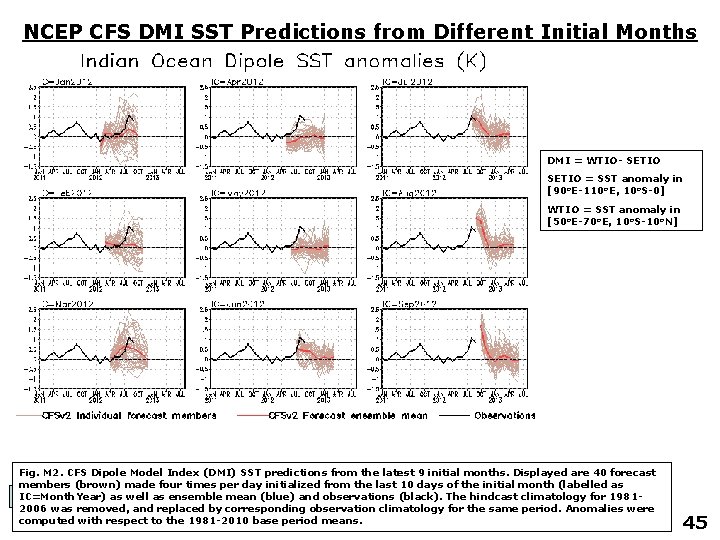
NCEP CFS DMI SST Predictions from Different Initial Months DMI = WTIO- SETIO = SST anomaly in [90 o. E-110 o. E, 10 o. S-0] WTIO = SST anomaly in [50 o. E-70 o. E, 10 o. S-10 o. N] Fig. M 2. CFS Dipole Model Index (DMI) SST predictions from the latest 9 initial months. Displayed are 40 forecast members (brown) made four times per day initialized from the last 10 days of the initial month (labelled as IC=Month. Year) as well as ensemble mean (blue) and observations (black). The hindcast climatology for 19812006 was removed, and replaced by corresponding observation climatology for the same period. Anomalies were computed with respect to the 1981 -2010 base period means. 45
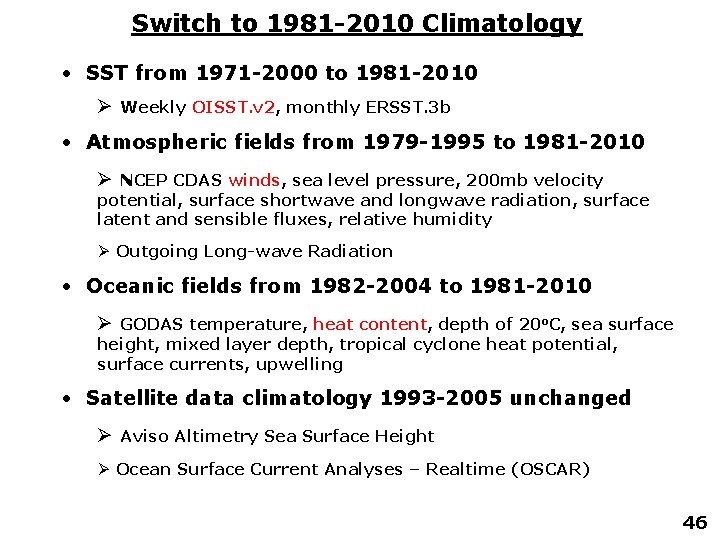
Switch to 1981 -2010 Climatology • SST from 1971 -2000 to 1981 -2010 Ø Weekly OISST. v 2, monthly ERSST. 3 b • Atmospheric fields from 1979 -1995 to 1981 -2010 Ø NCEP CDAS winds, sea level pressure, 200 mb velocity potential, surface shortwave and longwave radiation, surface latent and sensible fluxes, relative humidity Ø Outgoing Long-wave Radiation • Oceanic fields from 1982 -2004 to 1981 -2010 Ø GODAS temperature, heat content, depth of 20 o. C, sea surface height, mixed layer depth, tropical cyclone heat potential, surface currents, upwelling • Satellite data climatology 1993 -2005 unchanged Ø Aviso Altimetry Sea Surface Height Ø Ocean Surface Current Analyses – Realtime (OSCAR) 46
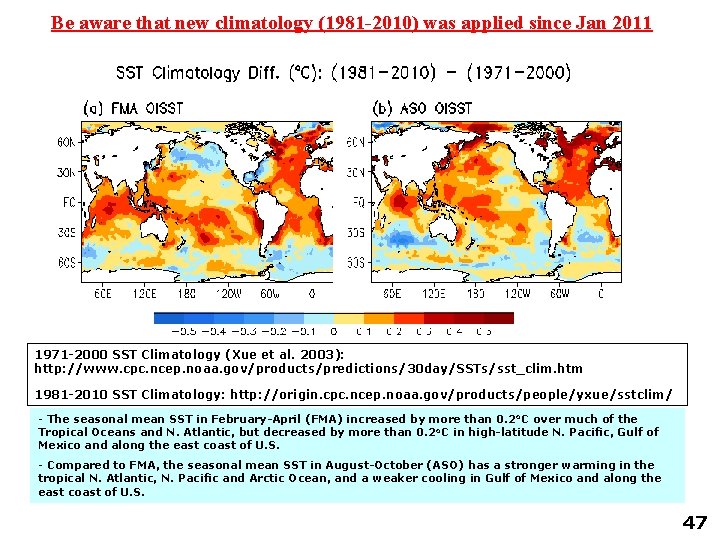
Be aware that new climatology (1981 -2010) was applied since Jan 2011 1971 -2000 SST Climatology (Xue et al. 2003): http: //www. cpc. ncep. noaa. gov/products/predictions/30 day/SSTs/sst_clim. htm 1981 -2010 SST Climatology: http: //origin. cpc. ncep. noaa. gov/products/people/yxue/sstclim/ - The seasonal mean SST in February-April (FMA) increased by more than 0. 2 o. C over much of the Tropical Oceans and N. Atlantic, but decreased by more than 0. 2 o. C in high-latitude N. Pacific, Gulf of Mexico and along the east coast of U. S. - Compared to FMA, the seasonal mean SST in August-October (ASO) has a stronger warming in the tropical N. Atlantic, N. Pacific and Arctic Ocean, and a weaker cooling in Gulf of Mexico and along the east coast of U. S. 47
Data Sources and References • Optimal Interpolation SST (OI SST) version 2 (Reynolds et al. 2002) • NCEP CDAS winds, surface radiation and heat fluxes • NESDIS Outgoing Long-wave Radiation • NDBC TAO data (http: //tao. noaa. gov) • PMEL TAO equatorial temperature analysis • NCEP’s Global Ocean Data Assimilation System temperature, heat content, currents (Behringer and Xue 2004) • Aviso Altimetry Sea Surface Height • Ocean Surface Current Analyses – Realtime (OSCAR) Please send your comments and suggestions to Yan. Xue@noaa. gov. Thanks! 48
- Slides: 48