
Global Nuclear Waste Disposal American Nuclear Society San
Global Nuclear Waste Disposal American Nuclear Society San Diego Section Mehdi Sarram, PE September 20, 2018
Agenda • General information • Disposal of Spent Fuel (Used Fuel) in the world, Nuclear Waste vs SF, this presentation covers only civilian nuclear plants • 21 of 31 countries with nuclear power are selected for this presentation • The US: The Yucca Mountain national repository disaster, how politics terminated this national project • Which nations are more successful in their SF management • Walkaway message • Q/A 2
General information • NRC: High-level radioactive wastes are the highly radioactive materials produced as a byproduct of the reactions that occur inside nuclear reactors • High-level wastes take one of two forms: – Spent Fuel (SF) when it is accepted for disposal (SF is the same as used fuel) – Waste materials remaining after spent fuel is reprocessed • Transuranic waste: Material contaminated with artificially made, radioactive elements, such as NP, Pu, etc. and is primarily produced from recycling SF or using plutonium to fabricate nuclear weapons • LLW has four subcategories: Classes A, B, C, and Greater. Than Class-C (GTCC), described below • Class A is the lowest and GTCC is the highest class 3
General information, cont • 450 (IAEA) nuclear plants operating in 31 countries • Permanent disposal (Deep Geologic Repository - DGR) of spent fuel is like Fusion, it is decades away in the future • Wet storage of the SF in pool of water is the most commonly adopted mode all over the world • An alternate mode, dry storage has also been considered and used in a safe manner in many of the 31 countries • A large majority of countries with nuclear power are NOT even close to having a permanent DGR • Some have postponed the need for DGR by having long term interim storage of up to 100 years • The US could have been the first country with a major state of the art operational DGR (Yucca Mountain) in 1998, the project was killed by politicians in 2010 4
General information cont • 31 countries operate nuclear power plants in the world; but sensitive fuel cycle capabilities are concentrated in fewer than ten countries • Globally, reactors generate about 10, 500 metric tons SF/year • June 2017: The IAEA estimate was that 370, 000 metric tonnes of heavy metal in the form of SF have been discharged since the first nuclear power plants commenced operation, of this 120, 000 Mt have been reprocessed, the rest in storage • Reprocessing gives us 30% more energy than original fuel • Reprocessing reduces the volume of material to be disposed of as high-level waste to about one-fifth • In addition, the level of radioactivity in the waste from reprocessing is much smaller and after about 100 years falls 5 much more rapidly than in SF itself
Disposal of spent fuel in the world, 21 of 31 countries selected • A brief discussion of SF disposal is provided in 21 countries: Czeck Republic, Romania, Finland, Spain, Belgium, Canada, India, Pakistan, Sweden, Japan, China, Taiwan, Brazil, UK, Argentina, Russia, S Korea, Italy, Ukraine, Germany and US (have been to most of these countries) • DGRs have been studied in many countries for decades, including laboratory tests, exploratory boreholes, and the construction and operation of underground research labs (Belgium, Canada, France, S Korea, Finland, Sweden, Switzerland, and the US) • During Q/A, will discuss which nations are more successful in spent fuel management, certainly the US is not one of them! 6
Czech Republic, 6 NPPs • Spent fuel to be stored in storage until handover to SURAO (the Czeck Radioactive Waste Repository Authority) for Disposal (after 2065) in the deep repository • The dry Interim Spent Fuel Storage Installation (ISFSI) has been commissioned in 1997 • Currently there are three radioactive waste disposal facilities • On September 12, 2014, SÚJB (State Office for Nuclear Safety) and SÚRAO signed an agreement on the cooperation in the development of Deep Geological Repository (DGR) • The first geological survey was performed on six locations with granitic in 2003 – 2005 • SURAO is responsible for activities related to DGR • The amount of spent fuel generated during a 30 years period of operation all NPPs is estimated to be about 2, 850 t 7
Romania, 2 NPPs (CANDU 6) • Spent fuel is stored at the reactors for six to ten years • It is then transferred to a dry storage facility (DICA) at Cernavoda based on the Macstor system designed by AECL, where it will remain for about 50 years • The first module was commissioned in 2003 • On Dec 31, 2013, there were 55, 000 irradiated fuel bundles at the dry storage facility • Preliminary investigations have been under way since 1992 regarding a deep geological repository • Six geological formations are considered potential and have been identified • The final repository should start to operate in 2055 • Baita Bihor repository started operation in 1985 and is a disposal facility for low and intermediate-level waste 8
Finland, 4 NPPs • For now, wet and dry storage, high density racks • Site identification among 100 sites, 1983 -1985, preliminary site characterization (5 sites), 1986 -1992 • Olkiluoto site was finally selected in 2000 • In early 1970 s - the starting point for spent fuel management was transport abroad for reprocessing • The last consignments of spent fuel from the Loviisa plants were sent to Russia in 1996 • Government passed a law in 1994 prohibiting the imports and exports of nuclear waste • In 2015, government decided on a DGR, a $3. 2 -billion facility at Olkiluoto will start storing spent fuel in a DGR from about 2023, possibly later (a success story) • Repository can store up to 6, 500 tonnes in cannisters, it will be 9 400 m under ground
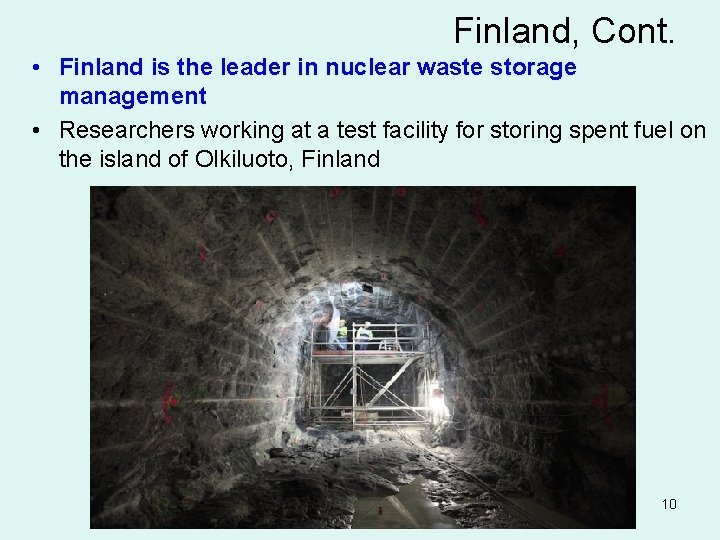
Finland, Cont. • Finland is the leader in nuclear waste storage management • Researchers working at a test facility for storing spent fuel on the island of Olkiluoto, Finland 10
Spain, 7 NPPs • Over 6, 700 t of SF, 20, 000 assemblies, mostly in pools, some in dry storage at 3 sites • The planned facilities are designed to receive and store for decades to come all the spent fuel resulting from Spanish nuclear power reactors • To increase efficiency, re-racking is used at all sites • HI-STORM system is used for dry storage of spent fuel • Independent Spent Fuel Storage Installation (ISFSI) commissioned in 1992 • Deep Geologic Repository design, 1990 -2004 • DGR operational in 2050 • Spain's nuclear regulator has concluded that Villar de Cañas is a suitable site for a national high-level waste storage facility, more studies needed 11
Belgium, 7 NPPs • The spent fuel of the first three NPPs (Doel 1, 2 and Tihange 1) was sent to Cogema in La Hague for reprocessing • Temporary storage for other NPPs • Capacity: 3, 720 storage positions in 8 pools since 1997 • In 1993, a moratorium was put on reprocessing abroad and all SF are stored at nuclear sites • This led to a shortage in pool storage capacity • Belgatom and Synatom have implemented interim spent fuel storage facilities • The emphasis was placed on the dry storage facility, ISFSI at Tihange • Research on DGR for SF storage is underway at Boom Clay at Mol (2070 -2080) • No final decision has been made on DGR 12
Canada, 19 NPPS, CANDU • Canada is a step closer to picking a place to store spent nuclear fuel underground • Despite the stigma of radioactivity, 22 Canadian municipalities expressed interest in hosting such a facility • In January 2012, nine communities, scattered across Saskatchewan and Ontario, have volunteered to host the country’s spent fuel • The towns are a combination of native reserves and old mining towns • Many have spent the past decade watching their populations shrink and are desperate for an economic boost Even if it is Canada’s DGR 13
Canada Cont • When final site is approved, construction of Canada’s deep repository can start in 2035 • Meanwhile, Canada’s nuclear plants have no choice but to store spent fuel in the pools or in dry storage which is a proven technology that has been in use around the world since the 1980 s • Each year, about 5, 000 fuel bundles per reactor are added to the pools • Note: I worked for AREVA in Toronto for 8 years and we submitted a major proposal for DGR site selection in 2005 14
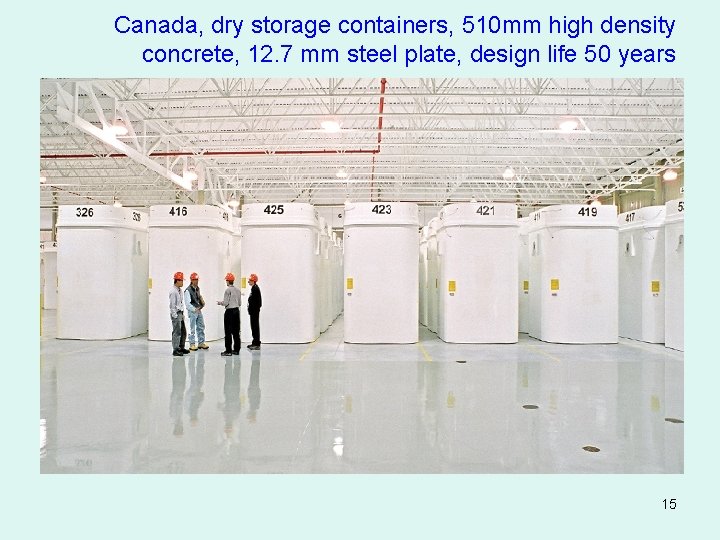
Canada, dry storage containers, 510 mm high density concrete, 12. 7 mm steel plate, design life 50 years 15
India, 21 NPPs • Spent fuel is a valuable material for India (a unique policy) • India has adopted a closed fuel cycle option, which involves reprocessing and recycling of the spent fuel • The discharged spent fuel from reactors is stored in spent fuel storage bay either at reactor site (wet storage) or at reprocessing facilities • India has 3 reprocessing plants, Trombay, Kalpakam, Tarapur • During reprocessing, 2 -3% of radioactivity associated with SF is generated in form of high level liquid waste, this is vitrified • These vitrified products will be in interim storage, in specially designed storage vaults for a period of 40 -50 years and will be eventually disposed off in Geological Disposal Facility • India claims they do not have a nuclear waste management problem, they will have their DGR 2020 -2030 16 • I visited the reprocessing facility at Trombay in May 1975
Pakistan, 4 NPPs • Pakistan AEC is responsible for SF management • The spent fuel from the reactors is presently stored in spent fuel pools at the plant sites • After 10 years cooling, SF will be stored in dry storage facilities licensed for 50 year • Important Note: Although Pakistan is not reprocessing its spent fuel from nuclear power plants, it has not yet declared it as nuclear waste • At present, the decision to put the spent fuel in a nonretrievable DGR is postponed, some site characterization has started • It may be feasible in the future to use the spent fuel as a resource and it may be reprocessed (do they need more than a couple of hundred nuclear weapons? ) 17
Sweden, 10 NPPs • Research to find a disposal site has taken place since 1977, 11 sites examined, with extensive work undertaken at 7 sites • SKB is planning to complete the licensing process for the country’s SF repository at Forshmark (2023 -2025 or later) • Until the repository comes into operation, Sweden’s spent nuclear fuel will be stored at SKB’s Clab interim storage facility, located at Oskarshamn and commissioned in 1985 • In June 1997 some 2, 700 t of SF in about 900 casks had been received in addition to about 80 casks with activated core components (control rods) • An important SF management system is Clab – Central interim storage facility for spent nuclear fuel • The fuel is kept in interim storage for about 30 years 18
Japan, 54 NPPs, Currently five are operating • Japan has a full fuel cycle set-up, including enrichment and reprocessing of used fuel for recycle • Japan has 13, 000 Mt of spent fuel stored at 18 nuclear sites • Japanese policy since 1956 has been extracting an extra 2530% of energy from nuclear fuel by recycling the unburned uranium and plutonium as mixed-oxide fuel (MOX) • Japanese utility companies have their spent nuclear fuel reprocessed by AREVA and BNFL • Government plans for SF disposal sites, it is not clear, whether the effort will move forward as hoped • All returned vitrified waste by AREVA and BNFL is placed in storage pits of the Vitrified Waste Storage Centre at JNFL in Rokkasho village and will remain there for 30 to 50 years 19
Japan cont • The Rokkasho Reprocessing Facility has storage capacity for 2, 880 canisters of vitrified HLW • In April 2015 it had 1, 574 canisters, 1, 310 of these from La Hague and 264 from Sellafield • In September 2016, there were 14, 830 Mt of SF in wet and dry storage at Japan’s power plants, filling about 71% of the existing storage capacity • A final disposal facility is expected to be in operation in 2035 or later 20
China, 38 NPPs • The spent fuel activities in China include: at-reactor storage; away-from-reactor storage; and reprocessing • A centralized SF storage facility has been built at Lanzhou Nuclear Fuel Complex, with a capacity of 550 t. HM • The initial stage of that project has a storage capacity of 550 tonnes and could be doubled • However, most SF is stored at reactor sites, in ponds • Some SF – about 100 fuel assemblies per year – is transported 3, 700 km by road to Gansu province for storage, and it is planned to increase this substantially soon • Separated high-level wastes will be vitrified, encapsulated and put into a geological repository some 500 meters deep • Site selection and evaluation has been under way since 1986 and is focused on candidate locations in the Beishan area of 21 Gansu province and will be completed by 2020
China, Cont • China National Nuclear Corporation said that it estimated that 23, 500 tonnes of SF will have been discharged from reactors by 2030 and that 15, 000 tonnes of that would be in dry cask storage • A pilot reprocessing plant using the Purex process was constructed in 2006 at Lanzhou NF Complex in Gansu • It completed hot commissioning in 2010 to reprocess about 50 tonnes of SF in 2013 -15 • The next step is to construct the final repository by 2040 and to carry out demonstration disposal • A geological disposal repository for high-level waste will start operation in 2050 at the earliest 22
Taiwan, 6 NPPs • Due to the limited capacity of the original design, most of the spent fuel pools at NPPs in Taiwan are almost full • The preferred option for increasing capacity is to store spent fuel in a dry storage facility, called an independent spent fuel storage installation (ISFSI) • Final repository: • 2005 -2017, evaluation, issue progress report • To 2028, assessment of potential sites • To 2038, feasibility study; to 2044 -2055, construction • 2055 and beyond, repository operation Now you know it takes a long time to build a repository! 23
Brazil, 2 NPPs • Brazil has NOT adopted a technical solution for its spent fuel or high-level waste disposal • Spent fuel is stored at Angra pending formulation of policy on reprocessing or direct disposal • Use of high density racks, a temporary solution • In order to increase the present storage capacity of SF assemblies, Eletronuclear is developing a concept for SF storage which involves the construction of a new storage building at near the NPPs • Rusatom Overseas, a unit of Russian Rosatom, signed a memorandum of understanding with Carmargo Correa of Brazil to build additional spent fuel storage facility and nuclear power plants 24
UK, 15 NPPs • The long history of nuclear power in the UK means there is over 40 years operating experience with different fuel types and a variety of storage systems in the UK • Spent fuel storage facilities in the UK currently consist of a mixture of at-reactor stores and large, centralized ponds associated with the reprocessing activities which take place at the Sellafield site • The Government policy in the UK is that it is for the owners of the spent fuel to decide on the appropriate spent fuel management option, subject to meeting the necessary regulatory requirements • The spent Magnox fuel is received at the Sellafield site in the Fuel Handling Plant which has a capacity of some 2, 700 t. U 25
UK, Cont • OVERSEAS LWR FUEL, BNFL has contracts with a number of overseas utilities for reprocessing of over 5, 000 t. U of spent LWR fuel • The UK regulator has given approval to begin a dry nuclear fuel store at Sizewell B, the country's first such nuclear fuel storage facility, construction of the store began in early 2013 • The new dry fuel store will provide capacity for the unit’s SF for the lifetime of the power station or until a deep geological disposal facility is available • Holtec International, provides the storage facility, using the HI-STORM stainless steel multi-purpose canisters • Spent fuel from the UK's Magnox and Advanced Gas-cooled Reactor fleets is sent to Sellafield for reprocessing, but all of Sizewell B’s spent fuel has remained stored under water in 26 an on-site fuel storage pond
Argentina, 3 NPPs • Dry storage alternative was implemented in 1993 to cope with the spent fuel storage demand • The spent bundles must remain at least 6 years in the wet storage before transfer to the dry storage • The dry storage is a modular array of concrete canisters arranged in a yard at the NPP site • The canister yard is inside the NPP for security protection • The canisters are 6. 3 m high and external diameter of 3 m • They are cooled by natural convection and were designed as to support some accidental events as earthquakes, floods, tornadoes and the risk of explosions • The total canisters that will be constructed are 240, presently 216 built silos, 191 of them full load • No plan for a national repository 27
Russia, 34 NPPs • Russia has developed a program for management of spent fuel covering the period "2016 -2018 and up to 2020“ • The aims is to solve the main problems in the management of spent fuel from Russia’s NPPs • The concept provides for transportation of spent fuel from the sites of NPPs to Mayak Production Association in Ozersk for reprocessing or to a centralized repository • A centralized dry interim storage facility for spent fuel from Russia's RBMK-1000 reactors has been in operation since February 2012 • This initial stage of the facility is for storing 8, 129 tonnes of RBMK fuel, it is the largest dry storage in the world • The second stage of dry storage will take VVER-1000 spent fuel currently in wet storage there and increase capacity to 28 over 37, 000 tonnes
Russia, Cont • The used fuel from these plants is currently stored in on-site water-filled pools, but these are reaching full-capacity • Spent VVER-1000 fuel will also be stored at the facility later • A 60 t/yr commercial MOX fuel fabrication facility commenced operation in 2015 • MOX plant will make 400 pelletized MOX fuel assemblies per year for the BN-800 fast reactor, operation in 2015 • Reprocessing at Mayak: about 93% of its feed to 2015 has been from Russian and Ukrainian VVER-440 reactors, about 3% from naval sources or icebreakers, more reprocessing facilities planned • Reprocessing has always had a role in SF management 29
Russia, HLW disposal, geological repositories • Earlier, site selection was proceeding in granite on the Kola Peninsula • 30 potential disposal sites have been identified in 18 regions, including Siberia, the Urals, the Volga region and the Northwest federal district • In 2003 the Chita region 7000 km east of Moscow was suggested for a major spent fuel repository • A decision on repository construction is due by 2025, and the facility itself is to be completed by 2035 • Phase 1 of the facility is to be designed to hold 20, 000 tonnes of intermediate- and high-level waste, which will be retrievable • Russia opened it first ever repository for low and medium level nuclear waste in 2016 (Sverdlovsk Region), 48, 000 cubic meter at shallow depth, design for 300 years 30
South Korea, 24 NPPs • At a rate of 700 Mt per year, S Korea will have 19, 000 Mt SF by 2020 (A typical 1, 000 MWe PWR will discharge about 20 Mt of SNF per year) • But reprocessing is currently banned under the South Korea. US Atomic Energy Agreement. • The only solution might be to build additional dry storage facilities, also high density racking to save in pools • South Korea plans to select a site for permanent storage of its high level radioactive waste by 2028, and will also consider storing spent nuclear fuel overseas • Small country, 52 M people, no repository and no reprocessing • Worked in Seoul for one year in 2012 for KEPCO 31
Italy, Zero NPP as of 1990 • There are no nuclear power plants in operation in Italy (all FOUR plants shutdown (1982 -1990) • Italy has pursued the reprocessing option using foreign reprocessing facilities • In April 2007 SOGIN signed a contract with AREVA for reprocessing of the spent fuel still present in Italy (235 t. HM) • Up to 2005, the following amounts of spent fuel had been transferred abroad for reprocessing: 963. 2 t. HM • In this case, the radioactive waste resulting from reprocessing will not return to Italy • Currently Sogin is proceeding to identify sites for repository • The closing down of all NPPs following the 1987 referendum was a terrible mistake, the cost of which was about $68 billion (Italy Minister of Economy, 2009) • Italy imports nuclear power from France, not a good situation 32
Ukraine, 15 NPPs • In December 2005, Energoatom signed a $150 million agreement with Holtec to implement the Central Spent Fuel Storage Facility (CSFSF) project near the Chernobyl site • The CSFSF will be a dry storage facility for storage of SF • The facility will mean Ukraine will no longer have to spend $200 million each year on its arrangement with Russia to transport and reprocess used nuclear fuel • Construction of the CSFSF commenced in August 2014 • This central storage will begin accepting SF in 2019 -2020 • Vitrified high-level wastes from reprocessing Ukrainian spent fuel will be returned from Russia to Ukraine and will be stored at the CSFSF 33
Germany, 7 NPPs • WNA May 18: Germany until March 2011 obtained onequarter of its electricity from nuclear energy, using 17 reactors • The figure is now about 12% from seven reactors, while 42% of electricity comes from coal • Like many other countries, Germany is facing the problem of storing its radioactive waste properly • The estimated nuclear waste in Germany after shutting down all nuclear power plants is 29, 000 m 3 for high-level waste and 300, 000 m 3 for low- and intermediate-level waste • The German government decided to store the nuclear waste in deep geological repositories • However, a permanent repository site has not yet been found 34
Germany cont • Experts do not expect the final solution for storage of all nuclear waste in Germany before the end of the 21 st century • The costs are expected to be 50 to 70 billion Euro • Efforts for NW storage since 1963 (it is like Fusion!) • In 2013, Fed Gov and all States reached an agreement to spend € 2 billion to find and develop a new repository • In December 2016, decision was make to create a € 23. 6 billion state-owned fund to pay for the interim storage and disposal of all German used fuel • The last separated high-level wastes from past reprocessing in France and UK are expected to be returned to Germany over 2017 to 2022 and stored • A pilot reprocessing plant known as WAK operated at Karlsruhe from 1971 to 1991, processing 206 tonnes of used 35 fuel using the PUREX process
Germany cont • The separated HLW from this was 60 m 3 in liquid form, and after a series of political delays it was vitrified in 2009 -10 • The 122 canisters of vitrified waste are stored at Greifswald while awaiting disposal in a geological repository • Gorleben: Several billion euros have been invested, but still no nuclear waste has been deposited • The process of decommissioning the Morsleben nuclear waste repository is now entering a crucial phase • In Salzgitter, a permanent repository site for low- and intermediate-level waste is under construction 36
The US, 99 NPPs, Introduction • We have been storing spent fuel on nuclear reactor sites SAFELY since December 1957 when our first nuclear plant Shippingport became operational • Study for site selection of a national repository started in 1978 • Federal law required the US DOE to begin moving spent fuel from all US NPPs in 1998, but this has not happened • As a result of failure of our government, nuclear plants have run out of pool storage capacity • At these nuclear plants, spent fuel is stored in pools or above ground in dry storage containers 37
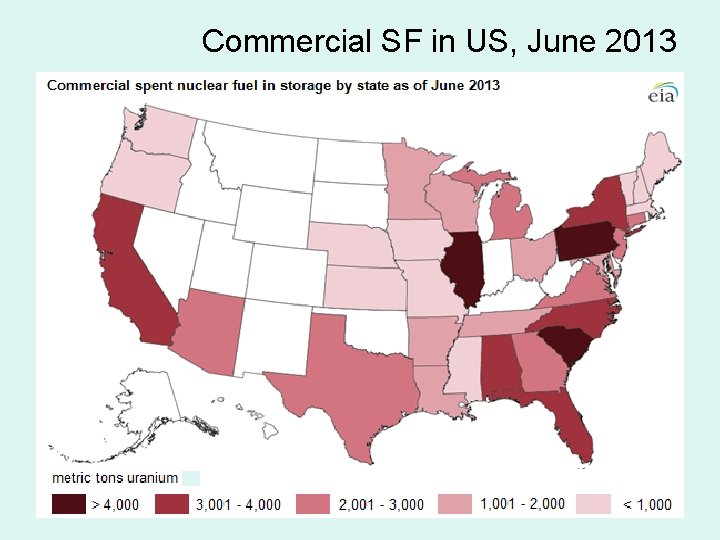
Commercial SF in US, June 2013 38
US NRC 10 CFR 72 on spent fuel storage • US NRC: There are two acceptable storage methods for spent fuel after it is removed from the reactor core • Dry Cask Storage - Licensees may also store spent nuclear fuel in dry cask storage systems at Independent Spent Fuel Storage Installation (ISFSI) at the following sites: – At Reactor – Licensees may use dry storage systems when approaching their pool capacity limit. – Away-From-Reactor – Licensees may use dry storage systems at one of the following locations: • Decommissioned Reactor Sites – After terminating reactor operations and removing structures used in reactor operations • Consolidated Interim Storage Facility (CISF) – Dry cask storage at an away-from-reactor site pending 39 disposal at a permanent disposal facility
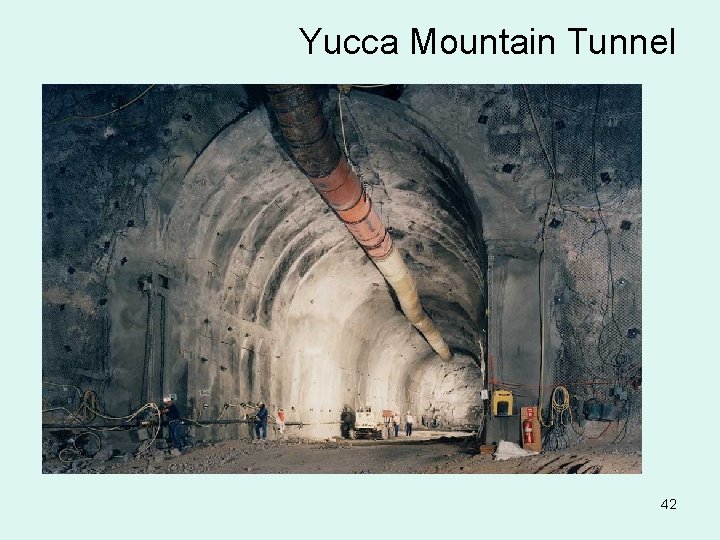
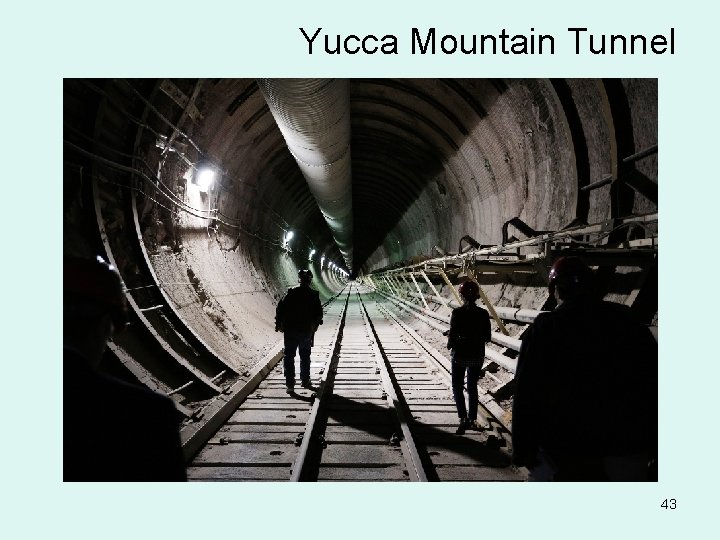
Yucca Mountain National Repository, the $38 billion fiasco • Yucca Mountain, the site that was intended to be the permanent burial for the nation's 70, 000 tons of spent fuel • It has laid lifeless since 2010, when NRC Chairman Gregory Jaczko cut funding for the project • Jaczko was nominated as Chairman of NRC by Obama on May 13, 2009, the Senate under Harry Reid approved his nomination • Harry Reid support for Jaczko was BASED on his run for Senate that year, (influence of Las Vegas Casinos) • The first $15 billion is what the government spent on a SF repository at Yucca Mountain until the Obama administration scrapped the project in 2010 • We the Americans paid $15 B to our government 40 • Can we call this a success story?
The $38 billion nuclear waste fiasco • The other $23 billion is the DOE estimate of the damages the government will have to pay to nuclear utilities, which for the past 30 years have paid a fee to DOE on the promise that the DOE would begin collecting their waste in 1998 • The US industry argues that the damages are closer to $50 billion — which raises the bottom line to $65 billion including the money spent on Yucca • The FY 2019 budget request for DOE includes $120 million for Yucca Mountain and an interim storage program for spent fuel 41
Yucca Mountain Tunnel 42
Yucca Mountain Tunnel 43
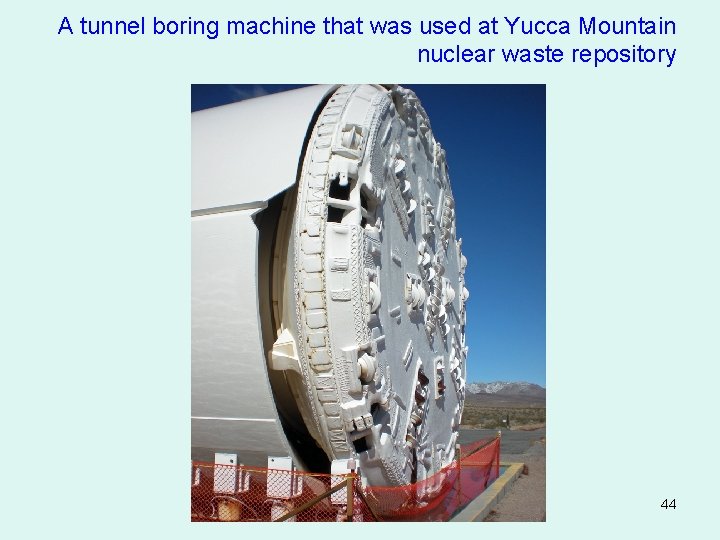
A tunnel boring machine that was used at Yucca Mountain nuclear waste repository 44
West Texas Facility, Interim Storage of Spent Fuel • Waste Control Specialists’ facility in western Andrew County is the only commercial facility licensed in more than 30 years to dispose of Class A, B and C low-level radioactive waste • WCS submitted application to NRC in 2016 for a consolidated interim storage facility (CISF) for SF • WCS application was put on hold due to financial problems • WCS was acquired by JF Lehman &Company, 2018, private equity firm • In March 13, 2018: WCS asked NRC to resume the licensing process to store spent fuel , could take 20 plus years to transfer spent fuel • Additional phases up to 40, 000 Mton heavy metal eventually • Even if this site ever becomes operational, it does NOT have adequate capacity for 70, 000 t of Yucca Mountain 45
New Mexico interim repository • Holtec International has announced that it has submitted a site-specific license application to the US NRC for its proposed consolidated interim storage facility in SE of NM • With a capacity of 10, 000 canisters (8, 680 Mt), Holtec's Hi. STORM facility could store spent fuel from any US nuclear power plants • The project is supported by the Eddy-Lea Energy Alliance in Carlsbad and Hobbs in NM • NRC currently reviewing application submitted March 2017, expected service date: 2022 or later • According to NRC Project Manager (March 2018), the NM review is slightly ahead of the West Texas application 46
International Nuclear Waste Storage Concepts • There have been several proposal for regional and international repositories for disposal of HLW • The South Australian Commission proposal, in May 2016 reported on a major recommendation that a facility for the disposal of international spent nuclear fuel and intermediate level waste should be stablished • The facility could generate about AUD 100 billion in income in excess of expenditure • In 2002, 14 EU countries resolved to set up a European Repository Development Organisation (ERDO) to collaborate on nuclear waste disposal 47
Walkaway message • The US was the world leader in nuclear technology • We lost the lead due to lack of vision of our administrations in the past decades • On April 7, 1977, President Carter announced that the US would defer indefinitely reprocessing of SF • Other nations got ahead of us, some reprocess • 2018 marks the 20 th anniversary since our Federal government failing to take title to America’s inventory of SF • This is an abdication that has cost American taxpayers billions of dollars in judgments and settlements • In 2018, the US does NOT have a single repository for storing spent fuel from our commercial nuclear plants providing about 20% of electricity needs • NRC: In 2018, with no repository operational, ALL spent fuel shall be stored ON all nuclear SITES in wet or dry storage 48
QA-Nuclear Happy Face
Latest • April 4, 2017 (San Diego) – A lawsuit filed against the California Coastal Commission by Citizens Oversight, heads to trial beginning Friday, April 14 in San Diego • The Coastal Commission approved the permit to bury 3. 6 million pounds of nuclear waste at San Onofre only 100 feet from the beach and only inches over the high-tide mark • They said the deadly nuclear waste will remain so for up to 250, 000 years ! • The location has 8. 4 million residents within 50 miles, as well as a freeway and railway, making it a potential terrorist site, opponents say ! • This is all about misleading the public and creating fear • We have been storing spent fuel at reactor sites in the US since 1957 SAFELY, US NRC has approved the storage 50
- Slides: 50