
Global Navigation Satellite Systems Many thanks and recognition
Global Navigation Satellite Systems Many thanks and recognition to the ITC - University of Twente community for base materials
The Basics Segments, Signals, Clocks
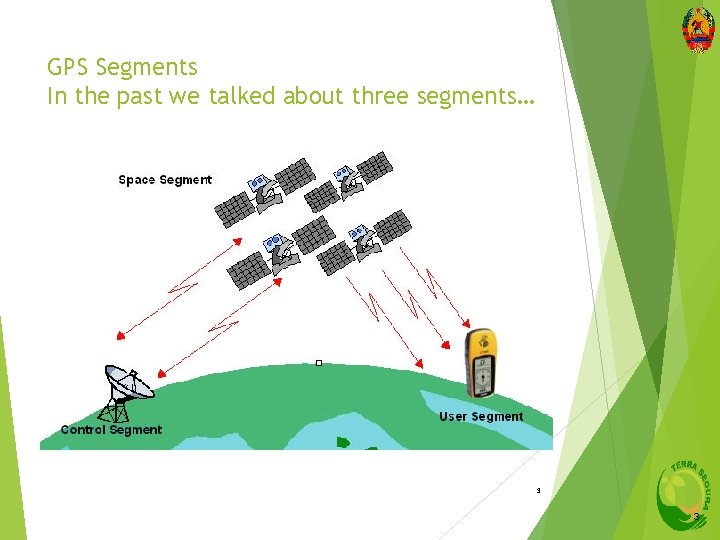
GPS Segments In the past we talked about three segments… 3 3
GPS Segments More and more we talk about ‘GNSS Infrastructure’ Space Segment (multiple constellations) Control Segment User Segment Augmentation and Corrections Systems National or Commercial CORS Networks Satellite Augmentation Systems or Networks …and so on 4 4
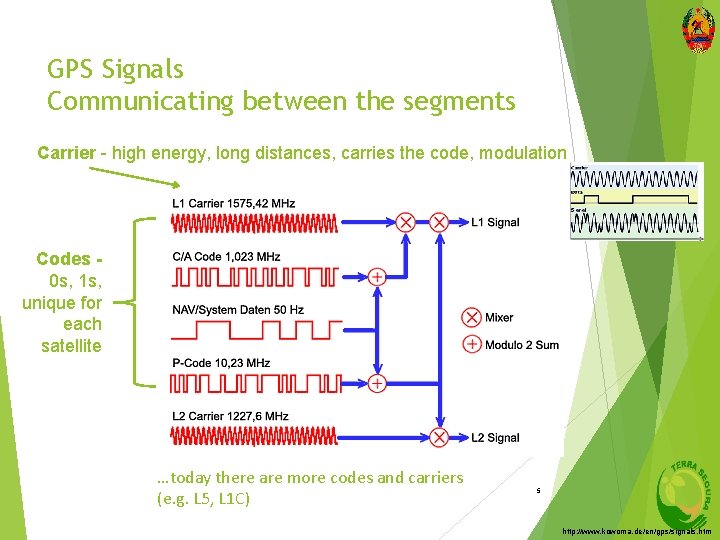
GPS Signals Communicating between the segments Carrier - high energy, long distances, carries the code, modulation Codes 0 s, 1 s, unique for each satellite …today there are more codes and carriers (e. g. L 5, L 1 C) 5 http: //www. kowoma. de/en/gps/signals. htm
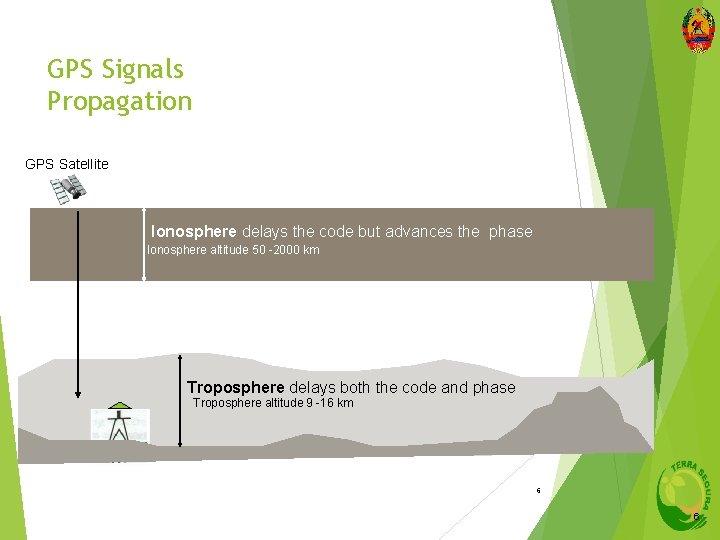
GPS Signals Propagation GPS Satellite Ionosphere delays the code but advances the phase Ionosphere altitude 50 -2000 km Troposphere delays both the code and phase Troposphere altitude 9 -16 km 6 6
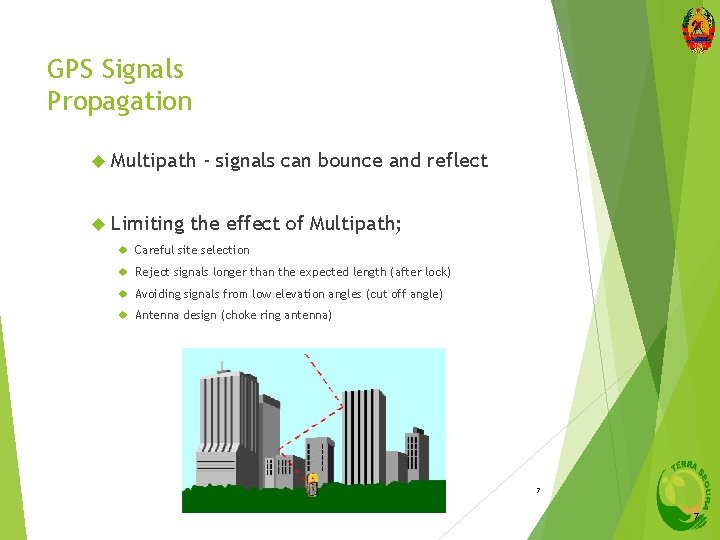
GPS Signals Propagation Multipath Limiting - signals can bounce and reflect the effect of Multipath; Careful site selection Reject signals longer than the expected length (after lock) Avoiding signals from low elevation angles (cut off angle) Antenna design (choke ring antenna) 7 7
GPS Satellites and their clocks Each satellite carries its own onboard a very stable atomic clock Satellites are set to GPS time not UTC – no leap seconds/corrections The clocks can drift (satellite clock error): the control segment monitors and sends corrections The navigation messages enables receivers to convert to UTC The orbits can also drift (orbital error): control segment also monitors 8 8
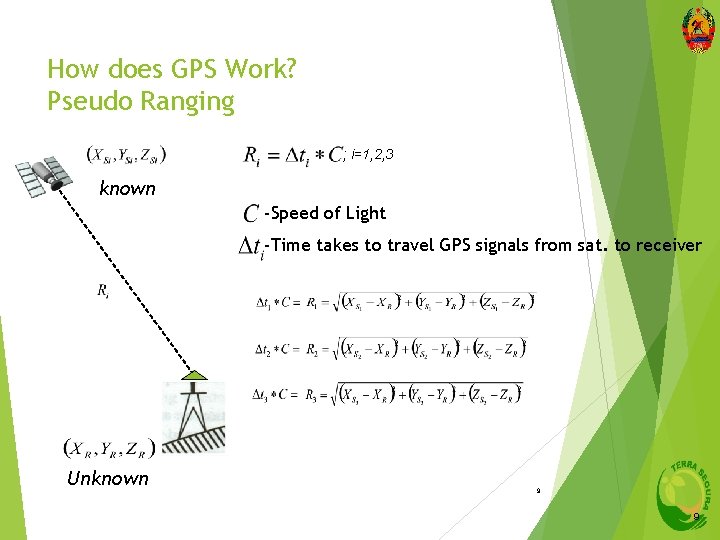
How does GPS Work? Pseudo Ranging ; i=1, 2, 3 known -Speed of Light -Time takes to travel GPS signals from sat. to receiver Unknown 9 9
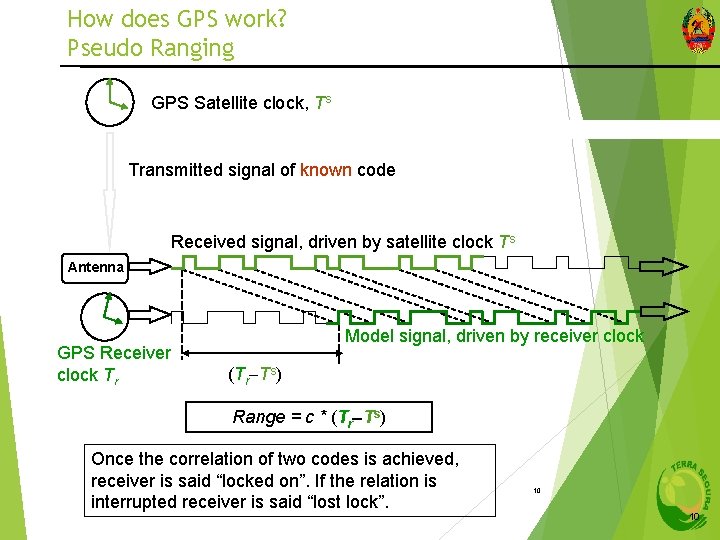
How does GPS work? Pseudo Ranging GPS Satellite clock, Ts Transmitted signal of known code Received signal, driven by satellite clock Ts Antenna GPS Receiver clock Tr Model signal, driven by receiver clock (Tr-Ts) Range = c * (Tr-Ts) Once the correlation of two codes is achieved, receiver is said “locked on”. If the relation is interrupted receiver is said “lost lock”. 10 10
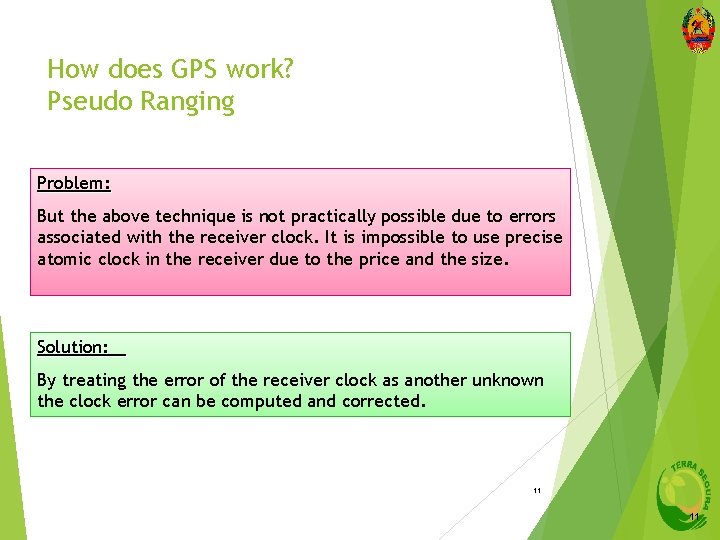
How does GPS work? Pseudo Ranging Problem: But the above technique is not practically possible due to errors associated with the receiver clock. It is impossible to use precise atomic clock in the receiver due to the price and the size. Solution: By treating the error of the receiver clock as another unknown the clock error can be computed and corrected. 11 11
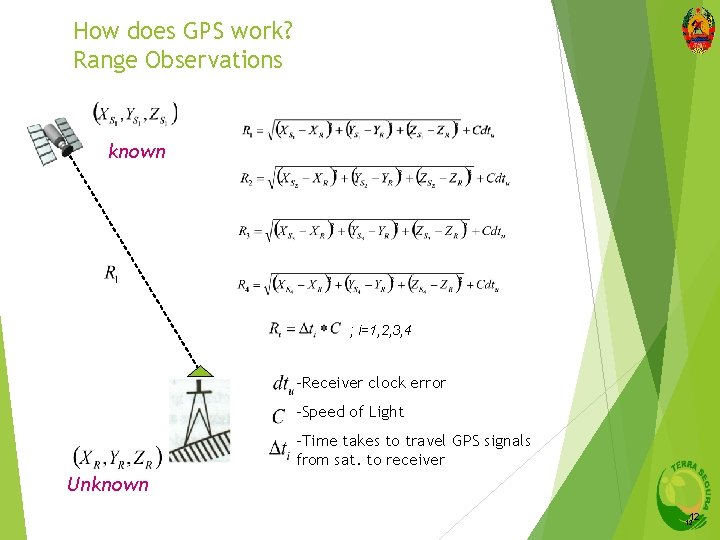
How does GPS work? Range Observations known ; i=1, 2, 3, 4 -Receiver clock error -Speed of Light -Time takes to travel GPS signals from sat. to receiver Unknown 12 12
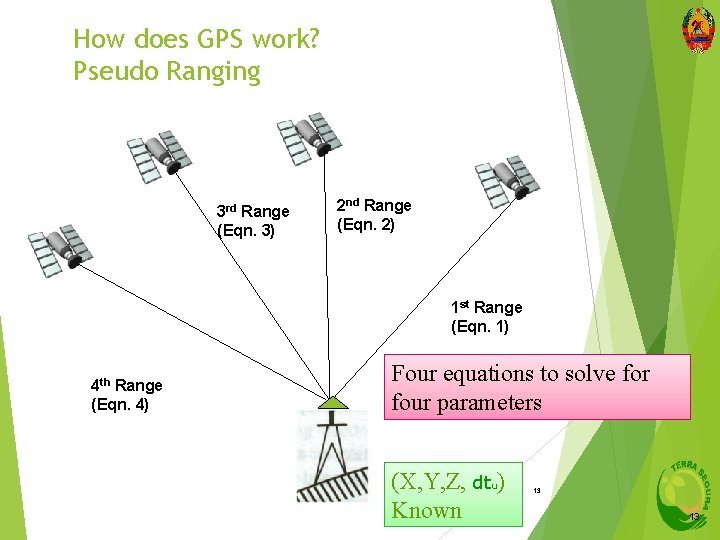
How does GPS work? Pseudo Ranging 3 rd Range (Eqn. 3) 2 nd Range (Eqn. 2) 1 st Range (Eqn. 1) 4 th Range (Eqn. 4) Four equations to solve for four parameters (X, Y, Z, dt) dtu) Unknown Known 13 13
Summary (1) GPS Segments GNSS Infrastructures Codes Carrier Waves GPS time, not UTC Range = c x d Minimum 4 satellites for 3 D positioning 14 14
DGPS Accuracy, Augmentation, Wide Area, and Real-Time
DGPS Why? Pseudo range can get us to 3 m, but, usually more like 5 -10 m Sometimes we want to be more accurate So we need to reduce errors: random, systematic, or blunders Removing ‘random’ requires comparing many multiple measurements Removing systematic we use DGPS (or network augmentation systems) 16 16
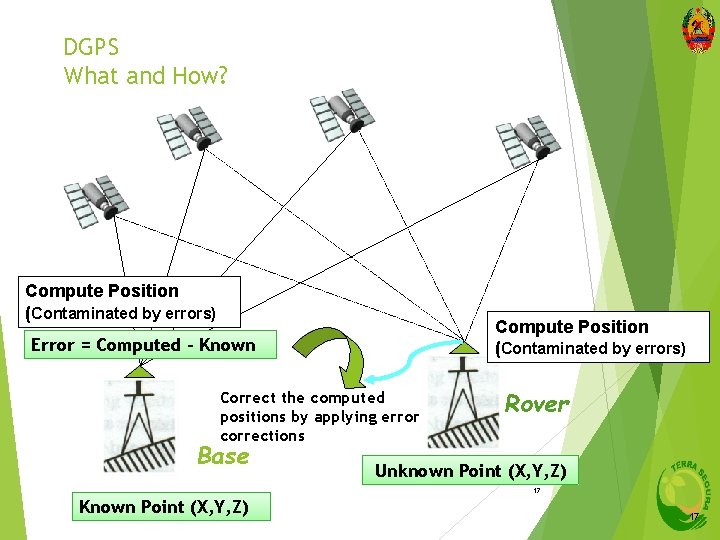
DGPS What and How? Compute Position (Contaminated by errors) Error = Computed - Known Correct the computed positions by applying error corrections Base Rover Unknown Point (X, Y, Z) 17 Known Point (X, Y, Z) 17
DGPS Corrections An accuracy of 0. 5 m Most of the systematic errors can be removed this way (we will cover these later) This is a suitable accuracy range for most civilian applications Correction between GPS receivers becomes weaker as the rover gets farther from the base Corrections can occur in real-time or post-processed 18 18
Local Area DGPS CORS or RTN Services Established your own base station on known point Note - base lines are limited to couple of hundred kilometers or RTN Services or CORS networks Ground based network of base stations Cheaper for users On demand 19 19
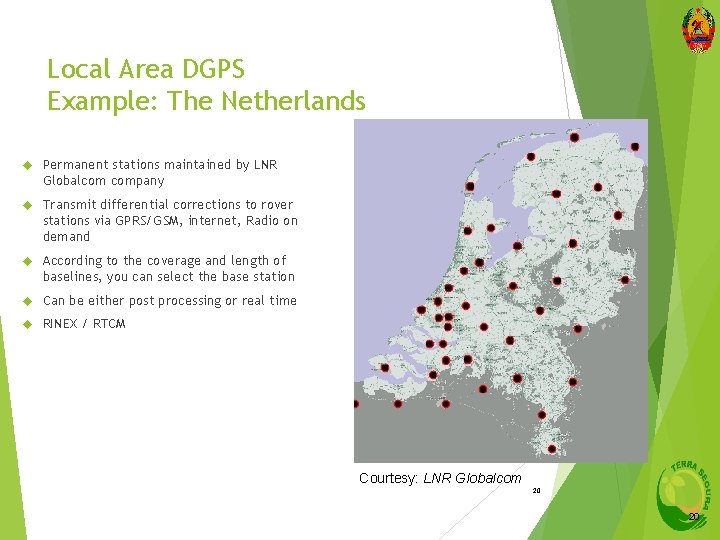
Local Area DGPS Example: The Netherlands Permanent stations maintained by LNR Globalcom company Transmit differential corrections to rover stations via GPRS/GSM, internet, Radio on demand According to the coverage and length of baselines, you can select the base station Can be either post processing or real time RINEX / RTCM Courtesy: LNR Globalcom 20 20
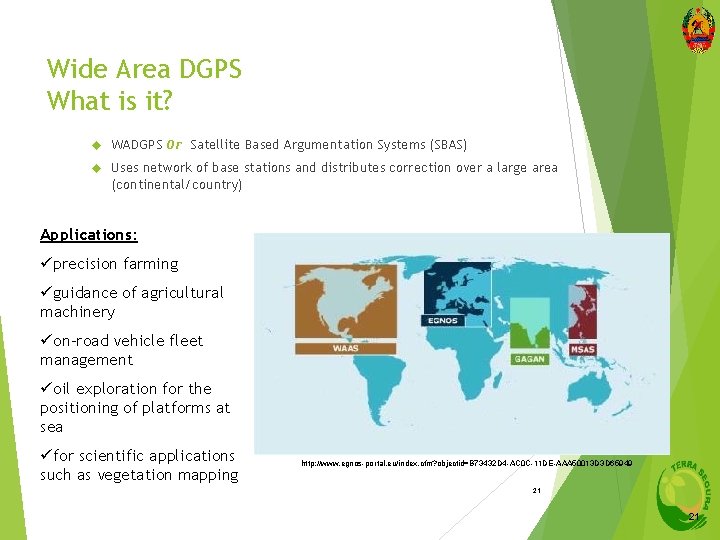
Wide Area DGPS What is it? WADGPS Or Satellite Based Argumentation Systems (SBAS) Uses network of base stations and distributes correction over a large area (continental/country) Applications: üprecision farming üguidance of agricultural machinery üon-road vehicle fleet management üoil exploration for the positioning of platforms at sea üfor scientific applications such as vegetation mapping http: //www. egnos-portal. eu/index. cfm? objectid=B 73432 D 4 -AC 0 C-11 DE-AAA 50013 D 3 D 65949 21 21
Wide Area DGPS How does it work? Many Base Receivers send their measurements to a data center, which computes a model for range error corrections for a large area. Correction model uploaded to a geostationary satellites and broadcast to GPS receivers Receiver corrects its own measurements with help of the received correction model and computes immediately more accurate positions. 22 22
Global DGPS Omni. STAR Global Real Time Differential GPS system delivering corrections Network of base stations around the globe Two network control centers (USA and Australia) – uplink measurements to geo-stationary satellites Geo-stationary satellites broadcast data to user http: //www. omnistar. nl/products-services/how-it-works 23
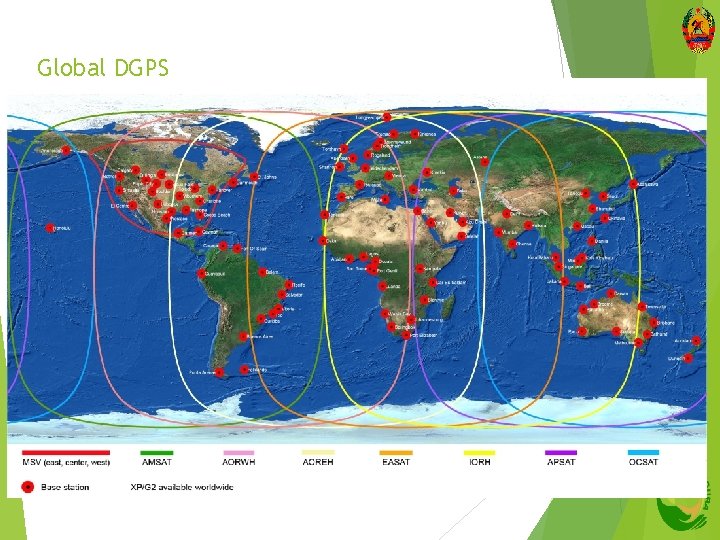
Global DGPS Omni. STAR coverage 24
Summary (2) Single receiver observing 4 satellites (Code +/- 10 m) DGPS removes many systematic errors (Code +/- 5 m) Base station and rovers Real-time or post processing WADGPS (continental/country) LADGPS (base line limited to couple of hundred kilometers): Real Time Network Services and CORS 25 25
Carrier Phase Observations Even more accuracy!
More accuracy. . . To improve the accuracy we must remove more errors: ‘reading accuracy’ To do this we measure another quantity: the phase of the carrier wave Carrier phase measurements use the carriers L 1 & L 2, rather than codes Measurements can be made on a stand-alone device (2 -3 m) OR differential (0. 05 m or better) Remember, carriers do not contain any information of time 27 27
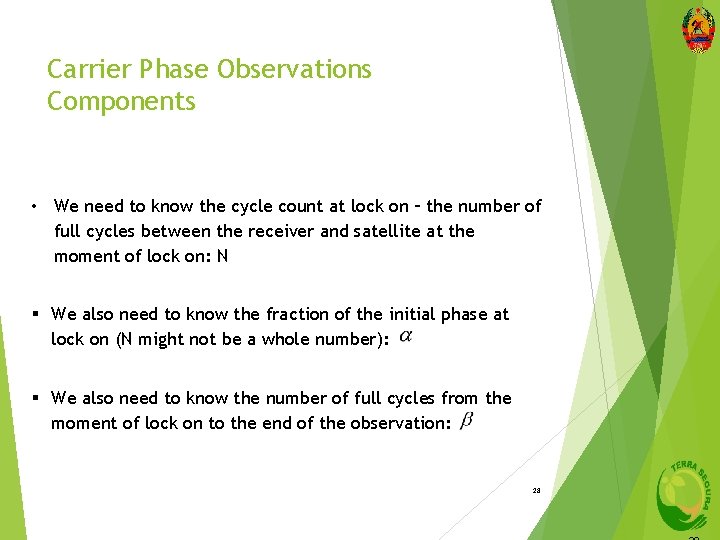
Carrier Phase Observations Components • We need to know the cycle count at lock on – the number of full cycles between the receiver and satellite at the moment of lock on: N § We also need to know the fraction of the initial phase at lock on (N might not be a whole number): § We also need to know the number of full cycles from the moment of lock on to the end of the observation: 28
Carrier Phase Measurements Initialization (lock on) The receiver doesn’t know the initial phase of the signal when it left the satellite. So, the received carrier is compared with a replica of the carrier generated by the receiver itself Then, the receiver measures signals for period and waits to: find the number of full cycles between satellite and the receiver download the almanac fix with satellites - called initialization 29 29
Summary (3) To reach better accuracy receiver noise must be minimized The phase of the carrier wave is measured, codes are not used Accuracy after applying differential correction: cm level Can be done in real-time 30 30

PPP …a fourth way
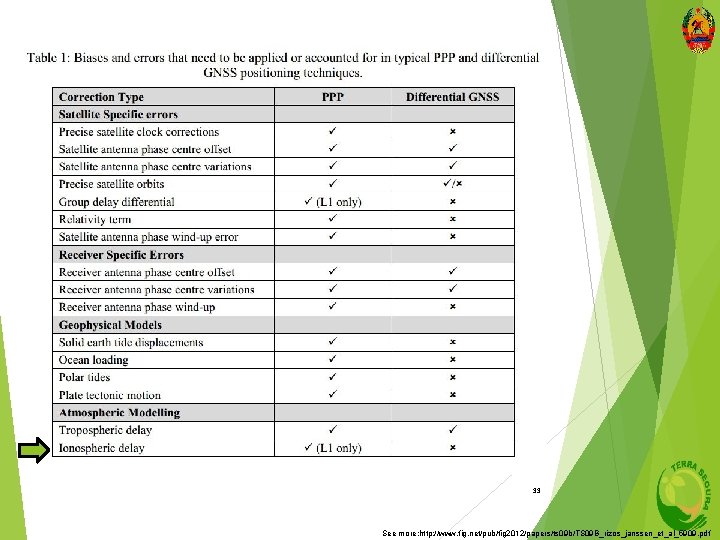
PPP (Precise Point Positioning) DGPS dominant for 3 -decades CORS infrastructure rolled out across regions and nations to support Meanwhile, PPP emerges- applies a ‘truckload’ of freely available corrections to measurements made by a single receiver (http: //igs. org/). No CORS!? Generally done using post processing, but, moving towards real time (See Trimble RTX)- however, arguably still require dense CORS networks to achieve high performance 32 32 See more: http: //www. fig. net/pub/fig 2012/papers/ts 09 b/TS 09 B_rizos_janssen_et_al_5909. pdf
33 See more: http: //www. fig. net/pub/fig 2012/papers/ts 09 b/TS 09 B_rizos_janssen_et_al_5909. pdf

Receivers, Quality, and Methods Where the real decision lies for land administration
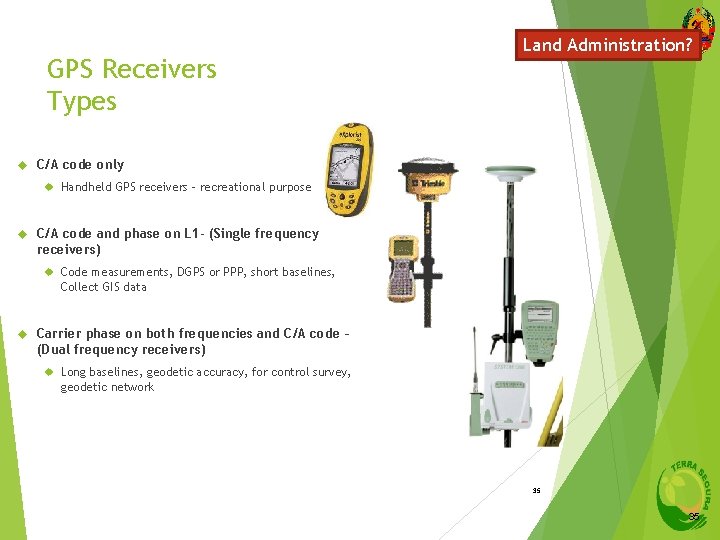
GPS Receivers Types Land Administration? C/A code only Handheld GPS receivers – recreational purpose C/A code and phase on L 1 - (Single frequency receivers) Code measurements, DGPS or PPP, short baselines, Collect GIS data Carrier phase on both frequencies and C/A code – (Dual frequency receivers) Long baselines, geodetic accuracy, for control survey, geodetic network 35 35
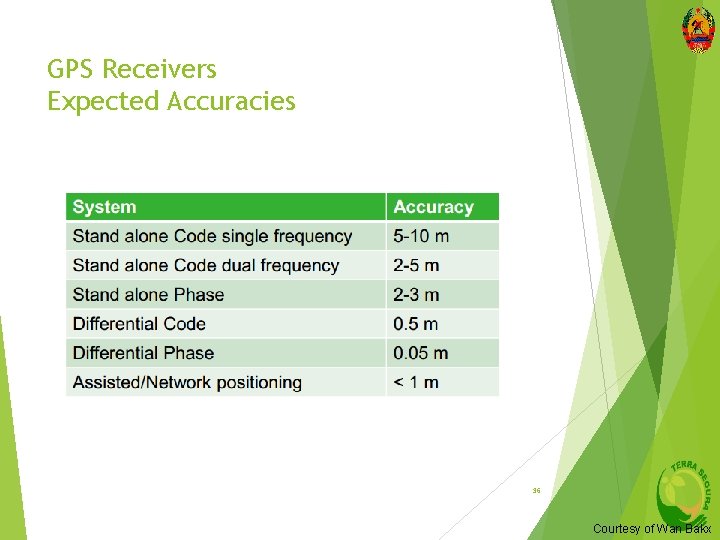
GPS Receivers Expected Accuracies 36 Courtesy of Wan Bakx
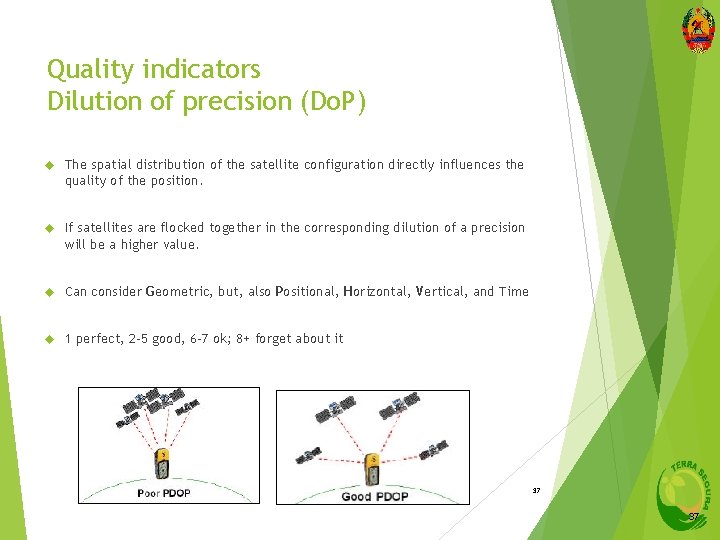
Quality indicators Dilution of precision (Do. P) The spatial distribution of the satellite configuration directly influences the quality of the position. If satellites are flocked together in the corresponding dilution of a precision will be a higher value. Can consider Geometric, but, also Positional, Horizontal, Vertical, and Time 1 perfect, 2 -5 good, 6 -7 ok; 8+ forget about it 37 37
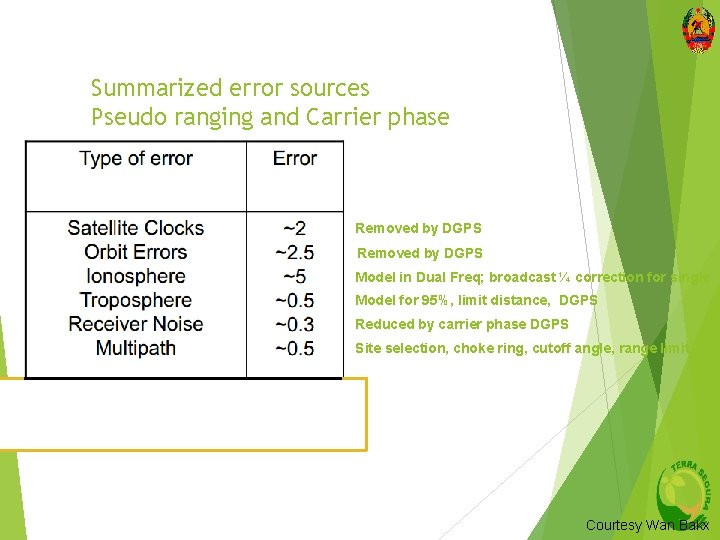
Summarized error sources Pseudo ranging and Carrier phase Removed by DGPS Model in Dual Freq; broadcast ¼ correction for single Model for 95%, limit distance, DGPS Reduced by carrier phase DGPS Site selection, choke ring, cutoff angle, range limit Courtesy Wan Bakx
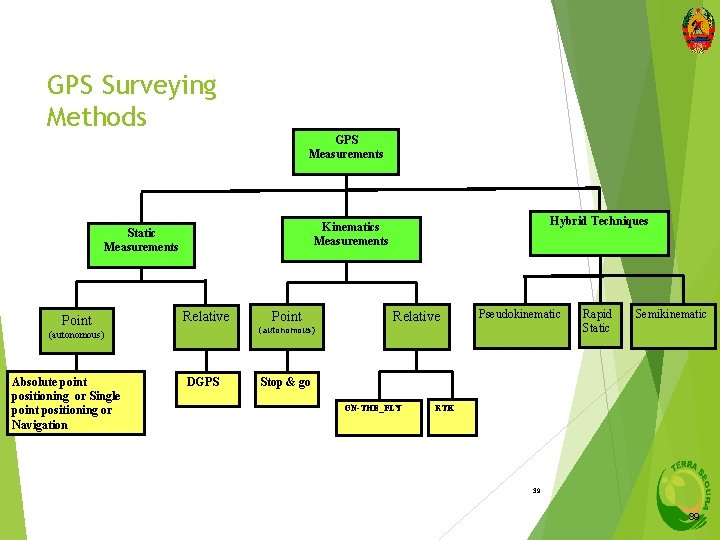
GPS Surveying Methods GPS Measurements Point Relative Pseudokinematic (autonomous) Absolute point positioning or Single point positioning or Navigation Hybrid Techniques Kinematics Measurements Static Measurements DGPS Rapid Static Semikinematic Stop & go ON-THE_FLY RTK 39 39
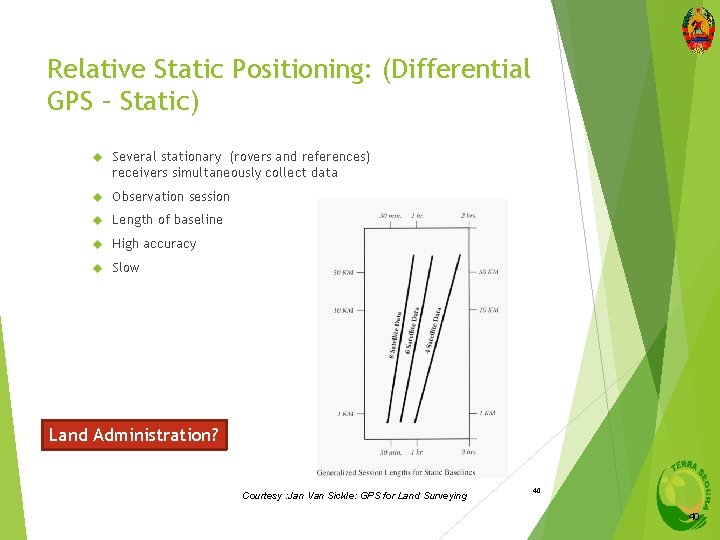
Relative Static Positioning: (Differential GPS – Static) Several stationary (rovers and references) receivers simultaneously collect data Observation session Length of baseline High accuracy Slow Land Administration? Courtesy : Jan Van Sickle: GPS for Land Surveying 40 40
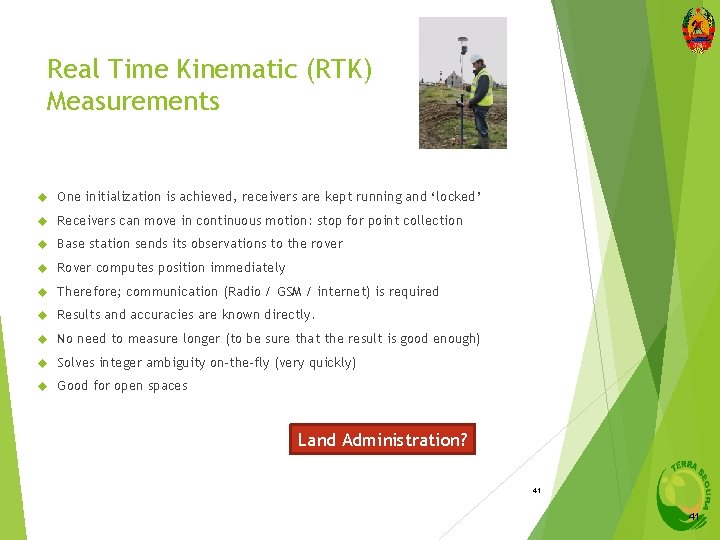
Real Time Kinematic (RTK) Measurements One initialization is achieved, receivers are kept running and ‘locked’ Receivers can move in continuous motion: stop for point collection Base station sends its observations to the rover Rover computes position immediately Therefore; communication (Radio / GSM / internet) is required Results and accuracies are known directly. No need to measure longer (to be sure that the result is good enough) Solves integer ambiguity on-the-fly (very quickly) Good for open spaces Land Administration? 41 41

Questions Thanks again for your time.
- Slides: 42