
Global Navigation Satellite Systems GNSS for Aviation United
Global Navigation Satellite Systems (GNSS) for Aviation United Nations International Committee on GNSS 1 - 2 December, 2005 Ken Alexander United States (US) Federal Aviation Administration (FAA) Federal Aviation Administration
GNSS Aviation Integrity • Using ICAO GNSS Implementation Strategy and ICAO Standards and Recommended Practices • GPS Aviation Use Approved for Over a Decade – Aircraft Based Augmentation Systems (ABAS) – (e. g. RAIM) • Space Based Augmentation System (SBAS) since 2003 – Wide Area Augmentation System (WAAS) augmenting GPS • Development of GNSS Ground Based Augmentation System (GBAS) Continues – Local Area Augmentation System (LAAS) • GNSS is Cornerstone for National Airspace System Federal Aviation Administration 2
GPS (ABAS) Aviation Receivers • Over 16, 000 * Commercial Air Carrier Instrument Flight Rated (IFR) GPS Receivers Sold (as of 2003) • Additional 70, 000 – 80, 000 * General Aviation IFR GPS receivers sold * U. S. manufacturer sales only (does not include units limited to visual situational awareness) Federal Aviation Administration 3
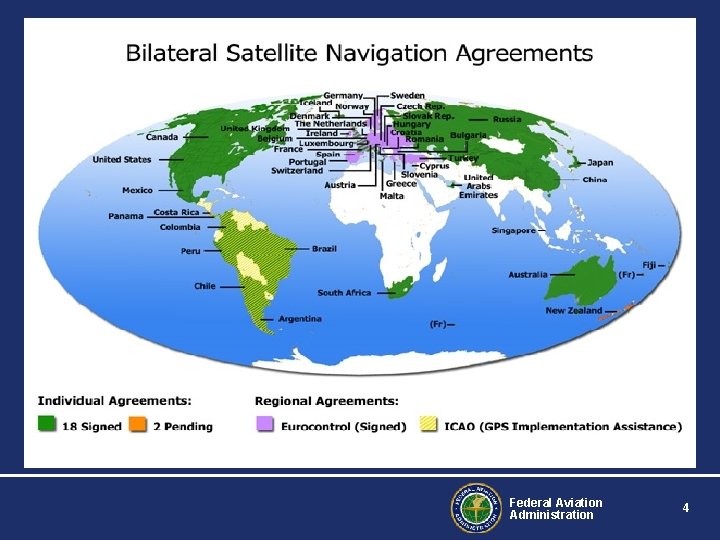
Federal Aviation Administration 4
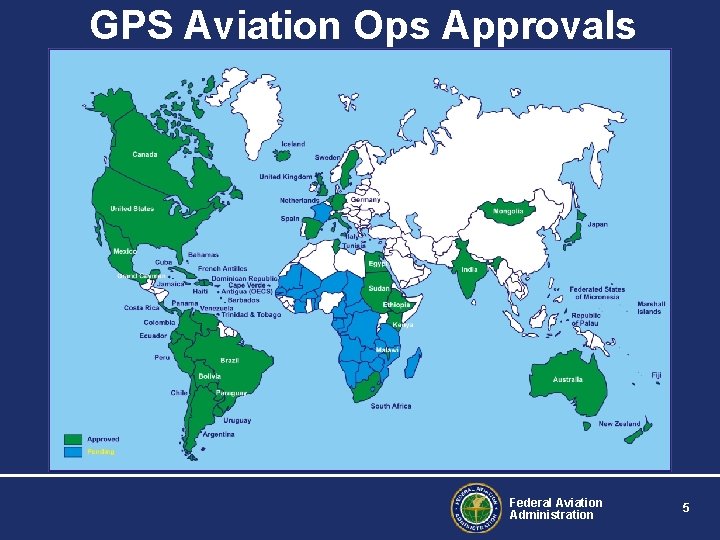
GPS Aviation Ops Approvals 42 2 Federal Aviation Administration 5
Space Based Augmentation System (e. g. WAAS) • Enhanced Navigation for All Phases of Flight – Enroute, Arrival, and Departure: Provides Navigation Services to Users Not Currently Served by Land Based Navigation Aids – Increases Availability of GNSS – Vertically Guided Aircraft Approach: • Enhances Safety by Providing Vertical Guidance • No Ground Hardware Required at Airport • Allows Instrument Operations to All Capable Airports • Supports Every Runway in Coverage Area • Provides Safety of Life Integrity Services today – Use Expanding Globally • SBAS Can Augment Multiple Satellite Navigation System Constellations Federal Aviation Administration 6

SBAS (WAAS) Architecture Federal Aviation Administration 7
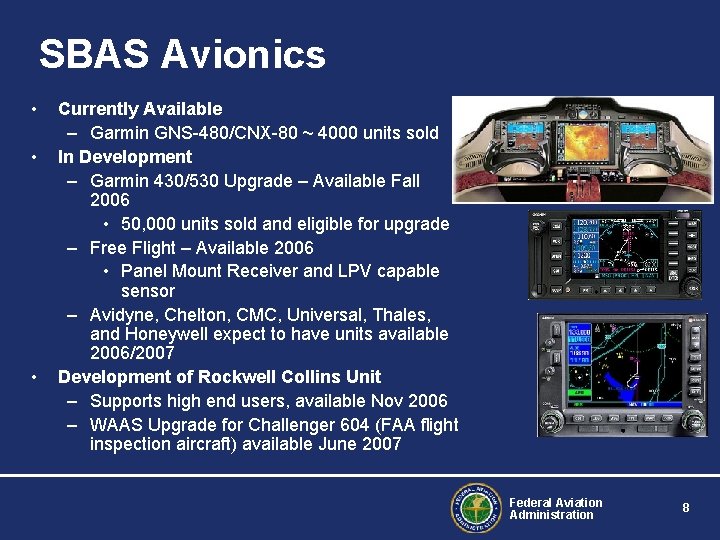
SBAS Avionics • • • Currently Available – Garmin GNS-480/CNX-80 ~ 4000 units sold In Development – Garmin 430/530 Upgrade – Available Fall 2006 • 50, 000 units sold and eligible for upgrade – Free Flight – Available 2006 • Panel Mount Receiver and LPV capable sensor – Avidyne, Chelton, CMC, Universal, Thales, and Honeywell expect to have units available 2006/2007 Development of Rockwell Collins Unit – Supports high end users, available Nov 2006 – WAAS Upgrade for Challenger 604 (FAA flight inspection aircraft) available June 2007 Federal Aviation Administration 8
Ground-Based Augmentation System (GBAS) • U. S. Approach to ICAO Strategy for Interoperable GBAS is Local Area Augmentation System (LAAS) • Provides Navigation Signal to Support Most Demanding Approach Requirements • One LAAS Ground Station Can Cover Entire Airport to Provide Precision Guidance – Approach and Departure Procedures to All Runway Ends – Surface Movement (Taxi operations) Federal Aviation Administration 9
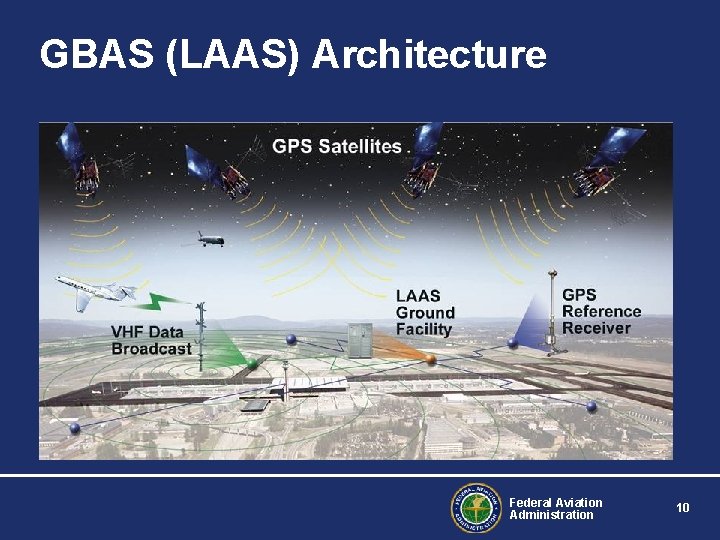
GBAS (LAAS) Architecture Federal Aviation Administration 10
GBAS International Cooperation • International Service Providers Need Precision Approach capability (200 to zero foot Decision Height) – FAA, Airservices Australia, AENA/Spain, and DFS/Germany Have Ongoing Contract Activities • International GBAS Working Group established – With European Service Providers, EUROCONTROL and Industry • Boeing & Airbus Joined in Support of GBAS – Boeing B-737 NG Certified With GBAS Avionics – Airbus A-380 to be Certified • International GBAS Development Activities – Airservices Australia Interested in cooperation with FAA to Leverage U. S. GBAS Technology Investments to provide initial ops capability – Germany and Spain Interested in use of resulting product Federal Aviation Administration 11
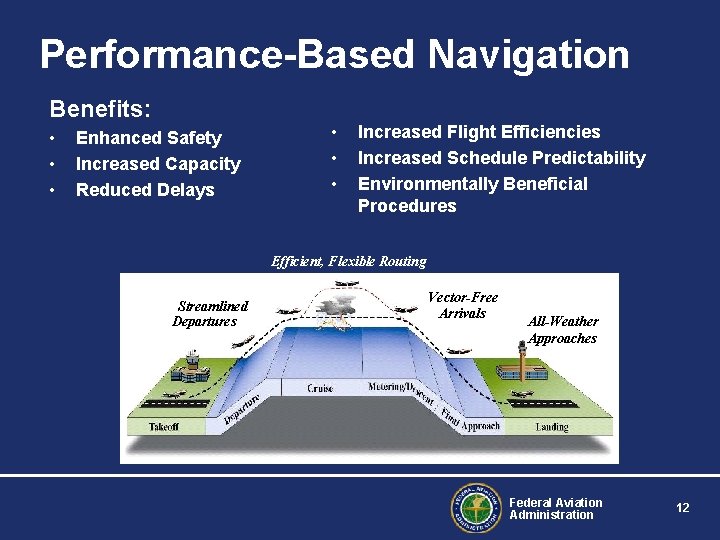
Performance-Based Navigation Benefits: • • • Enhanced Safety Increased Capacity Reduced Delays • • • Increased Flight Efficiencies Increased Schedule Predictability Environmentally Beneficial Procedures Efficient, Flexible Routing Streamlined Departures Vector-Free Arrivals All-Weather Approaches Federal Aviation Administration 12
Summary • GPS: Robust and Operating above Standards; Modernized System will Meet Aviation Needs • SBAS: WAAS Commissioned for Instrument Use and Incrementally Adding Capability – – Supports Performance Based Airspace Capability Benefits All Classes of Aviation Users Enhances Navigation for All Phases of Flight Receivers Available Today, More Coming Next 3 Years • GBAS (LAAS) – Continuing to investigate Technical Approach • Performance Based Navigation – U. S. Committed to Performance Based Systems Transitions Leveraging Aircraft and Aviation Infrastructure Investments Federal Aviation Administration 13
BACKUPS Federal Aviation Administration 14

Federal Aviation Administration http: //gps. faa. gov
- Slides: 15