
Global Marketing Communications Decisions I Advertising and Public
Global Marketing Communications Decisions I: Advertising and Public Relations Chapter 13 Global Marketing WARREN J. KEEGAN MARK C. GREEN Ninth Edition, Global Edition Copyright © 2017 Pearson Education, Ltd. 13 -1
Learning Objectives 1. Define global advertising and identify the top-ranked companies in terms of worldwide ad spending. 2. Explain the structure of the advertising industry and describe the difference between agency holding companies and individual agency brands. 3. Identify the key roles of ad agency personnel and describe their respective roles in creating global advertising. 4. Explain how different media availability varies around the world. 5. Compare and contrast publicity and public relations and identify global companies that have recently been impacted by negative publicity. Copyright © 2017 Pearson Education, Ltd. 13 -2
IMC • Integrated Marketing Communications (IMC) is becoming more popular because of the challenges of communicating across national borders “We have an integrated marketing model that involves all elements of the marketing mix from digital to sports marketing, from event marketing to advertising to entertainment, all sitting at the table driving ideas. ” Trevor Edwards, President, Nike Brand Copyright © 2017 Pearson Education, Ltd. 13 -3
Global Advertising • Advertising is any sponsored, paid message that is communicated in a non-personal way – Single country – Regional – Global • Global advertising is the use of the same advertising appeals, messages, art, copy, photographs, stories, and video segments for worldwide suitability • Surpassed $560 billion in 2019 Copyright © 2017 Pearson Education, Ltd. 13 -4
Globalization and Product Cultures • Products such as coffee and soft drink have emerged as true global products – Starbucks and the coffee culture – Coke halls in every where Copyright © 2017 Pearson Education, Ltd. 13 -5

Worldwide Market Segments “Eighteen-year olds in Paris have more in common with 18 -year-olds in New York than with their own parents. They buy the same products, go to the same movies, listen to the same music, sip the same colas. Global advertising merely works on that premise. ” - William Roedy, Director, MTV Europe Copyright © 2017 Pearson Education, Ltd. 13 -6
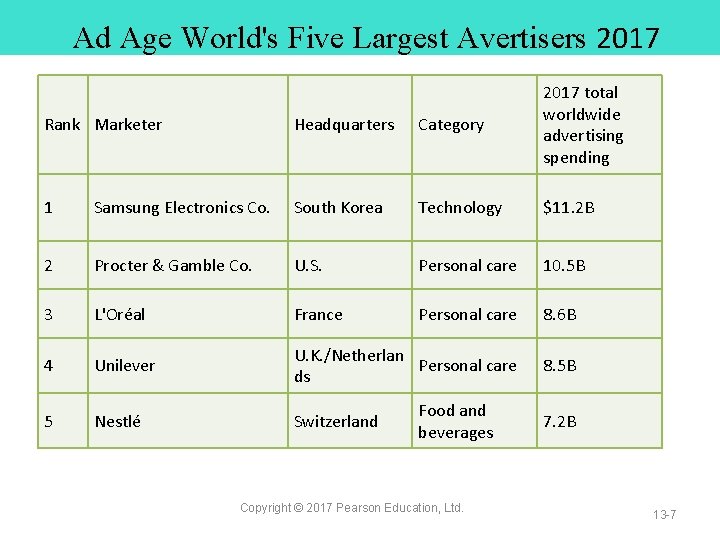
Ad Age World's Five Largest Avertisers 2017 Rank Marketer Headquarters Category 2017 total worldwide advertising spending 1 Samsung Electronics Co. South Korea Technology $11. 2 B 2 Procter & Gamble Co. U. S. Personal care 10. 5 B 3 L'Oréal France Personal care 8. 6 B 4 Unilever U. K. /Netherlan Personal care ds 8. 5 B 5 Nestlé Switzerland Food and beverages Copyright © 2017 Pearson Education, Ltd. 7. 2 B 13 -7
Standardization vs. Adaptation • Primary Issue – Must the specific advertising message and media strategy be changed from region to region or country to country? • Think of cultural and legal issues Copyright © 2017 Pearson Education, Ltd. 13 -8
Standardization vs. Adaptation • Four difficulties that compromise an organization’s communication efforts 1. The message may not get through to the intended recipient. (media) 2. The message may reach the target audience but may not be understood or may even be misunderstood. (target) 3. The message may reach the target audience and may be understood but still may not induce the recipient to take the action desired by the sender. (cultur) 4. The effectiveness of the message can be impaired by noise. Copyright © 2017 Pearson Education, Ltd. 13 -9
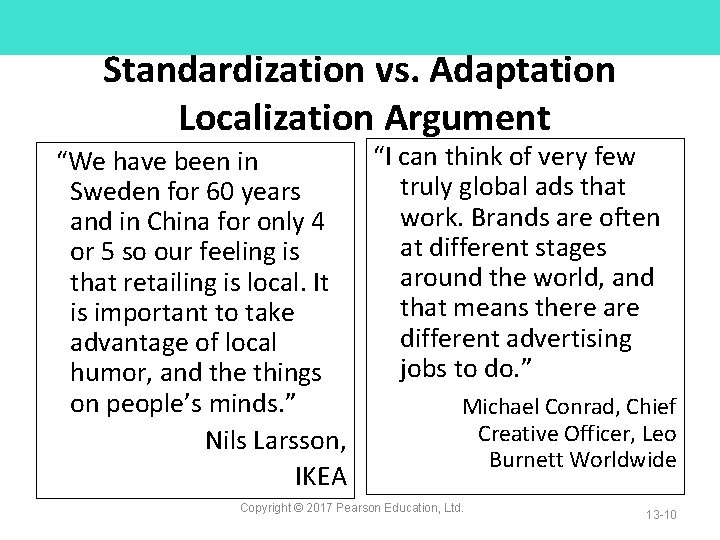
Standardization vs. Adaptation Localization Argument “I can think of very few “We have been in truly global ads that Sweden for 60 years work. Brands are often and in China for only 4 at different stages or 5 so our feeling is around the world, and that retailing is local. It that means there are is important to take different advertising advantage of local jobs to do. ” humor, and the things on people’s minds. ” Michael Conrad, Chief Creative Officer, Leo Nils Larsson, Burnett Worldwide IKEA Copyright © 2017 Pearson Education, Ltd. 13 -10
Standardization vs. Adaptation Globalization Argument “Why should three artists in three different countries sit drawing the same electric iron and three copywriters write about what, after all, is largely the same copy for the same iron? ” Eric Elinder, Swedish ad agency exec in the 1960 s Copyright © 2017 Pearson Education, Ltd. 13 -11
Pattern Advertising • A middle ground between 100% standardization and 100% adaptation • A basic pan-regional or global communication concept for which copy, artwork, or other elements can be adapted as required for individual countries Copyright © 2017 Pearson Education, Ltd. 13 -12

Pattern Advertising Similar: • Layout • Dominant visuals on left • Brand signature and slogan Contrasting: • Photos • Body copy is localized, not simply translated Copyright © 2017 Pearson Education, Ltd. 13 -13
Advertising Agencies: Organizations and Brands • Understanding the term organization is key – Umbrella corporations/holding companies have one or more ‘core’ advertising agencies – Each ‘organization’ has units specializing in direct marketing, marketing services, public relations, or research • Individual agencies are considered brands – Full service brands create advertising, and provide services such as market research, media buying, and direct marketing Copyright © 2017 Pearson Education, Ltd. 13 -14
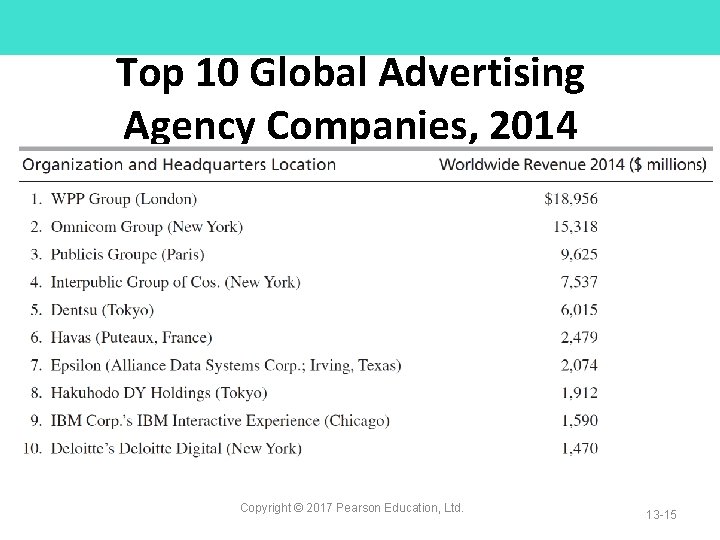
Top 10 Global Advertising Agency Companies, 2014 Copyright © 2017 Pearson Education, Ltd. 13 -15
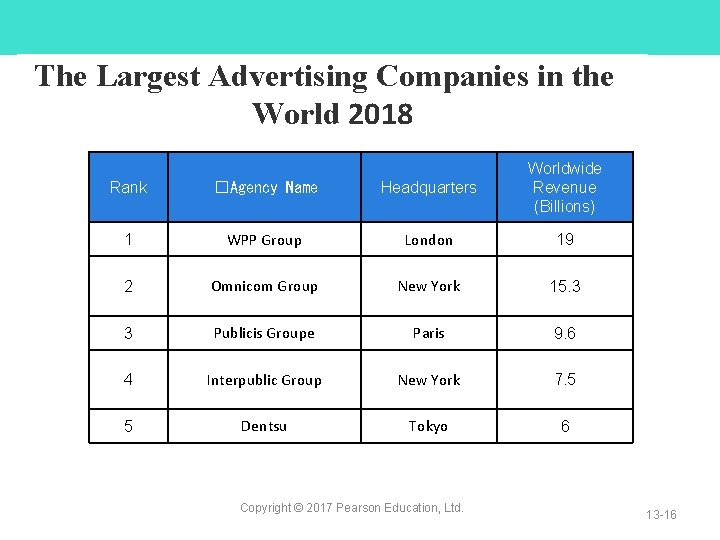
The Largest Advertising Companies in the World 2018 Rank �Agency Name Headquarters Worldwide Revenue (Billions) 1 WPP Group London 19 2 Omnicom Group New York 15. 3 3 Publicis Groupe Paris 9. 6 4 Interpublic Group New York 7. 5 5 Dentsu Tokyo 6 Copyright © 2017 Pearson Education, Ltd. 13 -16
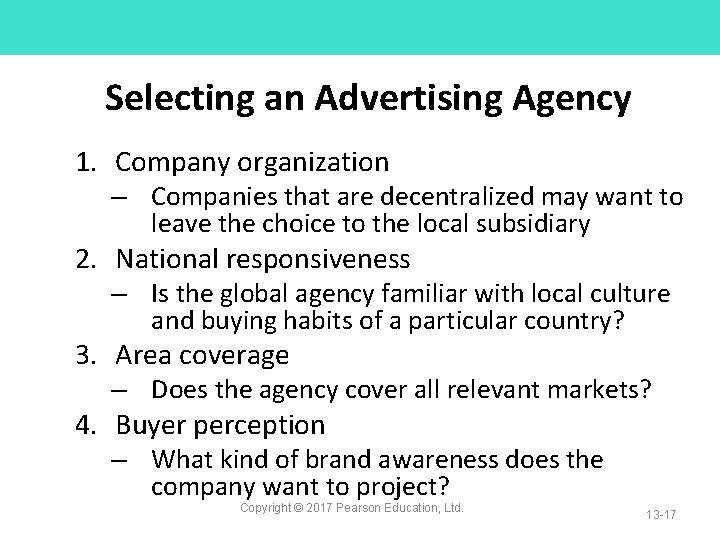
Selecting an Advertising Agency 1. Company organization – Companies that are decentralized may want to leave the choice to the local subsidiary 2. National responsiveness – Is the global agency familiar with local culture and buying habits of a particular country? 3. Area coverage – Does the agency cover all relevant markets? 4. Buyer perception – What kind of brand awareness does the company want to project? Copyright © 2017 Pearson Education, Ltd. 13 -17
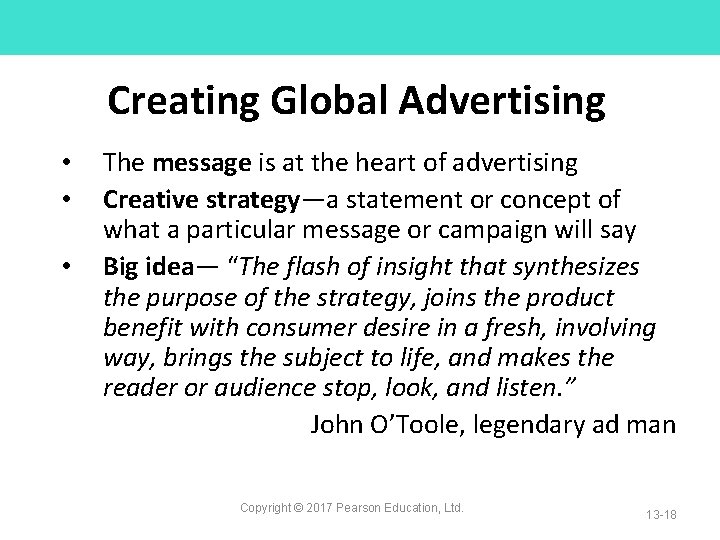
Creating Global Advertising • • • The message is at the heart of advertising Creative strategy—a statement or concept of what a particular message or campaign will say Big idea— “The flash of insight that synthesizes the purpose of the strategy, joins the product benefit with consumer desire in a fresh, involving way, brings the subject to life, and makes the reader or audience stop, look, and listen. ” John O’Toole, legendary ad man Copyright © 2017 Pearson Education, Ltd. 13 -18
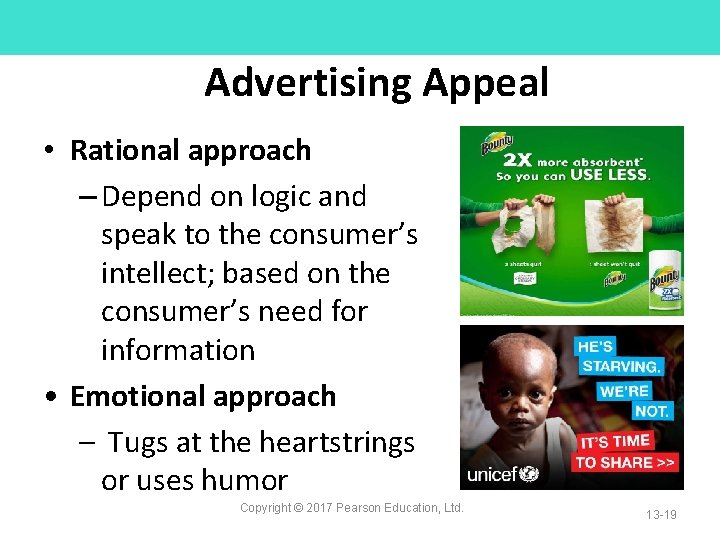
Advertising Appeal • Rational approach – Depend on logic and speak to the consumer’s intellect; based on the consumer’s need for information • Emotional approach – Tugs at the heartstrings or uses humor Copyright © 2017 Pearson Education, Ltd. 13 -19
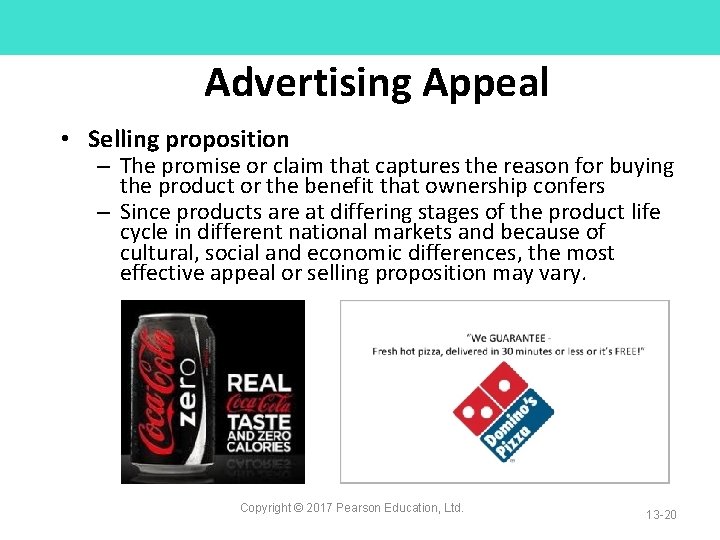
Advertising Appeal • Selling proposition – The promise or claim that captures the reason for buying the product or the benefit that ownership confers – Since products are at differing stages of the product life cycle in different national markets and because of cultural, social and economic differences, the most effective appeal or selling proposition may vary. Copyright © 2017 Pearson Education, Ltd. 13 -20
Creative Execution • Creative execution – The way an appeal or proposition is presented • straight sell • scientific evidence • demonstration • comparison • slice of life • animation • fantasy • dramatization Copyright © 2017 Pearson Education, Ltd. 13 -21
Creatives and Their Tasks • Art Directors – Advertising professional who has the general responsibility for the overall look of an ad – Will choose graphics, pictures, type styles, and other visual elements that appear in an ad • Copy is written or spoken communication elements • Copywriters are language specialists who develop headlines, subheads, and body copy • Art Direction – The visional presentation of an advertisement Copyright © 2017 Pearson Education, Ltd. 13 -22
Copywriting Decisions • Prepare new copy foreign markets in host country’s language • Translate the original copy into target language • Leave some or all copy elements in home country language Copyright © 2017 Pearson Education, Ltd. 13 -23
Advertising Copy Mistakes • In Asia, Pepsi’s “Come Alive” was interpreted as asking to bring ancestors back from the dead • In China, Citicorp’s “Citi Never Sleeps” was taken to mean that Citi had a sleeping disorder, like insomnia • Mc. Donald’s does not use multiple 4’s in advertising prices in China; “four” sounds like the word “death” Copyright © 2017 Pearson Education, Ltd. 13 -24
Cultural Considerations • Images of male/female intimacy are in bad taste in Japan; illegal in Saudi Arabia • Wedding rings are worn on the right hand in Spain, Denmark, Holland, Germany • European men kiss the hands of married women only, not single women • In Germany, France and Japan, a man enters a door before a woman; no ladies first! Copyright © 2017 Pearson Education, Ltd. 13 -25
Cultural Considerations • Humorous or irritating ads may be perceived differently in other countries • American ads with direct comparisons & spokespeople use logic to appeal to the viewer’s sense of reason; Japanese ads rely on implied sentiment • Partial nudity & same-sex couples are featured in Latin America & Europe • Food is the most culturally sensitive category Copyright © 2017 Pearson Education, Ltd. 13 -26
Cultural Considerations– Japanese & American Differences • Indirect rather than direct forms of expression are preferred in the messages • There is often little relationship between ad content and the advertised product • Only brief dialogue or narration is used in television commercials, with minimal explanatory content • Humor is used to create a bond of mutual feelings • Famous celebrities appear as close acquaintances or everyday people • Priority is placed on company trust rather than product quality • The product name is impressed on the viewer with short, 15 -second commercials Copyright © 2017 Pearson Education, Ltd. 13 -27
Global Media Decisions • Which medium or media to use? – Print such as daily and weekly newspapers to magazines with regional, national, or international audiences – Electronic media like broadcast TV, cable TV, radio, and the internet – Other such as outdoor, transit, and direct mail • Must know country-specific regulations – Ex. France bans TV ads by retailers Copyright © 2017 Pearson Education, Ltd. 13 -28
Global Advertising Expenditures and Media Vehicles • More money spent in U. S. than anywhere else in the world; $176 billion in 2014 • China is #2 at $52 billion • 1/3 of current growth in ad spending in BRICS • Worldwide, TV is the #1 medium with estimated spending of $206 billion in 2014; TV captured slightly less than 40% of global ad spending • In Germany newspapers are #1 advertising vehicle Copyright © 2017 Pearson Education, Ltd. 13 -29
Media Decisions • The availability of TV, newspapers and other media varies widely globally • In developed countries, newspapers are declining as Internet usage rises • In India, newly redesigned papers are growing – 300 daily papers, only 4 million Indians subscribe to Internet service • In Moscow, billboards are #1; In a city built for 30, 000 cars, there are 3 million, creating massive traffic jams and captive audiences Copyright © 2017 Pearson Education, Ltd. 13 -30
Media Decisions: Arab Countries • People are depicted less often than in the U. S. • Women may only appear in those commercials that relate the advertised product • Women must wear long dresses • Brevity is a virtue in ads • Use of comparative advertising claims very limited • U. S. ads have more price information Copyright © 2017 Pearson Education, Ltd. 13 -31
Media Decisions: Scandinavia • Limited TV ads in Sweden, Norway, and Denmark • No advertising to children under 12 in Sweden • Spending on print media is 3 times higher than TV Copyright © 2017 Pearson Education, Ltd. 13 -32
Public Relations • Fosters goodwill and understanding • Generates favorable publicity • Tools – – – – – News releases Media kits Press conferences Tours Articles in trade, professional journals TV and radio talk show appearances Special events Social media Corporate Web sites Copyright © 2017 Pearson Education, Ltd. 13 -33
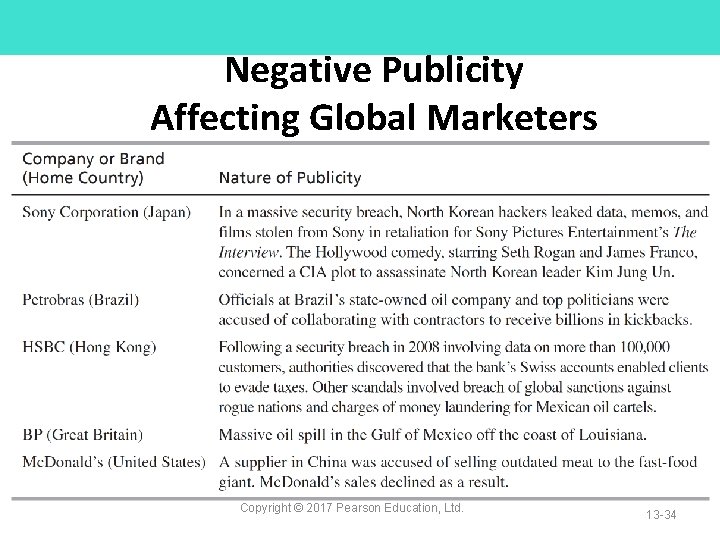
Negative Publicity Affecting Global Marketers Copyright © 2017 Pearson Education, Ltd. 13 -34
Advertising as a PR Function • Corporate advertising – Compensates for lack of control over publicity – Calls attention to the company’s other communication efforts • Image advertising – Enhances the public’s perception, creates goodwill • Advocacy advertising – Presents the company’s point of view on a particular issue Copyright © 2017 Pearson Education, Ltd. 13 -35
Role of Public Relations in Global Marketing Communications • PR’s role is growing in the post global recession – Build consensus and understanding – Create harmony and trust – Articulate and influence public opinion – Anticipate conflicts and resolve disputes – Smartphones, broadband Internet, social media, satellite links allow PR pros to stay in touch with media anywhere, anytime Copyright © 2017 Pearson Education, Ltd. 13 -36
Public Relations Practices Around the World • Public relations practices can be affected by: – Cultural traditions – Social and political contexts – Economic environments • Public relations professionals must understand these differences and tailor the message appropriately • PR can shine in a crisis; best to be forthright, direct, reassure the public, be accurate with the media Copyright © 2017 Pearson Education, Ltd. 13 -37
- Slides: 37