
Global Marketing CHAPTER 10 Strategy 2013 Pearson Education
Global Marketing CHAPTER 10 Strategy © 2013 Pearson Education, Inc. publishing as Prentice Hall Slide 10 -1

AFTER READING THIS CHAPTER YOU SHOULD BE ABLE TO: 1. Identify the reasons organizations chose to market their offerings outside their home country. 2. Describe the process of identifying global market opportunities. © 2013 Pearson Education, Inc. publishing as Prentice Hall Slide 10 -2
AFTER READING THIS CHAPTER YOU SHOULD BE ABLE TO: 3. Explain the four general modes for entering and competing in foreign markets. 4. Discuss the issues involved in designing and implementing a global marketing strategy. © 2013 Pearson Education, Inc. publishing as Prentice Hall Slide 10 -3
GLOBAL MARKETING STRATEGY World trade is driven by: • Global competition among… • Global organizations for… • Global consumers Global marketing involves the performance of activities designed to plan, price, promote, and direct the flow of an organization’s offerings in more than one country for a profit © 2013 Pearson Education, Inc. publishing as Prentice Hall Slide 10 -4
GLOBAL MARKETING STRATEGY Global marketing involves two related strategic decisions: Where to Compete How to Compete • Is global marketing right for the firm? • Which countries/markets should be pursued? • What mode? Different options for entering and competing in a foreign market. • What means? Choice regarding market targeting and the marketing mix within and between countries. © 2013 Pearson Education, Inc. publishing as Prentice Hall Slide 10 -5

CHAPTER 10: GLOBAL MARKETING STRATEGY THE DECISION TO GO GLOBAL © 2013 Pearson Education, Inc. publishing as Prentice Hall Slide 10 -6

THE DECISION TO GO GLOBAL: REASONS Gain access to new buyers: • Potential for increased revenues, profits, and long-term growth • Attractive if home country’s markets are mature Spread business risk across a wider market base Capitalize on an firm’s distinctive competencies and capabilities Lower costs and achieve operating efficiencies, thereby enhancing a firm’s competitiveness © 2013 Pearson Education, Inc. publishing as Prentice Hall Slide 10 -7

CHAPTER 10: GLOBAL MARKETING STRATEGY IDENTIFYING GLOBAL MARKETING OPPORTUNITIES © 2013 Pearson Education, Inc. publishing as Prentice Hall Slide 10 -8
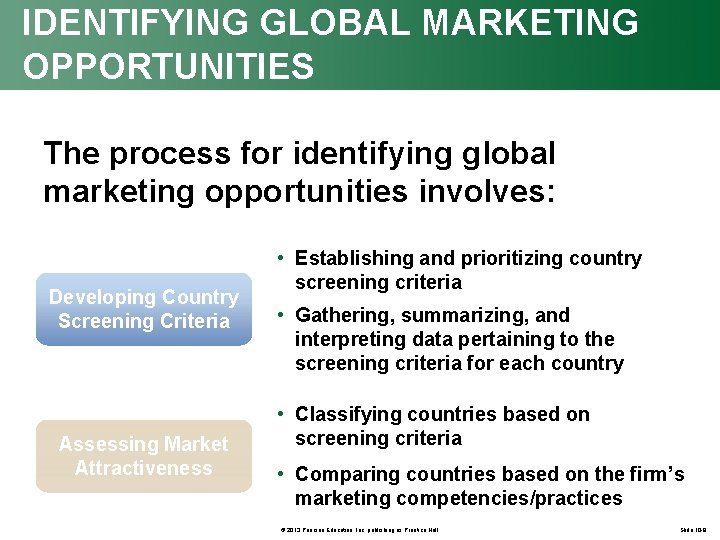
IDENTIFYING GLOBAL MARKETING OPPORTUNITIES The process for identifying global marketing opportunities involves: Developing Country Screening Criteria Assessing Market Attractiveness • Establishing and prioritizing country screening criteria • Gathering, summarizing, and interpreting data pertaining to the screening criteria for each country • Classifying countries based on screening criteria • Comparing countries based on the firm’s marketing competencies/practices © 2013 Pearson Education, Inc. publishing as Prentice Hall Slide 10 -9

IDENTIFYING GLOBAL MARKETING OPPORTUNITIES Developing Country Screening Criteria Quantitative Criteria • Market and profit potential (chain ratio) • Variables: demographics and usage • Sociocultural factors that underlie behaviors Qualitative Criteria • Country income and technological infrastructure • Trade regulations or free-trade zones • Strength of competitors (local & foreign) © 2013 Pearson Education, Inc. publishing as Prentice Hall Slide 10 -10
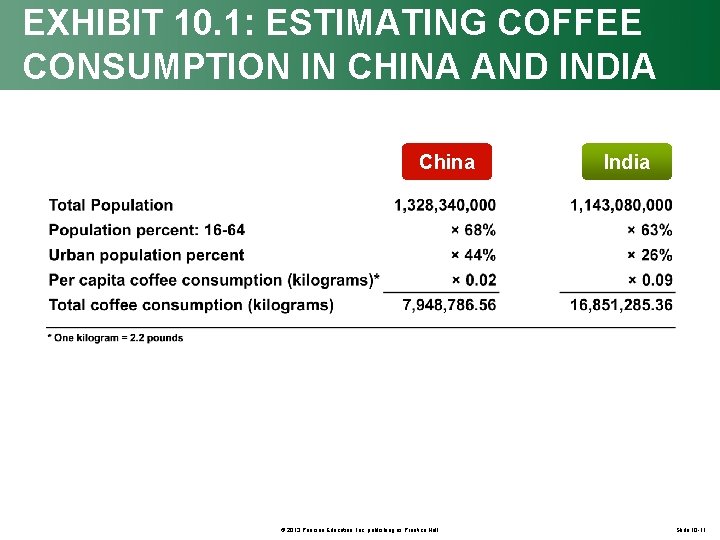
EXHIBIT 10. 1: ESTIMATING COFFEE CONSUMPTION IN CHINA AND INDIA China © 2013 Pearson Education, Inc. publishing as Prentice Hall India Slide 10 -11
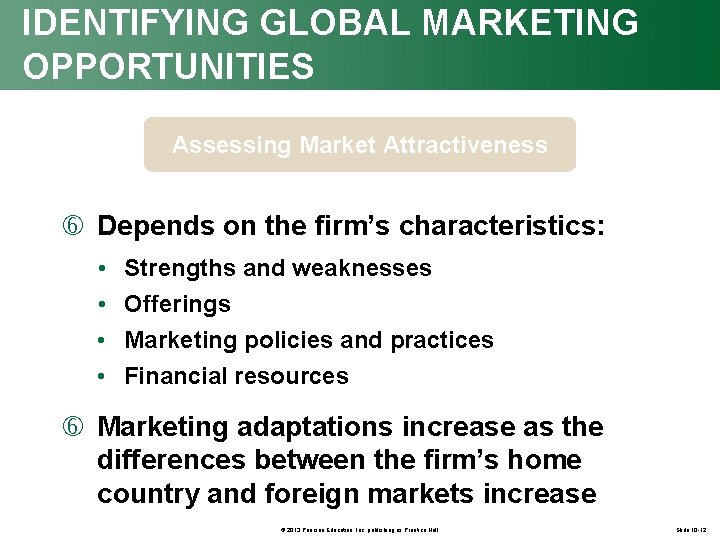
IDENTIFYING GLOBAL MARKETING OPPORTUNITIES Assessing Market Attractiveness Depends on the firm’s characteristics: • • Strengths and weaknesses Offerings Marketing policies and practices Financial resources Marketing adaptations increase as the differences between the firm’s home country and foreign markets increase © 2013 Pearson Education, Inc. publishing as Prentice Hall Slide 10 -12
CHAPTER 10: GLOBAL MARKETING STRATEGY ENTERING AND COMPETING IN FOREIGN MARKETS © 2013 Pearson Education, Inc. publishing as Prentice Hall Slide 10 -13

EXHIBIT 10. 2: FOUR GENERAL MODES OF ENTRY INTO FOREIGN MARKETS Exporting Licensing Joint Venture Direct Investment Increasing financial commitment, risk, marketing control, and profit potential © 2013 Pearson Education, Inc. publishing as Prentice Hall Slide 10 -14
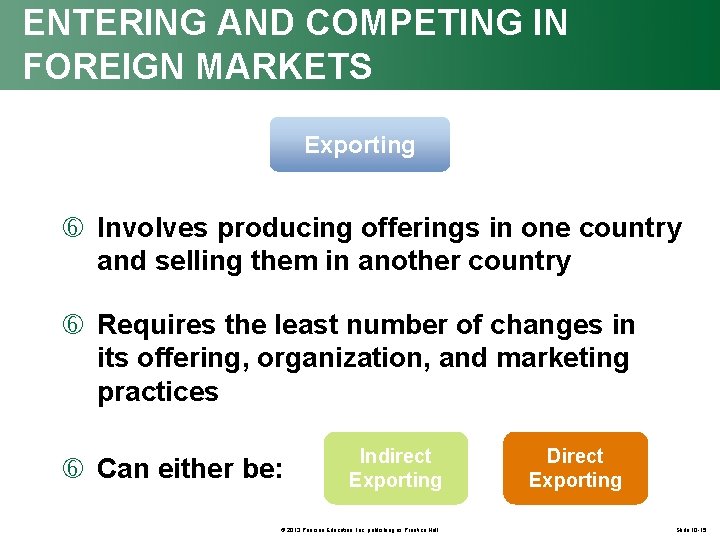
ENTERING AND COMPETING IN FOREIGN MARKETS Exporting Involves producing offerings in one country and selling them in another country Requires the least number of changes in its offering, organization, and marketing practices Can either be: Indirect Exporting © 2013 Pearson Education, Inc. publishing as Prentice Hall Direct Exporting Slide 10 -15
ENTERING AND COMPETING IN FOREIGN MARKETS Exporting Indirect Exporting A firm uses an intermediary to sell its domestic offerings in a foreign country Has the least financial commitment and risk Returns the least profit May be a distributor with the expertise and resources Is ideal for a firm with no foreign business contacts © 2013 Pearson Education, Inc. publishing as Prentice Hall Slide 10 -16
ENTERING AND COMPETING IN FOREIGN MARKETS Exporting Direct Exporting A firm sells its domestic offerings in a foreign country without an intermediary Used when sales volume is large enough and easy to obtain Involves more risk Can obtain more profits © 2013 Pearson Education, Inc. publishing as Prentice Hall Slide 10 -17
ENTERING AND COMPETING IN FOREIGN MARKETS Licensing Is a contract where a firm (licensee) is given the rights to intellectual property (patents, trademarks, trade secrets, etc. ) by the owner (licensor) in turn for a royalty or fee. © 2013 Pearson Education, Inc. publishing as Prentice Hall Slide 10 -18
ENTERING AND COMPETING IN FOREIGN MARKETS Licensing Advantages For the licensor: Is a low-risk, quick, and capital-free entry into a foreign market For the licensee: Gains info that allows it to start with a competitive advantage © 2013 Pearson Education, Inc. publishing as Prentice Hall Slide 10 -19
ENTERING AND COMPETING IN FOREIGN MARKETS Licensing Disadvantages To the licensor: Limits the production/marketing control over offering Reduced potential profits The firm may be creating its own competition If licensee is a poor choice, it may harm the firm’s and its brand reputation © 2013 Pearson Education, Inc. publishing as Prentice Hall Slide 10 -20
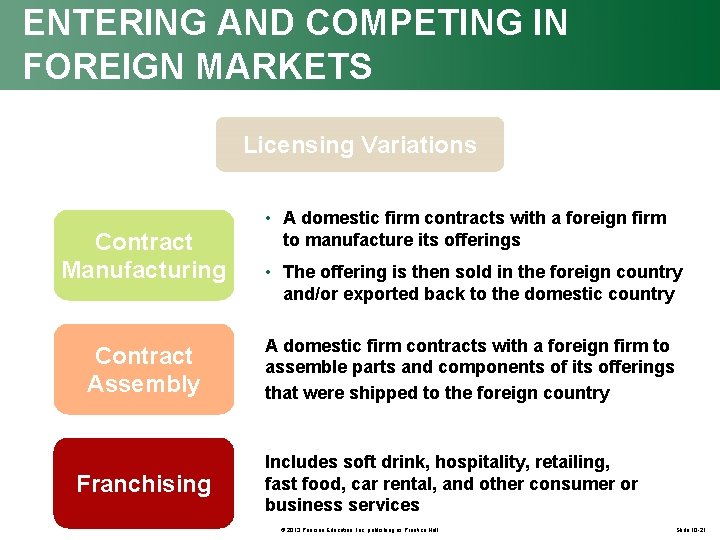
ENTERING AND COMPETING IN FOREIGN MARKETS Licensing Variations Contract Manufacturing Contract Assembly Franchising • A domestic firm contracts with a foreign firm to manufacture its offerings • The offering is then sold in the foreign country and/or exported back to the domestic country A domestic firm contracts with a foreign firm to assemble parts and components of its offerings that were shipped to the foreign country Includes soft drink, hospitality, retailing, fast food, car rental, and other consumer or business services © 2013 Pearson Education, Inc. publishing as Prentice Hall Slide 10 -21
ENTERING AND COMPETING IN FOREIGN MARKETS Joint Venture Occurs when a foreign and a local company invest together to create a new entity in the host country Allows the two firms share ownership, control, and profits of the entity Is popular because one firm may not have the required resources to enter a market alone May be trade barriers for other entry options Is difficult to manage: Choice of a partner and quality of the relationship © 2013 Pearson Education, Inc. publishing as Prentice Hall Slide 10 -22
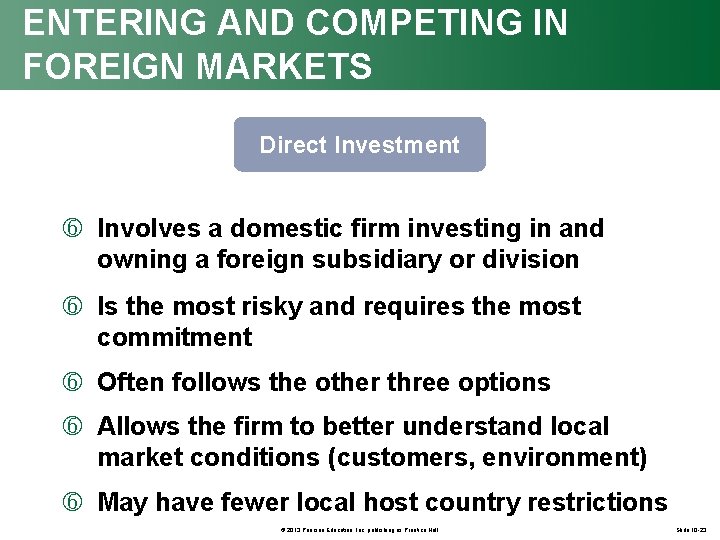
ENTERING AND COMPETING IN FOREIGN MARKETS Direct Investment Involves a domestic firm investing in and owning a foreign subsidiary or division Is the most risky and requires the most commitment Often follows the other three options Allows the firm to better understand local market conditions (customers, environment) May have fewer local host country restrictions © 2013 Pearson Education, Inc. publishing as Prentice Hall Slide 10 -23

CHAPTER 10: GLOBAL MARKETING STRATEGY CRAFTING A GLOBAL MARKETING STRATEGY © 2013 Pearson Education, Inc. publishing as Prentice Hall Slide 10 -24

CRAFTING A GLOBAL MARKETING STRATEGY “The art of global marketing is to standardize marketing strategies whenever possible and customize them wherever necessary. ” © 2013 Pearson Education, Inc. publishing as Prentice Hall Slide 10 -25
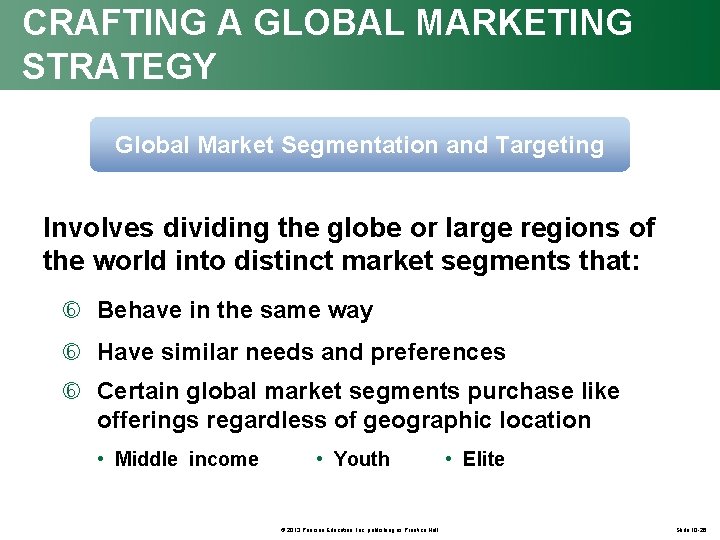
CRAFTING A GLOBAL MARKETING STRATEGY Global Market Segmentation and Targeting Involves dividing the globe or large regions of the world into distinct market segments that: Behave in the same way Have similar needs and preferences Certain global market segments purchase like offerings regardless of geographic location • Middle income • Youth © 2013 Pearson Education, Inc. publishing as Prentice Hall • Elite Slide 10 -26
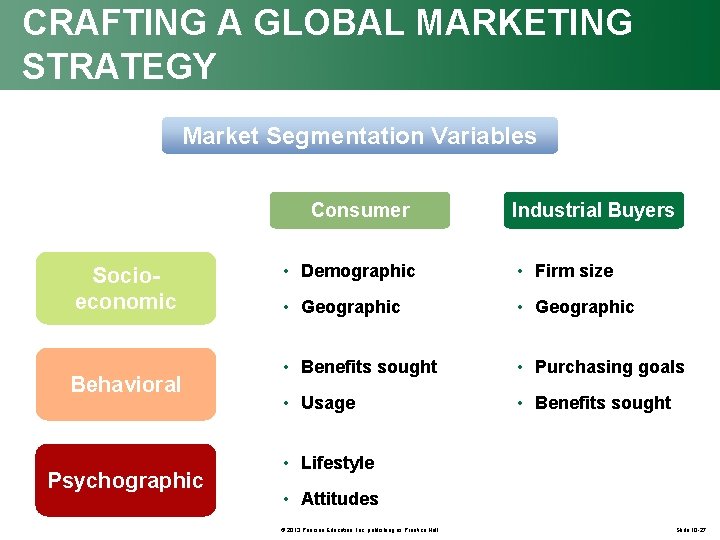
CRAFTING A GLOBAL MARKETING STRATEGY Market Segmentation Variables Consumer Socioeconomic Behavioral Psychographic Industrial Buyers • Demographic • Firm size • Geographic • Benefits sought • Purchasing goals • Usage • Benefits sought • Lifestyle • Attitudes © 2013 Pearson Education, Inc. publishing as Prentice Hall Slide 10 -27
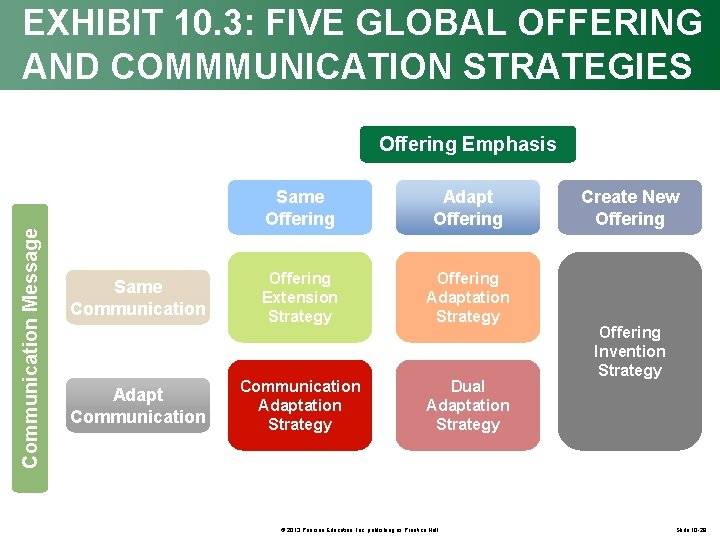
EXHIBIT 10. 3: FIVE GLOBAL OFFERING AND COMMMUNICATION STRATEGIES Communication Message Offering Emphasis Same Communication Adapt Communication Same Offering Adapt Offering Extension Strategy Offering Adaptation Strategy Communication Adaptation Strategy Dual Adaptation Strategy © 2013 Pearson Education, Inc. publishing as Prentice Hall Create New Offering Invention Strategy Slide 10 -28
CRAFTING A GLOBAL MARKETING STRATEGY Offering and Communication Strategies An offering may be sold globally in 1 of 3 ways: Offering Extension Offering Adaptation Offering Invention • Selling the same offering in other countries • Works best when the offering’s target market is alike across countries and cultures Changing an offering in some way to match a country’s climate or consumer preferences Inventing new offerings to satisfy common needs across countries © 2013 Pearson Education, Inc. publishing as Prentice Hall Slide 10 -29
CRAFTING A GLOBAL MARKETING STRATEGY Offering and Communication Strategies Global marketers use an identical communication message for both product extension and product adaptation strategies Global marketers adapt a communication message if cultural and purchase motives vary among target markets © 2013 Pearson Education, Inc. publishing as Prentice Hall Slide 10 -30
CRAFTING A GLOBAL MARKETING STRATEGY Marketing Channel and Pricing Strategies Standardization of marketing channel and pricing strategies is a challenge due to trade regulations and consumer buying preferences and practices of the various countries Competitive, political, tax, exchange rates, and legal constraints affect the pricing latitude and strategy of global marketers © 2013 Pearson Education, Inc. publishing as Prentice Hall Slide 10 -31
CRAFTING A GLOBAL MARKETING STRATEGY Global Brands and Positioning A global brand is a brand marketed under the same name in multiple countries with similar and centrally coordinated marketing programs, including positioning. © 2013 Pearson Education, Inc. publishing as Prentice Hall Slide 10 -32
CRAFTING A GLOBAL MARKETING STRATEGY Global Brands and Positioning Successful Characteristics of a Global Brand 1. High-technology products with strong functional images 2. High-image products with strong associations to fashionability, sensuality, wealth, or status 3. Services and business-to-business products that emphasize corporate images in their global marketing campaigns © 2013 Pearson Education, Inc. publishing as Prentice Hall Slide 10 -33
CRAFTING A GLOBAL MARKETING STRATEGY Global Brands and Positioning Successful Characteristics of a Global Brand 4. Retailers that sell to upper-class individuals or specialize in a salient but unfulfilled need 5. Brands positioned primarily on the basis of their country of origin 6. Products that do not need customization or other special products to function properly © 2013 Pearson Education, Inc. publishing as Prentice Hall Slide 10 -34

All rights reserved. No part of this publication may be reproduced, stored in a retrieval system, or transmitted, in any form or by any means, electronic, mechanical, photocopying, recording, or otherwise, without the prior written permission of the publisher. Printed in the United States of America. © 2013 Pearson Education, Inc. publishing as Prentice Hall Slide 10 -35
- Slides: 35