
Global Internet Global Internet NSFNET backbone Stanford ISU

Global Internet
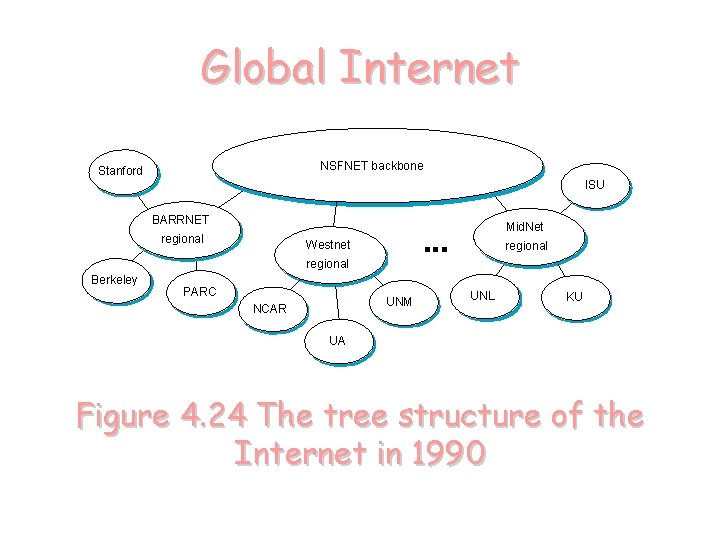
Global Internet NSFNET backbone Stanford ISU BARRNET Mid. Net regional Westnet regional ■■■ regional Berkeley PARC UNM NCAR UNL KU UA Figure 4. 24 The tree structure of the Internet in 1990
Global Internet • Each provider network is regional and a single autonomous system (AS) • Major issues are: – Scalability of routing – Address utilization (running out of IP addresses • Hierarchy is used to improve scalability.
Subnetting • Assigning one network number physical network uses up IP address too fast! • More network numbers also increases forwarding table size. • The idea is to take a single IP network number and allocate the IP addresses with that network number to several physical networks which are referred to as subnets. • The subnets need to be close to each other for routing purposes.
Subnetting • The mechanism by which a single network nubmer can be shared among multiple networks involves configuring all the nodes on each subnet with a subnet mask. • The subnet mask enables introduction of a single subnet number which provides for another level of hierarchy into the IP address. • All hosts on a given subnet are configured with the same mask, i. e. , there is one subnet mask per subnet.
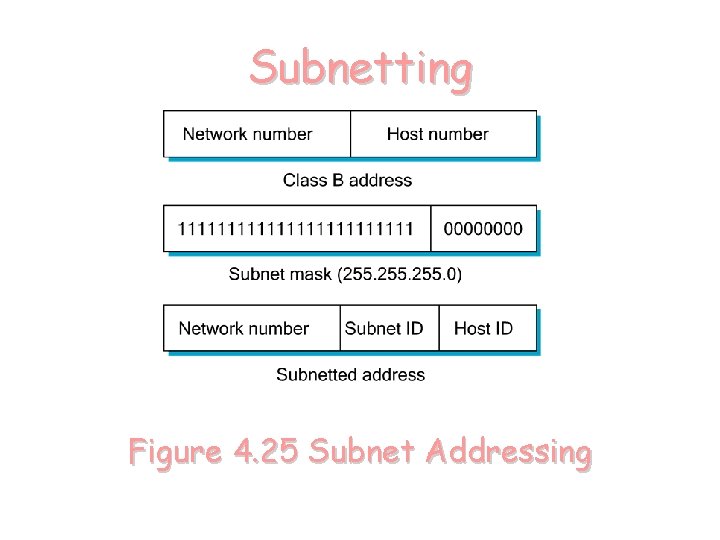
Subnetting Figure 4. 25 Subnet Addressing
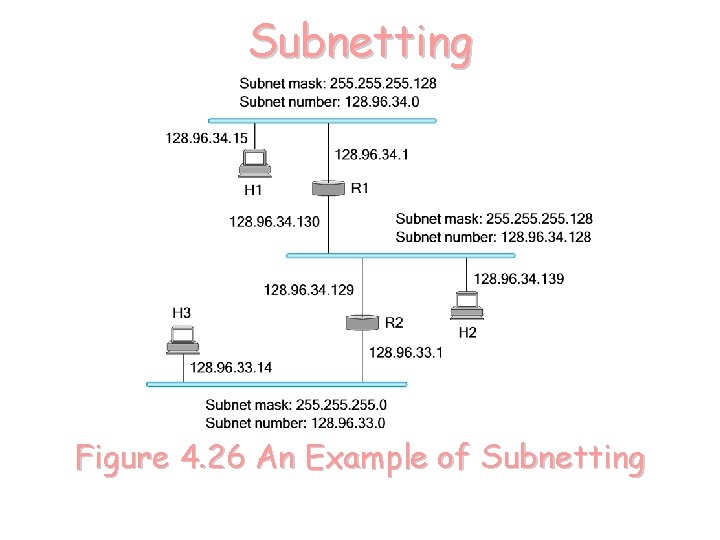
Subnetting Figure 4. 26 An Example of Subnetting
Classless Routing (CIDR) • Classless interdomain routing (CIDR) addresses: – The growth of backbone routing tables – The potential for 32 -bit IP address space to be exhausted • The problem is with the Class B numbers (64 K addresses) – Give out appropriate number of Class C addresses in 256 address chunks. – But this increases routing table entries for a single AS!
Classless Routing (CIDR) • CIDR helps us to aggregate routes by breaking up rigid boundaries between classes. • Hand out Class C addresses in contiguous blocks by address. • Make it so the addresses share a common prefix => allocate Class C networks as a power of 2. • We need a protocol that understands these rules, e. g. , BGP! • Network numbers are represented by (length, value) where length is the length of the prefix {similar to a mask}.
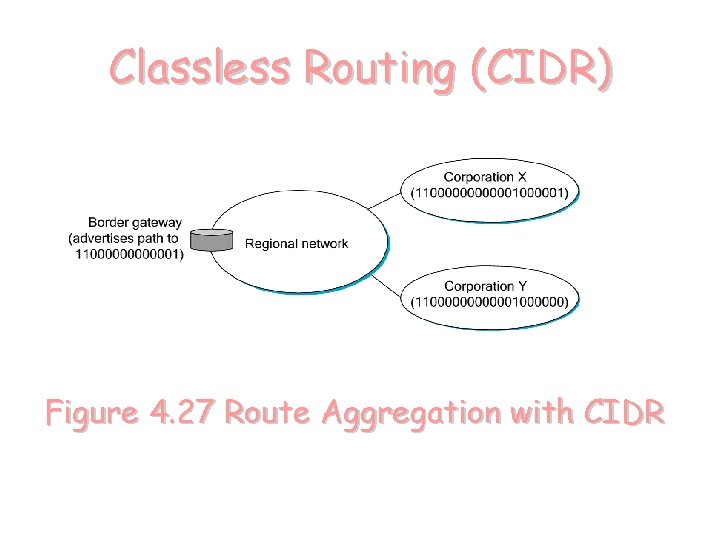
Classless Routing (CIDR) Figure 4. 27 Route Aggregation with CIDR
- Slides: 10