
Global Information Management System on Sanitation and Drinkingwater
Global Information Management System on Sanitation and Drinking-water (GIMS) Rifat Hossain 1 | GIMS - EXPERT GROUP MEETING ON MDG INDICATORS Astana 5 -8 October 2009
Presentation overview: from data collection, to analysis and effective decision making l What is GIMS? l GIMS and the bigger picture – – Global health situation WHO strategy for health information l GIMS functionality and connectivity l GIMS clients – – l JMP GLASS Benefits and next steps 2 | GIMS - EXPERT GROUP MEETING ON MDG INDICATORS Astana 5 -8 October 2009
What is GIMS? 3 | GIMS - EXPERT GROUP MEETING ON MDG INDICATORS Astana 5 -8 October 2009
Introduction l 2. 5 billion people without improved sanitation, around 900 million people without improved drinking-water l No surprise: diarrhoeal disease is the 2 nd leading cause of death from infectious diseases, even before HIV/AIDS - mostly children l Such deaths could be prevented, with good evidence based policies l It is difficult to make pro-poor evidence-based policy decisions: – Difficult to relate improvements in service levels to the drivers of the sector – Missing links between service levels to other socio-economic indicators, burden of water-borne diseases, climate resilience etc. 4 | GIMS - EXPERT GROUP MEETING ON MDG INDICATORS Astana 5 -8 October 2009
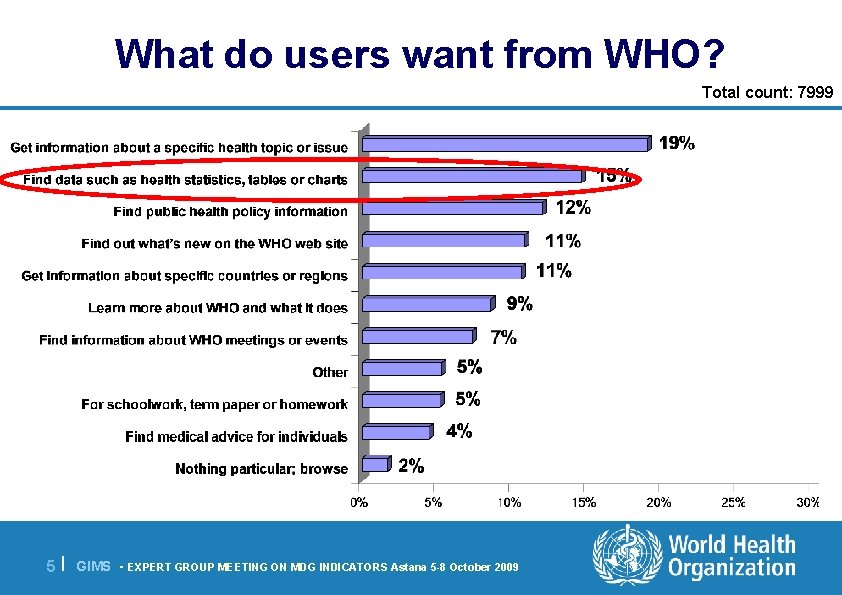
What do users want from WHO? Total count: 7999 5 | GIMS - EXPERT GROUP MEETING ON MDG INDICATORS Astana 5 -8 October 2009
What improvements are needed? Total count: 5598 6 | GIMS - EXPERT GROUP MEETING ON MDG INDICATORS Astana 5 -8 October 2009

GIMS: Why another system? l To strengthen the evidence base: filling gaps and links – – – Robust access estimates (use for JMP etc. ) Links between sanitation, drinking-water and health (disease burden etc. ) Links between Wat. San and other environmental issues l To measure progress of societies; link between service levels to poverty, Bo. D, climate resilience etc. l Build national capacity through – – Cost-effective dynamic online data reconciliation An integrated country/regional coordination mechanism and its interactive and dynamic support to populate GIMS 7 | GIMS - EXPERT GROUP MEETING ON MDG INDICATORS Astana 5 -8 October 2009
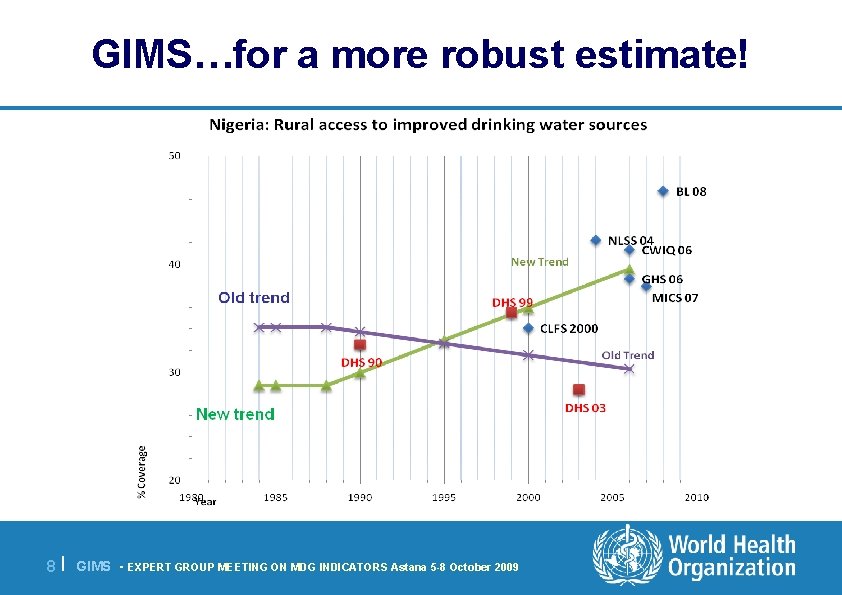
GIMS…for a more robust estimate! 8 | GIMS - EXPERT GROUP MEETING ON MDG INDICATORS Astana 5 -8 October 2009
GIMS: to reduce burden on data collection l Integrated into Global Health Observatory – A WHO data management portal l Connectivity to country data management tool – Dev. Info automatic connectivity l Other data management system (WSP, World Bank, OECD etc. ) 9 | GIMS - EXPERT GROUP MEETING ON MDG INDICATORS Astana 5 -8 October 2009
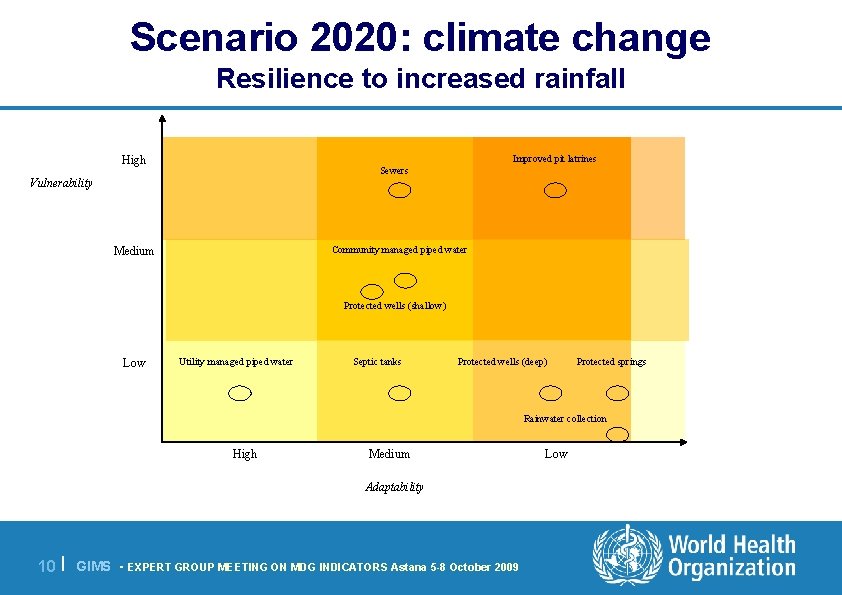
Scenario 2020: climate change Resilience to increased rainfall Improved pit latrines High Sewers Vulnerability Community managed piped water Medium Protected wells (shallow) Low Utility managed piped water Septic tanks Protected wells (deep) Protected springs Rainwater collection High Medium Adaptability 10 | GIMS - EXPERT GROUP MEETING ON MDG INDICATORS Astana 5 -8 October 2009 Low

GIMS: Who is it for? l Country authorities l Global bodies who provides policy relevant information l Researchers l Policy makers l Etc. 11 | GIMS - EXPERT GROUP MEETING ON MDG INDICATORS Astana 5 -8 October 2009

GIMS: components l A comprehensive data management system – Data collection – Data analysis – Data dissemination l A dynamic data linking system l Data to be shared with interested parties l Dynamic, web-enabled (Web 2. 0) – As opposed to static Web 1. 0 architecture 12 | GIMS - EXPERT GROUP MEETING ON MDG INDICATORS Astana 5 -8 October 2009
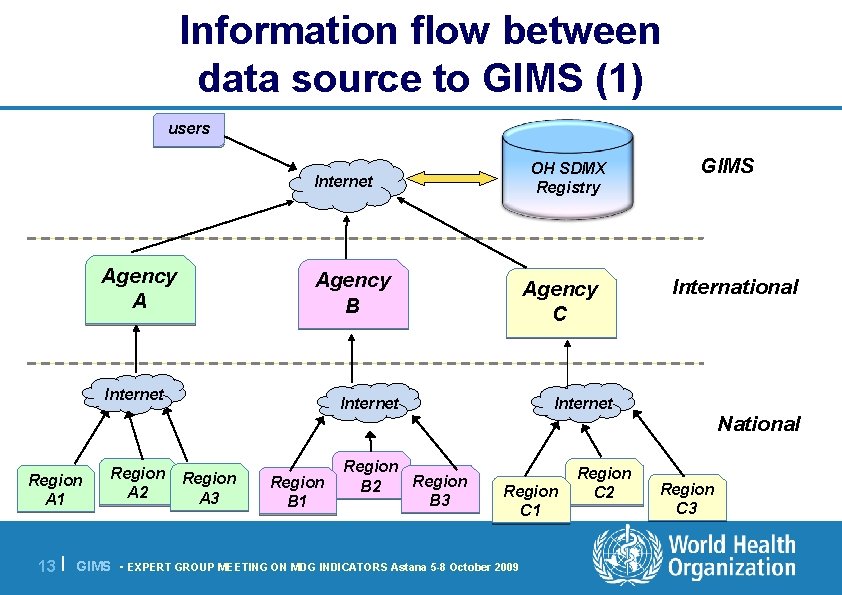
Information flow between data source to GIMS (1) users OH SDMX Registry Internet Agency A Agency B Internet Agency C Internet GIMS International Internet National Region A 1 Region A 2 Region A 3 Region B 1 Region B 2 B 3 Region C 1 13 | GIMS - EXPERT GROUP MEETING ON MDG INDICATORS Astana 5 -8 October 2009 Region C 2 Region C 3

Information flow between data source to GIMS (2) users OH SDMX Registry Internet Region A 1 Region A 2 Region A 3 Region B 1 Region B 2 B 3 International (GIMS) National Region C 1 14 | GIMS - EXPERT GROUP MEETING ON MDG INDICATORS Astana 5 -8 October 2009 Region C 2 Region C 3
GIMS and the bigger picture: 15 | GIMS - EXPERT GROUP MEETING ON MDG INDICATORS Astana 5 -8 October 2009
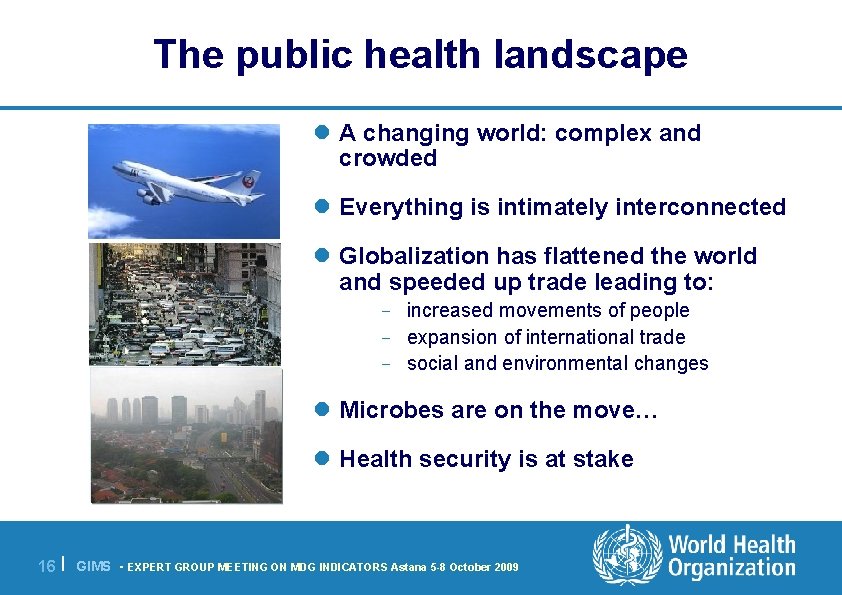
The public health landscape l A changing world: complex and crowded l Everything is intimately interconnected l Globalization has flattened the world and speeded up trade leading to: - increased movements of people - expansion of international trade - social and environmental changes l Microbes are on the move… l Health security is at stake 16 | GIMS - EXPERT GROUP MEETING ON MDG INDICATORS Astana 5 -8 October 2009
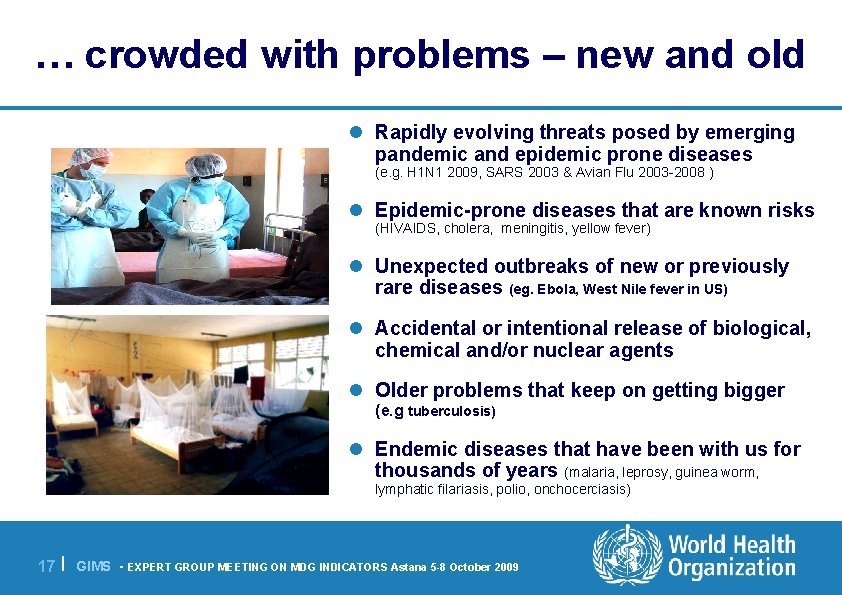
… crowded with problems – new and old l Rapidly evolving threats posed by emerging pandemic and epidemic prone diseases (e. g. H 1 N 1 2009, SARS 2003 & Avian Flu 2003 -2008 ) l Epidemic-prone diseases that are known risks (HIVAIDS, cholera, meningitis, yellow fever) l Unexpected outbreaks of new or previously rare diseases (eg. Ebola, West Nile fever in US) l Accidental or intentional release of biological, chemical and/or nuclear agents l Older problems that keep on getting bigger (e. g tuberculosis) l Endemic diseases that have been with us for thousands of years (malaria, leprosy, guinea worm, lymphatic filariasis, polio, onchocerciasis) 17 | GIMS - EXPERT GROUP MEETING ON MDG INDICATORS Astana 5 -8 October 2009
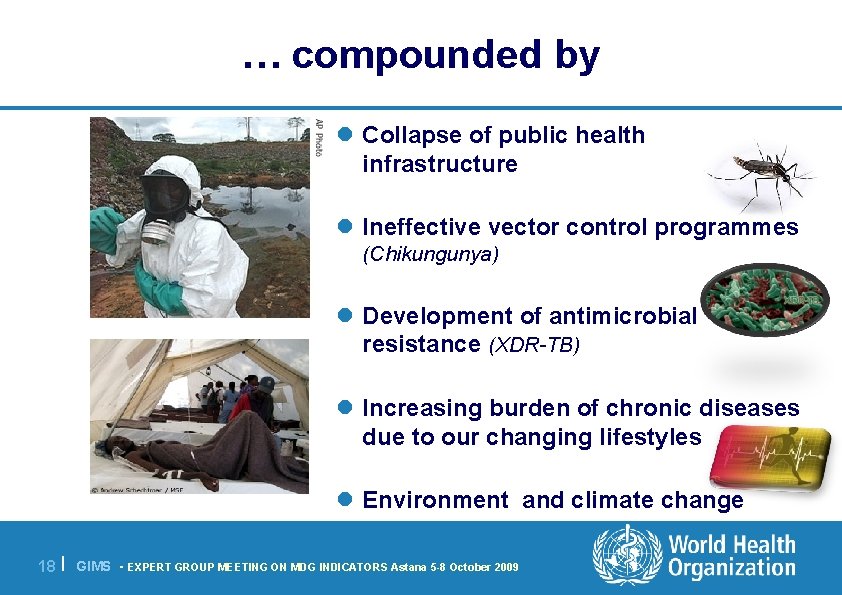
… compounded by l Collapse of public health infrastructure l Ineffective vector control programmes (Chikungunya) l Development of antimicrobial resistance (XDR-TB) l Increasing burden of chronic diseases due to our changing lifestyles l Environment and climate change 18 | GIMS - EXPERT GROUP MEETING ON MDG INDICATORS Astana 5 -8 October 2009
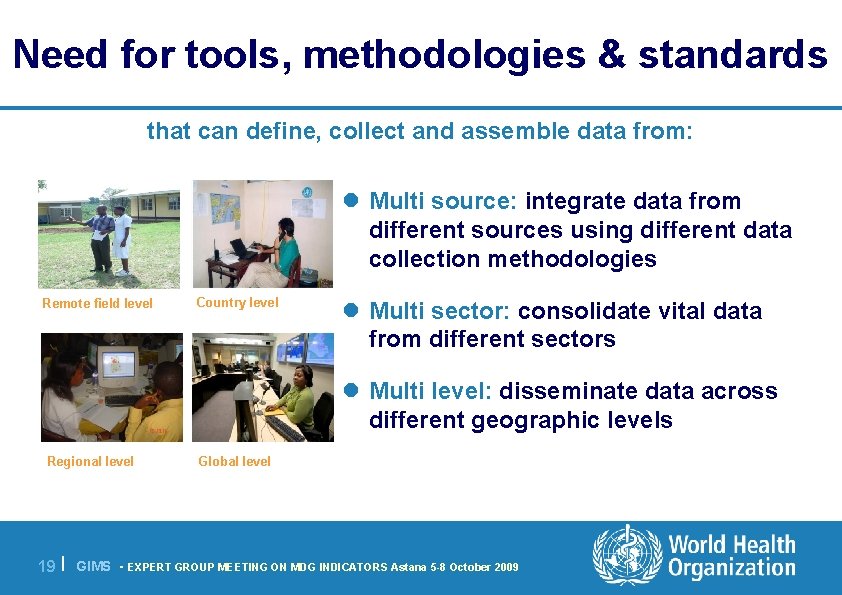
Need for tools, methodologies & standards that can define, collect and assemble data from: l Multi source: integrate data from different sources using different data collection methodologies Remote fieldsurveys level Community Health Country level Population surveys Education l Multi sector: consolidate vital data from different sectors l Multi level: disseminate data across different geographic levels Regional level Water Laboratory results level Global Environment 19 | GIMS - EXPERT GROUP MEETING ON MDG INDICATORS Astana 5 -8 October 2009
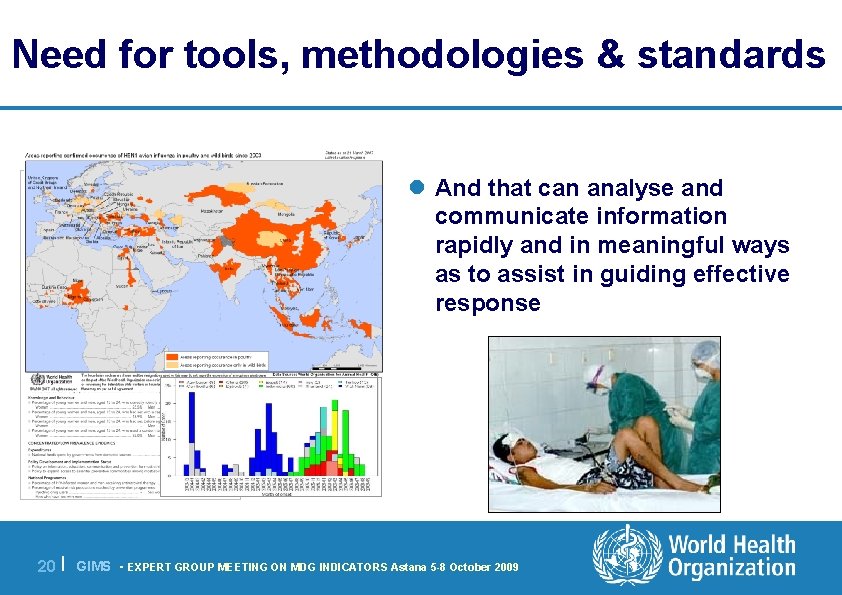
Need for tools, methodologies & standards l And that can analyse and communicate information rapidly and in meaningful ways as to assist in guiding effective response 20 | GIMS - EXPERT GROUP MEETING ON MDG INDICATORS Astana 5 -8 October 2009
Challenges in Information Management l Fragmentation and duplication l Lack of use of standards (case definitions, identifiers, geocoding, data exchange) l Lack of interoperability between database systems l Uncoordinated approaches to data collection l Data quality assessment and transparency: often weak l Major data gaps remain l Duplication of efforts/resources l Data portability, use and decision making is hampered 21 | GIMS - EXPERT GROUP MEETING ON MDG INDICATORS Astana 5 -8 October 2009
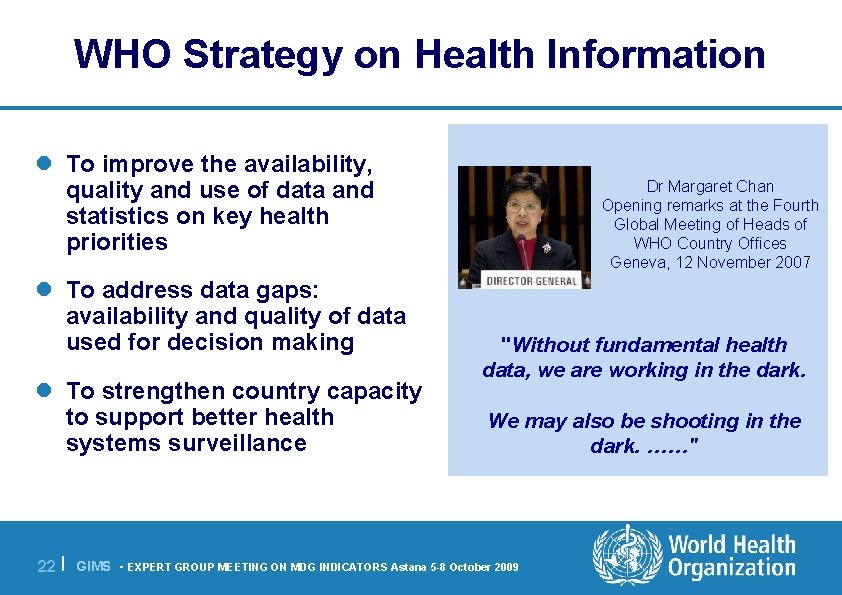
WHO Strategy on Health Information l To improve the availability, quality and use of data and statistics on key health priorities l To address data gaps: availability and quality of data used for decision making l To strengthen country capacity to support better health systems surveillance Dr Margaret Chan Opening remarks at the Fourth Global Meeting of Heads of WHO Country Offices Geneva, 12 November 2007 "Without fundamental health data, we are working in the dark. We may also be shooting in the dark. ……" 22 | GIMS - EXPERT GROUP MEETING ON MDG INDICATORS Astana 5 -8 October 2009
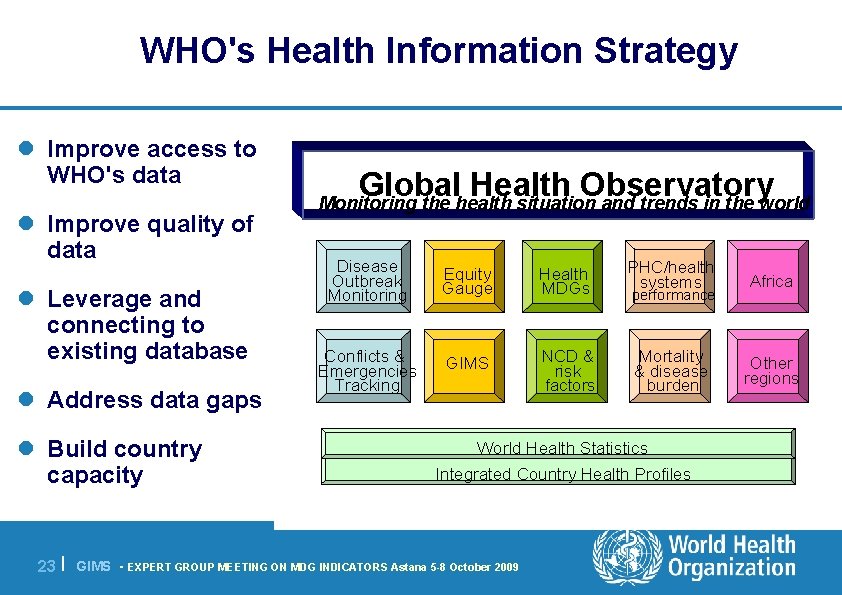
WHO's Health Information Strategy l Improve access to WHO's data l Improve quality of data l Leverage and connecting to existing database l Address data gaps l Build country capacity Global Health Observatory Monitoring the health situation and trends in the world Disease Outbreak Monitoring Equity Gauge Health MDGs PHC/health systems Africa Conflicts & Emergencies Tracking GIMS NCD & risk factors Mortality & disease burden Other regions performance World Health Statistics Integrated Country Health Profiles 23 | GIMS - EXPERT GROUP MEETING ON MDG INDICATORS Astana 5 -8 October 2009
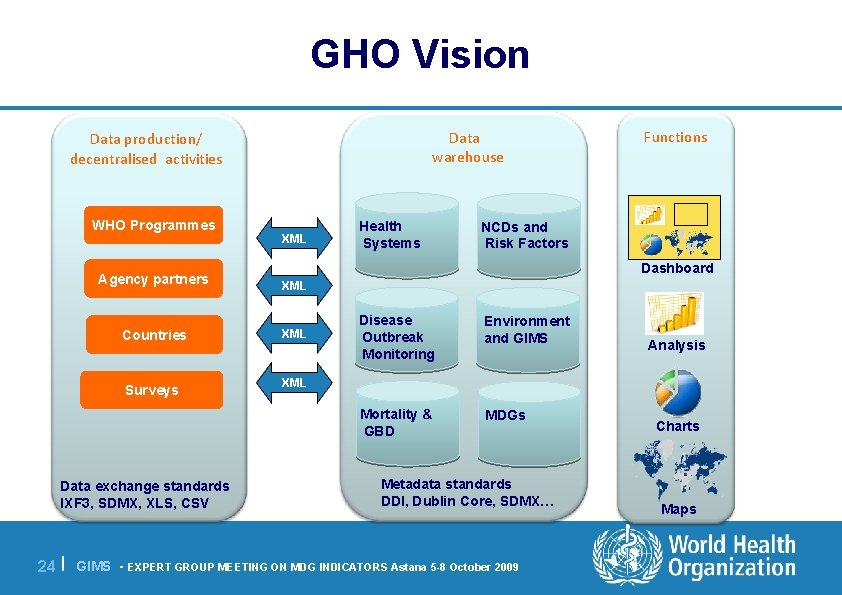
GHO Vision Data warehouse Data production/ decentralised activities WHO Programmes XML NCDs and Risk Factors Dashboard Agency partners XML Countries XML Surveys XML Data exchange standards IXF 3, SDMX, XLS, CSV Health Systems Functions Disease Outbreak Monitoring Environment and GIMS Mortality & GBD MDGs Metadata standards DDI, Dublin Core, SDMX… 24 | GIMS - EXPERT GROUP MEETING ON MDG INDICATORS Astana 5 -8 October 2009 Analysis Charts Maps
What will GHO not do l Centralize all data production and dissemination. l Control individual data producers: – statistical techniques for validating data – imputation of missing values – correction for bias, heterogeneity in the values of quantities of interest l Over-ride existing legacy systems and databases Instead l preserve the independence of data producers while making data and metadata part of a coherent and seamless corporate system l A constellation or federation of databases. 25 | GIMS - EXPERT GROUP MEETING ON MDG INDICATORS Astana 5 -8 October 2009
GIMS functionality and connectivity 26 | GIMS - EXPERT GROUP MEETING ON MDG INDICATORS Astana 5 -8 October 2009
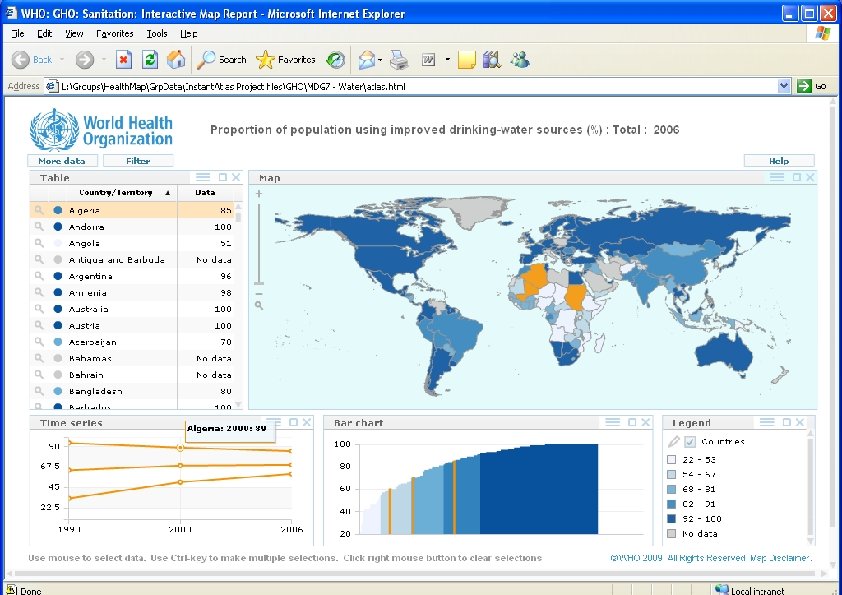
27 | GIMS - EXPERT GROUP MEETING ON MDG INDICATORS Astana 5 -8 October 2009
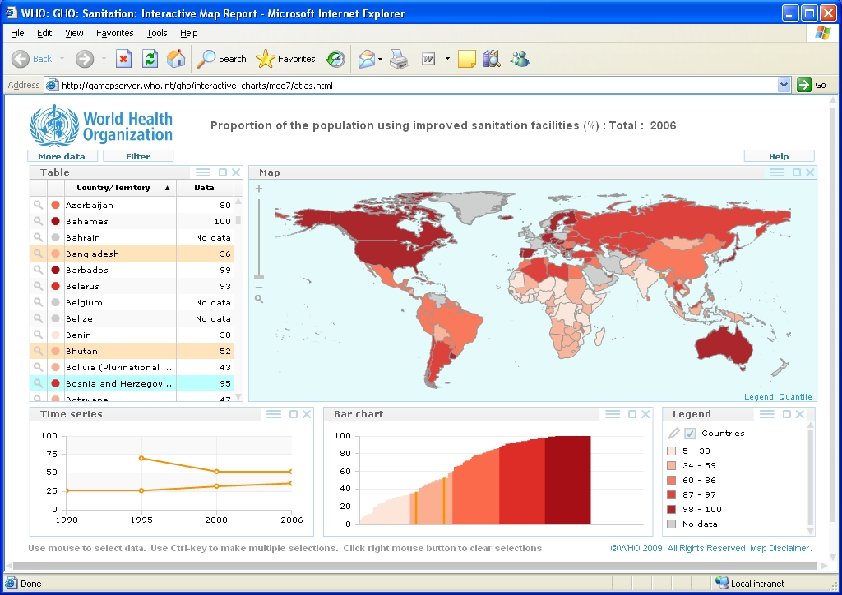
28 | GIMS - EXPERT GROUP MEETING ON MDG INDICATORS Astana 5 -8 October 2009
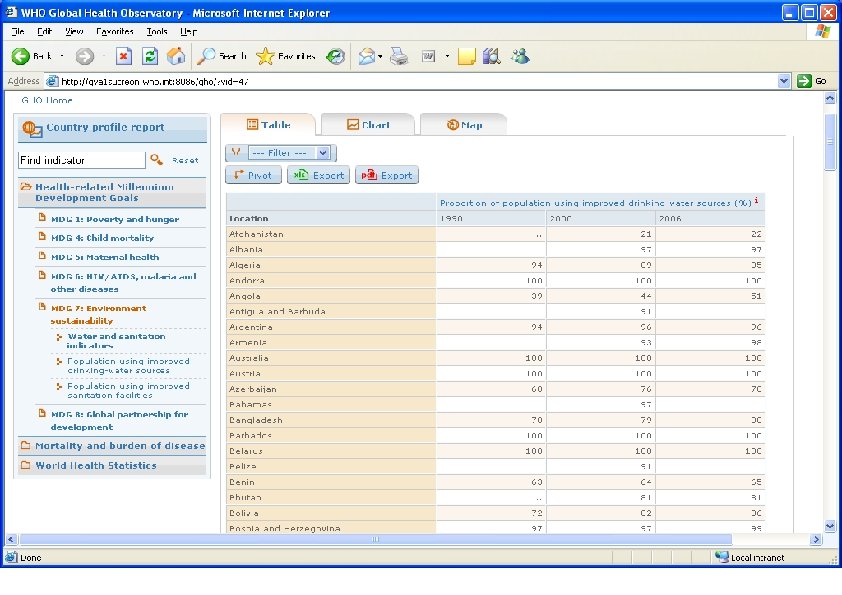
29 | GIMS - EXPERT GROUP MEETING ON MDG INDICATORS Astana 5 -8 October 2009
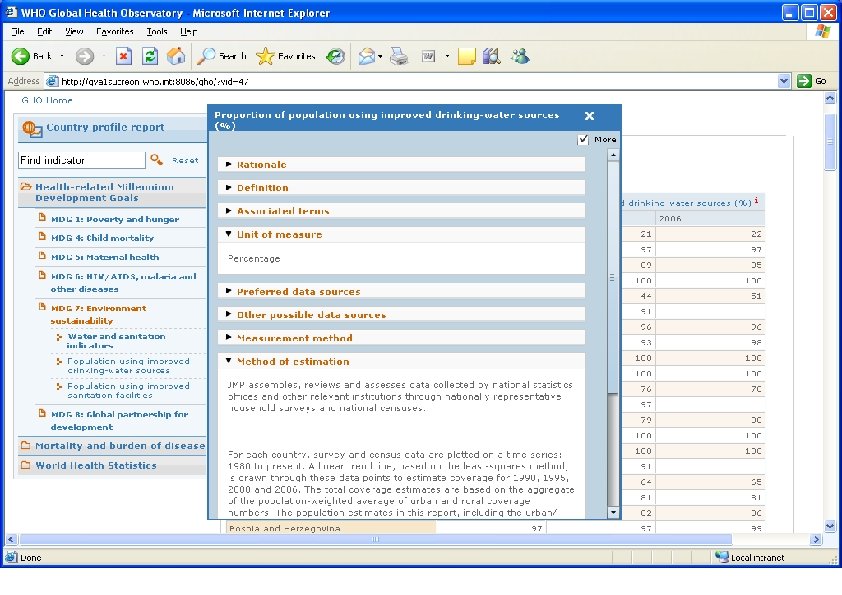
30 | GIMS - EXPERT GROUP MEETING ON MDG INDICATORS Astana 5 -8 October 2009
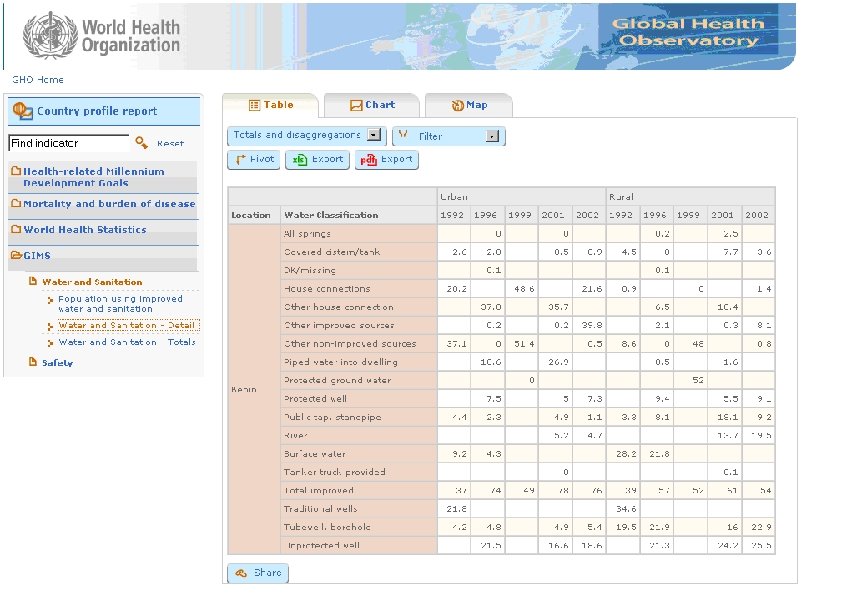
31 | GIMS - EXPERT GROUP MEETING ON MDG INDICATORS Astana 5 -8 October 2009
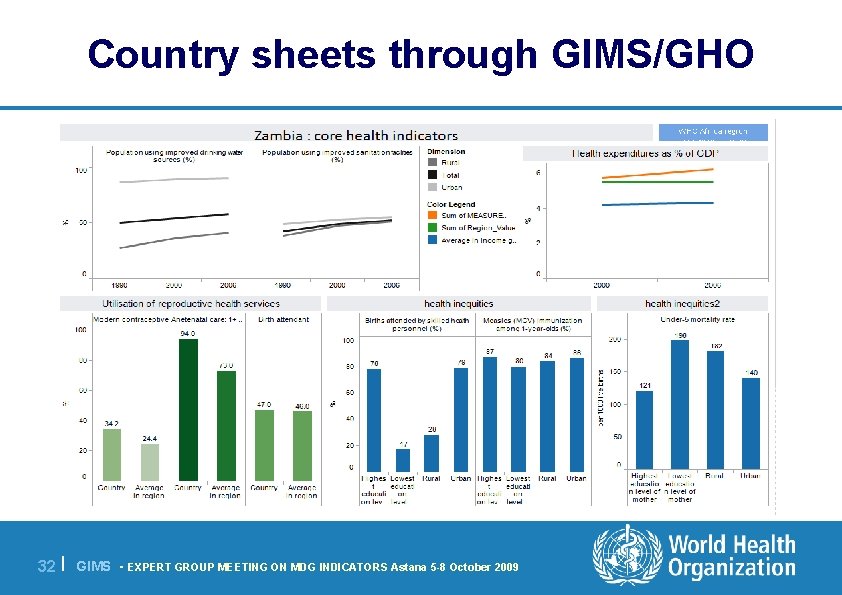
Country sheets through GIMS/GHO 32 | GIMS - EXPERT GROUP MEETING ON MDG INDICATORS Astana 5 -8 October 2009
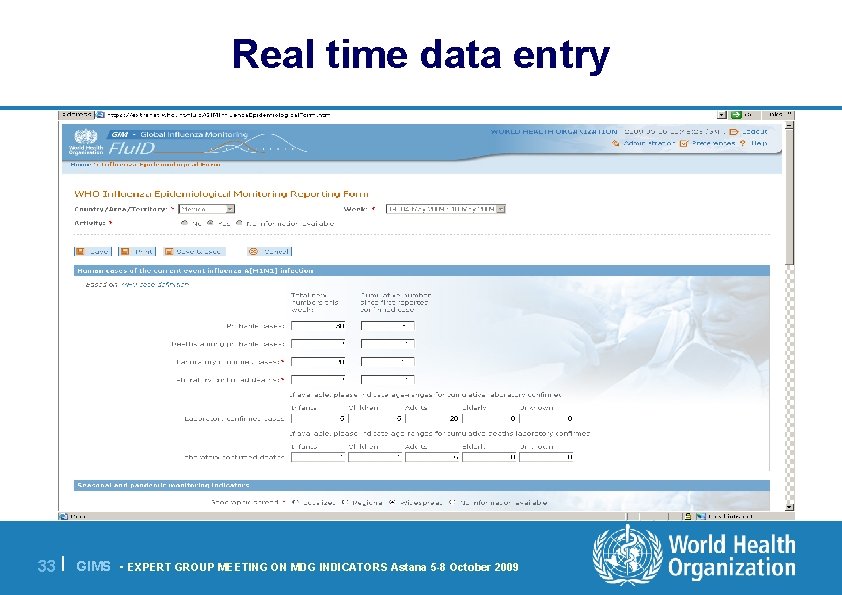
Real time data entry 33 | GIMS - EXPERT GROUP MEETING ON MDG INDICATORS Astana 5 -8 October 2009
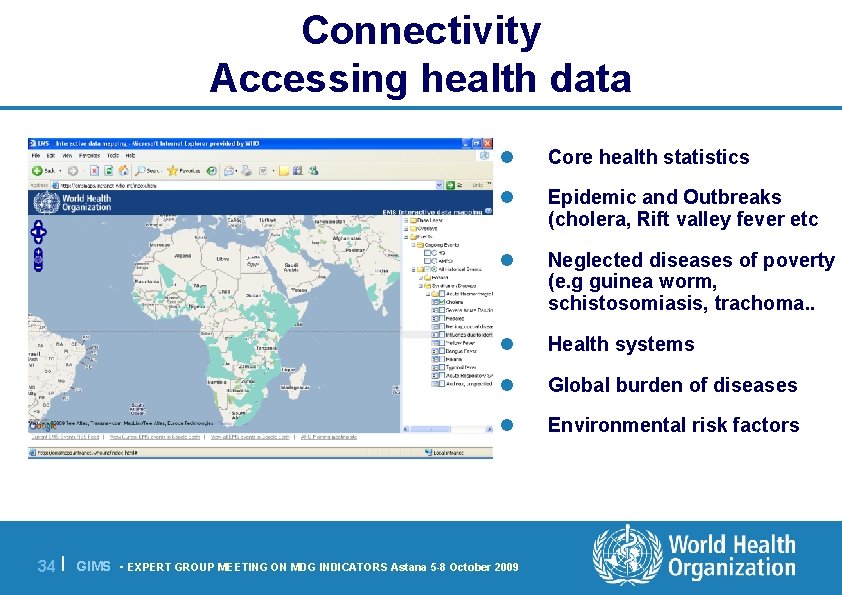
Connectivity Accessing health data l Core health statistics l Epidemic and Outbreaks (cholera, Rift valley fever etc l Neglected diseases of poverty (e. g guinea worm, schistosomiasis, trachoma. . l Health systems l Global burden of diseases l Environmental risk factors 34 | GIMS - EXPERT GROUP MEETING ON MDG INDICATORS Astana 5 -8 October 2009
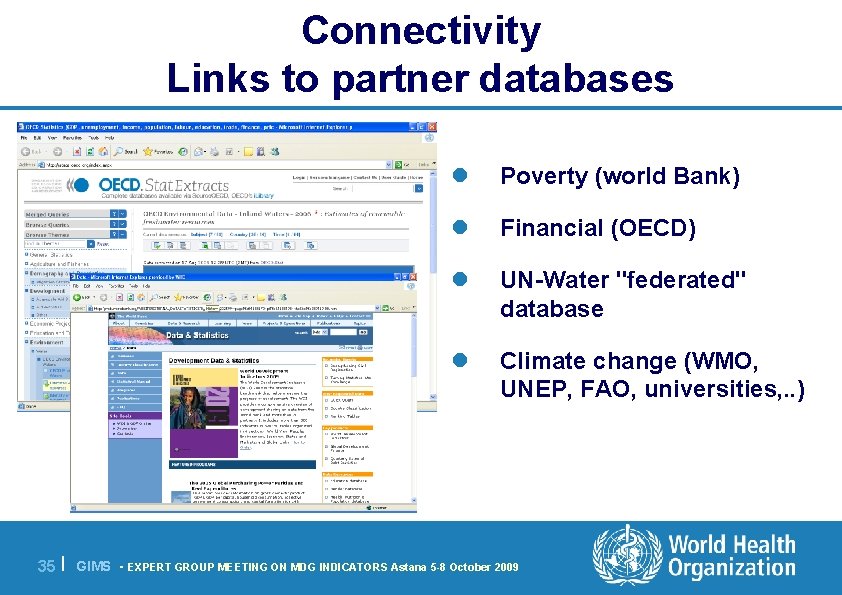
Connectivity Links to partner databases l Poverty (world Bank) l Financial (OECD) l UN-Water "federated" database l Climate change (WMO, UNEP, FAO, universities, . . ) 35 | GIMS - EXPERT GROUP MEETING ON MDG INDICATORS Astana 5 -8 October 2009
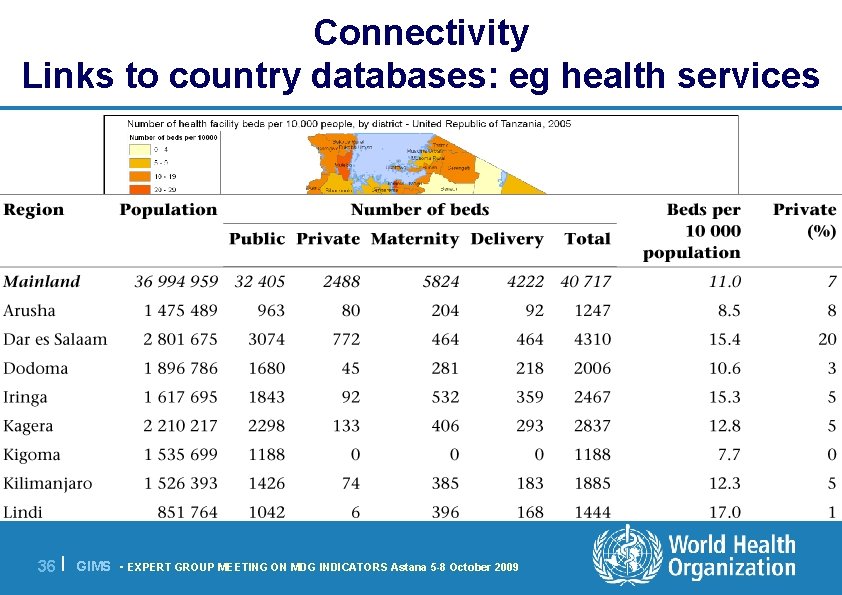
Connectivity Links to country databases: eg health services 36 | GIMS - EXPERT GROUP MEETING ON MDG INDICATORS Astana 5 -8 October 2009
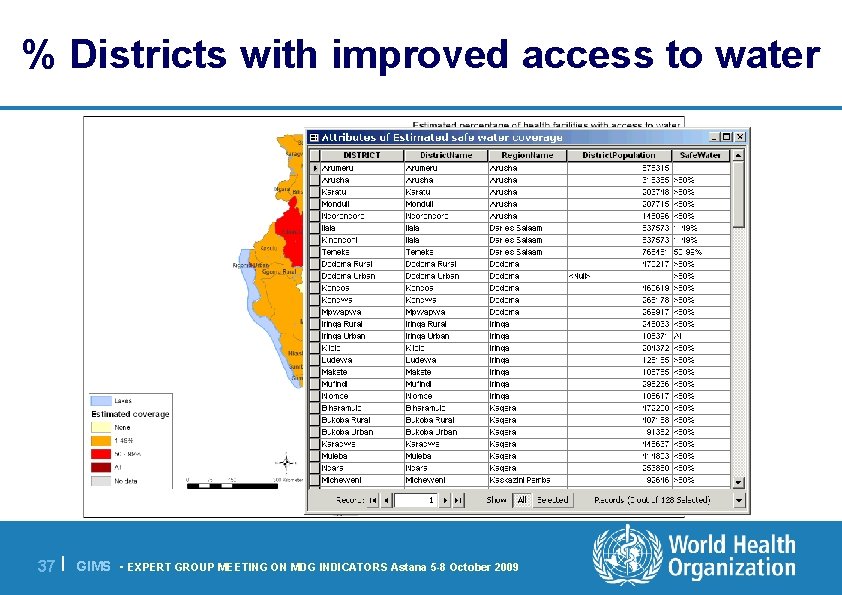
% Districts with improved access to water 37 | GIMS - EXPERT GROUP MEETING ON MDG INDICATORS Astana 5 -8 October 2009
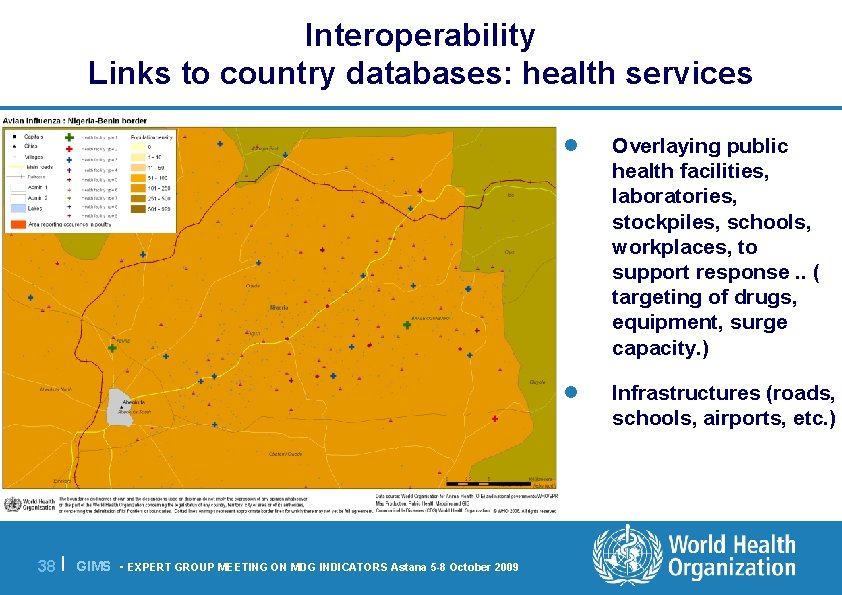
Interoperability Links to country databases: health services 38 | GIMS - EXPERT GROUP MEETING ON MDG INDICATORS Astana 5 -8 October 2009 l Overlaying public health facilities, laboratories, stockpiles, schools, workplaces, to support response. . ( targeting of drugs, equipment, surge capacity. ) l Infrastructures (roads, schools, airports, etc. )
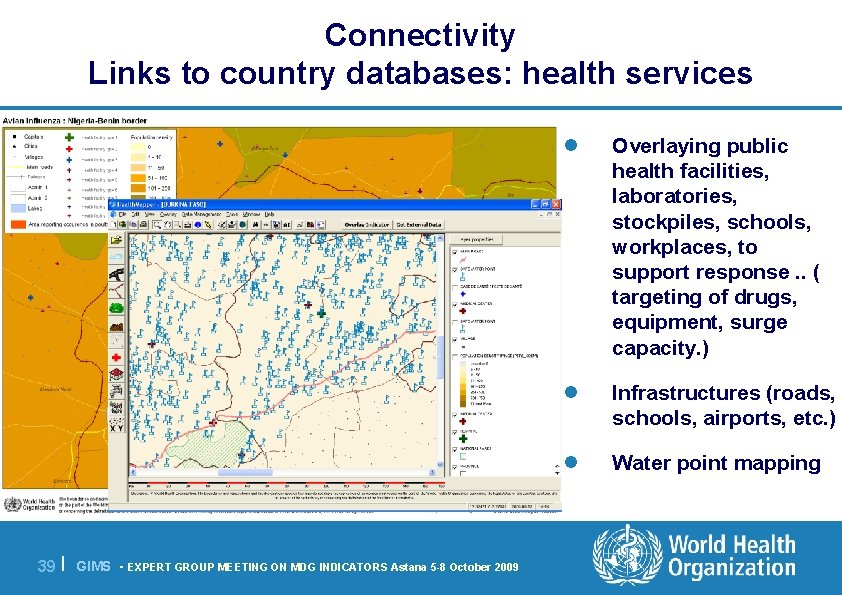
Connectivity Links to country databases: health services 39 | GIMS - EXPERT GROUP MEETING ON MDG INDICATORS Astana 5 -8 October 2009 l Overlaying public health facilities, laboratories, stockpiles, schools, workplaces, to support response. . ( targeting of drugs, equipment, surge capacity. ) l Infrastructures (roads, schools, airports, etc. ) l Water point mapping
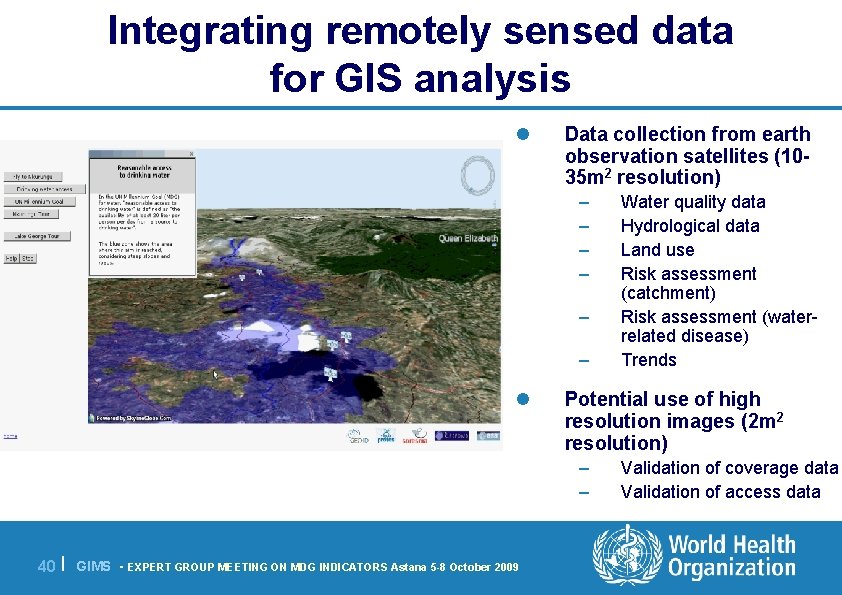
Integrating remotely sensed data for GIS analysis l Data collection from earth observation satellites (1035 m 2 resolution) – – – l Potential use of high resolution images (2 m 2 resolution) – – 40 | GIMS - EXPERT GROUP MEETING ON MDG INDICATORS Astana 5 -8 October 2009 Water quality data Hydrological data Land use Risk assessment (catchment) Risk assessment (waterrelated disease) Trends Validation of coverage data Validation of access data
GIMS clients 41 | GIMS - EXPERT GROUP MEETING ON MDG INDICATORS Astana 5 -8 October 2009
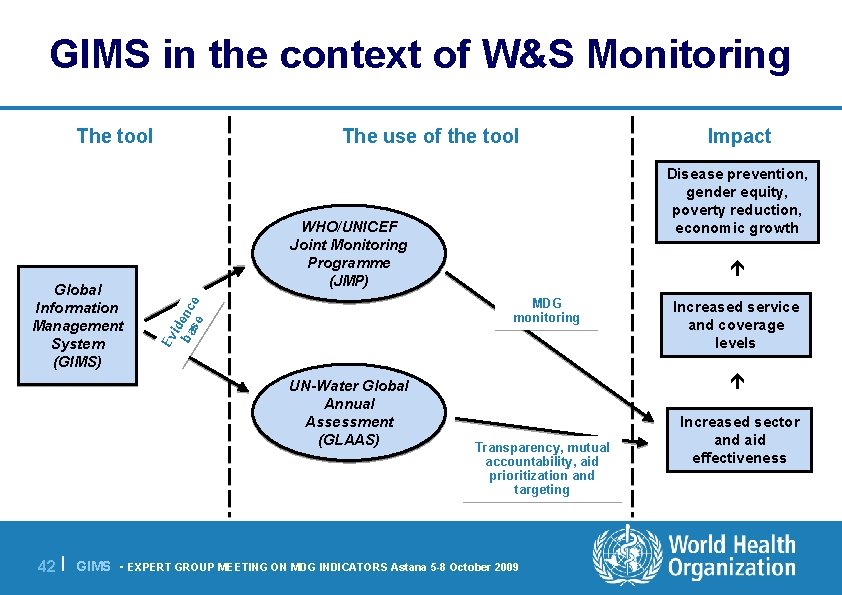
GIMS in the context of W&S Monitoring The tool MDG monitoring UN-Water Global Annual Assessment (GLAAS) Impact Disease prevention, gender equity, poverty reduction, economic growth WHO/UNICEF Joint Monitoring Programme (JMP) Ev id ba enc se e Global Information Management System (GIMS) The use of the tool Increased service and coverage levels Transparency, mutual accountability, aid prioritization and targeting 42 | GIMS - EXPERT GROUP MEETING ON MDG INDICATORS Astana 5 -8 October 2009 Increased sector and aid effectiveness
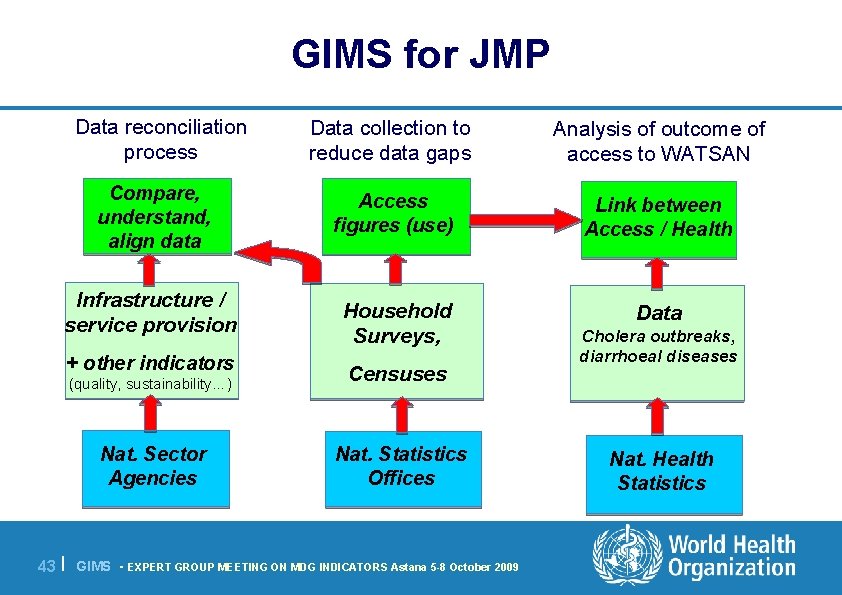
GIMS for JMP Data reconciliation process Compare, understand, align data Infrastructure / service provision + other indicators Data collection to reduce data gaps Analysis of outcome of access to WATSAN Access figures (use) Link between Access / Health Household Surveys, Data (quality, sustainability…) Censuses Nat. Sector Agencies Nat. Statistics Offices 43 | GIMS - EXPERT GROUP MEETING ON MDG INDICATORS Astana 5 -8 October 2009 Cholera outbreaks, diarrhoeal diseases Nat. Health Statistics
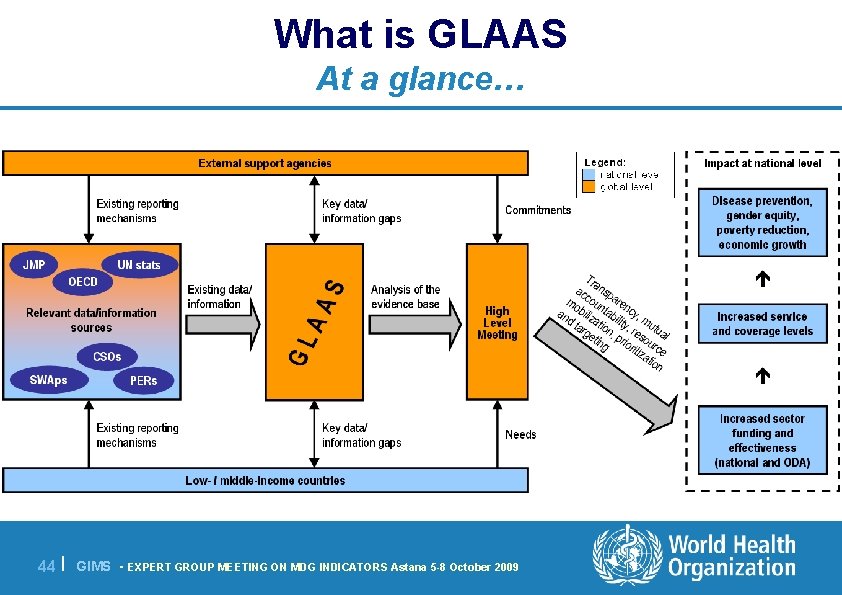
What is GLAAS At a glance… 44 | GIMS - EXPERT GROUP MEETING ON MDG INDICATORS Astana 5 -8 October 2009
Benefits and next steps 45 | GIMS - EXPERT GROUP MEETING ON MDG INDICATORS Astana 5 -8 October 2009
Benefits of GIMS l Comprehensive picture of the situation – Dynamic linking of service levels to other indicators of progress – Assessing problems, resources and gaps – Guiding rational allocation of resources l Building country capacity for strengthening evidence base – Provide standards-based platform for integrating, analysing and using country data – Participatory data gathering and analysis – Local ownership and institutional capacity building l Fostering a collaborative /open approach – – Collaborative community of practice (involving public , private, NGOs, civil society) Accessible, shareable, transparent data Open source tools Leveraging collective investments and resources 46 | GIMS - EXPERT GROUP MEETING ON MDG INDICATORS Astana 5 -8 October 2009
Next steps l Incremental data uploads – MDGs, World health statistics, Global Burden of Disease, outbreaks – Water and sanitation country survey data – Water service provider data (2010) l Incremental functionality enhancements -leveraging efforts/tools of partners (World Bank, OECD, UN………) – Open source data architecture and platform under development – UI and customizable analyses tools – 1 st launch of data dissemination system: end 2009 l Closer links to regional and country databases/observatories l Expanding the partner network l Project plan, roadmap and resource mobilisation 47 | GIMS - EXPERT GROUP MEETING ON MDG INDICATORS Astana 5 -8 October 2009
THANK YOU For further information: hossainr@who. int 48 | GIMS - EXPERT GROUP MEETING ON MDG INDICATORS Astana 5 -8 October 2009
- Slides: 48