
Global Impact of Satellite Data on NWP Model
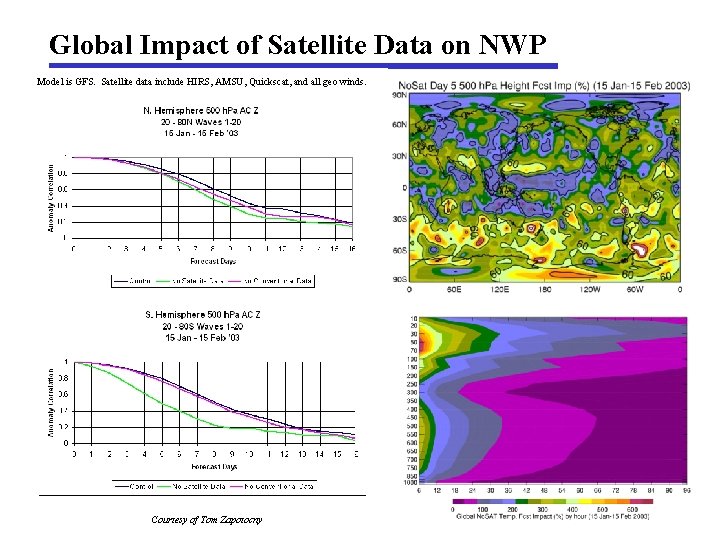
Global Impact of Satellite Data on NWP Model is GFS. Satellite data include HIRS, AMSU, Quickscat, and all geo winds. Courtesy of Tom Zapotocny
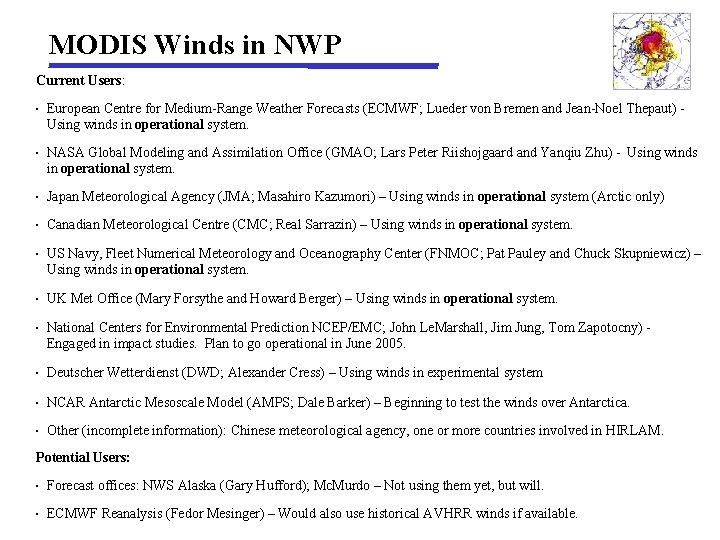
MODIS Winds in NWP Current Users: • European Centre for Medium-Range Weather Forecasts (ECMWF; Lueder von Bremen and Jean-Noel Thepaut) - Using winds in operational system. • NASA Global Modeling and Assimilation Office (GMAO; Lars Peter Riishojgaard and Yanqiu Zhu) - Using winds in operational system. • Japan Meteorological Agency (JMA; Masahiro Kazumori) – Using winds in operational system (Arctic only) • Canadian Meteorological Centre (CMC; Real Sarrazin) – Using winds in operational system. • US Navy, Fleet Numerical Meteorology and Oceanography Center (FNMOC; Pat Pauley and Chuck Skupniewicz) – Using winds in operational system. • UK Met Office (Mary Forsythe and Howard Berger) – Using winds in operational system. • National Centers for Environmental Prediction NCEP/EMC; John Le. Marshall, Jim Jung, Tom Zapotocny) - Engaged in impact studies. Plan to go operational in June 2005. • Deutscher Wetterdienst (DWD; Alexander Cress) – Using winds in experimental system • NCAR Antarctic Mesoscale Model (AMPS; Dale Barker) – Beginning to test the winds over Antarctica. • Other (incomplete information): Chinese meteorological agency, one or more countries involved in HIRLAM. Potential Users: • Forecast offices: NWS Alaska (Gary Hufford); Mc. Murdo – Not using them yet, but will. • ECMWF Reanalysis (Fedor Mesinger) – Would also use historical AVHRR winds if available.
NASA Global Modeling and Assimilation Office (GMAO) (Lars Peter Riishojgaard and Yanqiu Zhu) • MOWSAP (MODIS Winds Special Acquisition Period): November 8, 2003 January 31, 2004 – Winds generated by CIMSS and by NESDIS (pre-operational mode) • Different code bases • Different backgrounds for QC and height assignment – Winds generated from MODIS Aqua and MODIS Terra imagery – Assimilation experiments by GMAO, ECMWF, Met Office, CMC – Standard common diagnostics – GMAO experiments: 5 -day forecast every other day; 42 members in the ensemble
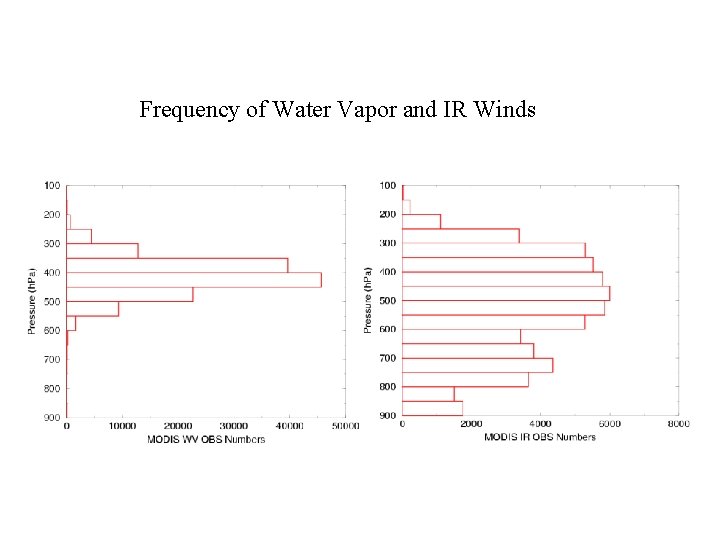
Frequency of Water Vapor and IR Winds
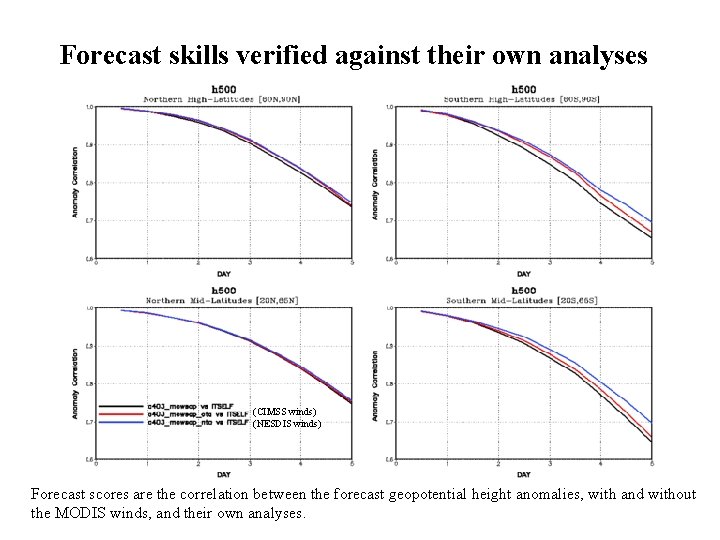
Forecast skills verified against their own analyses (CIMSS winds) (NESDIS winds) Forecast scores are the correlation between the forecast geopotential height anomalies, with and without the MODIS winds, and their own analyses.
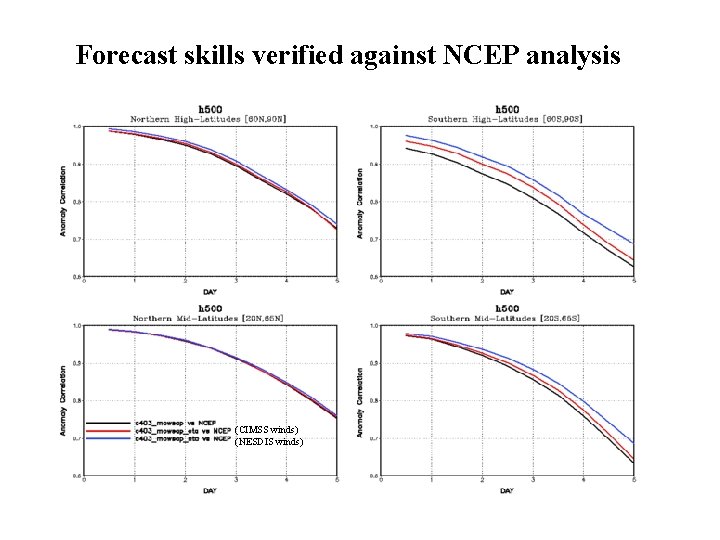
Forecast skills verified against NCEP analysis (CIMSS winds) (NESDIS winds)
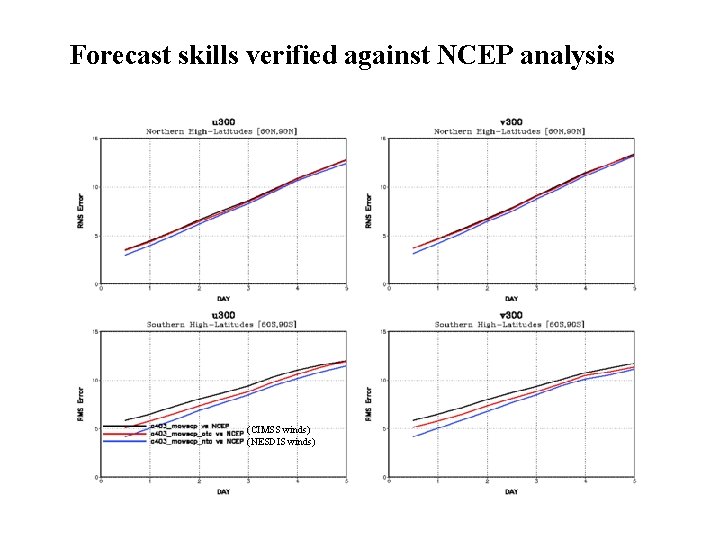
Forecast skills verified against NCEP analysis (CIMSS winds) (NESDIS winds)
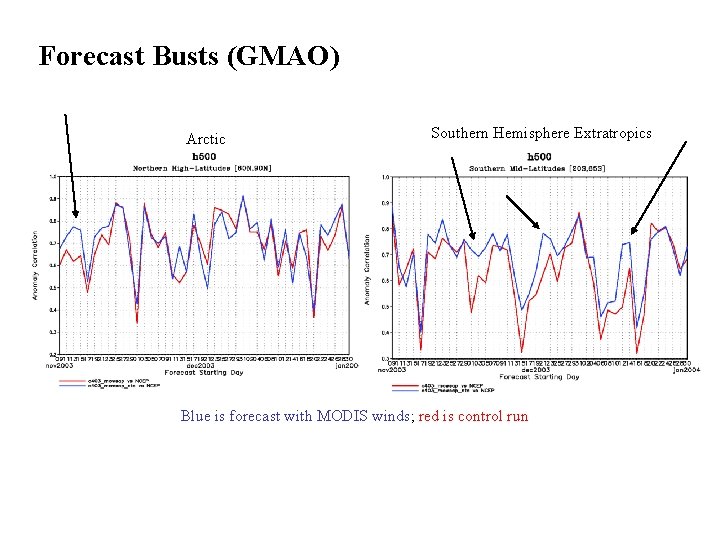
Forecast Busts (GMAO) Arctic Southern Hemisphere Extratropics Blue is forecast with MODIS winds; red is control run
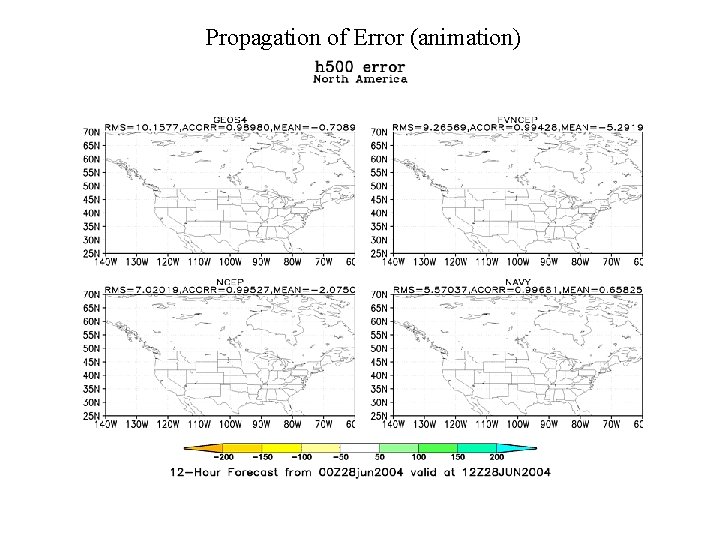
Propagation of Error (animation)
Summary of GMAO Results • MODIS winds complement other observations in the high latitudes; more so in the SH than in the NH due to the current data sparsity • Consistency of data delivery is acceptable; timeliness remains problematic; being addressed using DB capability • Based on independent verification and innovation statistics, the quality of the information is acceptable • Positive overall contribution to forecast skill; substantial in the SH
European Centre for Medium-Range Weather Forecasts (ECMWF) (Lueder von Bremen and Jean-Noel Thepaut) Assimilation experiments - 3 DVAR, T 159/159: 5 March— 3 April 2001 - 4 DVAR, T 511/159, compared to ops: 13 July— 16 August 2002… - 4 DVAR, T 511/159: 5— 15 March 2002… Use same assimilation settings as for geostationary AMVs, except for blacklisting of lower level winds: Winds used: IR, WV cloudy and clear Over land: IR and WV winds above 400 h. Pa. Over sea: IR winds above 700 h. Pa, WV above 550 h. Pa.
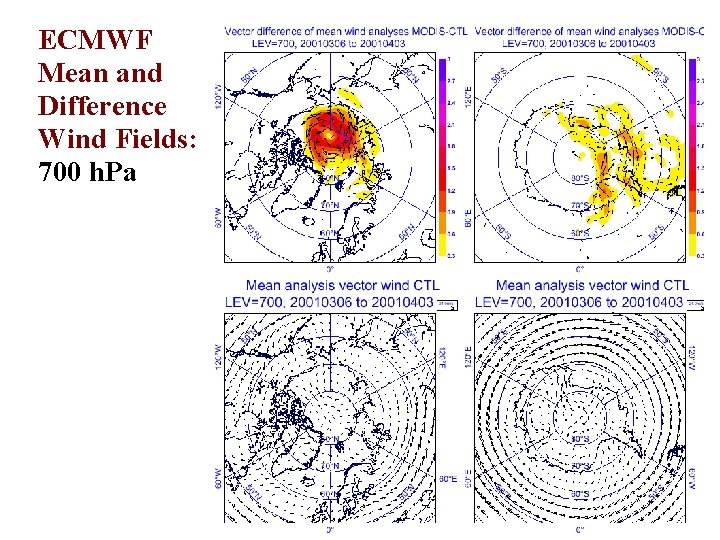
ECMWF Mean and Difference Wind Fields: 700 h. Pa
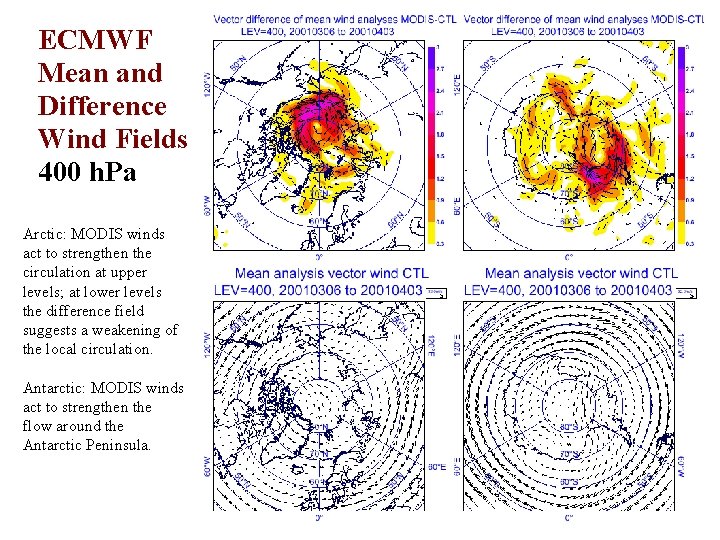
ECMWF Mean and Difference Wind Fields: 400 h. Pa Arctic: MODIS winds act to strengthen the circulation at upper levels; at lower levels the difference field suggests a weakening of the local circulation. Antarctic: MODIS winds act to strengthen the flow around the Antarctic Peninsula.
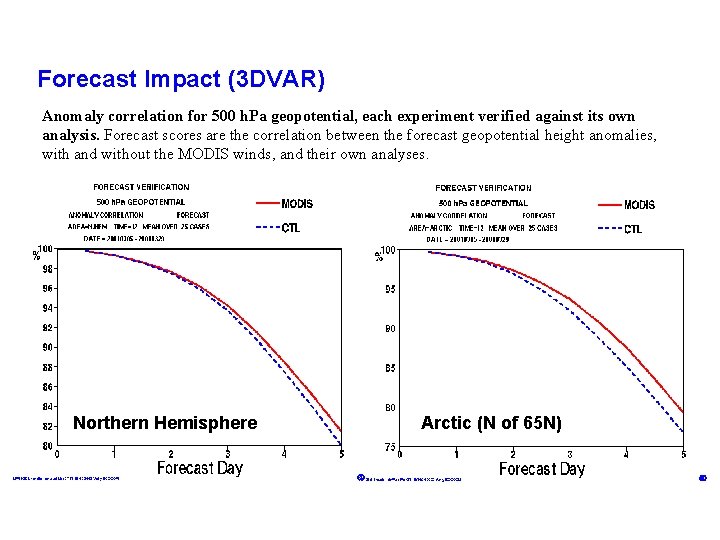
Forecast Impact (3 DVAR) Anomaly correlation for 500 h. Pa geopotential, each experiment verified against its own analysis. Forecast scores are the correlation between the forecast geopotential height anomalies, with and without the MODIS winds, and their own analyses. Northern Hemisphere Arctic (N of 65 N)
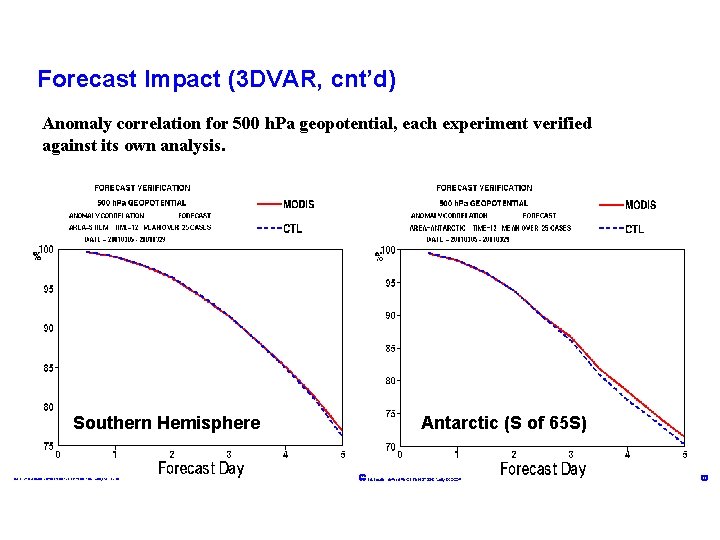
Forecast Impact (3 DVAR, cnt’d) Anomaly correlation for 500 h. Pa geopotential, each experiment verified against its own analysis. Southern Hemisphere Antarctic (S of 65 S)
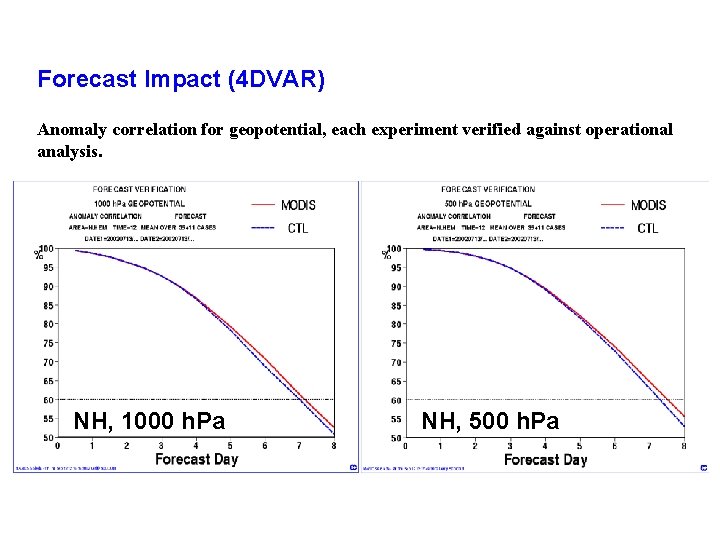
Forecast Impact (4 DVAR) Anomaly correlation for geopotential, each experiment verified against operational analysis. NH, 1000 h. Pa NH, 500 h. Pa
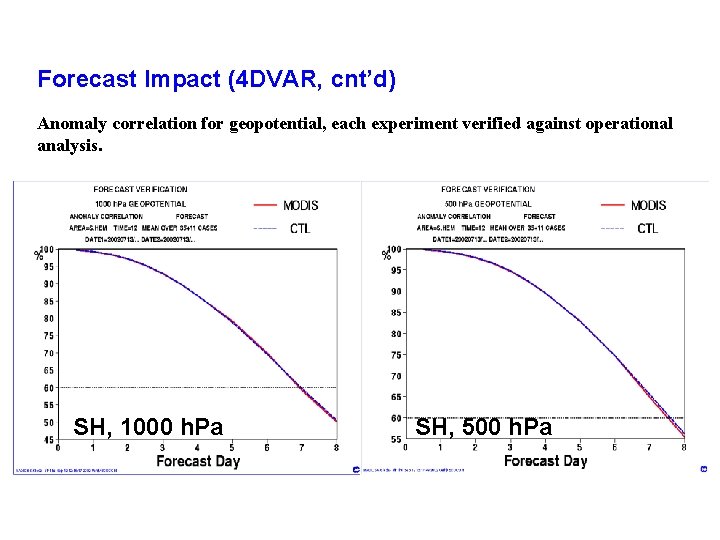
Forecast Impact (4 DVAR, cnt’d) Anomaly correlation for geopotential, each experiment verified against operational analysis. SH, 1000 h. Pa SH, 500 h. Pa
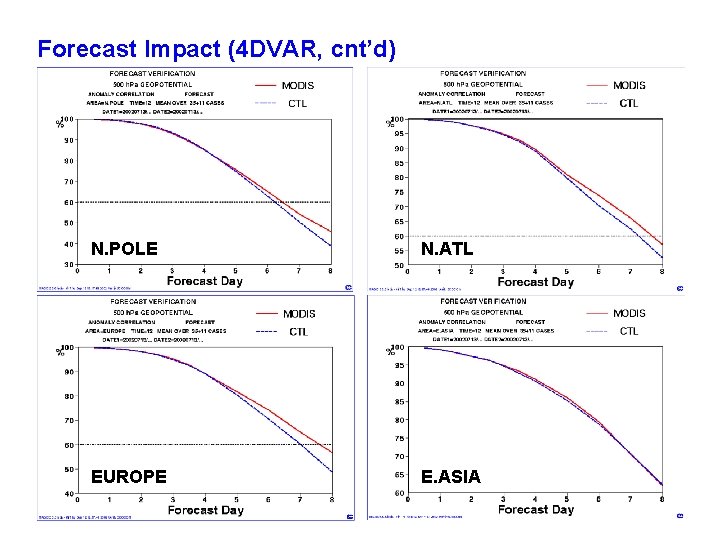
Forecast Impact (4 DVAR, cnt’d) N. POLE N. ATL EUROPE E. ASIA
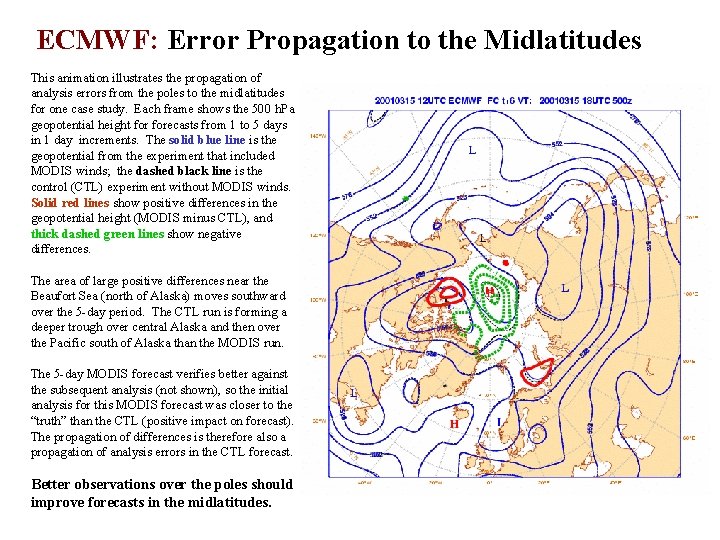
ECMWF: Error Propagation to the Midlatitudes This animation illustrates the propagation of analysis errors from the poles to the midlatitudes for one case study. Each frame shows the 500 h. Pa geopotential height forecasts from 1 to 5 days in 1 day increments. The solid blue line is the geopotential from the experiment that included MODIS winds; the dashed black line is the control (CTL) experiment without MODIS winds. Solid red lines show positive differences in the geopotential height (MODIS minus CTL), and thick dashed green lines show negative differences. The area of large positive differences near the Beaufort Sea (north of Alaska) moves southward over the 5 -day period. The CTL run is forming a deeper trough over central Alaska and then over the Pacific south of Alaska than the MODIS run. The 5 -day MODIS forecast verifies better against the subsequent analysis (not shown), so the initial analysis for this MODIS forecast was closer to the “truth” than the CTL (positive impact on forecast). The propagation of differences is therefore also a propagation of analysis errors in the CTL forecast. Better observations over the poles should improve forecasts in the midlatitudes.
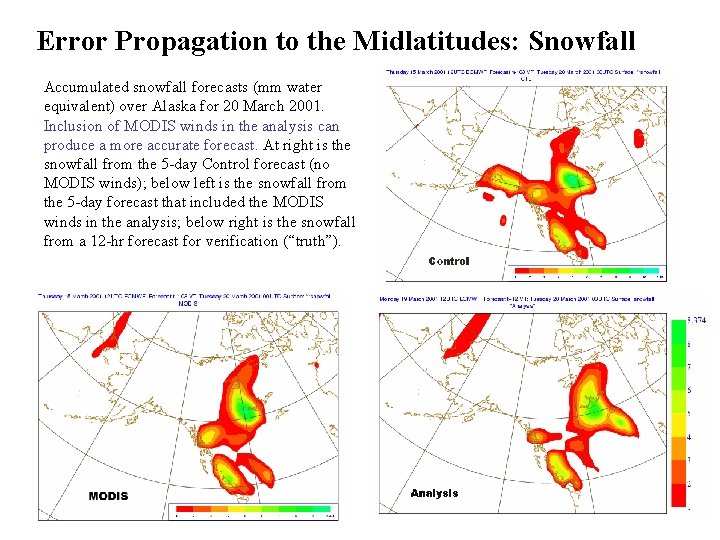
Error Propagation to the Midlatitudes: Snowfall Accumulated snowfall forecasts (mm water equivalent) over Alaska for 20 March 2001. Inclusion of MODIS winds in the analysis can produce a more accurate forecast. At right is the snowfall from the 5 -day Control forecast (no MODIS winds); below left is the snowfall from the 5 -day forecast that included the MODIS winds in the analysis; below right is the snowfall from a 12 -hr forecast for verification (“truth”).
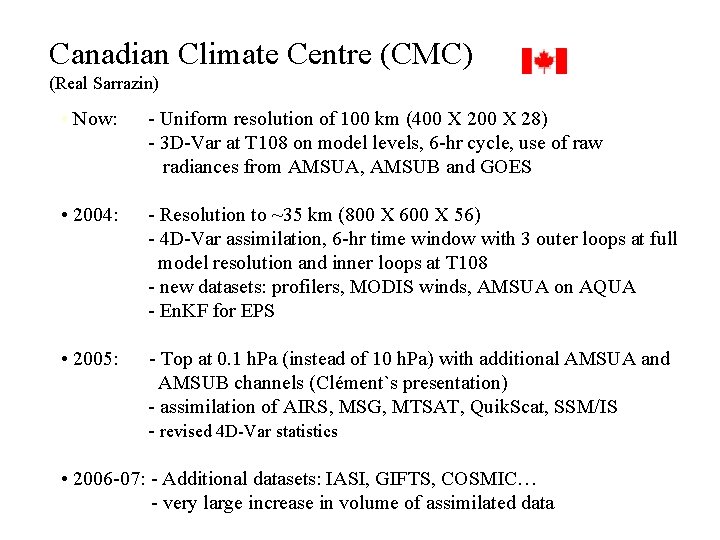
Canadian Climate Centre (CMC) (Real Sarrazin) • Now: - Uniform resolution of 100 km (400 X 28) - 3 D-Var at T 108 on model levels, 6 -hr cycle, use of raw radiances from AMSUA, AMSUB and GOES • 2004: - Resolution to ~35 km (800 X 600 X 56) - 4 D-Var assimilation, 6 -hr time window with 3 outer loops at full model resolution and inner loops at T 108 - new datasets: profilers, MODIS winds, AMSUA on AQUA - En. KF for EPS • 2005: - Top at 0. 1 h. Pa (instead of 10 h. Pa) with additional AMSUA and AMSUB channels (Clément`s presentation) - assimilation of AIRS, MSG, MTSAT, Quik. Scat, SSM/IS - revised 4 D-Var statistics • 2006 -07: - Additional datasets: IASI, GIFTS, COSMIC… - very large increase in volume of assimilated data
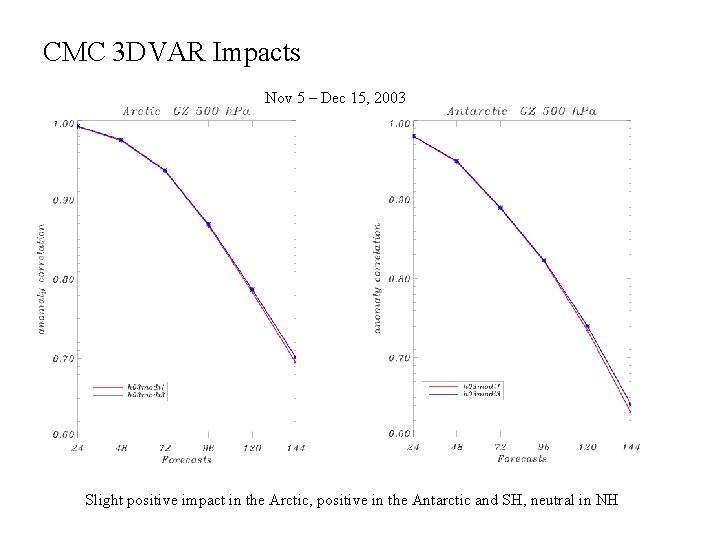
CMC 3 DVAR Impacts Nov 5 – Dec 15, 2003 Slight positive impact in the Arctic, positive in the Antarctic and SH, neutral in NH
MODIS winds: latest results at the Met Office Mary Forsythe (1), Howard Berger (1, 2) (1) Met Office, Exeter, UK (2) UW-CIMSS Madison, WI
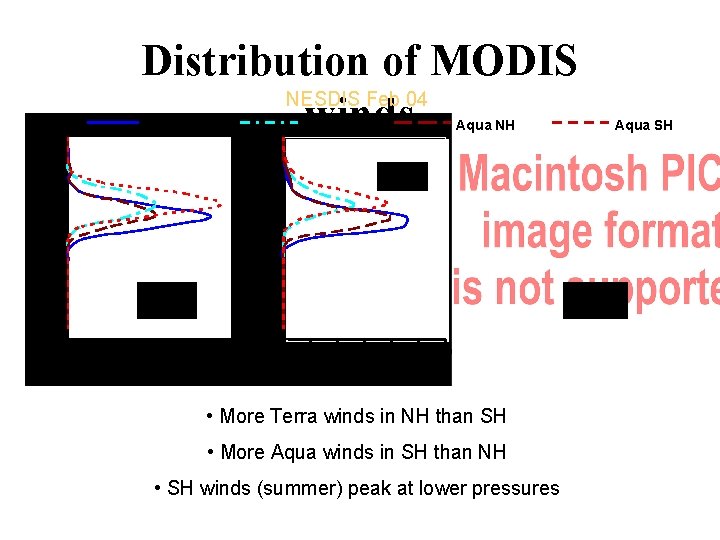
Distribution of MODIS NESDIS Feb 04 winds Terra NH 200 300 400 500 600 700 800 700 WV IR 1000 0 20 40 60 80 Number of winds Thousands 100 120 Aqua SH 600 900 1000 Aqua NH 500 800 CSWV 900 Terra SH 100 Pressure (h. Pa) 100 0 20 40 60 80 Number of winds Thousands 100 120 • More Terra winds in NH than SH • More Aqua winds in SH than NH • SH winds (summer) peak at lower pressures
Some Statistical Comparisons to NESDIS Feb 04 Met. O background Comparing Satellites IR Comparing Channels Terra NH
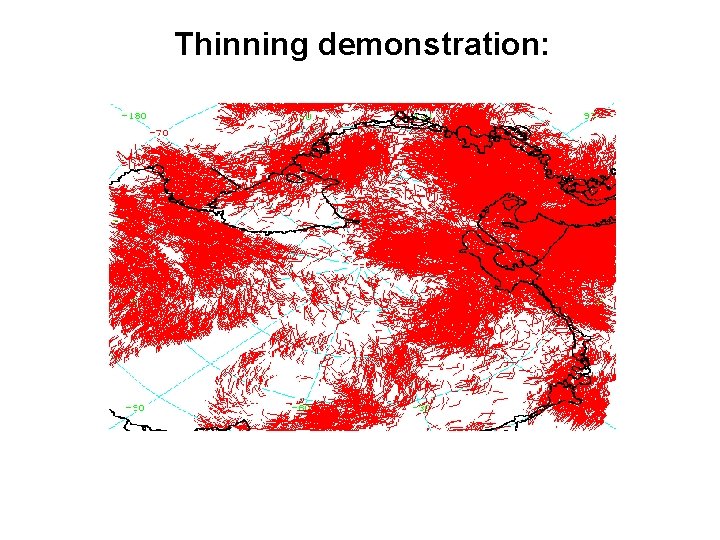
Thinning demonstration:
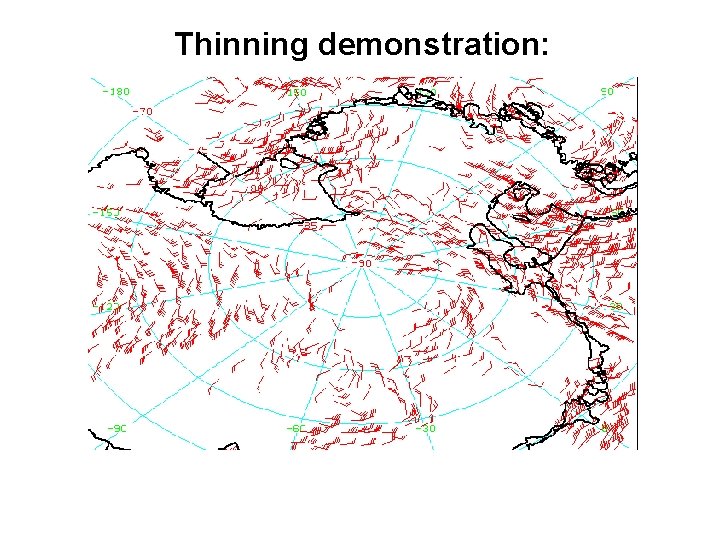
Thinning demonstration:
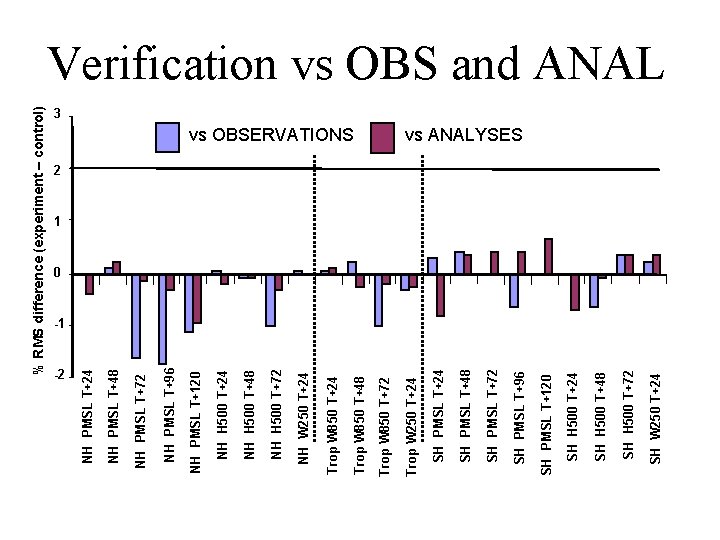
% RMS difference (experiment – control) -2 SH W 250 T+24 SH H 500 T+72 SH H 500 T+48 SH H 500 T+24 SH PMSL T+120 SH PMSL T+96 SH PMSL T+72 SH PMSL T+48 SH PMSL T+24 vs OBSERVATIONS Trop W 250 T+24 Trop W 850 T+72 Trop W 850 T+48 Trop W 850 T+24 NH W 250 T+24 NH H 500 T+72 NH H 500 T+48 NH H 500 T+24 NH PMSL T+120 NH PMSL T+96 NH PMSL T+72 NH PMSL T+48 NH PMSL T+24 Verification vs OBS and ANAL 3 vs ANALYSES 2 1 0 -1
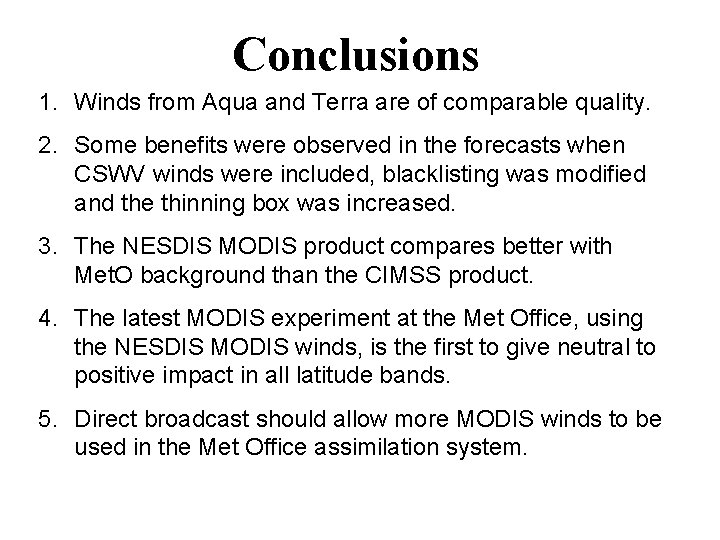
Conclusions 1. Winds from Aqua and Terra are of comparable quality. 2. Some benefits were observed in the forecasts when CSWV winds were included, blacklisting was modified and the thinning box was increased. 3. The NESDIS MODIS product compares better with Met. O background than the CIMSS product. 4. The latest MODIS experiment at the Met Office, using the NESDIS MODIS winds, is the first to give neutral to positive impact in all latitude bands. 5. Direct broadcast should allow more MODIS winds to be used in the Met Office assimilation system.
MODIS Polar Winds Assimilation Experiments at JMA Masahiro Kazumori, Yoshiyuki Nakamura Numerical Prediction Division Japan Meteorological Agency
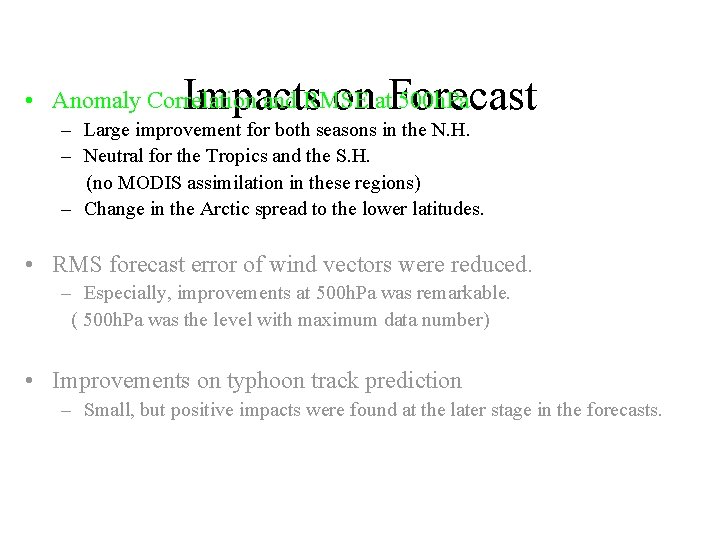
Impacts on Forecast • Anomaly Correlation and RMSE at 500 h. Pa – Large improvement for both seasons in the N. H. – Neutral for the Tropics and the S. H. (no MODIS assimilation in these regions) – Change in the Arctic spread to the lower latitudes. • RMS forecast error of wind vectors were reduced. – Especially, improvements at 500 h. Pa was remarkable. ( 500 h. Pa was the level with maximum data number) • Improvements on typhoon track prediction – Small, but positive impacts were found at the later stage in the forecasts.
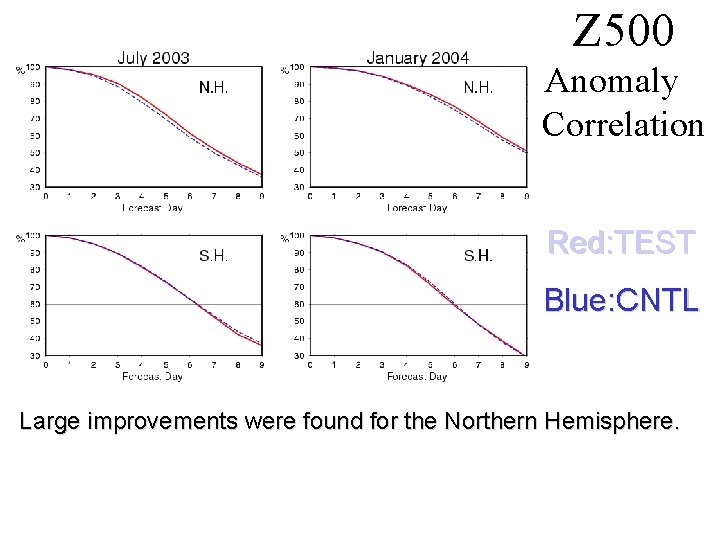
Z 500 Anomaly Correlation Red: TEST Blue: CNTL Large improvements were found for the Northern Hemisphere.
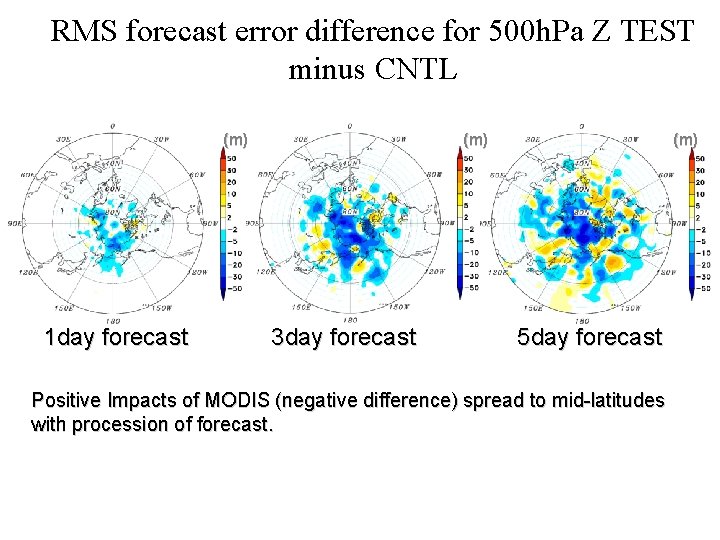
RMS forecast error difference for 500 h. Pa Z TEST minus CNTL (m) (m) • Monthly mean difference for July 2003 1 day forecast 3 day forecast 5 day forecast Positive Impacts of MODIS (negative difference) spread to mid-latitudes with procession of forecast.
Impacts on Forecast • Anomaly Correlation and RMSE at 500 h. Pa – Large improvement for both seasons by 9 -day forecasts – Neutral for the tropics and the S. H. (no MODIS assimilation) – Change in the Arctic spread to the lower latitudes. • RMS forecast error of wind vectors were reduced. – Especially, improvements at 500 h. Pa were remarkable. ( 500 h. Pa was the level with maximum data number) • Improvements on typhoon track prediction – Small, but positive impacts were found at the later stage in the forecasts.
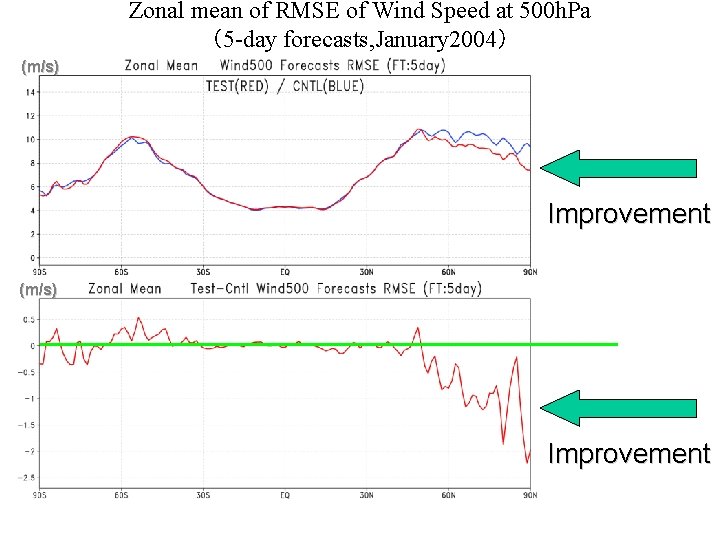
Zonal mean of RMSE of Wind Speed at 500 h. Pa (5 -day forecasts, January 2004) (m/s) Improvement
Impacts on Forecast • Anomaly Correlation and RMSE at 500 h. Pa – Large improvement for both seasons by 9 -day forecasts – Neutral for the tropics and the S. H. (no MODIS assimilation) – Change in the Arctic spread to the lower latitudes. • RMS forecast error of wind vectors were reduced. – Especially, improvements at 500 h. Pa was remarkable. ( 500 h. Pa was the level with maximum data number) • Improvements on typhoon track prediction – Small, but positive impacts were found at the later stage in the forecasts.
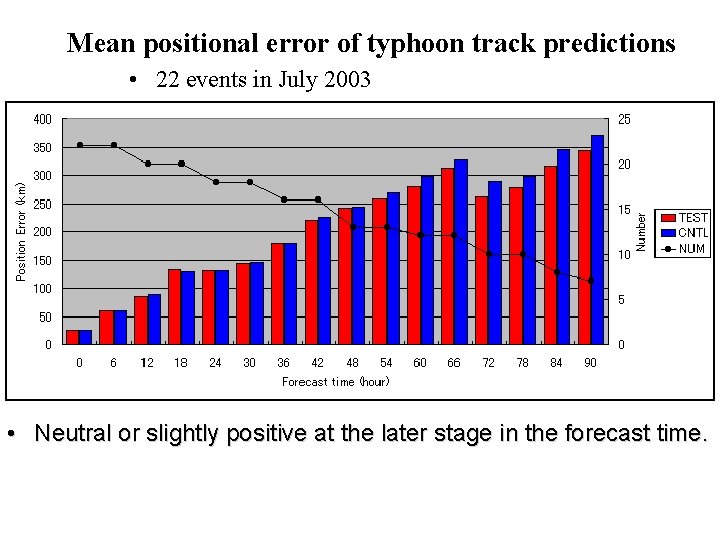
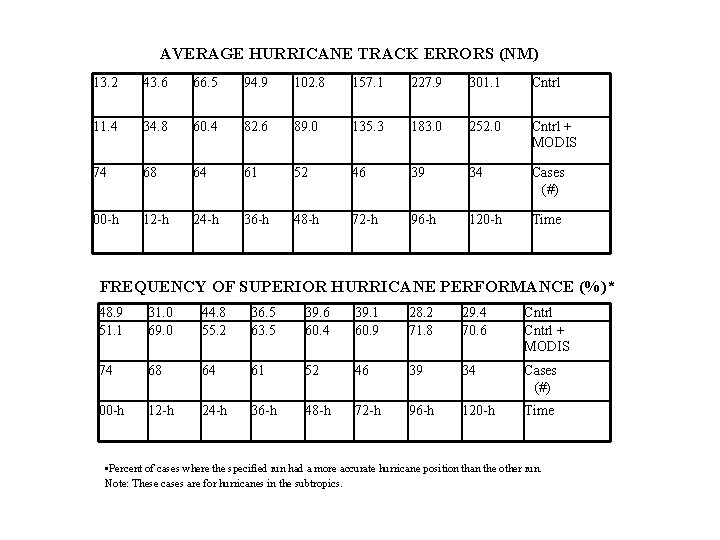
Mean positional error of typhoon track predictions • 22 events in July 2003 • Neutral or slightly positive at the later stage in the forecast time.
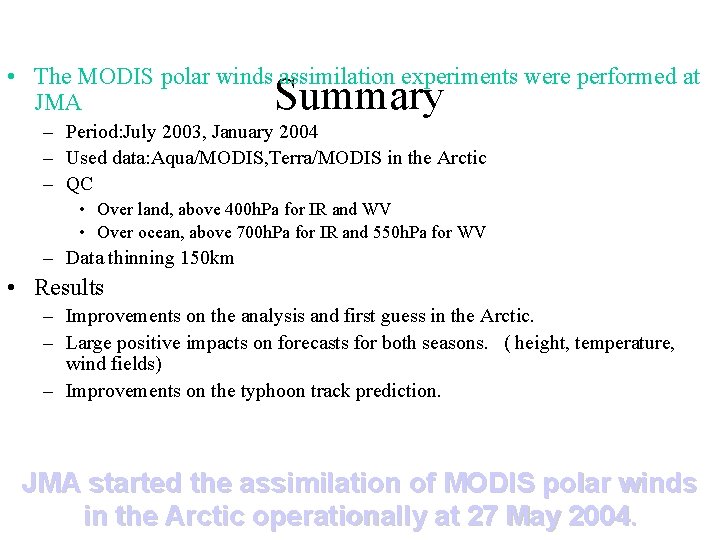
• The MODIS polar winds assimilation experiments were performed at JMA Summary – Period: July 2003, January 2004 – Used data: Aqua/MODIS, Terra/MODIS in the Arctic – QC • Over land, above 400 h. Pa for IR and WV • Over ocean, above 700 h. Pa for IR and 550 h. Pa for WV – Data thinning 150 km • Results – Improvements on the analysis and first guess in the Arctic. – Large positive impacts on forecasts for both seasons. ( height, temperature, wind fields) – Improvements on the typhoon track prediction. JMA started the assimilation of MODIS polar winds in the Arctic operationally at 27 May 2004.
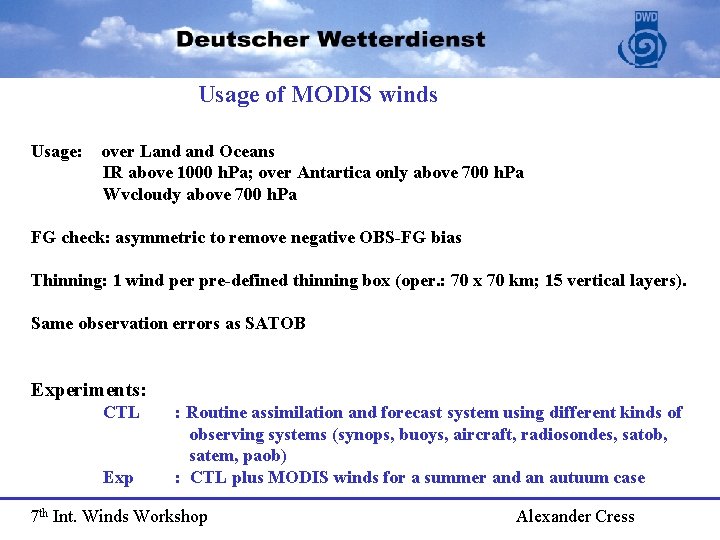
Usage of MODIS winds Usage: over Land Oceans IR above 1000 h. Pa; over Antartica only above 700 h. Pa Wvcloudy above 700 h. Pa FG check: asymmetric to remove negative OBS-FG bias Thinning: 1 wind per pre-defined thinning box (oper. : 70 x 70 km; 15 vertical layers). Same observation errors as SATOB Experiments: CTL Exp : Routine assimilation and forecast system using different kinds of observing systems (synops, buoys, aircraft, radiosondes, satob, satem, paob) : CTL plus MODIS winds for a summer and an autuum case 7 th Int. Winds Workshop Alexander Cress
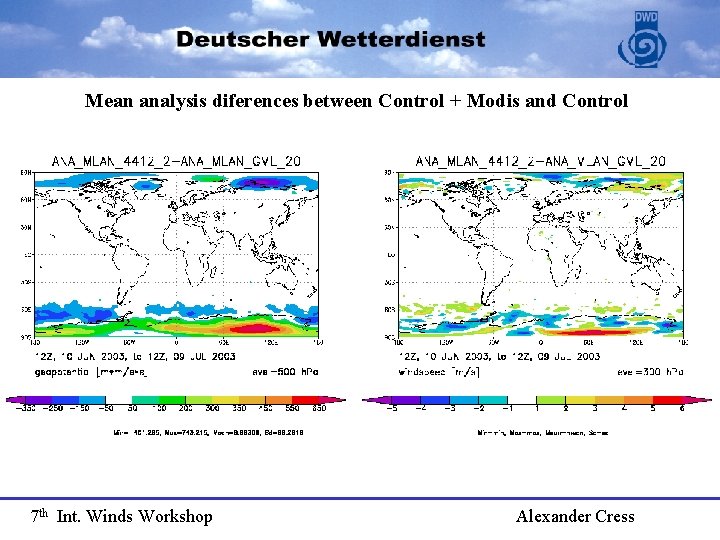
Mean analysis diferences between Control + Modis and Control 7 th Int. Winds Workshop Alexander Cress
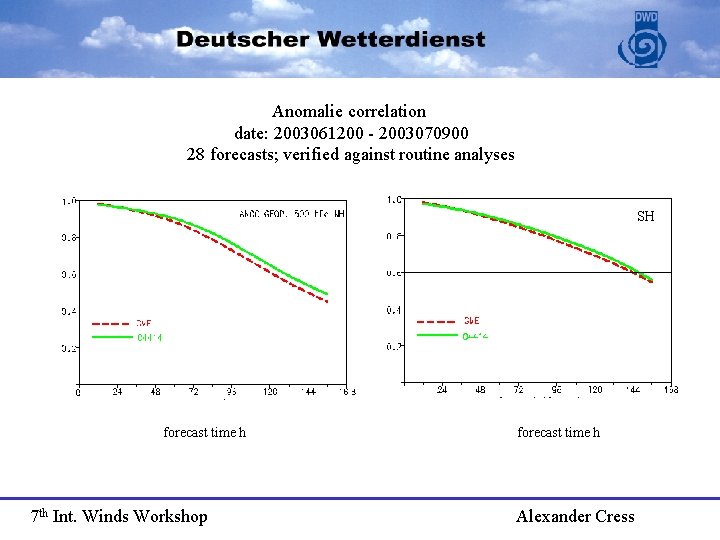
Anomalie correlation date: 2003061200 - 2003070900 28 forecasts; verified against routine analyses SH forecast time h 7 th Int. Winds Workshop forecast time h Alexander Cress
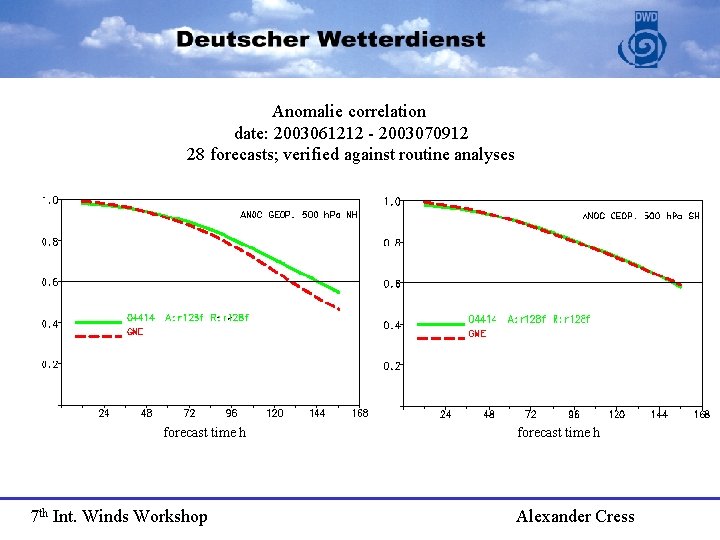
Anomalie correlation date: 2003061212 - 2003070912 28 forecasts; verified against routine analyses forecast time h 7 th Int. Winds Workshop forecast time h Alexander Cress
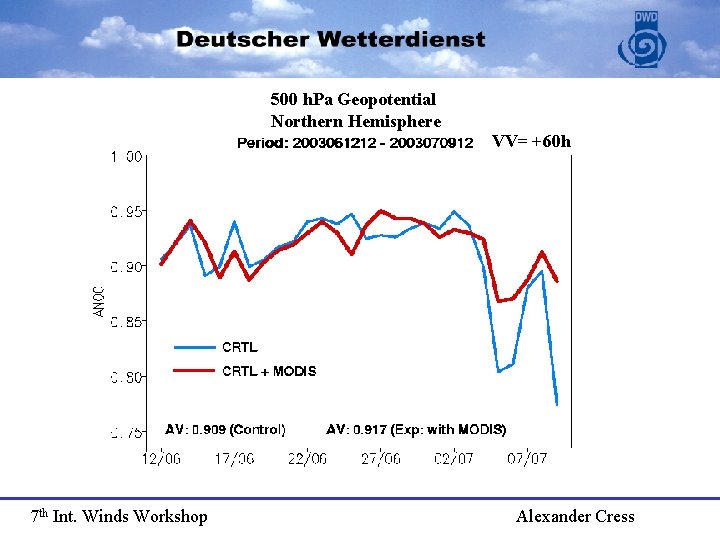
500 h. Pa Geopotential Northern Hemisphere VV= +60 h 7 th Int. Winds Workshop Alexander Cress
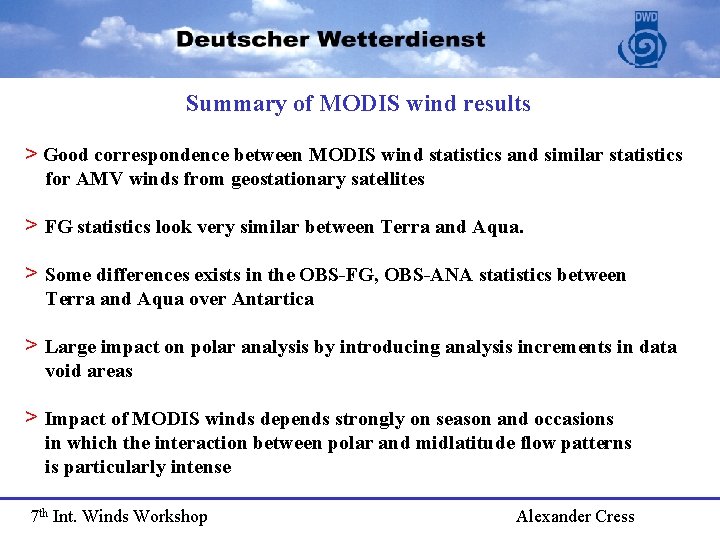
Summary of MODIS wind results > Good correspondence between MODIS wind statistics and similar statistics for AMV winds from geostationary satellites > FG statistics look very similar between Terra and Aqua. > Some differences exists in the OBS-FG, OBS-ANA statistics between Terra and Aqua over Antartica > Large impact on polar analysis by introducing analysis increments in data void areas > Impact of MODIS winds depends strongly on season and occasions in which the interaction between polar and midlatitude flow patterns is particularly intense 7 th Int. Winds Workshop Alexander Cress
MODIS Wind Assimilation NCEP’s Global Forecast System John Le Marshall (JCSDA) James Jung (CIMSS) John Derber (NCEP) Jaime Daniels (NESDIS) International Winds Workshop June 14, 2004
Global Forecast System Background • Operational SSI (3 DVAR) version used • Operational GFS T 254 L 64 with reductions in resolution at 84 (T 170 L 42) and 180 (T 126 L 28) hours. 2. 5 hr cut off
The Trial • • • Used MOWSAP (MODIS Winds Special Acquisition Period) data – NESDIS (Ops. ) generated AMVs – 1 Jan – 15 Feb ‘ 04 – Terra & Aqua satellites Similar assimilation methodology that used for GOES AMVs Middle image used for tracers AMVs largely used NESDIS QC Post NESDIS QC used, particularly for gross errors cf. background and for winds above tropopause Winds assimilated only in second last analysis (later “final” analysis) to simulate realistic data availability.




Discussion and Conclusions • Overall positive impact • AMV observation fit to background worst over land ice near the surface. AMVs still have positive impact in lower levels • Post NESDIS QC used, particularly for gross errors cf. background and for winds above tropopause • Repeat with emissivity corrections for ice and snow in GFC • Planned for implementation in next upgrade
RMS (m/s) Impact of MODIS Winds on Hurricane Track Forecasts Forecast (days)
AVERAGE HURRICANE TRACK ERRORS (NM) 13. 2 43. 6 66. 5 94. 9 102. 8 157. 1 227. 9 301. 1 Cntrl 11. 4 34. 8 60. 4 82. 6 89. 0 135. 3 183. 0 252. 0 Cntrl + MODIS 74 68 64 61 52 46 39 34 Cases (#) 00 -h 12 -h 24 -h 36 -h 48 -h 72 -h 96 -h 120 -h Time FREQUENCY OF SUPERIOR HURRICANE PERFORMANCE (%)* 48. 9 51. 1 31. 0 69. 0 44. 8 55. 2 36. 5 63. 5 39. 6 60. 4 39. 1 60. 9 28. 2 71. 8 29. 4 70. 6 Cntrl + MODIS 74 68 64 61 52 46 39 34 Cases (#) 00 -h 12 -h 24 -h 36 -h 48 -h 72 -h 96 -h 120 -h Time • Percent of cases where the specified run had a more accurate hurricane position than the other run. Note: These cases are for hurricanes in the subtropics.
Fleet Numerical Meteorology and Oceanography Center (FNMOC) (Pat Pauley, Randal Pauley) NAVDAS • NRL Atmospheric Variational Data Assimilation System • Three-dimensional variational data assimilation system cast in observation space • Determines an optimal state of the atmosphere using the error statistics of the observing and forecast systems • Directly assimilates observations without conversion to the model state variables • Operates on both global and regional model domains • Transitioned to operational use at FNMOC on 1 Oct 2003 • Original implementation included geostationary feature-track winds but not MODIS winds
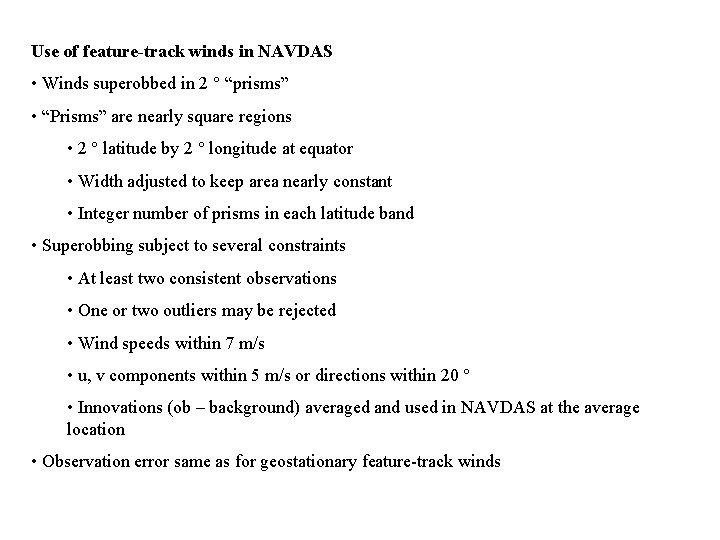
Use of feature-track winds in NAVDAS • Winds superobbed in 2 ° “prisms” • “Prisms” are nearly square regions • 2 ° latitude by 2 ° longitude at equator • Width adjusted to keep area nearly constant • Integer number of prisms in each latitude band • Superobbing subject to several constraints • At least two consistent observations • One or two outliers may be rejected • Wind speeds within 7 m/s • u, v components within 5 m/s or directions within 20 ° • Innovations (ob – background) averaged and used in NAVDAS at the average location • Observation error same as for geostationary feature-track winds
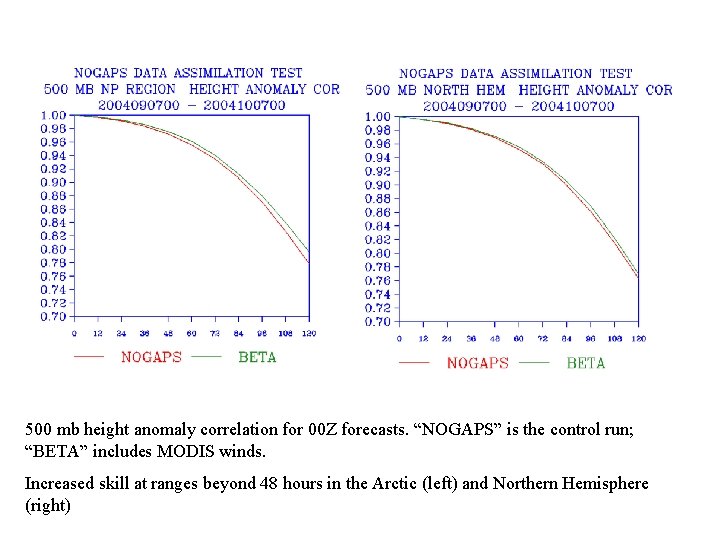
500 mb height anomaly correlation for 00 Z forecasts. “NOGAPS” is the control run; “BETA” includes MODIS winds. Increased skill at ranges beyond 48 hours in the Arctic (left) and Northern Hemisphere (right)
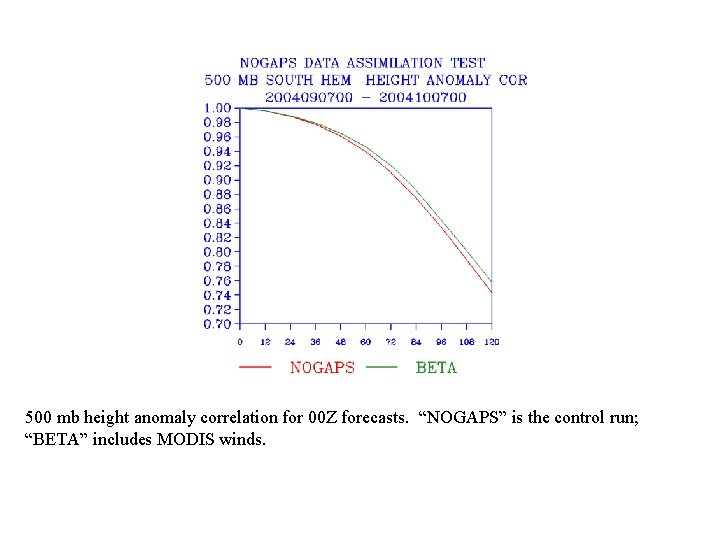
500 mb height anomaly correlation for 00 Z forecasts. “NOGAPS” is the control run; “BETA” includes MODIS winds.
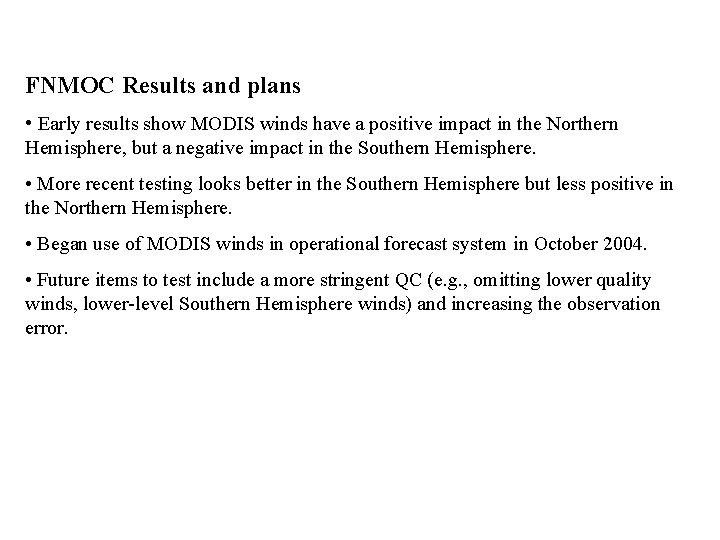
FNMOC Results and plans • Early results show MODIS winds have a positive impact in the Northern Hemisphere, but a negative impact in the Southern Hemisphere. • More recent testing looks better in the Southern Hemisphere but less positive in the Northern Hemisphere. • Began use of MODIS winds in operational forecast system in October 2004. • Future items to test include a more stringent QC (e. g. , omitting lower quality winds, lower-level Southern Hemisphere winds) and increasing the observation error.
Recommendation from WMO NWP Workshop held in 9 -12 March 2004 in Alpbach, Austria (attended by 52 NWP experts representing more than 20 NWP centers) “polar wind observations should be developed further and an operational follow-on to the MODIS winds be secured (this will require a water vapour channel on the operational imagers on NPOESS and METOP). Timeliness of data delivery can be addressed through direct data read-out. The number of stations with direct read-out capability should be increased. Such data should be made available directly to the processing centres. ”
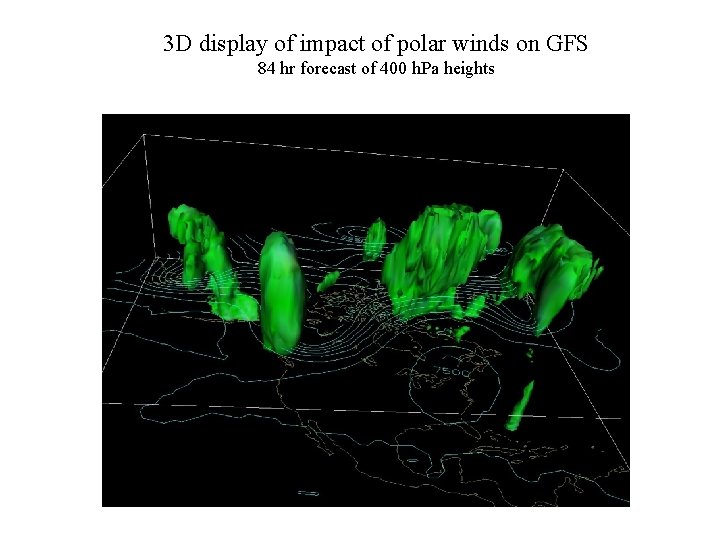
3 D display of impact of polar winds on GFS 84 hr forecast of 400 h. Pa heights
- Slides: 61