
Global Illumination cont Shadow Mapping shadow mapping suffers
Global Illumination (cont)
Shadow Mapping � shadow mapping suffers from self-shadow aliasing or “surface acne” � polygon is incorrectly considered to shadow itself � occurs because of � limited precision in the z-buffer � depth values from two different perspective projections are being compared

Shadow Mapping
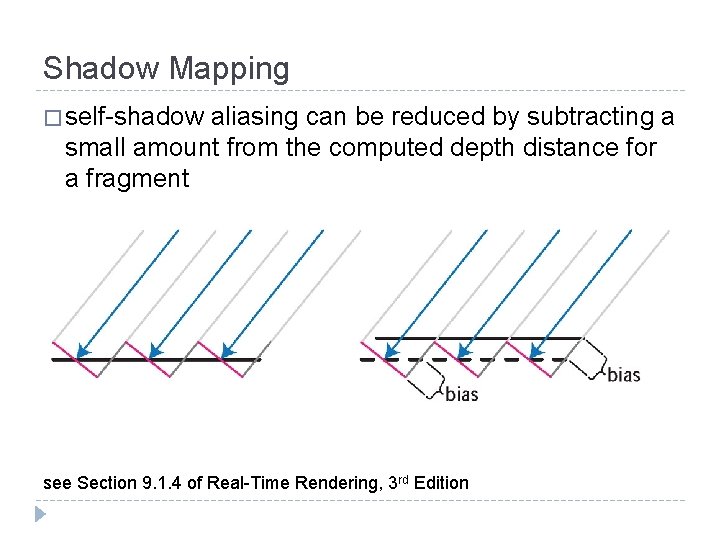
Shadow Mapping � self-shadow aliasing can be reduced by subtracting a small amount from the computed depth distance for a fragment see Section 9. 1. 4 of Real-Time Rendering, 3 rd Edition
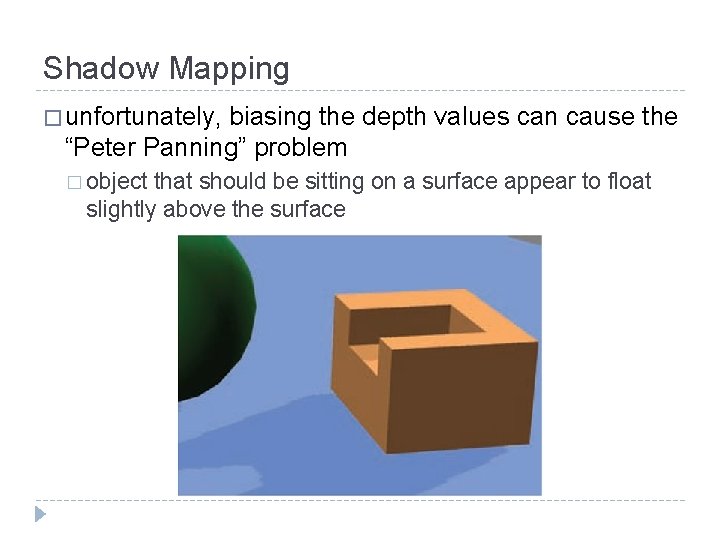
Shadow Mapping � unfortunately, biasing the depth values can cause the “Peter Panning” problem � object that should be sitting on a surface appear to float slightly above the surface

Shadow Mapping � the edges of shadow mapped shadows often have severe aliasing because of the finite size of the shadow map
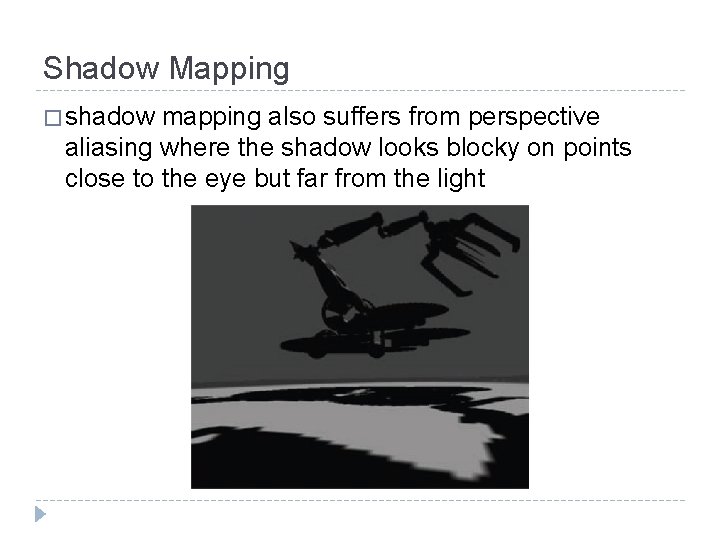
Shadow Mapping � shadow mapping also suffers from perspective aliasing where the shadow looks blocky on points close to the eye but far from the light
Shadow Mapping � percentage-closer filtering (PCF) is a common technique for softening the edges of shadow mapped shadows � tries to compute the percentage of the surface that is closer to the light (hence, not in shadow) � instead of comparing the fragment depth value to one texel in the shadow map, the four nearest texels are used � the results are bi-linearly interpolated to determine how much light is visible to the fragment � has hardware support in Open. GL � in general, the number of texels sampled should vary with the distance between the occluder and the receiver

Shadow Mapping

Shadow Mapping
Shadow Mapping � the Wikipedia page for shadow mapping is quite good � http: //en. wikipedia. org/wiki/Shadow_mapping
Refraction
Refraction � we have already talked briefly about refraction � Day 07: Fresnel equations � Day 10: Cube mapping
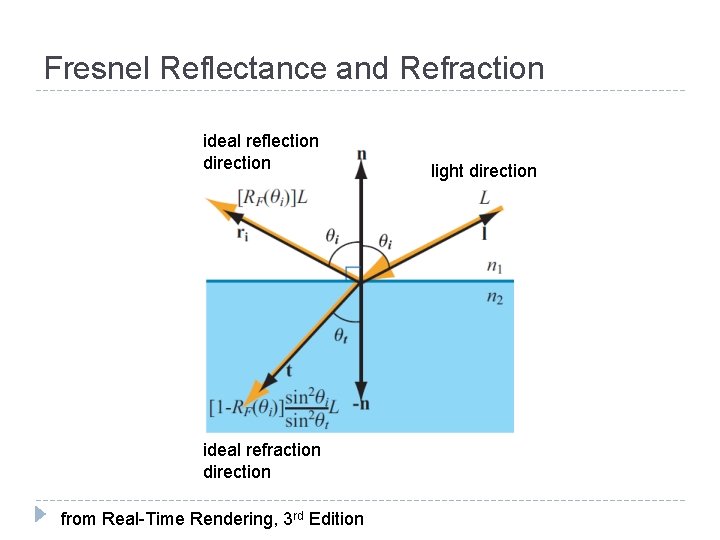
Fresnel Reflectance and Refraction ideal reflection direction ideal refraction direction from Real-Time Rendering, 3 rd Edition light direction
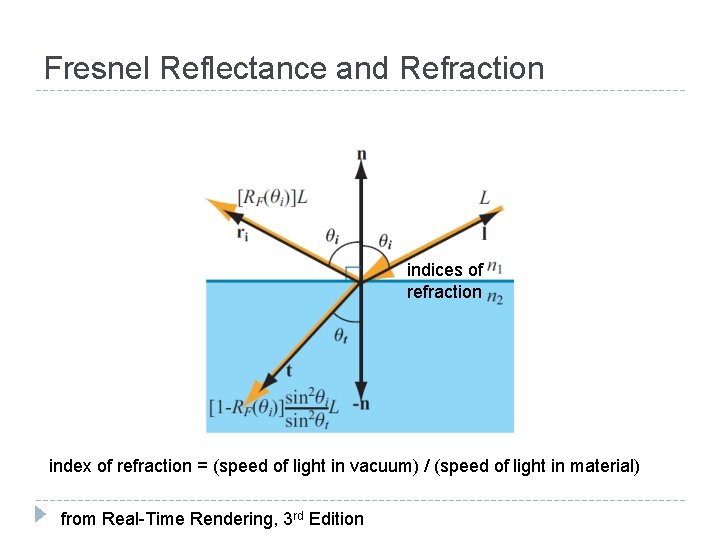
Fresnel Reflectance and Refraction indices of refraction index of refraction = (speed of light in vacuum) / (speed of light in material) from Real-Time Rendering, 3 rd Edition
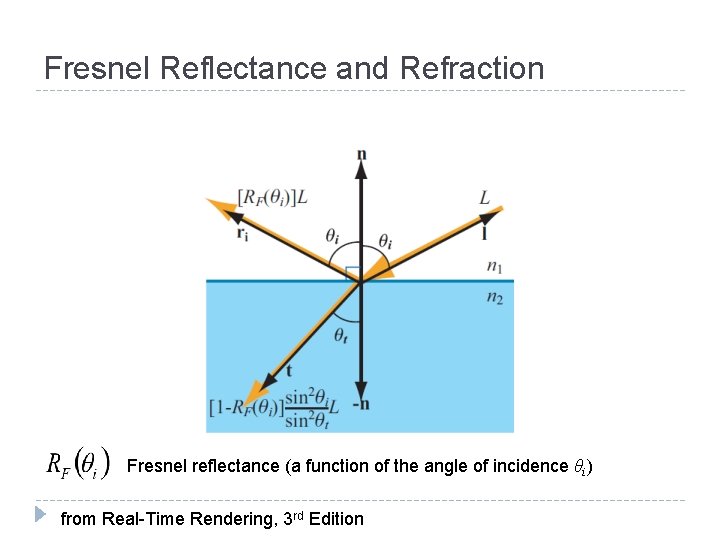
Fresnel Reflectance and Refraction Fresnel reflectance (a function of the angle of incidence θi) from Real-Time Rendering, 3 rd Edition
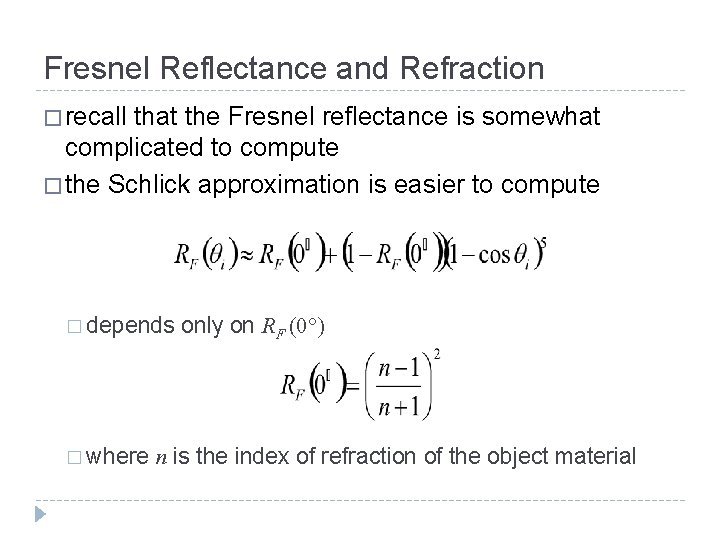
Fresnel Reflectance and Refraction � recall that the Fresnel reflectance is somewhat complicated to compute � the Schlick approximation is easier to compute � depends � where only on RF (0°) n is the index of refraction of the object material
Refraction � the refraction direction can be computed using the glsl function refract � only the first refraction can be easily calculated
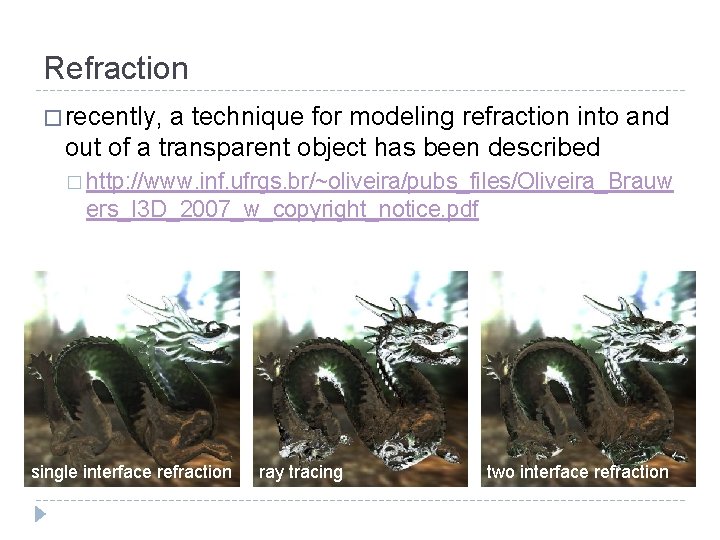
Refraction � recently, a technique for modeling refraction into and out of a transparent object has been described � http: //www. inf. ufrgs. br/~oliveira/pubs_files/Oliveira_Brauw ers_I 3 D_2007_w_copyright_notice. pdf single interface refraction ray tracing two interface refraction
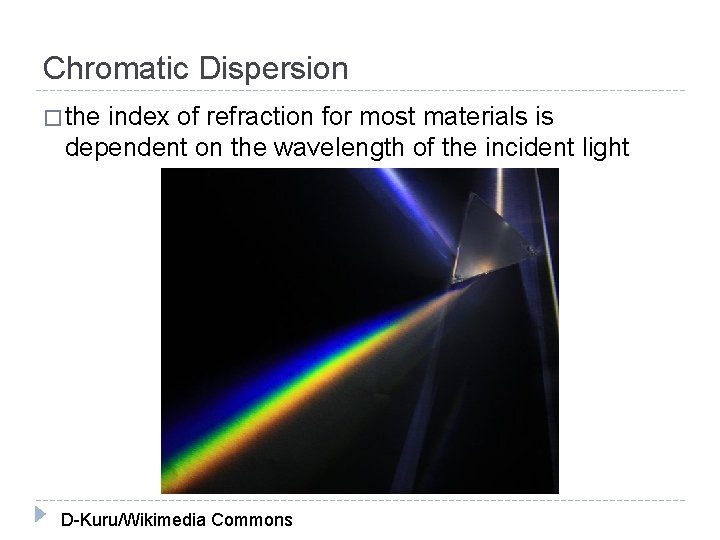
Chromatic Dispersion � the index of refraction for most materials is dependent on the wavelength of the incident light D-Kuru/Wikimedia Commons
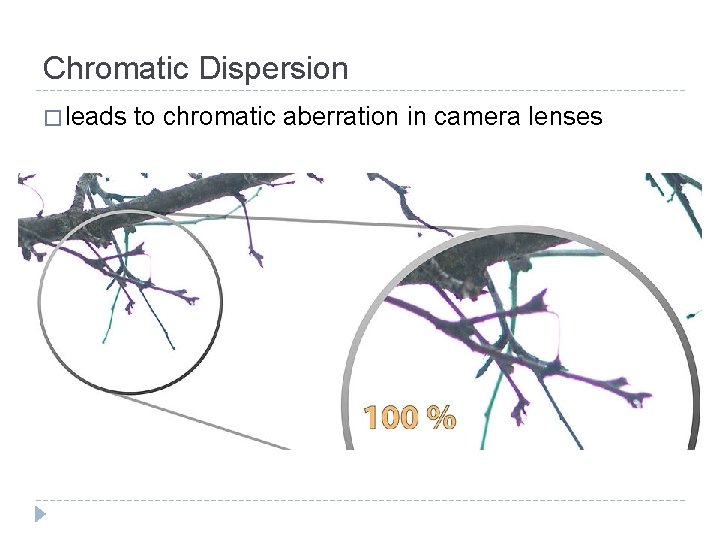
Chromatic Dispersion � leads to chromatic aberration in camera lenses
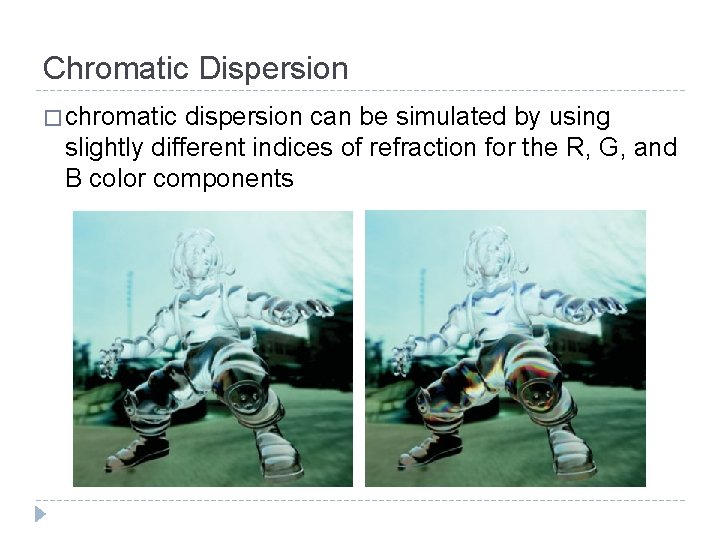
Chromatic Dispersion � chromatic dispersion can be simulated by using slightly different indices of refraction for the R, G, and B color components
Diffraction
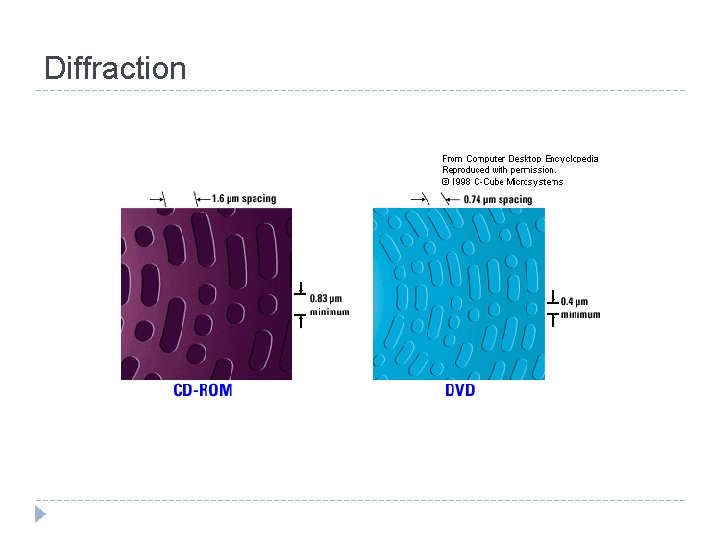
Diffraction � in computer graphics it is usually assumed that small -scale surface detail is unimportant � thus the fact that light behaves like a wave can be ignored � some surfaces have regular small-scale detail with spacing on the order of the wavelengths of visible light � such surfaces can reflect light in such a way that the light splits into its separate wavelength components
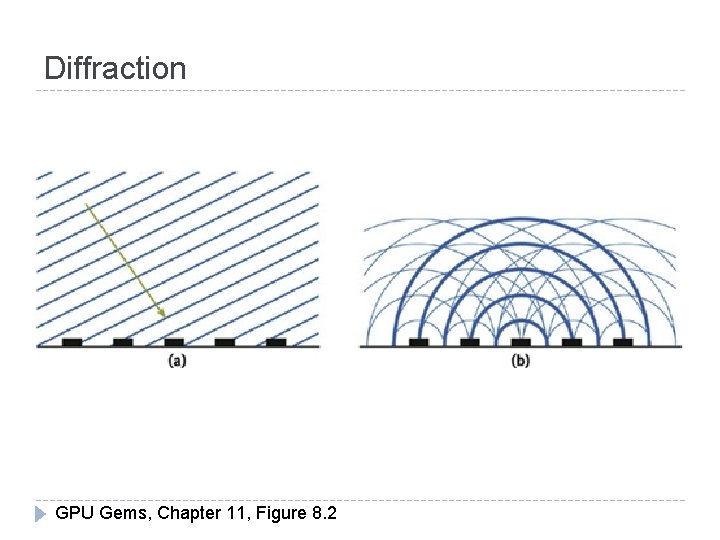
Diffraction GPU Gems, Chapter 11, Figure 8. 2
Diffraction
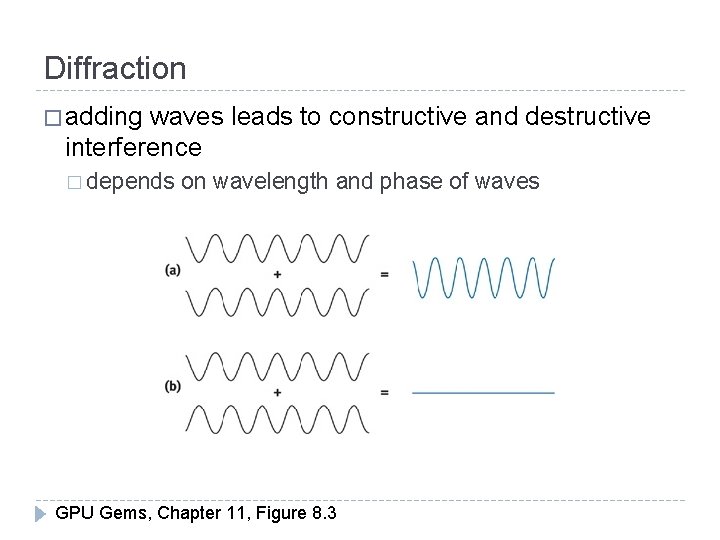
Diffraction � adding waves leads to constructive and destructive interference � depends on wavelength and phase of waves GPU Gems, Chapter 11, Figure 8. 3
Diffraction � we are interested in the case where waves interfere constructively � waves from adjacent bands will interfere constructively when the difference in distance from the source to the eye is equal to an integer number of wavelengths
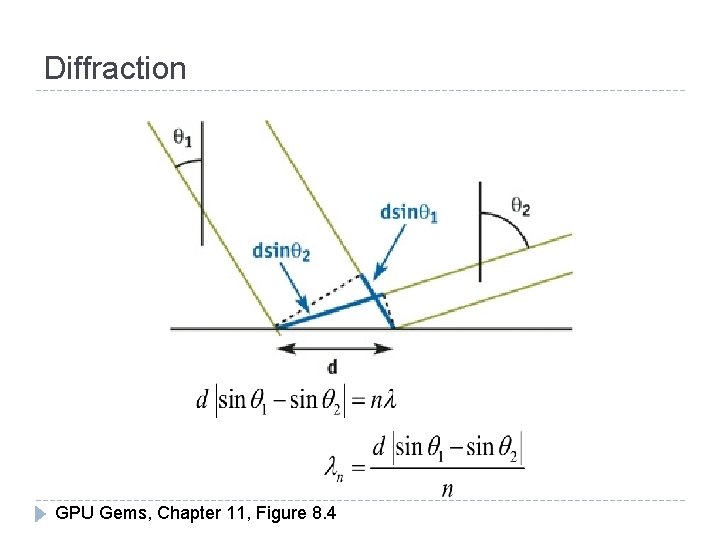
Diffraction GPU Gems, Chapter 11, Figure 8. 4
Diffraction � by looping from 1 to n we can compute the n wavelengths that interfere constructively at a point � converting the wavelengths into RGB values and summing them produces the diffraction color � see the lambda 2 rgb function in the handout
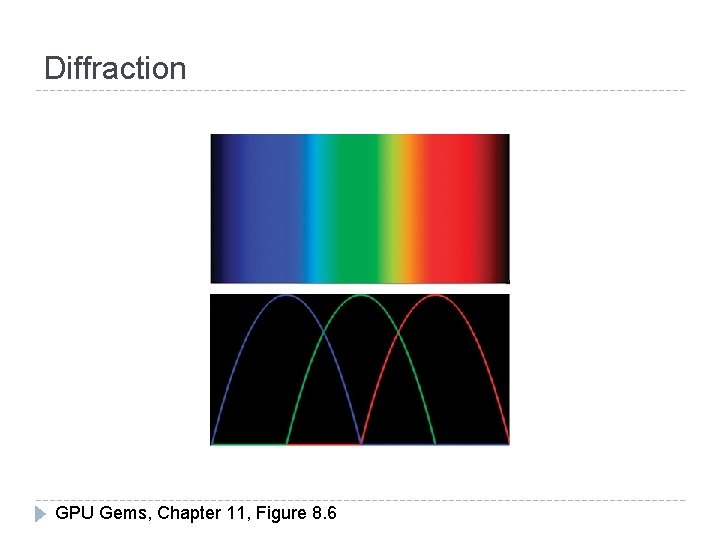
Diffraction GPU Gems, Chapter 11, Figure 8. 6
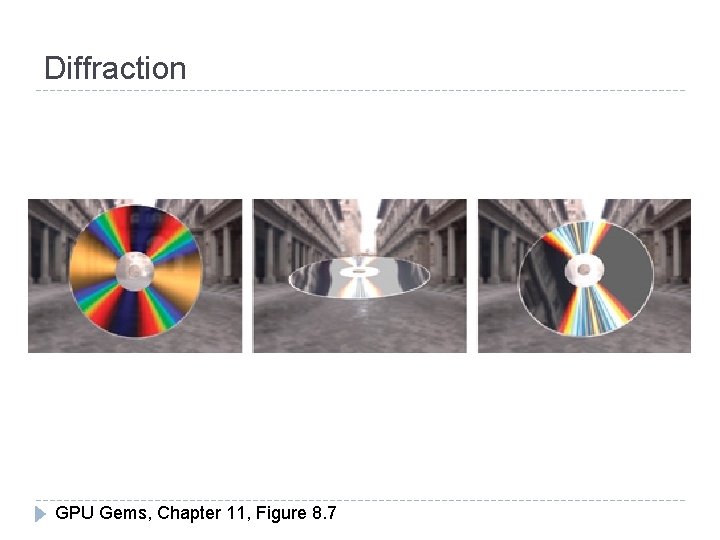
Diffraction GPU Gems, Chapter 11, Figure 8. 7
- Slides: 32