
Global History Final Exam Review PART ONE Primary
Global History Final Exam Review PART ONE
Primary vs. Secondary Sources Primary sources are first-hand accounts of an historical event. - Diary - Photograph - Autobiography - Artifact (something used or made by someone from the event) Secondary sources are second-hand accounts of an historical event. - Textbook - Encyclopedia - Biography
Fields within Social Science Anthropologists study humans and culture. Archaeologists study the artifacts (objects made or used by humans) humans have left behind. Paleoanthropologists study ancient human fossils. Economists study economic systems. Linguists study language.
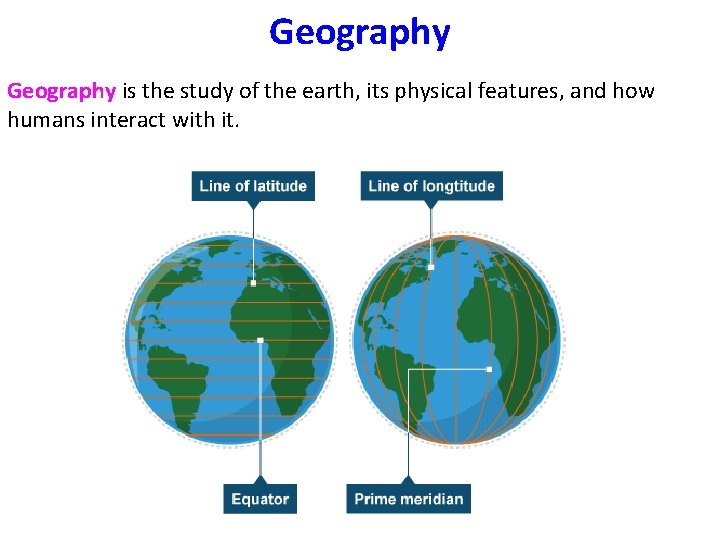
Geography is the study of the earth, its physical features, and how humans interact with it.
Islamic Golden Age 8 th- 13 th centuries CE ü Occurred at the same time as medieval western Europe ü Achievements in algebra, astronomy, medicine (smallpox vaccination), cataracts surgery ü Kept knowledge of classical Greece and Rome alive
Types of Maps Physical maps show physical features of the earth (mountains, lakes…) Political maps show cities and political boundaries. Political maps change much more quickly than physical maps. Topographic maps show elevation. Climate maps show climate (weather patterns over time).
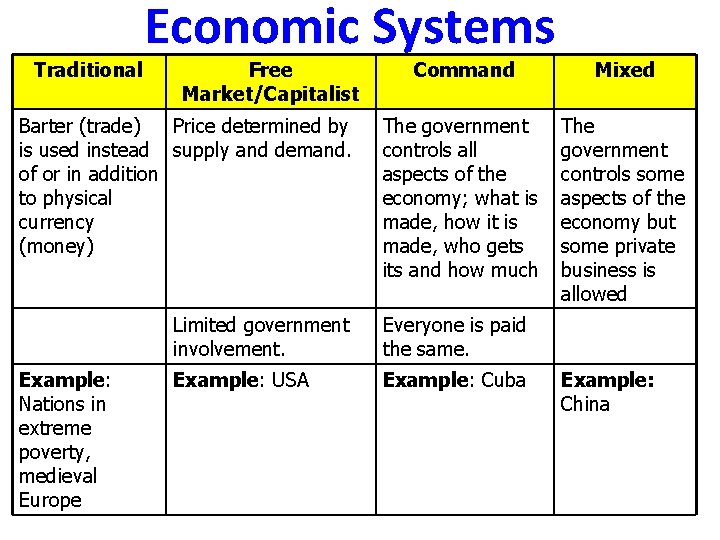
Traditional Economic Systems Free Market/Capitalist Barter (trade) Price determined by is used instead supply and demand. of or in addition to physical currency (money) Example: Nations in extreme poverty, medieval Europe Command Mixed The government controls all aspects of the economy; what is made, how it is made, who gets its and how much The government controls some aspects of the economy but some private business is allowed Limited government involvement. Everyone is paid the same. Example: USA Example: Cuba Example: China
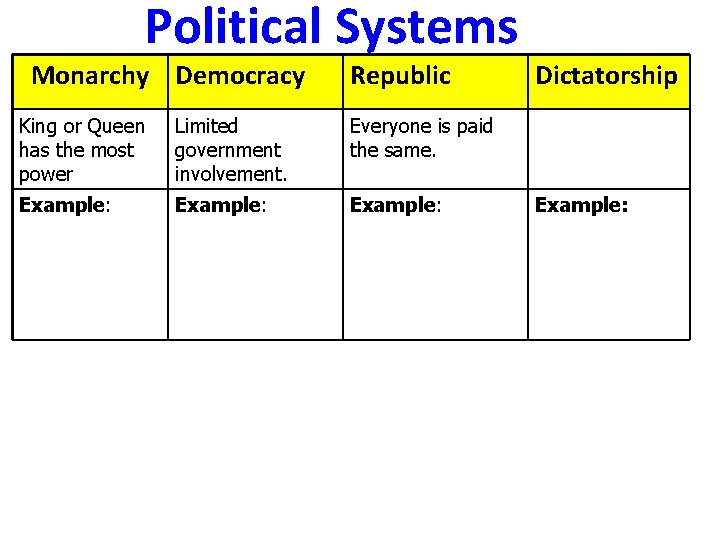
Political Systems Monarchy Democracy Republic King or Queen has the most power Limited government involvement. Everyone is paid the same. Example: Dictatorship Example:
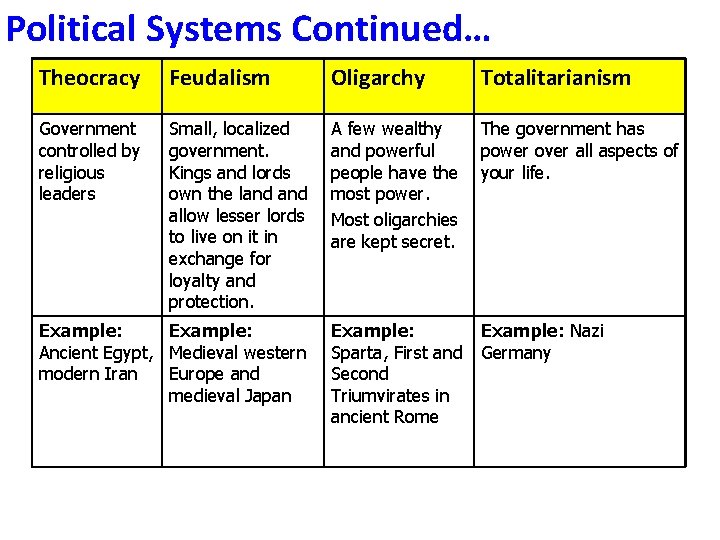
Political Systems Continued… Theocracy Feudalism Oligarchy Totalitarianism Government controlled by religious leaders Small, localized government. Kings and lords own the land allow lesser lords to live on it in exchange for loyalty and protection. A few wealthy and powerful people have the most power. Most oligarchies are kept secret. The government has power over all aspects of your life. Example: Ancient Egypt, Medieval western modern Iran Europe and medieval Japan Example: Sparta, First and Second Triumvirates in ancient Rome Example: Nazi Germany
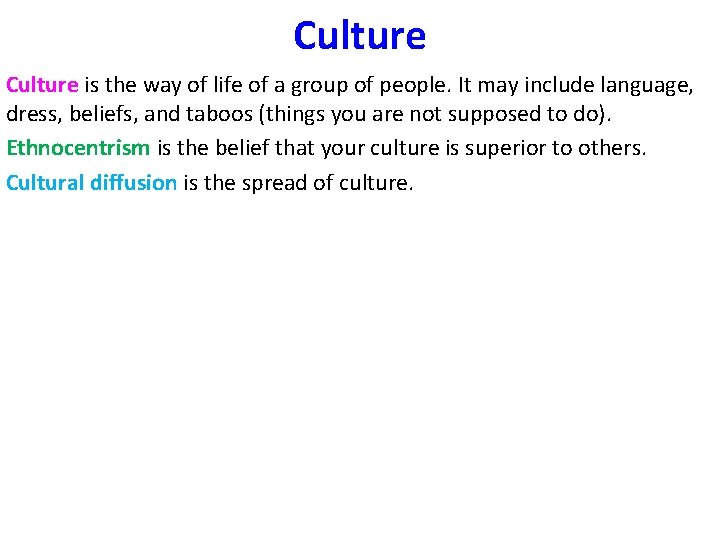
Culture is the way of life of a group of people. It may include language, dress, beliefs, and taboos (things you are not supposed to do). Ethnocentrism is the belief that your culture is superior to others. Cultural diffusion is the spread of culture.
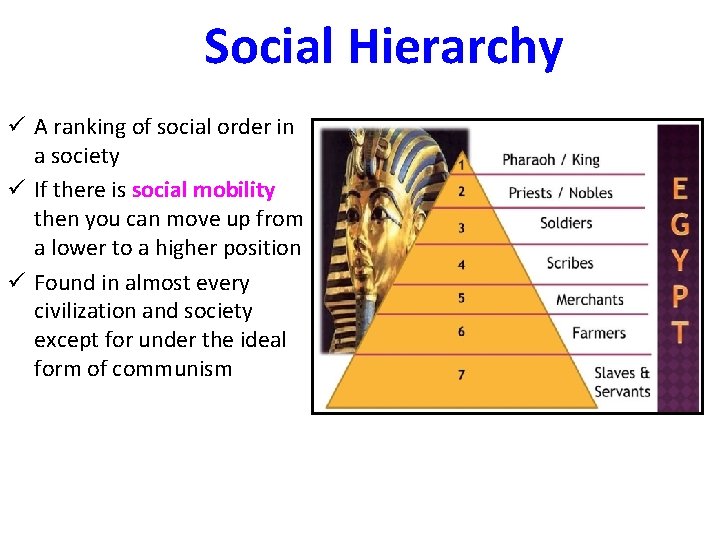
Social Hierarchy ü A ranking of social order in a society ü If there is social mobility then you can move up from a lower to a higher position ü Found in almost every civilization and society except for under the ideal form of communism
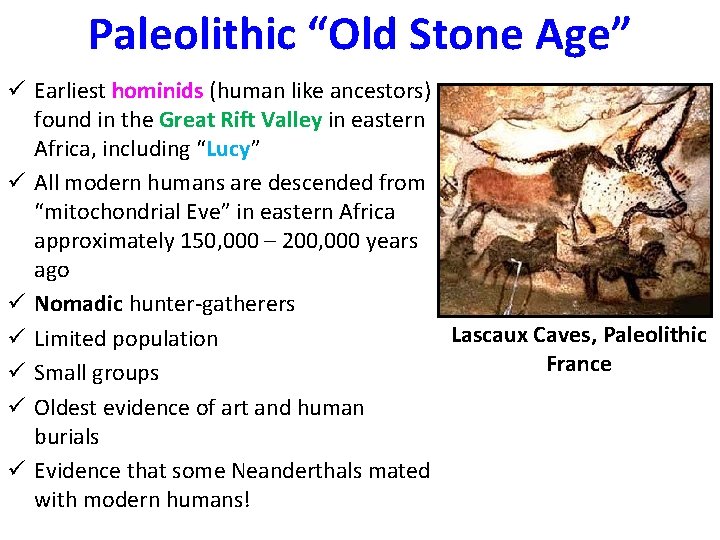
Paleolithic “Old Stone Age” ü Earliest hominids (human like ancestors) found in the Great Rift Valley in eastern Africa, including “Lucy” ü All modern humans are descended from “mitochondrial Eve” in eastern Africa approximately 150, 000 – 200, 000 years ago ü Nomadic hunter-gatherers Lascaux Caves, Paleolithic ü Limited population France ü Small groups ü Oldest evidence of art and human burials ü Evidence that some Neanderthals mated with modern humans!

Out of Africa Theory
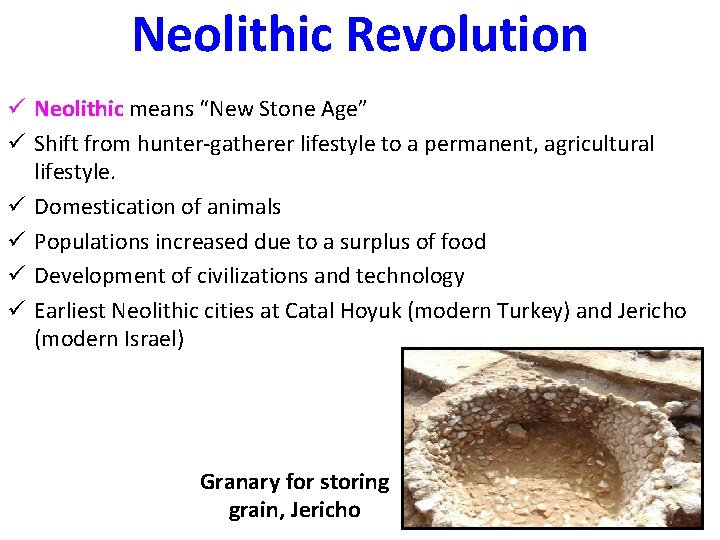
Neolithic Revolution ü Neolithic means “New Stone Age” ü Shift from hunter-gatherer lifestyle to a permanent, agricultural lifestyle. ü Domestication of animals ü Populations increased due to a surplus of food ü Development of civilizations and technology ü Earliest Neolithic cities at Catal Hoyuk (modern Turkey) and Jericho (modern Israel) Granary for storing grain, Jericho
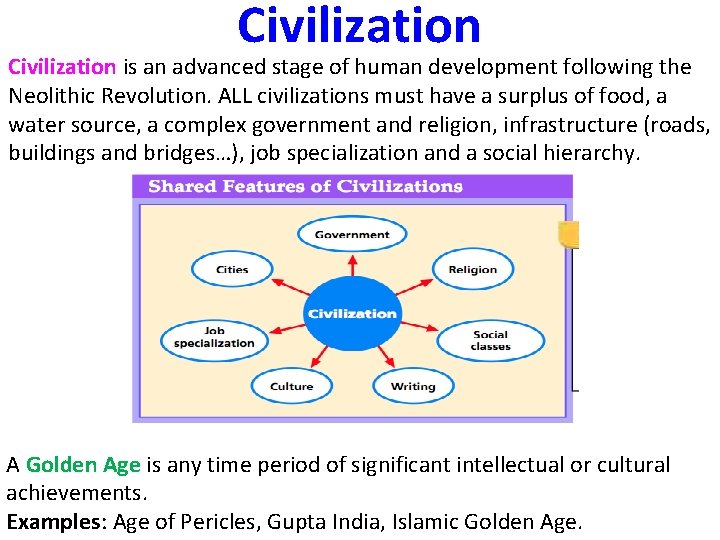
Civilization is an advanced stage of human development following the Neolithic Revolution. ALL civilizations must have a surplus of food, a water source, a complex government and religion, infrastructure (roads, buildings and bridges…), job specialization and a social hierarchy. A Golden Age is any time period of significant intellectual or cultural achievements. Examples: Age of Pericles, Gupta India, Islamic Golden Age.
Animism and Polytheism Animism is the belief that a soul or spirit exists in every object in nature even if it is inanimate. Examples: Traditional African and Native American religions, Shinto in Japan Polytheism: The belief in more than one god. Examples: Ancient Egypt, ancient Greece, ancient Rome…
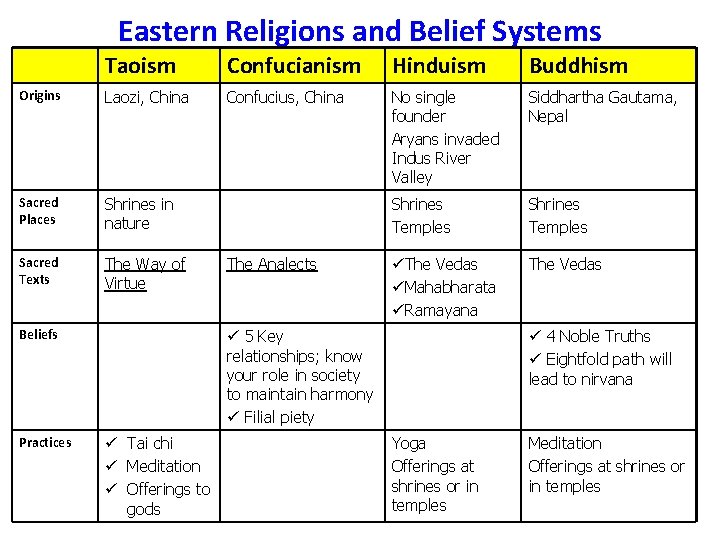
Eastern Religions and Belief Systems Taoism Confucianism Hinduism Buddhism Origins Laozi, China Confucius, China No single founder Aryans invaded Indus River Valley Siddhartha Gautama, Nepal Sacred Places Shrines in nature Shrines Temples Sacred Texts The Way of Virtue üThe Vedas üMahabharata üRamayana The Vedas Beliefs Practices The Analects ü 5 Key relationships; know your role in society to maintain harmony ü Filial piety ü Tai chi ü Meditation ü Offerings to gods ü 4 Noble Truths ü Eightfold path will lead to nirvana Yoga Offerings at shrines or in temples Meditation Offerings at shrines or in temples
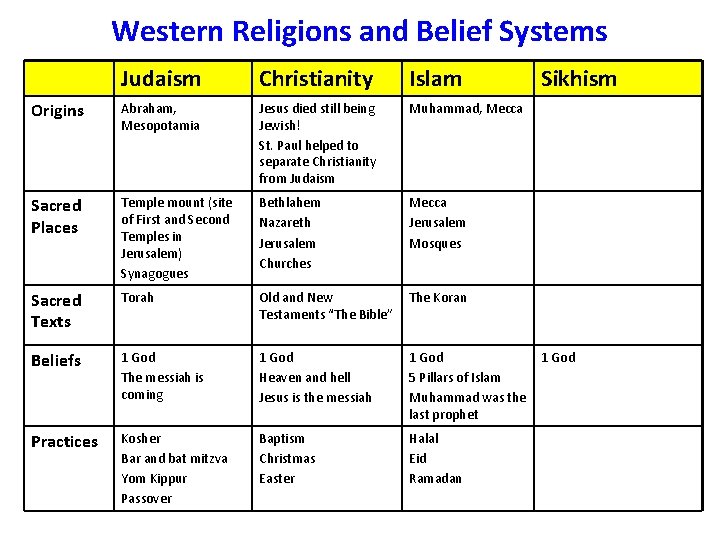
Western Religions and Belief Systems Judaism Christianity Islam Origins Abraham, Mesopotamia Jesus died still being Jewish! St. Paul helped to separate Christianity from Judaism Muhammad, Mecca Sacred Places Temple mount (site of First and Second Temples in Jerusalem) Synagogues Bethlahem Nazareth Jerusalem Churches Mecca Jerusalem Mosques Sacred Texts Torah Old and New Testaments “The Bible” The Koran Beliefs 1 God The messiah is coming 1 God Heaven and hell Jesus is the messiah 1 God 5 Pillars of Islam Muhammad was the last prophet Practices Kosher Bar and bat mitzva Yom Kippur Passover Baptism Christmas Easter Halal Eid Ramadan Sikhism 1 God
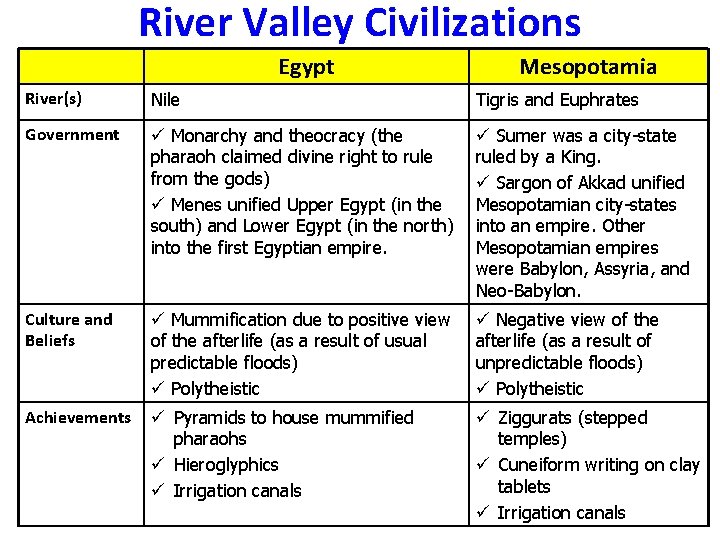
River Valley Civilizations Egypt Mesopotamia River(s) Nile Tigris and Euphrates Government ü Monarchy and theocracy (the pharaoh claimed divine right to rule from the gods) ü Menes unified Upper Egypt (in the south) and Lower Egypt (in the north) into the first Egyptian empire. ü Sumer was a city-state ruled by a King. ü Sargon of Akkad unified Mesopotamian city-states into an empire. Other Mesopotamian empires were Babylon, Assyria, and Neo-Babylon. Culture and Beliefs ü Mummification due to positive view of the afterlife (as a result of usual predictable floods) ü Polytheistic ü Negative view of the afterlife (as a result of unpredictable floods) ü Polytheistic Achievements ü Pyramids to house mummified pharaohs ü Hieroglyphics ü Irrigation canals ü Ziggurats (stepped temples) ü Cuneiform writing on clay tablets ü Irrigation canals
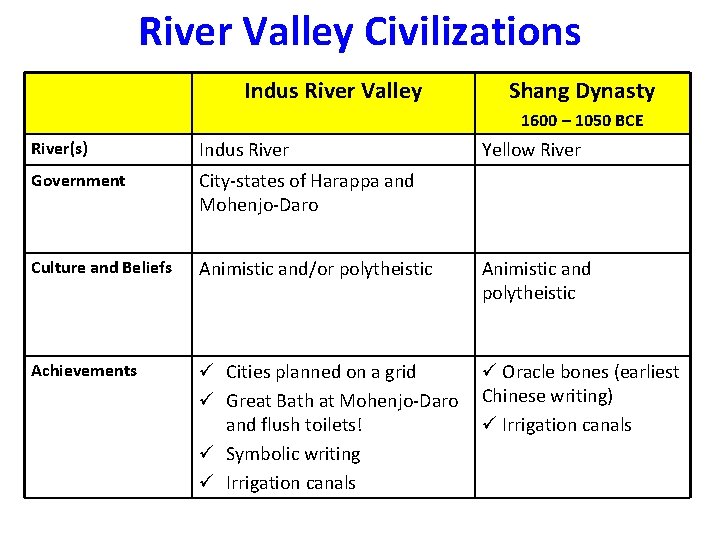
River Valley Civilizations Indus River Valley Shang Dynasty 1600 – 1050 BCE River(s) Indus River Yellow River Government City-states of Harappa and Mohenjo-Daro Culture and Beliefs Animistic and/or polytheistic Animistic and polytheistic Achievements ü Cities planned on a grid ü Great Bath at Mohenjo-Daro and flush toilets! ü Symbolic writing ü Irrigation canals ü Oracle bones (earliest Chinese writing) ü Irrigation canals
The First Americans ü The First Americans arrived approximately 17, 000 years ago during the Paleolithic! Most came from Asia across the Bering Land Bridge (land exposed when the ocean level was lowered during the last ice age). Some may have come by boat. ü Eventually North and South America was settled by millions of people before the arrival of Europeans.
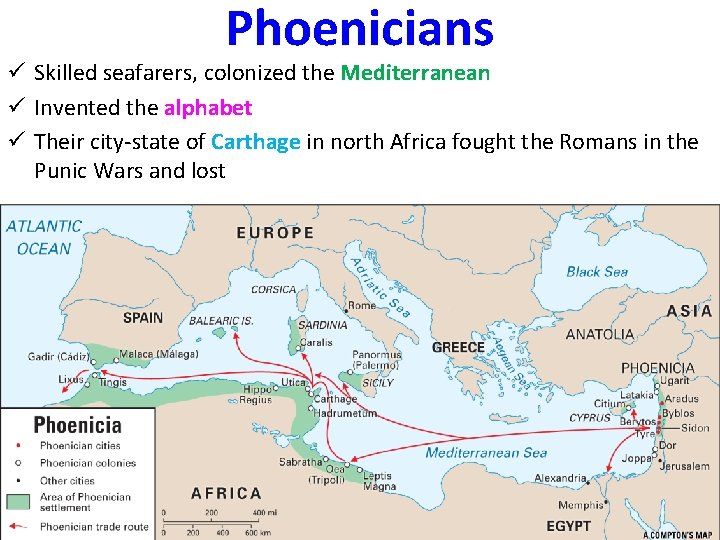
Phoenicians ü Skilled seafarers, colonized the Mediterranean ü Invented the alphabet ü Their city-state of Carthage in north Africa fought the Romans in the Punic Wars and lost
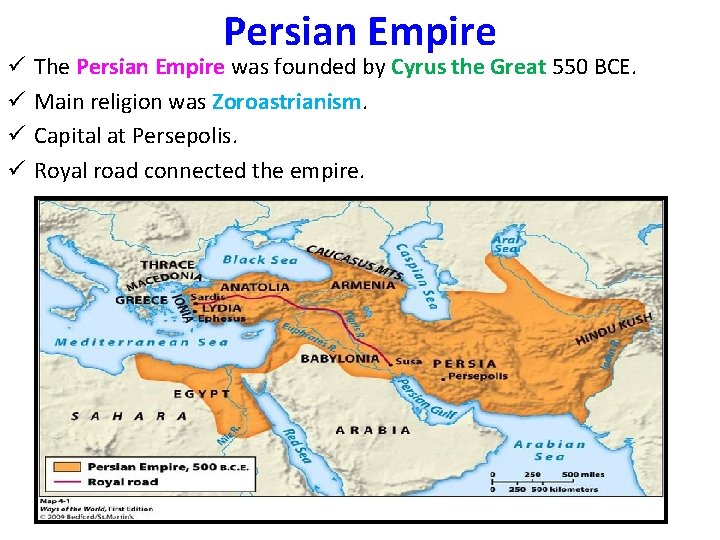
ü ü Persian Empire The Persian Empire was founded by Cyrus the Great 550 BCE. Main religion was Zoroastrianism. Capital at Persepolis. Royal road connected the empire.
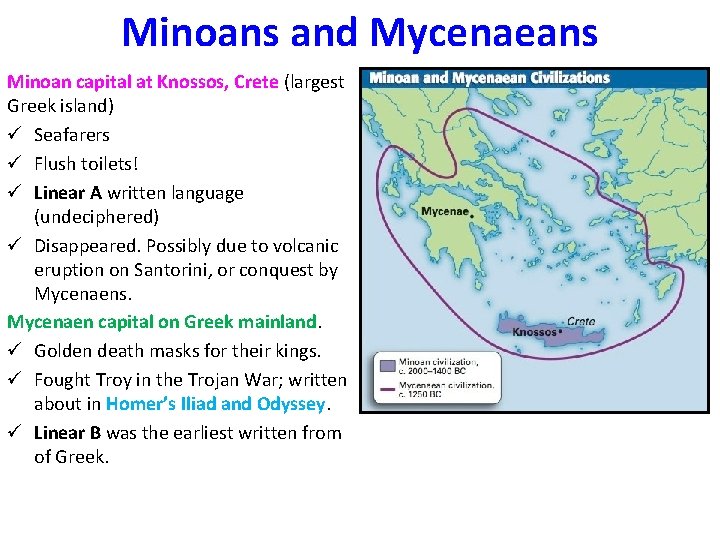
Minoans and Mycenaeans Minoan capital at Knossos, Crete (largest Greek island) ü Seafarers ü Flush toilets! ü Linear A written language (undeciphered) ü Disappeared. Possibly due to volcanic eruption on Santorini, or conquest by Mycenaens. Mycenaen capital on Greek mainland. ü Golden death masks for their kings. ü Fought Troy in the Trojan War; written about in Homer’s Iliad and Odyssey. ü Linear B was the earliest written from of Greek.
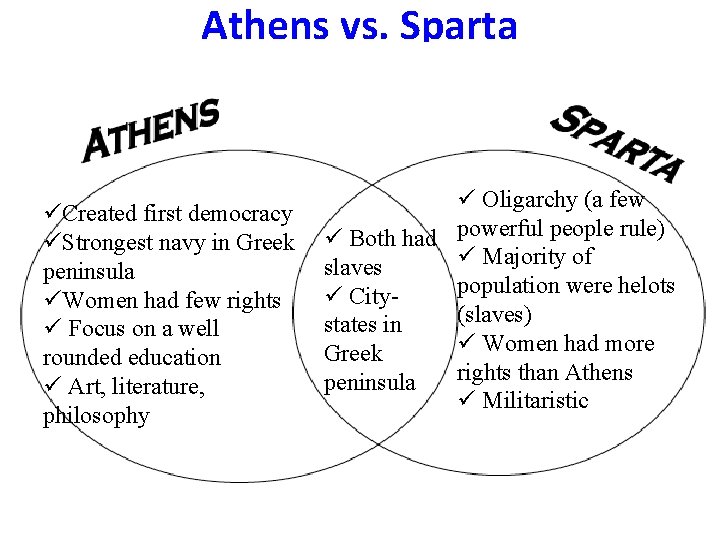
Athens vs. Sparta üCreated first democracy üStrongest navy in Greek peninsula üWomen had few rights ü Focus on a well rounded education ü Art, literature, philosophy ü Oligarchy (a few ü Both had powerful people rule) ü Majority of slaves population were helots ü City(slaves) states in ü Women had more Greek rights than Athens peninsula ü Militaristic
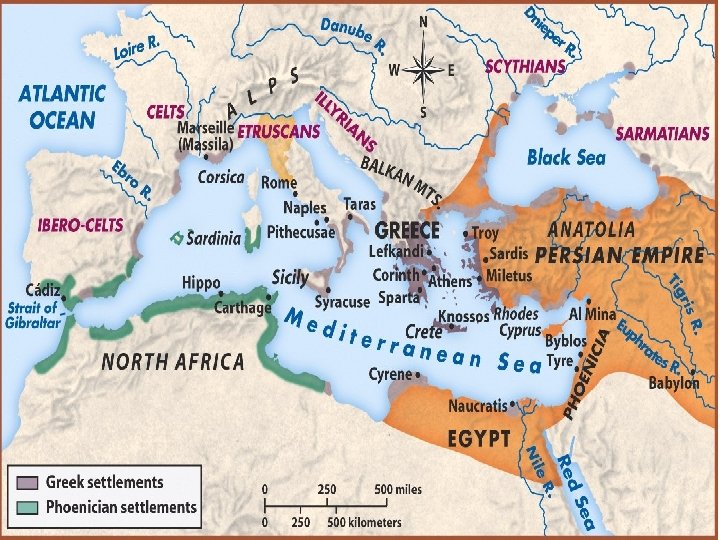
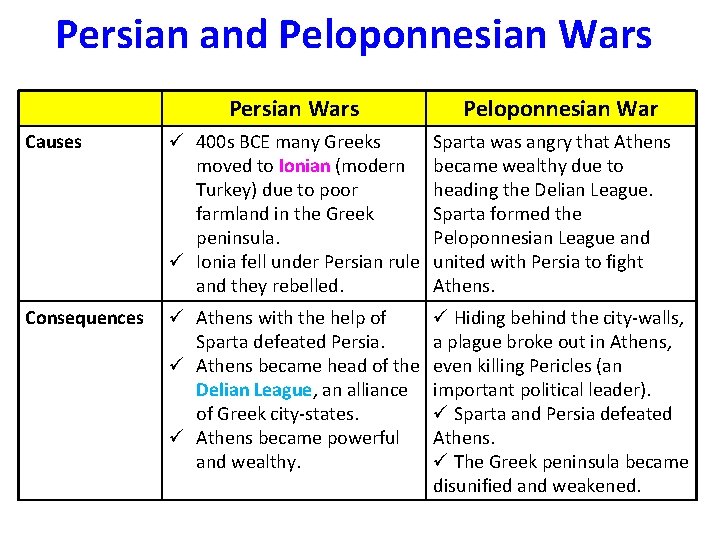
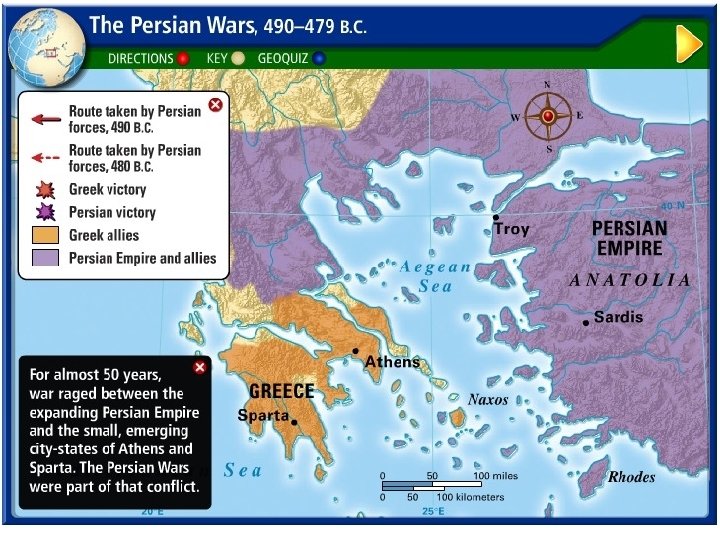
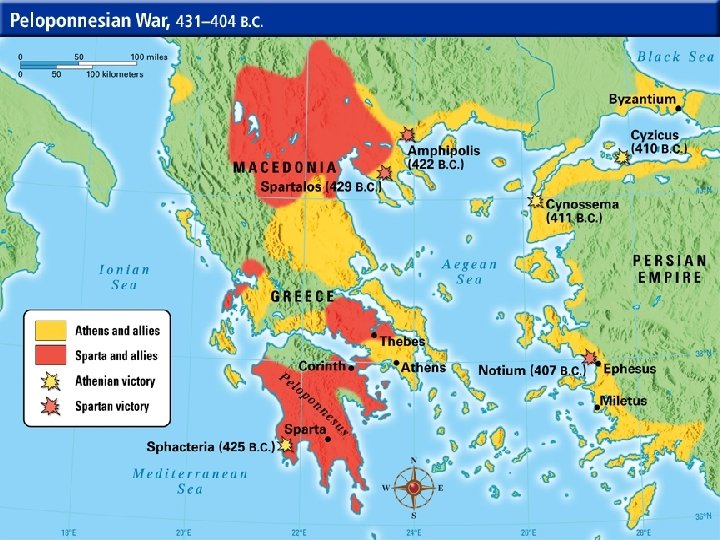
Persian and Peloponnesian Wars Persian Wars Peloponnesian War Causes ü 400 s BCE many Greeks moved to Ionian (modern Turkey) due to poor farmland in the Greek peninsula. ü Ionia fell under Persian rule and they rebelled. Sparta was angry that Athens became wealthy due to heading the Delian League. Sparta formed the Peloponnesian League and united with Persia to fight Athens. Consequences ü Athens with the help of Sparta defeated Persia. ü Athens became head of the Delian League, an alliance of Greek city-states. ü Athens became powerful and wealthy. ü Hiding behind the city-walls, a plague broke out in Athens, even killing Pericles (an important political leader). ü Sparta and Persia defeated Athens. ü The Greek peninsula became disunified and weakened.
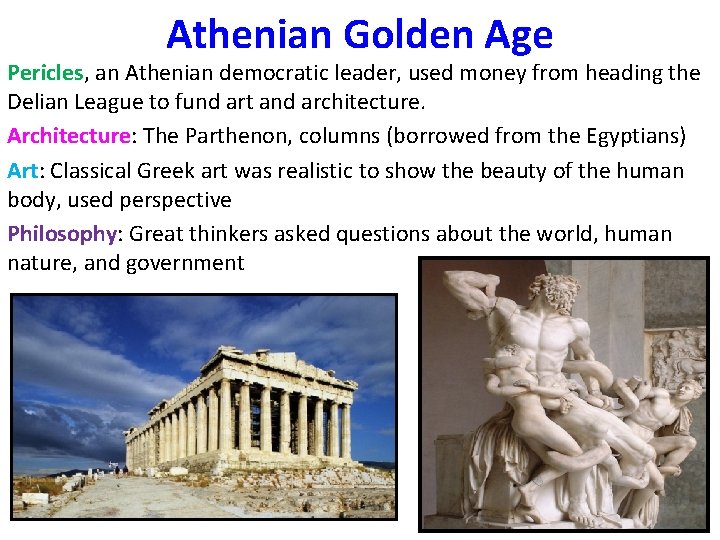
Athenian Golden Age Pericles, an Athenian democratic leader, used money from heading the Delian League to fund art and architecture. Architecture: The Parthenon, columns (borrowed from the Egyptians) Art: Classical Greek art was realistic to show the beauty of the human body, used perspective Philosophy: Great thinkers asked questions about the world, human nature, and government
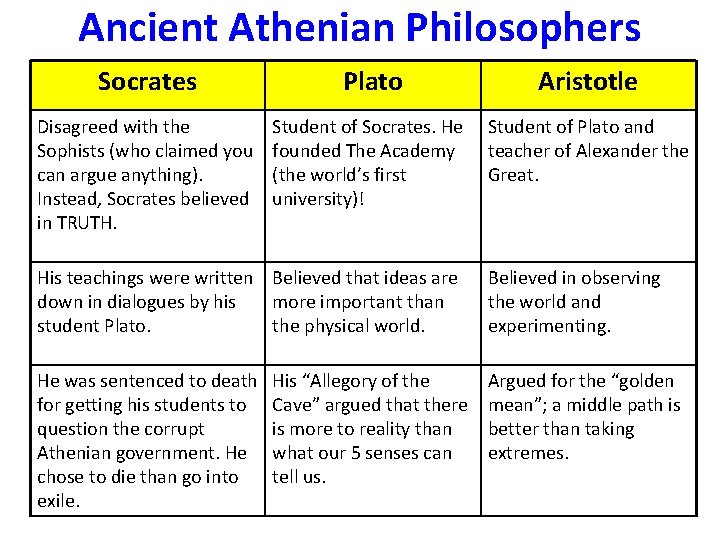
Ancient Athenian Philosophers Socrates Plato Aristotle Disagreed with the Sophists (who claimed you can argue anything). Instead, Socrates believed in TRUTH. Student of Socrates. He founded The Academy (the world’s first university)! Student of Plato and teacher of Alexander the Great. His teachings were written Believed that ideas are down in dialogues by his more important than student Plato. the physical world. Believed in observing the world and experimenting. He was sentenced to death for getting his students to question the corrupt Athenian government. He chose to die than go into exile. Argued for the “golden mean”; a middle path is better than taking extremes. His “Allegory of the Cave” argued that there is more to reality than what our 5 senses can tell us.
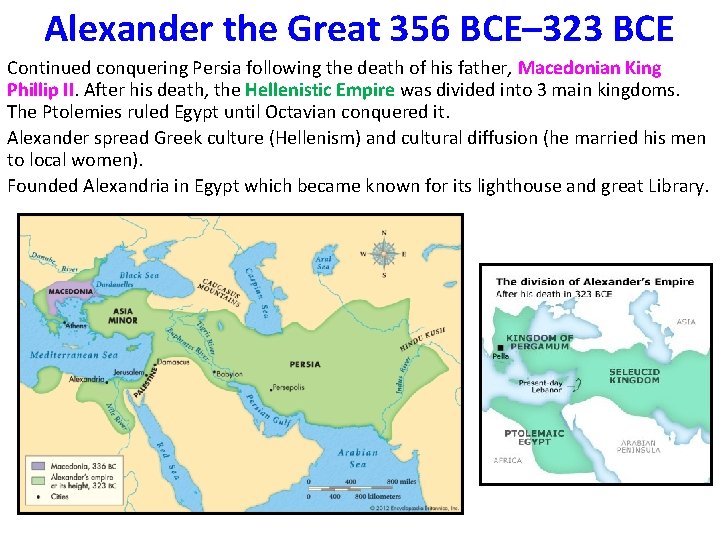
Alexander the Great 356 BCE– 323 BCE Continued conquering Persia following the death of his father, Macedonian King Phillip II. After his death, the Hellenistic Empire was divided into 3 main kingdoms. The Ptolemies ruled Egypt until Octavian conquered it. Alexander spread Greek culture (Hellenism) and cultural diffusion (he married his men to local women). Founded Alexandria in Egypt which became known for its lighthouse and great Library.
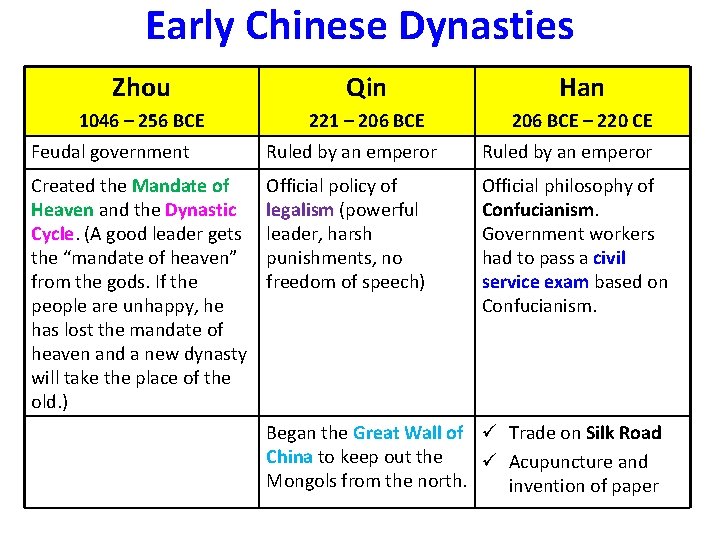
Early Chinese Dynasties Zhou Qin Han 1046 – 256 BCE 221 – 206 BCE – 220 CE Feudal government Ruled by an emperor Created the Mandate of Heaven and the Dynastic Cycle. (A good leader gets the “mandate of heaven” from the gods. If the people are unhappy, he has lost the mandate of heaven and a new dynasty will take the place of the old. ) Official policy of legalism (powerful leader, harsh punishments, no freedom of speech) Official philosophy of Confucianism. Government workers had to pass a civil service exam based on Confucianism. Began the Great Wall of ü Trade on Silk Road China to keep out the ü Acupuncture and Mongols from the north. invention of paper
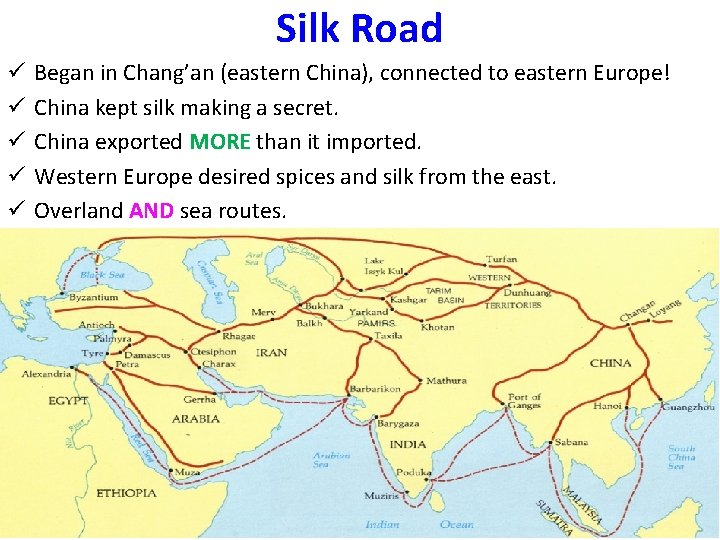
Silk Road ü ü ü Began in Chang’an (eastern China), connected to eastern Europe! China kept silk making a secret. China exported MORE than it imported. Western Europe desired spices and silk from the east. Overland AND sea routes.
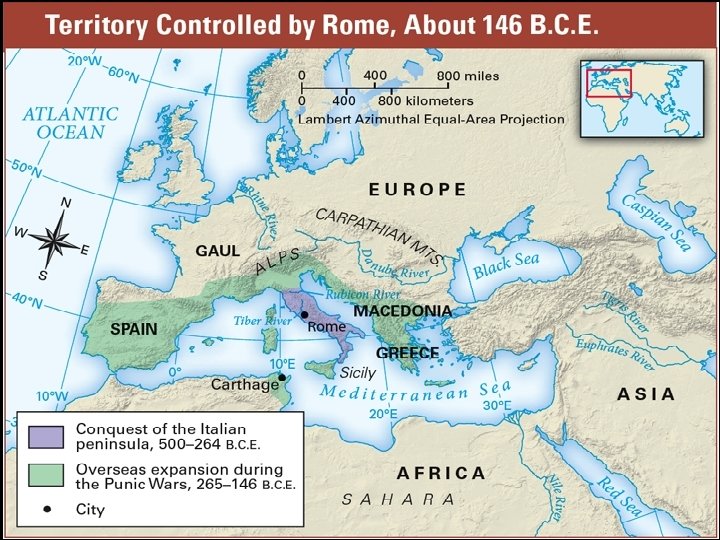
Roman Republic ü Roman mythology says Romulus and Remus were the first Roman kings. ü In reality, in 509 BCE the Latins overthrew the last Etruscan King of Rome. ü Rome conquered the Italian peninsula and conquered Carthage in the Punic Wars. Built roads connecting their empire. ü Created the first Republic. The Senate had the most power, but their power was “checked” by the Consuls (in charge of the army) and the plebian Tribunes (veto power). A dictator could rule for up to 6 months. ü 12 Tables (Roman law code). *Greatly influenced western law!
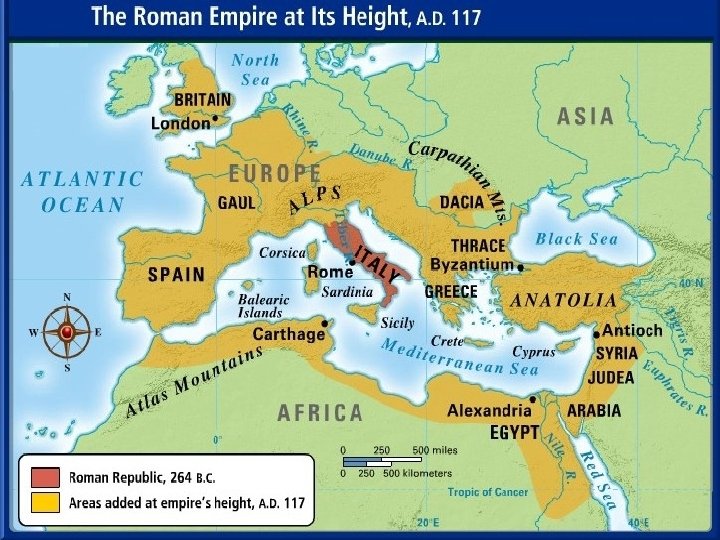
Roman Empire 45 BCE Julius Caesar became dictator of Rome. This was the end of the Roman Republic. He was assassinated by the Senate who feared he was becoming too powerful. 27 BCE Octavian renamed himself Augustus and became the most powerful man in Rome. Many historians consider him to be Rome’s first “official” emperor. Pax Romana 27 BCE – 14 CE: Period of stability in the empire. Diocletian divided Rome. The western capital remained in Rome, and the east was in Constantinople. *Due to Rome’s size, this was to better control the empire. Constantine converted to Christianity. The official religion of Rome changed from polytheism to Christianity. Decline of Rome:
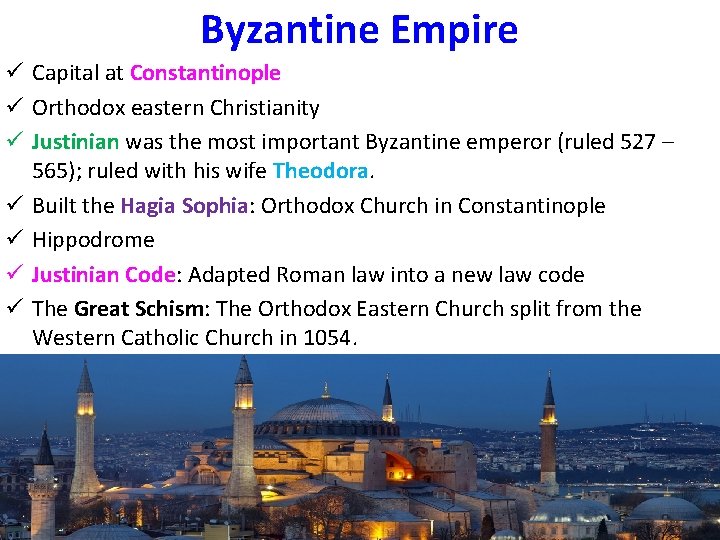
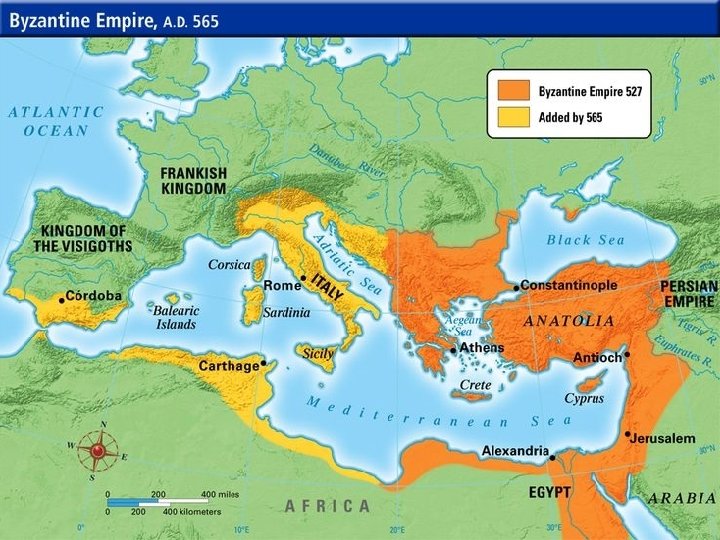
Byzantine Empire ü Capital at Constantinople ü Orthodox eastern Christianity ü Justinian was the most important Byzantine emperor (ruled 527 – 565); ruled with his wife Theodora. ü Built the Hagia Sophia: Orthodox Church in Constantinople ü Hippodrome ü Justinian Code: Adapted Roman law into a new law code ü The Great Schism: The Orthodox Eastern Church split from the Western Catholic Church in 1054.
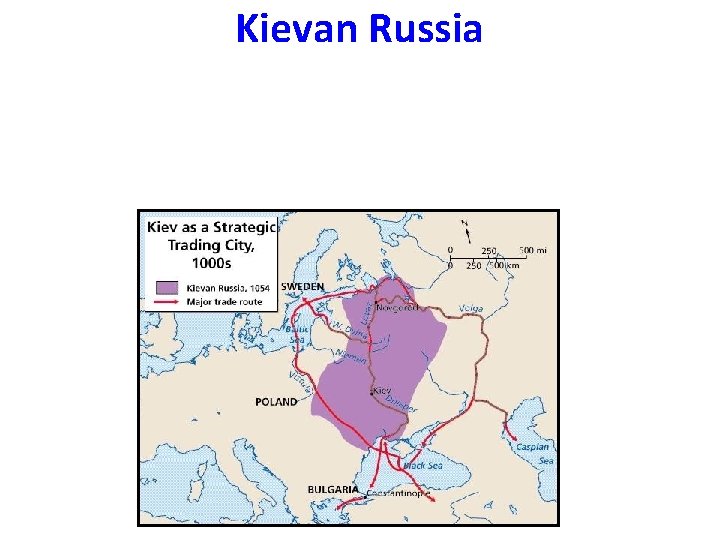
Kievan Russia
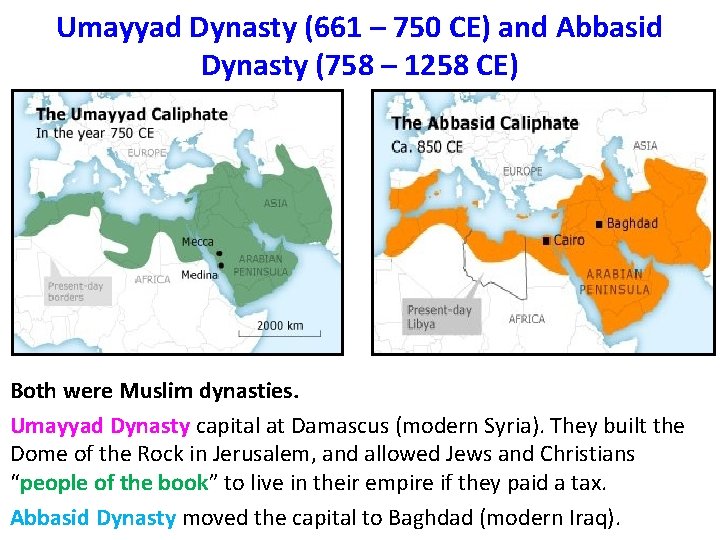
Umayyad Dynasty (661 – 750 CE) and Abbasid Dynasty (758 – 1258 CE) Both were Muslim dynasties. Umayyad Dynasty capital at Damascus (modern Syria). They built the Dome of the Rock in Jerusalem, and allowed Jews and Christians “people of the book” to live in their empire if they paid a tax. Abbasid Dynasty moved the capital to Baghdad (modern Iraq).
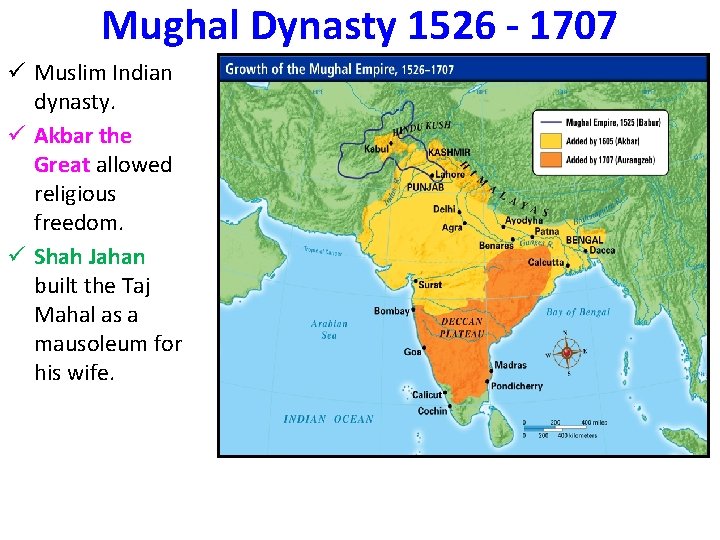
Mughal Dynasty 1526 - 1707 ü Muslim Indian dynasty. ü Akbar the Great allowed religious freedom. ü Shah Jahan built the Taj Mahal as a mausoleum for his wife.
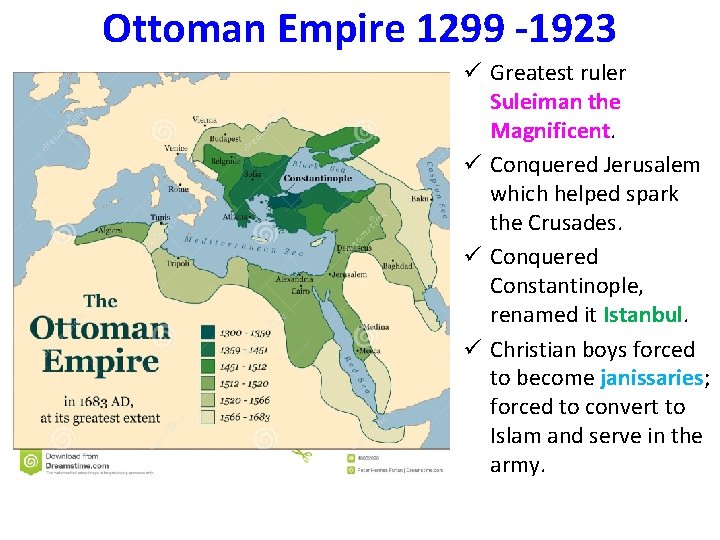
Ottoman Empire 1299 -1923 ü Greatest ruler Suleiman the Magnificent. ü Conquered Jerusalem which helped spark the Crusades. ü Conquered Constantinople, renamed it Istanbul. ü Christian boys forced to become janissaries; forced to convert to Islam and serve in the army.
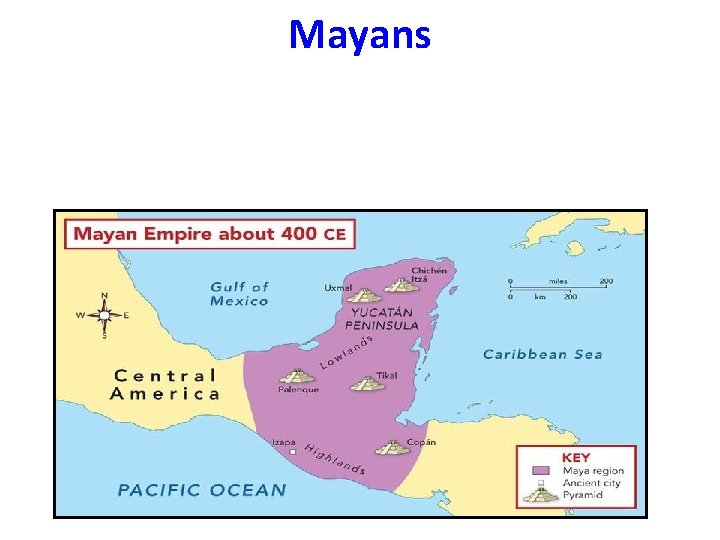
Mayans

YOU ARE NOT DONE YET!! There is a Part Two you know!
- Slides: 46