
Global Green USA LOCAL GOVERNMENT GREEN BUILDING INITIATIVE
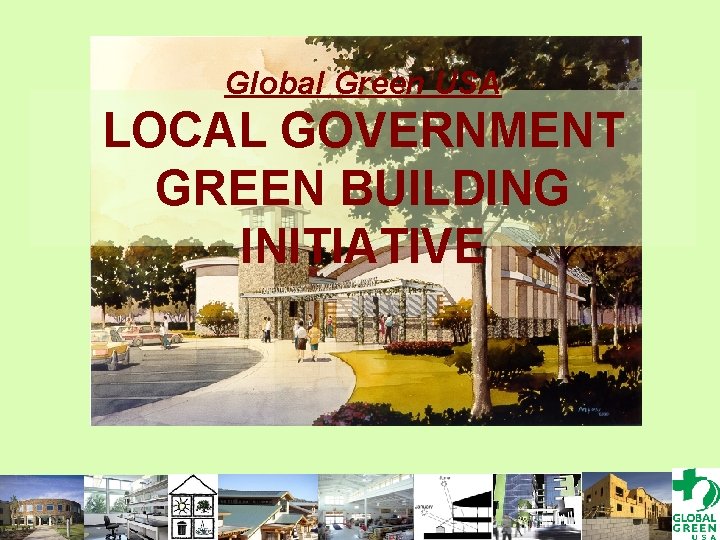
Global Green USA LOCAL GOVERNMENT GREEN BUILDING INITIATIVE
Global Green USA Resource Efficiency and Sustainable Communities for the Urban Environment Program Focus Areas • Local Government Green Building Initiative • Greening Affordable Housing Initiative
Local Government Green Building Initiative • Current city and county partners – – – – Irvine Santa Clarita West Hollywood Los Angeles Santa Monica San Francisco San Jose • Member of US Green Building Council Board and Local Government Commitee
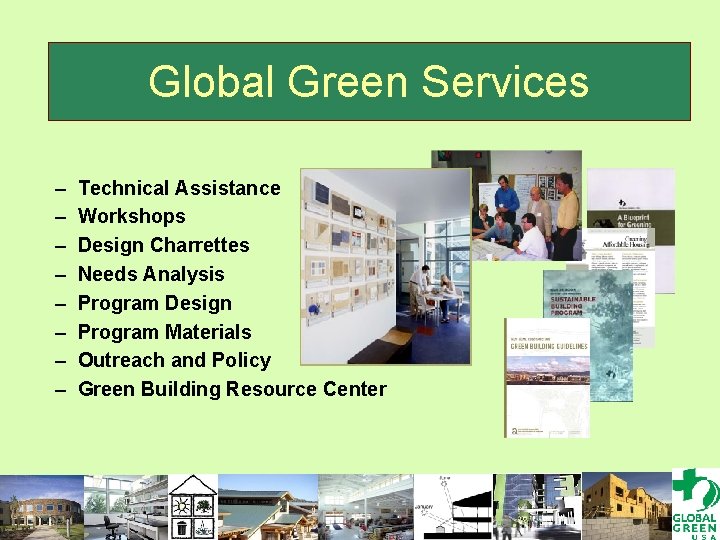
Global Green Services – – – – Technical Assistance Workshops Design Charrettes Needs Analysis Program Design Program Materials Outreach and Policy Green Building Resource Center
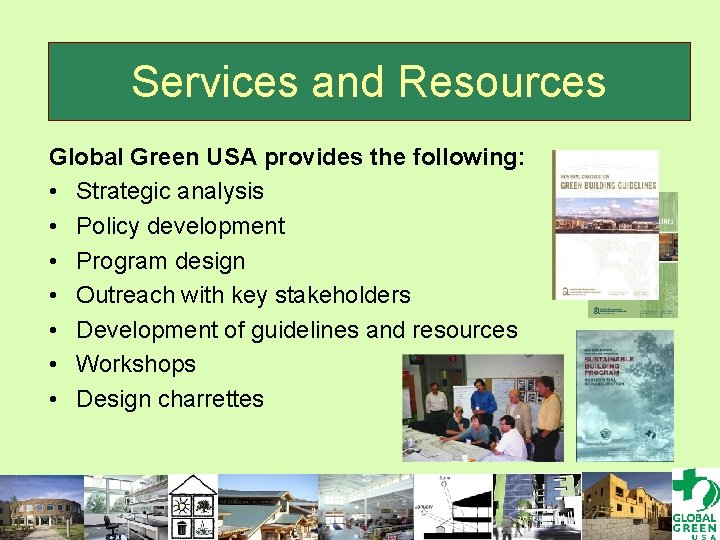
Services and Resources Global Green USA provides the following: • Strategic analysis • Policy development • Program design • Outreach with key stakeholders • Development of guidelines and resources • Workshops • Design charrettes
WHAT IS GREEN BUILDING? “Green Building” is a process for creating buildings and supporting infrastructure that: 1) minimize the use of resources, 2) reduce harmful effects on the environment, and 3) create healthier environments for people.
ENVIRONMENTAL IMPACTS OF BUILDINGS The construction and operation of buildings has numerous detrimental effects on the local, regional, and global environment: § § § 40% of annual US energy use 30% of US CO 2 production 25% of water use 20% - 40% of solid waste 30% of wood and raw materials 30%+ of buildings have poor indoor air quality (people spend about 90% of their time indoors) § § § § § Air pollution Global warming Water scarcity Landfills Deforestation Public Health Habitat loss Ozone layer depletion Urban Heat Island
GREEN BUILDING BENEFITS TO THE ENVIRONMENT: TO BUILDERS: § § § § Greenhouse gas reduction Improved water quality Solid waste reduction Improved air quality TO THE CITY: • • • Increase the value of existing programs Demonstrate environmental leadership Preserve local quality of life Lower waste disposal cost Reduced use of materials Unique marketing potential TO OWNERS/USERS: § § § Lower energy and water bills Healthier/more productive living/working environment Reduced maintenance costs Greater price appreciation and increased resale value Preferential mortgages
GREEN BUILDING PROCESS § The Green Building Process includes: – – – Multi-disciplinary teams Collaboration from beginning of the project Identification of agreed upon objectives and targets Commitment from all parties Life-cycle costing (long-term perspective) Follow through into construction and operation § Sustainable building strategies should be incorporated into all project phases - from programming & budgeting, to design & construction, to operation & maintenance.
GREEN BUILDING COMPONENTS § SITE: site selection & planning, landscaping, stormwater management, construction and demo recycling § WATER EFFICIENCY: efficient fixtures, wastewater reuse, efficient irrigation § ENERGY/ATMOSPHERE: energy efficiency, clean/renewable energy, no HCFCs or CFCs § MATERIALS/RESOURCES: materials reuse, efficient building systems, use of recycled and rapidly renewable materials § INDOOR ENVIRONMENTAL QUALITY: improved indoor air quality, increased daylighting, better thermal comfort/control
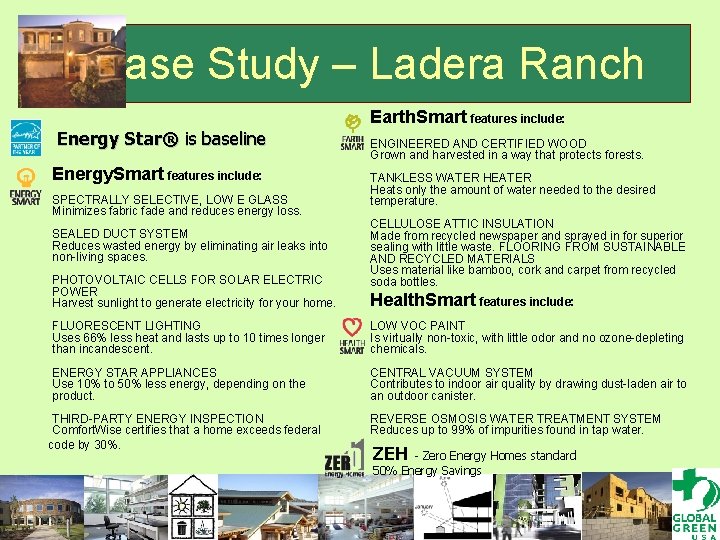
Case Study – Ladera Ranch Energy Star® is baseline Energy. Smart features include: SPECTRALLY SELECTIVE, LOW E GLASS Minimizes fabric fade and reduces energy loss. SEALED DUCT SYSTEM Reduces wasted energy by eliminating air leaks into non-living spaces. PHOTOVOLTAIC CELLS FOR SOLAR ELECTRIC POWER Harvest sunlight to generate electricity for your home. Earth. Smart features include: ENGINEERED AND CERTIFIED WOOD Grown and harvested in a way that protects forests. TANKLESS WATER HEATER Heats only the amount of water needed to the desired temperature. CELLULOSE ATTIC INSULATION Made from recycled newspaper and sprayed in for superior sealing with little waste. FLOORING FROM SUSTAINABLE AND RECYCLED MATERIALS Uses material like bamboo, cork and carpet from recycled soda bottles. Health. Smart features include: FLUORESCENT LIGHTING Uses 66% less heat and lasts up to 10 times longer than incandescent. LOW VOC PAINT Is virtually non-toxic, with little odor and no ozone-depleting chemicals. ENERGY STAR APPLIANCES Use 10% to 50% less energy, depending on the product. CENTRAL VACUUM SYSTEM Contributes to indoor air quality by drawing dust-laden air to an outdoor canister. THIRD-PARTY ENERGY INSPECTION Comfort. Wise certifies that a home exceeds federal code by 30%. REVERSE OSMOSIS WATER TREATMENT SYSTEM Reduces up to 99% of impurities found in tap water. ZEH - Zero Energy Homes standard 50% Energy Savings
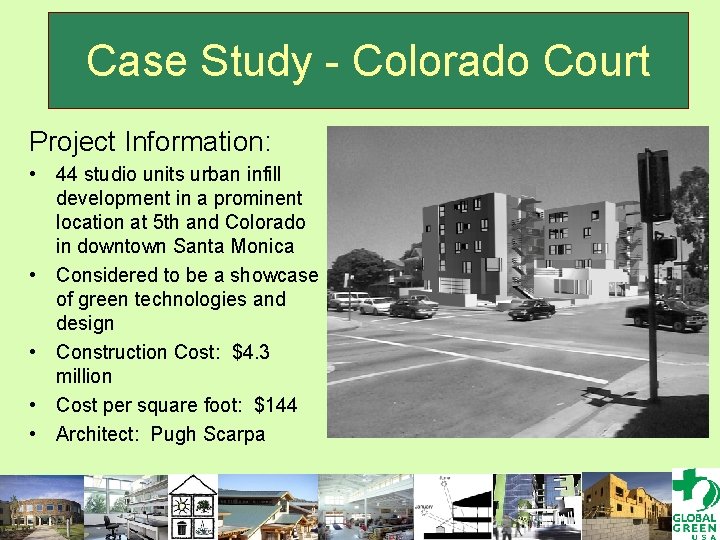
Case Study - Colorado Court Project Information: • 44 studio units urban infill development in a prominent location at 5 th and Colorado in downtown Santa Monica • Considered to be a showcase of green technologies and design • Construction Cost: $4. 3 million • Cost per square foot: $144 • Architect: Pugh Scarpa
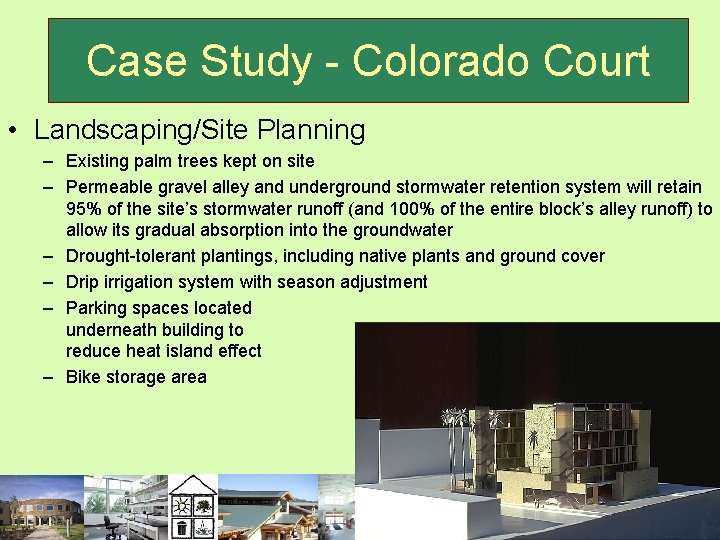
Case Study - Colorado Court • Landscaping/Site Planning – Existing palm trees kept on site – Permeable gravel alley and underground stormwater retention system will retain 95% of the site’s stormwater runoff (and 100% of the entire block’s alley runoff) to allow its gradual absorption into the groundwater – Drought-tolerant plantings, including native plants and ground cover – Drip irrigation system with season adjustment – Parking spaces located underneath building to reduce heat island effect – Bike storage area
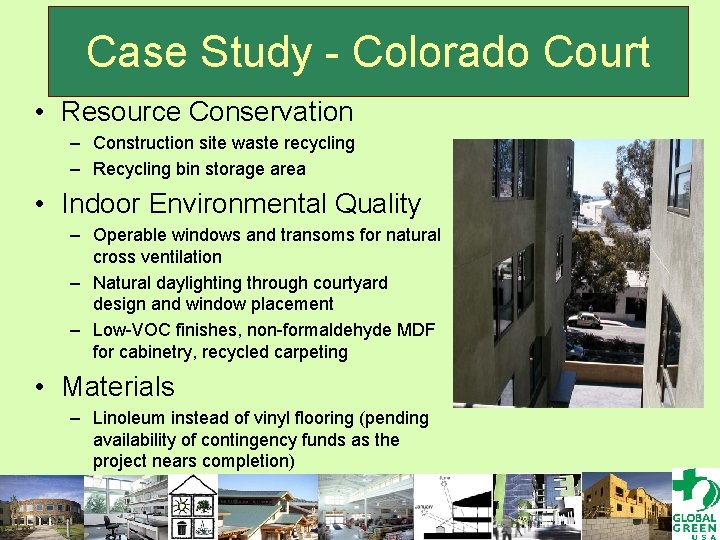
Case Study - Colorado Court • Resource Conservation – Construction site waste recycling – Recycling bin storage area • Indoor Environmental Quality – Operable windows and transoms for natural cross ventilation – Natural daylighting through courtyard design and window placement – Low-VOC finishes, non-formaldehyde MDF for cabinetry, recycled carpeting • Materials – Linoleum instead of vinyl flooring (pending availability of contingency funds as the project nears completion)
Case Study - Colorado Court • Energy Efficiency – Maximize natural daylighting and ventilation. Air conditioning will be needed and provided in only one small area of office space. – Shading for south-facing windows – Minimal glazing on west façade – Double-pane, low-E, high efficiency glazing – Compact fluorescent, low-mercury bulbs – Indoor and outdoor motion sensors for lighting – R-30 insulation in the roof – Compact, energy-efficient refrigerators – The building will exceed California Title 24 Energy Code efficiency standards by 50%
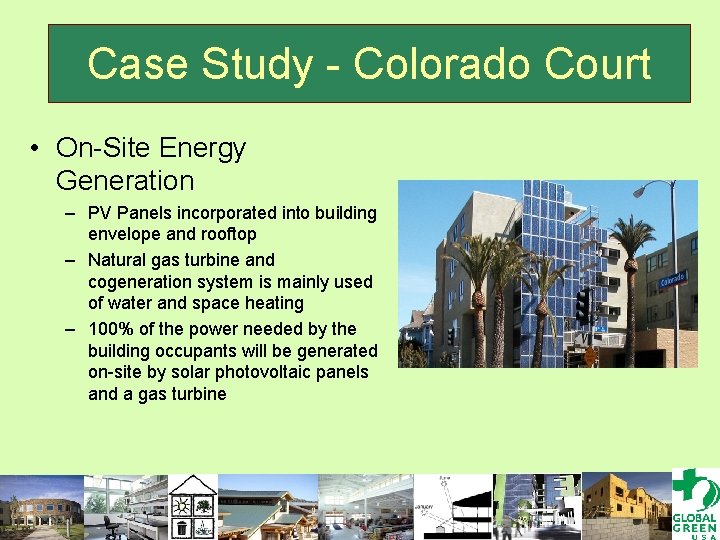
Case Study - Colorado Court • On-Site Energy Generation – PV Panels incorporated into building envelope and rooftop – Natural gas turbine and cogeneration system is mainly used of water and space heating – 100% of the power needed by the building occupants will be generated on-site by solar photovoltaic panels and a gas turbine
GUIDELINES • PUBLIC / COMMERCIAL LEED™ rating developed by the U. S. Green Building Council • RESIDENTIAL Alameda County Waste Management – New Home Construction Guidelines – Remodeler Guidelines Both guidelines were developed in collaboration with public & private stakeholders
SOUTHERN CALIFORNIA PROGRAMS § Los Angeles Sustainable Building Program (1998) – Single- and multi-family rehab projects (V) – Established LEED Certified as standard for municipal projects § Santa Monica Green Building Design and Construction Guidelines and Program (1999) – Municipal projects (M) – Multi-family projects (M&V) – Commercial projects (M&V)
SOUTHERN CALIFORNIA PROGRAMS § City of Santa Clarita (2001 - ) - Established the Community Energy Efficiency Program (CEEP) in 2000. Provides incentives (fee reduction and expedited processing) for projects that exceed Title 24 energy efficiency requirements (V). Considering greening the new transportation center. § City of Irvine (2002) - Completed survey of all environmental programs. Identified residential as target for private sector green building program. Explored using LEED for City Wilderness Awareness Center project. Developed directory of locally available green building products. Considered printing Alameda County Guidelines for local use.
CITY OF SANTA CLARITA • City currently has policies in the General Plan that support sustainable building practices. • Existing Community Energy Efficiency Program (CEEP) Program provides a foundation: – Requires energy efficiency improvements – Offers expedited permit processing and fee reductions to participating builders – Experience with recognition programs such as “Caught You Doing Something Good” awards.
CITY OF SANTA CLARITA Current • Demonstrating leadership by “greening” several upcoming municipal projects. • Exploring options for adopting LEED as a local standard for municipal projects. Future • Establish Residential Program by adding several components to the existing CEEP Program. • Use LEED as the basis for a Commercial Program.
POSSIBLE TIME LINE YEAR 1: Initiate Sustainable Building Program by “greening” several upcoming projects: – Aquatic Center – Transportation Facility YEAR 2: Adopt LEED as standard for municipal projects. YEAR 2: Launch Residential Program YEAR 3: Launch Commercial Program
- HOW TO GET STARTED 1. Inventory existing City policies and programs, identify relationship to green building components, identify gaps 2. Coordinate with City and private-sector stakeholders 3. Determine the program focus (municipal, residential, commercial) 4. “Green” an upcoming municipal project to build community interest and support for the program 5. Develop a program implementation plan utilizing LEED™, Alameda County, and other standards & guidelines 6. Establish incentives 7. Create program outreach materials 8. Provide training for City staff, local designers, and builders 9. Apply for funding from CIWMB, California Energy Commission, CPUC, and utilities to leverage incentives
FOR MORE INFORMATION Global Green USA 2218 Main Street Santa Monica, CA 90405 (310) 394 -2700 www. globalgreen. org Walker Wells, AICP LEED AP RESCUE Program Director Wwells@globalgreen. org
- Slides: 24