
Global Future Circular Collider FCC Study Goals and
Global Future Circular Collider (FCC) Study Goals and Governance Future Circular Collider Study Preparatory Collaboration Board Meeting September 2014 R-D Heuer 1
Why Push the energy frontier beyond LHC • High priority item within the European Strategy for Particle Physics • Timely • Ø lead times for R&D very long Ø LHC physics program for ~20 years • Need for a project plan when results from LHC (and other facilities) indicate direction to go Future Circular Collider Study Preparatory Collaboration Board Meeting September 2014 R-D Heuer 2

What • Technical / Conceptual Design Reports for linear e+e- colliders exist: ILC and CLIC Ø Japan interested in housing ILC Ø Europe and CERN: participation in both endeavours will be continued • Need to go beyond present energy frontier circular high energy collider Future Circular Collider Study Preparatory Collaboration Board Meeting September 2014 R-D Heuer 3
How • Exploitation of all options for such a project (hh – ee – ep) within one study • Global Collaboration for the study of Future Circular Collider options (similar to the CLIC collaboration) • Hosted by CERN Future Circular Collider Study Preparatory Collaboration Board Meeting September 2014 R-D Heuer 4
Scope (i) A conceptual design study of options for a future highenergy frontier circular collider at CERN for the post. LHC era shall be carried out, implementing the request in the 2013 update of the European Strategy for Particle Physics. Many results of the study will be site independent. The design study shall be organised on a world-wide international collaboration basis under the auspices of the European Committee for Future Accelerators (ECFA) and shall be available in time for the next update of the European Strategy for Particle Physics, foreseen by 2018. Future Circular Collider Study Preparatory Collaboration Board Meeting September 2014 R-D Heuer 5
Scope (ii) The main emphasis of the conceptual design study shall be the long-term goal of a hadron collider with a centre-of-mass energy of the order of 100 Te. V in a new tunnel of 80 - 100 km circumference for the purposes of studying physics at the highest energies. The conceptual design study shall also include a lepton collider and its detectors, as a potential intermediate step towards realization of the hadron facility. Potential synergies with linear collider detector designs should be considered. Options for e-p scenarios and their impact on the infrastructure shall be examined at conceptual level. The study shall include cost and energy optimisation, industrialisation aspects and provide implementation scenarios, including schedule and cost profiles. Future Circular Collider Study Preparatory Collaboration Board Meeting September 2014 R-D Heuer 6
The FCC Collaboration Organisations working together to carry out the conceptual design study, leading to a set of Conceptual Design Report volumes • • Circular energy frontier collider designs Physics cases for collider options & experiments Key parameters of collider options & experiments Infrastructure concepts Detector concepts Identify, launch and coordinate R&D programmes Identify synergies with other high-energy frontier studies Cost estimates, implementation scenarios Future Circular Collider Study Preparatory Collaboration Board Meeting September 2014 R-D Heuer
Host Organisation CERN is legal entity organising the study. Participates in the study as collaboration member and appoints study leader • • Establish organisational framework to carry out study Set up international collaboration Identify required R&D actions Monitor compliance of collaboration members Collect, review, verify reports and deliverables Transmit relevant information to any party concerned Administer member contributions and external funding Future Circular Collider Study Preparatory Collaboration Board Meeting September 2014 R-D Heuer
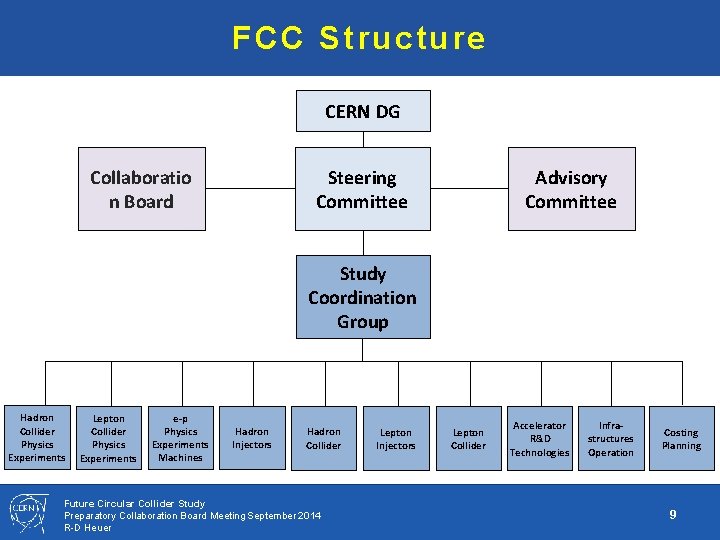
FCC Structure CERN DG Collaboratio n Board Steering Committee Advisory Committee Study Coordination Group Hadron Collider Physics Experiments Lepton Collider Physics Experiments e-p Physics Experiments Machines Hadron Injectors Hadron Collider Future Circular Collider Study Preparatory Collaboration Board Meeting September 2014 R-D Heuer Lepton Injectors Lepton Collider Accelerator R&D Technologies Infrastructures Operation Costing Planning 9
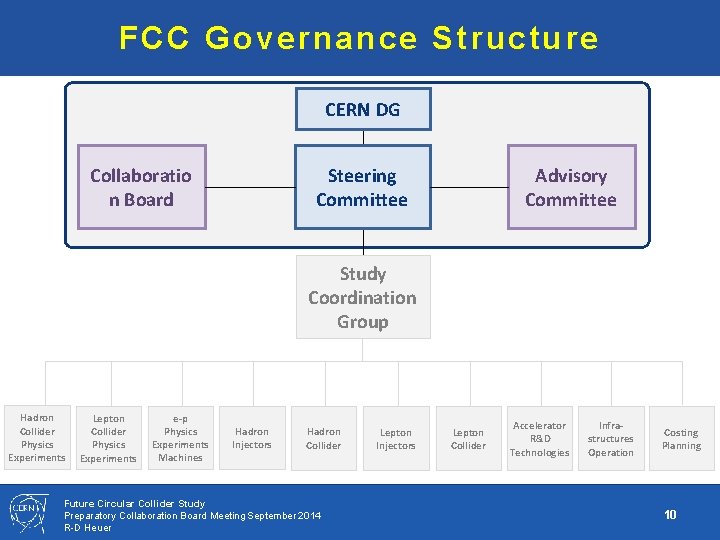
FCC Governance Structure CERN DG Collaboratio n Board Steering Committee Advisory Committee Study Coordination Group Hadron Collider Physics Experiments Lepton Collider Physics Experiments e-p Physics Experiments Machines Hadron Injectors Hadron Collider Future Circular Collider Study Preparatory Collaboration Board Meeting September 2014 R-D Heuer Lepton Injectors Lepton Collider Accelerator R&D Technologies Infrastructures Operation Costing Planning 10
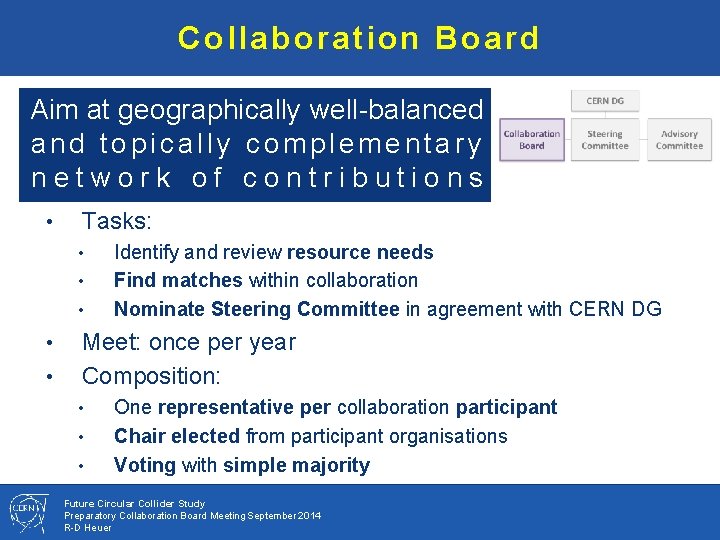
Collaboration Board Aim at geographically well-balanced and topically complementary network of contributions • Tasks: • • • Identify and review resource needs Find matches within collaboration Nominate Steering Committee in agreement with CERN DG Meet: once per year Composition: • • • One representative per collaboration participant Chair elected from participant organisations Voting with simple majority Future Circular Collider Study Preparatory Collaboration Board Meeting September 2014 R-D Heuer
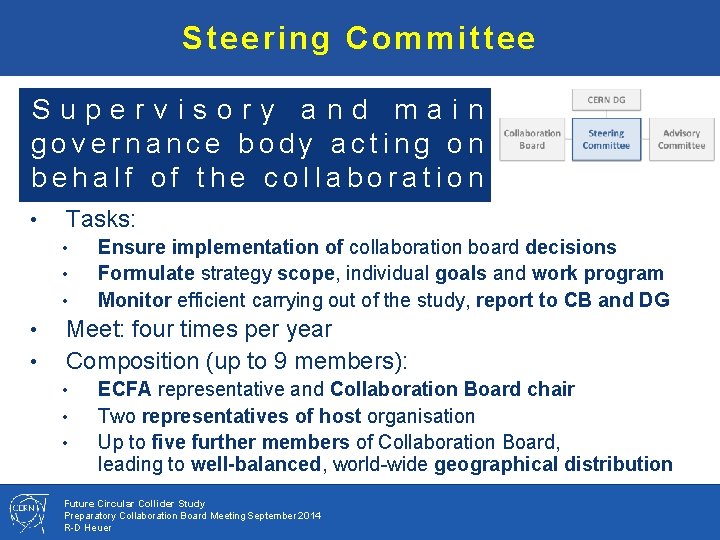
Steering Committee Supervisory and main governance body acting on behalf of the collaboration • Tasks: • • • Ensure implementation of collaboration board decisions Formulate strategy scope, individual goals and work program Monitor efficient carrying out of the study, report to CB and DG Meet: four times per year Composition (up to 9 members): • • • ECFA representative and Collaboration Board chair Two representatives of host organisation Up to five further members of Collaboration Board, leading to well-balanced, world-wide geographical distribution Future Circular Collider Study Preparatory Collaboration Board Meeting September 2014 R-D Heuer
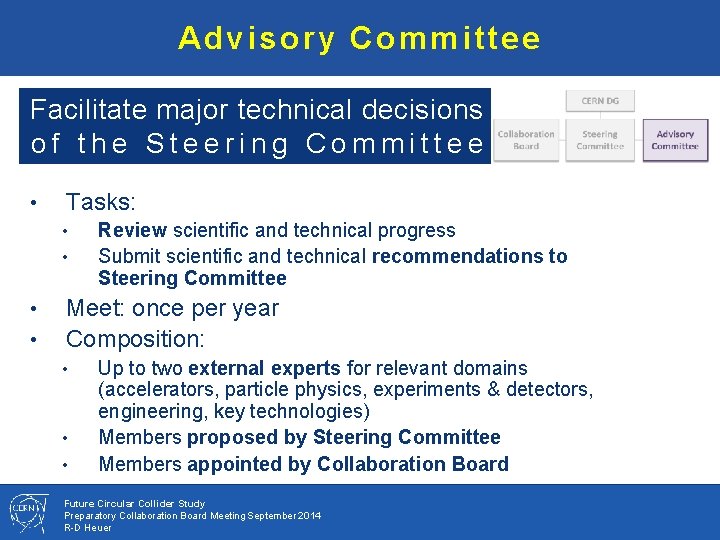
Advisory Committee Facilitate major technical decisions of the Steering Committee • Tasks: • • Review scientific and technical progress Submit scientific and technical recommendations to Steering Committee Meet: once per year Composition: • • • Up to two external experts for relevant domains (accelerators, particle physics, experiments & detectors, engineering, key technologies) Members proposed by Steering Committee Members appointed by Collaboration Board Future Circular Collider Study Preparatory Collaboration Board Meeting September 2014 R-D Heuer
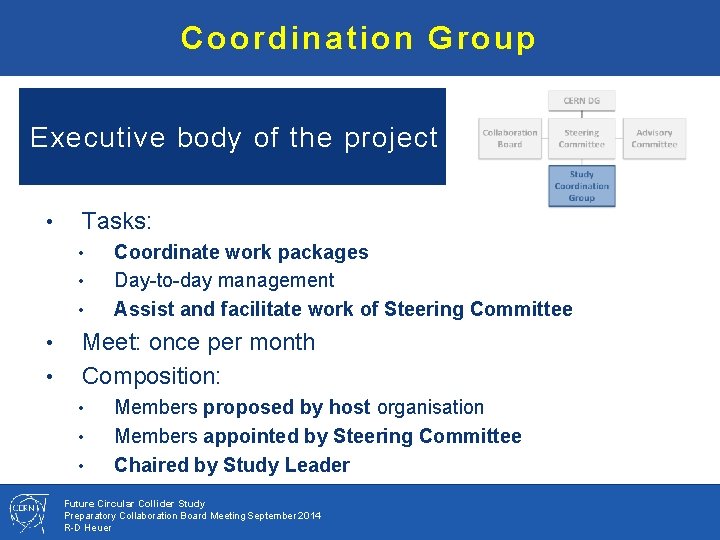
Coordination Group Executive body of the project • Tasks: • • • Coordinate work packages Day-to-day management Assist and facilitate work of Steering Committee Meet: once per month Composition: • • • Members proposed by host organisation Members appointed by Steering Committee Chaired by Study Leader Future Circular Collider Study Preparatory Collaboration Board Meeting September 2014 R-D Heuer
Conclusions • • The FCC conceptual design study, includes two large machine studies (hh, ee), as well as three detector and physics options (hh, ee, he). The Coordination Group and Study Team will face a large parameter area and a challenging overall optimisation process. Intensive and frequent exchange between Coordination Group and the Governance Structure will be essential in this process. The proposed FCC organisation structure is well adapted to these challenging tasks. Future Circular Collider Study Preparatory Collaboration Board Meeting September 2014 R-D Heuer
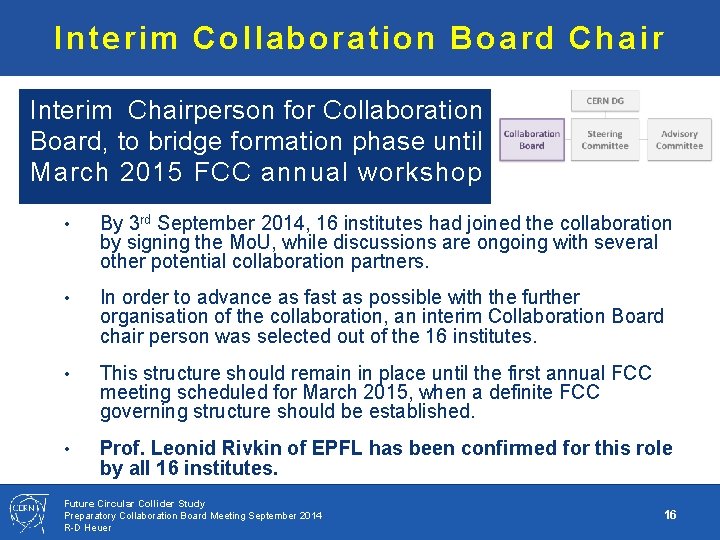
Interim Collaboration Board Chair Interim Chairperson for Collaboration Board, to bridge formation phase until March 2015 FCC annual workshop • By 3 rd September 2014, 16 institutes had joined the collaboration by signing the Mo. U, while discussions are ongoing with several other potential collaboration partners. • In order to advance as fast as possible with the further organisation of the collaboration, an interim Collaboration Board chair person was selected out of the 16 institutes. • This structure should remain in place until the first annual FCC meeting scheduled for March 2015, when a definite FCC governing structure should be established. • Prof. Leonid Rivkin of EPFL has been confirmed for this role by all 16 institutes. Future Circular Collider Study Preparatory Collaboration Board Meeting September 2014 R-D Heuer 16
- Slides: 16