
Global Footprint and Growing Oerlikon Textile Oerlikon Vacuum

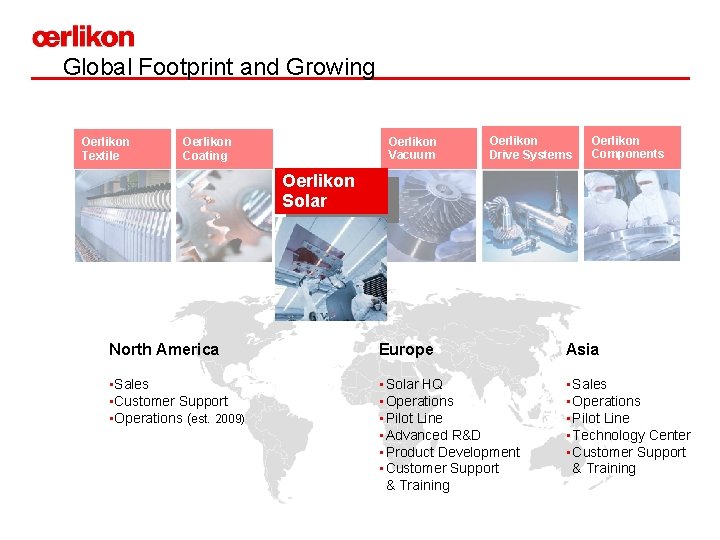
Global Footprint and Growing Oerlikon Textile Oerlikon Vacuum Oerlikon Coating Oerlikon Drive Systems Oerlikon Components Oerlikon Solar North America Europe Asia • Sales • Customer Support • Operations (est. 2009) • Solar HQ • Operations • Pilot Line • Advanced R&D • Product Development • Customer Support & Training • Sales • Operations • Pilot Line • Technology Center • Customer Support & Training
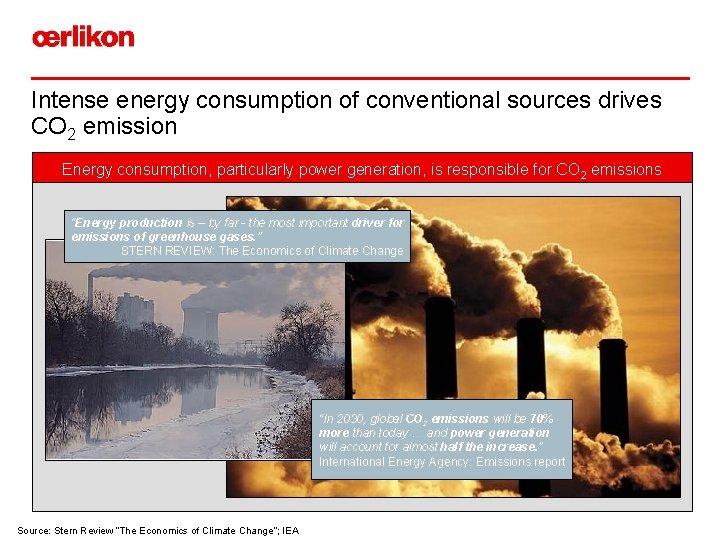
Intense energy consumption of conventional sources drives CO 2 emission Energy consumption, particularly power generation, is responsible for CO 2 emissions “Energy production is – by far - the most important driver for emissions of greenhouse gases. ” STERN REVIEW: The Economics of Climate Change “In 2030, global CO 2 emissions will be 70% more than today … and power generation will account for almost half the increase. ” International Energy Agency: Emissions report Source: Stern Review “The Economics of Climate Change”; IEA
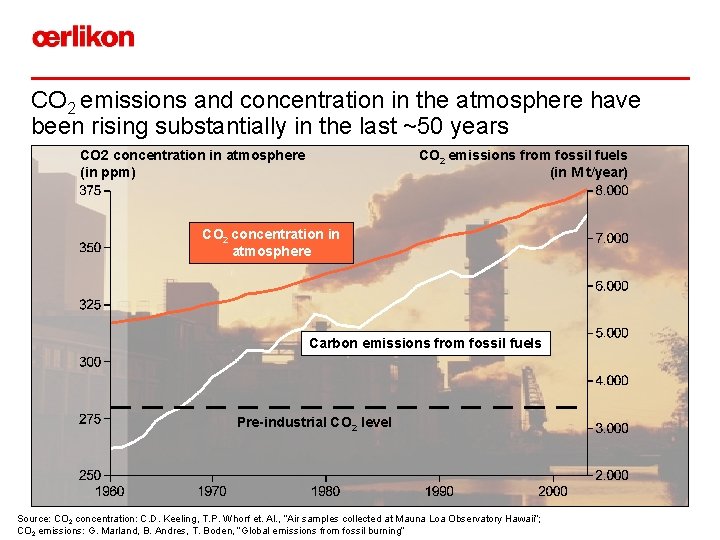
CO 2 emissions and concentration in the atmosphere have been rising substantially in the last ~50 years CO 2 concentration in atmosphere (in ppm) CO 2 emissions from fossil fuels (in M t/year) CO 2 concentration in atmosphere Carbon emissions from fossil fuels Pre-industrial CO 2 level Source: CO 2 concentration: C. D. Keeling, T. P. Whorf et. Al. , “Air samples collected at Mauna Loa Observatory Hawaii”; CO 2 emissions: G. Marland, B. Andres, T. Boden, “Global emissions from fossil burning”
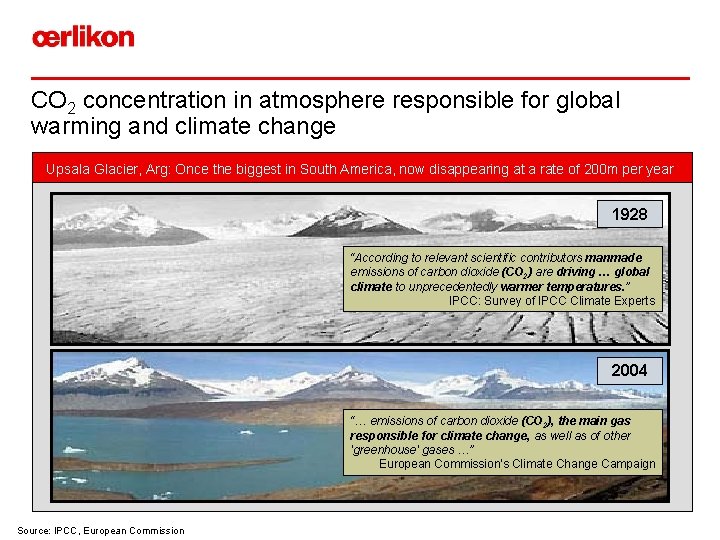
CO 2 concentration in atmosphere responsible for global warming and climate change Upsala Glacier, Arg: Once the biggest in South America, now disappearing at a rate of 200 m per year 1928 “According to relevant scientific contributors manmade emissions of carbon dioxide (CO ) are driving … global emissions of carbon dioxide 2 (CO 2) are driving … global climate to unprecedentedly warmer temperatures” climate to unprecedentedly warmer temperatures. ” IPCC: Survey of IPCC Climate Experts 2004 “… emissions of carbon dioxide (CO 2), the main gas responsible for climate change, as well as of other 'greenhouse' gases …” European Commission's Climate Change Campaign Source: IPCC, European Commission
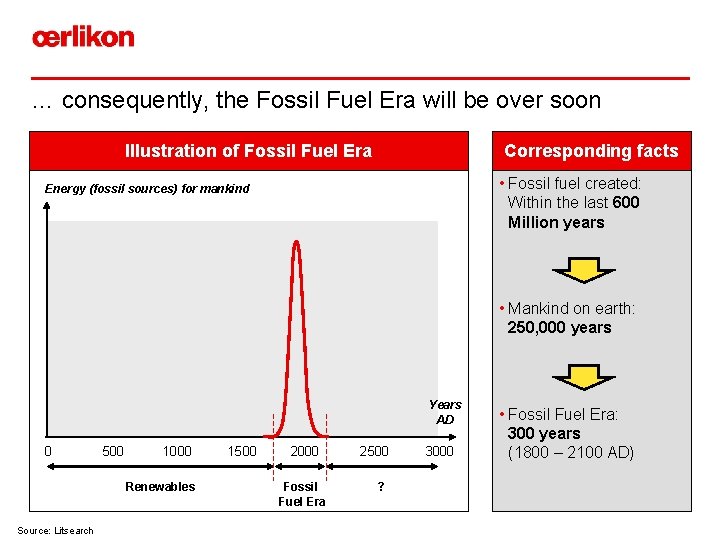
… consequently, the Fossil Fuel Era will be over soon Illustration of Fossil Fuel Era Corresponding facts • Fossil fuel created: Within the last 600 Million years Energy (fossil sources) for mankind • Mankind on earth: 250, 000 years Years AD 0 500 1000 Renewables Source: Litsearch 1500 2000 Fossil Fuel Era 2500 ? 3000 • Fossil Fuel Era: 300 years (1800 – 2100 AD)
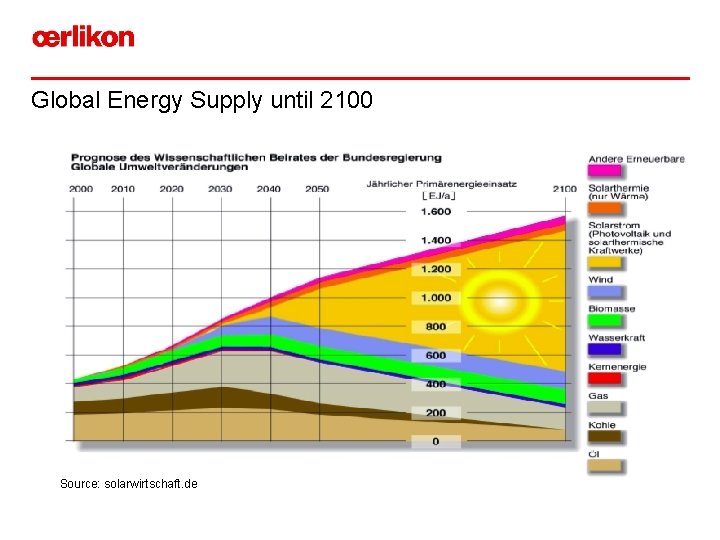
Global Energy Supply until 2100 Source: solarwirtschaft. de
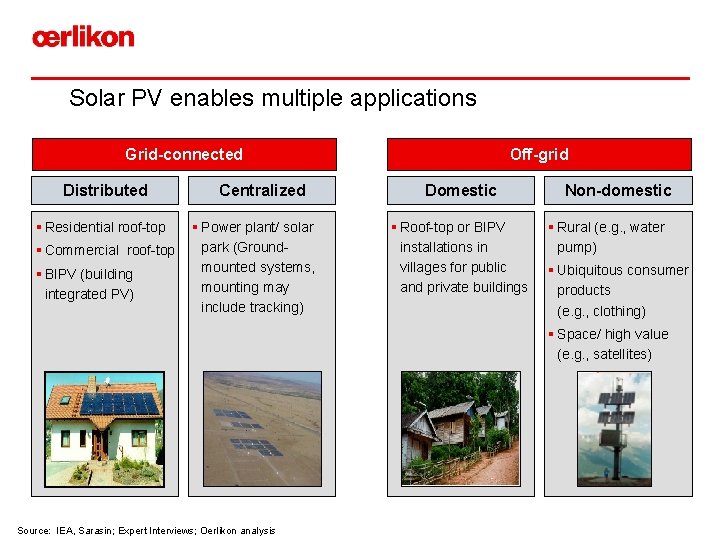
Solar PV enables multiple applications Grid-connected Distributed § Residential roof-top § Commercial roof-top § BIPV (building integrated PV) Centralized § Power plant/ solar park (Groundmounted systems, mounting may include tracking) Off-grid Domestic § Roof-top or BIPV installations in villages for public and private buildings Non-domestic § Rural (e. g. , water pump) § Ubiquitous consumer products (e. g. , clothing) § Space/ high value (e. g. , satellites) Source: IEA, Sarasin; Expert Interviews; Oerlikon analysis
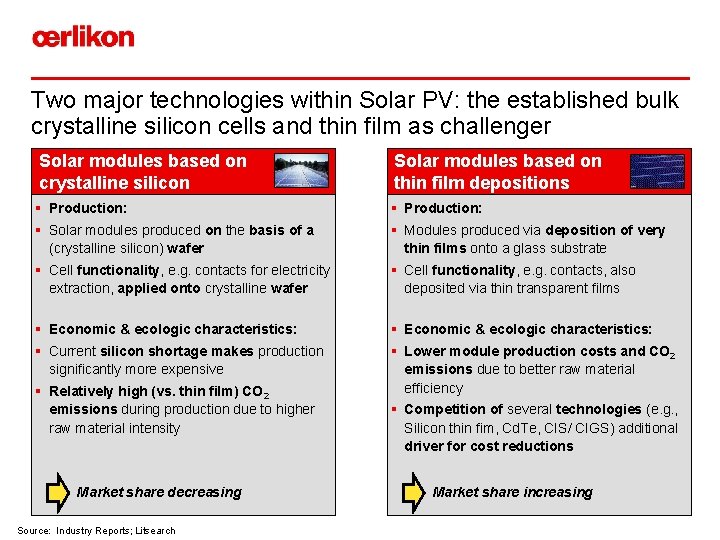
Two major technologies within Solar PV: the established bulk crystalline silicon cells and thin film as challenger Solar modules based on crystalline silicon Solar modules based on thin film depositions § Production: § Solar modules produced on the basis of a (crystalline silicon) wafer § Modules produced via deposition of very thin films onto a glass substrate § Cell functionality, e. g. contacts for electricity extraction, applied onto crystalline wafer § Cell functionality, e. g. contacts, also deposited via thin transparent films § Economic & ecologic characteristics: § Current silicon shortage makes production significantly more expensive § Lower module production costs and CO 2 emissions due to better raw material efficiency § Relatively high (vs. thin film) CO 2 emissions during production due to higher raw material intensity Market share decreasing Source: Industry Reports; Litsearch § Competition of several technologies (e. g. , Silicon thin fim, Cd. Te, CIS/ CIGS) additional driver for cost reductions Market share increasing
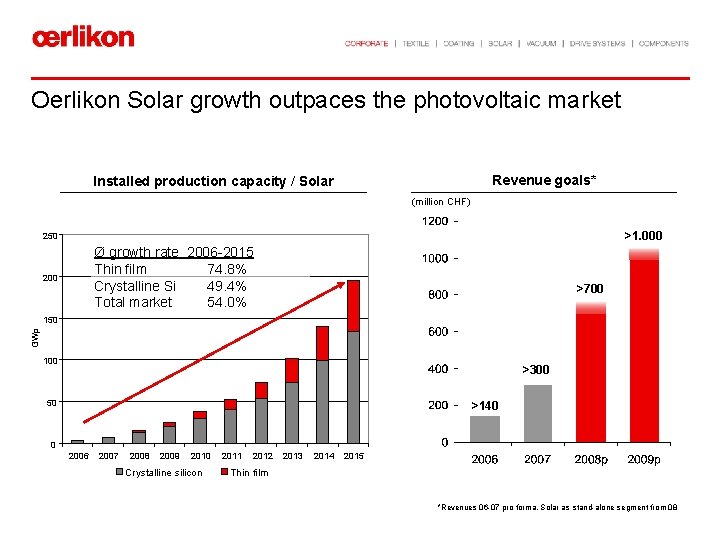
Oerlikon Solar growth outpaces the photovoltaic market Revenue goals* Installed production capacity / Solar (million CHF) >1. 000 250 Ø growth rate 2006 -2015 Thin film 74. 8% Crystalline Si 49. 4% Total market 54. 0% 200 >700 GWp 150 100 >300 50 >140 0 2006 2007 2008 2009 2010 Crystalline silicon 2011 2012 2013 2014 2015 Thin film *Revenues 06 -07 pro forma, Solar as stand-alone segment from 08
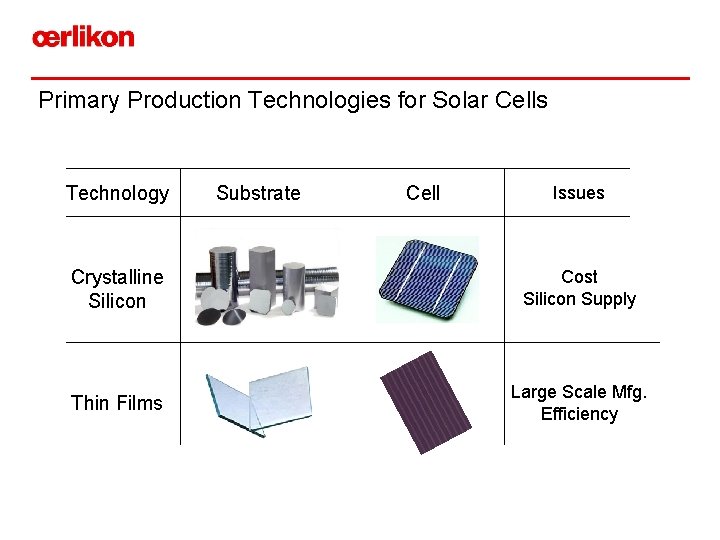
Primary Production Technologies for Solar Cells Technology Substrate Cell Issues Crystalline Silicon Cost Silicon Supply Thin Films Large Scale Mfg. Efficiency
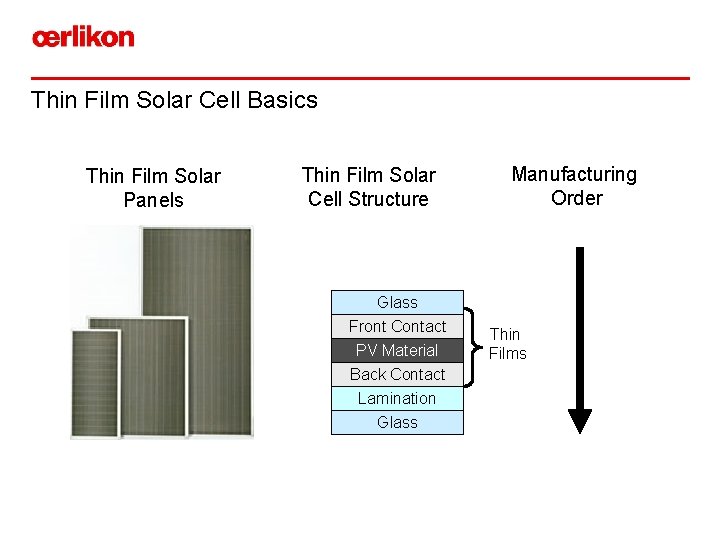
Thin Film Solar Cell Basics Thin Film Solar Panels Thin Film Solar Cell Structure Glass Front Contact PV Material Back Contact Lamination Glass Manufacturing Order Thin Films
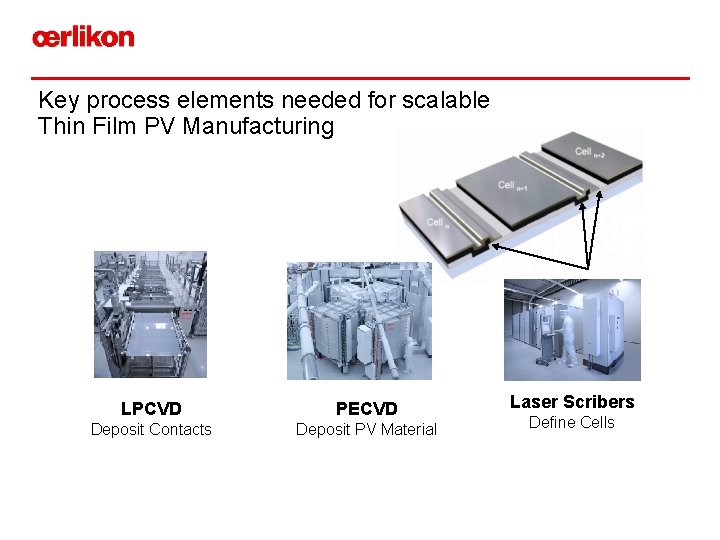
Key process elements needed for scalable Thin Film PV Manufacturing LPCVD PECVD Deposit Contacts Deposit PV Material Laser Scribers Define Cells
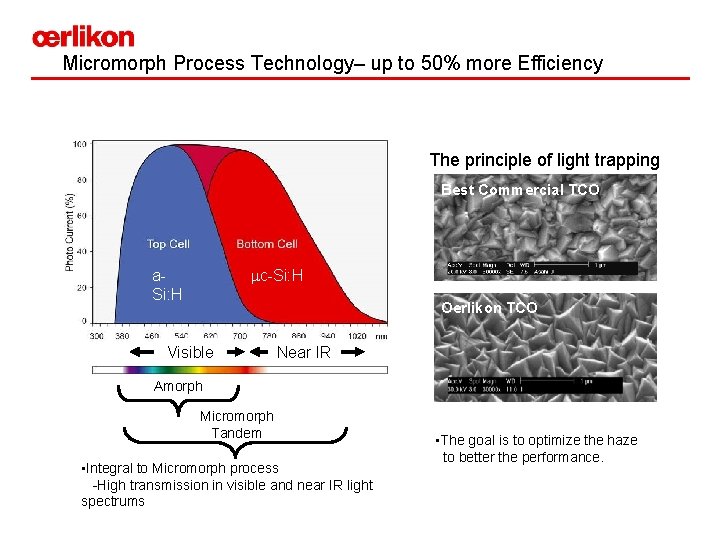
Micromorph Process Technology– up to 50% more Efficiency The principle of light trapping to deliver high performance Best Commercial TCO mc-Si: H a. Si: H Oerlikon TCO Visible Near IR Amorph Micromorph Tandem • Integral to Micromorph process a-Si/IR µ-Si -High transmission in visible and near light spectrums • The goal is to optimize the haze to better the performance.
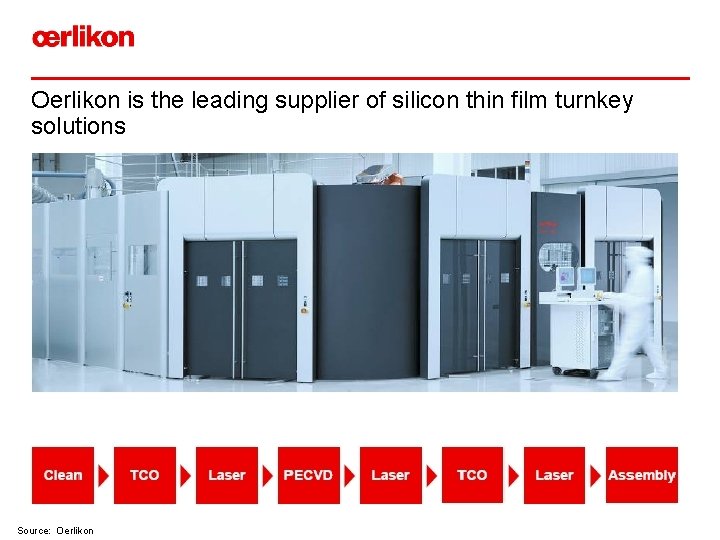
Oerlikon is the leading supplier of silicon thin film turnkey solutions Source: Oerlikon
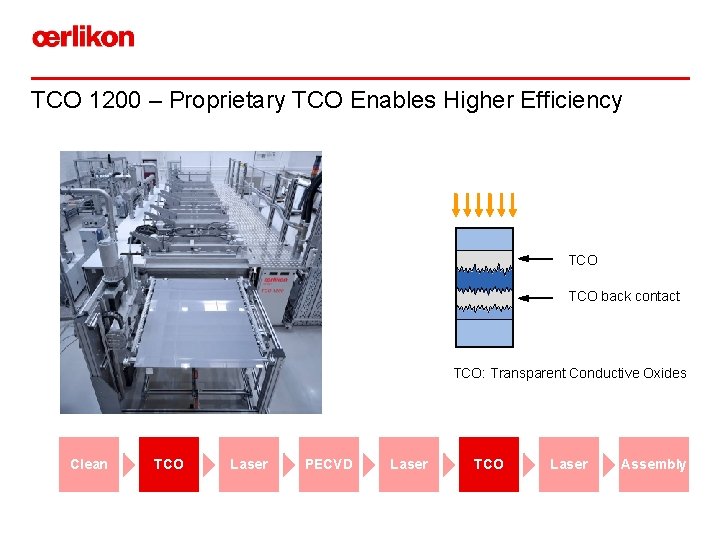
TCO 1200 – Proprietary TCO Enables Higher Efficiency TCO back contact TCO: Transparent Conductive Oxides Clean TCO Laser PECVD Laser TCO Laser Assembly
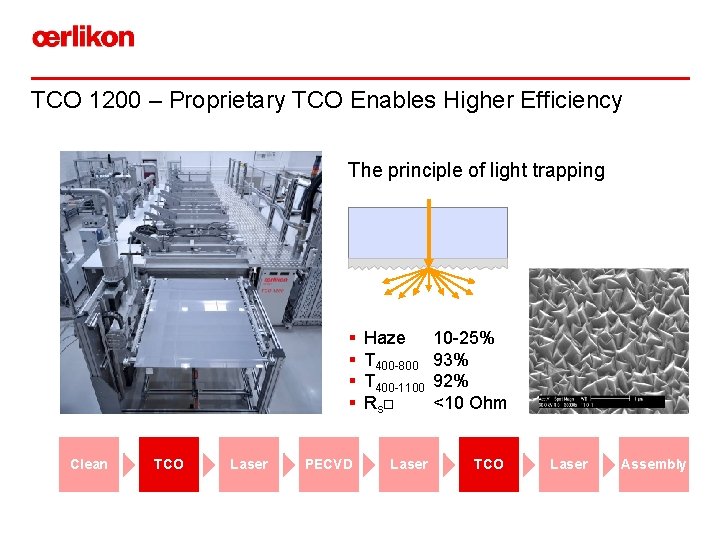
TCO 1200 – Proprietary TCO Enables Higher Efficiency The principle of light trapping Clean TCO Laser § § Haze T 400 -800 T 400 -1100 Rs PECVD Laser 10 -25% 93% 92% <10 Ohm TCO Laser Assembly
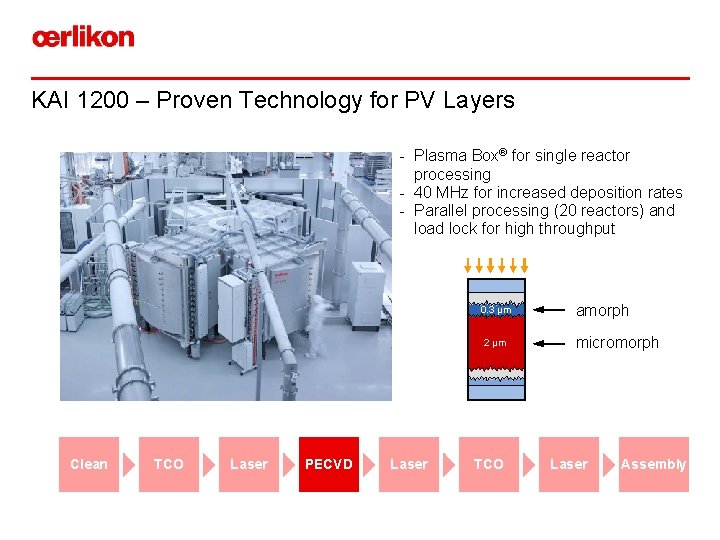
KAI 1200 – Proven Technology for PV Layers - Plasma Box® for single reactor processing - 40 MHz for increased deposition rates - Parallel processing (20 reactors) and load lock for high throughput Clean TCO Laser PECVD Laser 0. 3 µm amorph 2 µm micromorph TCO Laser Assembly
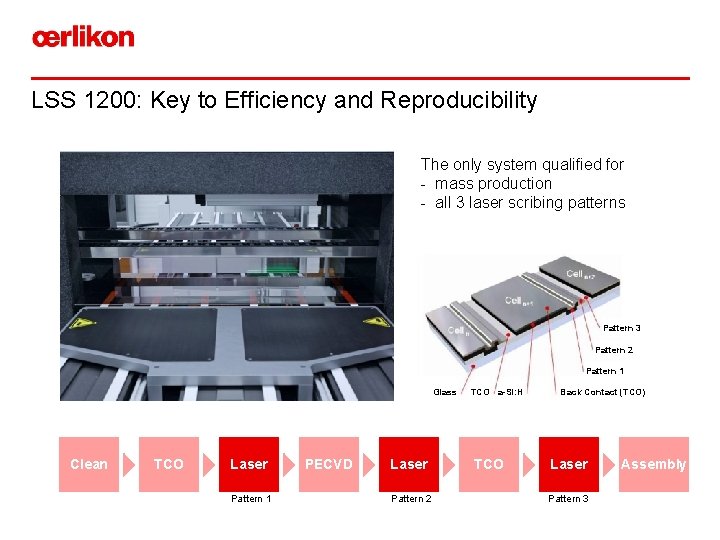
LSS 1200: Key to Efficiency and Reproducibility The only system qualified for - mass production - all 3 laser scribing patterns Pattern 3 Pattern 2 Pattern 1 Glass Clean TCO Laser Pattern 1 PECVD Laser Pattern 2 TCO a-Si: H TCO Back Contact (TCO) Laser Pattern 3 Assembly
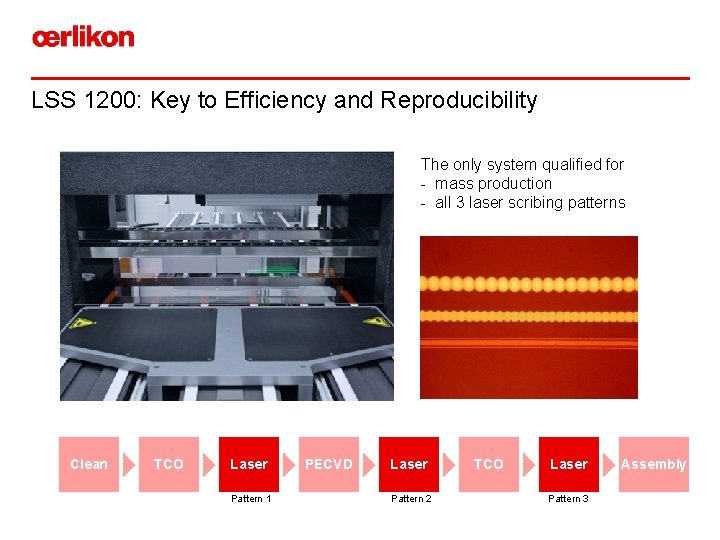
LSS 1200: Key to Efficiency and Reproducibility The only system qualified for - mass production - all 3 laser scribing patterns Clean TCO Laser Pattern 1 PECVD Laser Pattern 2 TCO Laser Pattern 3 Assembly
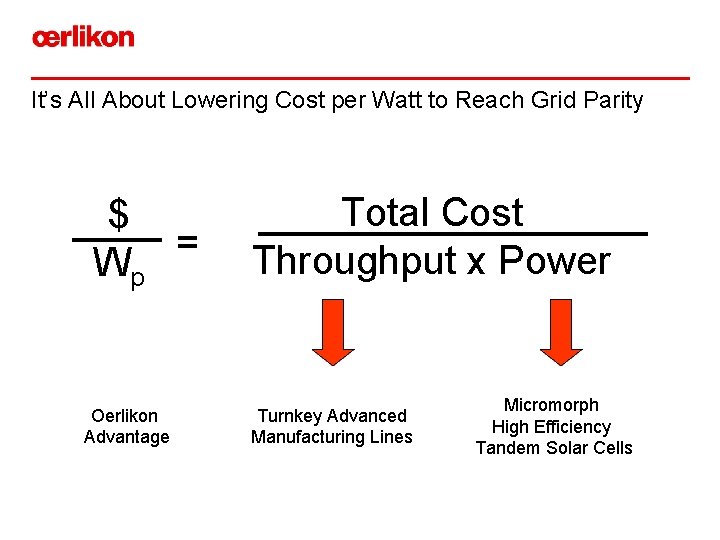
It’s All About Lowering Cost per Watt to Reach Grid Parity $ = Wp Oerlikon Advantage Total Cost Throughput x Power Turnkey Advanced Manufacturing Lines Micromorph High Efficiency Tandem Solar Cells
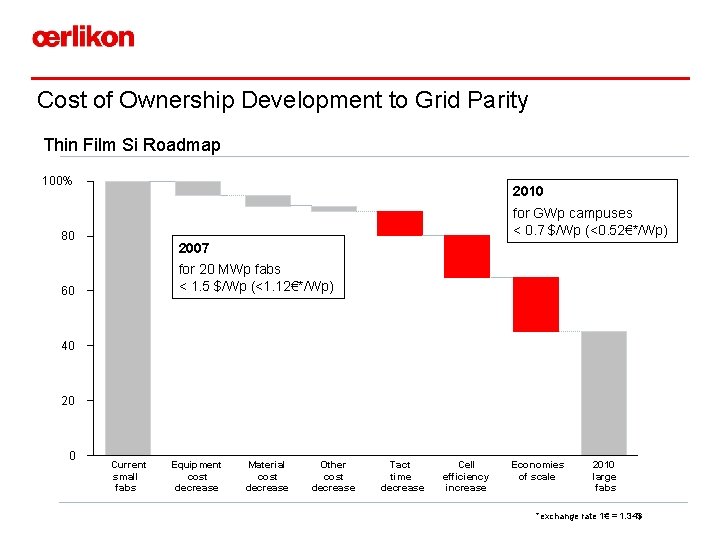
Cost of Ownership Development to Grid Parity Thin Film Si Roadmap 100% 2010 for GWp campuses < 0. 7 $/Wp (<0. 52€*/Wp) 80 2007 for 20 MWp fabs < 1. 5 $/Wp (<1. 12€*/Wp) 60 40 20 0 Current small fabs Equipment cost decrease Material cost decrease Other cost decrease Tact time decrease Cell efficiency increase Economies of scale 2010 large fabs *exchange rate 1€ = 1. 34$
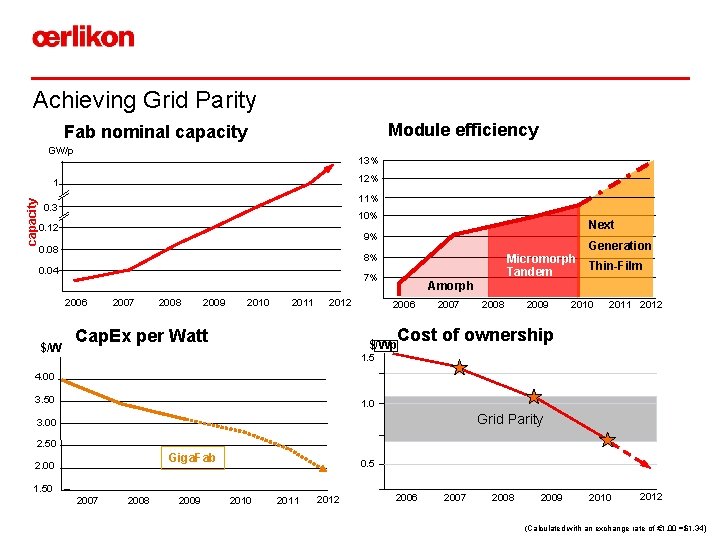
Achieving Grid Parity Module efficiency Fab nominal capacity GW/p 13% 12% capacity 1 11% 0. 3 10% 0. 12 0. 08 Generation 8% 0. 04 Micromorph Tandem 7% 2006 $/W Next 9% 2007 2008 2009 2010 2011 2012 Cap. Ex per Watt Thin-Film Amorph 2006 $/Wp 2007 2008 2009 2010 2011 2012 Cost of ownership 1. 5 4. 00 3. 50 1. 0 Grid Parity 3. 00 2. 50 Giga. Fab 2. 00 0. 5 1. 50 2007 2008 2009 2010 2011 2012 2006 2007 2008 2009 2010 2012 (Calculated with an exchange rate of € 1. 00 =$1. 34)

- Slides: 24