
Global Consideration Presented by Kimberly Morton Craig Redford
Global Consideration Presented by: Kimberly Morton Craig Redford Pamela Galluch Ryan Kloos Logan Culbertson
Organizing for International Operations 5 Steps towards International Operations » Commission Agent » Export Manager » Export Department » Internal Corporation » Multinational Corporation
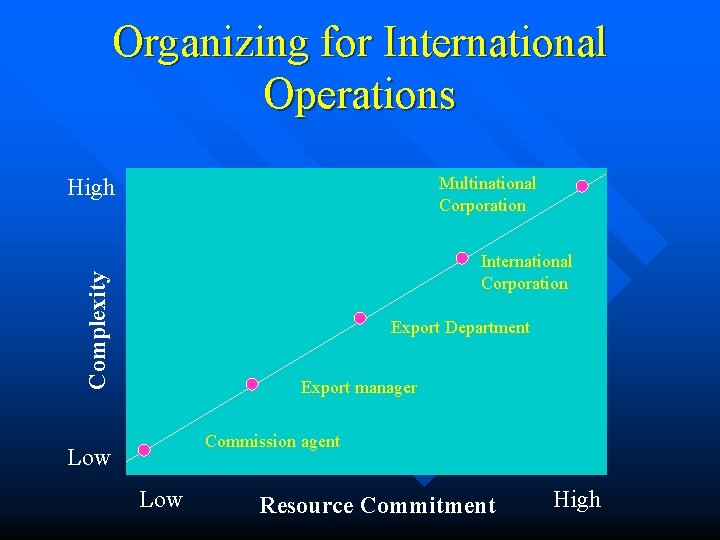
Organizing for International Operations Multinational Corporation High Complexity International Corporation Export Department Export manager Commission agent Low Resource Commitment High
Commission Agent A person or firm who represents businesses in foreign transactions in return for a negotiated percentage of each transaction’s value. n Nu Skin International n
Export Manager n An employee who actively searches out foreign markets for the firm’s goods and services. – Increase in new, ongoing costs
Export Department 1) 2) 3) 4) 5) Represents the interests of foreign customers to the firm’s other departments and to top management. Meets the increasing demand for services by foreign customers. Makes special arrangements for customs clearance and international shipping. Assists foreign customers with financing of the good or services that they are purchasing. Arranges for the collection of accounts receivable from foreign customers.
International Corporation n A firm having significant business interests that cut across national boundaries, often focusing on importing and exporting goods or services, and operates production and marketing units in other countries
Multinational Corporation n A firm that takes a worldwide approach to markets, services, and products and has a global philosophy of doing business. – Coca-Cola
Strategies for International Business
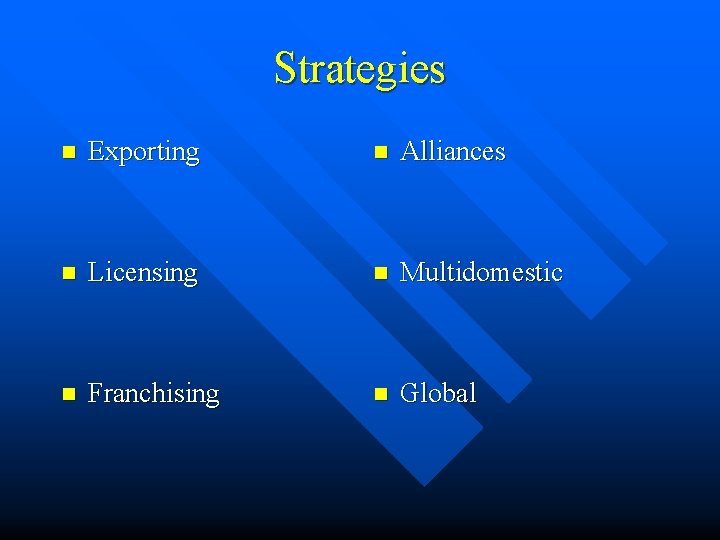
Strategies n Exporting n Alliances n Licensing n Multidomestic n Franchising n Global
Exporting Strategy Maintaining facilities within a home country and transferring goods and services abroad for sale in foreign markets n Cooley and Cooley , Ltd. n
Licensing Strategy A firm (licensor) in one country giving other domestic or foreign firms (licensees) the right to use a patent, trademark, technology, production process, or product in return for the payment of a royalty or fee n US and Canadian book publishers allow translations n Pepsi and Coca-Cola with bottle companies, distributors n
Franchising Strategy A parent organization (franchiser) granting other companies or individuals (franchisees) the right to use its trademarked name and to produce and sell its goods or services n Mc. Donalds, Holiday Inn n
Alliance Strategy Agreeing with other companies to pool physical, financial, and human resources to achieve common goals n Chinese-foreign joint ventures n
Reasons for Alliances n Share and lower costs of high risks, technology n Desire to learn another firms technology, or advantages, benchmarking n Lower costs by sharing the large fixed-costs for manufacturing plants n Desire to participate in evolution of competitive activity in growing global industries
Multidomestic Strategy Adjusting products, services, and practices to individual countries or regions n Frito Lays and Campbell Foods n
Global Strategy Stressing worldwide consistency, standardization, and low relative cost n Black and Decker subsidiary manufacture certain parts for families of products in one country n
Needs for a Multinational Global Strategy n n n Significant competitor New goods and services must be developed for whole world Profit targets need to be based on product lines n Decisions need to be based on global considerations n Narrow minded attitudes need to be overcome n Foreign managers need to be promoted to senior ranks at corporate head quarters
Strategies for International Operations
Political-Legal Forces n Political Risk. n Assessing Political Risk. n Political Mechanisms.
Political Risk n Political risk- the probability that political decisions or events in a country will negatively affect the long-term profitability of an investment
Assessing Political Risk
Domestic Instability n Amount of subversion, revolution, assassinations, guerrilla warfare, and government crisis in a country.
Foreign Conflict n Degree of hostility that one nation expresses to others
Political Climate n Likelihood that a government will swing to the far left or far right politically
Economic Climate n Reflects the extent of government control of markets and financial investments, as well as government support services and capabilities.
Political Mechanisms Protectionism n Tariff n Quota n Subsidy n Cartel n Bribery n Extortion n
Protectionism n Covers the many mechanisms designed to help a home-based industry or firms avoid (or reduce) potential/actual competitive or political threats from abroad.
Tariff n A government tax on goods and services entering the country
Quota n A restriction on the quantity of a country’s imports (or sometimes on its exports).
Subsidy n A direct or indirect payment by a government to its country’s firms to make selling or investing abroad cheaper for them - thus more profitable.
Cartel n An alliance of producers engaged in the same type of business, formed to limit or eliminate competition and control production and prices
Bribery n An improper payment made to induce the recipient to do something for the payer.
Extortion n Payment made to ensure that the recipient doesn’t harm the payer in some way.
Grease Payments n Small payments- almost gratuities- used to get lower level government employees to speed up required paperwork.
Competitive Forces n n n Rivalry among existing firms in industry(competitors) Supplier bargaining power(suppliers) Threat of goods or services(substitute goods and services) Threat of new competition(new entrants) Customer bargaining power(customer)
Rivalry Among Existing Firms in Industry n Competitors are the single most important day-to-day force facing organizations. n Rivalry among competitors produces strategies such as: Price cutting Advertising promotions Enhanced customer service or warranties Improvements in product or service quality
Supplier Bargaining Power: The bargaining power of supplies often controls how much they can raise prices above their costs or reduce the quality of goods or services they provide before losing customers n All businesses play the role of supplier and customer in their competitive environments. n
Threats of Goods or Services (Substitute goods and services) n In general sense, all competitors produce substitute goods or services, or goods or services that can easily replace another’s goods or services.
Threat of New Competition (New Entrants) n n The threat or reality of increased competition in an industry depends on the relative ease with which new firms can compete with established firms. In an industry with low barriers to entry competition will be fierce. (e. g. , the photocopy industry or fast food industry) Customer Bargaining Power (Customers) Customers for goods or services naturally try to force down prices, obtain more or higher quality products, and increase competition among sellers by playing one against the other.
Three Major Trade Agreements n n n The General Agreement on Tariffs and trade(GATT) North American Free Trade Agreement (NAFTA) European Union (EU)
General Agreement on Tariffs and Trade n n n GATT represents series of negotiated understandings regarding trade and released issues among the participating countries. Twenty three countries signed the first GATT in 1974. GATT proposed to cut tariffs and other barriers to trade on 8000 categories of manufactured goods. GATT attempted to strengthen intellectual property right protections(copyright, trademark, patent). GATT attempted to extend world trade rules to services.
GATT Principles in Negotiations Favored nation principle-Country A grants tariff concession to country B, the same concession automatically applies to all other countries that are members of GATT. n Reciprocity principle-each member country will not be forced to reduce tariffs unilaterally. n Transparency principle-tariffs are to be readily visible to all countries. n
World Trade Organization n n WTO set up by GATT and replaced GATT Difference b/t GATT and WTO, under GATT, US and other nations were able to block adverse rulings by arbitration panels, but cannot do so under WTO membership up to 144 countries WTO rules and agreements are result of negotiations between members. Current rules and agreements set were the outcome of the 1986 -1994 Uruguay Round negotiations which included a major revision of original General Agreement on Tariffs and trade (GATT)
WTO Agreements cover: n n n n Goods Services and intellectual property Spell out principles of liberalization, and permitted exception Include individual country commitments to lower customs tariffs and other trade barriers, and to open and keep open service markets Set procedures for settling disputes Prescribe special treatment for developing countries. Require governments to make their trade policies transparent
WTO n n n Only international organization dealing with global rules of trade between nations Main function-ensure trade flows smoothly, predictable and freely as possible Key goal is to progressively reduce the remaining trade barriers (making more free will increase competitive forces throughout world) Assurance to consumers of secure supplies and greater choice of finished products, and producers that foreign markets will remain open to them
WTO Benefits and Misunderstandings Benefits Misunderstandings n Promotes peace n WTO dictates n Disputes are handled n Ignores Development constructively n Wrecks Jobs n Freer trade cuts cost of n Small left out living n Weak forced to join n More choice of products and qualities n Trade stimulates economic growth and creates jobs
North American Free Trade Agreement (NAFTA) NAFTA went into effect in 1994 to increase free trade among US, Canada, and Mexico n Extension of US-Canada free trade agreement, which went into effect in 1989 n Over 50 year period, NAFTA reducing numerous tariffs and most other barriers among three countries n 70% of Goods imported from Mexico may now enter US without tariffs n
NAFTA cont. . . n n n Retains protectionist provisions Temporarily protects sensitive industries by stretching out the phase in time Service industries like finance, insurance, transportation, and telecommunications received a lot of attention NAFTA and GATT (WTO) do not eliminate all trade problems, but do provide framework through which such problems can be resolved Increasing competitive forces that act on firms, the ultimate intent is to achieve greater efficiency and consumer satisfaction
European Union (EU) European Union was formally known as European Community until 1994 n 15 country membership n Goals include: n – Create a single market among member countries through removal of trade barriers (tariffs) – Establishing the free movement of goods, people, services and investment capital
EU goals cont. . . n In addition, the changes also include social changes: – A directive was issued that recognizes diplomas of higher education across national boundaries. This action makes it easier for professionals to work in different countries. – Most member countries have developed master’s degree programs in business administration that are compatible with other countries and the United States.
Cultural Forces n Views of Social Change – Passive or Active n Time Orientation – Scarce or Unlimited n Language – Verbal and Nonverbal n Value Systems – Individualism Vs. Collectivism
Views of Social Change Passive or Active n Western cultures – Active n – Change can be shaped and controlled to achieve their own goals and aspirations. – Try to introduce innovation to rapidly n Non-Western Cultures – Passive/Reactive – New ways of doing things must go hand in hand with a painstaking concern for their effect on interpersonal relationships
Time Orientation Scarce or Unlimited n U. S. and Canada – Time is scarce n – “Time is money” – “There is too little time n India – Time is unlimited and unending – Hindus believe in reincarnation – Better use your time wisely so you won’t come back and use spend your time as a rat
Time Orientation Cont. U. S. sticks to the deadlines for accomplishing tasks n India is quite casual about keeping deadlines and appointments n n Can be Frustrating
Language Verbal and Nonverbal n Language serves as a bind as well as to separate cultures n A manager must be able to recognize and interpret the nuances of phrases, sayings, and nonverbal gestures. n
Decoding Some Body Language COMBATIVE n LYING – – – – touches face hand over mouth pulls ear eyes down glances at you shifts in seat looks down and to left n AGGRESSIVE – – – n leaning forwards finger pointing fists clenched DEFIANT – – – (standing) hands on hips frown
Decoding Some Body Language cont…. Responsive ENGAGED – – leaning forward open body open arms open hands n n n EAGER (sprint position) open legs feet under chair on toes leaning forward
Decoding Some Body Language cont…. REFLECTIVE n LISTENING – – n head tilted lots of eye contact nodding high blink rate EVALUATING – – – sucks glasses/pencil strokes chin looks up and right legs crossed in 4 pos. (ankle on knee) n ATTENTIVE – – – (standing) arms behind back Smile open feet
Decoding Some Body Language cont…. FUGITIVE n BORED – – n staring into space slumped posture doodling foot tapping LET ME GO – – – feet towards door looking around buttoning jacket n REJECTION – – – sitting/moving back arms folded legs crossed 11 pos (thigh on knee) head down frown
Value Systems Individual Vs. Collectivism n 5 value dimensions: n – Power distance – Uncertainty avoidance – Individualism – Masculinity – Confucian dynamics
Power Distance The measure of the degree to which influence and control are unequally distributed among individuals and institutions within a particular culture n Examples of highly ranked societies n – Mexico, France, Malaysia, and the Philippians n Examples of lower ranked societies – United States, Canada, Sweden, Austria
Uncertainty Avoidance n n The measure of the degree to which members of a society attempt to avoid ambiguity, risk, and the indefiniteness of the future. Great deal of energy trying to avoid or minimize ambiguous situations US and Canada are ranked low Taiwan and Japan are ranked high
Individualism n n The measure of the degree to which society expects people to take care of themselves and their immediate families and the degree to which individuals believe they are masters of their own destiny The opposite is Collectivism which is tight social frame-work in which group members focus on the common welfare and feel strong loyalty toward one another High Individualism – U. S. and Canada High Collectivism – Taiwan and Japan
Masculinity The degree to which assertiveness and the acquisition of money and material things are valued, as well as the degree of indifference to others’ quality of life n The Opposite is femininity, which is a more nurturing, people-oriented approach to life. n U. S. and Canada are now ranked low n Mexico, Japan Austria, and Italy are ranked high n
Confucian Dynamics n n The Stability of society is based on unequal relationships between people The family is the prototype of all social organizations People should treat others as they would like to be treated A person’s tasks in life consist of acquiring skills, and education, working hard, not spending more than necessary, being patient, and preserving the values of the society
Confucian Dynamism Cont… n High Confucian culture – Japan, Hong Kong, Taiwan, and Korea – Practice thrift, gift giving, good manners, and saving face – Thrift leads to saving which provides capital for reinvestment
Tie Back to Value Systems The differences in cultural values affect how managers and professionals function in international business. n There are different definitions on what the word “Won” means n
- Slides: 68