
Global Climate Observing System GCOS Implementation Needs Carolin
Global Climate Observing System (GCOS) - Implementation Needs Carolin Richter Director, GCOS Secretariat
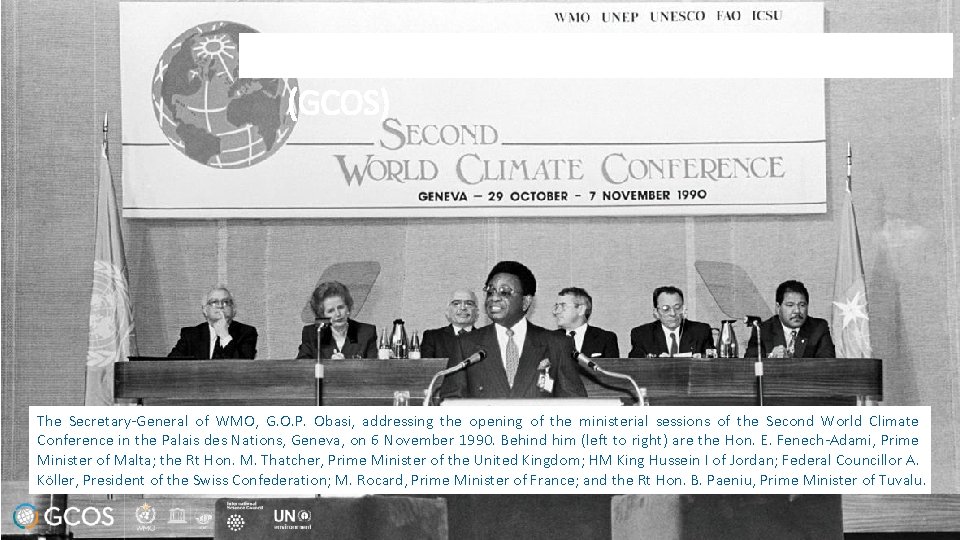
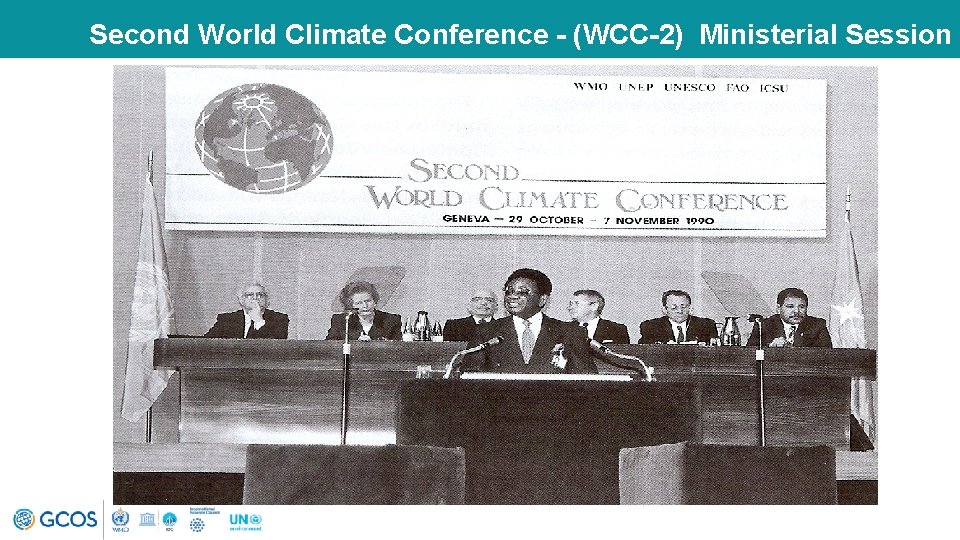
1. THE GLOBAL CLIMATE OBSERVING SYSTEM (GCOS) The Secretary-General of WMO, G. O. P. Obasi, addressing the opening of the ministerial sessions of the Second World Climate Conference in the Palais des Nations, Geneva, on 6 November 1990. Behind him (left to right) are the Hon. E. Fenech-Adami, Prime Minister of Malta; the Rt Hon. M. Thatcher, Prime Minister of the United Kingdom; HM King Hussein I of Jordan; Federal Councillor A. Köller, President of the Swiss Confederation; M. Rocard, Prime Minister of France; and the Rt Hon. B. Paeniu, Prime Minister of Tuvalu.
Intergovernmental Panel on Climate Change (IPCC), First Assessment Report, Summary for Policymakers, August 1990: “We need […] to improve the systematic observation of climate-related variables on a global basis […]” “It is necessary to develop a comprehensive Global Earth Observing System”.
Second World Climate Conference, November 1990: “Present observational systems for monitoring the climate system are inadequate for operational and research purposes. They are deteriorating in both industrialised and developing regions…” “There is an urgent need to create a Global Climate Observing System (GCOS) built upon the World Weather Watch Global Observing System and the Integrated Global Ocean Service System and including both space-based and surface-based components […]”. “In particular, we invite the 11 th Congress of the World Meteorological Organization […] to ensure that the necessary arrangements are established in consultation with UNEP, UNESCO (and its IOC), FAO, ICSU […] for effective coordination of climate and climate change related research and monitoring programmes”
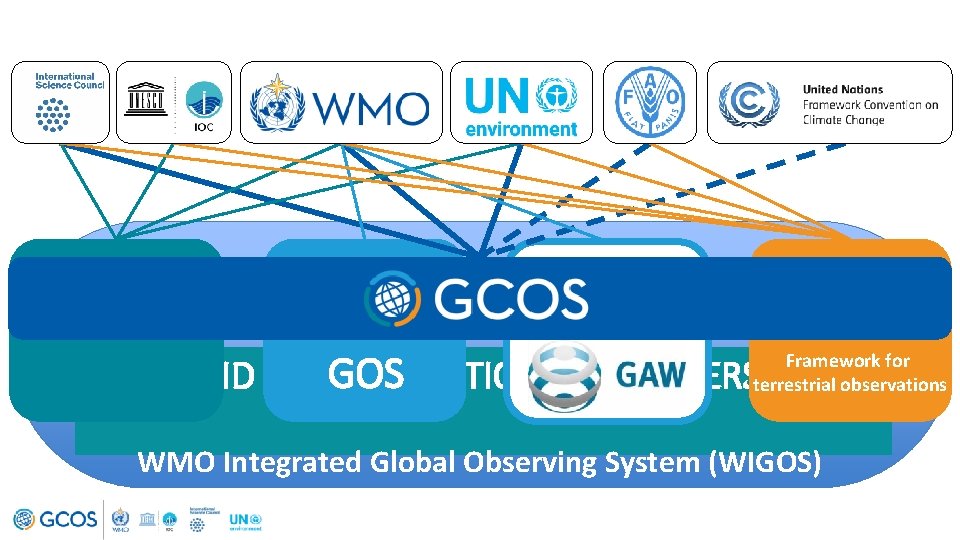
GOS GCOS AND ITS INTERNATIONAL PARTNERS Framework for terrestrial observations WMO Integrated Global Observing System (WIGOS)

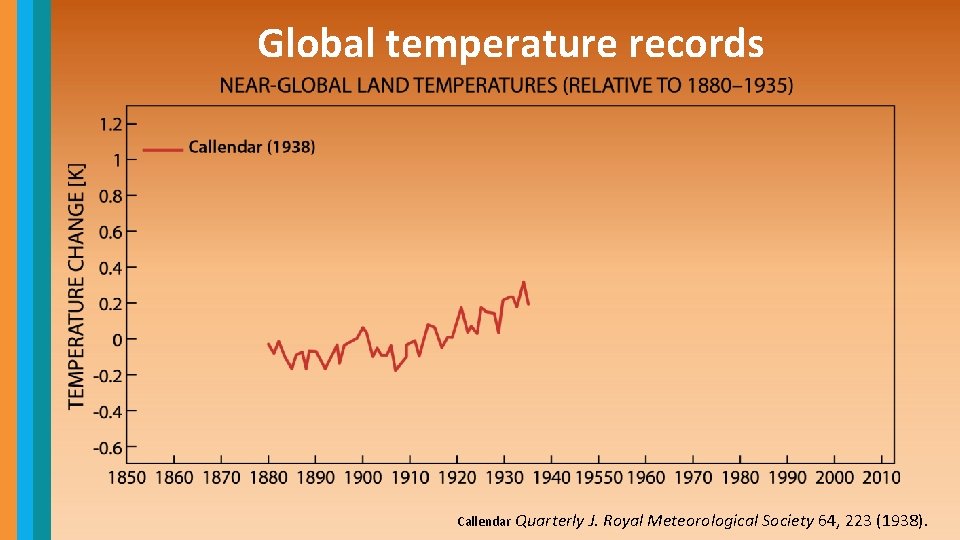
Global temperature records Callendar Quarterly J. Royal Meteorological Society 64, 223 (1938).
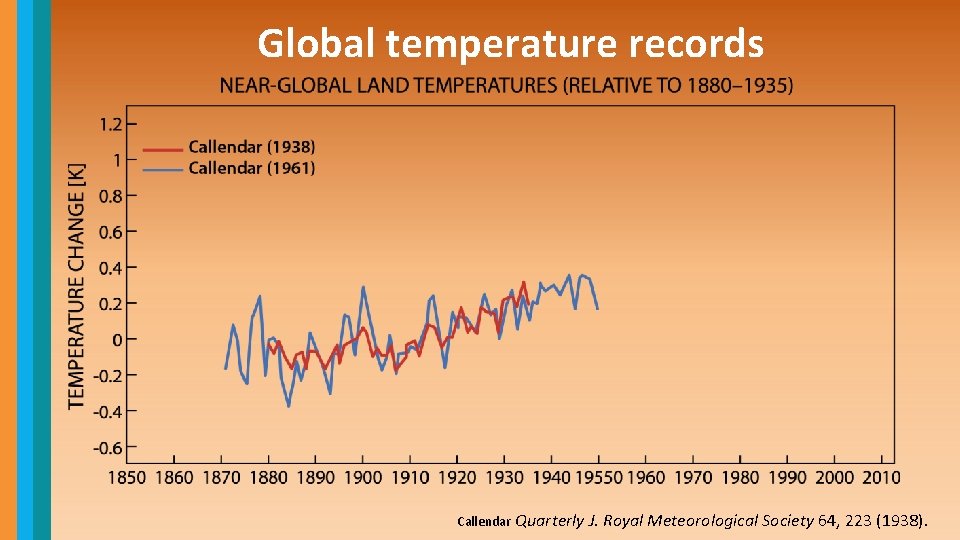
Global temperature records Callendar Quarterly J. Royal Meteorological Society 64, 223 (1938).
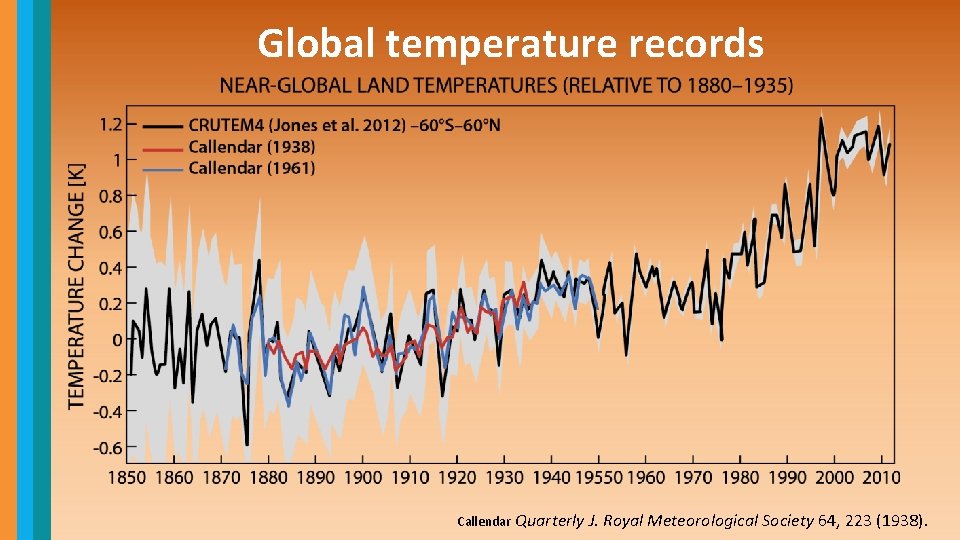
Global temperature records Callendar Quarterly J. Royal Meteorological Society 64, 223 (1938).
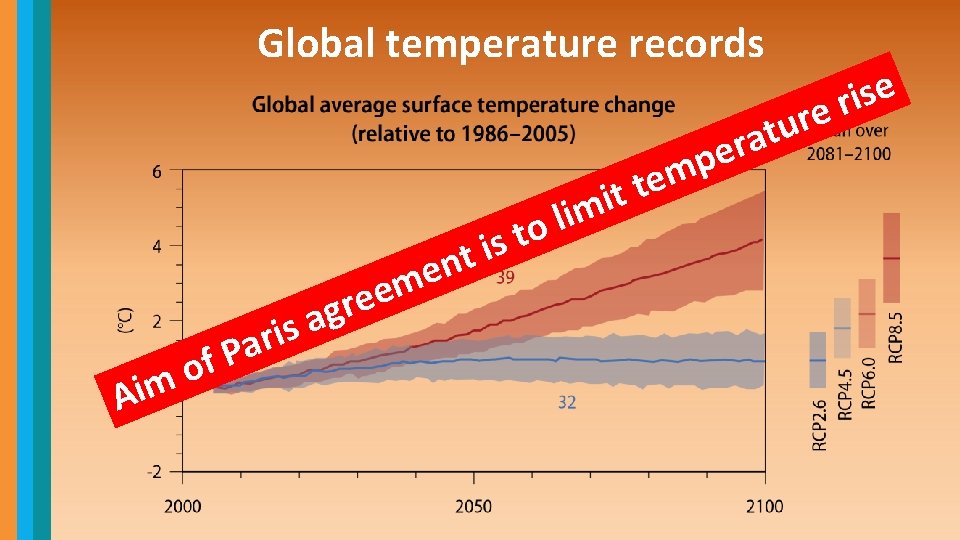
Global temperature records A f o im s i r Pa e e r ag t n me o t is t i lim p m te u t a er se i r re
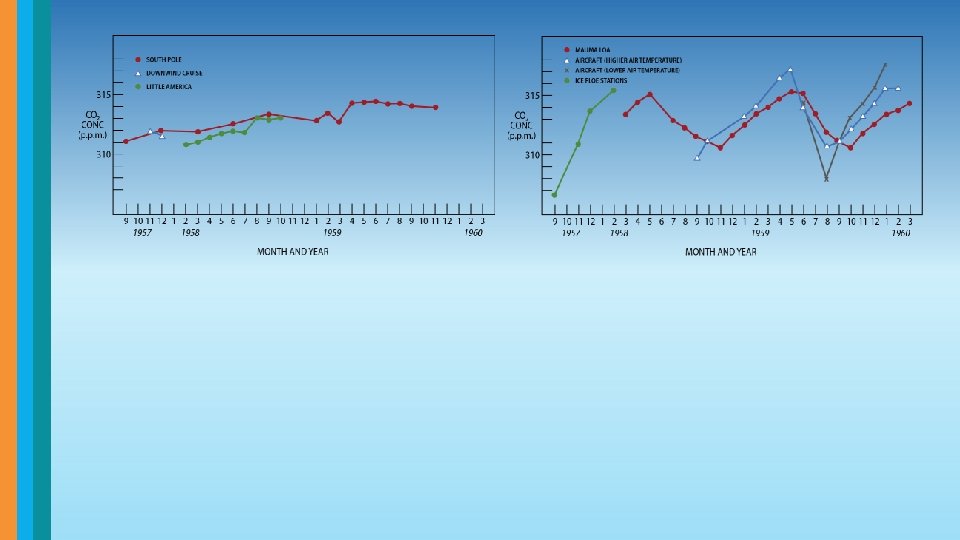
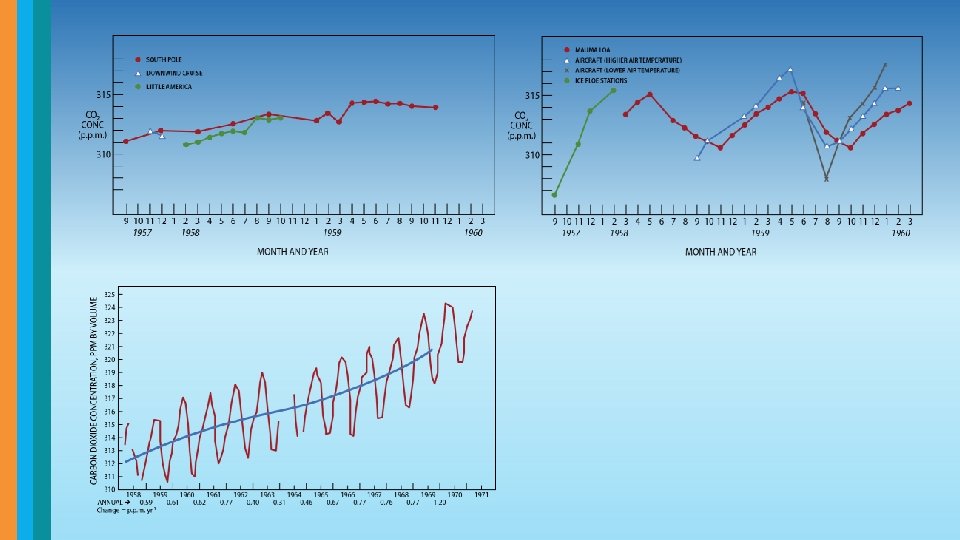
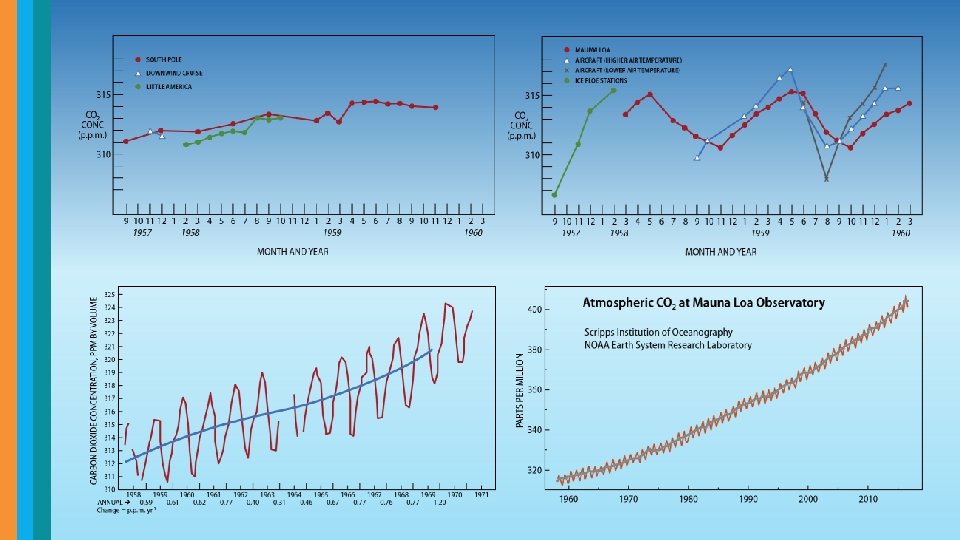
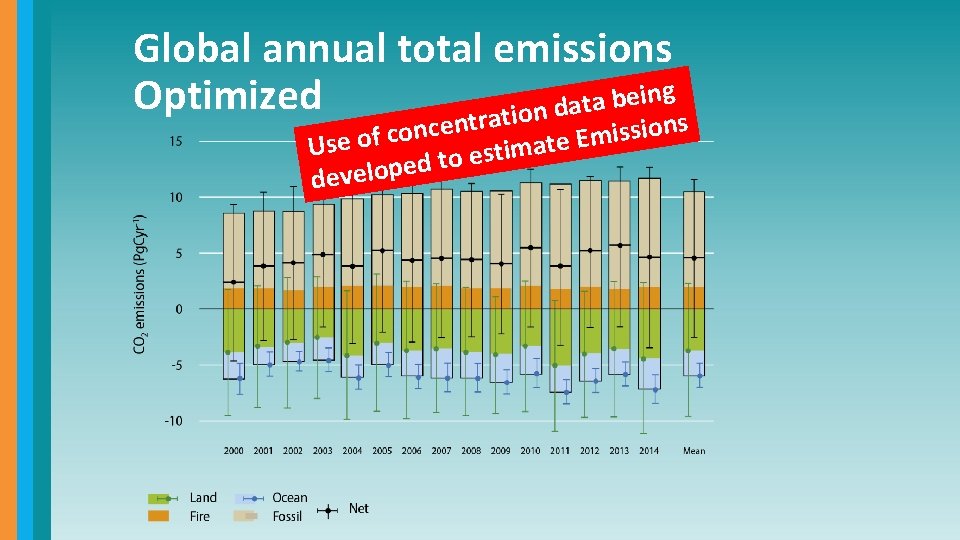
Global annual total emissions ng i e b Optimized a tration d s n n e o c i n s s o i c m f E e t a Use o m i t s e o t d e p o devel
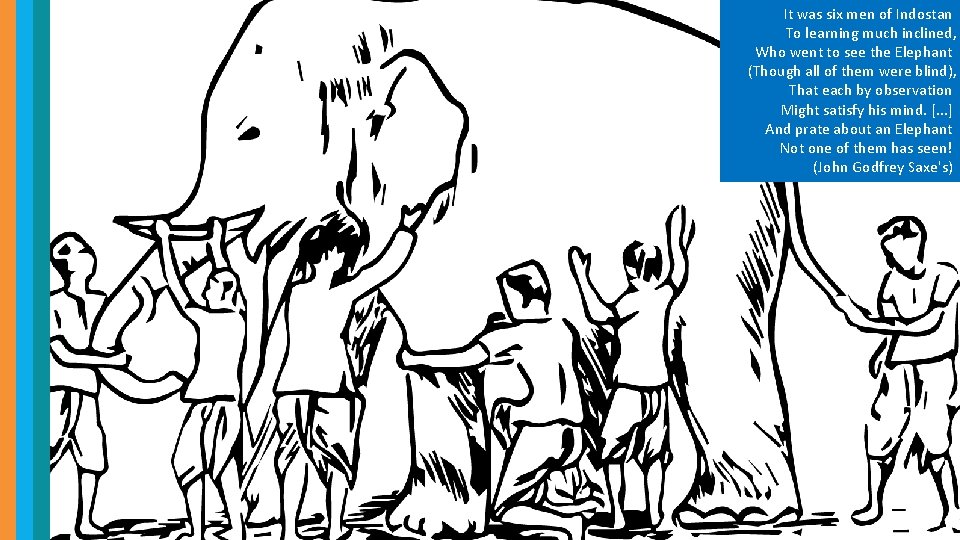
It was six men of Indostan To learning much inclined, Who went to see the Elephant (Though all of them were blind), That each by observation Might satisfy his mind. [. . . ] And prate about an Elephant Not one of them has seen! (John Godfrey Saxe's)
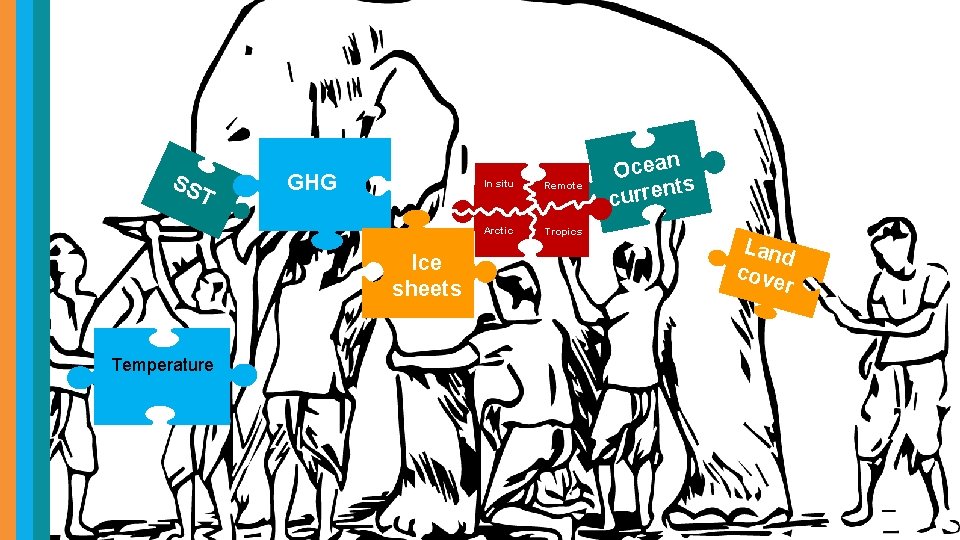
SS T GHG Ice sheets Temperature In situ Remote Arctic Tropics Ocean ts curren Land cove r
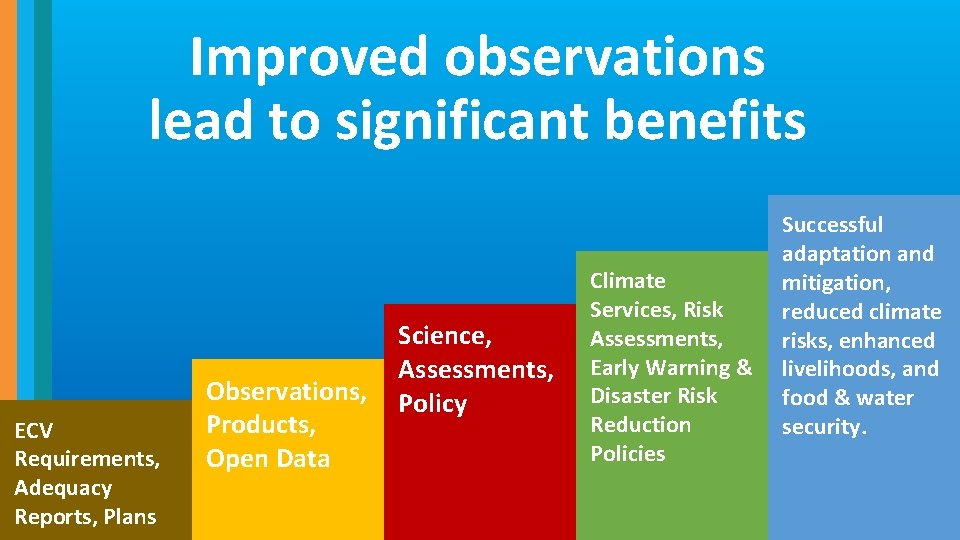
Improved observations lead to significant benefits ECV Requirements, Adequacy Reports, Plans Observations, Products, Open Data Science, Assessments, Policy Climate Services, Risk Assessments, Early Warning & Disaster Risk Reduction Policies Successful adaptation and mitigation, reduced climate risks, enhanced livelihoods, and food & water security.
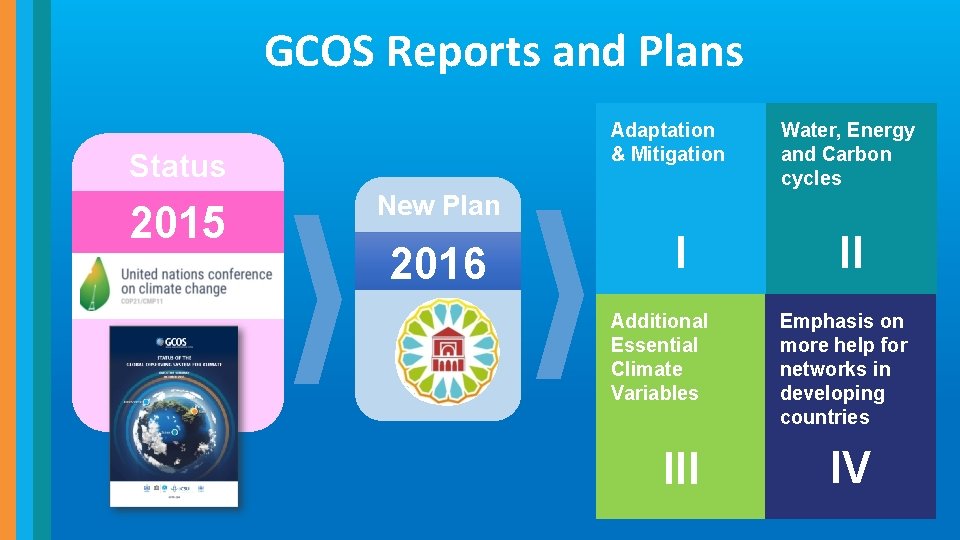
GCOS Reports and Plans Adaptation & Mitigation Status 2015 Water, Energy and Carbon cycles New Plan 2016 I Additional Essential Climate Variables III II Emphasis on more help for networks in developing countries IV
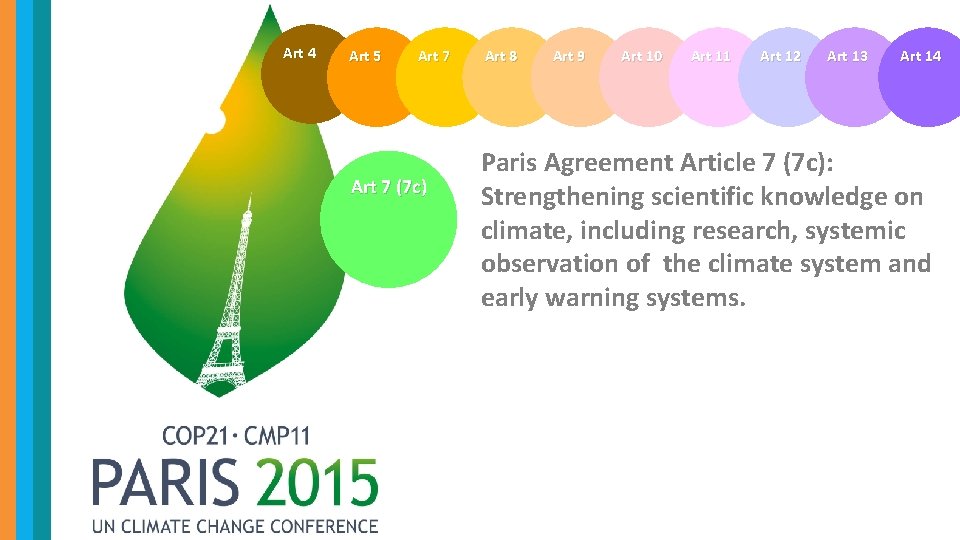
Art 4 Art 5 Art 7 (7 c) Art 8 Art 9 Art 10 Art 11 Art 12 Art 13 Art 14 Paris Agreement Article 7 (7 c): Strengthening scientific knowledge on climate, including research, systemic observation of the climate system and early warning systems.
gcos. wmo. int @gcos_un GCOS Implementation Plan
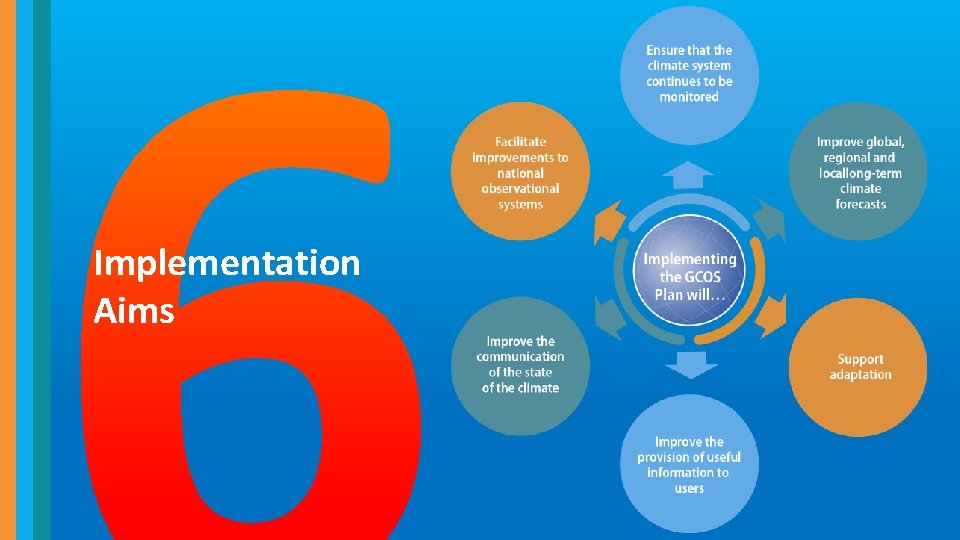
Implementation Aims
Adaptation, mitigation and climate indicators
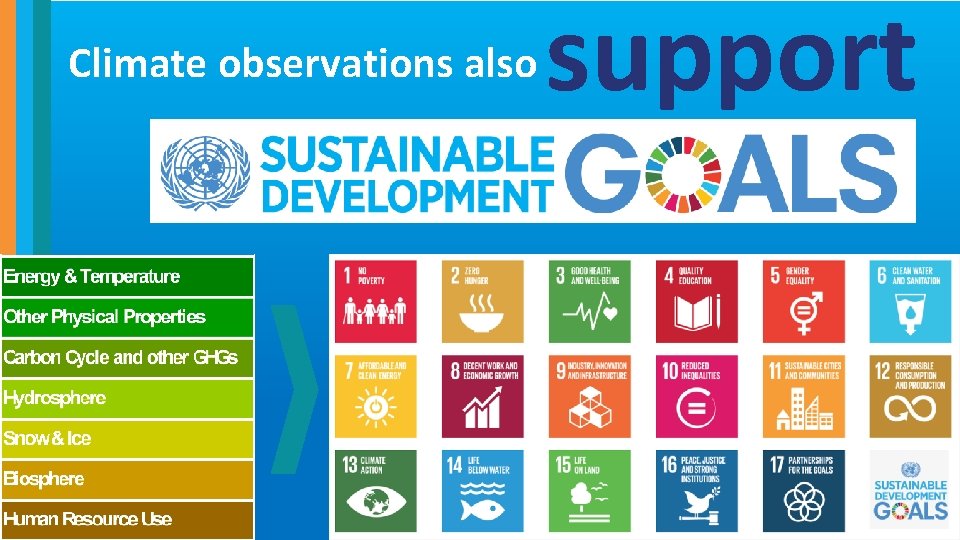
Climate observations also support
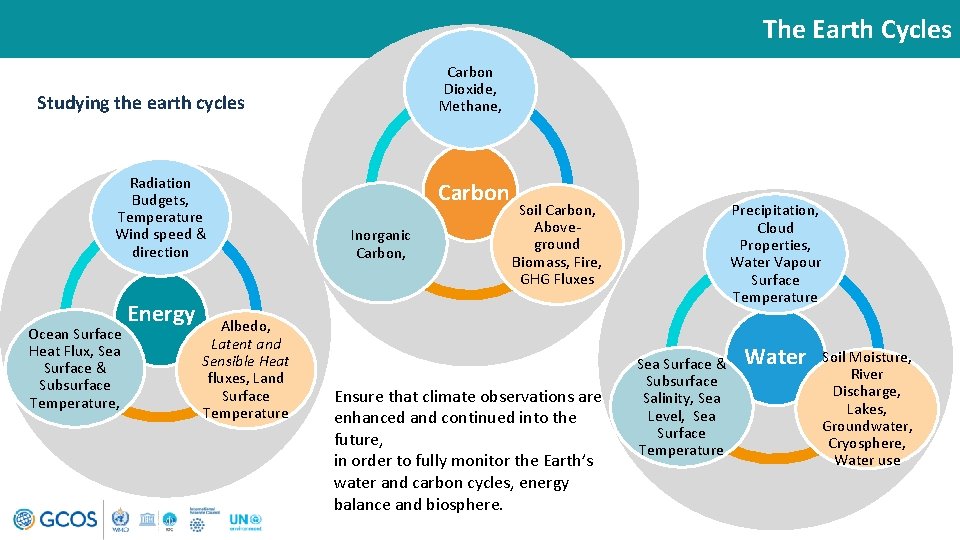
The Earth Cycles Carbon Dioxide, Methane, Studying the earth cycles Radiation Budgets, Temperature Wind speed & direction Ocean Surface Heat Flux, Sea Surface & Subsurface Temperature, Energy Albedo, Latent and Sensible Heat fluxes, Land Surface Temperature Carbon Inorganic Carbon, Soil Carbon, Aboveground Biomass, Fire, GHG Fluxes Ensure that climate observations are enhanced and continued into the future, in order to fully monitor the Earth’s water and carbon cycles, energy balance and biosphere. Precipitation, Cloud Properties, Water Vapour Surface Temperature Sea Surface & Subsurface Salinity, Sea Level, Sea Surface Temperature Water Soil Moisture, River Discharge, Lakes, Groundwater, Cryosphere, Water use
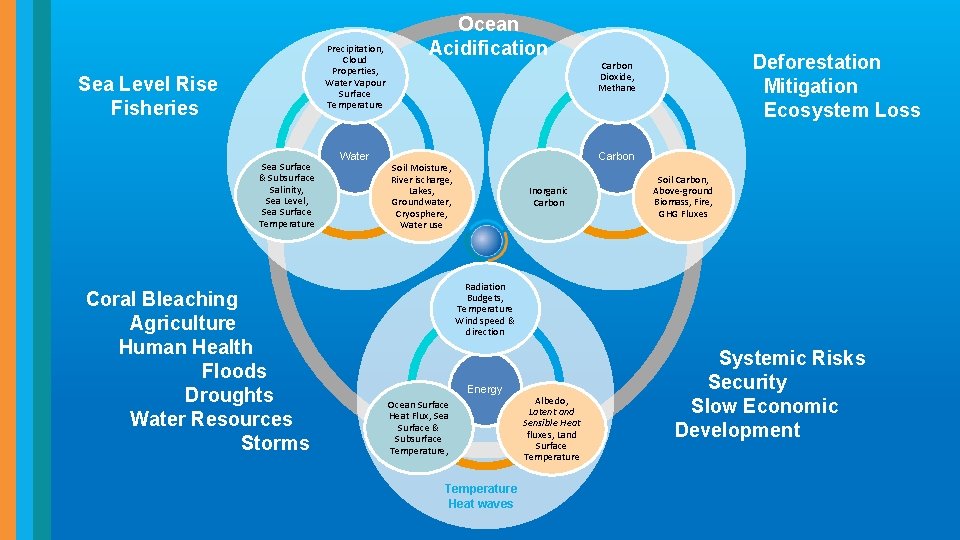
Precipitation, Cloud Properties, Water Vapour Surface Temperature Sea Level Rise Fisheries Sea Surface & Subsurface Salinity, Sea Level, Sea Surface Temperature Coral Bleaching Agriculture Human Health Floods Droughts Water Resources Storms Water Ocean Acidification Deforestation Mitigation Ecosystem Loss Carbon Dioxide, Methane Carbon Soil Moisture, River ischarge, Lakes, Groundwater, Cryosphere, Water use Inorganic Carbon Soil Carbon, Above-ground Biomass, Fire, GHG Fluxes Radiation Budgets, Temperature Wind speed & direction Energy Ocean Surface Heat Flux, Sea Surface & Subsurface Temperature, Temperature Heat waves Albedo, Latent and Sensible Heat fluxes, Land Surface Temperature Systemic Risks Security Slow Economic Development
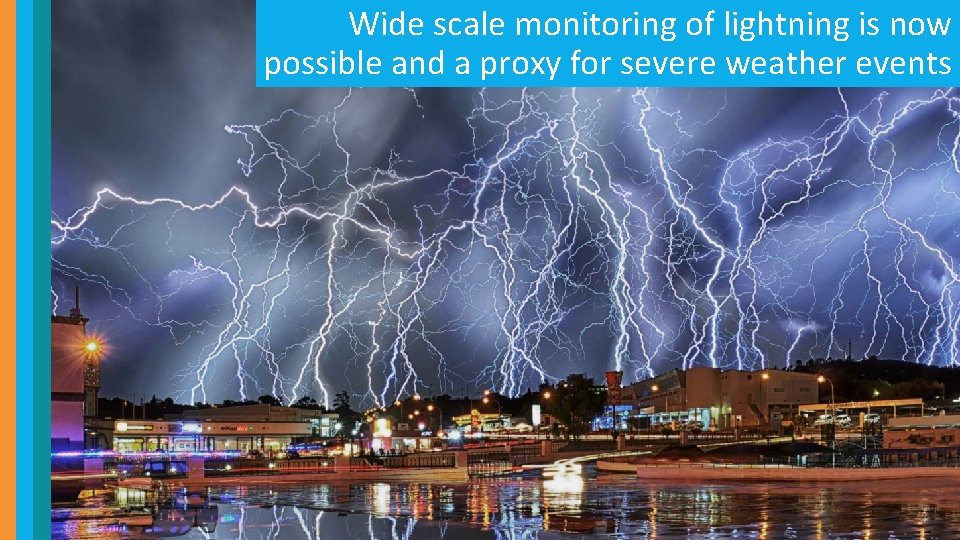
Wide scale monitoring of lightning is now possible and a proxy for severe weather events
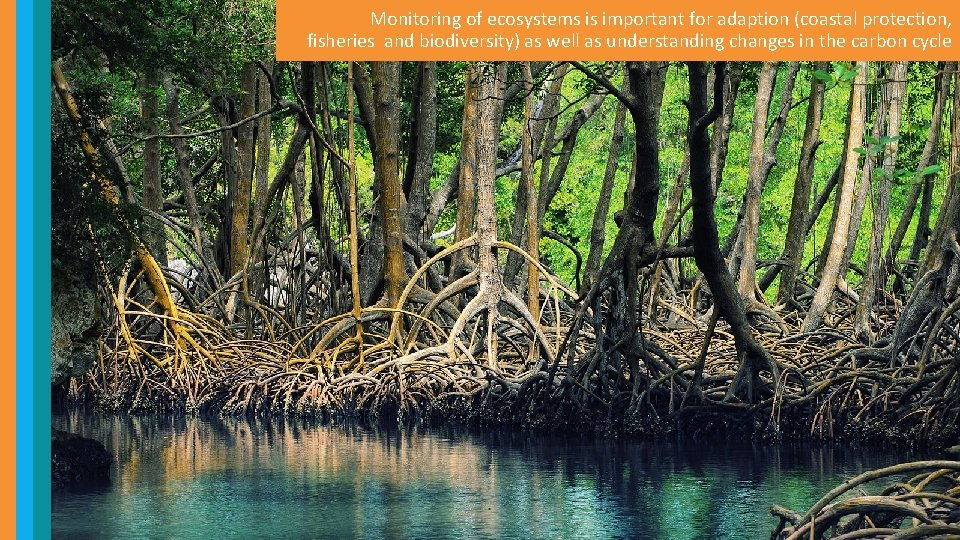
Monitoring of ecosystems is important for adaption (coastal protection, fisheries and biodiversity) as well as understanding changes in the carbon cycle
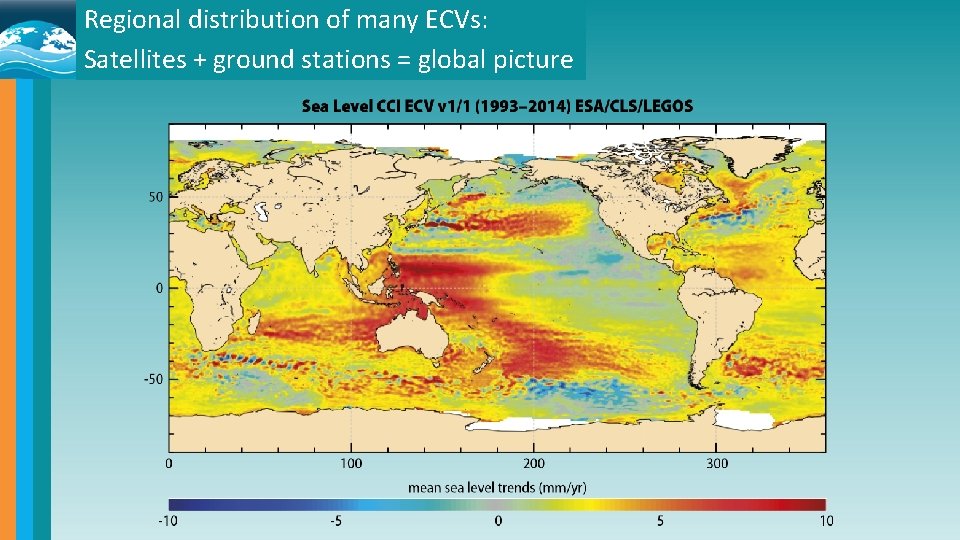
Regional distribution of many ECVs: Satellites + ground stations = global picture
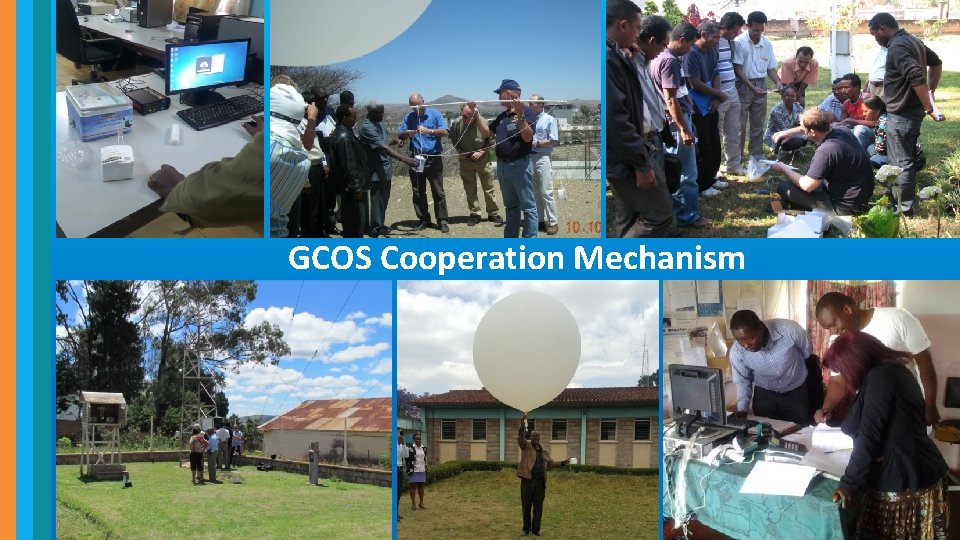
GCOS Cooperation Mechanism
Strategy From observations to implementation: meeting strategic objectives
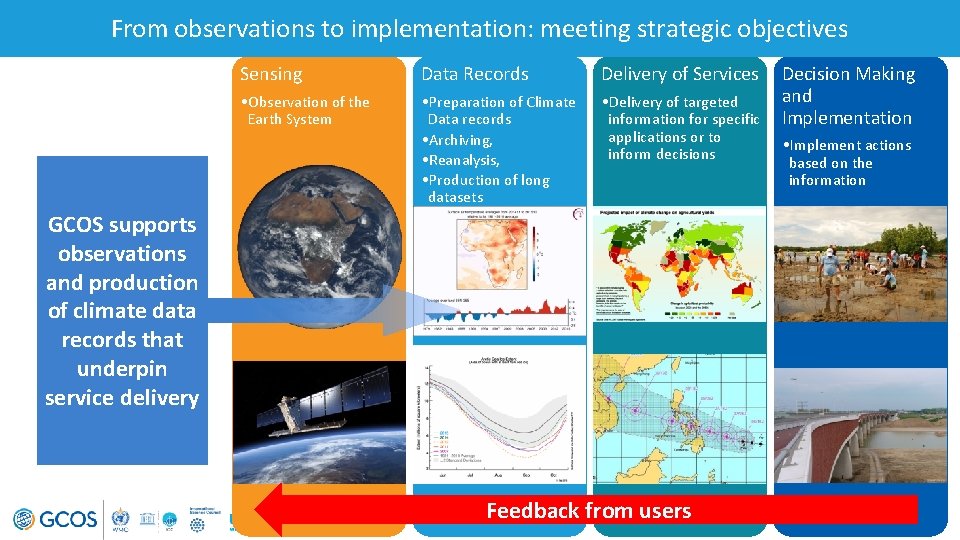
From observations to implementation: meeting strategic objectives Sensing Data Records Delivery of Services • Observation of the Earth System • Preparation of Climate Data records • Archiving, • Reanalysis, • Production of long datasets • Delivery of targeted information for specific applications or to inform decisions GCOS supports observations and production of climate data records that underpin service delivery Feedback from users Decision Making and Implementation • Implement actions based on the information
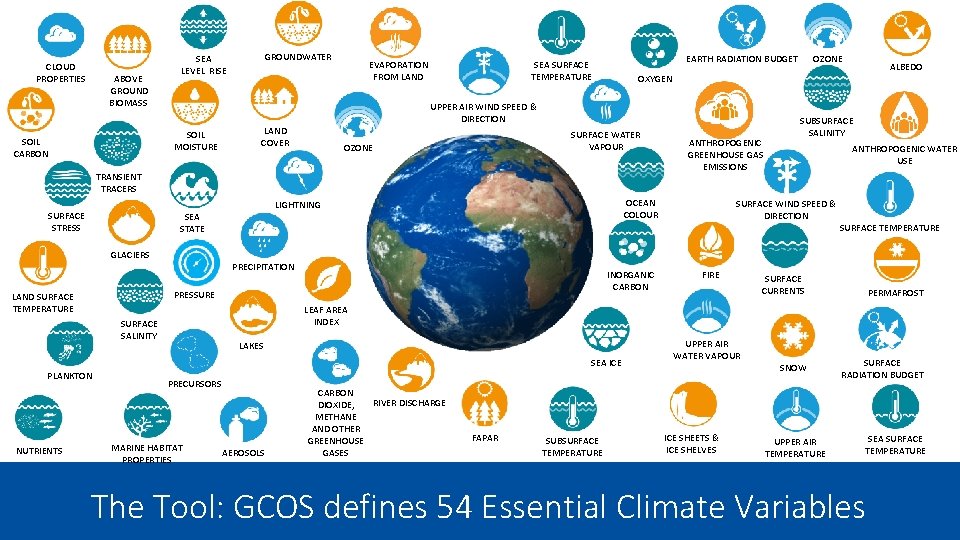
CLOUD PROPERTIES ABOVE GROUND BIOMASS SOIL MOISTURE SOIL CARBON GROUNDWATER SEA LEVEL RISE EARTH RADIATION BUDGET SEA SURFACE TEMPERATURE EVAPORATION FROM LAND SURFACE WATER VAPOUR OZONE TRANSIENT TRACERS SURFACE STRESS GLACIERS PRECIPITATION INORGANIC CARBON PRESSURE LAND SURFACE TEMPERATURE LAKES SEA ICE NUTRIENTS SUBSURFACE SALINITY ANTHROPOGENIC WATER USE SURFACE WIND SPEED & DIRECTION FIRE SURFACE TEMPERATURE SURFACE CURRENTS PERMAFROST LEAF AREA INDEX SURFACE SALINITY PLANKTON ANTHROPOGENIC GREENHOUSE GAS EMISSIONS OCEAN COLOUR LIGHTNING SEA STATE ALBEDO OXYGEN UPPER AIR WIND SPEED & DIRECTION LAND COVER OZONE PRECURSORS MARINE HABITAT PROPERTIES AEROSOLS CARBON RIVER DISCHARGE DIOXIDE, METHANE AND OTHER GREENHOUSE GASES FAPAR SUBSURFACE TEMPERATURE UPPER AIR WATER VAPOUR ICE SHEETS & ICE SHELVES SNOW UPPER AIR TEMPERATURE SURFACE RADIATION BUDGET SEA SURFACE TEMPERATURE The Tool: GCOS defines 54 Essential Climate Variables
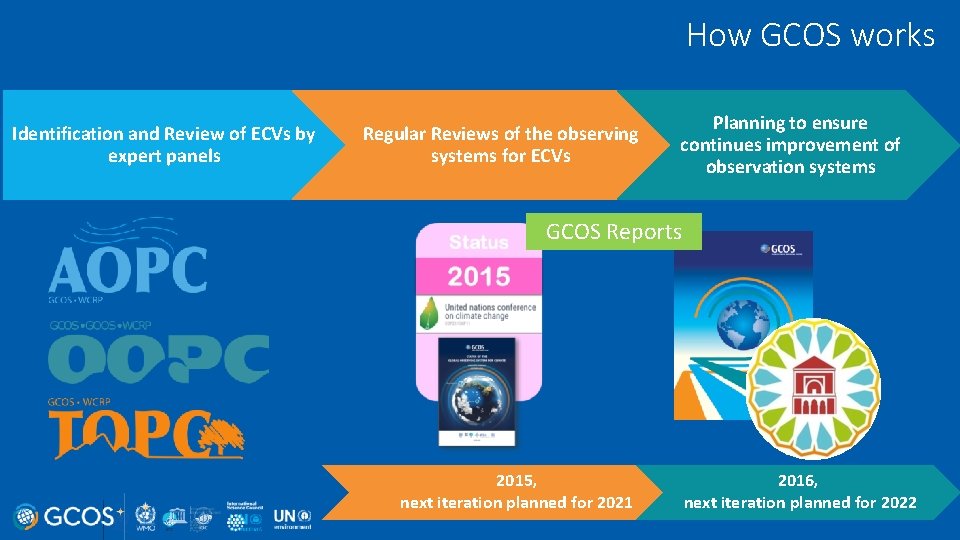
How GCOS works Identification and Review of ECVs by expert panels Regular Reviews of the observing systems for ECVs Planning to ensure continues improvement of observation systems GCOS Reports 2015, next iteration planned for 2021 2016, next iteration planned for 2022
Regional Activities Local observations for global understanding Mandated by UNFCCC COP-22, Marrakesh, 2016
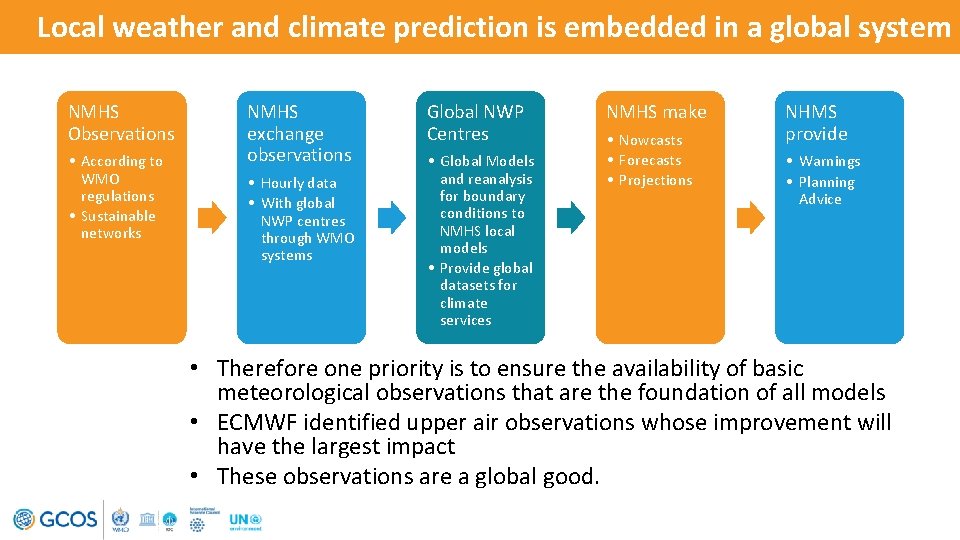
Local weather and climate prediction is embedded in a global system NMHS Observations • According to WMO regulations • Sustainable networks NMHS exchange observations • Hourly data • With global NWP centres through WMO systems Global NWP Centres • Global Models and reanalysis for boundary conditions to NMHS local models • Provide global datasets for climate services NMHS make • Nowcasts • Forecasts • Projections NHMS provide • Warnings • Planning Advice • Therefore one priority is to ensure the availability of basic meteorological observations that are the foundation of all models • ECMWF identified upper air observations whose improvement will have the largest impact • These observations are a global good.
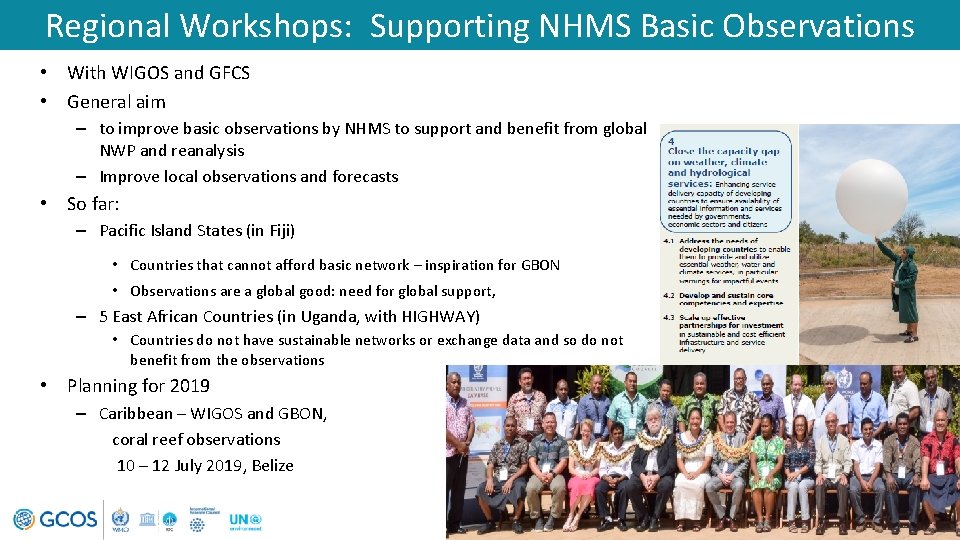
Regional Workshops: Supporting NHMS Basic Observations • With WIGOS and GFCS • General aim – to improve basic observations by NHMS to support and benefit from global NWP and reanalysis – Improve local observations and forecasts • So far: – Pacific Island States (in Fiji) • Countries that cannot afford basic network – inspiration for GBON • Observations are a global good: need for global support, – 5 East African Countries (in Uganda, with HIGHWAY) • Countries do not have sustainable networks or exchange data and so do not benefit from the observations • Planning for 2019 – Caribbean – WIGOS and GBON, coral reef observations 10 – 12 July 2019, Belize
Preparing for the 2022 IP update GCOS Secretariat
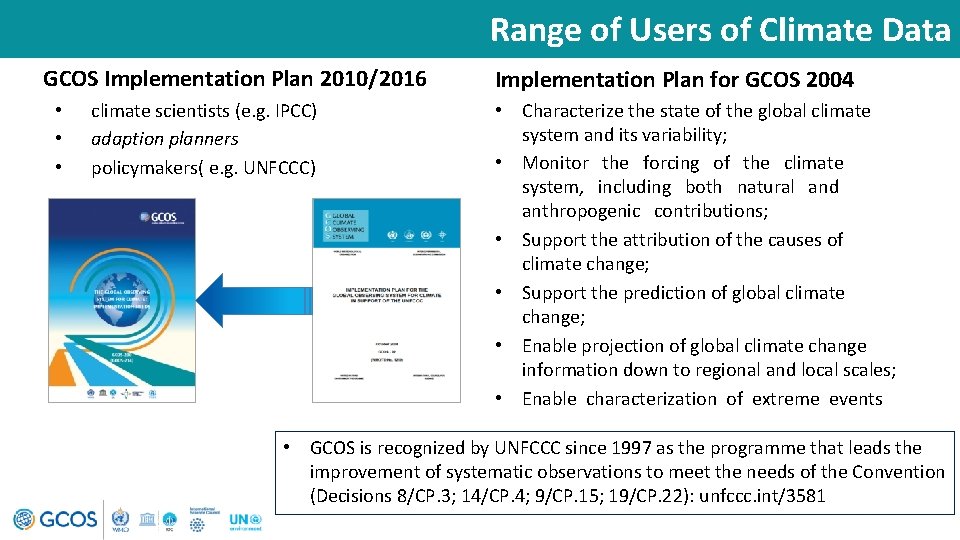
Range of Users of Climate Data GCOS Implementation Plan 2010/2016 • • • climate scientists (e. g. IPCC) adaption planners policymakers( e. g. UNFCCC) Implementation Plan for GCOS 2004 • Characterize the state of the global climate system and its variability; • Monitor the forcing of the climate system, including both natural and anthropogenic contributions; • Support the attribution of the causes of climate change; • Support the prediction of global climate change; • Enable projection of global climate change information down to regional and local scales; • Enable characterization of extreme events • GCOS is recognized by UNFCCC since 1997 as the programme that leads the improvement of systematic observations to meet the needs of the Convention (Decisions 8/CP. 3; 14/CP. 4; 9/CP. 15; 19/CP. 22): unfccc. int/3581
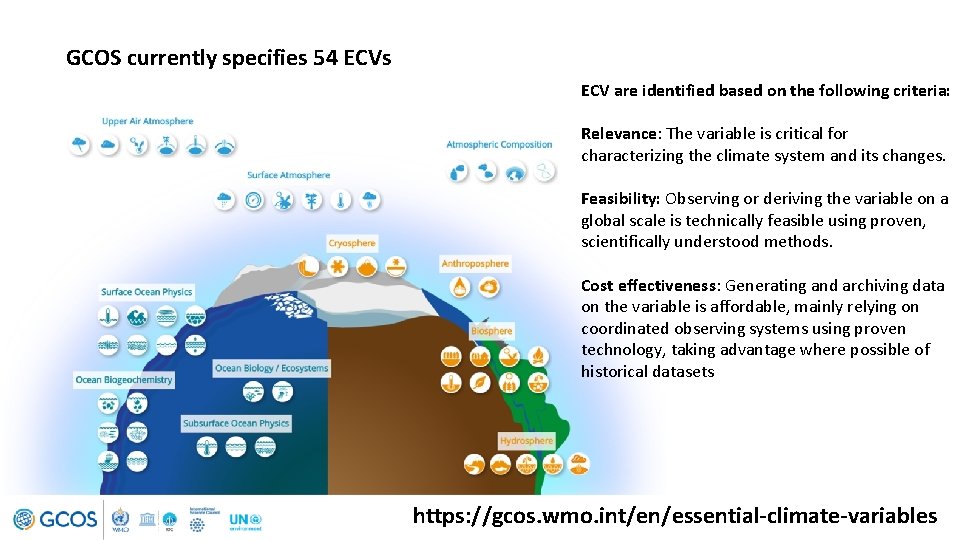
GCOS currently specifies 54 ECVs ECV are identified based on the following criteria: Relevance: The variable is critical for characterizing the climate system and its changes. Feasibility: Observing or deriving the variable on a global scale is technically feasible using proven, scientifically understood methods. Cost effectiveness: Generating and archiving data on the variable is affordable, mainly relying on coordinated observing systems using proven technology, taking advantage where possible of historical datasets https: //gcos. wmo. int/en/essential-climate-variables
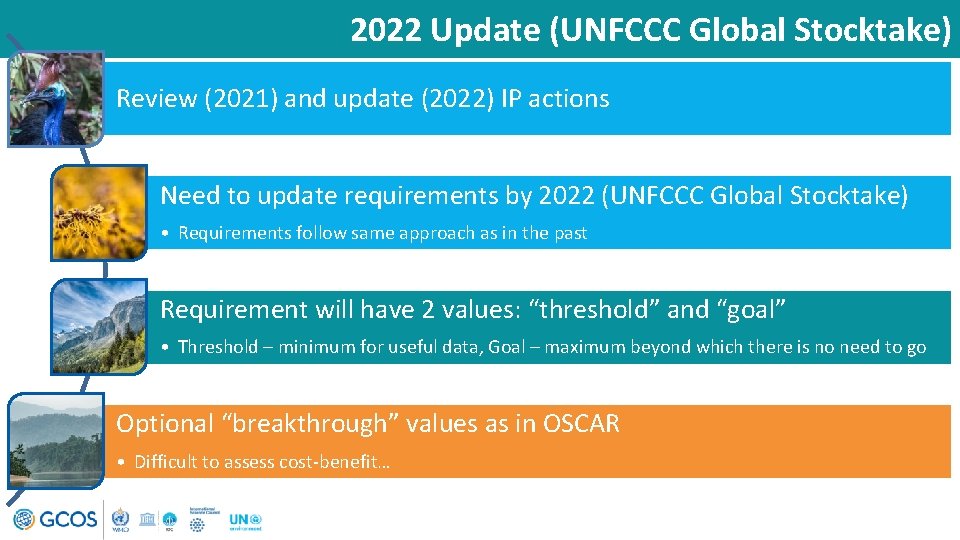
2022 Update (UNFCCC Global Stocktake) Review (2021) and update (2022) IP actions Need to update requirements by 2022 (UNFCCC Global Stocktake) • Requirements follow same approach as in the past Requirement will have 2 values: “threshold” and “goal” • Threshold – minimum for useful data, Goal – maximum beyond which there is no need to go Optional “breakthrough” values as in OSCAR • Difficult to assess cost-benefit…
Research & Observations GCOS Secretariat
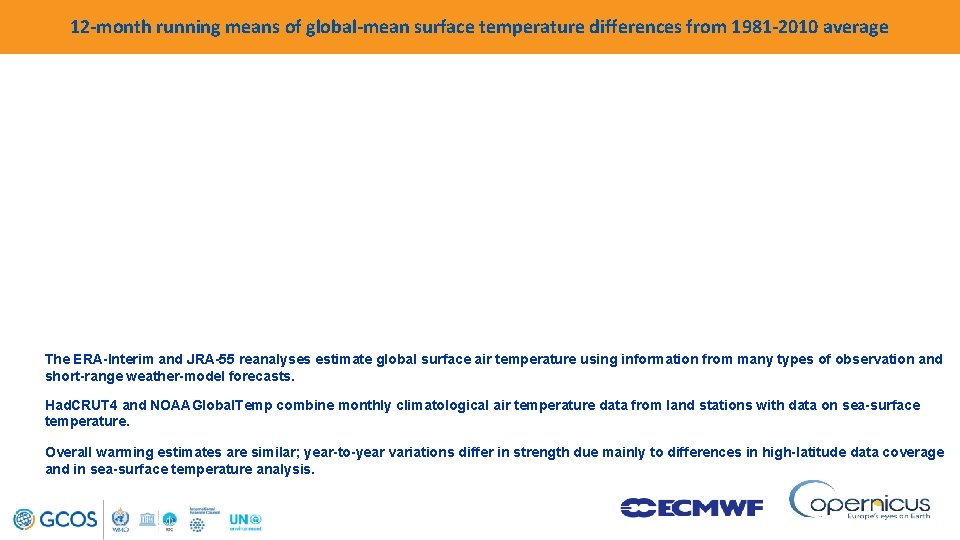
12 -month running means of global-mean surface temperature differences from 1981 -2010 average The ERA-Interim and JRA-55 reanalyses estimate global surface air temperature using information from many types of observation and short-range weather-model forecasts. Had. CRUT 4 and NOAAGlobal. Temp combine monthly climatological air temperature data from land stations with data on sea-surface temperature. Overall warming estimates are similar; year-to-year variations differ in strength due mainly to differences in high-latitude data coverage and in sea-surface temperature analysis.
Global Climate Observing – History GCOS Secretariat
Global Climate Observing before GCOS o o o o o Humboldt (1769 -1859) Maury and the Brussels Conference (1853) International Meteorological Organization (1873) The National Meteorological Service International Polar Years and the IGY (1957) The Wexler Vision and Weather Satellites World Weather Watch and GARP (1967) World Climate Conference (1979) and the World Climate Programme Villach (1985), Brundtland (1987) and the IPCC (1988) credit to: John W. Zillman (GCOS Sc Chairman 2006 -2009)
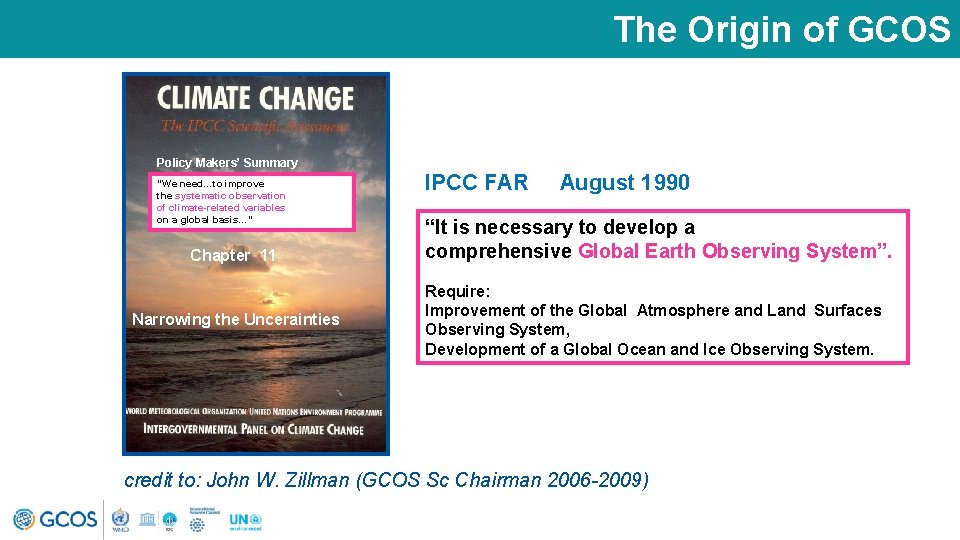
The Origin of GCOS Policy Makers’ Summary “We need…to improve the systematic observation of climate-related variables on a global basis…” Chapter 11 Narrowing the Uncerainties IPCC FAR August 1990 “It is necessary to develop a comprehensive Global Earth Observing System”. Require: Improvement of the Global Atmosphere and Land Surfaces Observing System, Development of a Global Ocean and Ice Observing System. credit to: John W. Zillman (GCOS Sc Chairman 2006 -2009)
Second World Climate Conference - (WCC-2) Ministerial Session Policy Makers’ Summary
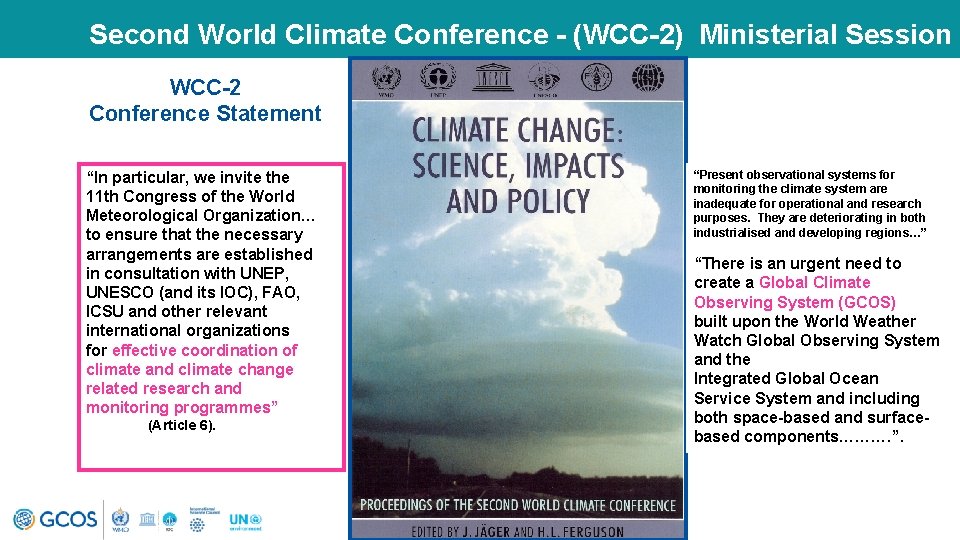
Second World Climate Conference - (WCC-2) Ministerial Session WCC-2 Conference Statement Policy Makers’ Summary “In particular, we invite the 11 th Congress of the World Meteorological Organization… to ensure that the necessary arrangements are established in consultation with UNEP, UNESCO (and its IOC), FAO, ICSU and other relevant international organizations for effective coordination of climate and climate change related research and monitoring programmes” (Article 6). “Present observational systems for monitoring the climate system are inadequate for operational and research purposes. They are deteriorating in both industrialised and developing regions…” “There is an urgent need to create a Global Climate Observing System (GCOS) built upon the World Weather Watch Global Observing System and the Integrated Global Ocean Service System and including both space-based and surfacebased components………. ”.
GCOS Memorandum of Understanding Policy Makers’ Summary This Mo. U defines the rationale for the establishment of GCOS and its purpose, concept of operation, governance and financial arrangements. Signed on 9. April 1992 by WMO, IOC, ICSU and UNEP; updated in 1998
Need of Global Coordination of Climate Observing Systems GCOS Secretariat
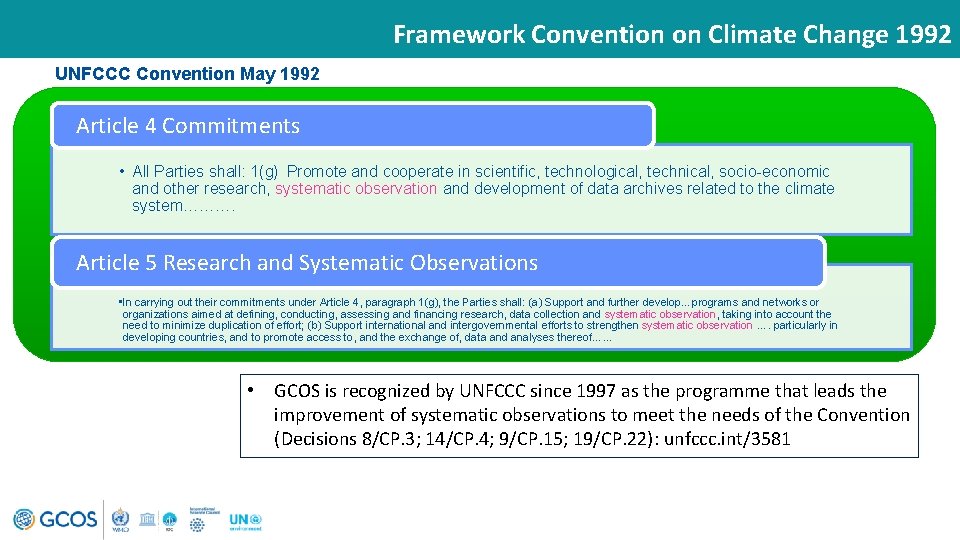
Framework Convention on Climate Change 1992 UNFCCC Convention May 1992 . . . meet other requirements of the UNFCCC and other international Policy Makers’ Summary concventions and agreements. Article 4 Commitments • All Parties shall: 1(g) Promote and cooperate in scientific, technological, technical, socio-economic and other research, systematic observation and development of data archives related to the climate system………. Article 5 Research and Systematic Observations • In carrying out their commitments under Article 4, paragraph 1(g), the Parties shall: (a) Support and further develop…programs and networks or organizations aimed at defining, conducting, assessing and financing research, data collection and systematic observation, taking into account the need to minimize duplication of effort; (b) Support international and intergovernmental efforts to strengthen systematic observation …. particularly in developing countries, and to promote access to, and the exchange of, data and analyses thereof…… • GCOS is recognized by UNFCCC since 1997 as the programme that leads the improvement of systematic observations to meet the needs of the Convention (Decisions 8/CP. 3; 14/CP. 4; 9/CP. 15; 19/CP. 22): unfccc. int/3581
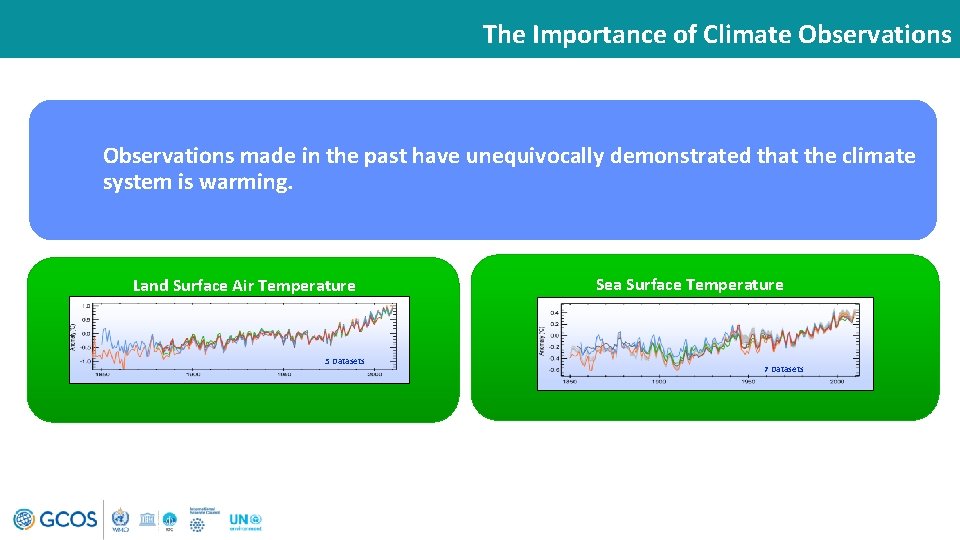
The Importance of Climate Observations Policy Makers’made Summary in the past have unequivocally demonstrated that the climate system is warming. Land Surface Air Temperature 5 Datasets Sea Surface Temperature 7 Datasets
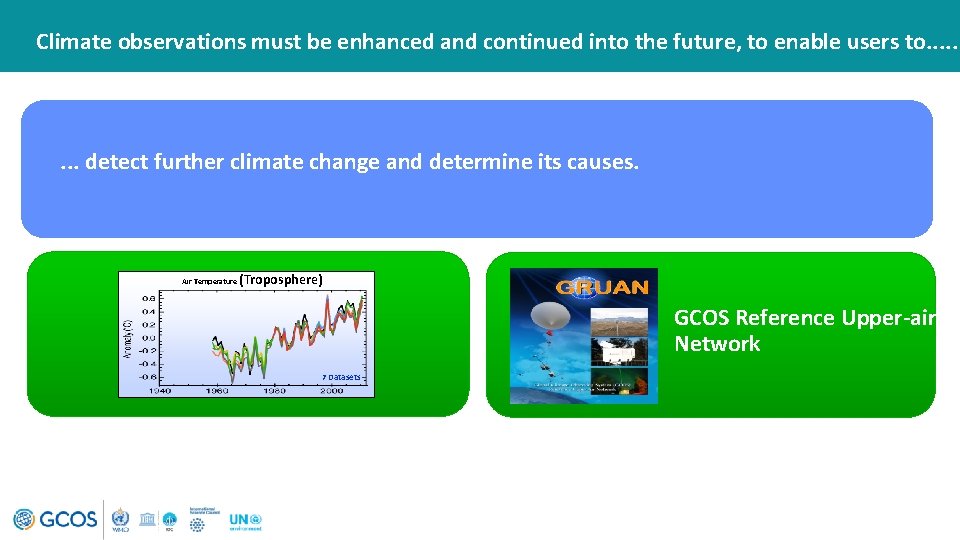
Climate observations must be enhanced and continued into the future, to enable users to. . . Policy Makers’ Summary change and determine its causes. . detect further climate Air Temperature (Troposphere) Model and predict the climate system. 7 Datasets GCOS Reference Upper-air Network
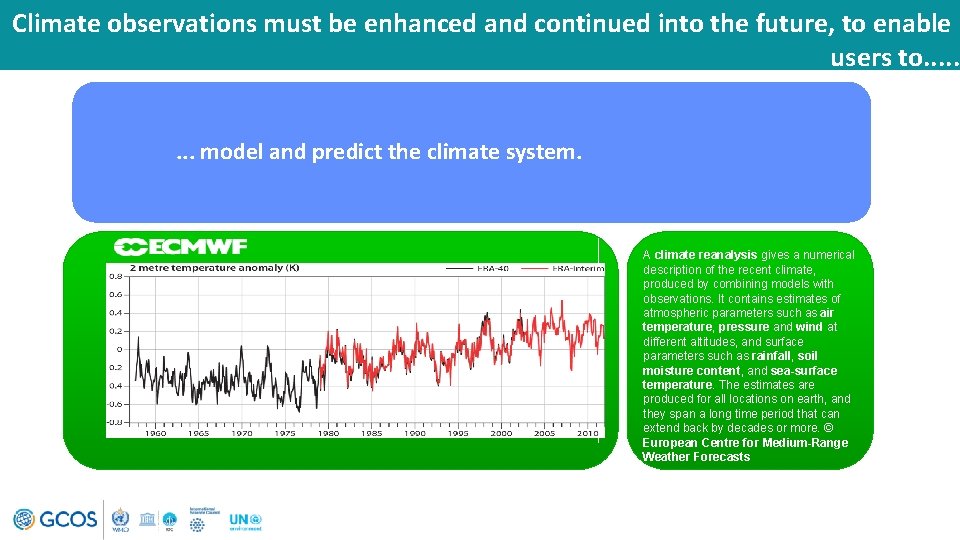
Climate observations must be enhanced and continued into the future, to enable users to. . . . model and predict the climate system. Policy Makers’ Summary A climate reanalysis gives a numerical description of the recent climate, produced by combining models with observations. It contains estimates of atmospheric parameters such as air temperature, pressure and wind at different altitudes, and surface parameters such as rainfall, soil moisture content, and sea-surface temperature. The estimates are produced for all locations on earth, and they span a long time period that can extend back by decades or more. © European Centre for Medium-Range Weather Forecasts
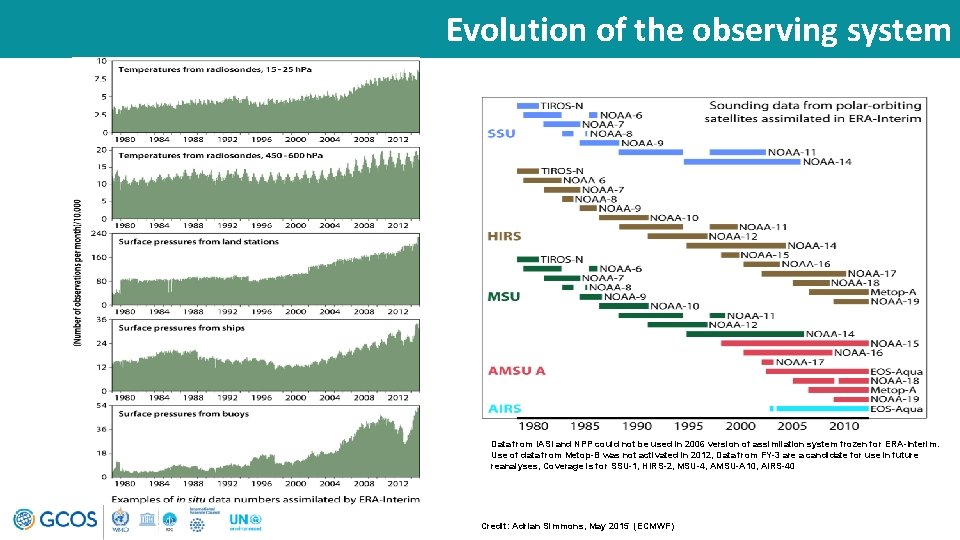
Evolution of the observing system Data from IASI and NPP could not be used in 2006 version of assimilation system frozen for ERA-Interim. Use of data from Metop-B was not activated in 2012, Data from FY-3 are a candidate for use in future reanalyses, Coverage is for SSU-1, HIRS-2, MSU-4, AMSU-A 10, AIRS-40 Credit: Adrian Simmons, May 2015 (ECMWF)
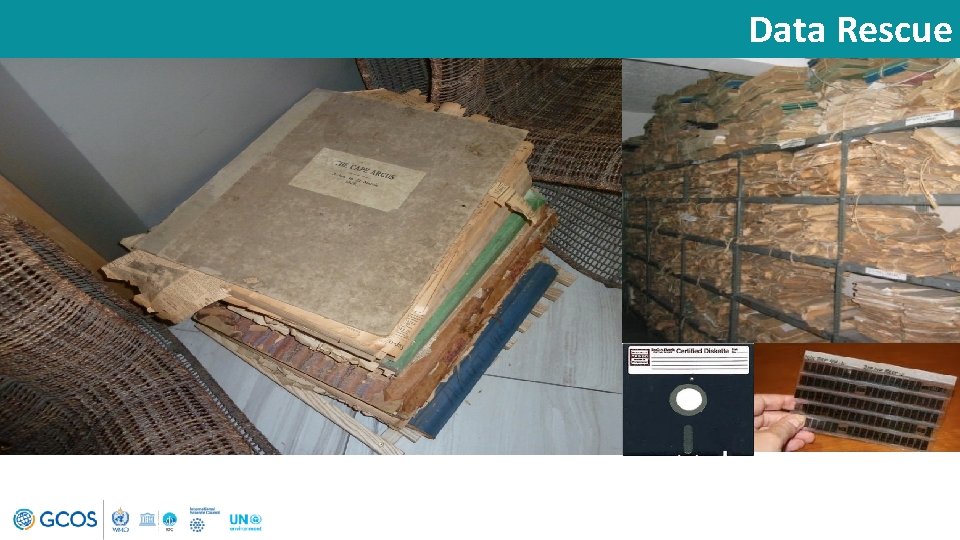
Data Rescue
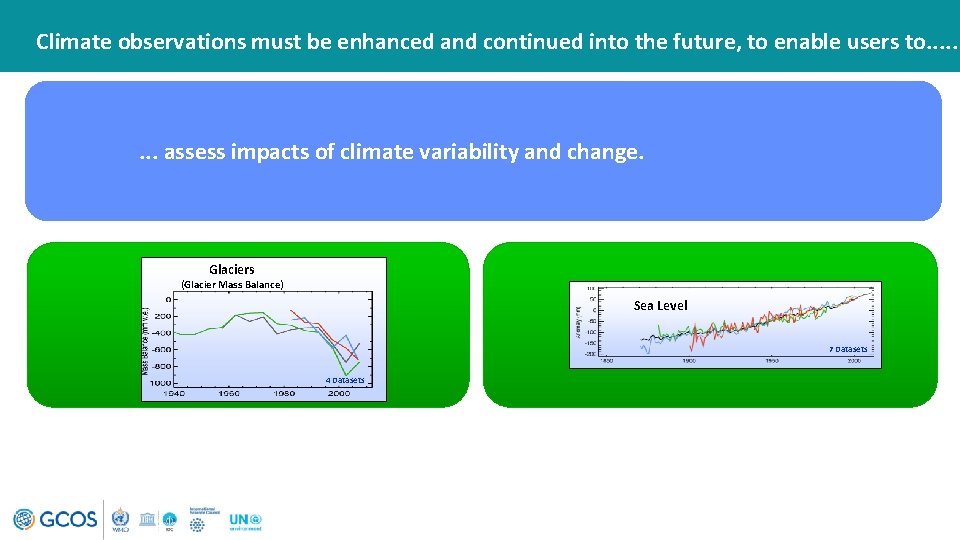
Climate observations must be enhanced and continued into the future, to enable users to. . . . Policy assess impacts of climate variability and change. Makers’ Summary Glaciers (Glacier Mass Balance) Sea Level 7 Datasets 4 Datasets
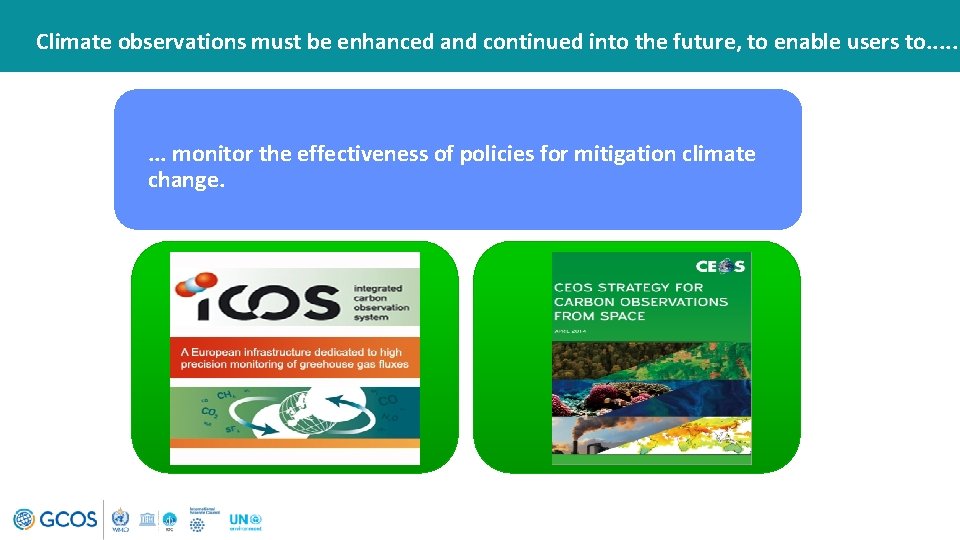
Climate observations must be enhanced and continued into the future, to enable users to. . . . Policy monitor the effectiveness of policies for mitigation climate Makers’ Summary change.
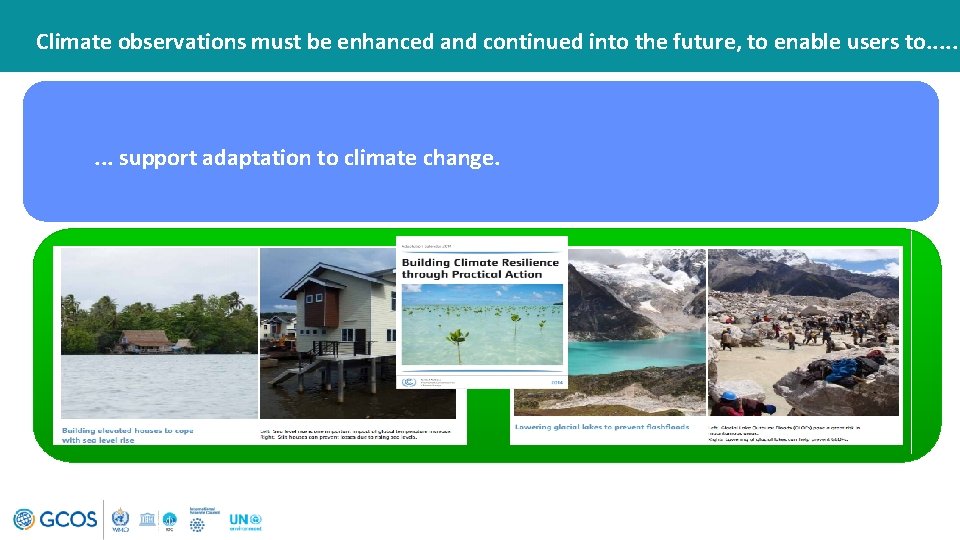
Climate observations must be enhanced and continued into the future, to enable users to. . . . support adaptation to climate change. Policy Makers’ Summary
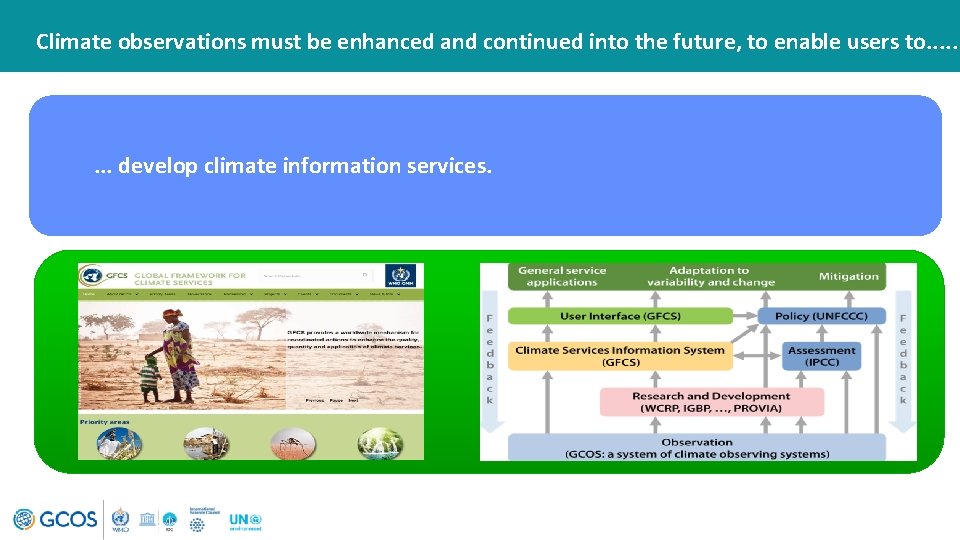
Climate observations must be enhanced and continued into the future, to enable users to. . . Policy Makers’ Summary. . . develop climate information services.
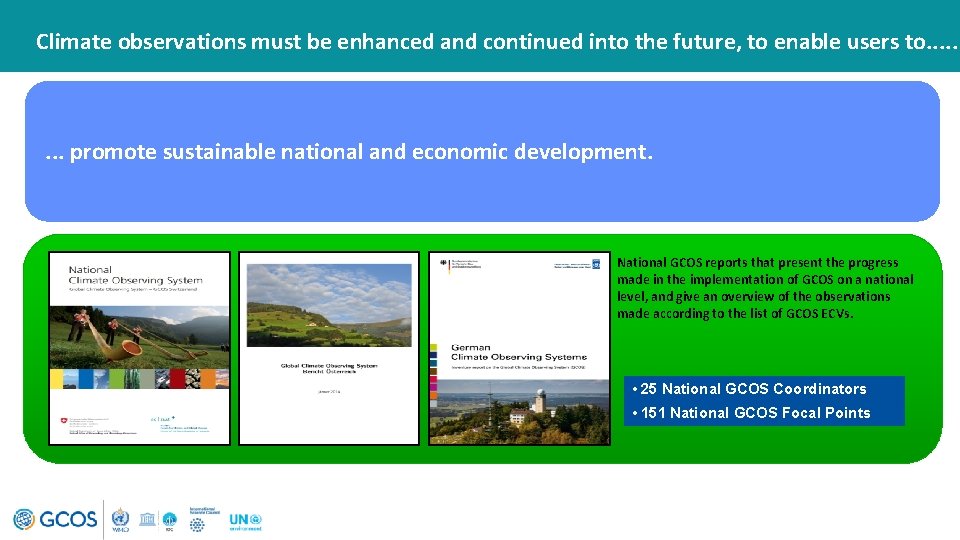
Climate observations must be enhanced and continued into the future, to enable users to. . . . promote. Policy sustainable national and economic development. Makers’ Summary National GCOS reports that present the progress made in the implementation of GCOS on a national level, and give an overview of the observations made according to the list of GCOS ECVs. • 25 National GCOS Coordinators • 151 National GCOS Focal Points
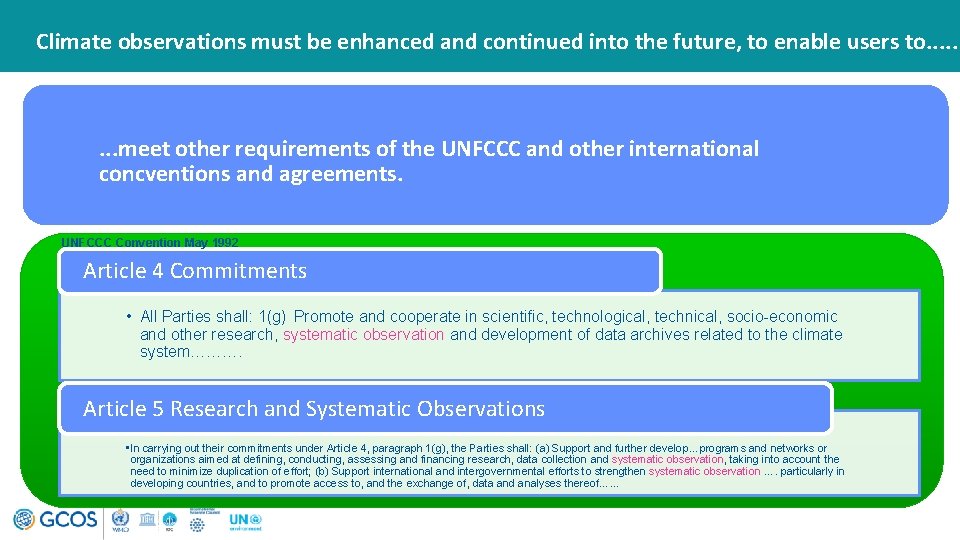
Climate observations must be enhanced and continued into the future, to enable users to. . . . meet other requirements of the UNFCCC and other international concventions and agreements. UNFCCC Convention May 1992 Article 4 Commitments • All Parties shall: 1(g) Promote and cooperate in scientific, technological, technical, socio-economic and other research, systematic observation and development of data archives related to the climate system………. Article 5 Research and Systematic Observations • In carrying out their commitments under Article 4, paragraph 1(g), the Parties shall: (a) Support and further develop…programs and networks or organizations aimed at defining, conducting, assessing and financing research, data collection and systematic observation, taking into account the need to minimize duplication of effort; (b) Support international and intergovernmental efforts to strengthen systematic observation …. particularly in developing countries, and to promote access to, and the exchange of, data and analyses thereof……
- Slides: 62