
Global Climate Models Any Progress on Prediction Dr
Global Climate Models: Any Progress on Prediction? Dr. Michael Previdi http: //data. giss. nasa. gov/imbalance/ Original Presented 7 Feb 2015
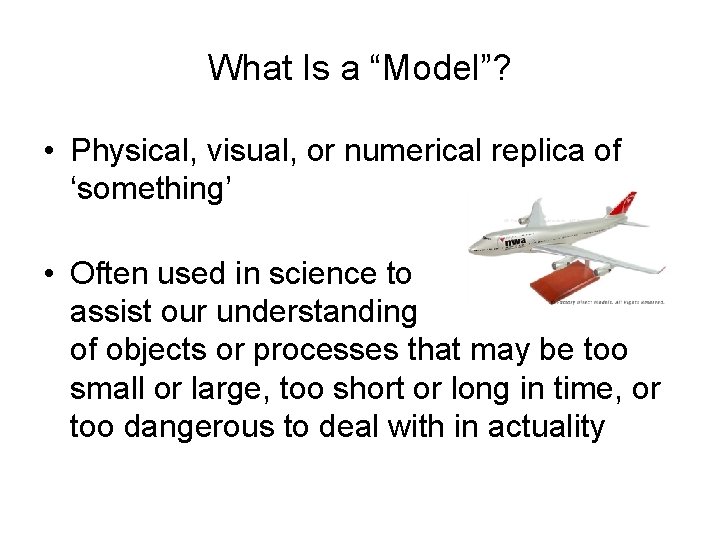
What Is a “Model”? • Physical, visual, or numerical replica of ‘something’ • Often used in science to assist our understanding of objects or processes that may be too small or large, too short or long in time, or too dangerous to deal with in actuality
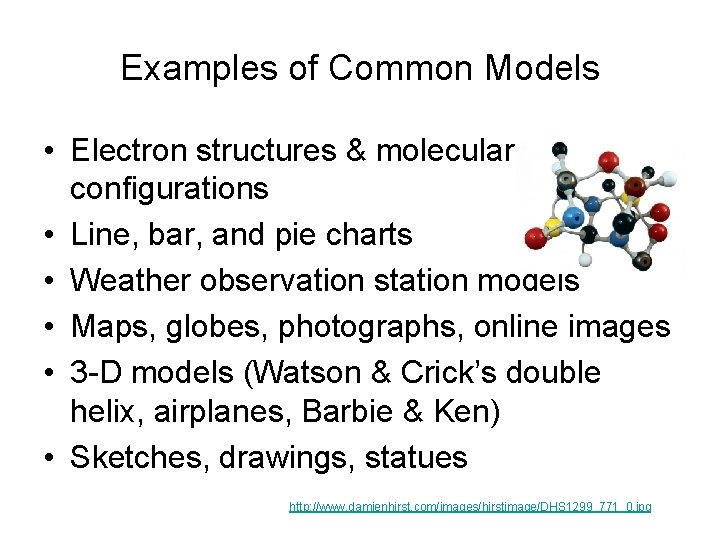
Examples of Common Models • Electron structures & molecular configurations • Line, bar, and pie charts • Weather observation station models • Maps, globes, photographs, online images • 3 -D models (Watson & Crick’s double helix, airplanes, Barbie & Ken) • Sketches, drawings, statues http: //www. damienhirst. com/images/hirstimage/DHS 1299_771_0. jpg
Components of a Good Model • Needs to behave like the object or process it represents, but need not look like it • Can be manipulated to provide new insights for the user about the original • Particularly helpful for “What happens if I change this? ” activities • Able to be modified as a result of observations on its behavior
Developing a Good Model • Identify essential components of the object, process, or system • Identify a “parallel” that can be used to reproduce the desired behavior • Construct the replica • Manipulate it, modify it, analyze it • Communicate results • Further refine and explore
“Climate” Climate refers to ‘average weather conditions’ Varies on timescales ranging from daily seasonal to millennial or longer Fluctuations result naturally from interactions between the atmosphere, ocean, land, cryosphere (frozen portion of the Earth's surface), and changes in the Earth's energy balance resulting from volcanic eruptions and variations in the sun's intensity. http: //www. research. noaa. gov/climate/t_modeling. html
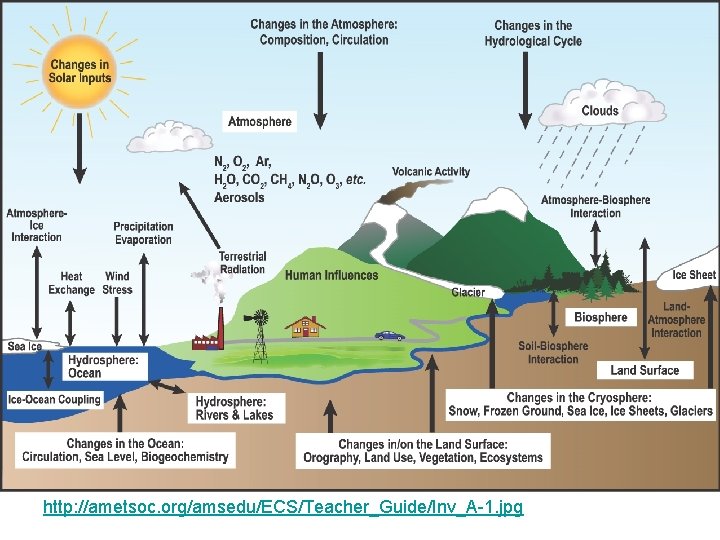
http: //ametsoc. org/amsedu/ECS/Teacher_Guide/Inv_A-1. jpg
What Makes Climate Modeling So Important? Since the Industrial Revolution, significant changes in radiative forcing (Earth's heat energy balance) have resulted from the build up of greenhouse gases and trace constituents. Impacts of these anthropogenically-induced (man-made) changes to the energy budget have been detected and are projected to become increasingly more important during the next century. http: //www. research. noaa. gov/climate/t_modeling. html
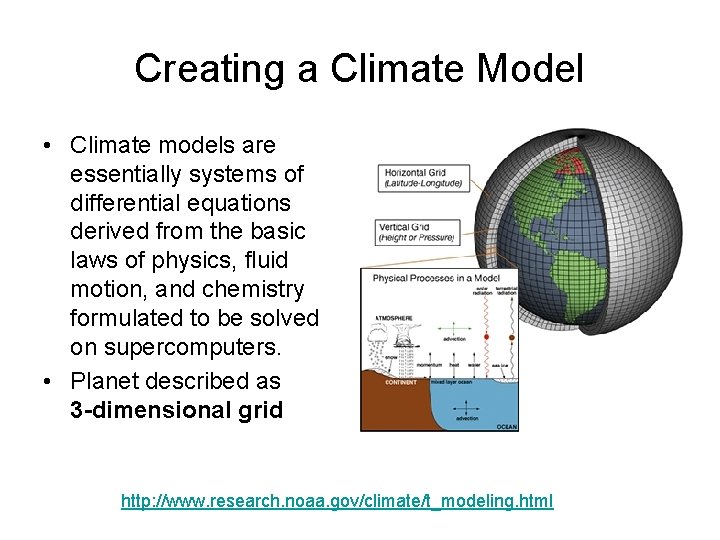
Creating a Climate Model • Climate models are essentially systems of differential equations derived from the basic laws of physics, fluid motion, and chemistry formulated to be solved on supercomputers. • Planet described as 3 -dimensional grid http: //www. research. noaa. gov/climate/t_modeling. html
Creating a Climate Model, cont’d. • Basic equations applied and evaluated over grid. • At each grid point, calculations can be made for such variables as motion of the air (winds), heat transfer (thermodynamics), radiation (solar and terrestrial), moisture content (relative humidity) and surface hydrology (precipitation, evaporation, snow melt and runoff) • May also calculate interactions between neighboring points. • Computations stepped forward or backward in time, depending on the study. http: //www. research. noaa. gov/climate/t_modeling. html
Creating a Climate Model, cont’d. • Accuracy of climate models limited by grid resolution, ability to describe the complicated atmospheric, oceanic, and chemical processes mathematically and available data • Current research directed at improving the representation of these processes. • Despite imperfections, models simulate remarkably well current understanding of climate and its variability. http: //www. research. noaa. gov/climate/t_modeling. html
Selected Areas of Interest for Atmospheric and Climate Modelers • Weather observations and forecasts (short -term) • Near-term climate forecasts (1 – 6 mo. ) (seasonal) • Climate Variability (El Nino-La Nina, NAO) • Atmospheric Chemistry • Greenhouse Warming • Paleoclimates
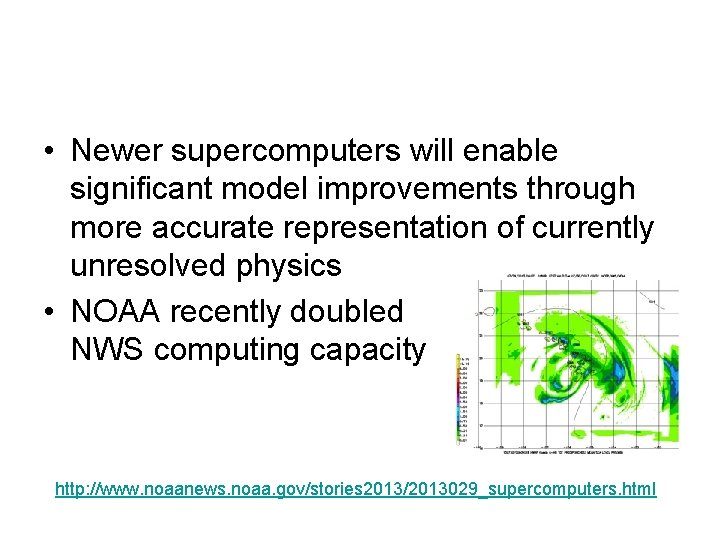
• Newer supercomputers will enable significant model improvements through more accurate representation of currently unresolved physics • NOAA recently doubled NWS computing capacity http: //www. noaanews. noaa. gov/stories 2013/2013029_supercomputers. html
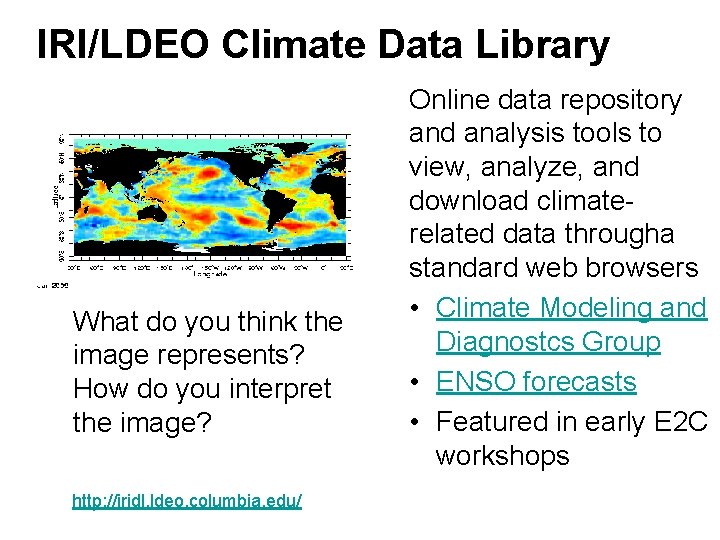
IRI/LDEO Climate Data Library What do you think the image represents? How do you interpret the image? http: //iridl. ldeo. columbia. edu/ Online data repository and analysis tools to view, analyze, and download climaterelated data througha standard web browsers • Climate Modeling and Diagnostcs Group • ENSO forecasts • Featured in early E 2 C workshops
IPCC: Focus of Recent Attention • Intergovernmental Panel on Climate Change • Established in 1988 to provide decisionmakers and others interested in climate change with objective source of information about climate change • Set up by WMO and UNEP • Governments, scientists, organizations, others
4 th IPCC Report – Nobel Prize • IPCC Working Group I (WG 1) assessed physical scientific aspects of the climate system and climate change • Climate Change 2007 “The Physical Science Basis” • Of special interest: FAQs
Additional 4 IPCC Reports • IPCC Working Group II assessed vulnerability of socio-economic and natural systems to climate change, negative and positive consequences of climate change, and options for adapting to it • IPCC WG 3 assessed options for mitigating climate change through limiting or preventing greenhouse gas emissions and enhancing activities that remove them from the atmosphere.
Challenges to the IPCC Reports • From “within the scientific community” • From “outside the scientific community” • This is the reality of how “Science” should be conducted – test and accept tentatively • Constantly changing, so 5 th IPCC Reports due in 2014
Climate Prediction and Schools • Climateprediction. net is a distributed computing project to produce predictions of the Earth's climate up to 2080 and to test the accuracy of climate models. To do this, we need people around the world to give us time on their computers - time when they have their computers switched on, but are not using them to their full capacity.
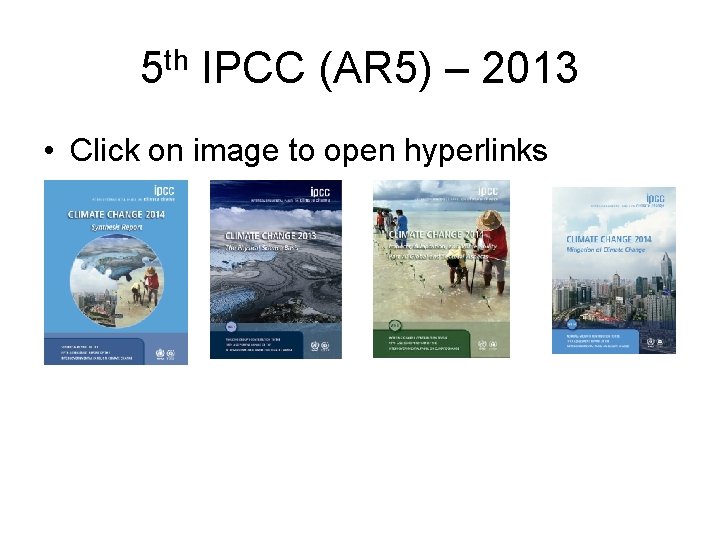
5 th IPCC (AR 5) – 2013 • Click on image to open hyperlinks
2014 National Climate Assessment • Focuses on climate change affecting USA • Key Finding: Global climate is changing and this is apparent across the United States in a wide range of observations. The global warming of the past 50 years is primarily due to human activities, predominantly the burning of fossil fuels. Climate Trends
Highlight Topics • Our Changing Climate • Extreme Weather • Future Climate • Widespread Impacts • Human Health • Infrastructure • • Water Supply Agriculture Indigenous People Ecosystems & Biodiversity • Oceans • Responses http: //nca 2014. globalchange. gov/highlights#section-5683
NCA 2014 – Regional Impacts • • • Northeast Southeast Midwest Great Plains Southwest • • Northwest Alaska Hawaii Rural Communities • Coasts http: //nca 2014. globalchange. gov/highlights#section-5681
Sample Questions about Climate Change from UCAR “Activities in the Middle” • What has Earth's climate been over time on various scales? • Why is the carbon cycle so important when investigating climate change issues? • What major events in human history are considered to be factors in changing the earth's atmosphere? • How do scientists measure gas concentrations in the atmosphere? • Why are climate change and global warming considered to be controversial topics by some groups and individuals? http: //www. ucar. edu/learn/1_4_1. htm
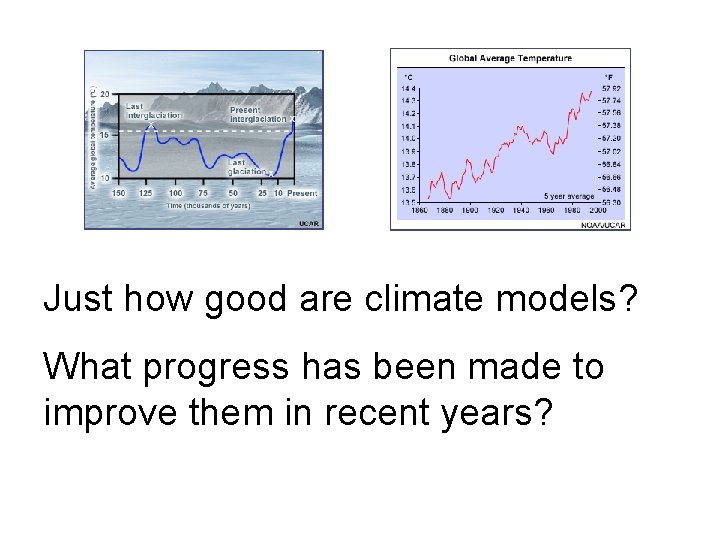
Just how good are climate models? What progress has been made to improve them in recent years?
- Slides: 25