
Global Climate Classification 2 6 1 b Compare
Global Climate Classification 2. 6. 1 b Compare weather and climate. 2. 6. 1 a Explain major climate categories (Köppen climate classification system - temperate, tropical, and polar).
Climate: Who studies it? �Climatologist studies climate and uses a system to classify the climates around the world �A classification system based on mean(average)monthly precipitation and mean(average)monthly temperature created by climatologist and botanist Dr. Vladimir Köppen
Determinants �Climate zones are largely determined by 2 factors: �Temperature �latitude, altitude, land-water, ocean currents, mountain barriers �Precipitation �Air pressure �Air mass influences �Prevailing winds
Climate Zone �Areas that have similar temperature and rainfall will share a similar climate zone.
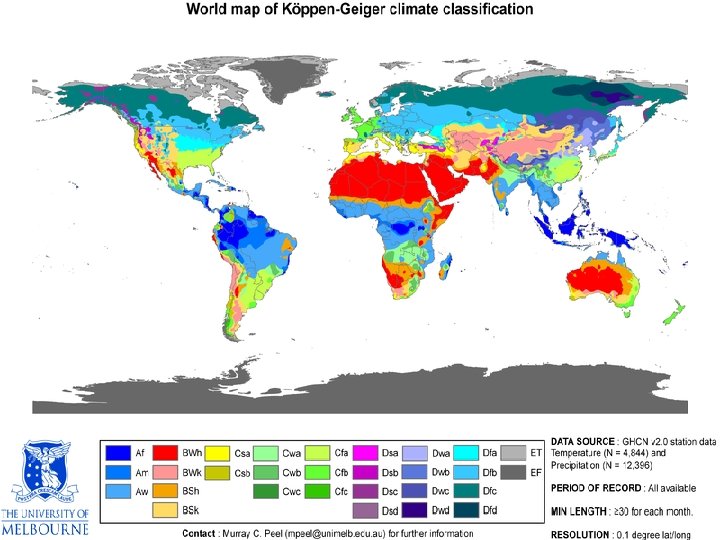
Köppen Climate Classification System �The most widely used for classifying the world's climates. �Köppen divided the Earth's surface into climatic regions that generally coincided with world patterns of vegetation and soils. �The Köppen system recognizes five major climate types based on the annual and monthly averages of temperature and precipitation. �Each type is designated by a capital letter. A, B, C, D, E
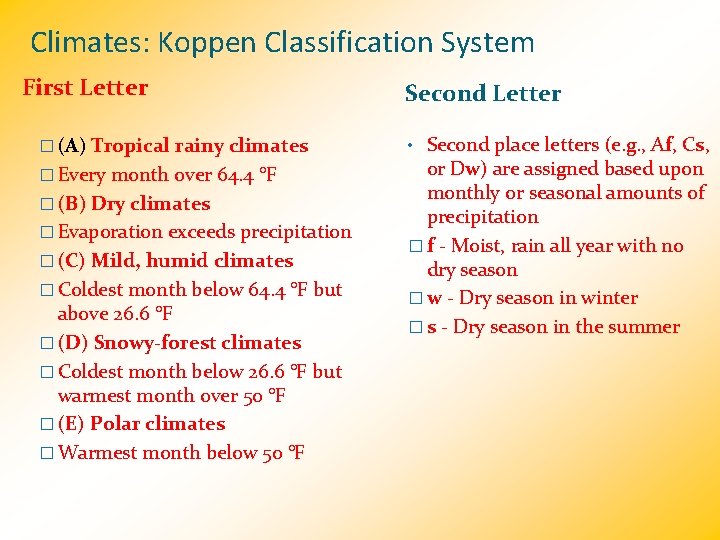
Climates: Koppen Classification System First Letter � (A) Tropical rainy climates � Every month over 64. 4 °F � (B) Dry climates � Evaporation exceeds precipitation � (C) Mild, humid climates � Coldest month below 64. 4 °F but above 26. 6 °F � (D) Snowy-forest climates � Coldest month below 26. 6 °F but warmest month over 50 °F � (E) Polar climates � Warmest month below 50 °F Second Letter • Second place letters (e. g. , Af, Cs, or Dw) are assigned based upon monthly or seasonal amounts of precipitation � f - Moist, rain all year with no dry season � w - Dry season in winter � s - Dry season in the summer
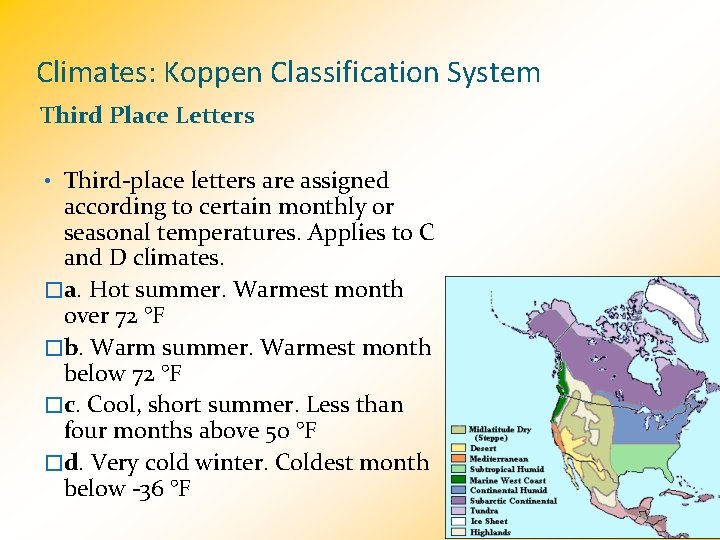
Climates: Koppen Classification System Third Place Letters • Third-place letters are assigned according to certain monthly or seasonal temperatures. Applies to C and D climates. �a. Hot summer. Warmest month over 72 °F �b. Warm summer. Warmest month below 72 °F �c. Cool, short summer. Less than four months above 50 °F �d. Very cold winter. Coldest month below -36 °F
3 Basic Climate Groups �Group I: Tropical �Low-latitude Climates �Group II: Temperate �Mid-latitude Climates �Group III: Polar �High-latitude climates
Group I Low-latitude Climates: Tropical Moist Climates (Af) rainforest Wet-Dry Tropical Climates (Aw) savanna Dry Tropical Climate (BW) desert biome
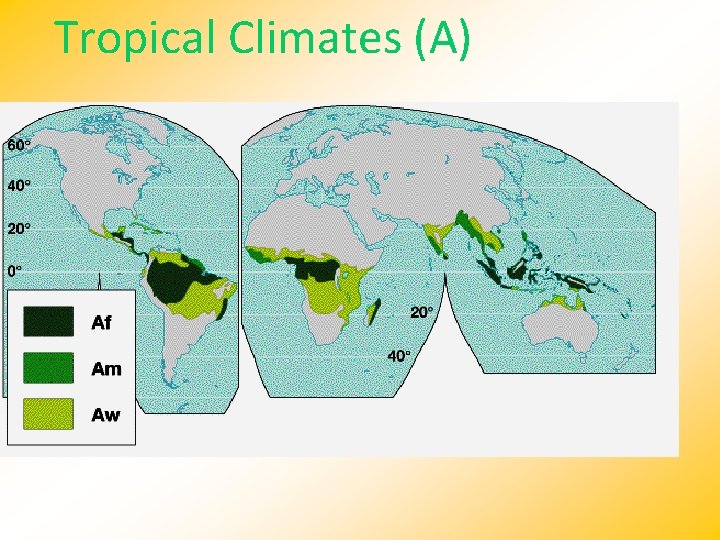
Tropical Climates (A)
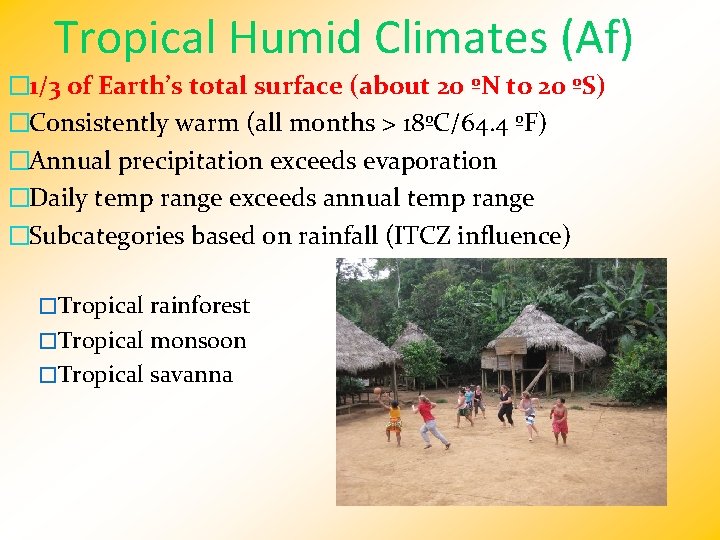
Tropical Humid Climates (Af) � 1/3 of Earth’s total surface (about 20 ºN to 20 ºS) �Consistently warm (all months > 18ºC/64. 4 ºF) �Annual precipitation exceeds evaporation �Daily temp range exceeds annual temp range �Subcategories based on rainfall (ITCZ influence) �Tropical rainforest �Tropical monsoon �Tropical savanna
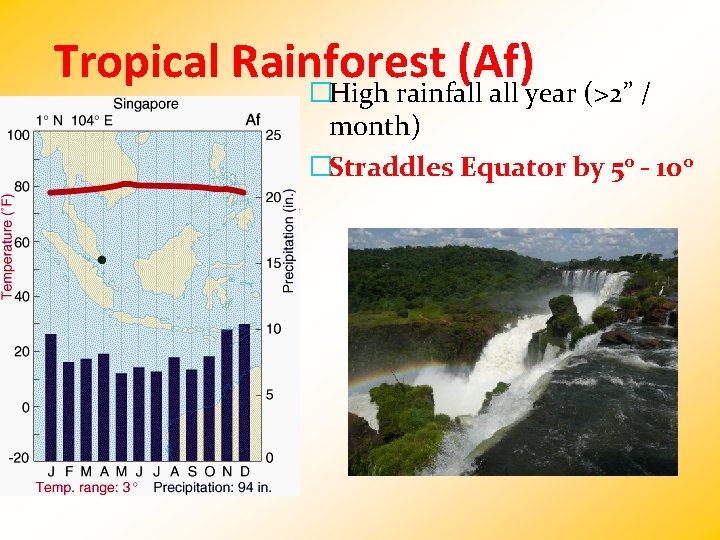
Tropical Rainforest (Af) �High rainfall year (>2” / month) �Straddles Equator by 5 o - 10 o
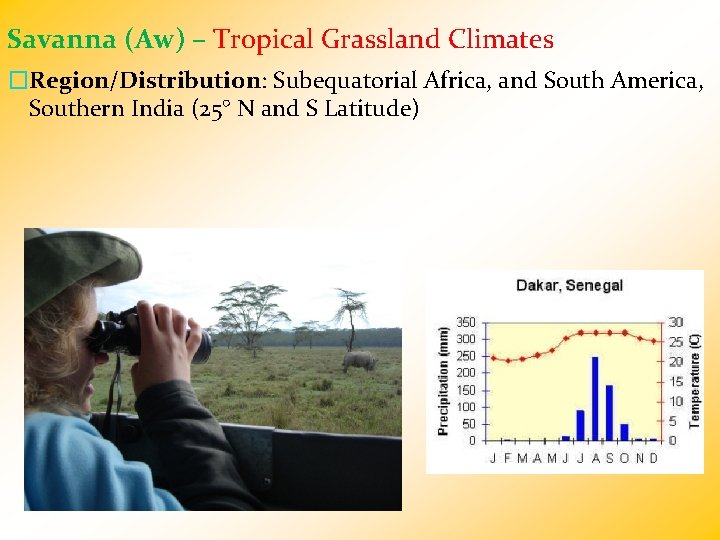
Savanna (Aw) – Tropical Grassland Climates �Region/Distribution: Subequatorial Africa, and South America, Southern India (25° N and S Latitude)
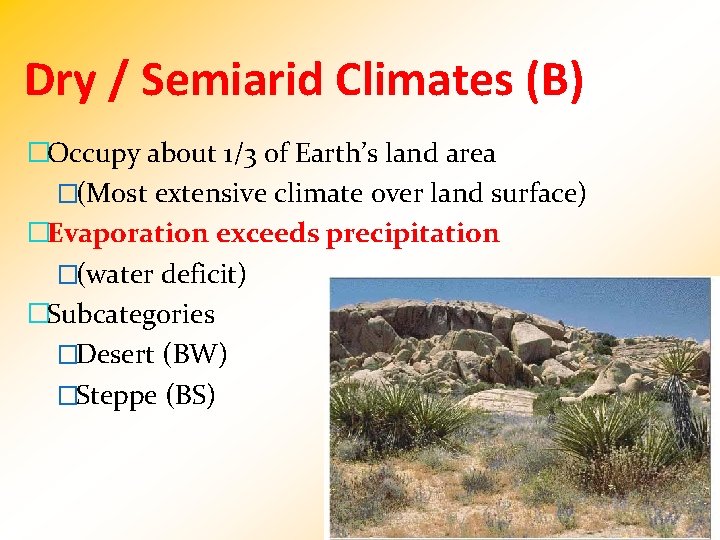
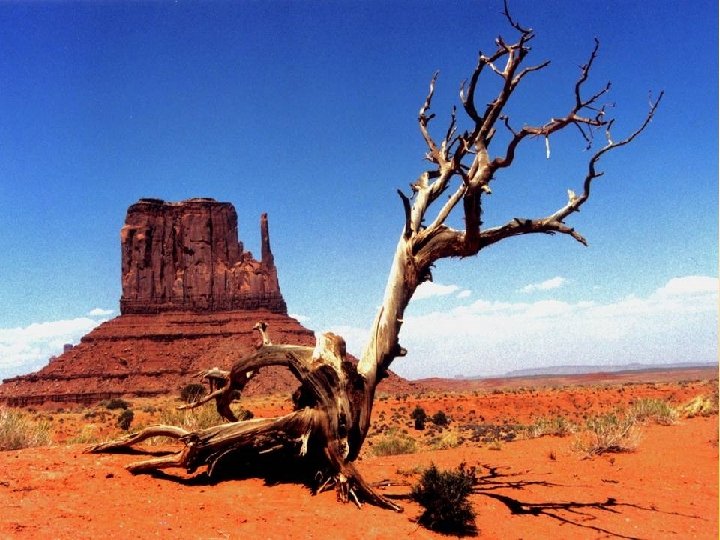
Dry / Semiarid Climates (B) �Occupy about 1/3 of Earth’s land area �(Most extensive climate over land surface) �Evaporation exceeds precipitation �(water deficit) �Subcategories �Desert (BW) �Steppe (BS)
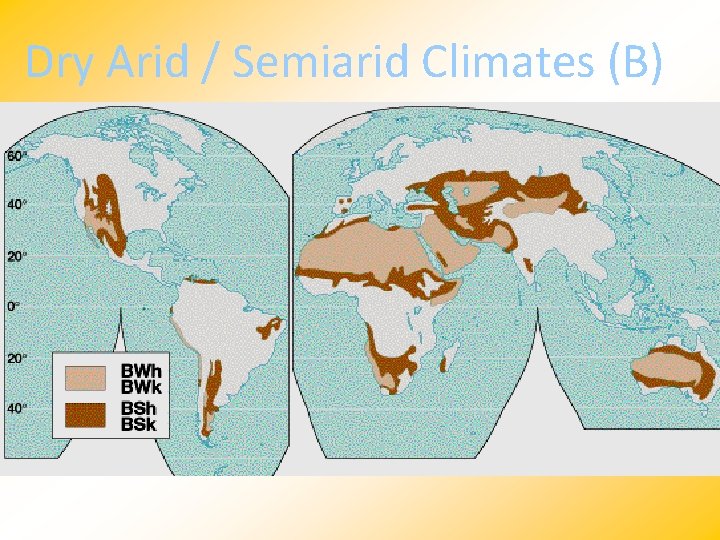
Dry Arid / Semiarid Climates (B)
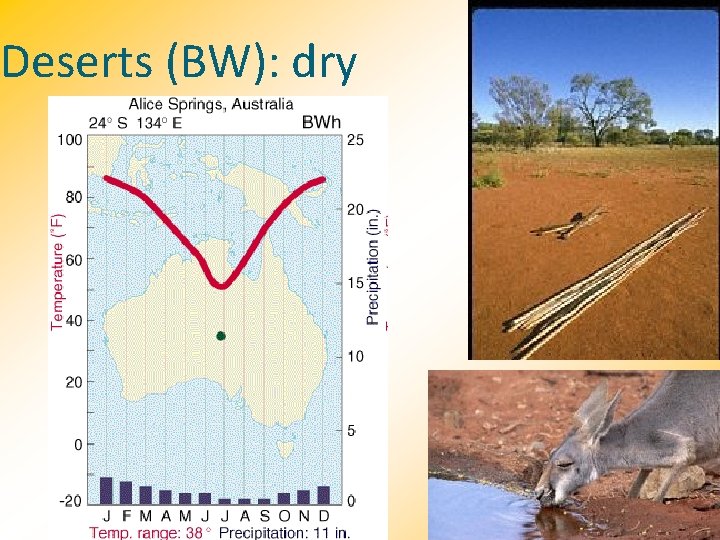
Deserts (BW): dry
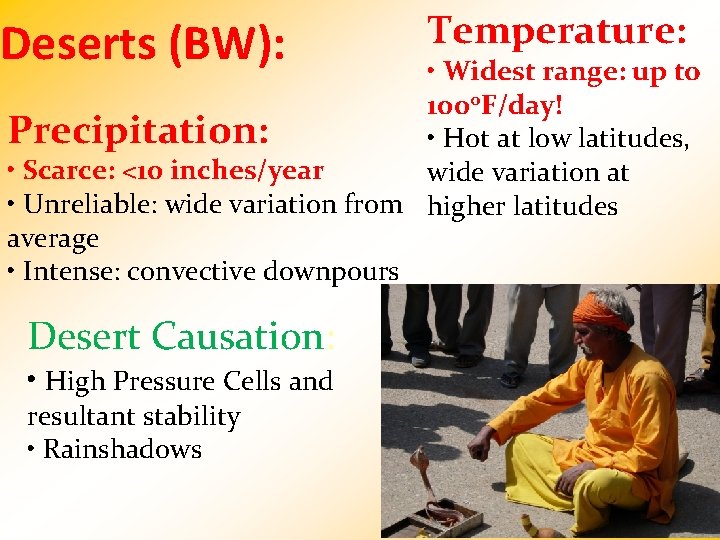
Deserts (BW): Temperature: • Widest range: up to 100 o. F/day! Precipitation: • Hot at low latitudes, • Scarce: <10 inches/year wide variation at • Unreliable: wide variation from higher latitudes average • Intense: convective downpours Desert Causation: • High Pressure Cells and resultant stability • Rainshadows
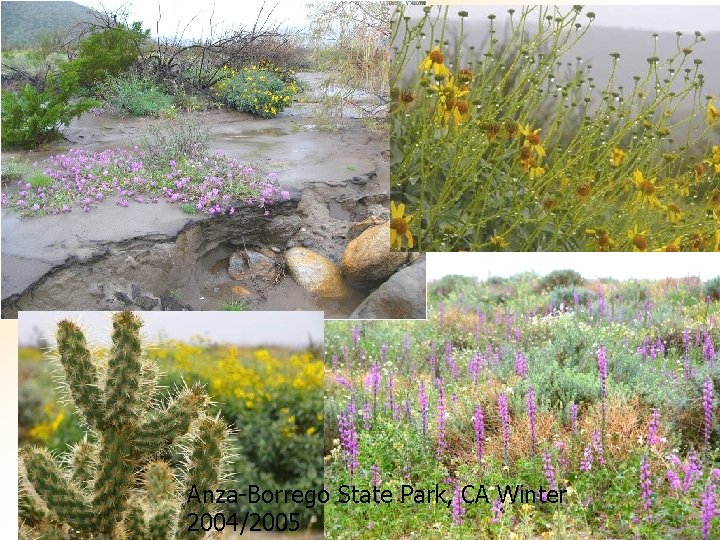
Anza-Borrego State Park, CA Winter 2004/2005
Group 2: Mid-latitude Climates: �Dry Midlatitude Climates (BS) steppe or grasslands �Mediterranean Climate (Cs) chaparral biome �Wet Midlatitude Climates (Cf) Decidous forest
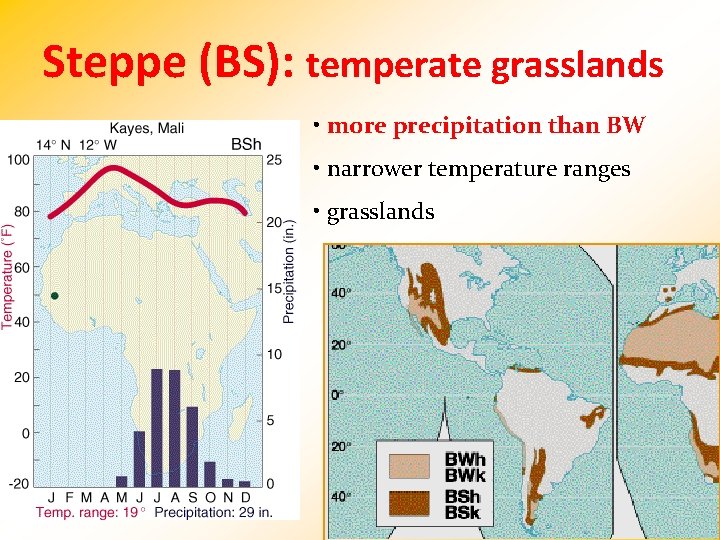
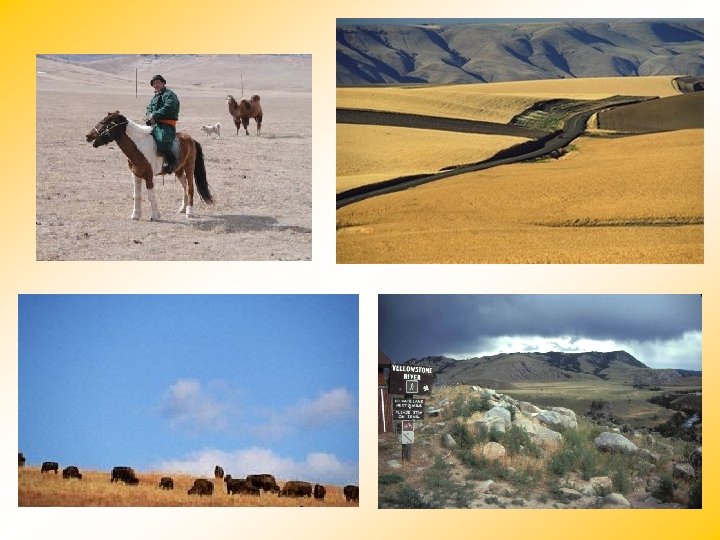
Steppe (BS): temperate grasslands • more precipitation than BW • narrower temperature ranges • grasslands
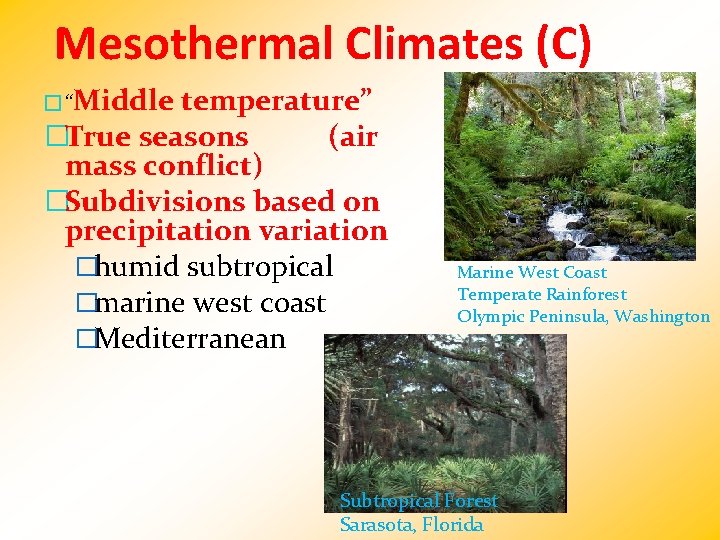
Mesothermal Climates (C) �“Middle temperature” �True seasons (air mass conflict) �Subdivisions based on precipitation variation �humid subtropical �marine west coast �Mediterranean Marine West Coast Temperate Rainforest Olympic Peninsula, Washington Subtropical Forest Sarasota, Florida
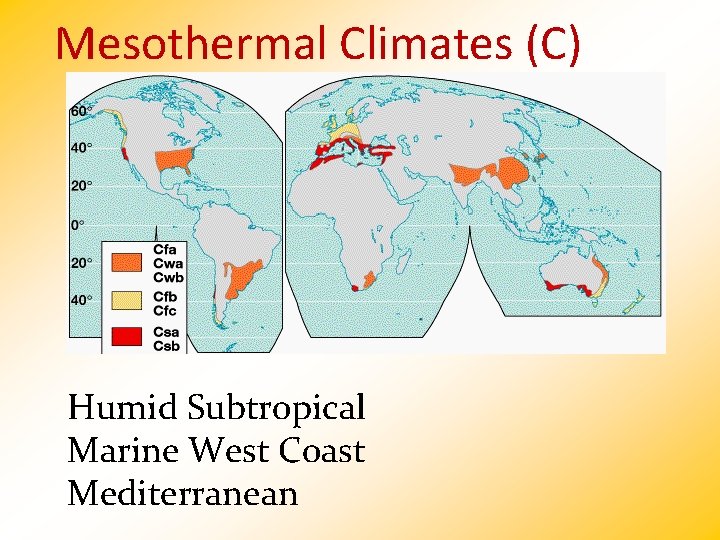
Mesothermal Climates (C) Humid Subtropical Marine West Coast Mediterranean
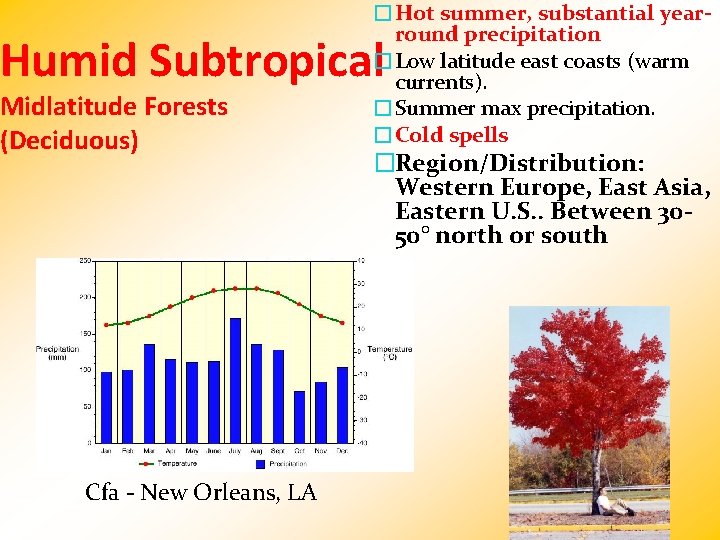
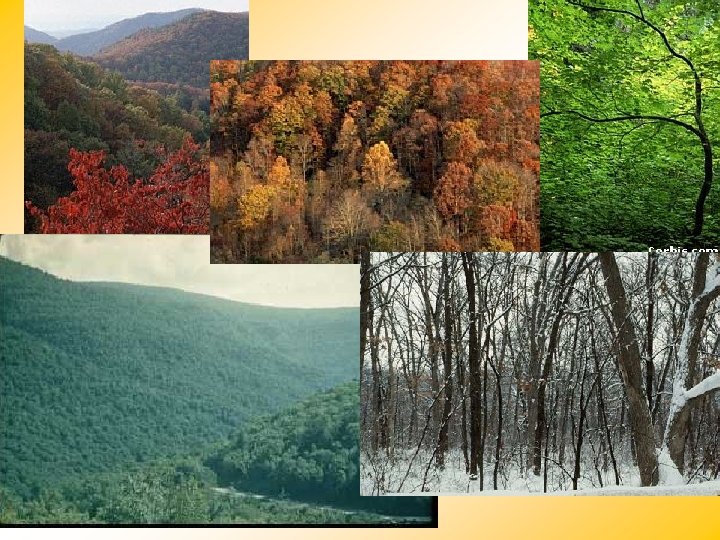
�Hot summer, substantial yearround precipitation �Low latitude east coasts (warm currents). �Summer max precipitation. �Cold spells Humid Subtropical Midlatitude Forests (Deciduous) Cfa - New Orleans, LA �Region/Distribution: Western Europe, East Asia, Eastern U. S. . Between 3050° north or south
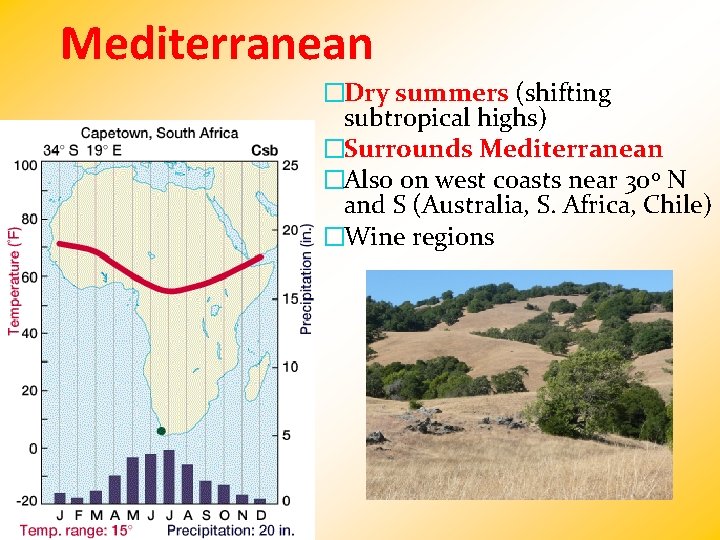
Mediterranean �Dry summers (shifting subtropical highs) �Surrounds Mediterranean �Also on west coasts near 30 o N and S (Australia, S. Africa, Chile) �Wine regions

Group 3: High-latitude Climates: �Subarctic Climates (Df) Boreal or Taiga �Polar Climate (Et) Tundra �Polar Climate (Ef) Ice Caps
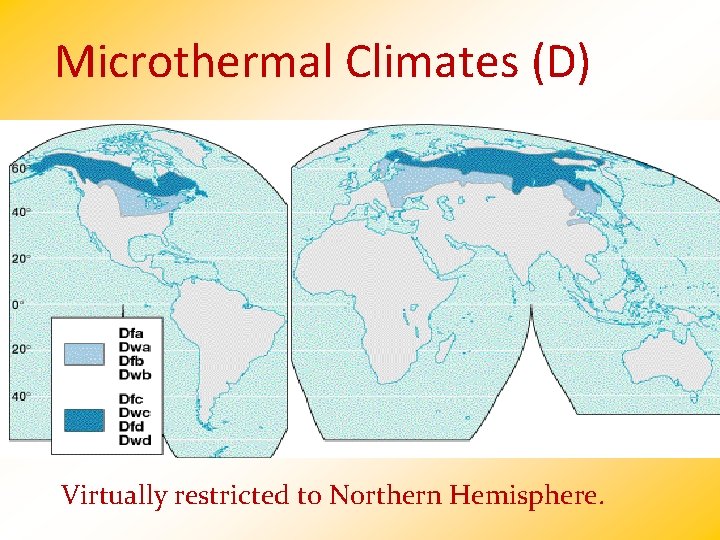
Microthermal Climates (D) Virtually restricted to Northern Hemisphere.
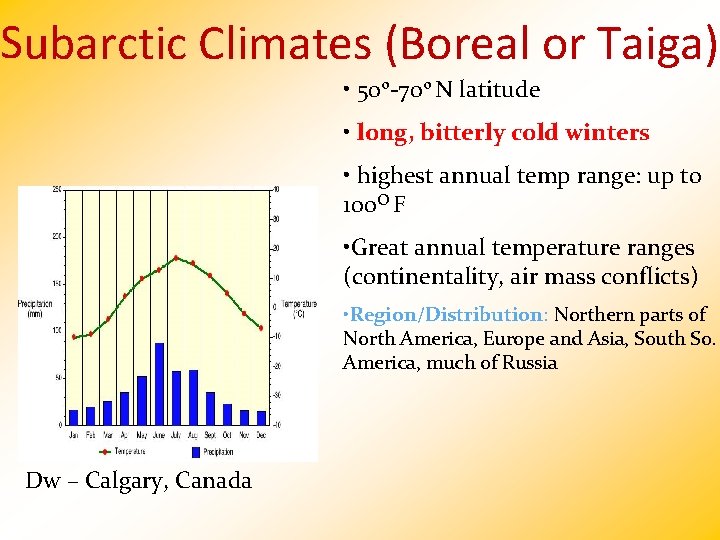
Subarctic Climates (Boreal or Taiga) • 50 o-70 o N latitude • long, bitterly cold winters • highest annual temp range: up to 100 O F • Great annual temperature ranges (continentality, air mass conflicts) • Region/Distribution: Northern parts of North America, Europe and Asia, South So. America, much of Russia Dw – Calgary, Canada
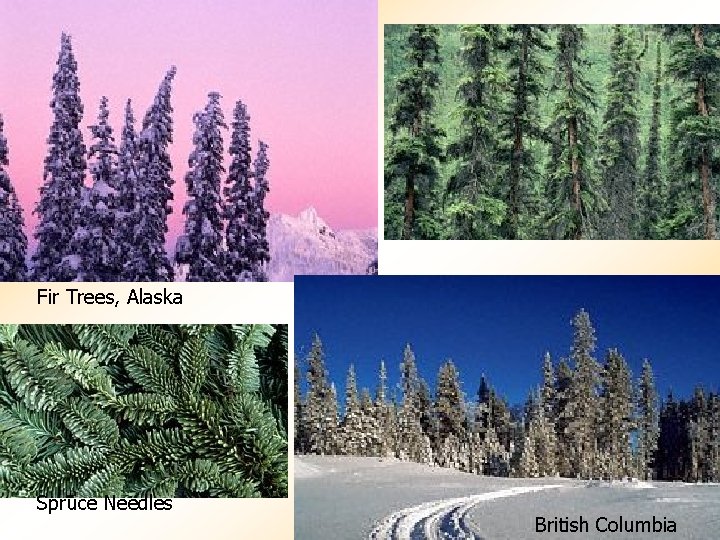
Fir Trees, Alaska Spruce Needles British Columbia
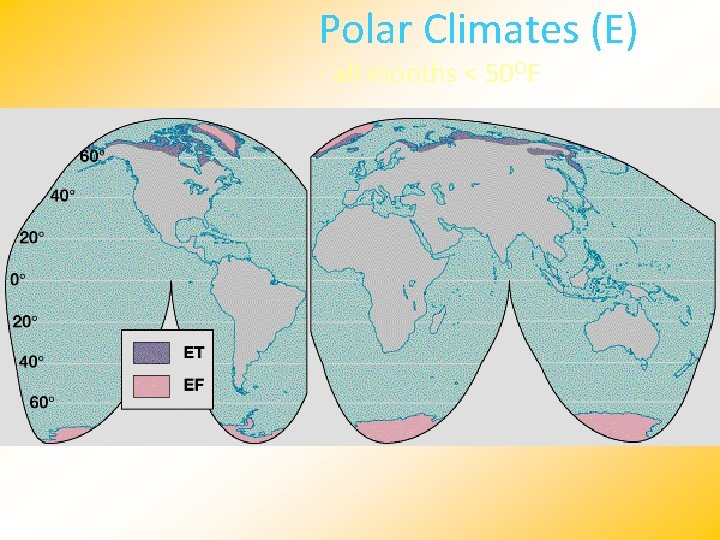
Polar Climates (E) - all months < 50 OF
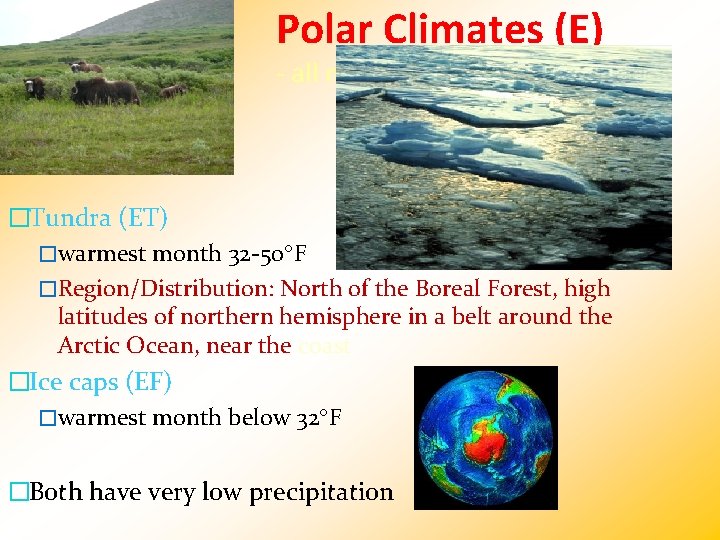
Polar Climates (E) - all months < 50 OF �Tundra (ET) �warmest month 32 -50 F �Region/Distribution: North of the Boreal Forest, high latitudes of northern hemisphere in a belt around the Arctic Ocean, near the coast �Ice caps (EF) �warmest month below 32 F �Both have very low precipitation
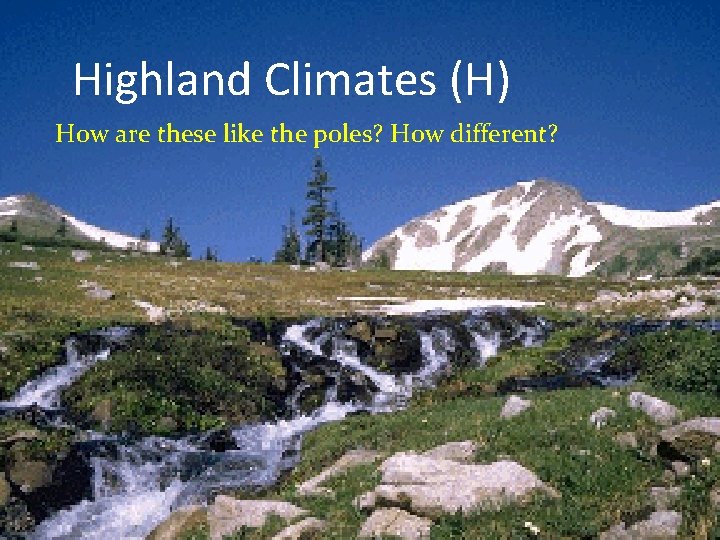
Highland Climates (H) How are these like the poles? How different?
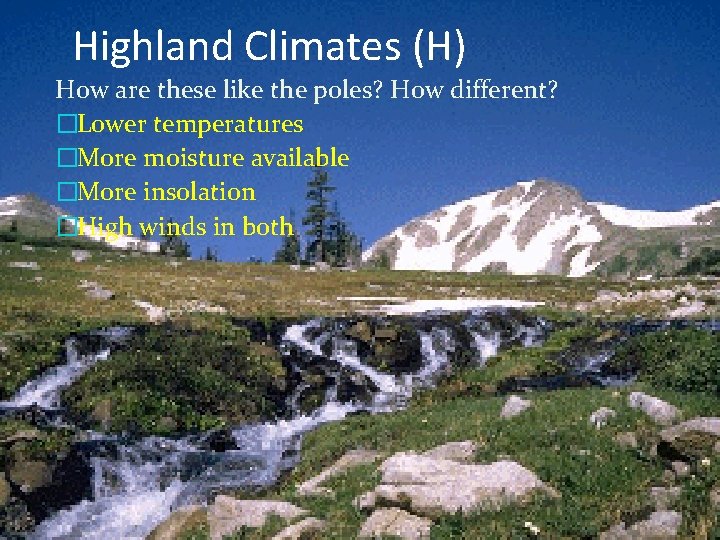
Highland Climates (H) How are these like the poles? How different? �Lower temperatures �More moisture available �More insolation �High winds in both
- Slides: 38