
GLOBAL CIVIL SOCIETY 1 3 LECTURE IMPORTANT ASPECTS
GLOBAL CIVIL SOCIETY 1 3. LECTURE
IMPORTANT ASPECTS OF GLOBAL GOVERNANCE Global governance is based on the importance of nongovernmental mechanisms in the current global system. Non-governmental mechanisms are as fundamental as the mechanisms of governmental actors. 2
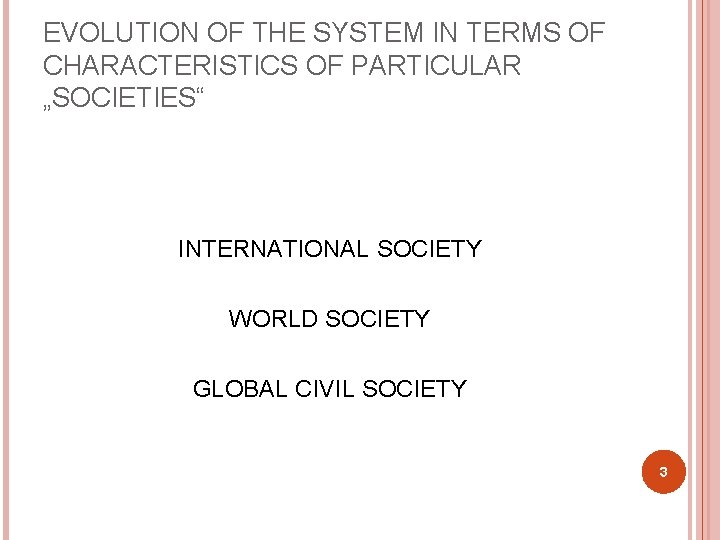
EVOLUTION OF THE SYSTEM IN TERMS OF CHARACTERISTICS OF PARTICULAR „SOCIETIES“ INTERNATIONAL SOCIETY WORLD SOCIETY GLOBAL CIVIL SOCIETY 3
International society - provides the international system with the dynamics and development of mutual cooperation. World Society - the term supports the acknowledgement that non-state actors are the main creators of the SOCIAL structure of international system. Global Civil Society - the analysis of non-state actors needs conception and order and that might be the space of „global civil society“. 4
GLOBAL CIVIL SOCIETY Spread of transnational civil activity within the current global system. Intensification of social relations across the system at the end of 20 th and in the beginning of 21 th Century. 5
PHILOSOPHIC APPROACHES Hobbes proclaimed, the existence of states is essential for the emergence of GCS. Kant on the other hand suggests the creation of the worldwide society of mutual shared values and norms without the necessity of the existence of state. Hegel says the creation of GCS is the proof of the modernity of the system. 6
MARY KALDOR AND FRANCIS FUKUYAMA Mary Kaldor: GCS is a social strenght connecting every single indiviual, states, ideas and all kinds of social units. It is the strenght that exceeds state boarders after the end of the cold war. Francis Fukuyama: GCS emerged after the cold war and is based on the existence and activity of non-state actors that proofed their influence and capacity. 7
BASIC CHARACTERISTICS OF GCS Heterogenity Nonuniformity Lack of order or not? Only/ especially within democratic and western states Only connected with the presence of capital 8
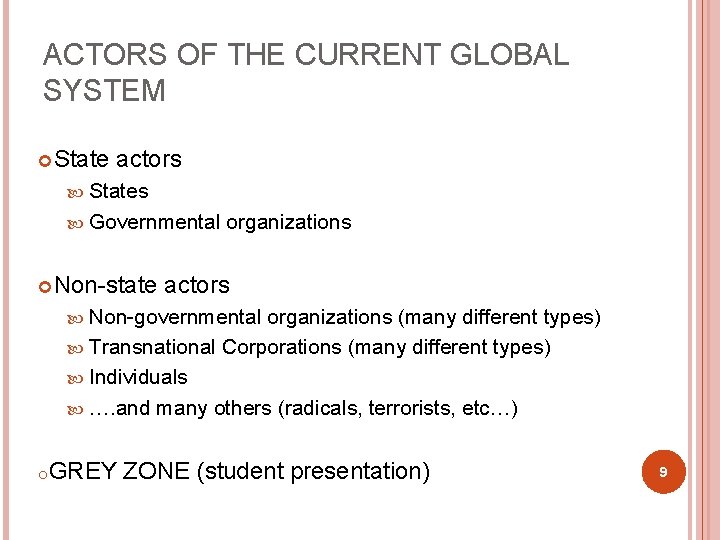
ACTORS OF THE CURRENT GLOBAL SYSTEM State actors States Governmental Non-state organizations actors Non-governmental organizations (many different types) Transnational Corporations (many different types) Individuals …. and many others (radicals, terrorists, etc…) o. GREY ZONE (student presentation) 9
- Slides: 9