
Global Citizenship Education Addressing violent extremism through education
Global Citizenship Education: Addressing violent extremism through education By Lydia RUPRECHT Team Leader & Programme Specialist, Global Citizenship Education UNESCO Section of Education for Sustainable Development and Global Citizenship Education

UNESCO’s understanding of GCED Global Citizenship Education (GCED) Education which aims to equip learners of all ages with those values, knowledge and skills that are based on and instill respect for human rights, social justice, diversity, gender equality and environmental sustainability and that empower learners to be active and responsible global citizens. GCED gives learners the competencies and opportunity to realize their rights and obligations to promote a better world and future for all. Source: Global Citizenship Education: An Emerging Perspective - Outcome Document of the Technical Consultation on Global Citizenship Education; UNESCO and APCEIU, Seoul, 2013 2
UNESCO’s understanding of GCED (cont’d) • Defining element of inclusive, equitable quality education (Target 4. 7): « Target 4. 7: education for sustainable development and sustainable lifestyles, human rights, gender equality, promotion of a culture of peace and nonviolence, global citizenship and appreciation of cultural diversity and of culture’s contribution to sustainable development” • Links education and all other SDGs , providing opportunity to mainstream GCED in education systems • Universally relevant (all regions of the world) • Conceptual framework of PVE-E 3

Key conceptual dimensions of GCED 4
GCED age-specific topics & learning objectives Source: Global Citizenship Education: Topics and Learning Objectives; UNESCO, 2015 5

Why a specific approach to the prevention of violent extremism ? 6

Preventing violent extremism through education (PVE-E) Specificity of the challenge Focus : Violent extremism - ideologically motivated violence to achieve radical ideological religious or political goals Perpetrators: isolated yet organized; the level of education is not a reliable predictor of vulnerability to radicalization. Violent extremists can be highly educated (engineers, from socially progressive societies, living in peace) Factors: combination of “push” & “pull” factors (S. Zeiger & A. Aly, 2015); systemic/structural and individual. No single pathway. (L. Davies, 2008) 7
UNESCO- HQ’s work Impetus: UNESCO’s Executive Board requesting UNESCO to enhance PVE-E work; in line with UN SG’s Plan of Action to Prevent Violent Extremism (Dec. 2015). Increasing focus on « prevention » vs « countering » Focus: production of guidance (normative tools); policy dialogue to ensure effective & appropriate contribution of Ed Sector to national PVE strategies; capacity building Outputs: Teacher’s Guide on PVE and Guide for Edu policy makers 8
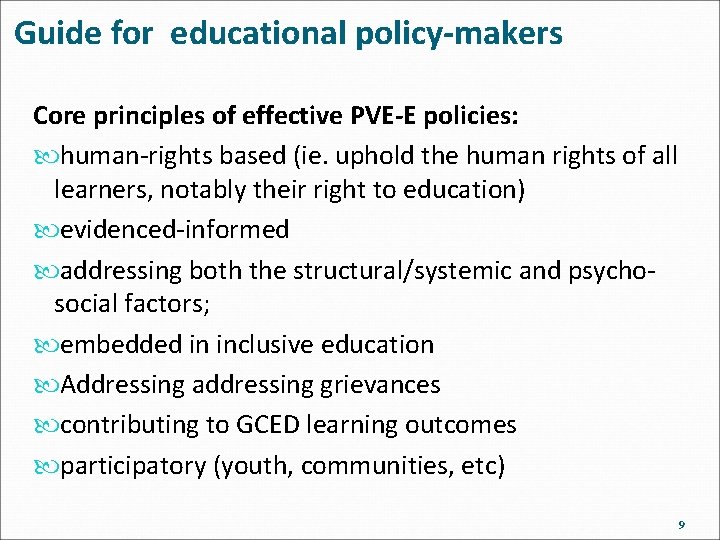
Guide for educational policy-makers Core principles of effective PVE-E policies: human-rights based (ie. uphold the human rights of all learners, notably their right to education) evidenced-informed addressing both the structural/systemic and psychosocial factors; embedded in inclusive education Addressing addressing grievances contributing to GCED learning outcomes participatory (youth, communities, etc) 9
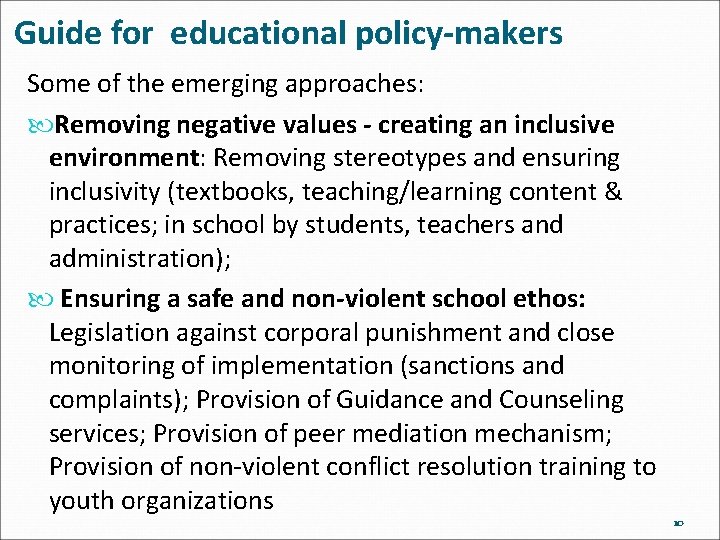
Guide for educational policy-makers Some of the emerging approaches: Removing negative values - creating an inclusive environment: Removing stereotypes and ensuring inclusivity (textbooks, teaching/learning content & practices; in school by students, teachers and administration); Ensuring a safe and non-violent school ethos: Legislation against corporal punishment and close monitoring of implementation (sanctions and complaints); Provision of Guidance and Counseling services; Provision of peer mediation mechanism; Provision of non-violent conflict resolution training to youth organizations 10
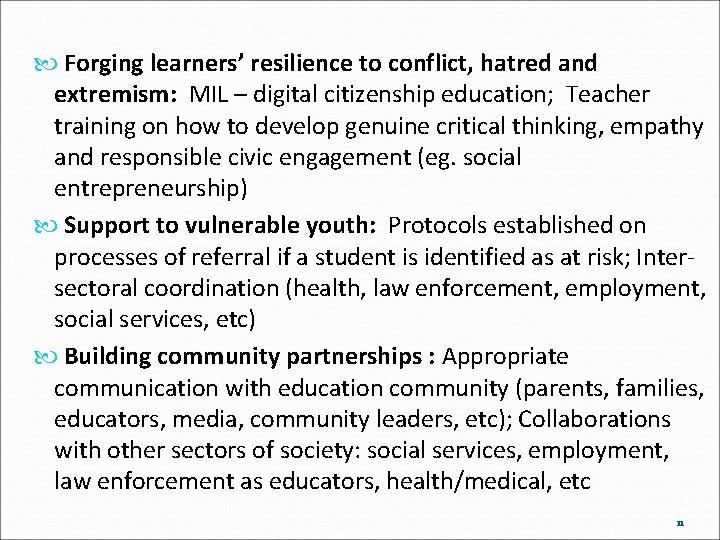
Forging learners’ resilience to conflict, hatred and extremism: MIL – digital citizenship education; Teacher training on how to develop genuine critical thinking, empathy and responsible civic engagement (eg. social entrepreneurship) Support to vulnerable youth: Protocols established on processes of referral if a student is identified as at risk; Intersectoral coordination (health, law enforcement, employment, social services, etc) Building community partnerships : Appropriate communication with education community (parents, families, educators, media, community leaders, etc); Collaborations with other sectors of society: social services, employment, law enforcement as educators, health/medical, etc 11
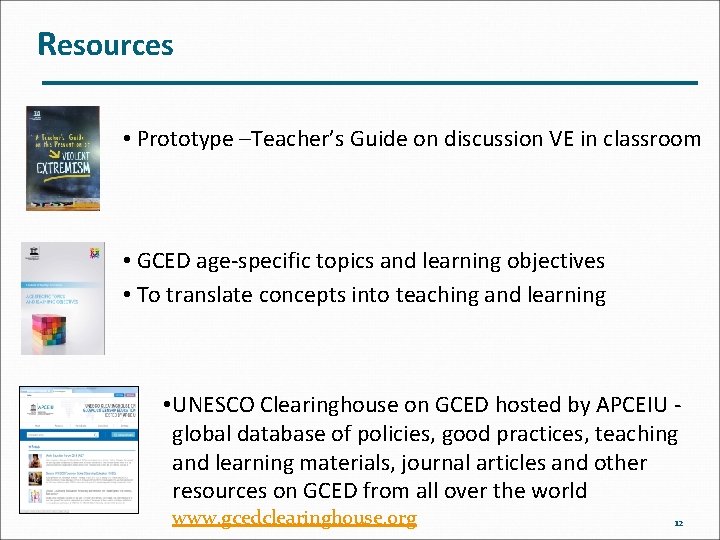
Resources • Prototype –Teacher’s Guide on discussion VE in classroom • GCED age-specific topics and learning objectives • To translate concepts into teaching and learning • UNESCO Clearinghouse on GCED hosted by APCEIU - global database of policies, good practices, teaching and learning materials, journal articles and other resources on GCED from all over the world www. gcedclearinghouse. org 12
Time to rethink education to promote learning to live together 13
- Slides: 13