
Global Change Tools TREE RINGS NATURAL ARCHIVES Trees
Global Change Tools TREE RINGS & NATURAL ARCHIVES

Trees and stones will teach you that which you can never learn from masters. ~ St. Bernard of Clairvaux p 117
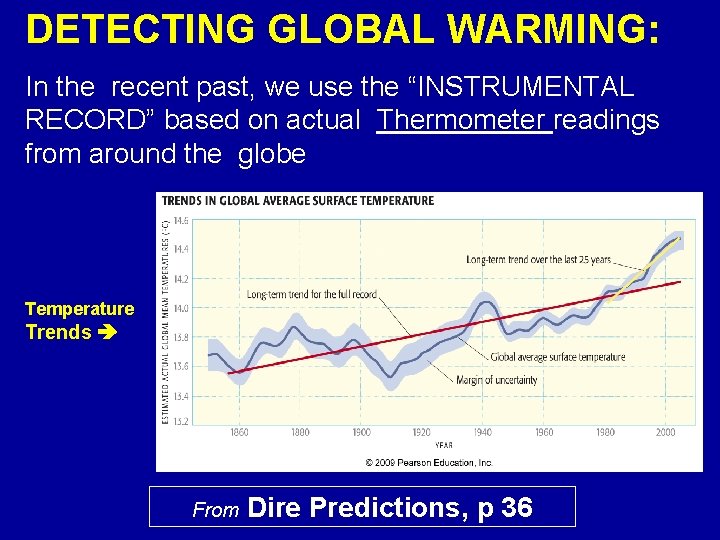
DETECTING GLOBAL WARMING: In the recent past, we use the “INSTRUMENTAL RECORD” based on actual Thermometer readings from around the globe Temperature Trends From Dire Predictions, p 36
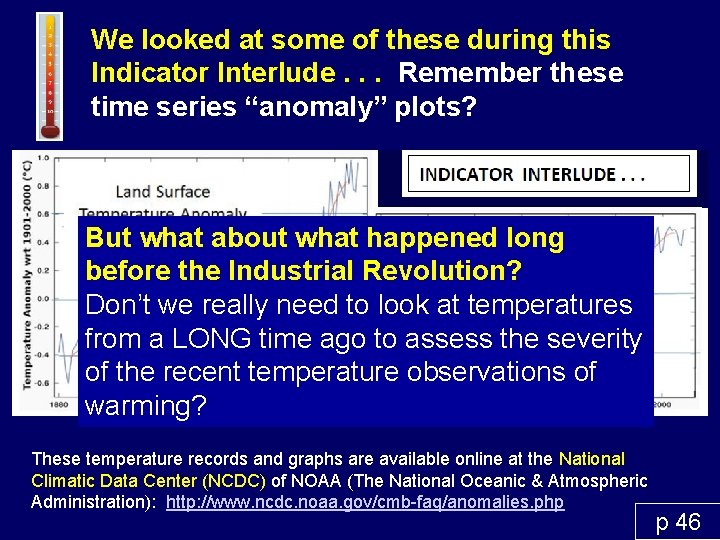
We looked at some of these during this Indicator Interlude. . . Remember these time series “anomaly” plots? But what about what happened long before the Industrial Revolution? Don’t we really need to look at temperatures from a LONG time ago to assess the severity of the recent temperature observations of warming? These temperature records and graphs are available online at the National Climatic Data Center (NCDC) of NOAA (The National Oceanic & Atmospheric Administration): http: //www. ncdc. noaa. gov/cmb-faq/anomalies. php p 46

To make an incontrovertible case about the role that humans play in global warming, what do scientists need? 1) a long-term temperature record, i. e. , centuries 2) over a large part of the globe 3) To be able to say. . . “What's the average been for several hundred years, & is this a significant departure from that? ” “And that's very difficult to do. ” (James Trefil, physicist) Review: p 21
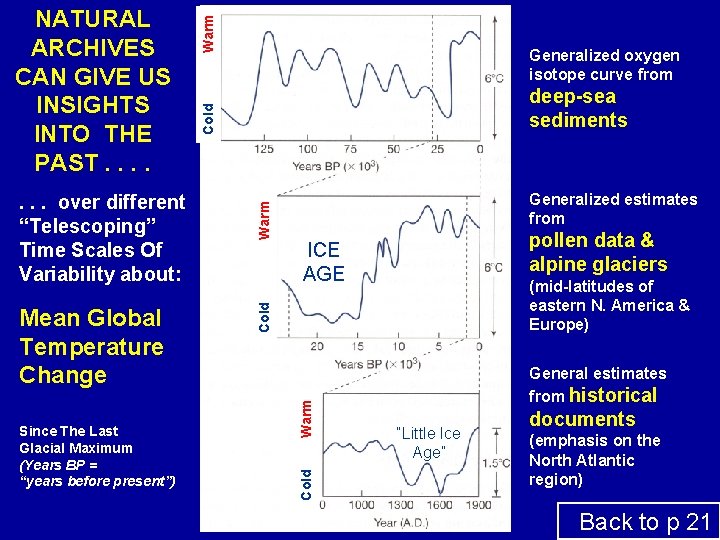
Since The Last Glacial Maximum (Years BP = “years before present”) deep-sea sediments Generalized estimates from pollen data & alpine glaciers ICE AGE Cold Warm Mean Global Temperature Change Generalized oxygen isotope curve from Cold Warm . . . over different “Telescoping” Time Scales Of Variability about: Cold Warm NATURAL ARCHIVES CAN GIVE US INSIGHTS INTO THE PAST. . (mid-latitudes of eastern N. America & Europe) General estimates from historical “Little Ice Age” documents (emphasis on the North Atlantic region) Back to p 21
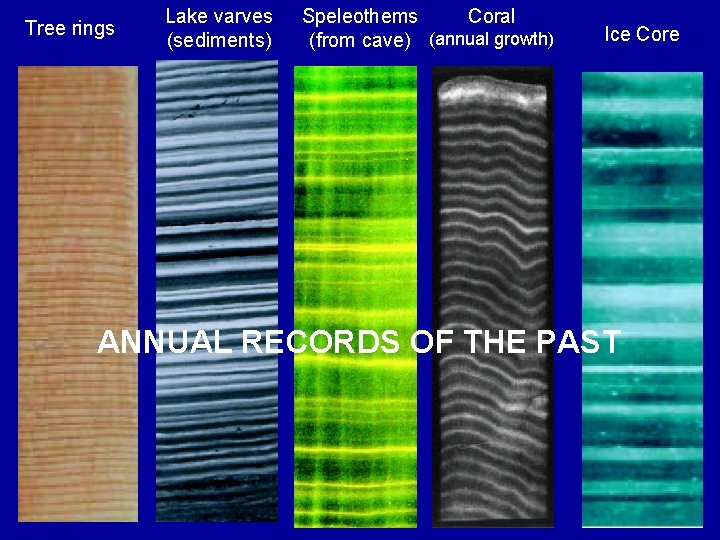
Tree rings Lake varves (sediments) Speleothems Coral (from cave) (annual growth) Ice Core ANNUAL RECORDS OF THE PAST
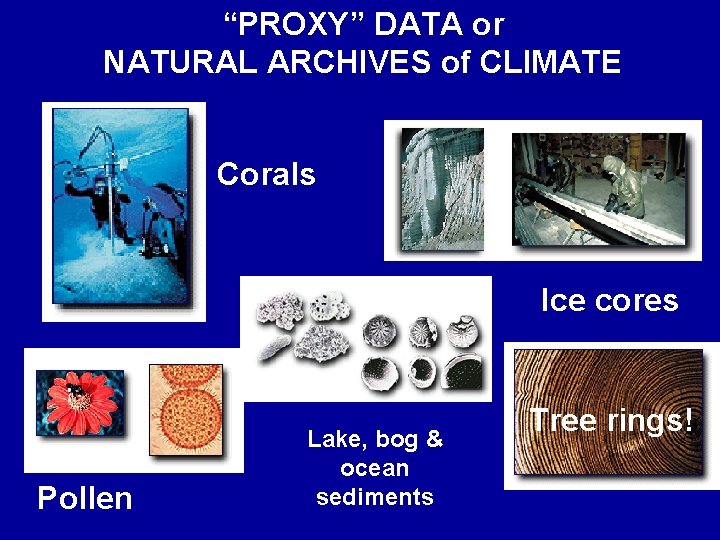
“PROXY” DATA or NATURAL ARCHIVES of CLIMATE Corals Ice cores Pollen Lake, bog & ocean sediments Tree rings!

INTRODUCTION TO TREE RINGS & DENDROCHRONOLOGY CLASS NOTES Appendix: p 117
Dendrochronology is the dating and study of annual rings in trees: • chronos: time, or more specifically events in past time • dendros: from trees, or more specifically the growth rings of trees • ology: the study of. . .
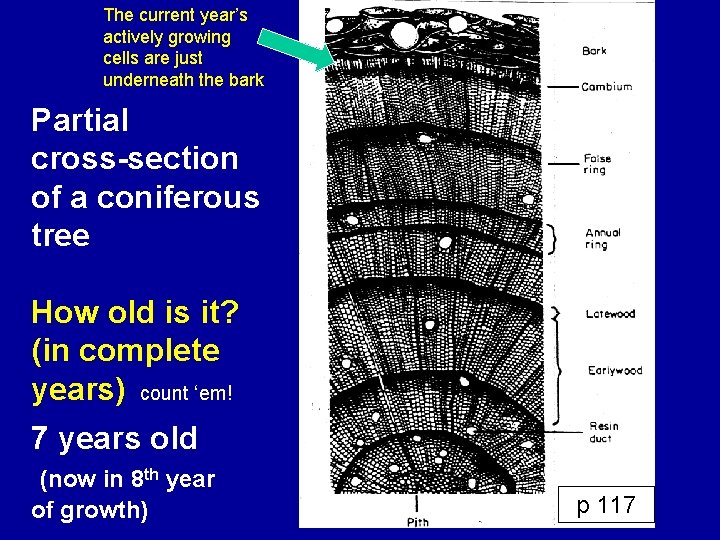
The current year’s actively growing cells are just underneath the bark Partial cross-section of a coniferous tree How old is it? (in complete years) count ‘em! 7 years old (now in 8 th year of growth) p 117
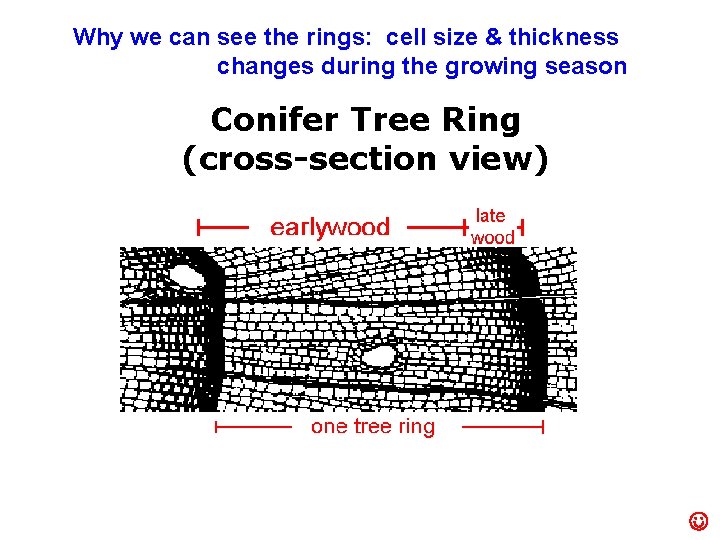
Why we can see the rings: cell size & thickness changes during the growing season Conifer Tree Ring (cross-section view)
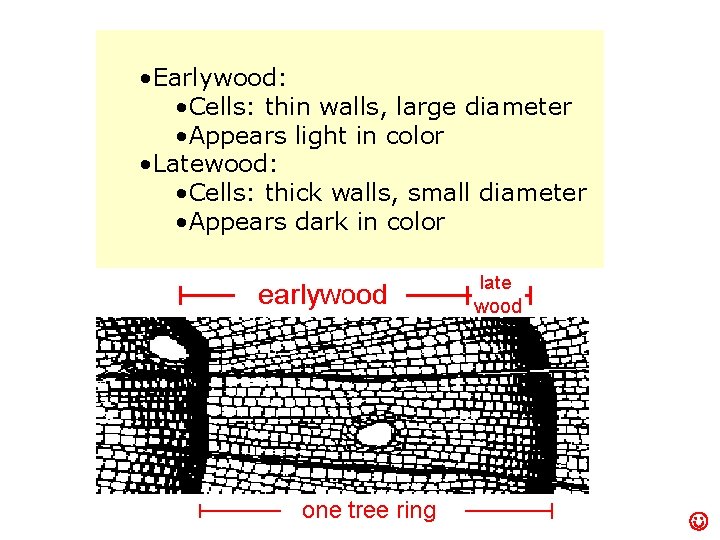
• Earlywood: • Cells: thin walls, large diameter • Appears light in color • Latewood: • Cells: thick walls, small diameter • Appears dark in color
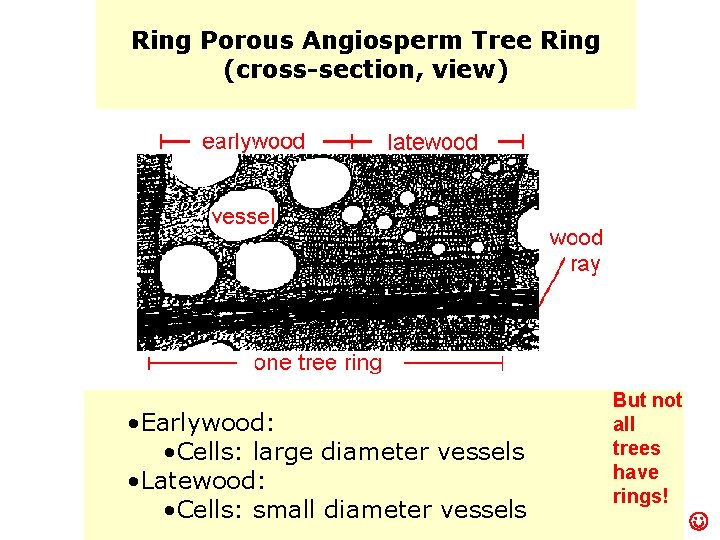
Ring Porous Angiosperm Tree Ring (cross-section, view) • Earlywood: • Cells: large diameter vessels • Latewood: • Cells: small diameter vessels But not all trees have rings!
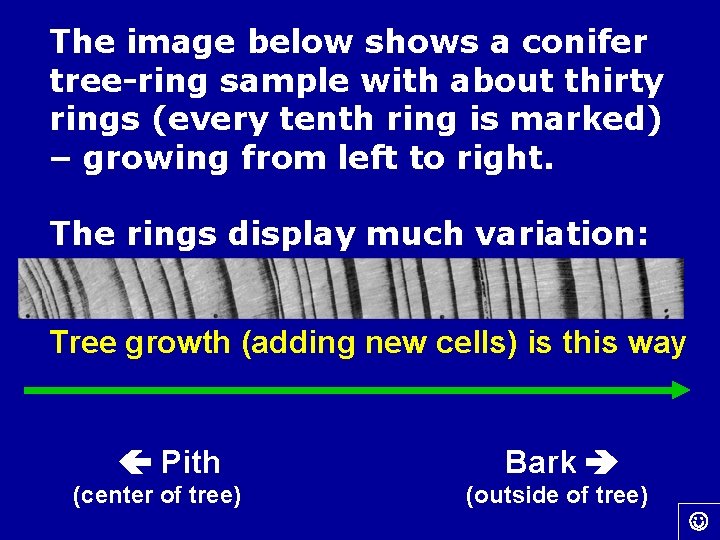
The image below shows a conifer tree-ring sample with about thirty rings (every tenth ring is marked) – growing from left to right. The rings display much variation: Tree growth (adding new cells) is this way Pith (center of tree) Bark (outside of tree)
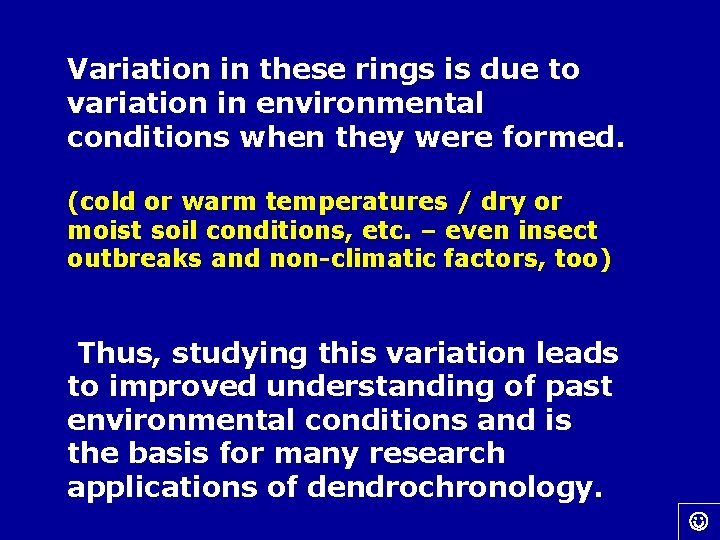
Variation in these rings is due to variation in environmental conditions when they were formed. (cold or warm temperatures / dry or moist soil conditions, etc. – even insect outbreaks and non-climatic factors, too) Thus, studying this variation leads to improved understanding of past environmental conditions and is the basis for many research applications of dendrochronology.
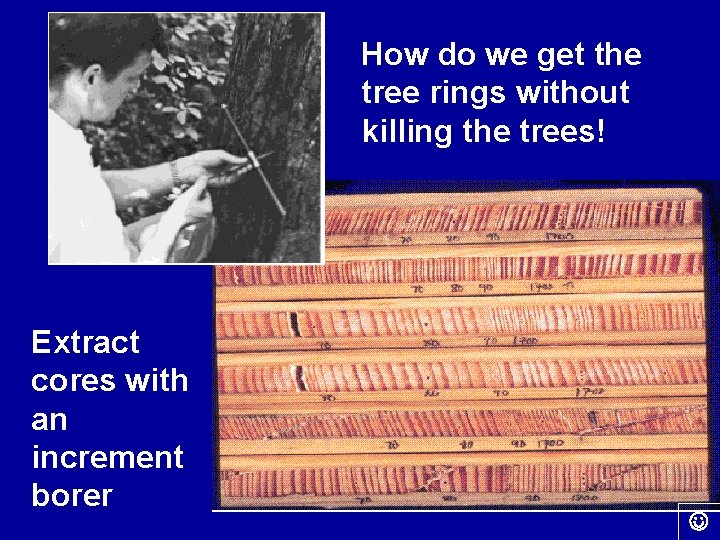
How do we get the tree rings without killing the trees! Extract cores with an increment borer
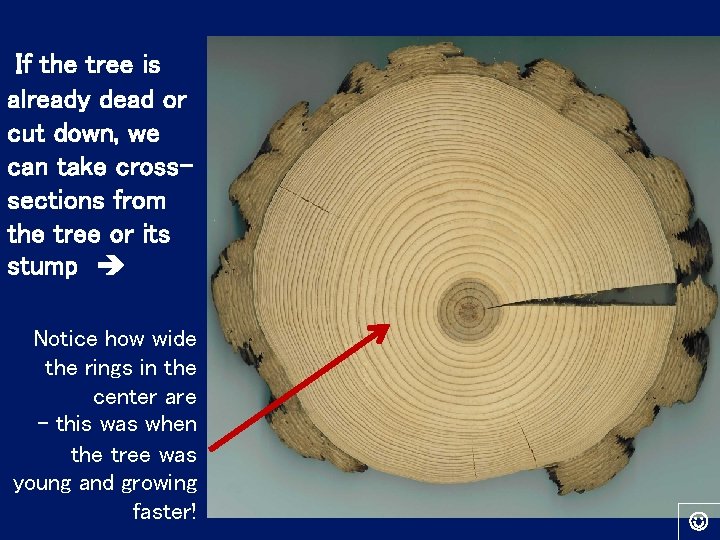
If the tree is already dead or cut down, we can take crosssections from the tree or its stump Notice how wide the rings in the center are – this was when the tree was young and growing faster!
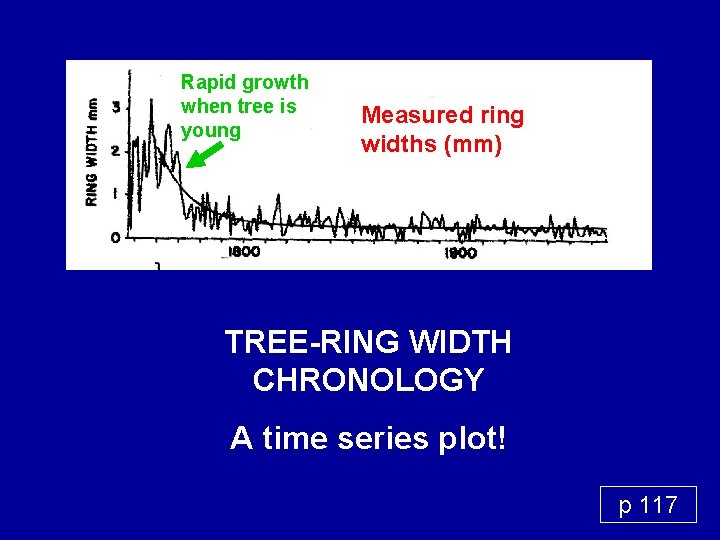
Rapid growth when tree is young Measured ring widths (mm) TREE-RING WIDTH CHRONOLOGY A time series plot! p 117
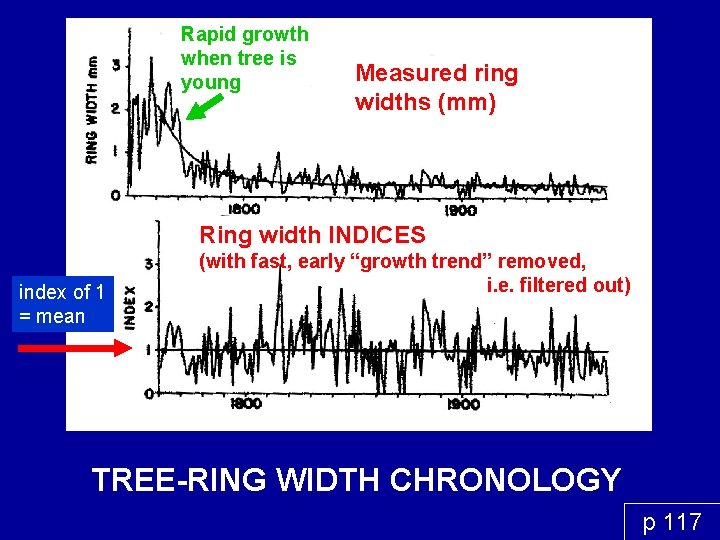
Rapid growth when tree is young Measured ring widths (mm) Ring width INDICES index of 1 = mean (with fast, early “growth trend” removed, i. e. filtered out) TREE-RING WIDTH CHRONOLOGY p 117
KEY PRINCIPLES OF DENDROCHRONOLOGY UNIFORMITARIANISM – “The present is the key to the past” (this is a key principle for many other natural archives used in the geological sciences as well) Key Principles p 117
LIMITING FACTORS – growth can occur only as fast as allowed by the factor that is most limiting, e. g. • “too dry” – the amount rainfall is the limiting factor • “too cold” or “too hot” – the temperature is the limiting factor • NOTE: the limiting factor can vary from site to site, even in the same species of tree! Key Principles p 117
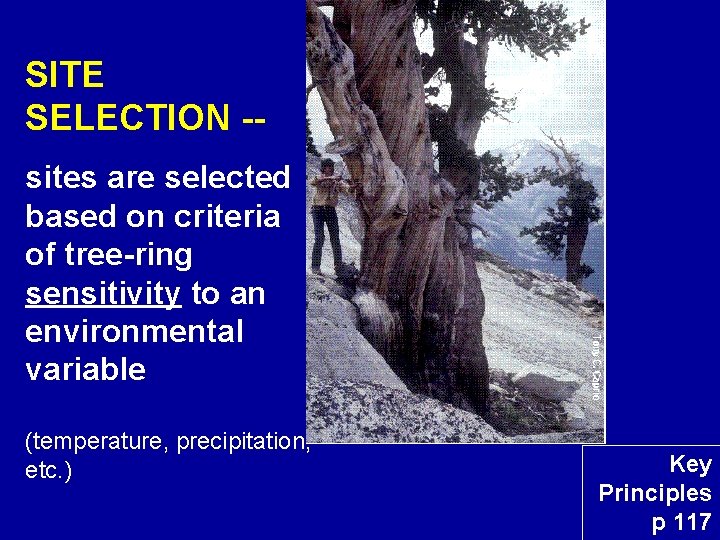
SITE SELECTION -- sites are selected based on criteria of tree-ring sensitivity to an environmental variable (temperature, precipitation, etc. ) Key Principles p 117
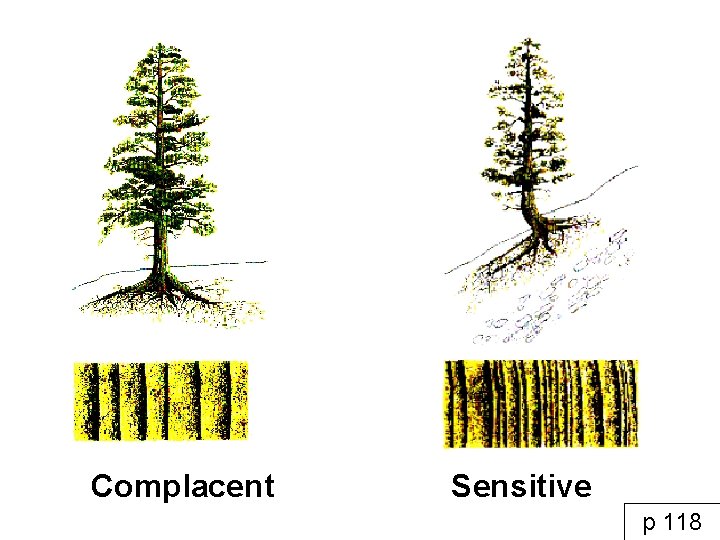
Complacent Sensitive p 118
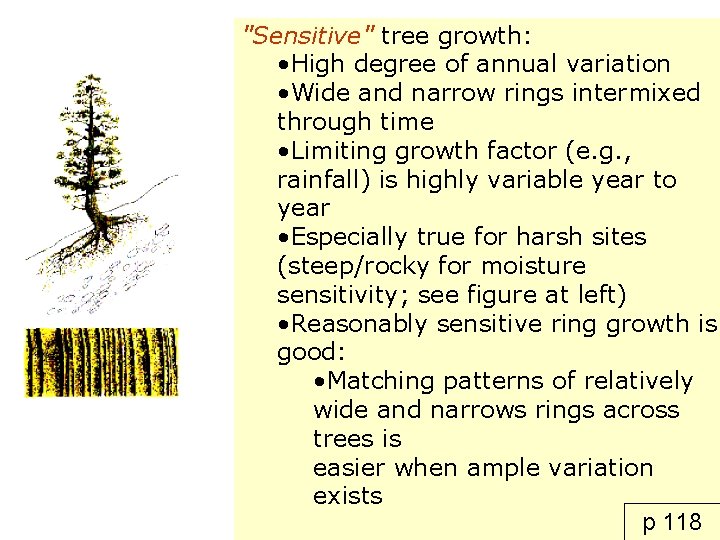
"Sensitive" tree growth: • High degree of annual variation • Wide and narrow rings intermixed through time • Limiting growth factor (e. g. , rainfall) is highly variable year to year • Especially true for harsh sites (steep/rocky for moisture sensitivity; see figure at left) • Reasonably sensitive ring growth is good: • Matching patterns of relatively wide and narrows rings across trees is easier when ample variation exists p 118
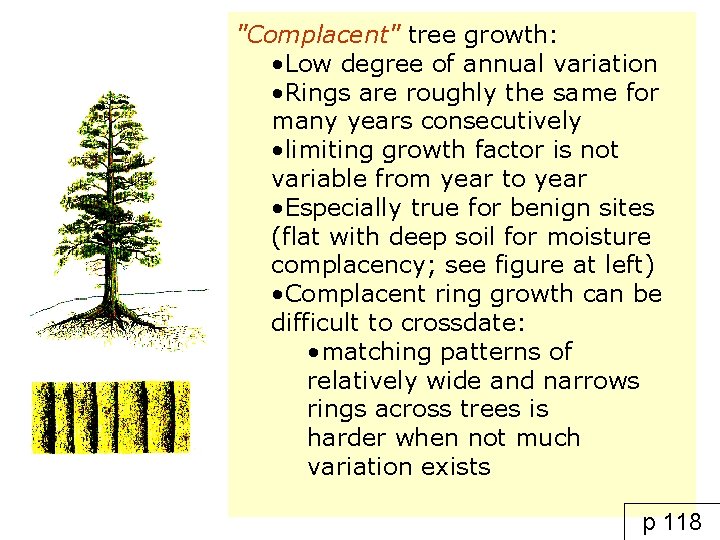
"Complacent" tree growth: • Low degree of annual variation • Rings are roughly the same for many years consecutively • limiting growth factor is not variable from year to year • Especially true for benign sites (flat with deep soil for moisture complacency; see figure at left) • Complacent ring growth can be difficult to crossdate: • matching patterns of relatively wide and narrows rings across trees is harder when not much variation exists p 118

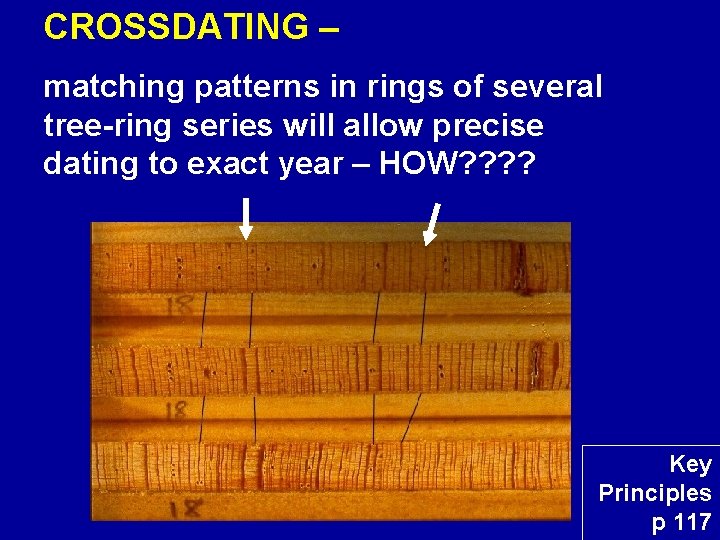
CROSSDATING – matching patterns in rings of several tree-ring series will allow precise dating to exact year – HOW? ? Key Principles p 117

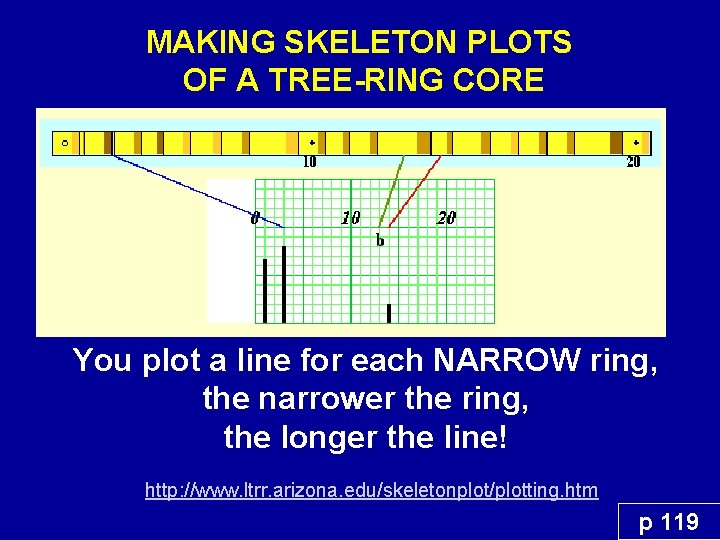
MAKING SKELETON PLOTS OF A TREE-RING CORE You plot a line for each NARROW ring, the narrower the ring, the longer the line! http: //www. ltrr. arizona. edu/skeletonplot/plotting. htm p 119
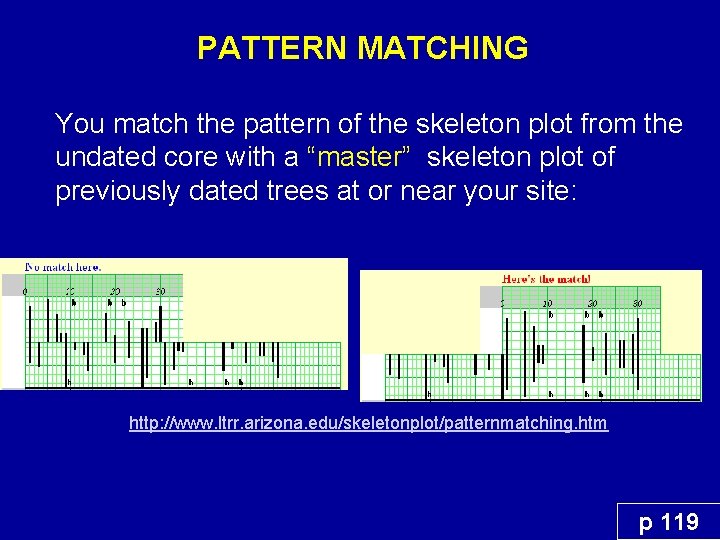
PATTERN MATCHING You match the pattern of the skeleton plot from the undated core with a “master” skeleton plot of previously dated trees at or near your site: http: //www. ltrr. arizona. edu/skeletonplot/patternmatching. htm p 119
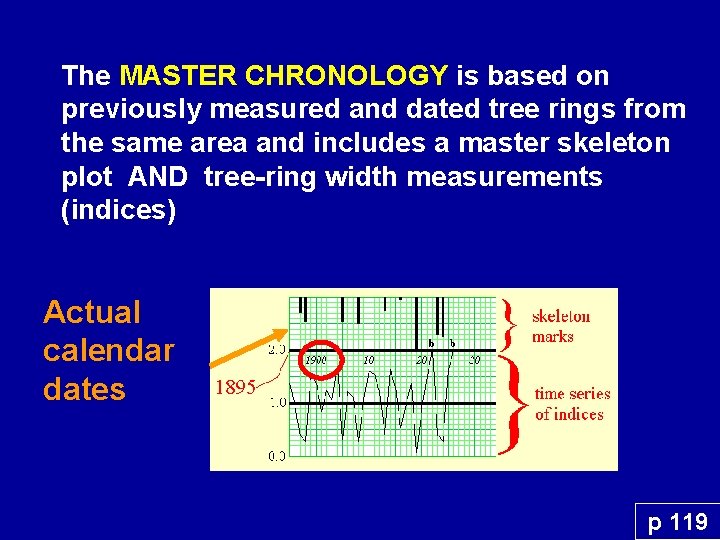
The MASTER CHRONOLOGY is based on previously measured and dated tree rings from the same area and includes a master skeleton plot AND tree-ring width measurements (indices) Actual calendar dates p 119

THEN, AFTER PATTERN MATCHING – WE CAN ASSIGN ACTUAL CALENDAR DATES! You match the pattern of the skeleton plot from the undated core with the skeleton plot of the dated master chronology: Now we know the calendar dates of the core’s skeleton plot This is CROSSDATING! Individual Assignment I-2 will teach you how!! p 119
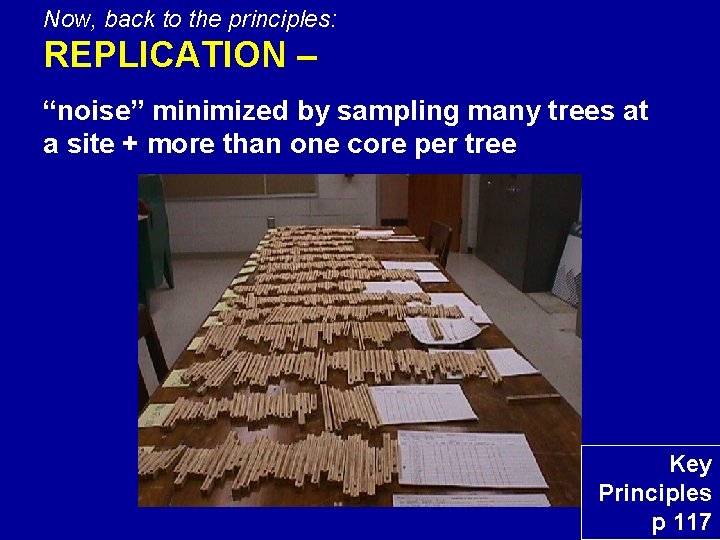
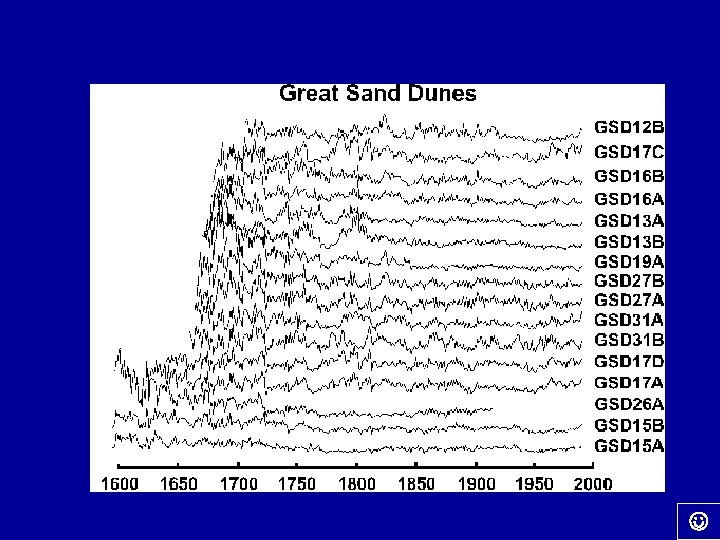
Now, back to the principles: REPLICATION – “noise” minimized by sampling many trees at a site + more than one core per tree Key Principles p 117
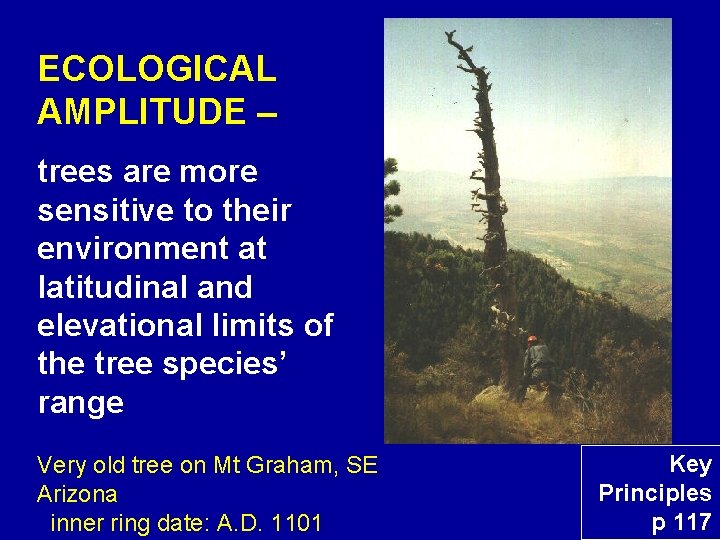
ECOLOGICAL AMPLITUDE – trees are more sensitive to their environment at latitudinal and elevational limits of the tree species’ range Very old tree on Mt Graham, SE Arizona inner ring date: A. D. 1101 Key Principles p 117
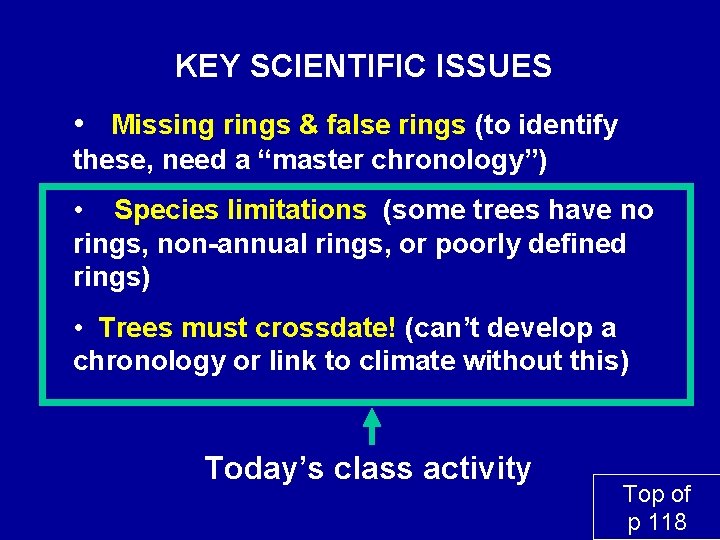
KEY SCIENTIFIC ISSUES • Missing rings & false rings (to identify these, need a “master chronology”) • Species limitations (some trees have no rings, non-annual rings, or poorly defined rings) • Trees must crossdate! (can’t develop a chronology or link to climate without this) Today’s class activity Top of p 118
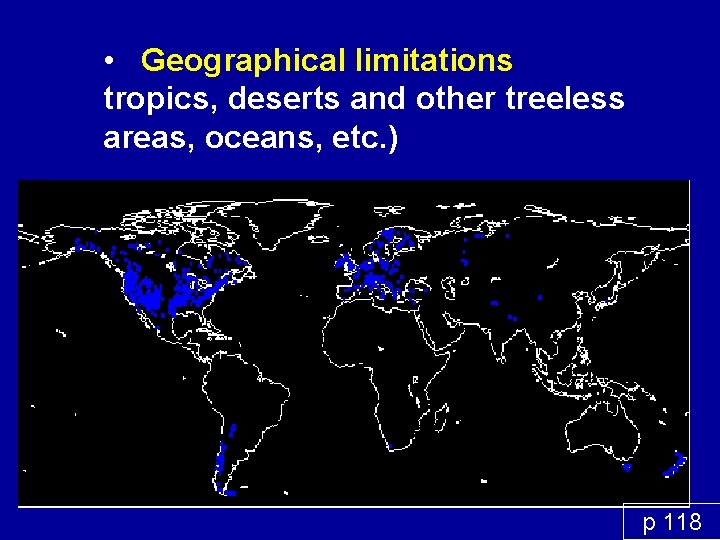
• Geographical limitations tropics, deserts and other treeless areas, oceans, etc. ) p 118
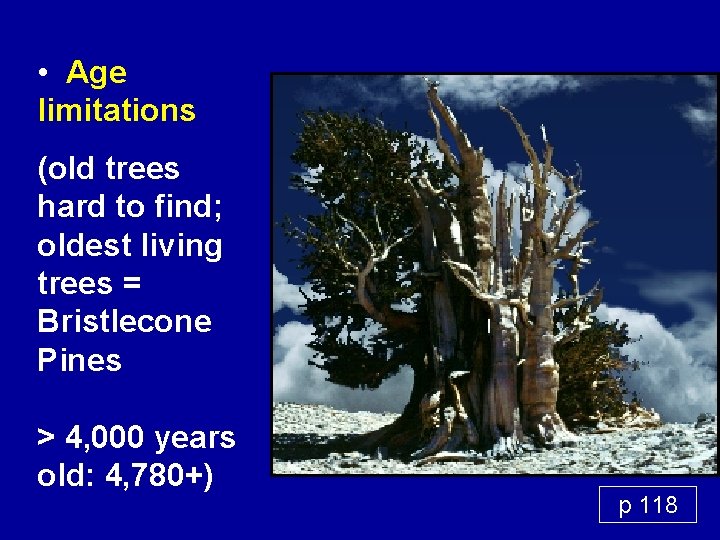
• Age limitations (old trees hard to find; oldest living trees = Bristlecone Pines > 4, 000 years old: 4, 780+) p 118
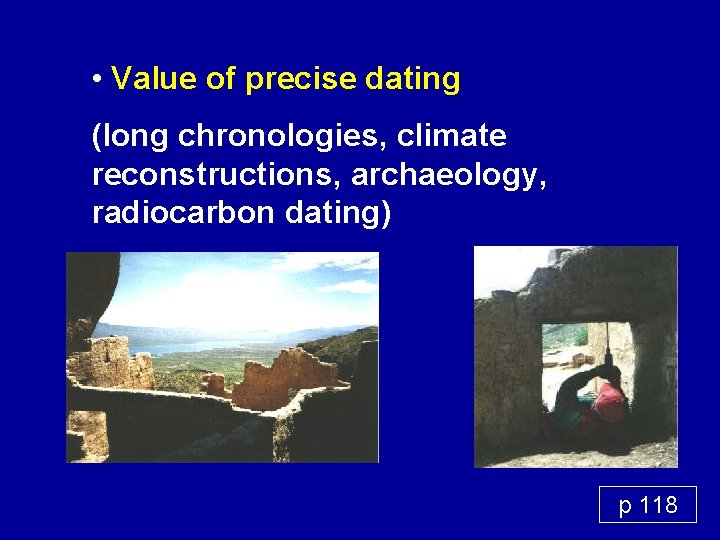
• Value of precise dating (long chronologies, climate reconstructions, archaeology, radiocarbon dating) p 118
NEXT: G - 3 “Wood Kits” Classifying Wood Samples from Different Types of Trees
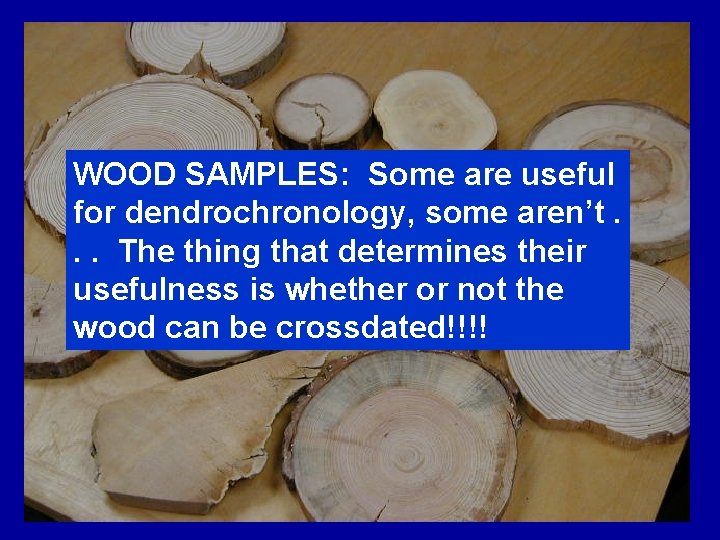
WOOD SAMPLES: Some are useful for dendrochronology, some aren’t. . . The thing that determines their usefulness is whether or not the wood can be crossdated!!!!
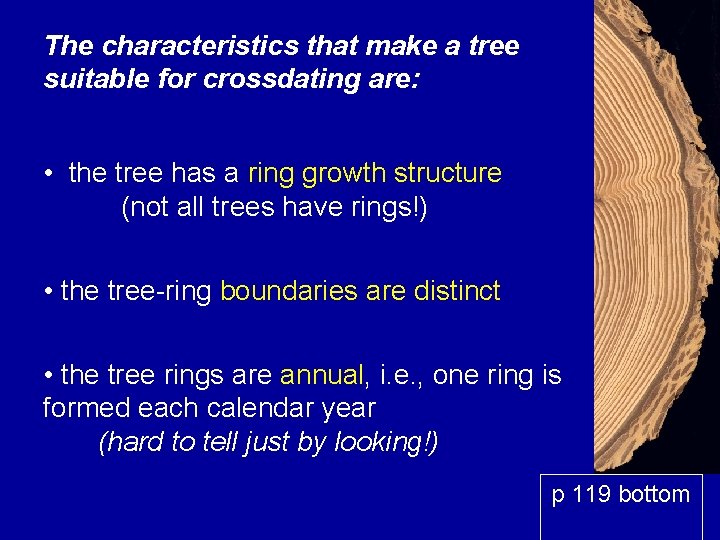
The characteristics that make a tree suitable for crossdating are: • the tree has a ring growth structure (not all trees have rings!) • the tree-ring boundaries are distinct • the tree rings are annual, i. e. , one ring is formed each calendar year (hard to tell just by looking!) p 119 bottom
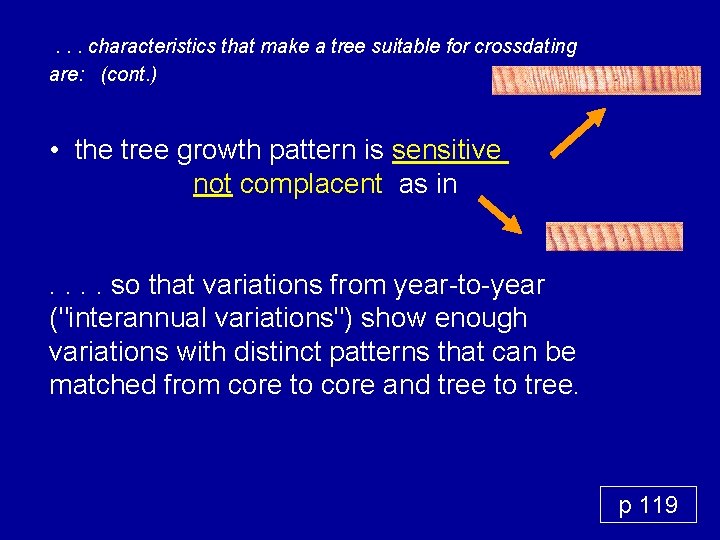
. . . characteristics that make a tree suitable for crossdating are: (cont. ) • the tree growth pattern is sensitive not complacent as in. . so that variations from year-to-year ("interannual variations") show enough variations with distinct patterns that can be matched from core to core and tree to tree. p 119
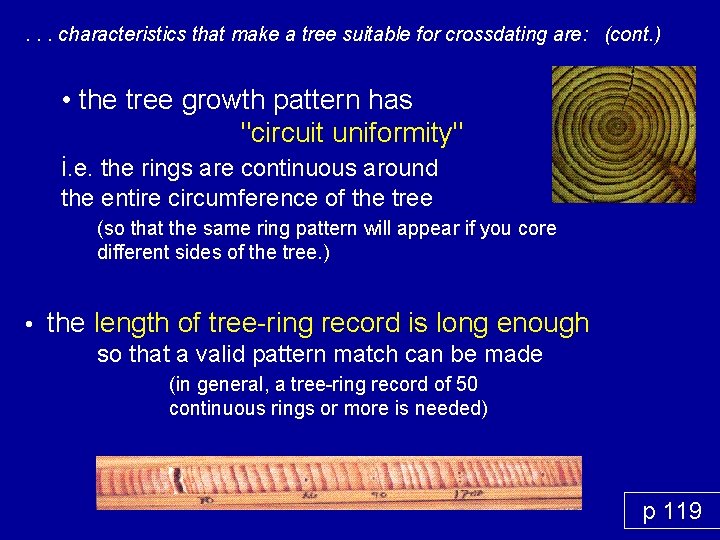
. . . characteristics that make a tree suitable for crossdating are: (cont. ) • the tree growth pattern has "circuit uniformity" i. e. the rings are continuous around the entire circumference of the tree (so that the same ring pattern will appear if you core different sides of the tree. ) • the length of tree-ring record is long enough so that a valid pattern match can be made (in general, a tree-ring record of 50 continuous rings or more is needed) p 119
Goal of Assignment G-3: To classify the wood samples in your wood kit into three categories -- those trees that are: (1) Suitable or (2) Unsuitable for crossdating and subsequent dendrochronological analysis.
• Sign & Print your name on the GROUP ANSWER FORM at the top and pick a group leader! • Two groups will share ONE specimen box, so pass them back and forth – your Teaching Team will assist. • Every team member should examine or more specimens. • Do Parts A, B & C together as a group. --------Start out by MATCHING the TREE PHOTOS with the CORRESPONDING WOOD SPECIMEN so you know what kind of tree you are looking at!
PART A – Look at specimens & match photos PART B – select example of sensitive and complacent ring width pattern PART C – sort into Suitable & Unsuitable

TIME TO WRAP UP FOR TODAY
I-2 ASSIGNMENT TREE-RING CROSDATING DEMO ASSIGNMENT I-2 LINK: http: //fp. arizona. edu/khirschboeck/nats 101 gc/i-1_skeleton. htm CROSSDATING TUTORIAL LINK: http: //www. ltrr. arizona. edu/skeletonplot/introcrossdate. htm MAKING YOUR OWN SKELETON PLOT ONLINE FOR I-3 http: //www. ltrr. arizona. edu/skeletonplot/Skeleton. Plot 19. htm See p 120 – 121 and D 2 L ASSIGNMENT I-2
VIDEO BREAK:
CROSSDATING – matching patterns in rings of several tree-ring series will allow precise dating to exact year – HOW? ? Key Principles p 117
MAKING SKELETON PLOTS OF A TREE-RING CORE You plot a line for each NARROW ring, the narrower the ring, the longer the line! http: //www. ltrr. arizona. edu/skeletonplot/plotting. htm p 119
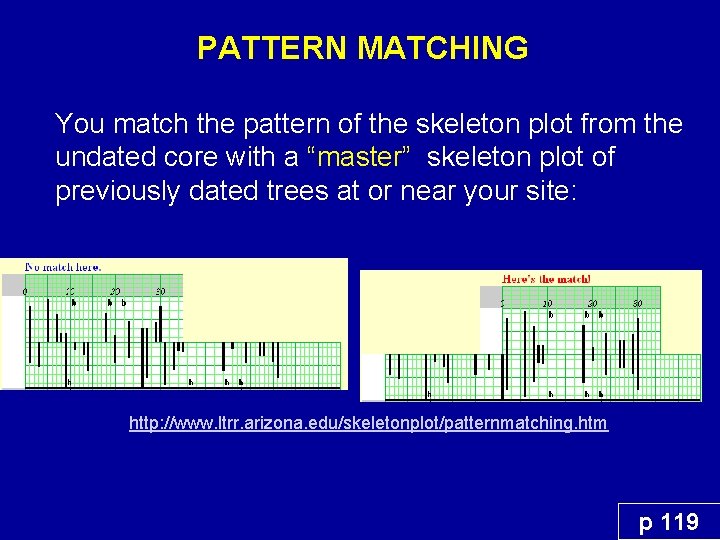
PATTERN MATCHING You match the pattern of the skeleton plot from the undated core with a “master” skeleton plot of previously dated trees at or near your site: http: //www. ltrr. arizona. edu/skeletonplot/patternmatching. htm p 119
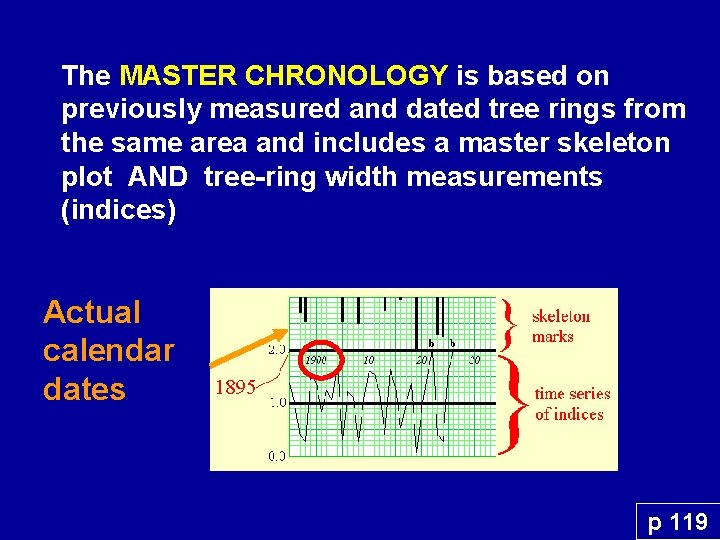
The MASTER CHRONOLOGY is based on previously measured and dated tree rings from the same area and includes a master skeleton plot AND tree-ring width measurements (indices) Actual calendar dates p 119

THEN, AFTER PATTERN MATCHING – WE CAN ASSIGN ACTUAL CALENDAR DATES! You match the pattern of the skeleton plot from the undated core with the skeleton plot of the dated master chronology: Now we know the calendar dates of the core’s skeleton plot This is CROSSDATING! Individual Assignment I-2 will teach you how!! p 119
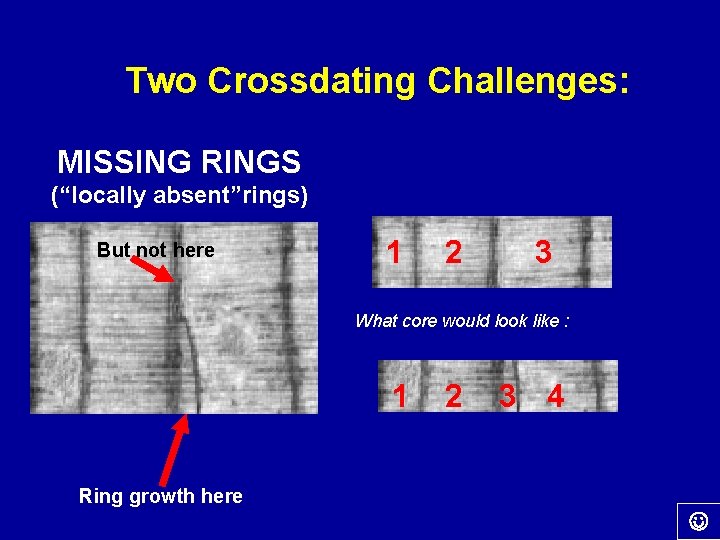
Two Crossdating Challenges: MISSING RINGS (“locally absent”rings) But not here 1 2 3 What core would look like : 1 2 3 4 Ring growth here
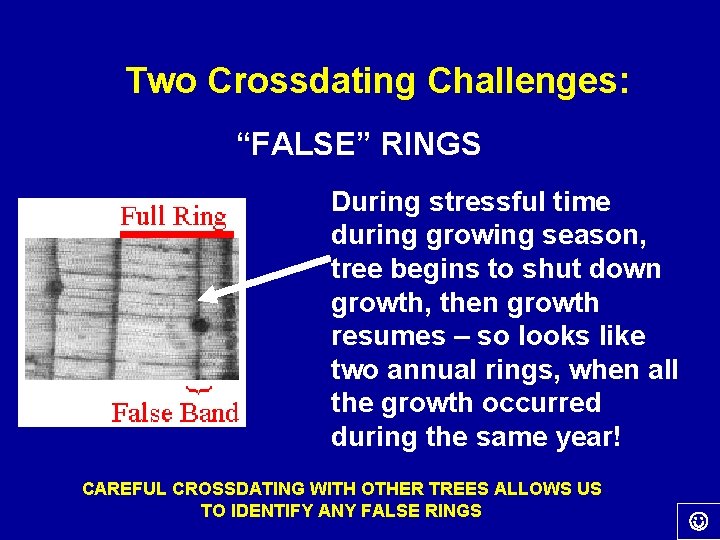
Two Crossdating Challenges: “FALSE” RINGS During stressful time during growing season, tree begins to shut down growth, then growth resumes – so looks like two annual rings, when all the growth occurred during the same year! CAREFUL CROSSDATING WITH OTHER TREES ALLOWS US TO IDENTIFY ANY FALSE RINGS
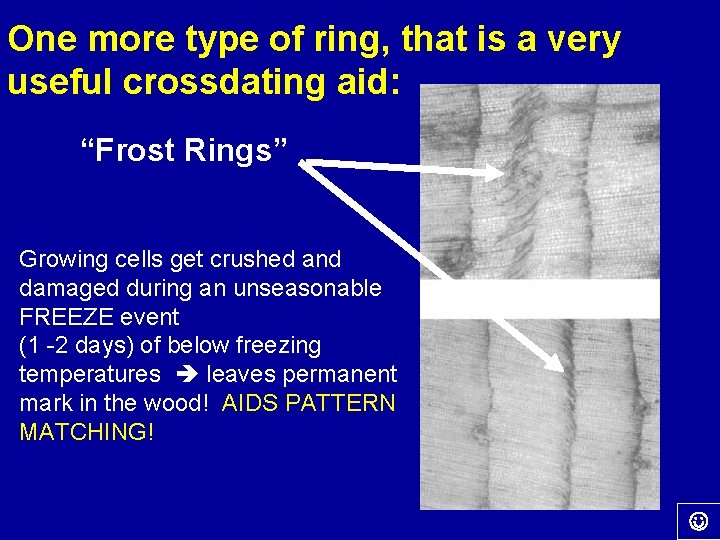
One more type of ring, that is a very useful crossdating aid: “Frost Rings” Growing cells get crushed and damaged during an unseasonable FREEZE event (1 -2 days) of below freezing temperatures leaves permanent mark in the wood! AIDS PATTERN MATCHING!
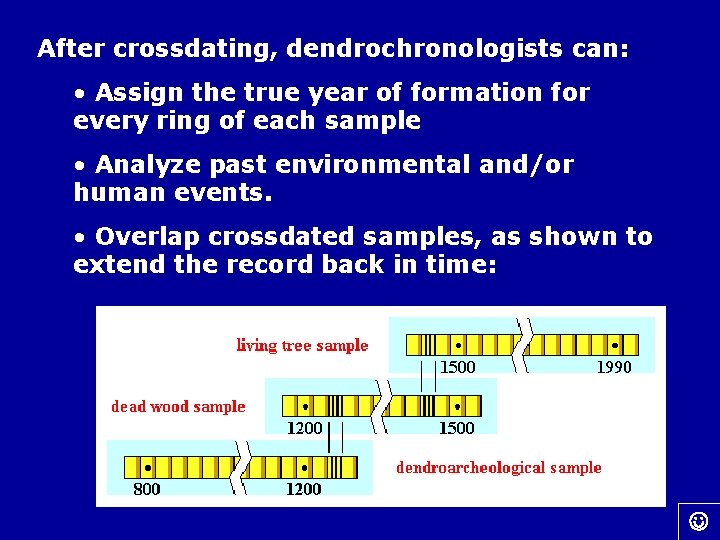
After crossdating, dendrochronologists can: • Assign the true year of formation for every ring of each sample • Analyze past environmental and/or human events. • Overlap crossdated samples, as shown to extend the record back in time:
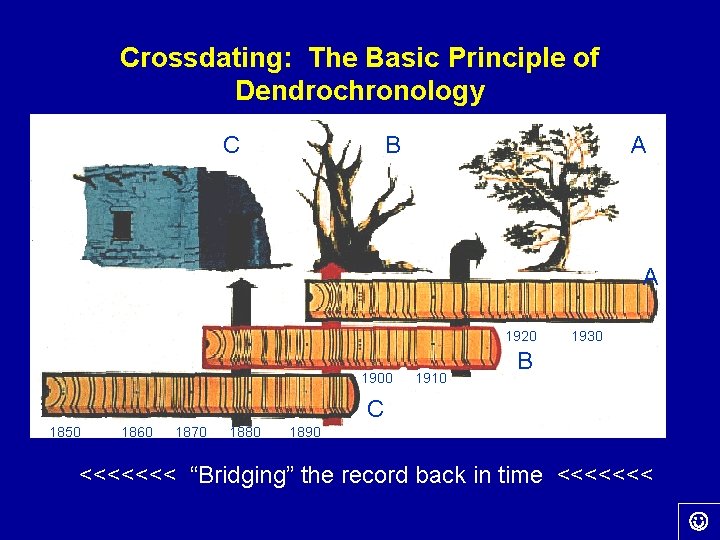
Crossdating: The Basic Principle of Dendrochronology C B A A 1920 1900 1910 1930 B C 1850 1860 1870 1880 1890 <<<<<<< “Bridging” the record back in time <<<<<<<
- Slides: 59