
Global causes of maternal death a WHO systematic
Global causes of maternal death: a WHO systematic analysis Penyebab kematian ibu secara global : sebuah analisis sistematik WHO Kamrianti Ramli
Background • Data for the causes of maternal deaths are needed to inform policies to improve maternal health. • We developed analysed global, regional, and subregional estimates of the causes of maternal death during 2003– 09, with a novel method, updating the previous WHO systematic review.
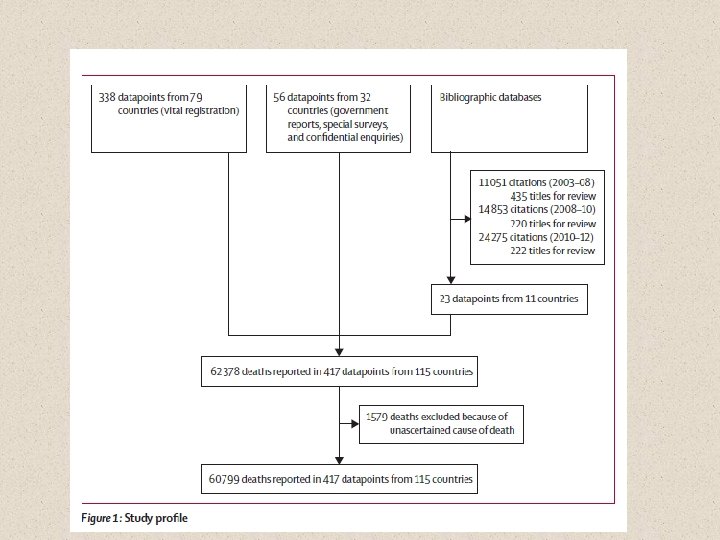
Methods • We searched specialised and general bibliographic databases for articles published between Jan 1, 2003, and Dec 31, 2012, for research data, with no language restrictions, and the WHO mortality database for vital registration data. On the basis of prespecifi ed inclusion criteria, we analysed causes of maternal death from datasets.
Methods • We aggregated country level estimates to report estimates of causes of death by Millennium Development Goal regions and worldwide, for main and subcauses of death categories with a Bayesian hierarchical model.
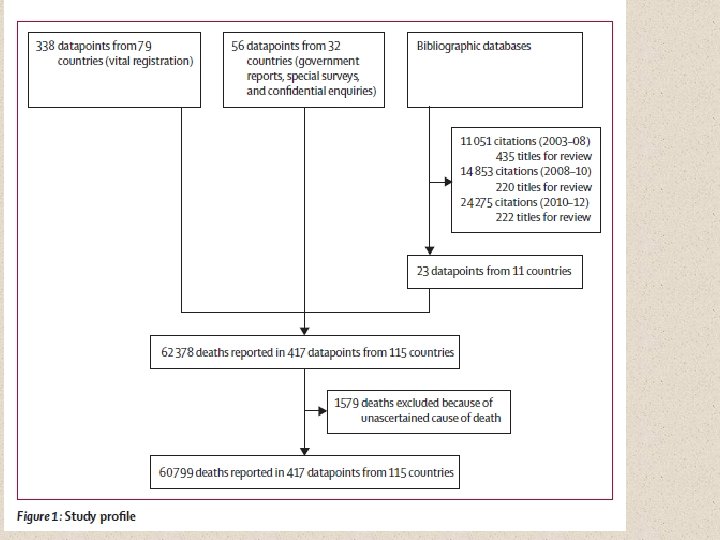
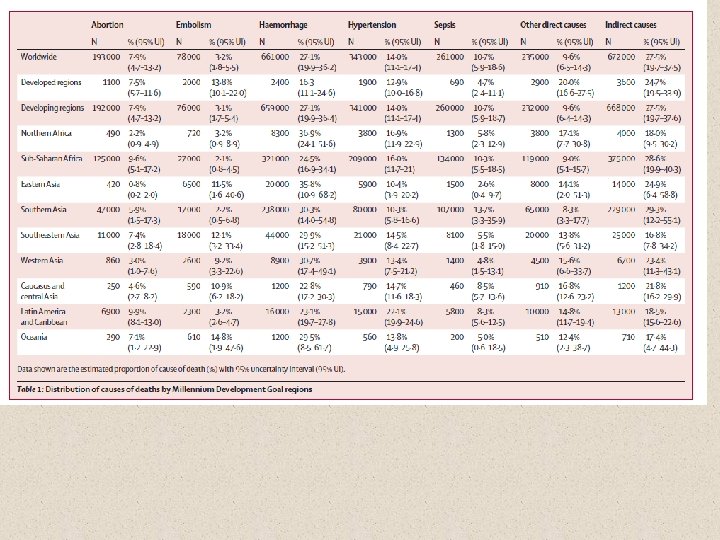
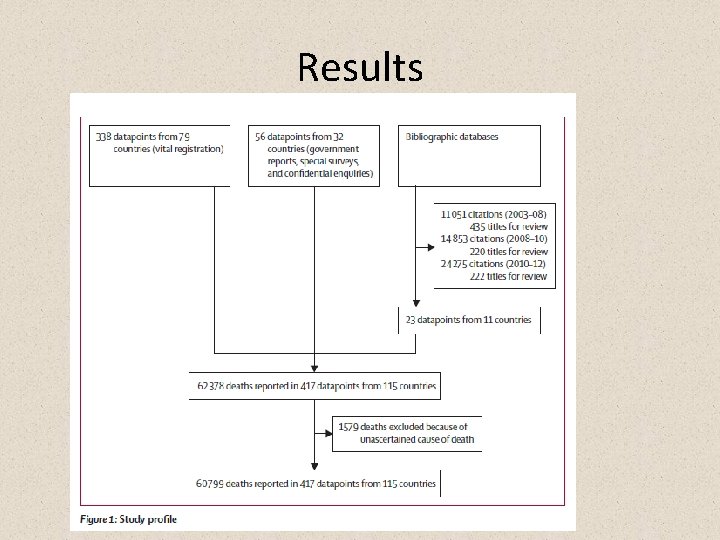
Findings • We identifi ed 23 eligible studies (published 2003– 12). We included 417 datasets from 115 countries comprising 60 799 deaths in the analysis. About 73% (1 771 000 of 2 443 000) of all maternal deaths between 2003 and 2009 were due to direct obstetric causes and deaths due to indirect causes accounted for 27· 5% (672 000, 95% UI 19· 7– 37· 5) of all deaths.
Finding • Haemorrhage accounted for 27· 1% (661 000, 19· 9– 36· 2), hypertensive disorders 14· 0% (343 000, 11· 1– 17· 4), and sepsis 10· 7% (261 000, 5· 9– 18· 6) of maternal deaths. • The rest of deaths were due to abortion (7· 9% [193 000], 4· 7– 13· 2), embolism (3· 2% [78 000], 1· 8– 5· 5), and all other direct causes of death (9· 6% [235 000], 6· 5– 14· 3). Regional estimates varied substantially.
Interpretation • Between 2003 and 2009, haemorrhage, hypertensive disorders, and sepsis were responsible for more than half of maternal deaths worldwide. More than a quarter of deaths were attributable to indirect causes.
Interpretation • These analyses should inform the prioritisation of health policies, programmes, and funding to reduce maternal deaths at regional and global levels. Further eff orts are needed to improve the availability and quality of data related to maternal mortality.
INTRODUCTION • Estimated 287000 maternal deaths occured worldwide in 2010 “most of which were in low-income and middle income countries and were avoidable” • Maternal mortality has long been a global health priority and is a target in the UN Millenium Development Goals (MDG) and Global Strategy for Women’s and Children’s Health
INTRODUCTION • Definition of maternal mortality (“the death of a woman whilst pregnant or within 42 days of delivery or termination of pregnancy, from any cause related to, or aggravated by pregnancy or its management, but excluding deaths from incidental or accidental causes”) allows the identifi cation of maternal deaths on the basis of their causes, as either direct or indirect.
INTRODUCTION • In 2006, we reported haemorrhage and hypertensive disorders as the leading causes of maternal mortality in developing regions.
INTRODUCTION • Analysed global, regional, and subregional estimates of the causes of maternal death during 2003 -2009 with a novel method • We also elaborated for the fi rst time further breakdown of main cause of death categories, and provided cause of death estimates for disorders that are clinically important—eg, antepartum and postpartum haemorrhage
METHODS Search Strategy We searched for data for causes of maternal death from two distinct sources a. We used vital registration datasets from the WHO mortality database, made available by countries b. We also did a literature search of bibliographic databases by adapting a previously described search strategy
DATA EXTRACTION • Data extraction from studies and reports was done by one reviewer (ABM) and independently checked on the form by another (JPD or DC) • When data presented were ambiguous, contradictory, or could not be disaggregated, we tried to contact the author for clarifi cation. If this was not successful, we used the consensus view of two of the authors (JPD, DC)
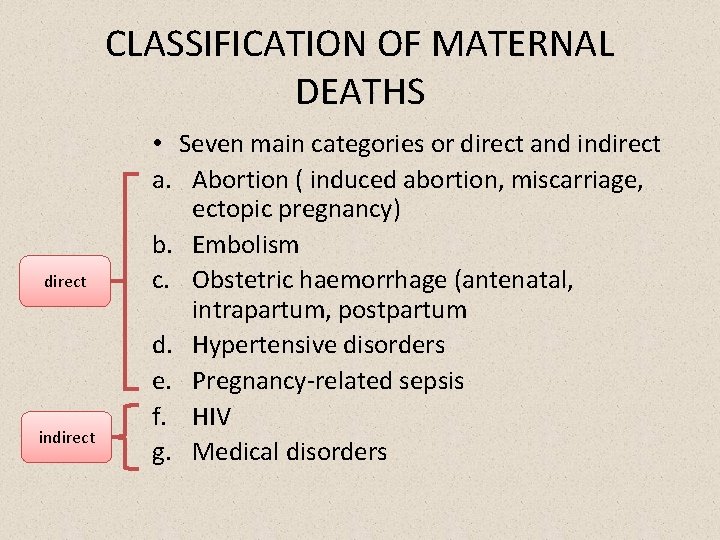
CLASSIFICATION OF MATERNAL DEATHS direct indirect • Seven main categories or direct and indirect a. Abortion ( induced abortion, miscarriage, ectopic pregnancy) b. Embolism c. Obstetric haemorrhage (antenatal, intrapartum, postpartum d. Hypertensive disorders e. Pregnancy-related sepsis f. HIV g. Medical disorders
STATISTICAL ANALYSIS • For every country, we estimated the causes of death distribution on the basis of countryspecific data (if available) • the regional causes of death distribution with a Bayesian hierarchical model
DIVIDED COUNTRIES INTO THREE CATEGORIES included all countries with good quality and complete vital registration data, where the sample of maternal deaths (for which the recorded causes of death distribution was obtained) was deemed to be representative of the total number of maternal deaths for the country during the period of interest A
DIVIDED COUNTRIES INTO THREE CATEGORIES for which vital registration data might have been available but not considered good quality, we assumed that the estimated causes of death distribution from the recorded samples were not necessarily representative of the causes of death distribution of all maternal deaths in the period of interest B
DIVIDED COUNTRIES INTO THREE CATEGORIES The cause of death distribution estimates were given by the typical regional estimates, and we assessed uncertainty on the basis of the estimated variability in, and correlation structure of, country-specifi c causes of death distribution within regions C
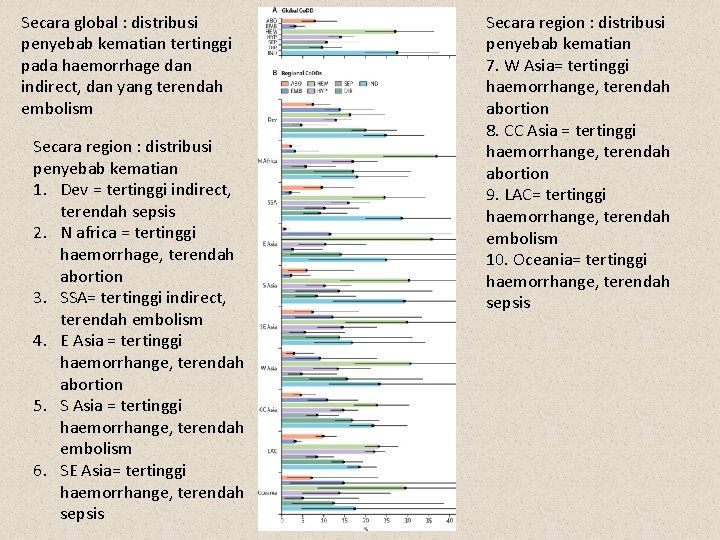
Secara global : distribusi penyebab kematian tertinggi pada haemorrhage dan indirect, dan yang terendah embolism Secara region : distribusi penyebab kematian 1. Dev = tertinggi indirect, terendah sepsis 2. N africa = tertinggi haemorrhage, terendah abortion 3. SSA= tertinggi indirect, terendah embolism 4. E Asia = tertinggi haemorrhange, terendah abortion 5. S Asia = tertinggi haemorrhange, terendah embolism 6. SE Asia= tertinggi haemorrhange, terendah sepsis Secara region : distribusi penyebab kematian 7. W Asia= tertinggi haemorrhange, terendah abortion 8. CC Asia = tertinggi haemorrhange, terendah abortion 9. LAC= tertinggi haemorrhange, terendah embolism 10. Oceania= tertinggi haemorrhange, terendah sepsis
ROLE OF THE FUNDING SOURCE • The funder of the study had no role in a. study design b. Data collection c. Data analysis d. Data interpretation e. Writing of the report
Results
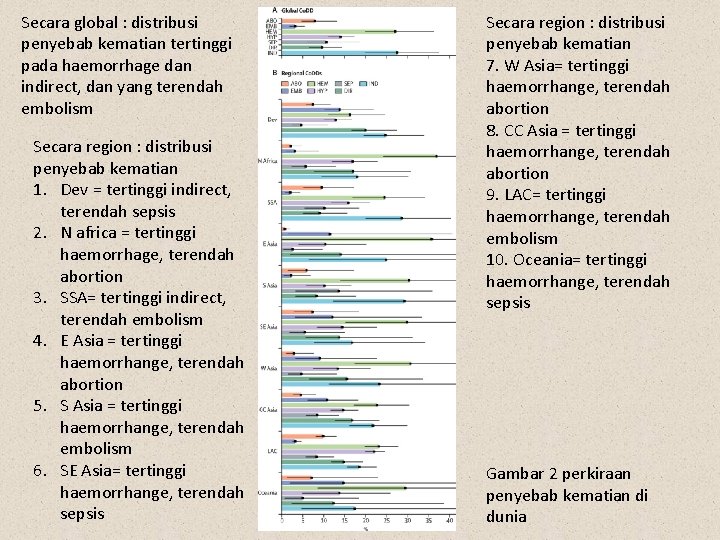
Secara global : distribusi penyebab kematian tertinggi pada haemorrhage dan indirect, dan yang terendah embolism Secara region : distribusi penyebab kematian 1. Dev = tertinggi indirect, terendah sepsis 2. N africa = tertinggi haemorrhage, terendah abortion 3. SSA= tertinggi indirect, terendah embolism 4. E Asia = tertinggi haemorrhange, terendah abortion 5. S Asia = tertinggi haemorrhange, terendah embolism 6. SE Asia= tertinggi haemorrhange, terendah sepsis Secara region : distribusi penyebab kematian 7. W Asia= tertinggi haemorrhange, terendah abortion 8. CC Asia = tertinggi haemorrhange, terendah abortion 9. LAC= tertinggi haemorrhange, terendah embolism 10. Oceania= tertinggi haemorrhange, terendah sepsis Gambar 2 perkiraan penyebab kematian di dunia
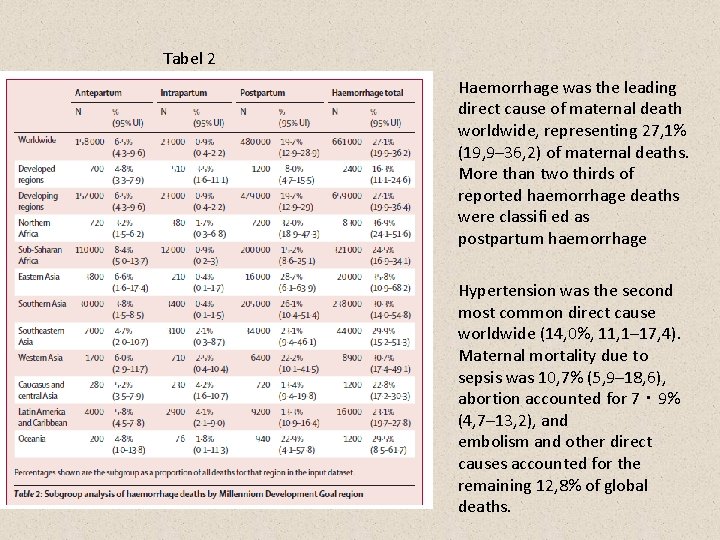
Tabel 2 Haemorrhage was the leading direct cause of maternal death worldwide, representing 27, 1% (19, 9– 36, 2) of maternal deaths. More than two thirds of reported haemorrhage deaths were classifi ed as postpartum haemorrhage Hypertension was the second most common direct cause worldwide (14, 0%, 11, 1– 17, 4). Maternal mortality due to sepsis was 10, 7% (5, 9– 18, 6), abortion accounted for 7・ 9% (4, 7– 13, 2), and embolism and other direct causes accounted for the remaining 12, 8% of global deaths.
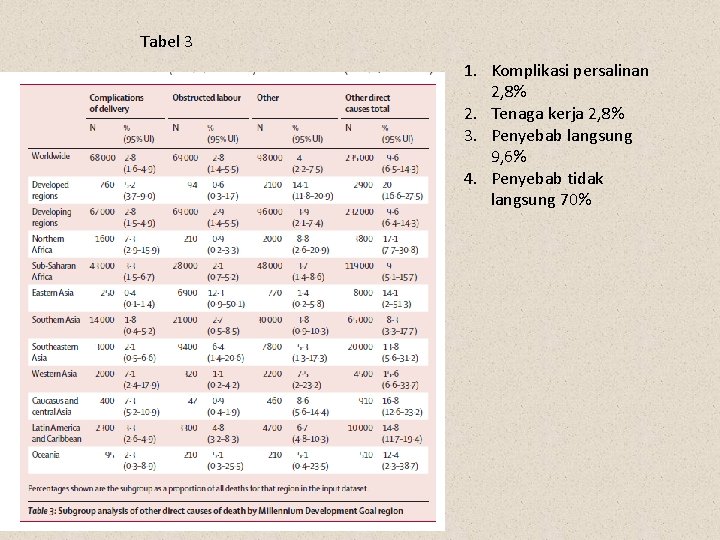
Tabel 3 1. Komplikasi persalinan 2, 8% 2. Tenaga kerja 2, 8% 3. Penyebab langsung 9, 6% 4. Penyebab tidak langsung 70%
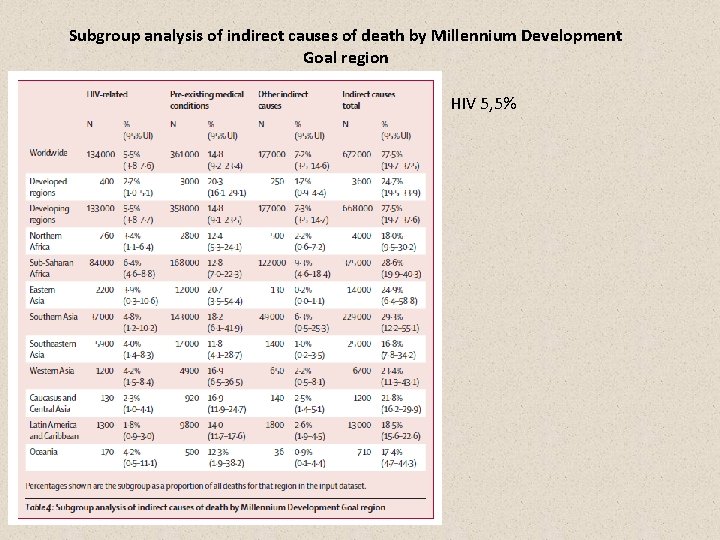
Subgroup analysis of indirect causes of death by Millennium Development Goal region HIV 5, 5%
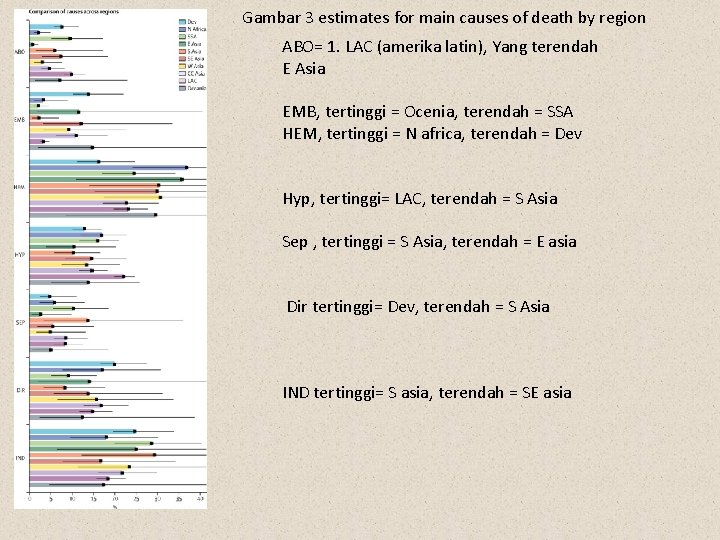
Gambar 3 estimates for main causes of death by region ABO= 1. LAC (amerika latin), Yang terendah E Asia EMB, tertinggi = Ocenia, terendah = SSA HEM, tertinggi = N africa, terendah = Dev Hyp, tertinggi= LAC, terendah = S Asia Sep , tertinggi = S Asia, terendah = E asia Dir tertinggi= Dev, terendah = S Asia IND tertinggi= S asia, terendah = SE asia
Discussion • Indirect causes are the largest of maternal death worlwide = haemorrhange, hypertensive disorders and sepsis • Although algoritma have been developed to adjust for misclassification of deaths not able to improve on misclasification • An alternative estimation method was used more recently in the GBD study 2010 to obtain estimates for the all cause of death distribution
Recommendations for policy and practice • First, where data are most needed, data are often not available, which is unfortunately the case in some countries with high mortality where estimates were obtained on the basis of modelling • Second, where data are available, they are often incomplete • ICD-MM suggests that maternal suicides will be included within the direct category of maternal death.
• Calls for inclusion of training on cause of death certification and the use of ICD use within medical curricula are well founded and should be supported • With regard to clinical implications, despite established interventions to prevent and treat postpartum haemorrhage failure to implement such intervention so must increasing rates of caesarean sections
• The improved method used in this analysis allowed delineation of haemorrhage deaths, reporting that about 24, 0 % of all haemorrhage deaths happened during pregnancy, and the rem ainder in the intrapartum or postpartum period. Thus we provide for the first time an evidence-based estimation of the proportion of maternal deaths due to antepartum haemorrhage.
- Slides: 34