
Global Business Cover class procedures Materials to class
Global Business Cover class procedures Materials to class daily Interactive notebook – Cornell format Where to find warmup, assignments Review website @ haisgb. weebly. com Resources • • Topics Homework Syllabus Organizers 1
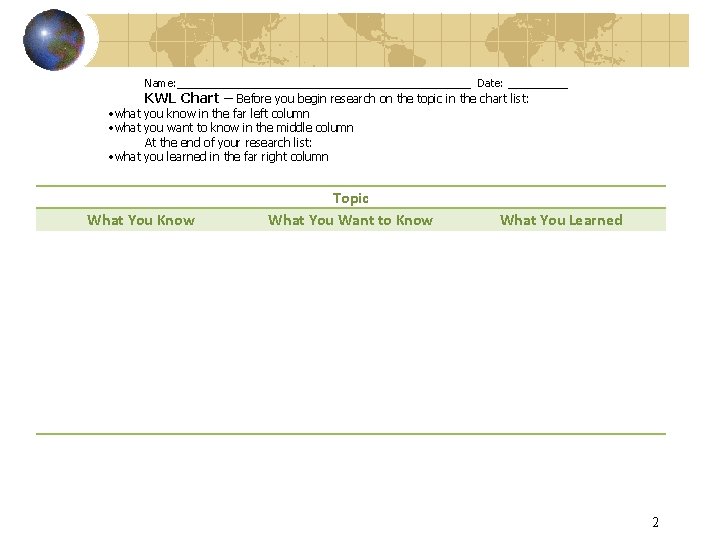
Name: _________________________ Date: _____ KWL Chart – Before you begin research on the topic in the chart list: • what you know in the far left column • what you want to know in the middle column At the end of your research list: • what you learned in the far right column What You Know Topic What You Want to Know What You Learned 2
3

Homework Create vocabulary cards from the vocabulary words you identify today. Due Tuesday – 1/ 15/13 4
Chapter 6 Trade and Investment Policies Impacting Global Business 5
Learning Objectives To see how trade and investment policies have historically been a subset of domestic policies. To examine how traditional attitudes toward trade and investment policies are changing. To see the effects of global links in trade and investment on policymakers. To understand that nations must cooperate closely in the future to maintain a viable global trade and investment environment. 6
Rationale and Goals Government policies are designed to regulate, stimulate, direct, and protect national activities, resulting in national sovereignty The domestic actions of most governments aim to increase the standard of living and improve the quality of life of its citizens. Additional goals include stimulating national development and achieving full employment 7 2 Chapter Czinkota: International Business, 8 e
Foreign Policy Goals Nations develop foreign policy to exercise influence abroad and to provide domestic benefits such as: National security Improved trade and investment opportunities Aid to develop markets and increase influence Each country develops its own domestic policies, so policy aims vary from nation to nation 8 2 Chapter Czinkota: International Business, 8 e
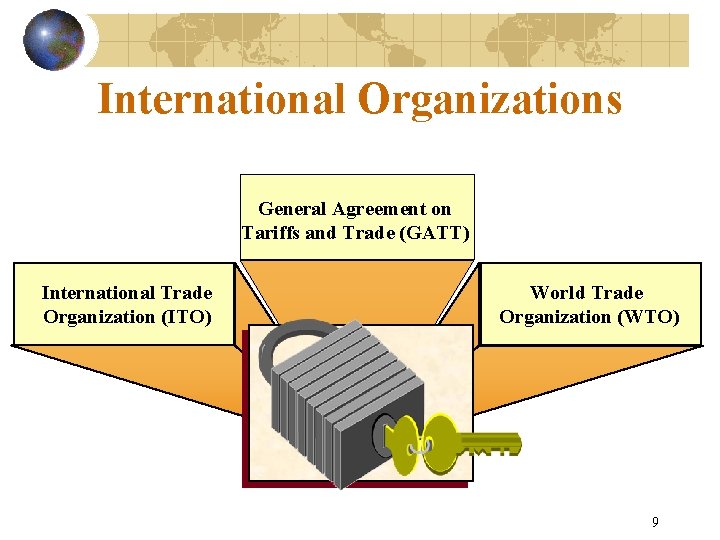
International Organizations General Agreement on Tariffs and Trade (GATT) International Trade Organization (ITO) World Trade Organization (WTO) 9
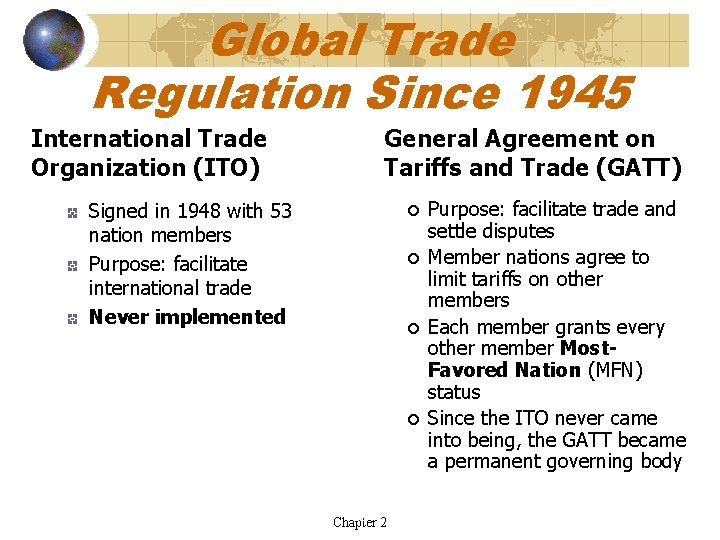
Global Trade Regulation Since 1945 International Trade Organization (ITO) General Agreement on Tariffs and Trade (GATT) Signed in 1948 with 53 nation members Purpose: facilitate international trade Never implemented 10 2 Chapter Purpose: facilitate trade and settle disputes Member nations agree to limit tariffs on other members Each member grants every other member Most. Favored Nation (MFN) status Since the ITO never came into being, the GATT became a permanent governing body Czinkota: International Business, 8 e
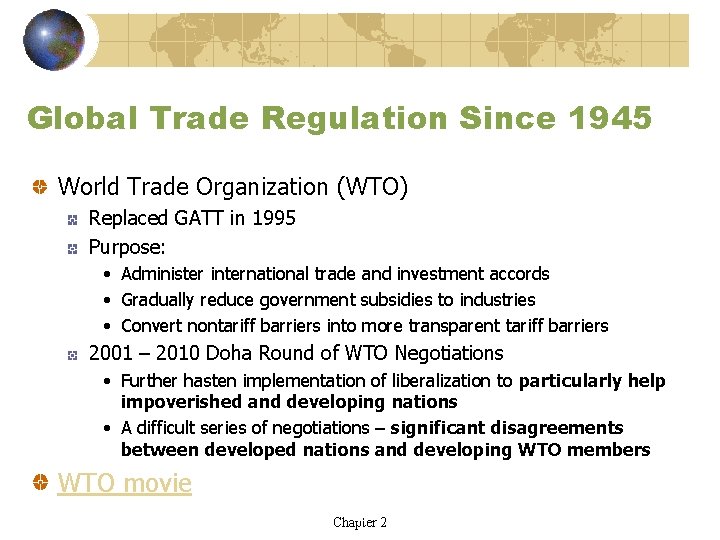
Global Trade Regulation Since 1945 World Trade Organization (WTO) Replaced GATT in 1995 Purpose: • Administer international trade and investment accords • Gradually reduce government subsidies to industries • Convert nontariff barriers into more transparent tariff barriers 2001 – 2010 Doha Round of WTO Negotiations • Further hasten implementation of liberalization to particularly help impoverished and developing nations • A difficult series of negotiations – significant disagreements between developed nations and developing WTO members WTO movie 11 2 Chapter Czinkota: International Business, 8 e
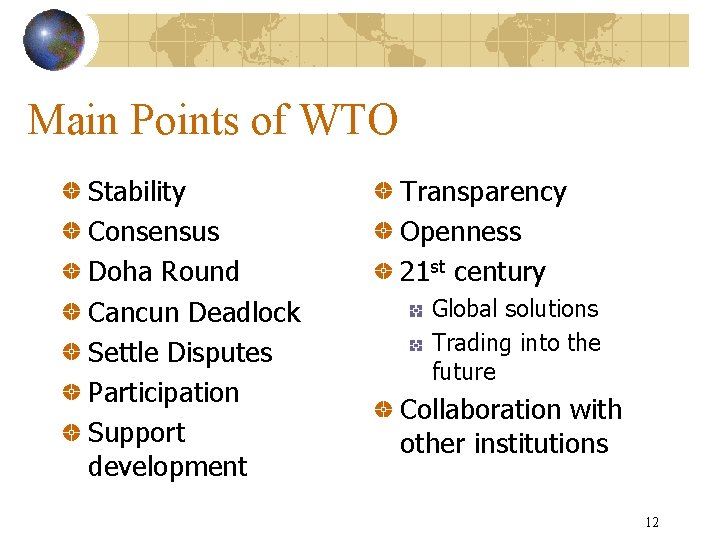
Main Points of WTO Stability Consensus Doha Round Cancun Deadlock Settle Disputes Participation Support development Transparency Openness 21 st century Global solutions Trading into the future Collaboration with other institutions 12
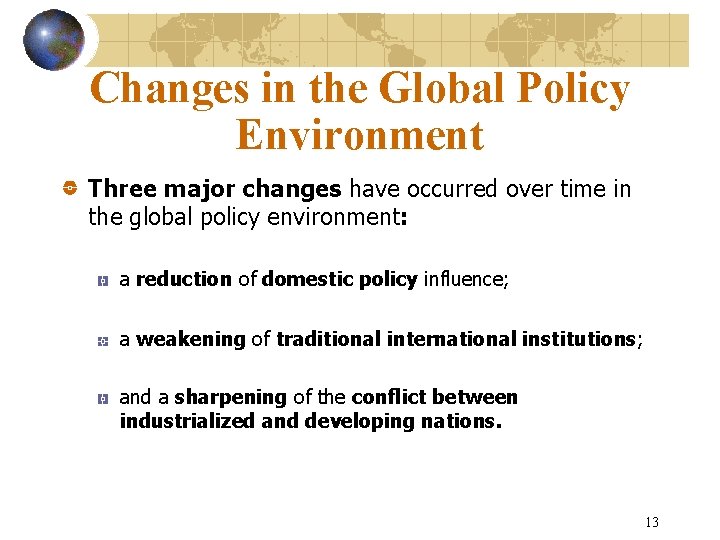
Changes in the Global Policy Environment Three major changes have occurred over time in the global policy environment: a reduction of domestic policy influence; a weakening of traditional international institutions; and a sharpening of the conflict between industrialized and developing nations. 13
Reduction of Domestic Policy Influences Currency flows have increased from an average daily trade volume of $18 billion in 1980 to $1. 2 trillion in 2001. As a result, currency flows have begun to set the value of exchange rates independent of trade, which in turn have now begun to determine the level of trade. The interactions between global and domestic financial flows have severely limited the influence of governments. To regain influence, some governments have tried to restrict world trade by erecting barriers, charging tariffs, and implementing import regulations. 14
Weakening of International Institutions The intense links among nations and the new economic environment resulting from new market entrants and the encounter of different economic systems are weakening the WTO. The International Monetary Fund (IMF) does not have the funds available to satisfy the needs of all struggling nations. The World Bank has been unsuccessful in furthering the economic goals of the developing world and newly emerging market economies. Some claim that its bank policies have created more poverty. 15
Conflict Between Industrialized and Developing Nations In the past, it was hoped that the gap between industrialized and developing nations would gradually be closed. Although several less-developed nations have emerged as newly industrialized countries, even more nations are facing grim economic futures. An increase in environmental awareness has led to a further sharpening of the conflict. 16
Restrictions of Imports Many countries including the United States have passed antidumping laws which help domestic industries by restricting foreign products being sold below the cost of production, or at prices lower than those in the home market. Imports are also restricted by nontariff barriers, such as buy-domestic campaigns. It is difficult to remove these barriers. Imports can also be reduced by tightening market access and entry of foreign products through involved procedures and inspections. 17
Effects of Import Restriction Import control may mean that the most efficient sources of supply are not available, resulting in second-best products or higher costs for restricted supplies. Import control may result in the downstream change in the composition of imports. Due to inefficiency, import controls may cause a lag in technological advancements. 18
Restrictions of Exports Nations control their exports for reasons of short supply, national security and foreign policy purposes, or the desire to retain capital. National security controls are placed on weapons and high-technology exports. Although restriction of exports is a valuable international relations tool, it may give a country’s firms the reputation of being unreliable suppliers and may divert orders to firms of other nations. 19
Export Promotion Designed to help firms enter and maintain their position in international markets and to match or counteract similar efforts by other nations. Various approaches toward export promotion include: knowledge transfer direct or indirect subsidization of export activities reducing governmental red tape for exporters export financing and mixed aid credits to exporters altered tax legislation for nationals living abroad 20
Import Promotion Countries that maintain large balance-of-trade surpluses use import promotion measures. The Japan External Trade Organization (JETRO) has begun to focus on the promotion of imports to Japan. 21
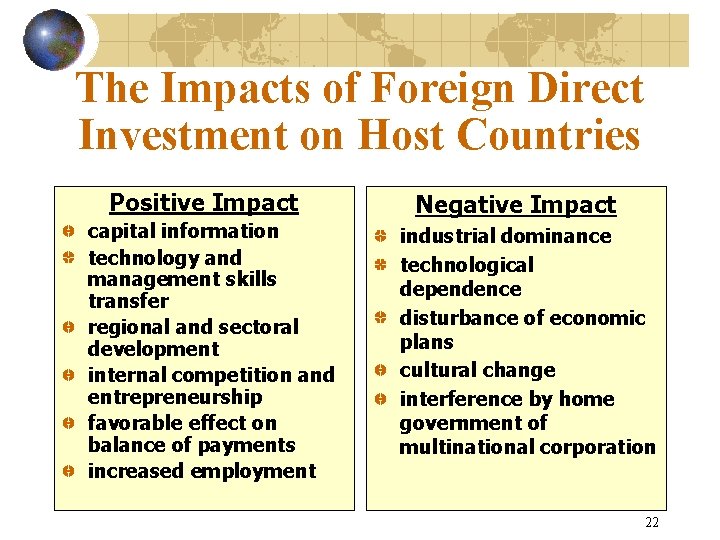
The Impacts of Foreign Direct Investment on Host Countries Positive Impact capital information technology and management skills transfer regional and sectoral development internal competition and entrepreneurship favorable effect on balance of payments increased employment Negative Impact industrial dominance technological dependence disturbance of economic plans cultural change interference by home government of multinational corporation 22
Restrictions on Investment Many nations that lack necessary foreign exchange reserves restrict exports of capital, because capital flight can be a major problem. Once governments impose restrictions on the export of funds, the desire to transfer capital abroad increases. This creates problems for gaining new outside investors. 23
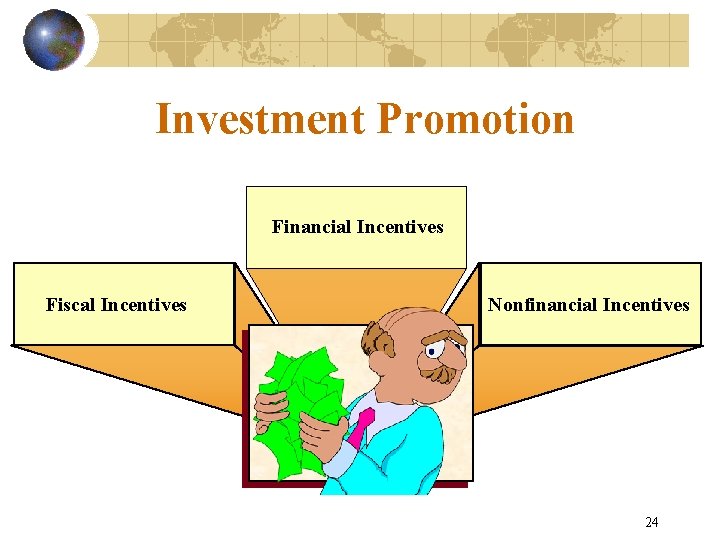
Investment Promotion Financial Incentives Fiscal Incentives Nonfinancial Incentives 24
Investment Promotion (cont. ) Fiscal incentives are specific tax measures designed to attract the foreign investor, including special depreciation allowances, tax credits or rebates, special deductions for capital expenditures, tax holidays, and reduction of tax burdens. Financial incentives offer special funding for the investor by providing land or building, loans, and loan guarantees. Nonfinancial incentives can consist of guaranteed government purchases, special protection from competition, and investments in infrastructure facilities. 25
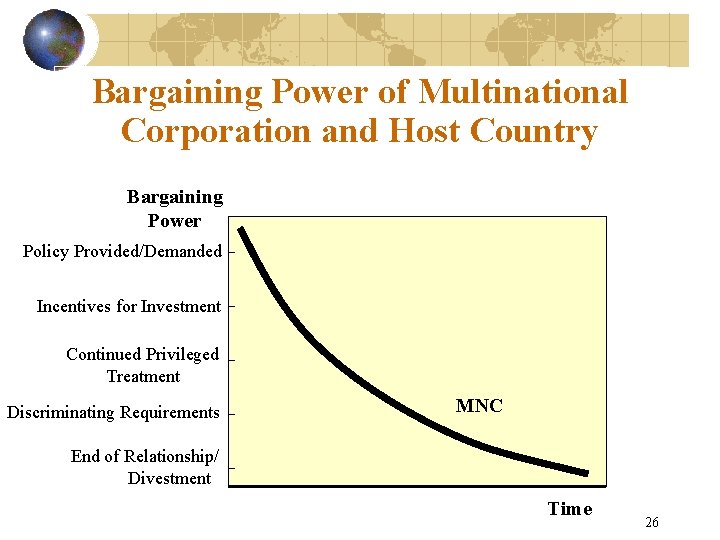
Bargaining Power of Multinational Corporation and Host Country Bargaining Power Policy Provided/Demanded Incentives for Investment Continued Privileged Treatment Discriminating Requirements MNC End of Relationship/ Divestment Time 26
U. S. Perspective on Trade and Investment Policies The U. S. seeks a positive trade policy rather than reactive, ad hoc responses to specific situations. Protectionist legislation can be helpful, provided it is not enacted into law. Trade promotion authority gives Congress the right to accept or reject treaties and agreements, but reduces the amendment procedures 27
International Perspective on Trade and Investment Policies From an international perspective, trade and investment negotiations must continue. In doing so, trade and investment policy can take either a multilateral or bilateral approach: bilateral negotiations are carried out mainly between two nations. multilateral negotiations are carried out among a number of nations. 28
- Slides: 28