
Global Average Temperatures of Planetary Surfaces and the
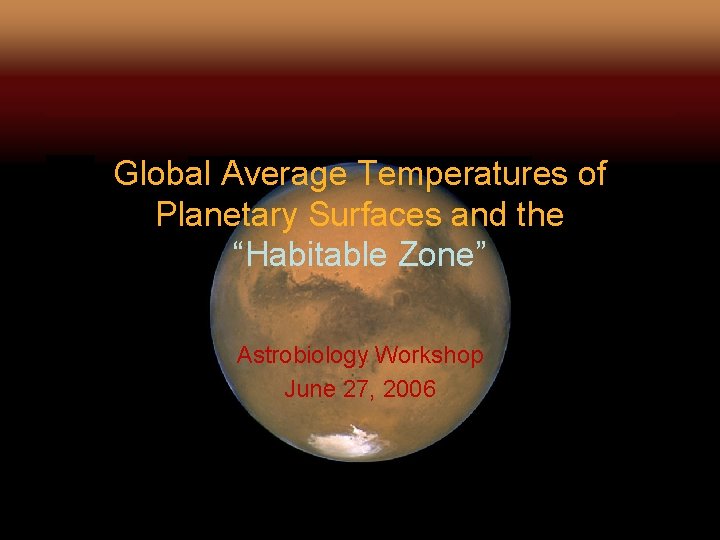
Global Average Temperatures of Planetary Surfaces and the “Habitable Zone” Astrobiology Workshop June 27, 2006
Habitability What Might Make a Planet or Moon “Habitable”? § IF • • • § IF § life on Earth is a reliable guide, life requires Carbon Chemistry Energy Source to Sustain Metabolism Liquid Water! – Or some other good liquid medium for carbon chemistry (but water seems best) liquid water really is essential, then • temperatures (and pressures) must permit liquid water to exist So we are led to ask: • What determines planet temperatures?
Planet Temperatures What Heats Surfaces of Moons & Planets? § § What are the sources of heat for the surfaces of a solid (or liquid) body in a planetary system? • Starlight and Planet Light • Outflow of Internal Heat • Impacts • Latent Heats of Surface or Atmosphere Constituents Which of these usually dominates the Global Average Temperature Tsurf after a fewx 108 years? • Starlight!
Planet Temperatures Basic Principles for Global Average T’s § § Equilibrium • Input of Energy per second to the surface equals the Output of Energy per second Factors affecting Input? Input • Luminosity of the star • Distance from the star • Reflectivity (Albedo) of the surface and/or atmosphere – The fraction of the starlight that is scattered or reflected by the surface without being absorbed
Planet Temperatures Basic Principles for Global Average T’s § § What is the principal mechanism that cools the surface of a planet? • Radiation by the surface because it is hot! Factors affecting Output? Output • Temperature of the surface – At typical temperatures of planetary surfaces, they radiate in the infrared – Energy/sec. as temperature • Insulation of the surface by a blanket of atmosphere that blocks the infrared – The Greenhouse Effect
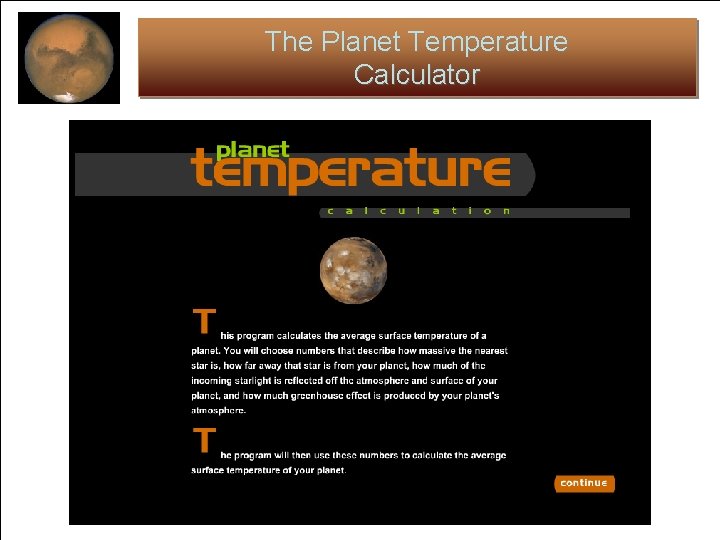
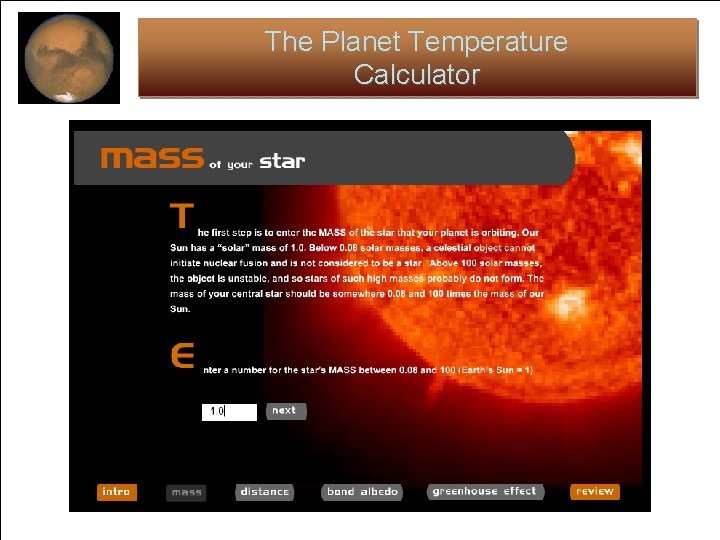
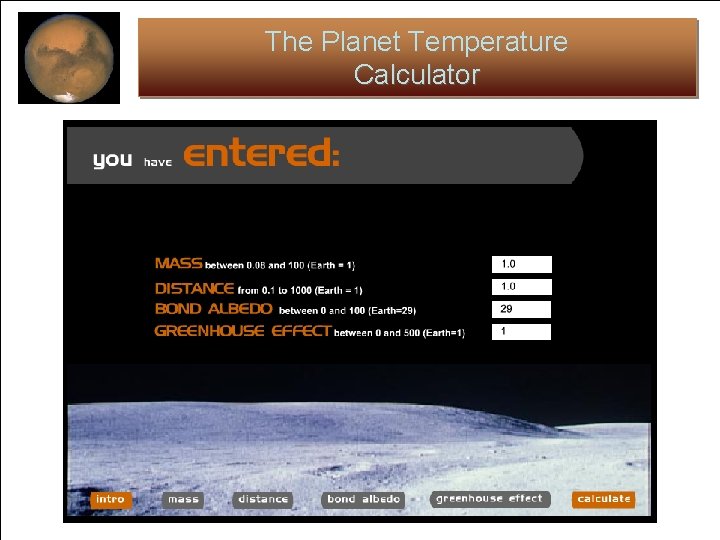
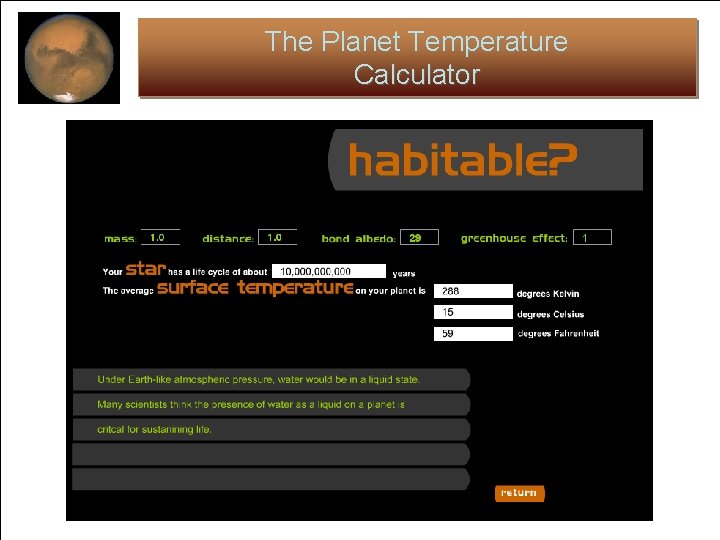
The Planet Temperature Calculator What is It? § § The PTC is a Web-based tool that calculates the Global Average Temperature Tsurf assuming • Energy Input Rate = Energy Output Rate Parameters you provide to the calculator: • Mass of the star Luminosity of the star • Distance of the planet from the star • The Albedo of the planet • The Greenhouse Factor relative to Earth – This is a measure of the column density of Greenhouse gases in the atmosphere relative to the same quantity on Earth
The Planet Temperature Calculator
The Planet Temperature Calculator
The Planet Temperature Calculator
The Planet Temperature Calculator

Calculating Tsurf with No Atmosphere Tsurf Calculation § § Equilibrium says • Star Energy/sec. In = Planet Energy/sec. Out Input Energy/sec. from starlight depends on • Luminosity L = light energy emitted per sec. • Distance D = distance of object from star • Energy/meter 2/sec. at the object L 4 D 2 • Energy/sec. hitting an object of Radius R L 4 D R 2 x 4 D 2

Calculating Tsurf with No Atmosphere § § Input Energy/sec. absorbed by the object • Albedo A = fraction of light energy scattered or reflected by object • Fraction absorbed is 1 -A Input Energy/sec. from star that is absorbed (I-A) R 2 x L 4 D 2
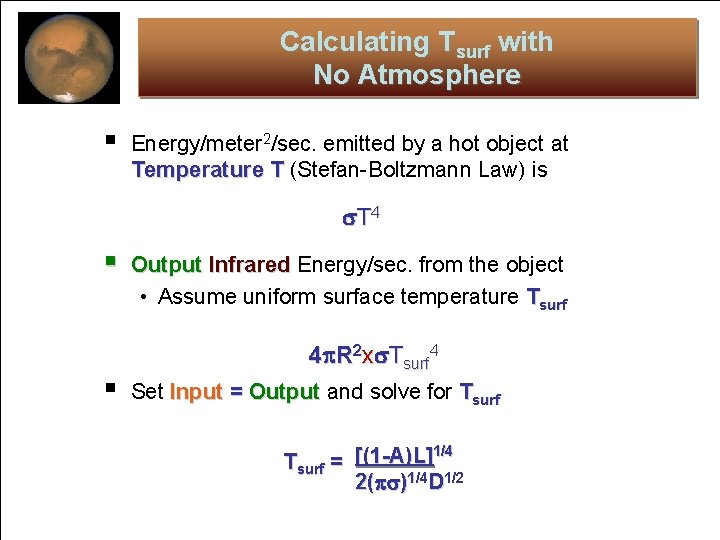
Calculating Tsurf with No Atmosphere § Energy/meter 2/sec. emitted by a hot object at Temperature T (Stefan-Boltzmann Law) is T 4 § § Output Infrared Energy/sec. from the object • Assume uniform surface temperature Tsurf 4 R 2 x Tsurf 4 Set Input = Output and solve for Tsurf 1/4 Tsurf = [(1 -A)L] 2( )1/4 D 1/2
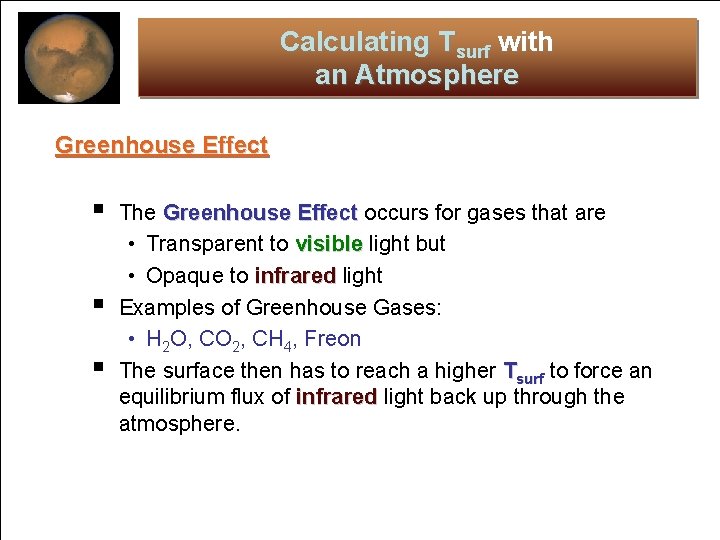
Calculating Tsurf with an Atmosphere Greenhouse Effect § § § The Greenhouse Effect occurs for gases that are • Transparent to visible light but • Opaque to infrared light Examples of Greenhouse Gases: • H 2 O, CO 2, CH 4, Freon The surface then has to reach a higher Tsurf to force an equilibrium flux of infrared light back up through the atmosphere.
Calculating Tsurf with an Atmosphere Greenhouse Effect § The change in Tsurf is greater when the “mean free path” path for infrared photons is smaller, which depends on the amount of greenhouse gas in the atmosphere. • Roughly one extra Tsurf 4 for each mean free path through the atmosphere • For large amounts of greenhouse gas, if you double the column density of greenhouse gas, then Tsurf increases by 21/4 times
Luminosities of Stars? § What about L? For Main Sequence Stars, Stars which burn hydrogen to helium in their centers, it is approximately true that L = L (M/M )3 § In this formula, M refers to the star’s mass and the subscript refers the solar value.
The Habitable Zone for Earth-Like Planets § § Simple Definition of the Habitable Zone: • Range of distances from a Star for Tsurf is such that the surface water of an Earth-like planet (or moon) would not either – Freeze or – Boil Questions for Activities & Discussions: • What is the Habitable Zone for the Sun and for your star? • What would happen to Earth if we moved it to the edges of the HZ? HZ What do Venus and Mars suggest about the edges of the HZ? HZ • Where was the Sun’s Habitable Zone in the past? Where will it be in the future?
- Slides: 17