
Global and EU perspective on microbial food safety
Global and EU perspective on microbial food safety ‘On the road to Innovation Union: European food legislation’ Marcia Oliveira Food Chemistry and Technology, Teagasc Food Research Centre Email: marcia. oliveira@teagasc. ie FOODstars
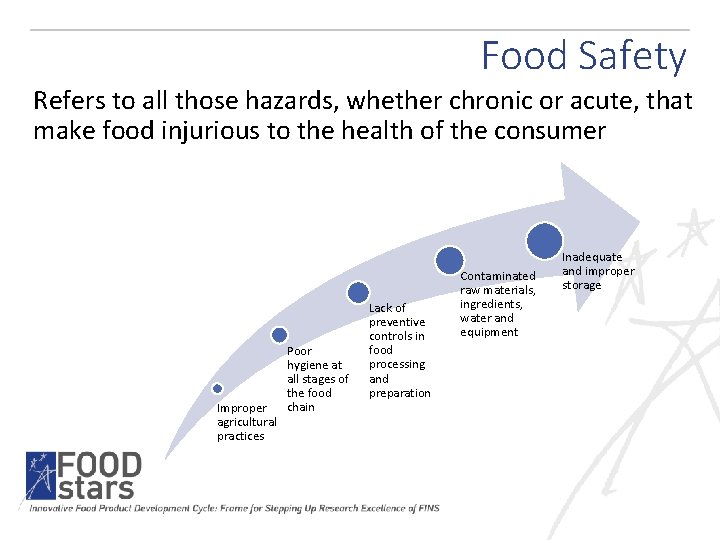
Food Safety Refers to all those hazards, whether chronic or acute, that make food injurious to the health of the consumer Improper agricultural practices Poor hygiene at all stages of the food chain Lack of preventive controls in food processing and preparation Contaminated raw materials, ingredients, water and equipment Inadequate and improper storage
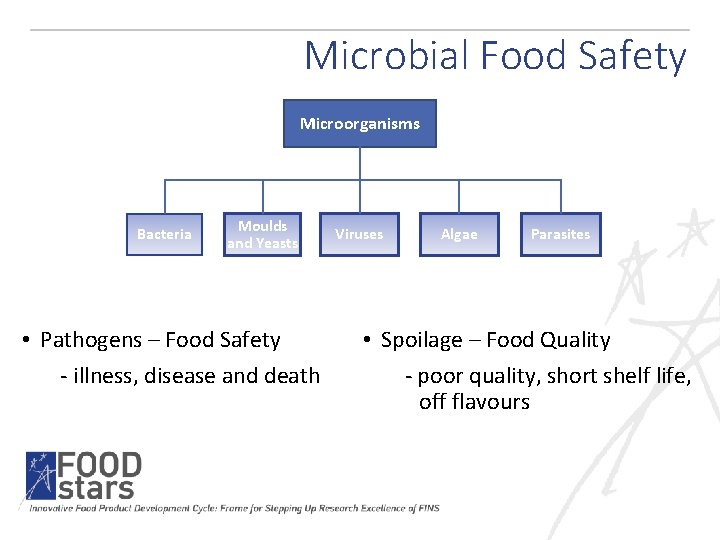
Microbial Food Safety Microorganisms Bacteria Moulds and Yeasts • Pathogens – Food Safety - illness, disease and death Viruses Algae Parasites • Spoilage – Food Quality - poor quality, short shelf life, off flavours
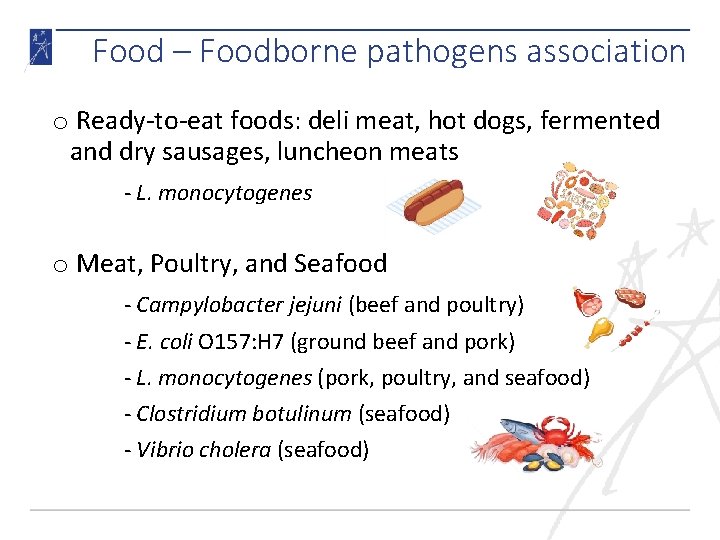
Food – Foodborne pathogens association o Ready-to-eat foods: deli meat, hot dogs, fermented and dry sausages, luncheon meats - L. monocytogenes o Meat, Poultry, and Seafood - Campylobacter jejuni (beef and poultry) - E. coli O 157: H 7 (ground beef and pork) - L. monocytogenes (pork, poultry, and seafood) - Clostridium botulinum (seafood) - Vibrio cholera (seafood)
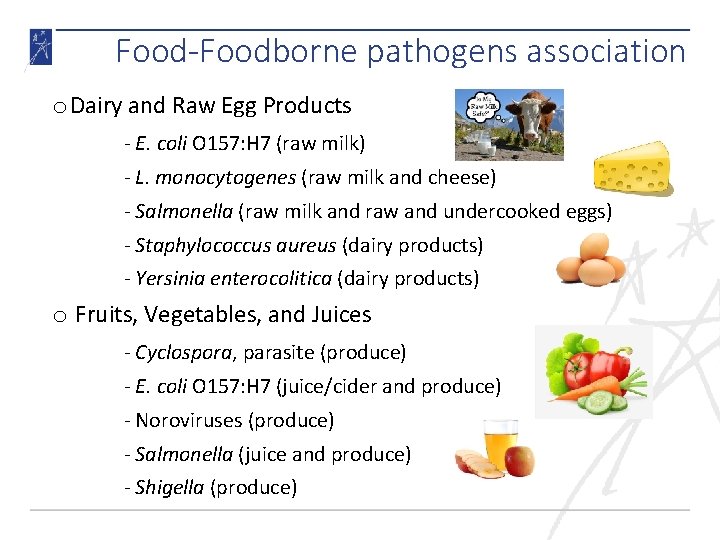
Food-Foodborne pathogens association o Dairy and Raw Egg Products - E. coli O 157: H 7 (raw milk) - L. monocytogenes (raw milk and cheese) - Salmonella (raw milk and raw and undercooked eggs) - Staphylococcus aureus (dairy products) - Yersinia enterocolitica (dairy products) o Fruits, Vegetables, and Juices - Cyclospora, parasite (produce) - E. coli O 157: H 7 (juice/cider and produce) - Noroviruses (produce) - Salmonella (juice and produce) - Shigella (produce)

Looking at the whole chain Prevention efforts have to integrate the full food production chain: from Farm to Fork Production Use of Good Practices Distribution Processing Monitor at Critical Control Points Use clean vehicles and maintain the cold chain Home Consumers Retail Restaurant Home Preparation Restaurant Consumer Use Good Hygiene and Manufacturing Practices Restaurant Preparation Always follow the 4 Cs of food safety: - Clean - Cook - Combat cross-contamination - Chill
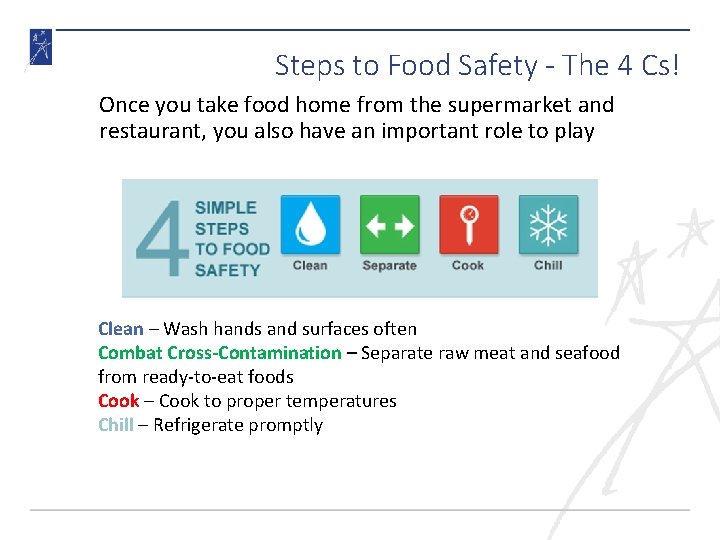
Steps to Food Safety - The 4 Cs! Once you take food home from the supermarket and restaurant, you also have an important role to play Clean – Wash hands and surfaces often Combat Cross-Contamination – Separate raw meat and seafood from ready-to-eat foods Cook – Cook to proper temperatures Chill – Refrigerate promptly
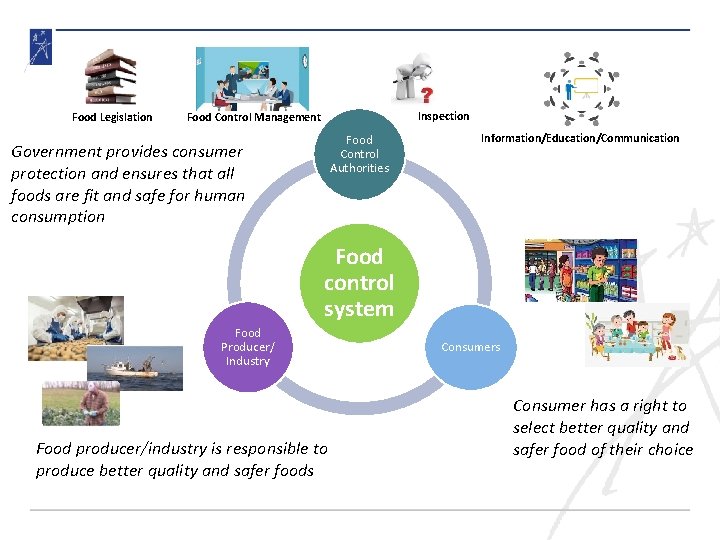
Food Legislation Inspection Food Control Management Food Control Authorities Government provides consumer protection and ensures that all foods are fit and safe for human consumption Information/Education/Communication Food control system Food Producer/ Industry Food producer/industry is responsible to produce better quality and safer foods Consumer has a right to select better quality and safer food of their choice
Reduce risk can be achieved • Prevention throughout the food chain: Farm-to-Fork • Food producers and operators are entrusted with primary responsibility for food safety and quality - Good practices: GAP, GMP, GHP - HACCP • Government are then responsible for - Auditing performance by monitoring and surveillance - Enforcing legal and regulatory requirements
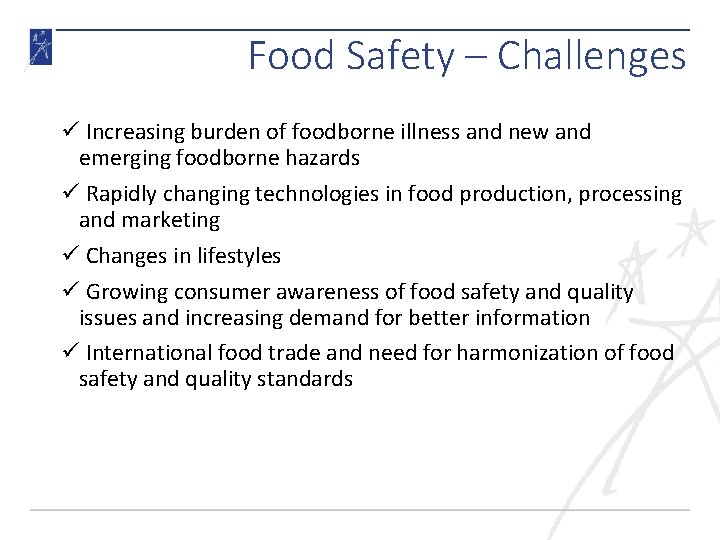
Food Safety – Challenges ü Increasing burden of foodborne illness and new and emerging foodborne hazards ü Rapidly changing technologies in food production, processing and marketing ü Changes in lifestyles ü Growing consumer awareness of food safety and quality issues and increasing demand for better information ü International food trade and need for harmonization of food safety and quality standards
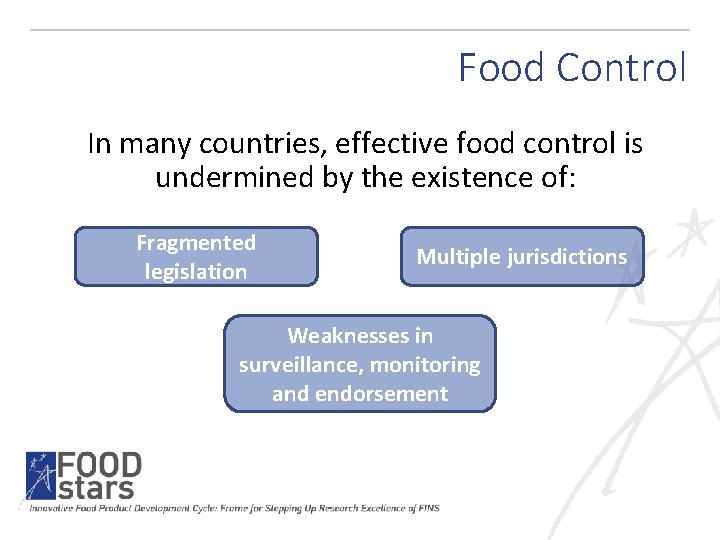
Food Control In many countries, effective food control is undermined by the existence of: Fragmented legislation Multiple jurisdictions Weaknesses in surveillance, monitoring and endorsement
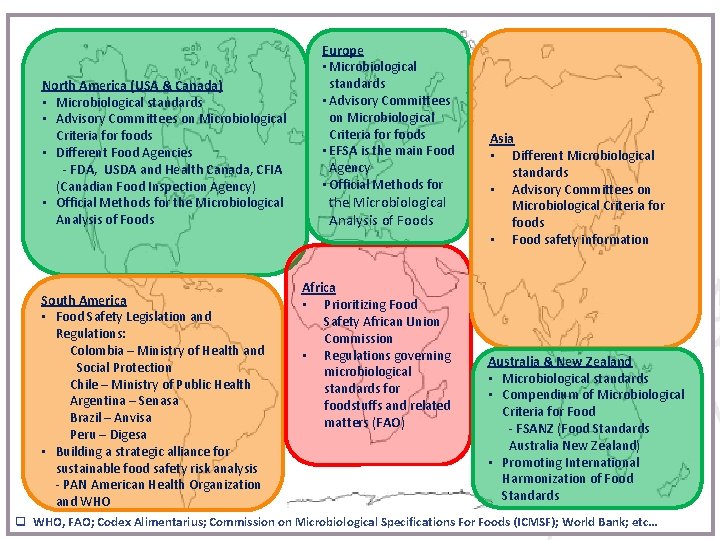
North America (USA & Canada) • Microbiological standards • Advisory Committees on Microbiological Criteria for foods • Different Food Agencies - FDA, USDA and Health Canada, CFIA (Canadian Food Inspection Agency) • Official Methods for the Microbiological Analysis of Foods South America • Food Safety Legislation and Regulations: Colombia – Ministry of Health and Social Protection Chile – Ministry of Public Health Argentina – Senasa Brazil – Anvisa Peru – Digesa • Building a strategic alliance for sustainable food safety risk analysis - PAN American Health Organization and WHO Europe • Microbiological standards • Advisory Committees on Microbiological Criteria for foods • EFSA is the main Food Agency • Official Methods for the Microbiological Analysis of Foods Africa • Prioritizing Food Safety African Union Commission • Regulations governing microbiological standards for foodstuffs and related matters (FAO) Asia • Different Microbiological standards • Advisory Committees on Microbiological Criteria for foods • Food safety information Australia & New Zealand • Microbiological standards • Compendium of Microbiological Criteria for Food - FSANZ (Food Standards Australia New Zealand) • Promoting International Harmonization of Food Standards q WHO, FAO; Codex Alimentarius; Commission on Microbiological Specifications For Foods (ICMSF); World Bank; etc…
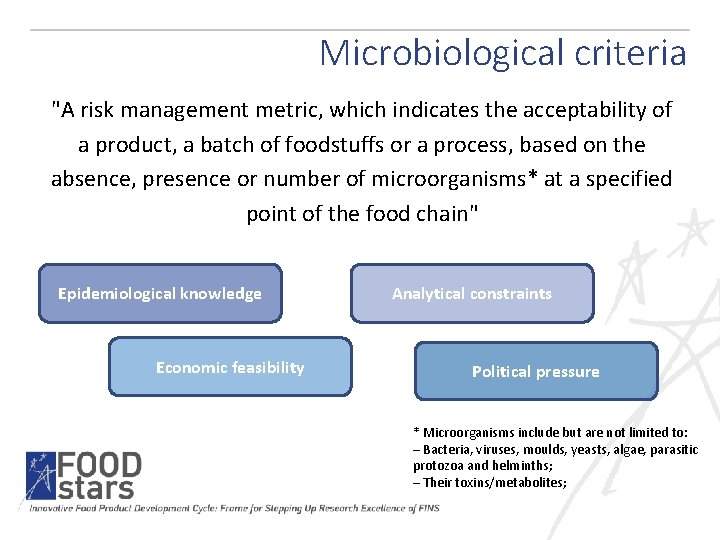
Microbiological criteria "A risk management metric, which indicates the acceptability of a product, a batch of foodstuffs or a process, based on the absence, presence or number of microorganisms* at a specified point of the food chain" Epidemiological knowledge Economic feasibility Analytical constraints Political pressure * Microorganisms include but are not limited to: – Bacteria, viruses, moulds, yeasts, algae, parasitic protozoa and helminths; – Their toxins/metabolites;
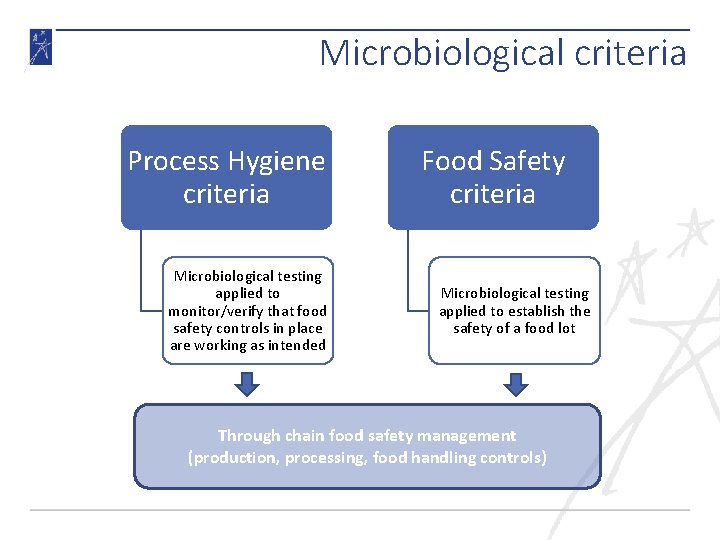
Microbiological criteria Process Hygiene criteria Microbiological testing applied to monitor/verify that food safety controls in place are working as intended Food Safety criteria Microbiological testing applied to establish the safety of a food lot Through chain food safety management (production, processing, food handling controls)
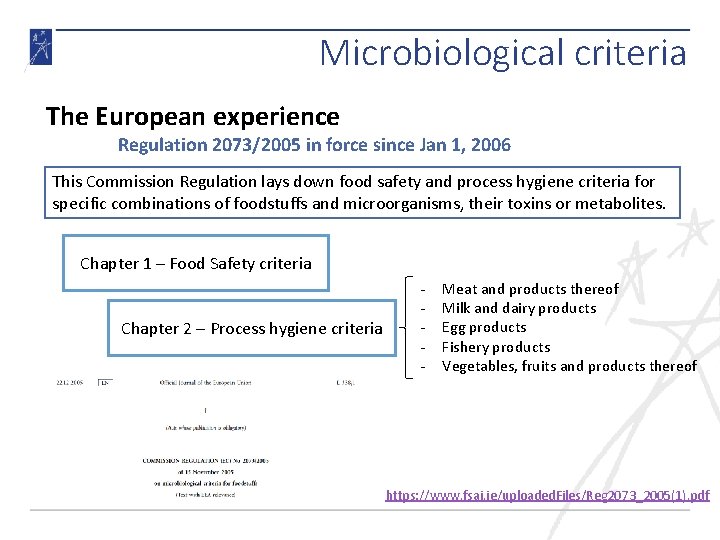
Microbiological criteria The European experience Regulation 2073/2005 in force since Jan 1, 2006 This Commission Regulation lays down food safety and process hygiene criteria for specific combinations of foodstuffs and microorganisms, their toxins or metabolites. Chapter 1 – Food Safety criteria Chapter 2 – Process hygiene criteria - Meat and products thereof Milk and dairy products Egg products Fishery products Vegetables, fruits and products thereof https: //www. fsai. ie/uploaded. Files/Reg 2073_2005(1). pdf
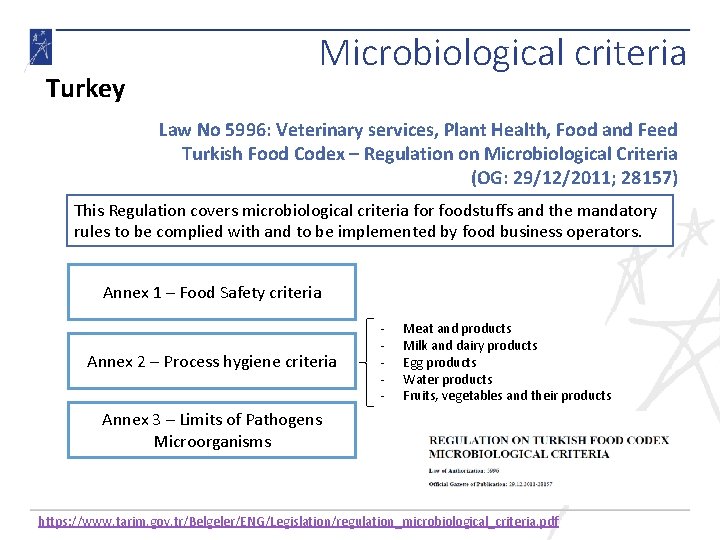
Turkey Microbiological criteria Law No 5996: Veterinary services, Plant Health, Food and Feed Turkish Food Codex – Regulation on Microbiological Criteria (OG: 29/12/2011; 28157) This Regulation covers microbiological criteria for foodstuffs and the mandatory rules to be complied with and to be implemented by food business operators. Annex 1 – Food Safety criteria Annex 2 – Process hygiene criteria - Meat and products Milk and dairy products Egg products Water products Fruits, vegetables and their products Annex 3 – Limits of Pathogens Microorganisms https: //www. tarim. gov. tr/Belgeler/ENG/Legislation/regulation_microbiological_criteria. pdf
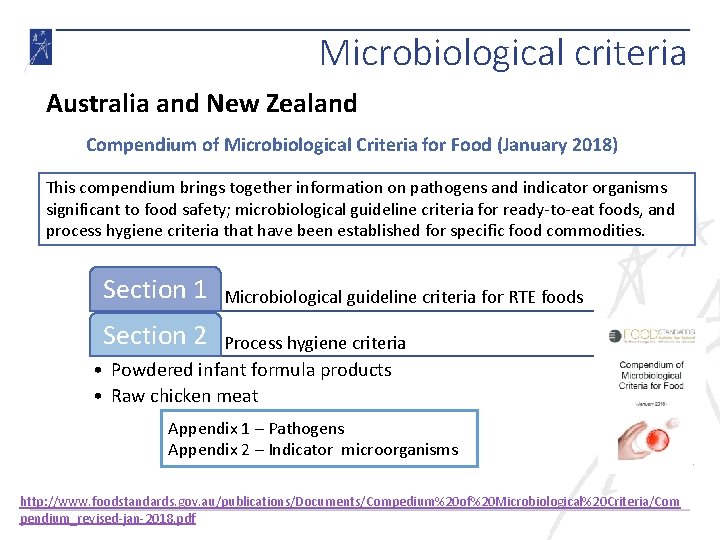
Microbiological criteria Australia and New Zealand Compendium of Microbiological Criteria for Food (January 2018) This compendium brings together information on pathogens and indicator organisms significant to food safety; microbiological guideline criteria for ready-to-eat foods, and process hygiene criteria that have been established for specific food commodities. Section 1 Microbiological guideline criteria for RTE foods Section 2 Process hygiene criteria • Powdered infant formula products • Raw chicken meat Appendix 1 – Pathogens Appendix 2 – Indicator microorganisms http: //www. foodstandards. gov. au/publications/Documents/Compedium%20 of%20 Microbiological%20 Criteria/Com pendium_revised-jan-2018. pdf
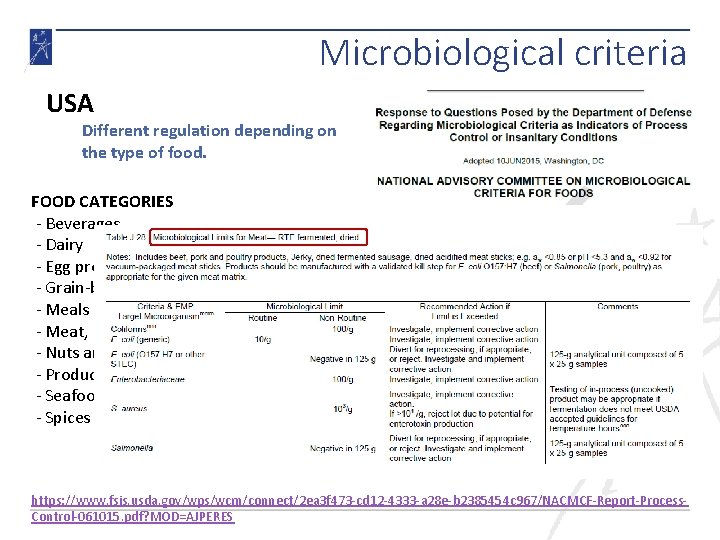
Microbiological criteria USA Different regulation depending on the type of food. FOOD CATEGORIES - Beverages - Dairy - Egg products - Grain-based products - Meals and entrees - Meat, pork, poultry products - Nuts and nut butters - Produce - Seafood - Spices and herbs, coffee and tea https: //www. fsis. usda. gov/wps/wcm/connect/2 ea 3 f 473 -cd 12 -4333 -a 28 e-b 2385454 c 967/NACMCF-Report-Process. Control-061015. pdf? MOD=AJPERES
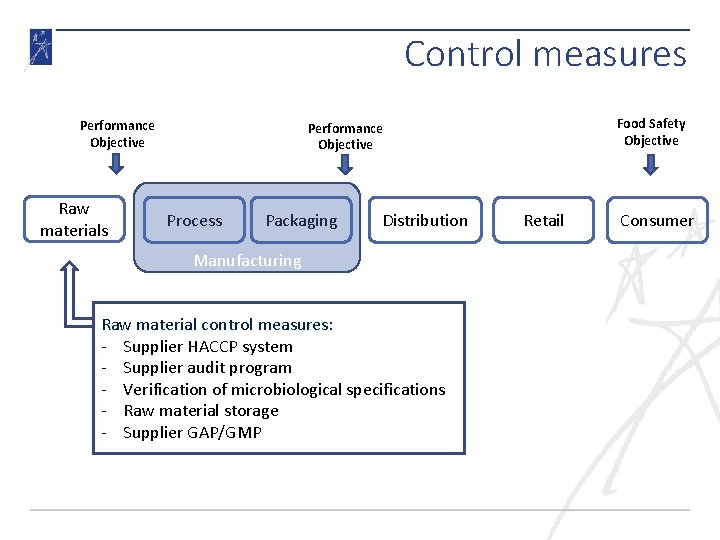
Control measures Performance Objective Raw materials Food Safety Objective Performance Objective Process Packaging Distribution Manufacturing Raw material control measures: - Supplier HACCP system - Supplier audit program - Verification of microbiological specifications - Raw material storage - Supplier GAP/GMP Retail Consumer
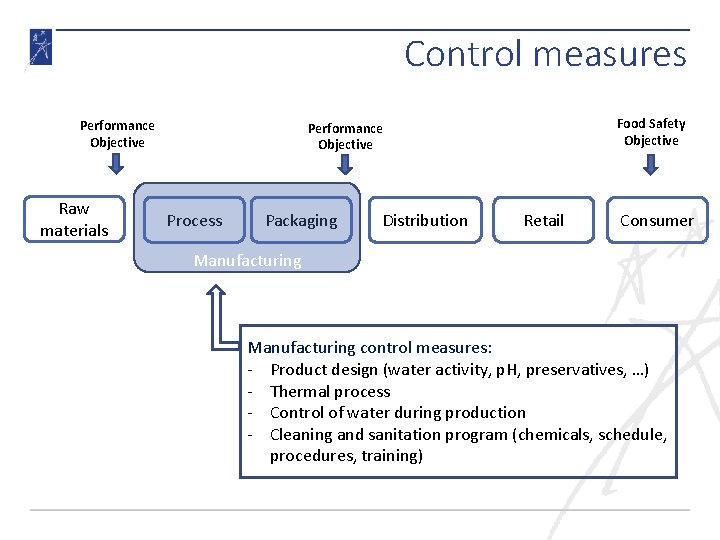
Control measures Performance Objective Raw materials Food Safety Objective Performance Objective Process Packaging Distribution Retail Consumer Manufacturing control measures: - Product design (water activity, p. H, preservatives, …) - Thermal process - Control of water during production - Cleaning and sanitation program (chemicals, schedule, procedures, training)
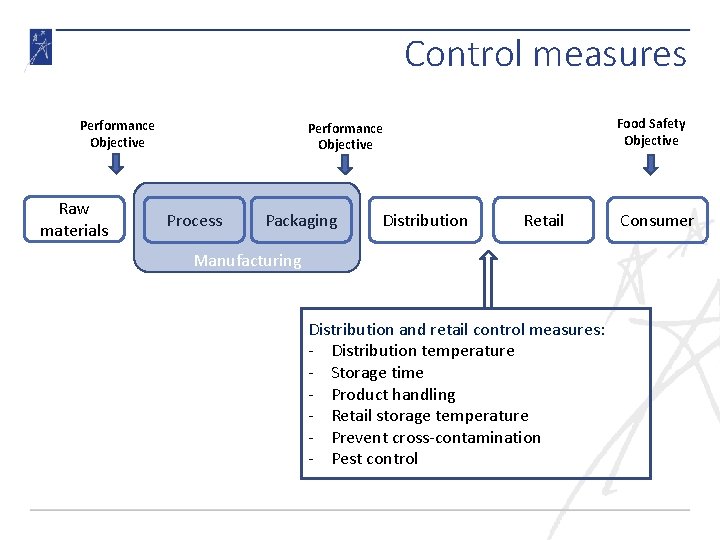
Control measures Performance Objective Raw materials Food Safety Objective Performance Objective Process Packaging Distribution Retail Manufacturing Distribution and retail control measures: - Distribution temperature - Storage time - Product handling - Retail storage temperature - Prevent cross-contamination - Pest control Consumer
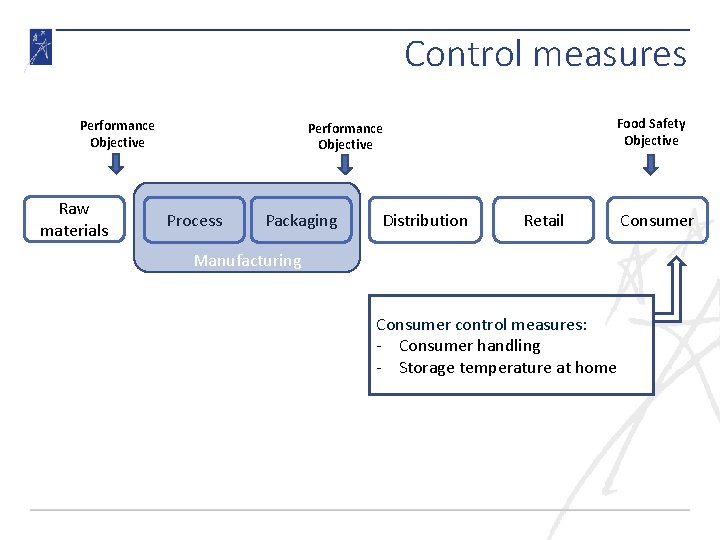
Control measures Performance Objective Raw materials Food Safety Objective Performance Objective Process Packaging Distribution Retail Manufacturing Consumer control measures: - Consumer handling - Storage temperature at home Consumer
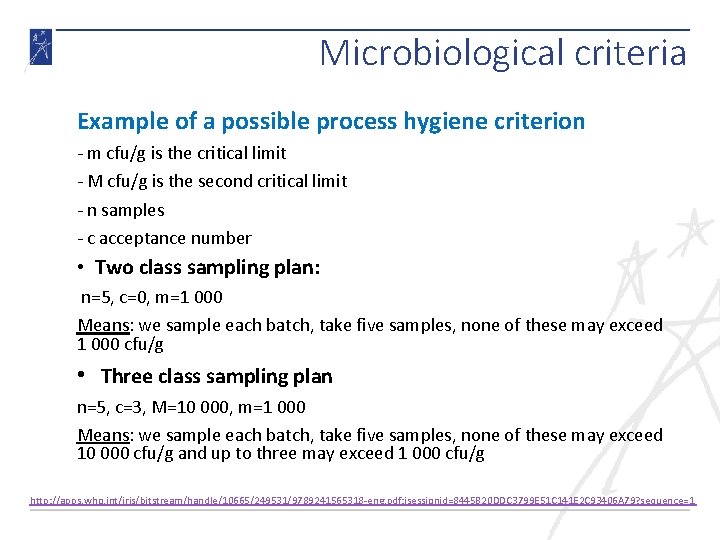
Microbiological criteria Example of a possible process hygiene criterion - m cfu/g is the critical limit - M cfu/g is the second critical limit - n samples - c acceptance number • Two class sampling plan: n=5, c=0, m=1 000 Means: we sample each batch, take five samples, none of these may exceed 1 000 cfu/g • Three class sampling plan n=5, c=3, M=10 000, m=1 000 Means: we sample each batch, take five samples, none of these may exceed 10 000 cfu/g and up to three may exceed 1 000 cfu/g http: //apps. who. int/iris/bitstream/handle/10665/249531/9789241565318 -eng. pdf; jsessionid=8445 B 20 DDC 3799 E 51 C 141 E 2 C 93406 A 79? sequence=1
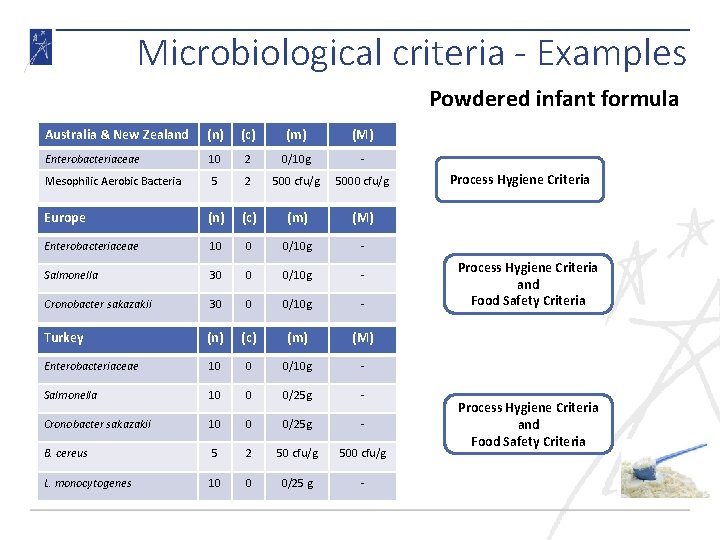
Microbiological criteria - Examples Powdered infant formula Australia & New Zealand (n) (c) (m) (M) Enterobacteriaceae 10 2 0/10 g - Mesophilic Aerobic Bacteria 5 2 500 cfu/g 5000 cfu/g Europe (n) (c) (m) (M) Enterobacteriaceae 10 0 0/10 g - Salmonella 30 0 0/10 g - Cronobacter sakazakii 30 0 0/10 g - Turkey (n) (c) (m) (M) Enterobacteriaceae 10 0 0/10 g - Salmonella 10 0 0/25 g - Cronobacter sakazakii 10 0 0/25 g - B. cereus 5 2 50 cfu/g 500 cfu/g L. monocytogenes 10 0 0/25 g - Process Hygiene Criteria and Food Safety Criteria
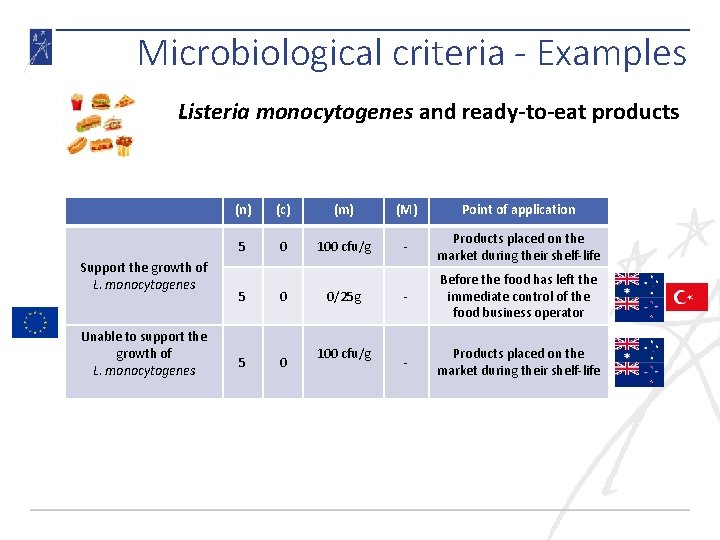
Microbiological criteria - Examples Listeria monocytogenes and ready-to-eat products Support the growth of L. monocytogenes Unable to support the growth of L. monocytogenes (n) (c) (m) (M) Point of application 5 0 100 cfu/g - Products placed on the market during their shelf-life - Before the food has left the immediate control of the food business operator - Products placed on the market during their shelf-life 5 0 0/25 g 100 cfu/g
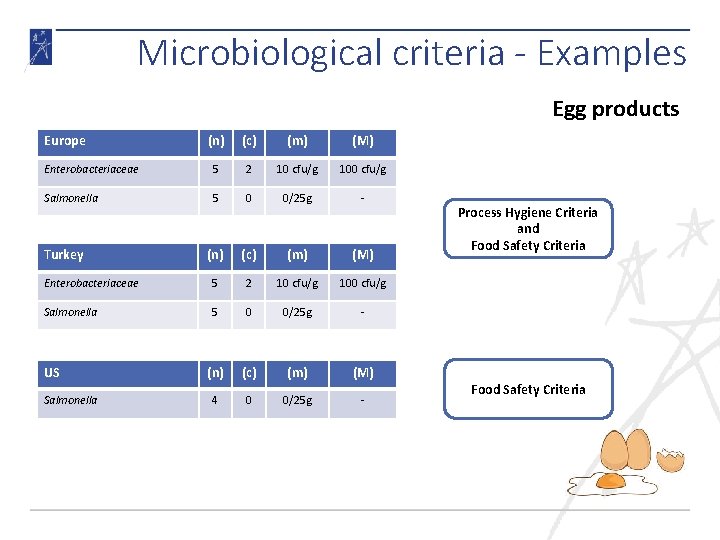
Microbiological criteria - Examples Egg products Europe (n) (c) (m) (M) Enterobacteriaceae 5 2 10 cfu/g 100 cfu/g Salmonella 5 0 0/25 g - (n) (c) (m) (M) 4 0 0/25 g - Turkey US Salmonella Process Hygiene Criteria and Food Safety Criteria
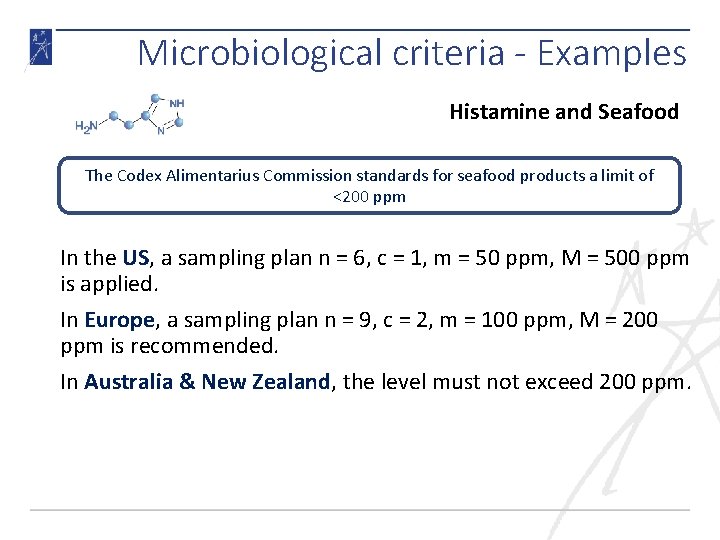
Microbiological criteria - Examples Histamine and Seafood The Codex Alimentarius Commission standards for seafood products a limit of <200 ppm In the US, a sampling plan n = 6, c = 1, m = 50 ppm, M = 500 ppm is applied. In Europe, a sampling plan n = 9, c = 2, m = 100 ppm, M = 200 ppm is recommended. In Australia & New Zealand, the level must not exceed 200 ppm.
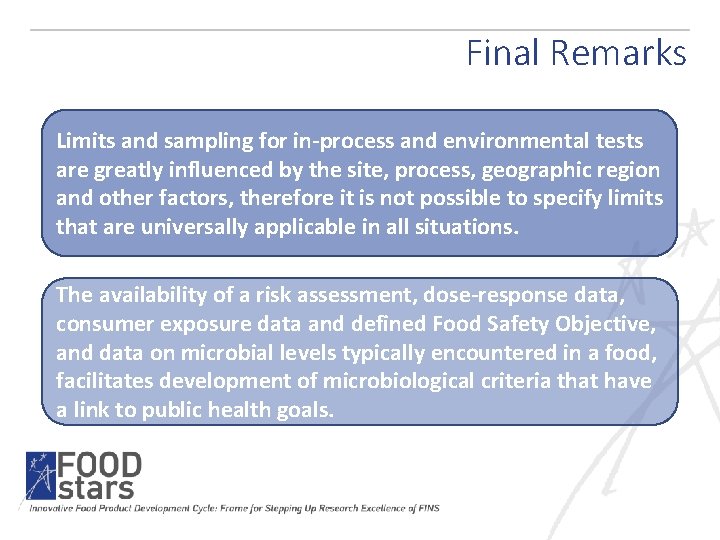
Final Remarks Limits and sampling for in-process and environmental tests are greatly influenced by the site, process, geographic region and other factors, therefore it is not possible to specify limits that are universally applicable in all situations. The availability of a risk assessment, dose-response data, consumer exposure data and defined Food Safety Objective, and data on microbial levels typically encountered in a food, facilitates development of microbiological criteria that have a link to public health goals.
THANK YOU FOR YOUR KIND ATTENTION
- Slides: 30