
Global Analysis of QCD and Parton Distribution Functions
Global Analysis of QCD and Parton Distribution Functions Dan Stump Department of Physics and Astronomy Michigan State University Ref: Pumplin, Stump, Huston, Lai, Nadolsky, Tung, New generation of parton distributions with uncertainties from global QCD analysis, JHEP 07 (2002) 012. May 2005 CTEQ Summer School 1
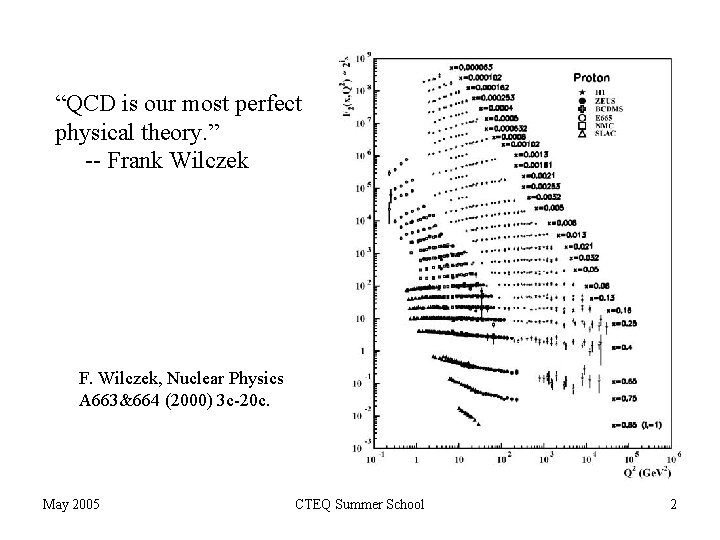
“QCD is our most perfect physical theory. ” -- Frank Wilczek F. Wilczek, Nuclear Physics A 663&664 (2000) 3 c-20 c. May 2005 CTEQ Summer School 2
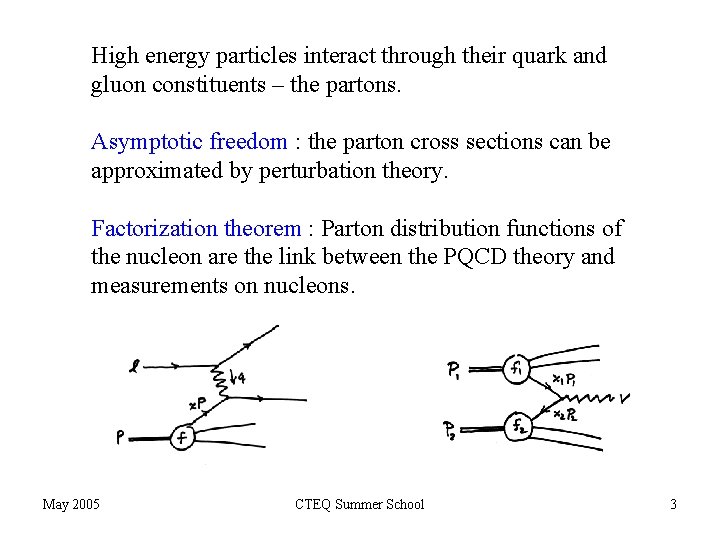
High energy particles interact through their quark and gluon constituents – the partons. Asymptotic freedom : the parton cross sections can be approximated by perturbation theory. Factorization theorem : Parton distribution functions of the nucleon are the link between the PQCD theory and measurements on nucleons. May 2005 CTEQ Summer School 3
Motivations for global analysis of QCD the deep structure of the nucleon testing QCD – gluon radiation, higher order perturbation theory, the value of a. S The PDF’s are needed to calculate cross sections for scattering processes at the LHC; the search for new physics. May 2005 CTEQ Summer School 4
The goals of QCD global analysis are to construct accurate PDF’s; to know the uncertainties of the PDF’s; to enable predictions, including uncertainties. May 2005 CTEQ Summer School 5
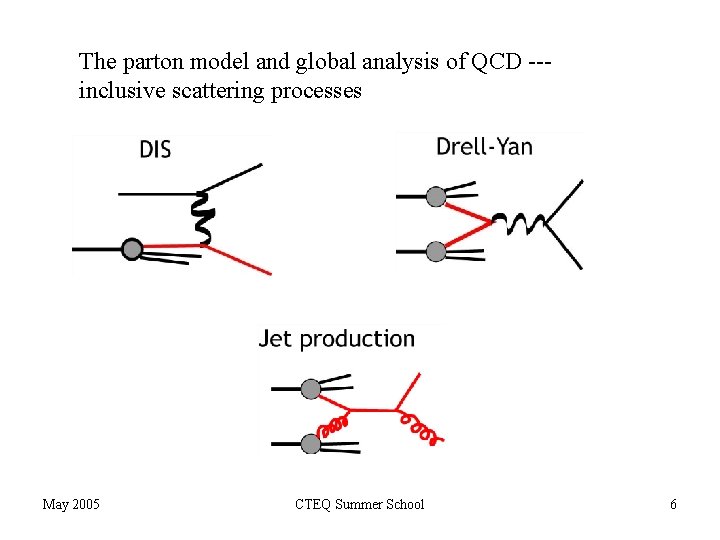
The parton model and global analysis of QCD --inclusive scattering processes May 2005 CTEQ Summer School 6
Outline 1/ Introduction 2/ Experiments 3/ Methods of Analysis 4/ Results May 2005 CTEQ Summer School 7
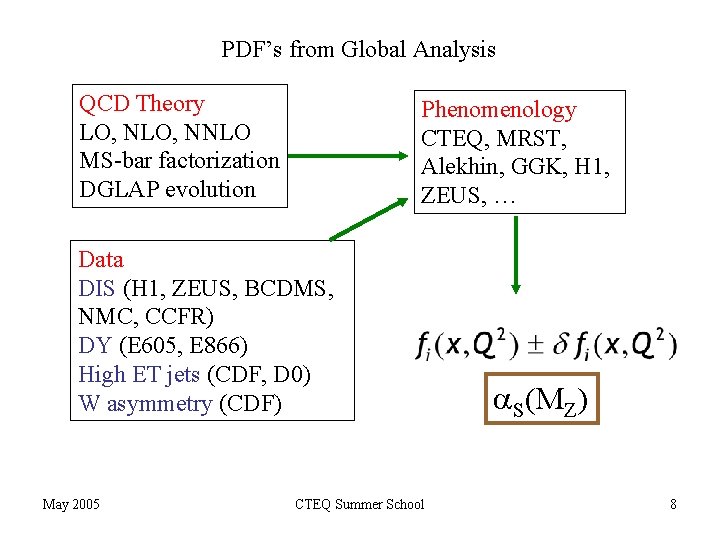
PDF’s from Global Analysis QCD Theory LO, NNLO MS-bar factorization DGLAP evolution Phenomenology CTEQ, MRST, Alekhin, GGK, H 1, ZEUS, … Data DIS (H 1, ZEUS, BCDMS, NMC, CCFR) DY (E 605, E 866) High ET jets (CDF, D 0) W asymmetry (CDF) May 2005 CTEQ Summer School a. S(MZ) 8
2/ Experiments May 2005 CTEQ Summer School 9
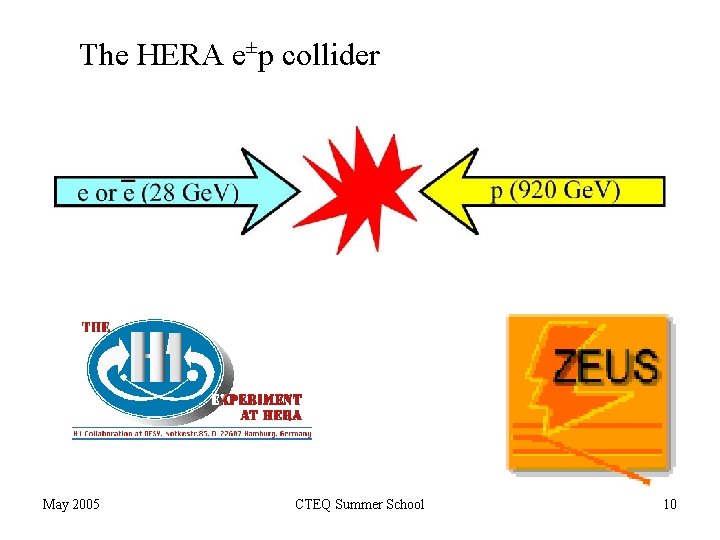
The HERA e±p collider May 2005 CTEQ Summer School 10
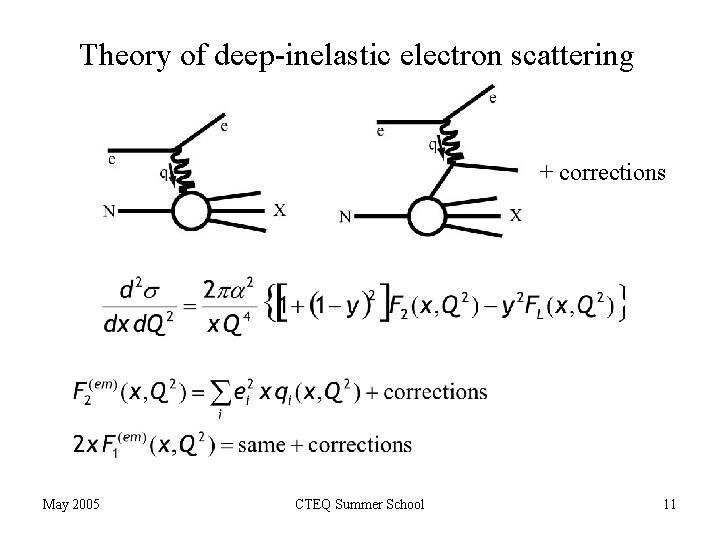
Theory of deep-inelastic electron scattering + corrections May 2005 CTEQ Summer School 11
H 1 collaboration at HERA Data used in the CTEQ 6 analysis… DIS e + p e + X @ low-x 104 points DIS e + p e + X @ high-x … published 2000, 2001 126 points May 2005 CTEQ Summer School 12
ZEUS collaboration at HERA Data used in the CTEQ 6 analysis … DIS e + p e + X 229 points … published 2001 May 2005 CTEQ Summer School 13
BCDMS collaboration Bologna - CERN - Dubna - Munich - Saclay NA 4 muon scattering experiment at CERN DIS m+p m+X DIS m+d m+X 339 points 251 points History: 1976 (C. Rubbia) to 1994 Homework Problem -- Why was muon scattering used? Why is md an interesting contrast to mp? May 2005 CTEQ Summer School 14
NMC collaboration at CERN DIS m+p m+X DIS m+d m+X … published 1997 201 points 123 points The kinematic range 0. 0001 < x < 0. 7 and 0. 01< Q 2 < 70 Ge. V 2 is covered. May 2005 CTEQ Summer School 15
CCFR collaboration Chicago Columbia Fermilab Rochester The Lab E neutrino experiments at Fermilab (E 744 in 1985; and E 770 in 1987 -88). Measurements of F 2(x, Q 2) and x. F 3(x, Q 2) for n and n DIS In the CTEQ 6 analysis, number of data points = 156; from publications of 1997 and 2001 Homework Problem: What do we learn from neutrino/antineutrino scattering that we don’t know from electron scattering? May 2005 CTEQ Summer School 16
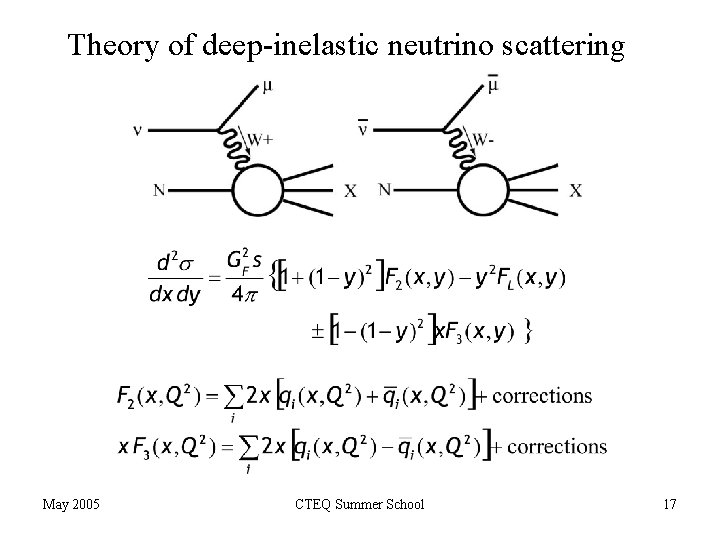
Theory of deep-inelastic neutrino scattering May 2005 CTEQ Summer School 17
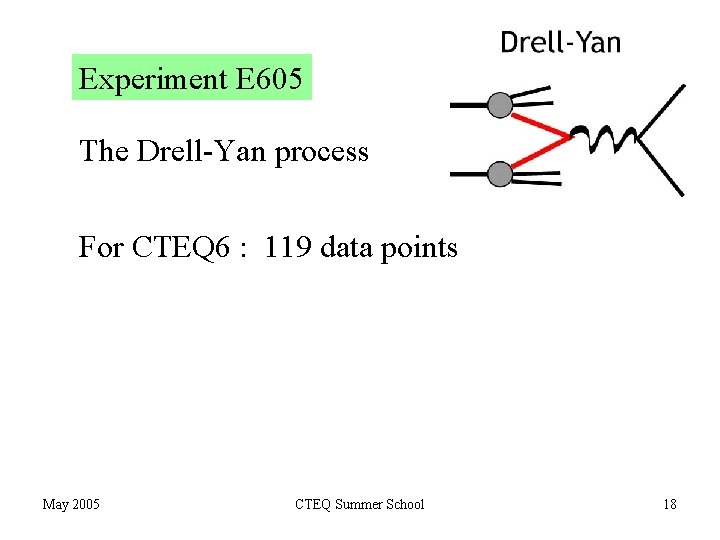
Experiment E 605 The Drell-Yan process For CTEQ 6 : 119 data points May 2005 CTEQ Summer School 18
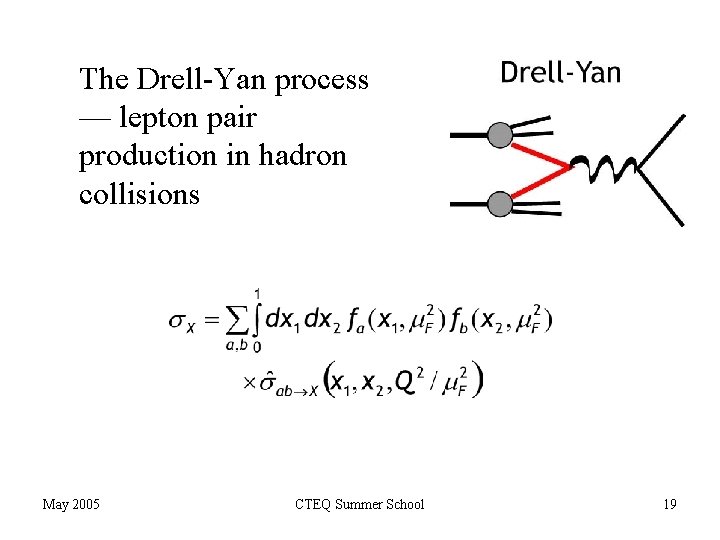
The Drell-Yan process — lepton pair production in hadron collisions May 2005 CTEQ Summer School 19
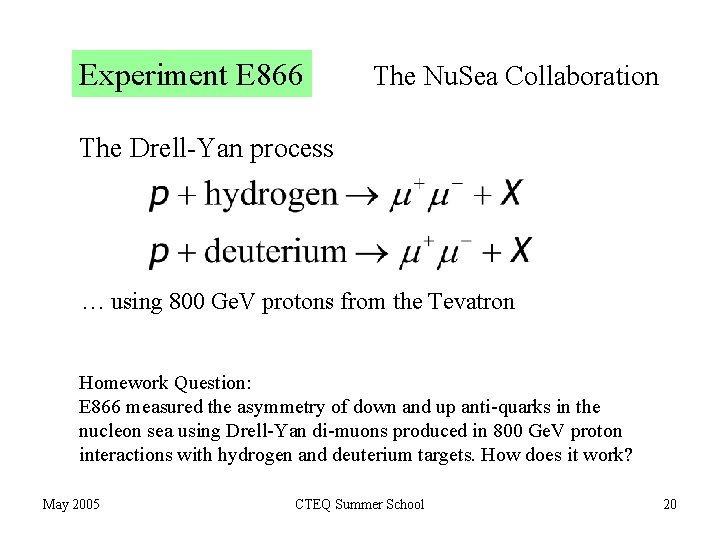
Experiment E 866 The Nu. Sea Collaboration The Drell-Yan process … using 800 Ge. V protons from the Tevatron Homework Question: E 866 measured the asymmetry of down and up anti-quarks in the nucleon sea using Drell-Yan di-muons produced in 800 Ge. V proton interactions with hydrogen and deuterium targets. How does it work? May 2005 CTEQ Summer School 20
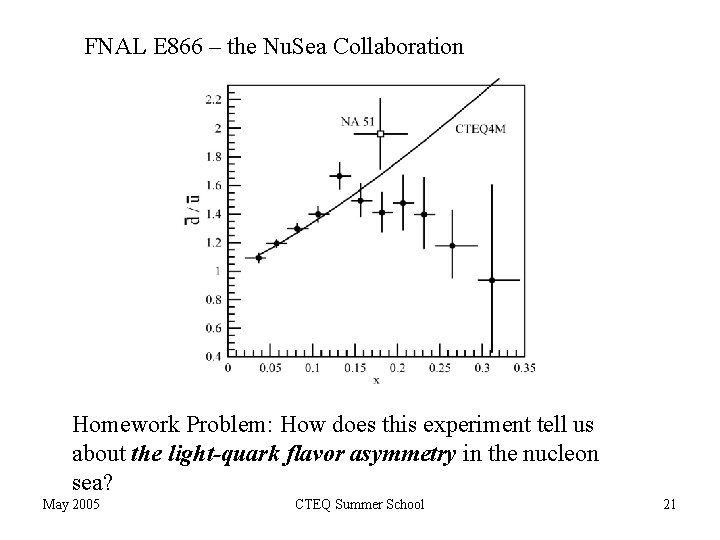
FNAL E 866 – the Nu. Sea Collaboration Homework Problem: How does this experiment tell us about the light-quark flavor asymmetry in the nucleon sea? May 2005 CTEQ Summer School 21
Inclusive jet production at the Tevatron collider CDF collaboration: 33 data points at central rapidity (-0. 7 < h < 0. 7) D 0 collaboration: 90 data points in five rapidity bins (-3 < h < 3) May 2005 CTEQ Summer School 22
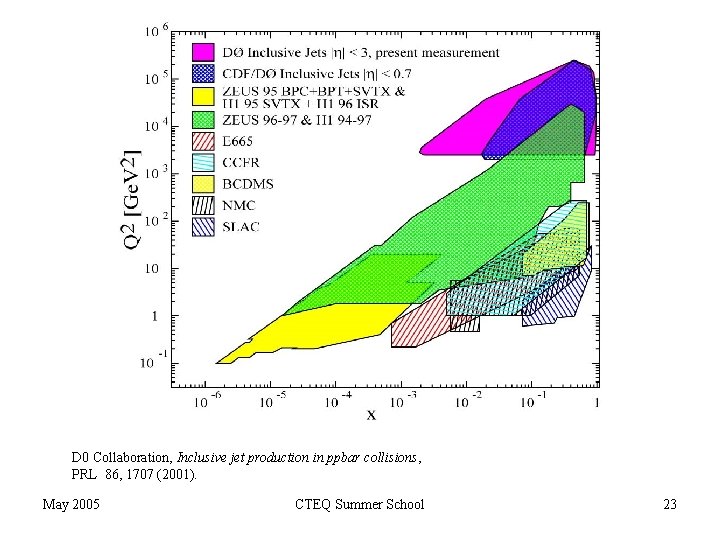
D 0 Collaboration, Inclusive jet production in ppbar collisions, PRL 86, 1707 (2001). May 2005 CTEQ Summer School 23
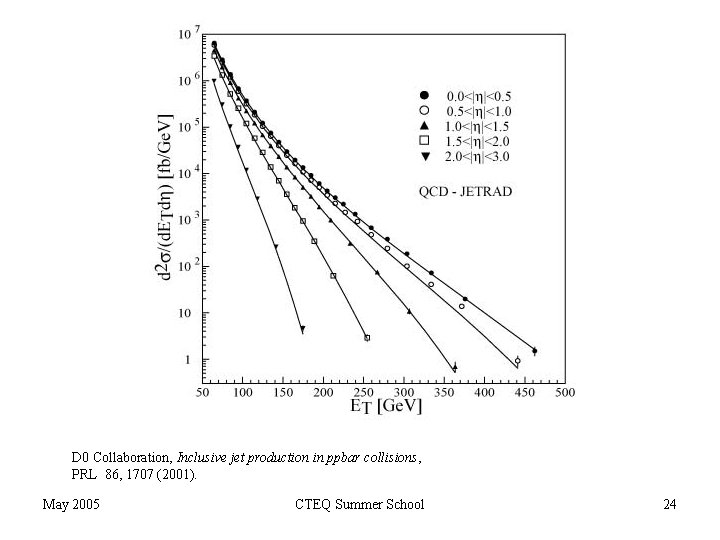
D 0 Collaboration, Inclusive jet production in ppbar collisions, PRL 86, 1707 (2001). May 2005 CTEQ Summer School 24
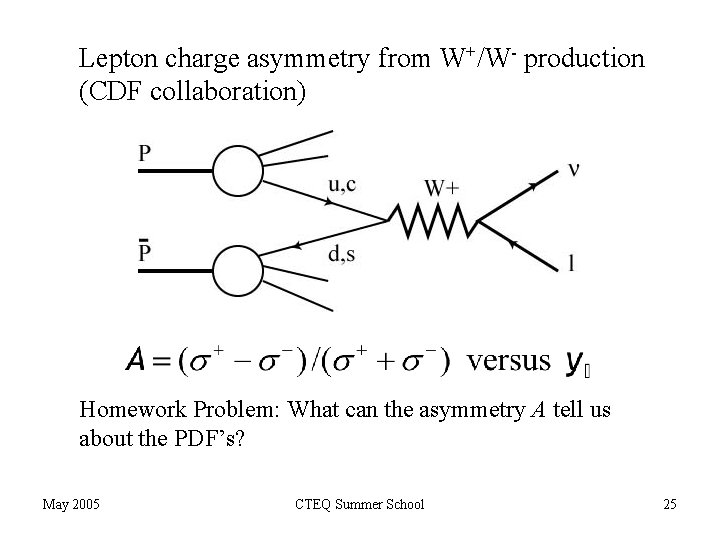
Lepton charge asymmetry from W+/W- production (CDF collaboration) Homework Problem: What can the asymmetry A tell us about the PDF’s? May 2005 CTEQ Summer School 25
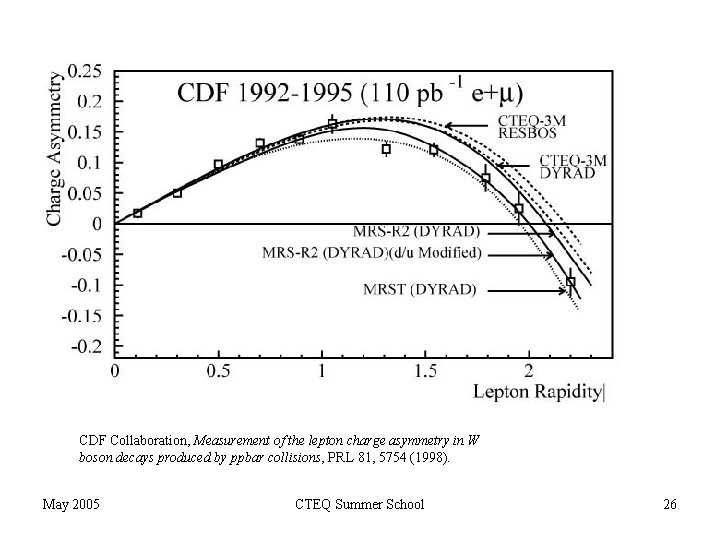
CDF Collaboration, Measurement of the lepton charge asymmetry in W boson decays produced by ppbar collisions, PRL 81, 5754 (1998). May 2005 CTEQ Summer School 26
- Slides: 26