
Global Alignment in LHCb Steve Blusk Syracuse University

Global Alignment in LHCb Steve Blusk Syracuse University LHC Alignment Workshop, Sept 4 -6, 2006
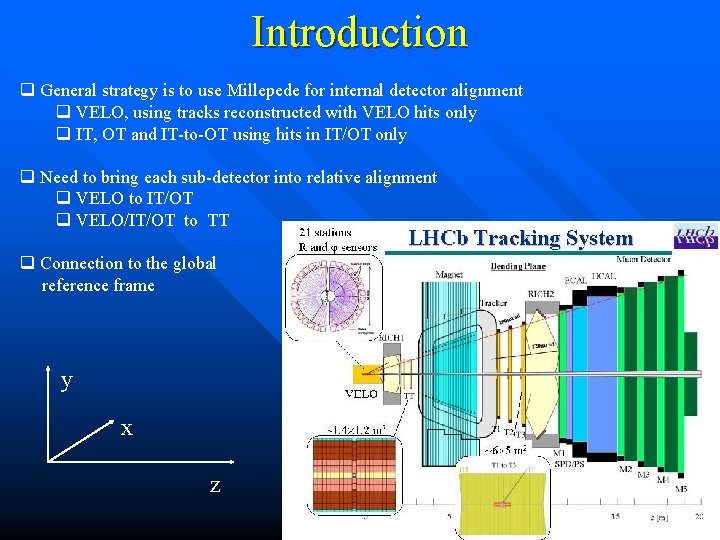
Introduction q General strategy is to use Millepede for internal detector alignment q VELO, using tracks reconstructed with VELO hits only q IT, OT and IT-to-OT using hits in IT/OT only q Need to bring each sub-detector into relative alignment q VELO to IT/OT q VELO/IT/OT to TT q Connection to the global reference frame y x z

Align IT/OT to VELO General Strategy q Perform relative VELO-to-IT/OT alignment using DX, DY at the center of magnet and Dq. X, Dq. Y (each vs X, Y). § DX, DY, Dq. X, Dq. Y must all peak at 0 (vs X, Y, as well) for proper alignment § With magnet OFF data the 7 relative misalignments can be determined – 3 translations, rotation around Z axis, Shearing along X, Y, & Z scaling DX, DQX ~ 4 meter track projection
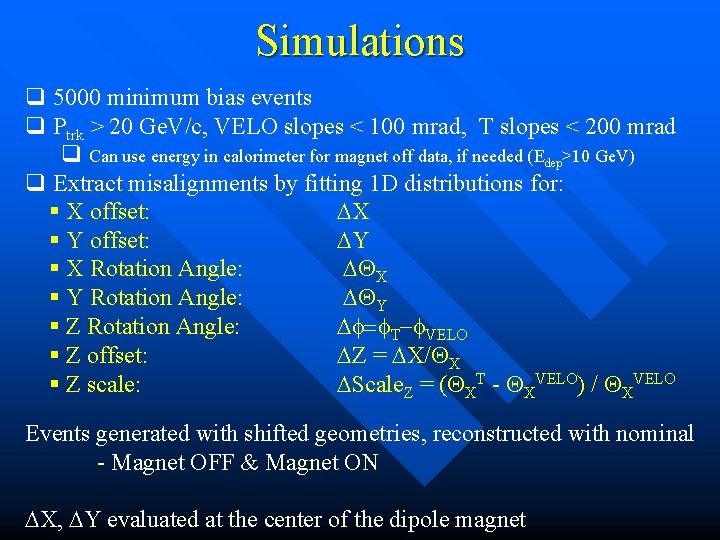
Simulations q 5000 minimum bias events q Ptrk > 20 Ge. V/c, VELO slopes < 100 mrad, T slopes < 200 mrad q Can use energy in calorimeter for magnet off data, if needed (Edep>10 Ge. V) q Extract misalignments by fitting 1 D distributions for: § X offset: DX § Y offset: DY § X Rotation Angle: DQX § Y Rotation Angle: DQY § Z Rotation Angle: Df=f. T-f. VELO § Z offset: DZ = DX/QX § Z scale: DScale. Z = (QXT - QXVELO) / QXVELO Events generated with shifted geometries, reconstructed with nominal - Magnet OFF & Magnet ON DX, DY evaluated at the center of the dipole magnet
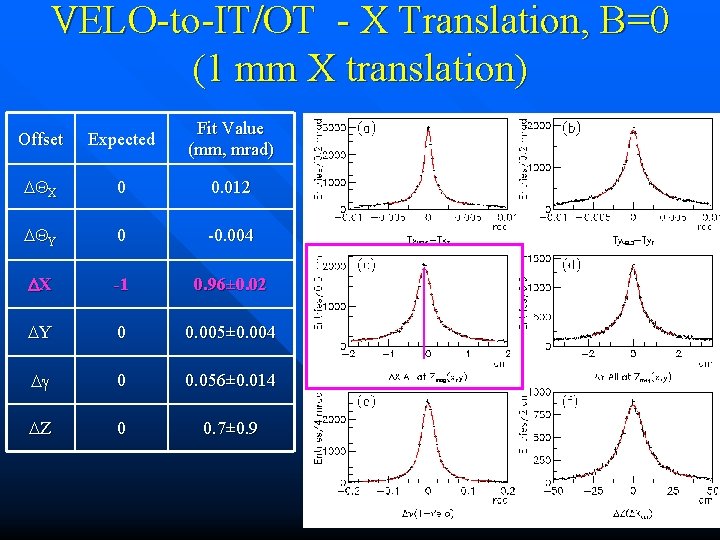
VELO-to-IT/OT - X Translation, B=0 (1 mm X translation) Offset Expected Fit Value (mm, mrad) DQX 0 0. 012 DQY 0 -0. 004 DX -1 0. 96± 0. 02 DY 0 0. 005± 0. 004 Dg 0 0. 056± 0. 014 DZ 0 0. 7± 0. 9
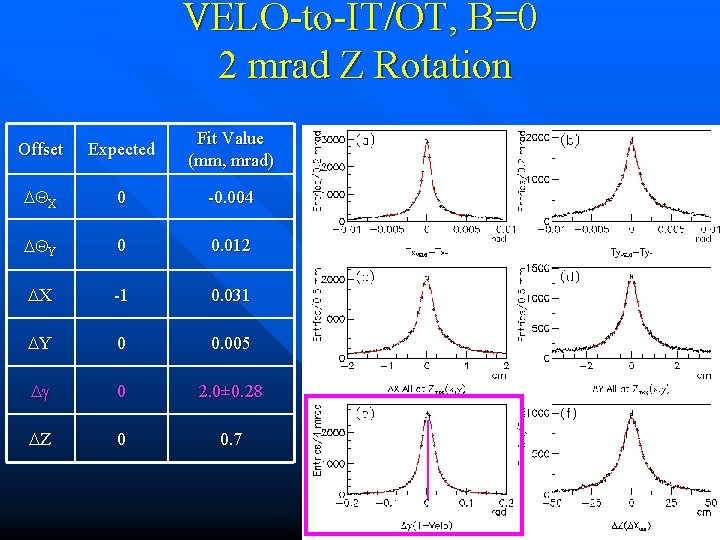
VELO-to-IT/OT, B=0 2 mrad Z Rotation Offset Expected Fit Value (mm, mrad) DQX 0 -0. 004 DQY 0 0. 012 DX -1 0. 031 DY 0 0. 005 Dg 0 2. 0± 0. 28 DZ 0 0. 7
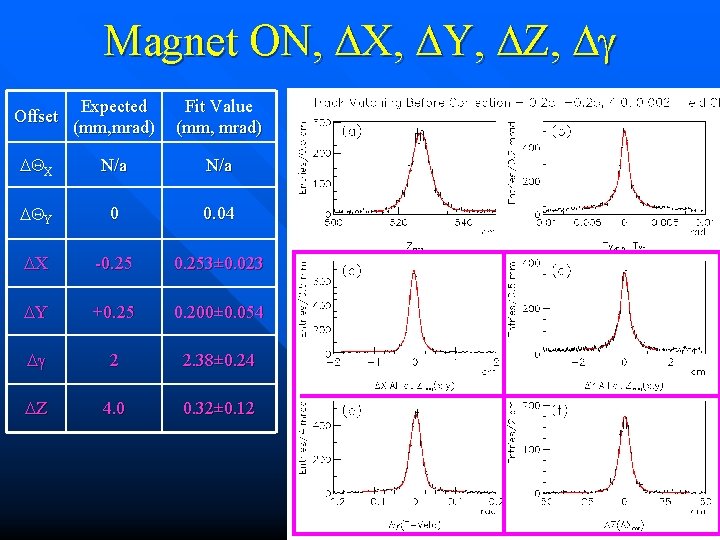
Magnet ON, DX, DY, DZ, Dg Offset Expected (mm, mrad) Fit Value (mm, mrad) DQX N/a DQY 0 0. 04 DX -0. 253± 0. 023 DY +0. 25 0. 200± 0. 054 Dg 2 2. 38± 0. 24 DZ 4. 0 0. 32± 0. 12
A second option With B=0 data, could also project high momentum tracks into TT, IT, OT and do a residual-based alignment. n This may be helpful, especially for OT, where the LR ambiguity adds to the hit confusion. n Still needs to be explored n
Alignment of Other Detectors q After VELO and T-Stations brought into alignment, TT (Trigger Tracker) is aligned to the VELO/T-Station system. q Residual-based alignment, work in progress here. q Other detectors rely on a well-aligned tracking system q RICH most sensitive, see talk by Antonis Papanestis q ECAL (HCAL) using electrons (hadrons) q Muon system using muon candidates q J/y for improved purity

Connection to the Global Frame q Every fill, the VELO is “re-centered” on the beam. q. VELO motion controller gives VELO position to 10 mm accuracy. Absolute coordinates of VELO only known to this accuracy. q Since rest of detector is aligned to VELO, absolute LHCb coordinate are only known to ~10 mm. q This is fine, since relative alignments, where needed (e. g. VELO), will be much better than this. q. So, what defines the absolute coordinate system? q Define it at the beginning of the run q Then, track changes using the readback from the motion controller
Summary q VELO well advanced on implementation and misalignment studies q Further development of algorithms and infrastructure for IT, OT, TT in progress. Expect results soon… q Aim for a common set of tools/interfaces shared by various alignment tasks. q Need to automate the alignment tasks, as they will run in real time, online. q Online alignment important for trigger, but pretty robust against small misalignments.
- Slides: 11